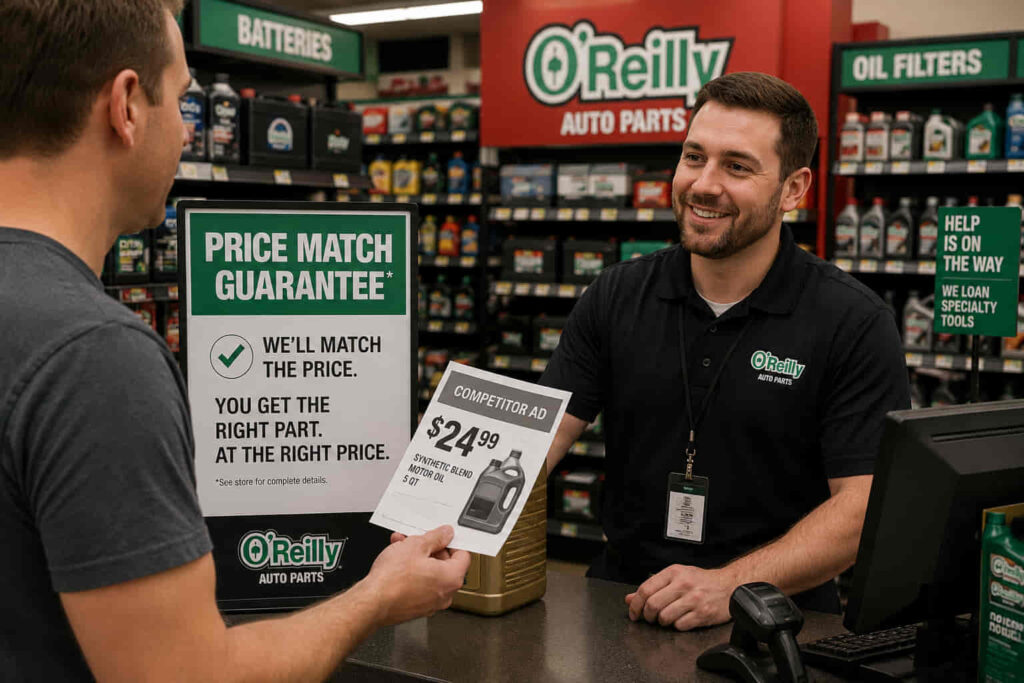
Finding the lowest price on auto parts can significantly reduce maintenance costs, especially when replacing expensive components such as batteries, brake pads, alternators, or starters. Many shoppers compare prices across retailers before making a purchase, which leads to one common question: Does O’Reilly price match?
Yes, O’Reilly Auto Parts offers a price match policy for qualifying products, but the policy applies only under specific conditions. The item must generally be identical, available from an eligible competitor, and meet the store’s verification requirements. Understanding these rules before visiting a store can help you avoid paying more than necessary and prevent disappointment if a requested price match is declined.
O’Reilly’s price match policy is designed to remain competitive with other major auto parts retailers while protecting the company from matching prices that cannot be verified or that result from special promotions, marketplace sellers, or liquidation sales. Because these conditions vary depending on the competitor and the product, many customers misunderstand what is actually eligible for a lower price.
This guide explains the 10 most important things you should know about O’Reilly’s price match policy, including which competitors qualify, whether online prices are accepted, which products are excluded, how to request a price match successfully, and how O’Reilly compares with other leading auto parts stores. By understanding these details before you shop, you can determine whether requesting a price match is worthwhile and maximize your savings on your next purchase.
Does O’Reilly Price Match?
Yes, O’Reilly Auto Parts offers a price match policy for qualifying products sold by eligible competitors. The purpose of this policy is to help customers purchase auto parts at competitive prices without visiting multiple stores. Instead of advertising that every competitor’s price will automatically be matched, O’Reilly verifies whether the lower price meets its eligibility requirements before approving the request.
A successful price match depends on several conditions rather than the price difference alone. The competing product must be identical to the item sold by O’Reilly, including the manufacturer, part number, specifications, and condition. The competitor must also have the product available for immediate purchase instead of listing it as out of stock or available only through backorder. These requirements allow O’Reilly to compare products with equivalent value instead of matching prices for similar but different items.
The retailer also distinguishes between qualified retail competitors and sellers that operate under different business models. In most cases, local automotive parts retailers with verifiable pricing are more likely to qualify than third-party marketplace sellers or liquidation websites. This distinction protects pricing consistency while allowing customers to benefit from legitimate competitive offers within the same market.
Although O’Reilly promotes a competitive pricing strategy, approval ultimately depends on store verification. Employees may confirm the competitor’s advertised price, inventory status, product identification, and any promotional restrictions before completing the transaction. For that reason, bringing evidence of the lower price before checkout typically increases the likelihood of receiving a successful price match.
What Is O’Reilly’s Price Match Policy?
O’Reilly’s price match policy allows customers to purchase qualifying products at the same price offered by an eligible competitor when the lower price can be verified. The policy focuses on matching the value of identical products instead of offering the lowest advertised price available anywhere on the internet. This approach ensures that both products being compared provide the same quality, warranty coverage, and manufacturer specifications.
Price verification is one of the most important elements of the policy. Store associates generally review the competitor’s current advertised price and confirm that the item matches the O’Reilly product in every significant aspect. Differences in brand, model number, package quantity, included accessories, or warranty coverage may result in the request being denied because the products are no longer considered equivalent.
The policy is also designed to exclude pricing situations that do not reflect normal retail conditions. Clearance merchandise, liquidation events, damaged products, refurbished components, closeout inventory, and limited-quantity promotions often fall outside standard price matching because they represent temporary or exceptional pricing rather than regular retail value. Likewise, prices offered by third-party marketplace sellers may not qualify if the seller is not an authorized retailer or if product authenticity cannot be verified.
Understanding the purpose behind O’Reilly’s price match policy helps explain why some requests are approved while others are declined. The objective is not to compete with every available online listing but to provide competitive pricing for comparable products sold through recognized retail channels. Customers who compare identical parts, verify availability, and present accurate pricing information generally have a much smoother experience when requesting a price match at an O’Reilly Auto Parts store.
Read more: How Much Is It to Recharge AC in Car
Which Stores Does O’Reilly Price Match?
O’Reilly Auto Parts primarily price matches eligible local retail competitors that sell identical automotive parts through traditional retail locations. The policy is intended to help customers receive competitive pricing within the same local market rather than comparing every price available across the internet. As a result, whether a competitor qualifies depends on both its business model and the store’s ability to verify the advertised price.
Large automotive parts chains are generally the competitors customers ask about most frequently because they carry many of the same national brands and replacement parts. Retailers such as AutoZone, Advance Auto Parts, and NAPA Auto Parts often stock identical brake components, batteries, filters, spark plugs, alternators, and other replacement parts manufactured by the same suppliers. When the product specifications, manufacturer, and part number match exactly, these retailers are the most common candidates for a price match request.
Local independently owned auto parts stores may also qualify if they operate as legitimate retail businesses and advertise verifiable prices. The key consideration is not the size of the retailer but whether the store sells the same new product under normal retail conditions. O’Reilly employees typically verify the competitor’s current selling price before approving the request, which helps ensure that both retailers are offering the same item under comparable purchasing conditions.
Not every retailer automatically qualifies simply because it sells automotive products. Warehouse clubs, liquidation businesses, salvage yards, wholesale distributors, and businesses that primarily serve commercial customers may follow different pricing structures that fall outside O’Reilly’s standard retail comparison policy. Likewise, temporary promotional pricing, member-exclusive discounts, employee pricing, and limited-quantity offers may not represent everyday retail prices and therefore may not satisfy the company’s verification requirements.
Understanding which competitors are most likely to qualify allows customers to compare prices more efficiently before visiting an O’Reilly store. Focusing on established automotive retailers selling identical products usually produces a much higher approval rate than attempting to match prices from businesses operating under different pricing models.
Does O’Reilly Price Match Online Prices?
O’Reilly’s price match policy generally focuses on verifiable prices offered by eligible retail competitors rather than every price available online. This distinction is important because online pricing often varies based on marketplace sellers, regional promotions, shipping costs, subscription discounts, or inventory availability. A lower internet price does not automatically qualify for a price match simply because it appears in a search result.
One of the biggest differences between traditional retailers and online marketplaces is product verification. Marketplace platforms frequently allow thousands of independent sellers to list the same automotive part at different prices. While the listing may appear identical, differences in product condition, warranty coverage, seller authorization, packaging, or shipping origin can affect the actual value of the purchase. Because of these variables, marketplace listings are often treated differently from prices offered directly by established retail competitors.
Customers also frequently ask whether prices from websites such as Amazon, eBay, or RockAuto qualify for price matching. The answer depends on whether the listing satisfies O’Reilly’s verification standards and whether the seller meets the company’s eligibility requirements. Products sold through third-party marketplace sellers, liquidation channels, auction listings, or unauthorized dealers are generally less likely to qualify because the retailer cannot always confirm that the products are directly comparable to those sold in its stores.
Even when an online retailer operates both physical stores and an official website, store associates may still verify that the advertised online price reflects a current retail offer rather than a regional promotion, flash sale, or pricing error. This verification process helps maintain consistency between competing retailers while ensuring that customers receive equivalent products backed by comparable manufacturer warranties and customer support.
For shoppers hoping to request a price match, the most effective approach is to present pricing from a recognized retailer that sells the identical product through an official sales channel. Doing so reduces uncertainty during verification and significantly improves the likelihood that the request will satisfy O’Reilly’s price match requirements.
What Products Qualify for Price Matching?
Not every item sold by O’Reilly Auto Parts qualifies for a price match. The policy applies primarily to identical products that can be directly compared with an eligible competitor’s current retail price. Matching the manufacturer, part number, product condition, and specifications is essential because even small differences may indicate that two products do not provide the same value or performance.
Product identification is the first factor store associates verify during a price match request. Automotive parts often appear similar while serving different vehicle models, engine sizes, or production years. A brake rotor designed for one vehicle may have different dimensions, materials, or warranty coverage than another rotor from the same manufacturer. For this reason, O’Reilly generally compares manufacturer part numbers instead of relying only on product descriptions or names.
Inventory availability is another important qualification requirement. The competing retailer must typically have the product available for immediate purchase so that customers are comparing two products that can actually be bought at the advertised price. A listing marked as out of stock, discontinued, backordered, or available only through special order may not satisfy the verification process because the advertised price is no longer immediately accessible to consumers.
Product condition also plays a significant role in determining eligibility. O’Reilly’s policy is intended for new retail merchandise rather than refurbished, remanufactured under different conditions, damaged, or previously owned products. Even when two parts perform the same function, differences in condition often affect warranty coverage, expected service life, and manufacturer support, making them unsuitable for direct price comparisons.
Customers can improve the likelihood of approval by confirming that the competitor’s listing contains the same brand, identical manufacturer part number, matching package quantity, and equivalent warranty information before requesting a price match. Providing accurate product information reduces verification time and allows store associates to determine eligibility more efficiently.
Which Products Are Excluded?
O’Reilly’s price match policy excludes several categories of products because their prices do not represent standard retail value. Items sold through clearance events, liquidation sales, closeout promotions, or other exceptional pricing situations are generally not eligible for price matching. These offers are designed to reduce inventory quickly rather than establish competitive everyday pricing, making them unsuitable for direct comparison.
Limited-time promotions are another common source of confusion. Flash sales, holiday specials, doorbuster events, coupon-only discounts, loyalty rewards, rebate programs, and member-exclusive pricing may significantly reduce the advertised cost of a product for a short period. Since these discounts often depend on special purchasing conditions rather than normal retail pricing, they may fall outside the scope of O’Reilly’s standard price match policy.
Products sold through third-party marketplace sellers are frequently excluded for a similar reason. Online marketplaces host independent merchants with different sourcing methods, warranty policies, shipping costs, and return procedures. Although a marketplace listing may advertise a lower price, the overall purchase conditions may differ substantially from buying the same product directly from an authorized automotive retailer. O’Reilly’s verification process is intended to compare equivalent retail transactions instead of marketplace listings that vary from seller to seller.
Pricing errors and unusually low advertised prices may also be declined if they cannot be reasonably verified. Retailers occasionally publish incorrect prices because of technical issues, typographical mistakes, or temporary system errors. Approving these prices would undermine consistent pricing practices and create an unfair comparison between retailers. As a result, store associates typically verify that the competitor’s advertised price is current, accurate, and legitimately available before considering a price match request.
Understanding these exclusions helps customers set realistic expectations before visiting an O’Reilly Auto Parts location. Comparing identical products sold through established retail channels under normal purchasing conditions provides a much higher probability of approval than relying on clearance events, marketplace sellers, or temporary promotional pricing.
How Do You Request a Price Match at O’Reilly?
Requesting a price match at O’Reilly Auto Parts is usually a straightforward process when customers prepare the necessary information before visiting the store. The most effective approach is to present evidence showing that an eligible competitor currently sells the identical product at a lower price. Because store associates must verify every request, having complete product details available can significantly reduce the time required for approval.
Verification begins with confirming that both products are exactly the same. Employees typically compare the manufacturer, brand, part number, product description, package quantity, and condition before reviewing the competitor’s advertised price. This comparison ensures that customers receive the same product with equivalent quality, warranty coverage, and performance rather than a similar replacement part with different specifications.
Once the product has been verified, the associate normally checks whether the competitor’s advertised price is still active and whether the item is available for immediate purchase. Availability is an important part of the verification process because price matching is intended to compare products that customers can actually buy at the advertised price. If the competitor’s inventory has already sold out or the offer has expired, the request may no longer satisfy the policy requirements.
Customers can improve their chances of approval by bringing clear evidence of the lower price before reaching the checkout counter. An official advertisement, a current product page from an authorized retailer, or another verifiable pricing source allows store employees to complete the comparison more efficiently. Waiting until after the purchase has been completed may require additional review, and some locations may handle post-purchase requests differently depending on store policy.
Although the process is relatively simple, final approval always depends on the store’s ability to verify the competing offer. Preparing accurate pricing information and confirming that the product meets all eligibility requirements creates the smoothest experience for both customers and store associates.
What Are the Best Ways to Increase Your Chances of Approval?
Receiving approval for a price match depends on more than simply finding a lower advertised price. Customers who compare identical products, verify competitor eligibility, and present complete pricing information are generally more successful than those who rely on incomplete or unverifiable offers. Understanding how O’Reilly evaluates price match requests helps eliminate many of the common reasons for rejection.
One of the most effective strategies is comparing products by manufacturer part number instead of product name alone. Automotive components often have similar descriptions while differing in fitment, specifications, warranty coverage, or included hardware. Matching the exact part number gives store associates immediate confirmation that both retailers are selling the same product, reducing uncertainty during verification.
Timing also plays an important role. Price matching is easier when the competitor’s promotion is still active and the product remains in stock. Temporary sales frequently end without notice, and inventory levels change throughout the day. Presenting current pricing while the advertised offer is still available allows employees to complete the verification process using up-to-date information rather than expired listings or cached search results.
Customers should also rely on official pricing whenever possible. Product pages published directly by established automotive retailers are generally easier to verify than screenshots, social media posts, or listings from third-party marketplace sellers. Official retail advertisements provide clearer product information, current availability, and consistent pricing, all of which support a faster review process.
Finally, approaching the request with complete documentation creates a better customer experience. Providing the product information, competitor details, and advertised price together allows store associates to focus on verification instead of searching for missing information. This preparation not only speeds up the transaction but also demonstrates that the comparison has been made carefully using equivalent products from qualified retailers.
How Does O’Reilly Compare With Other Auto Parts Stores?
O’Reilly Auto Parts follows a competitive pricing strategy, but its price match policy is only one factor customers should evaluate before choosing where to buy automotive parts. Major competitors such as AutoZone, Advance Auto Parts, and NAPA Auto Parts also offer pricing programs designed to remain competitive, although the eligibility requirements, verification procedures, and exclusions vary from one retailer to another. Understanding these differences allows shoppers to determine which store provides the best overall value instead of focusing solely on the advertised price.
AutoZone is often compared with O’Reilly because both retailers operate nationwide, stock many of the same aftermarket brands, and serve both DIY customers and professional repair shops. While each retailer verifies competitor pricing before approving a request, the final decision typically depends on product availability, identical specifications, and store policy. Customers comparing these two chains should evaluate warranty coverage, product availability, and customer support alongside the purchase price, since these factors influence the total ownership experience.
Advance Auto Parts follows a similar approach by selling many of the same replacement components, including batteries, filters, brake systems, ignition parts, and engine accessories. Because manufacturers frequently distribute identical products through multiple retailers, customers may find legitimate opportunities for price matching when comparing equivalent part numbers. However, promotional campaigns, coupon codes, loyalty rewards, and seasonal discounts may differ between retailers, meaning the lowest advertised price is not always eligible for comparison under a standard price match policy.
NAPA Auto Parts targets both retail customers and professional repair businesses, making it another common competitor for O’Reilly. Although NAPA often carries premium replacement parts and commercial-grade inventory, pricing structures may vary depending on customer accounts, regional distribution, and commercial purchasing agreements. These differences explain why identical-looking products do not always qualify for direct price matching even when both retailers stock components from the same manufacturer.
Comparing automotive retailers based only on price can overlook several factors that influence long-term value. Product quality, manufacturer warranty, inventory availability, return policies, technical support, and local store service all contribute to the overall purchasing decision. Customers who evaluate these elements together are more likely to choose the retailer that offers the best combination of price, reliability, and convenience.
Is O’Reilly Price Match Worth Using?
Yes, O’Reilly’s price match policy is worth using for customers who find a lower advertised price on an identical product sold by an eligible competitor. The policy provides an opportunity to reduce repair costs without sacrificing the convenience of purchasing from a nearby O’Reilly Auto Parts store. Instead of traveling between multiple retailers, customers may be able to obtain competitive pricing while still benefiting from local inventory, manufacturer warranties, and immediate product availability.
The greatest advantage of the policy is that it rewards customers who compare prices before making a purchase. Automotive repairs often involve high-value components, and even a modest price difference on batteries, alternators, brake kits, or suspension parts can generate meaningful savings. When the competing offer satisfies O’Reilly’s verification requirements, requesting a price match is a practical way to control repair expenses without compromising product quality.
At the same time, customers should recognize that price matching is governed by eligibility rules rather than automatic approval. Requests involving marketplace sellers, clearance merchandise, expired promotions, or products that cannot be verified are less likely to succeed. Understanding these limitations before visiting the store reduces unnecessary delays and helps customers focus on offers that genuinely qualify under the policy.
For most shoppers, the best strategy is to research prices in advance, compare identical manufacturer part numbers, and bring verifiable pricing information from an eligible competitor. This preparation aligns with the purpose of O’Reilly’s price match policy and significantly increases the likelihood of receiving the advertised price.
Ultimately, the answer to the question “Does O’Reilly Price Match?” is straightforward. O’Reilly does offer price matching for qualifying products, but successful approval depends on meeting the retailer’s verification standards. Customers who understand the policy, compare equivalent products, and prepare their request carefully can often save money while enjoying the convenience and customer support offered by one of the largest automotive parts retailers in the United States.