A Dodge Ram 1500 front parking sensor malfunction occurs when the front ParkSense system fails to detect obstacles correctly, produces false warnings, stops providing alerts, or displays a ParkSense warning message. The main causes include blocked sensor surfaces, snow or moisture, physical sensor damage, incorrect sensor positioning, damaged wiring or connectors, and faults within the ParkSense system.
Start troubleshooting by inspecting the front bumper sensors for dirt, road debris, ice, moisture, cracks, impact damage, or an unusual mounting position. A contaminated or temporarily obstructed sensor does not necessarily need replacement; cleaning the sensor and testing the system again can determine whether the problem is temporary. Persistent warnings, intermittent operation, or a sensor that remains unresponsive after inspection require further diagnosis of the sensor, its electrical connection, and the ParkSense system.
The correct repair depends on the identified cause. This guide explains the symptoms and causes of Ram 1500 front parking sensor problems, how to identify a faulty sensor, how to diagnose and fix the malfunction, when a reset may help, and when sensor replacement or professional diagnosis is necessary.
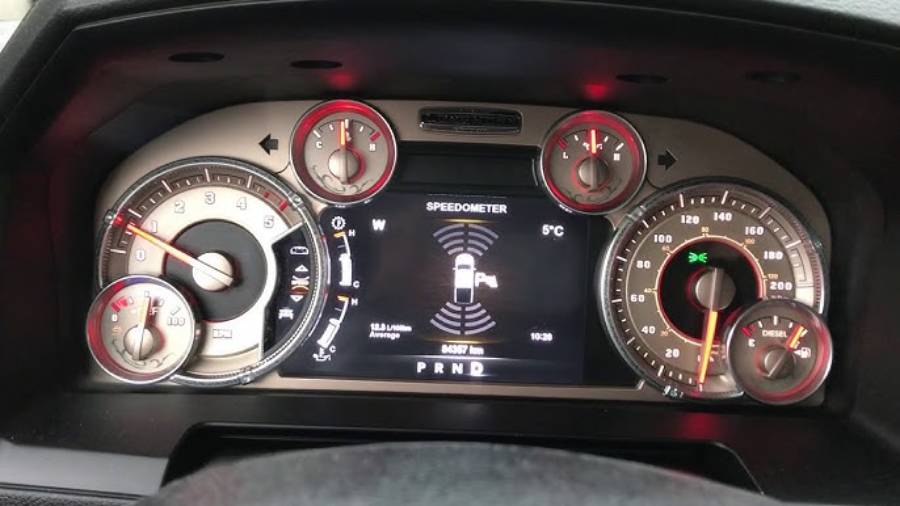
What Does a Front Parking Sensor Malfunction Mean on a Dodge Ram 1500?
A front parking sensor malfunction on a Dodge Ram 1500 means the ParkSense system cannot reliably detect or report obstacles in front of the vehicle. The problem can affect one sensor, several sensors, or another part of the parking-assistance system. Depending on the fault, the driver may receive false obstacle warnings, no warning at all, intermittent alerts, or a message indicating that ParkSense is unavailable or requires service.
The front ParkSense system uses sensors installed in the front bumper to monitor the area immediately ahead of the truck at low speeds. These sensors send signals toward nearby objects and use the returning signals to determine whether an obstacle is within the monitored area. The system then provides visual or audible warnings as the truck approaches an object. A sensor that is blocked, damaged, incorrectly positioned, or unable to communicate with the system can therefore produce inaccurate information.
A malfunction does not automatically mean that a front parking sensor has failed permanently. Dirt, mud, road salt, snow, ice, or moisture on the sensor surface can temporarily interfere with obstacle detection. Cleaning the affected area and testing ParkSense again can restore normal operation when contamination is the cause. Persistent problems require additional inspection because the fault may involve sensor damage, mounting position, wiring, connectors, or another part of the ParkSense system.
What Are the Symptoms of a Dodge Ram 1500 Front Parking Sensor Malfunction?
There are 5 common symptoms of a Dodge Ram 1500 front parking sensor malfunction: false warnings, continuous beeping, missing alerts, intermittent operation, and ParkSense warning messages. The exact symptom matters because it helps narrow the diagnostic path before parts are removed or replaced.
False warnings occur when ParkSense reports an obstacle even though the area in front of the truck appears clear. A dirty or obstructed sensor can cause this behavior because the sensor may interpret material close to its surface as an object. Physical damage or an incorrectly positioned sensor can also affect the direction in which the sensor monitors the surrounding area. A warning that repeatedly appears under the same environmental conditions should therefore be compared with the condition of the sensor surfaces and bumper.
Continuous or repeated beeping is another indication that the system is receiving information consistent with a nearby obstacle. The warning does not prove that the sensor itself is defective. Mud, ice, snow, moisture, bumper damage, or sensor-position problems should be eliminated first. If the warning continues after the front sensors are clean and unobstructed, the affected sensor and its electrical connection require further diagnosis.
Missing alerts create the opposite problem. The truck approaches an obstacle, but ParkSense provides no expected warning. This symptom can indicate that a sensor is not detecting correctly, the sensor is disconnected, the circuit has a fault, or the parking-assistance system is not operating normally. Because several components can produce the same symptom, replacing a sensor without confirming the source of the fault can result in an unnecessary repair.
Intermittent operation means ParkSense functions normally at some times but produces warnings or stops responding at others. Environmental contamination, moisture, loose electrical connections, or developing component faults can produce intermittent behavior. Recording when the problem occurs—for example, after rain, after washing the truck, or following a bumper impact—provides useful diagnostic context.
A ParkSense unavailable or service warning indicates that the system has detected a condition that prevents normal parking-assistance operation. Treat the warning as a diagnostic clue rather than proof that a specific sensor has failed. Inspect the sensors and bumper first, then move to sensor, wiring, connector, and diagnostic fault-code checks when the warning persists.
What Causes a Dodge Ram 1500 Front Parking Sensor Malfunction?
There are 4 main groups of causes of a Dodge Ram 1500 front parking sensor malfunction: sensor obstruction, physical sensor or mounting damage, wiring or connector faults, and ParkSense system faults. Identifying which group matches the symptoms is more reliable than immediately replacing the sensor that appears to be malfunctioning.
Can Dirt, Snow, Ice, or Moisture Affect the Front Parking Sensors?
Dirt, road debris, snow, ice, and moisture can interfere with a Ram 1500 front parking sensor by obstructing the area from which it detects nearby objects. This is one of the first conditions to inspect because it can imitate a component failure without requiring replacement.
Mud and road grime can accumulate directly over a sensor, especially because the sensors are mounted in the front bumper and are exposed to road conditions. Snow and ice can create a similar obstruction during cold weather. The resulting symptom may be a false obstacle warning, repeated beeping, reduced detection, or temporary ParkSense unavailability.
Environmental interference should be separated from a persistent electrical or component fault. Clean the sensor surfaces carefully, remove visible obstructions, and test ParkSense again. If normal operation returns and remains stable, contamination was a likely contributor. If the malfunction continues with clean, unobstructed sensors, proceed to physical and electrical inspection.
Can a Damaged or Misaligned Front Parking Sensor Cause a Malfunction?
A damaged or incorrectly positioned front parking sensor can cause false warnings, inconsistent detection, or complete loss of detection. Parking sensors depend on both component condition and correct mounting position, so a sensor does not need to be electrically dead to produce inaccurate information.
Front bumper impacts are an important diagnostic clue. Even when bumper damage appears minor, the impact can damage a sensor, its holder, or the mounting area around it. A sensor that sits at an unusual angle may monitor a different area than intended and generate warnings that appear unrelated to an actual obstacle.
Inspect each front sensor for cracks, impact marks, looseness, unusual depth, or a visibly different angle compared with adjacent sensors. The surrounding bumper and sensor holder should also be checked. A sensor that became problematic immediately after bumper damage or bumper repair deserves closer inspection before the malfunction is attributed to a control-system fault.
Can Damaged Wiring or a Loose Connector Cause ParkSense Problems?
Damaged wiring or a poor electrical connection can prevent a Ram 1500 front parking sensor from communicating correctly with the ParkSense system. This type of fault can produce persistent or intermittent symptoms depending on whether the circuit is completely open or the connection changes with vibration, movement, or moisture.
The front bumper area exposes wiring and connectors to vibration, road contamination, moisture, previous collision damage, and repair work. A connector that is loose or not fully seated can interrupt sensor operation. Wiring that has been pinched, stretched, cut, or otherwise damaged can produce similar symptoms even when the sensor itself remains functional.
Electrical inspection becomes more important when the sensor face is clean, its mounting position appears correct, and the malfunction remains. Accessible connectors should be checked for secure attachment and visible damage. More detailed circuit diagnosis should follow appropriate service information rather than assuming that replacing the sensor will correct an electrical fault.
Can a ParkSense System Fault Disable the Front Parking Sensors?
A ParkSense system fault can affect front parking-assistance operation even when the visible sensors are clean and physically undamaged. The parking sensors operate as components of a larger electronic system, so a persistent malfunction cannot always be isolated through an external bumper inspection.
A system-level problem becomes more likely when several sensors appear to stop operating together, a ParkSense service message persists, or cleaning and physical inspection reveal no obvious cause. Diagnostic information from the vehicle can then help distinguish an individual sensor problem from wiring, communication, or another ParkSense-related fault.
This distinction prevents unnecessary parts replacement. A new parking sensor will not correct damaged wiring or another system fault. Confirm the source of a persistent malfunction through systematic diagnosis before replacing components, especially when more than one front sensor appears affected.
How Do You Diagnose a Dodge Ram 1500 Front Parking Sensor Malfunction?
Diagnose a Dodge Ram 1500 front parking sensor malfunction by checking the sensor surfaces, sensor mounting, bumper condition, accessible wiring and connectors, individual sensor operation, and diagnostic fault information in that order. This sequence starts with faults that can be identified without removing parts and progresses to electrical and system-level diagnosis. It also reduces the risk of replacing a working sensor when dirt, physical damage, or wiring is responsible for the malfunction.
Start with all front parking sensor surfaces. Remove dirt, mud, snow, ice, road salt, or other material covering the sensors, then operate ParkSense again under suitable conditions. Compare all front sensors visually rather than inspecting only the sensor closest to a false warning. One contaminated sensor can affect how the driver perceives the operation of the entire front parking-assistance system.
Inspect the front bumper and sensor mounting positions next. Each sensor should sit securely in its intended mounting location without obvious cracks, looseness, displacement, or impact damage. Pay particular attention to this step when the malfunction started after a collision, bumper repair, sensor replacement, or other work around the front bumper. A sensor can remain electrically functional while producing inaccurate detection because its position has changed.
Check accessible sensor connectors and wiring when the sensors are clean and correctly positioned but the problem remains. Look for loose connections, damaged connector housings, corrosion or contamination where visible, and wiring that has been pinched, stretched, cut, or damaged near the bumper. An intermittent problem that changes after vibration, rain, vehicle washing, or bumper work increases the relevance of an electrical connection check.
Use diagnostic information when visual inspection does not identify the cause. A compatible scan tool that can access the relevant parking-assistance system can provide fault information that helps distinguish an individual sensor problem from a wiring, communication, or broader system fault. A basic code reader designed primarily for powertrain faults may not provide the same access, so tool capability matters.
Do not replace a front parking sensor solely because ParkSense is malfunctioning. Confirm the suspected component first. The same warning behavior can originate from a blocked sensor, damaged mounting, electrical connection, wiring fault, or system-level problem, and each cause requires a different repair.
How Can You Tell Which Front Parking Sensor Is Bad on a Ram 1500?
Identify a bad Ram 1500 front parking sensor by comparing the individual sensors, checking for physical abnormalities, and confirming the suspected sensor with appropriate diagnostic information when possible. A sensor that looks damaged or behaves differently from the others is a diagnostic lead, but a visible difference alone does not always prove internal sensor failure.
Begin by comparing all front sensors under the same conditions. Their surfaces should be clean, their mounting positions should appear consistent, and none should show obvious cracks or impact damage. If only one sensor repeatedly corresponds with false alerts or detection problems while the other sensors behave normally, that sensor and its circuit deserve closer inspection.
Physical damage strengthens the case for sensor failure. For example, a sensor with a cracked face after a front bumper impact has a clearer connection to a new ParkSense problem than an undamaged sensor chosen only because it is near the apparent warning area. The sensor holder should also be inspected because a loose or damaged mount can change sensor orientation and imitate a defective sensor.
Electrical diagnosis is necessary when no visible difference exists. Inspect the connector and associated wiring before condemning the sensor. A sensor cannot communicate correctly through a damaged circuit, so an electrical fault can make a functional sensor appear defective. This distinction is particularly important when a new sensor would require bumper access or additional labor to install.
Diagnostic fault information provides stronger evidence when the malfunction persists. A capable scan tool can help identify which part of the ParkSense system is reporting a problem, depending on the Ram 1500 model year and system configuration. Diagnostic procedures and fault-code interpretation should follow information applicable to the specific vehicle rather than assuming that every Ram 1500 uses identical components or procedures.
How Do You Fix a Dodge Ram 1500 Front Parking Sensor Malfunction?
Fix a Dodge Ram 1500 front parking sensor malfunction by correcting the confirmed cause: clean an obstructed sensor, restore a loose or incorrect mounting position, repair a wiring or connector fault, or replace a failed sensor. There is no single repair for every ParkSense malfunction because the same symptom can result from environmental, physical, or electrical problems.
Use the least invasive appropriate repair first. A dirty sensor needs cleaning rather than replacement, while a sensor that has moved in its holder requires its mounting condition to be corrected. Wiring damage requires circuit repair, and a confirmed internally failed sensor requires replacement. ParkSense problems that remain after these checks need further system diagnosis instead of repeated parts replacement.
How Do You Clean and Inspect the Ram 1500 Front Parking Sensors?
Clean the Ram 1500 front parking sensors by removing material from each sensor surface without damaging the sensor or surrounding bumper. Cleaning is the appropriate first repair when dirt, mud, road salt, snow, or ice is covering the detection surface.
Inspect the sensors before and after cleaning. The objective is not only to remove contamination but also to expose cracks, chips, impact marks, looseness, or mounting problems that were hidden by dirt. Compare each sensor with the others after the surfaces are clean. A sensor that is recessed, protruding, tilted, or loose compared with adjacent units requires additional inspection.
Test ParkSense after cleaning instead of immediately moving to replacement. Normal operation after the obstruction is removed indicates that contamination was associated with the malfunction. A warning that returns repeatedly despite clean sensor surfaces indicates that another cause should be investigated.
Avoid aggressive cleaning methods that can damage the sensor face, paint, mounting area, or electrical components. Snow and ice should be removed without striking or prying against the sensor. The goal is to restore a clear sensor surface without creating a new physical fault.
How Do You Fix Parking Sensor Wiring or Connector Problems?
Fix a parking sensor wiring or connector problem by locating the affected connection or circuit and restoring a secure, electrically sound path between the sensor and the ParkSense system. The exact repair depends on whether the problem is a loose connector, damaged connector housing, damaged wire, contamination, or another circuit fault.
Start with accessible connectors around the suspected sensor. Confirm that the connector is properly seated and inspect it for visible damage. Wiring near the front bumper should be checked for cuts, pinching, stretching, abrasion, or damage associated with previous collision or bumper work. Repairing the sensor itself will not solve a break elsewhere in its circuit.
Intermittent faults require particular attention because the electrical connection may work under one condition and fail under another. For example, a ParkSense problem that repeatedly appears after wet weather or changes after bumper movement provides useful context for inspecting connectors and wiring. The observation narrows the diagnostic path but does not independently prove the location of the fault.
Follow model-year-appropriate wiring diagrams and service procedures for circuit testing and repair. Wire colors, connector locations, module arrangements, and diagnostic specifications can differ across Ram 1500 configurations. Electrical measurements should therefore be compared with the correct service information rather than generalized values.
When Should You Replace a Ram 1500 Front Parking Sensor?
Replace a Ram 1500 front parking sensor when diagnosis identifies the sensor itself as failed or when physical damage prevents it from operating correctly. Replacement should follow diagnosis, not serve as the first response to every false warning or ParkSense unavailable message.
A replacement becomes reasonable when the sensor is visibly damaged and the damage corresponds with the malfunction, or when appropriate diagnosis isolates the fault to that sensor after its mounting, connector, and related wiring have been checked. A sensor damaged during a bumper impact is one example where physical evidence and the timing of the malfunction can support the diagnosis.
Do not replace a sensor simply because cleaning failed. Cleaning only eliminates surface obstruction as one cause. The next diagnostic steps should examine mounting, electrical connections, wiring, and available fault information. Installing a new sensor on a damaged circuit can leave the original ParkSense malfunction unchanged.
Confirm compatibility before installing a replacement. Ram 1500 parking sensor parts and service procedures can vary by model year, trim, bumper configuration, and equipment package. Match the replacement component to the specific vehicle rather than selecting a sensor solely because it is advertised for a Ram 1500.
How Do You Reset the Front Parking Sensors on a Dodge Ram 1500?
Resetting the front parking sensors on a Dodge Ram 1500 can restore operation after a temporary system condition, but it will not repair a blocked, damaged, disconnected, or failed sensor. Check the physical condition of the front sensors before treating a reset as the solution. A malfunction caused by dirt, bumper damage, wiring, or an electrical connection will remain until its underlying cause is corrected.
Start by confirming that ParkSense is enabled through the controls available on the specific Ram 1500. Clean all front sensor surfaces and remove snow, ice, mud, or other obstructions. Turn the vehicle off and restart it after the basic inspection, then check whether the warning returns during normal ParkSense operation. If the malfunction disappears and does not return, the condition may have been temporary rather than a permanent sensor failure.
A warning that returns immediately after restarting the vehicle requires diagnosis rather than repeated resets. The system may continue detecting a sensor, wiring, connector, or communication problem each time it performs its operating checks. Clearing the warning without repairing the underlying fault does not restore reliable obstacle detection.
Reset procedures should also be matched to the model year and ParkSense configuration. Ram 1500 generations can differ in their electronic systems, controls, and service procedures. Avoid disconnecting components or performing an assumed universal reset procedure without checking information for the specific vehicle. When ParkSense remains unavailable after cleaning, inspection, and restarting, retrieve diagnostic fault information before replacing parts.
How Do You Replace a Front Parking Sensor on a Dodge Ram 1500?
Replace a Dodge Ram 1500 front parking sensor by confirming the failed sensor, obtaining the correct replacement, accessing the sensor behind the front bumper, disconnecting it, installing the new unit in the correct position, and testing ParkSense afterward. The exact access and removal procedure depends on the truck’s model year and front bumper configuration.
Confirm the fault before beginning removal. Check the sensor surface, mounting position, connector, and related wiring so that a circuit problem is not mistaken for internal sensor failure. This step is especially important when the sensor has no visible physical damage. Replacing an electrically functional sensor will not correct a loose connector or broken wire.
Verify the replacement part against the vehicle configuration before installation. Ram 1500 trucks span different generations, trims, bumper designs, and equipment packages, so physical appearance alone is not sufficient evidence that two sensors are interchangeable. Vehicle-specific parts information or the identification on the original component provides a stronger basis for selecting the replacement.
Access to the back of the front bumper is required to disconnect and release the sensor from its holder. The amount of disassembly can vary by configuration. Once accessible, disconnect the electrical connector without pulling on the wiring, release the faulty sensor according to the applicable mounting design, and inspect the holder before installing the replacement. A damaged holder should be corrected because it can leave the new sensor at an incorrect angle.
Install the replacement in the intended orientation and make sure it sits securely in the holder. Reconnect the electrical connector, restore any components removed for access, and test ParkSense before considering the repair complete. The new sensor should not be assumed to have solved the malfunction until the warning has cleared and normal obstacle detection has been verified.
Does a Replacement Ram 1500 Parking Sensor Need Calibration?
Whether a replacement Ram 1500 parking sensor requires an additional calibration, initialization, or diagnostic procedure depends on the model year, system configuration, and repair performed. Do not apply one calibration rule to every Ram 1500 because ParkSense hardware and service procedures can differ between vehicle generations.
Correct installation remains essential even when a separate calibration procedure is not specified. A parking sensor depends on its designed position and orientation to monitor the intended area. Installing the sensor incorrectly, using a damaged holder, or leaving it at an abnormal angle can cause false obstacle detection even when the replacement sensor is functional.
Check the service information applicable to the specific truck after replacement. This is particularly important when the vehicle continues to display a ParkSense warning, the replacement sensor does not operate normally, or bumper repairs changed the mounting area. A diagnostic scan tool may also be required when the remaining problem involves stored faults or another part of the parking-assistance system.
Do not assume calibration is responsible when a replacement fails to correct the original malfunction. Recheck the replacement part, mounting position, connector, wiring, and original diagnosis first. A persistent fault after sensor replacement can indicate that the sensor was not the original cause.
When Should You Take a Ram 1500 to a Mechanic for a ParkSense Problem?
Take a Ram 1500 to a qualified mechanic or technician when the front ParkSense malfunction persists after basic cleaning and inspection, requires electrical diagnosis, follows significant bumper damage, affects several sensors, or remains after sensor replacement. These conditions indicate that troubleshooting has progressed beyond a simple sensor obstruction.
Professional diagnosis is appropriate when a ParkSense unavailable or service warning repeatedly returns despite clean and correctly positioned sensors. A technician with suitable diagnostic equipment can retrieve system information and use vehicle-specific service procedures to separate sensor faults from wiring, connector, communication, or other electronic problems.
Bumper impact is another reason to consider professional inspection. A collision can affect the sensor, holder, wiring, connector, and bumper mounting area at the same time. Replacing the visibly damaged sensor alone may not restore correct operation when other components were moved or damaged by the same impact.
Electrical problems also justify escalation when the repair requires circuit testing or wiring access beyond a straightforward connector inspection. Correct diagnosis should determine where electrical continuity or communication has been lost before components are replaced. This reduces unnecessary parts replacement and addresses the actual failure point.
Seek further diagnosis when a new sensor does not solve the malfunction. A persistent ParkSense problem after replacement indicates that the original diagnosis, replacement compatibility, sensor mounting, wiring, connector, or another system component needs to be checked. Repeatedly installing additional sensors without confirming the fault increases repair cost without establishing the cause.
How Can You Prevent Ram 1500 Front Parking Sensor Problems?
Prevent Ram 1500 front parking sensor problems by keeping the sensors clean, removing snow and ice promptly, inspecting the bumper after impacts, maintaining correct sensor positioning, and investigating recurring warnings before they develop into persistent faults. Preventive maintenance cannot eliminate internal electronic failures, but it can reduce problems caused by contamination, physical damage, and disturbed sensor mounting.
Keep the front sensor surfaces free from mud, road grime, snow, ice, and other debris. Because the sensors are positioned on the front bumper, they are directly exposed to material thrown up from the road. Inspecting and cleaning them is particularly useful after driving on muddy roads, in winter conditions, or anywhere road salt and debris can accumulate on the bumper.
Remove snow and ice carefully rather than striking, scraping aggressively, or prying around the sensor. The objective is to expose the detection surface without damaging the sensor face, holder, paint, or surrounding bumper. After cleaning, check that each sensor remains securely positioned and visually consistent with the adjacent sensors.
Inspect ParkSense operation after a front bumper impact, even when the exterior damage appears minor. An impact can affect the sensor itself, its holder, mounting position, connector, or nearby wiring. A new false warning or intermittent malfunction that begins immediately after an impact provides a clear reason to inspect the affected bumper area.
Sensor position should also be checked after bumper removal, collision repair, painting, or parking sensor replacement. A functional sensor installed incorrectly can monitor the wrong area and create inaccurate warnings. Correct mounting therefore matters as much as the electrical condition of the sensor.
Investigate recurring warnings instead of repeatedly clearing or ignoring them. A ParkSense problem that disappears and returns under similar conditions provides diagnostic information. For example, a warning associated with wet conditions points troubleshooting toward a different context than a warning that started immediately after bumper damage. Recording these patterns helps identify the underlying cause before unnecessary parts are replaced.
Can You Drive a Ram 1500 With a Front Parking Sensor Malfunction?
A Ram 1500 may remain physically drivable when only the front parking-assistance system is malfunctioning, but the driver should treat ParkSense as unavailable or unreliable until the fault is corrected. A parking sensor malfunction reduces an assistance function; it does not make an inaccurate sensor warning safe to rely on.
The immediate consequence is reduced obstacle-detection assistance during low-speed maneuvers. A failed sensor may provide no warning when the truck approaches an object, while another type of malfunction may generate a warning when no obstacle is present. Both conditions make ParkSense information unreliable for judging clearance around the front bumper.
Use direct observation, mirrors, and other functioning vehicle aids when parking or maneuvering while the problem remains. Parking sensors are assistance devices rather than substitutes for checking the vehicle’s surroundings. Extra attention is particularly important around low objects, walls, posts, other vehicles, and areas where pedestrians may be present.
Do not ignore a persistent ParkSense warning simply because the truck otherwise drives normally. Inspect and clean the front sensors first, then diagnose the system when the warning remains. Prompt diagnosis can distinguish a temporary obstruction from sensor damage, disturbed mounting, damaged wiring, a loose connector, or another ParkSense system fault.
A malfunction that appeared after a collision or is accompanied by other electrical or vehicle warnings deserves additional inspection. In that situation, the visible parking sensor symptom may not represent the full extent of the damage. Confirming the condition of the affected components provides a more reliable basis for deciding whether the truck requires professional repair.