The Dodge Journey “Service Keyless System” warning means the vehicle has detected a problem related to its keyless-entry or key-detection system. The message does not automatically mean the key fob itself has failed. The fault can involve the key fob or its battery, the vehicle’s 12V battery, electrical connections, or components responsible for detecting and communicating with the key.
The severity depends on the underlying fault and the symptoms that appear with the warning. A Dodge Journey may continue to start and drive normally when the problem is intermittent, while a more persistent fault can cause passive entry to stop working, prevent the vehicle from detecting the key, or interfere with push-button starting. Testing the key fob and basic power sources first can help separate a simple battery-related problem from a fault that requires electrical diagnosis.
This guide explains what the Dodge Journey Service Keyless System warning means, its main causes and symptoms, how to diagnose and fix the problem, whether the warning can be reset, and when professional repair is necessary.
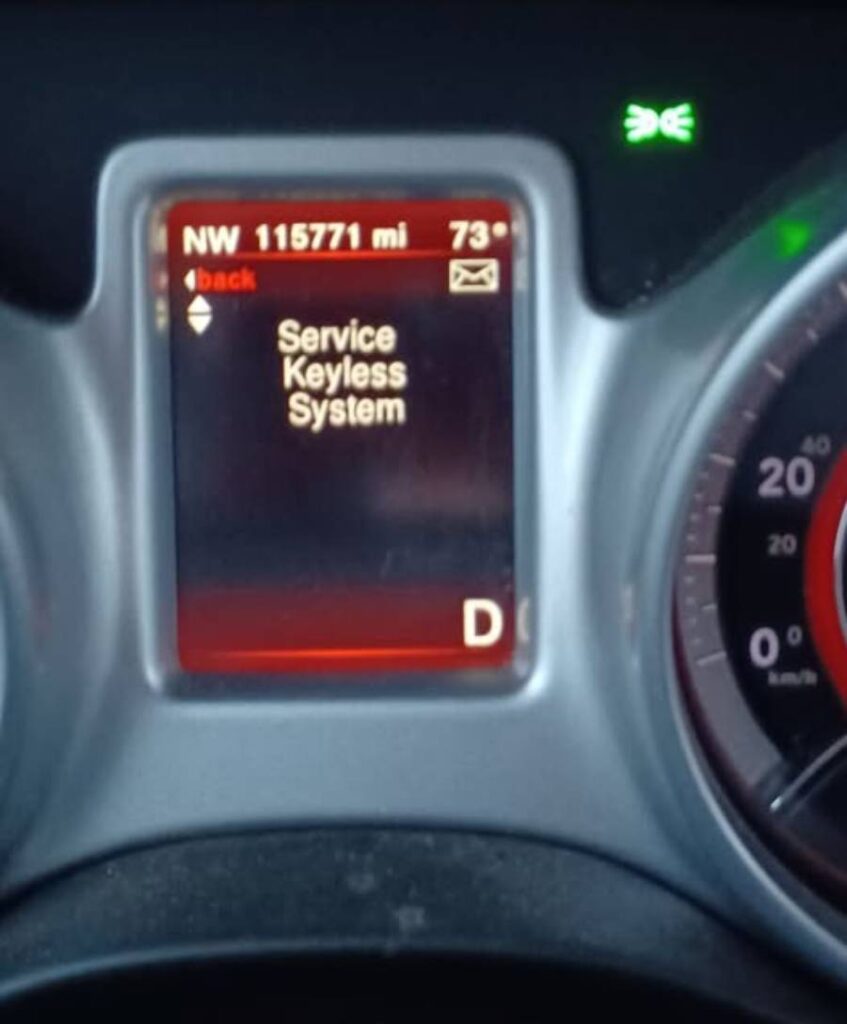
What Does “Service Keyless System” Mean on a Dodge Journey?
The “Service Keyless System” message on a Dodge Journey indicates that the vehicle has detected a fault affecting the keyless system or its ability to communicate with the key. The warning can involve key detection, passive entry, push-button starting, or another function that depends on communication between the key fob and the vehicle.
The warning does not prove that the key fob itself is defective. The keyless system depends on several elements working together, including the key fob and its battery, the vehicle’s electrical supply, wiring and connections, and the components responsible for receiving and processing the key signal. A fault affecting one part of this communication chain can cause the vehicle to display a keyless-system warning.
“Service Keyless System” should also be distinguished from a simple low key-fob battery condition. A weak fob battery is one possible starting point for diagnosis, but replacing it should not be treated as a guaranteed repair. If the message remains after the key and its battery have been checked, the vehicle side of the system requires further diagnosis.
The symptoms accompanying the message help narrow down the fault. For example, a Dodge Journey that recognizes one key but not a second key points diagnosis toward the affected key or fob. If neither key works reliably, the vehicle’s power supply, wiring, receiver-related components, or control electronics become more relevant areas to investigate.
What Causes the Service Keyless System Warning on a Dodge Journey?
The Service Keyless System warning can result from a fault in the key fob, its battery, the Dodge Journey’s electrical supply, wiring and connections, key programming, or a component involved in keyless communication. The correct repair depends on identifying which part of the system is interrupting communication between the vehicle and the programmed key.
Can a Weak or Dead Key Fob Battery Trigger the Warning?
A weak or dead key fob battery should be checked when a Dodge Journey develops key-detection or keyless-entry problems. The battery supplies the electrical power required by the fob to transmit its signal. As battery output deteriorates, communication between the fob and vehicle can become unreliable.
A battery-related problem can therefore appear alongside symptoms such as reduced remote range, inconsistent button operation, or intermittent key recognition. Replacing the fob battery is a logical early diagnostic step because it addresses the fob’s basic power source before more complex vehicle components are investigated. However, the supplied reference materials do not establish that a weak fob battery alone always triggers the specific “Service Keyless System” message.
Can a Faulty Key Fob Cause the Service Keyless System Message?
A faulty key fob can contribute to keyless-system problems when it cannot communicate correctly with the Dodge Journey. Battery replacement will not repair physical damage, internal electronic failure, or another defect within the transmitter itself.
A spare programmed key provides a useful diagnostic comparison. If the Service Keyless System problem or key-detection symptoms occur with one fob while the second fob functions normally, the malfunctioning fob becomes a stronger suspect. If both programmed keys experience the same problem, diagnosis should expand to the vehicle rather than assuming that two fobs failed simultaneously.
Can a Weak 12V Battery Affect the Dodge Journey Keyless System?
A weak 12V vehicle battery should be investigated when the Service Keyless System warning appears with other electrical symptoms. Unlike the small battery inside the key fob, the 12V battery supplies power to the vehicle’s electrical and electronic systems. Unstable or insufficient voltage can therefore affect systems that rely on electronic modules and communication.
The vehicle battery becomes especially relevant when the Dodge Journey also shows slow starting, dim or unstable electrical equipment, multiple warning messages, or other unusual electrical behavior. Battery condition and voltage should be tested before expensive electronic components are replaced. A battery test also helps distinguish a general power-supply problem from a fault isolated to the keyless system.
Can a Fuse or Wiring Problem Cause the Warning?
Fuse, wiring, connector, or electrical-connection faults can disrupt the power or communication required by a keyless system. An open circuit, damaged wire, loose connection, or corrosion can prevent an otherwise functional component from operating correctly.
Diagnosis should therefore inspect relevant electrical connections rather than immediately replacing the key fob or a control component. The exact fuse, connector, wiring path, and component location can vary by Dodge Journey model year and configuration, so these items should be verified against the appropriate service information before testing or replacement.
Can a Keyless System Component or Control Module Cause the Warning?
A failed component involved in receiving, processing, or controlling keyless-system communication can cause a persistent keyless-system fault. This possibility becomes more relevant after simpler causes such as the key fob, basic power supply, fuses, and accessible connections have been checked.
Electronic component faults require diagnosis rather than parts swapping. A technician can examine relevant diagnostic trouble codes, system communication, power and ground circuits, and component responses to determine where the failure occurs. The exact modules and receiver-related components involved should be identified according to the Dodge Journey’s model year instead of assuming that every Journey uses an identical configuration.
Can Key Programming or Communication Problems Trigger the Warning?
Key programming or communication problems can prevent the Dodge Journey from recognizing a key correctly. The vehicle must identify an authorized key before key-dependent functions can operate normally, so a recognition problem can resemble a defective fob or vehicle-side electrical fault.
Programming becomes particularly relevant after a replacement key or electronic component has been introduced, or when a key cannot be recognized despite having a functional battery. Reprogramming should not be used as a universal first repair, however. The key, power supply, electrical connections, diagnostic trouble codes, and other relevant components should be evaluated so that programming is performed only when the diagnosis supports it.
What Symptoms Can Appear With a Dodge Journey Keyless System Problem?
A Dodge Journey keyless system problem can cause failed passive entry, intermittent key detection, abnormal push-button starting, key-related dashboard messages, or inconsistent operation between two programmed keys. The exact symptoms depend on whether the fault originates from the key, the vehicle’s electrical supply, communication components, or another part of the keyless system.
Key detection problems are among the most useful symptoms for diagnosis. The vehicle may recognize the key normally on one attempt but fail to detect it on another. Intermittent recognition indicates that communication is not consistently completing, but the symptom alone does not identify the failed component. The key fob, its power source, vehicle-side electrical connections, and keyless communication components still need to be tested separately.
Passive-entry problems provide another diagnostic clue. A driver may find that the normal keyless-entry function does not respond even though another key-related function still works. The pattern matters because a complete loss of all key functions and the failure of only one function do not necessarily have the same cause.
Push-button starting can also become unreliable when the vehicle cannot consistently recognize an authorized key. A key-detection message may appear at the same time. When starting problems accompany the Service Keyless System warning, diagnosis should establish whether the vehicle recognizes the programmed key before unrelated starting-system components are suspected.
Comparing two programmed keys can narrow the diagnostic path. If one key consistently works and the other does not, investigate the failing key first. If both keys produce the same symptoms, investigate the vehicle side of the system. This comparison is a diagnostic indicator rather than proof of a specific failed component, but it can prevent unnecessary replacement of a working key.
How Do You Diagnose a Dodge Journey Service Keyless System Warning?
Diagnose a Dodge Journey Service Keyless System warning by checking the key fob first, comparing a spare programmed key, evaluating the vehicle’s 12V power supply, inspecting relevant electrical circuits, and retrieving applicable diagnostic trouble codes. The sequence should move from simple checks toward component-level diagnosis rather than replacing expensive parts based only on the dashboard message.
How Do You Check the Key Fob First?
Check the key fob for battery condition, physical damage, button operation, and consistent communication with the vehicle. This establishes whether the problem begins with the device the Dodge Journey is attempting to recognize.
Start with observable behavior. Check whether the remote buttons respond consistently and whether the effective range has noticeably decreased. Inspect the fob for damage that could have followed an impact, water exposure, or deterioration of the housing. A weak battery should be replaced with the correct battery type before the fob itself is considered defective.
Retest the keyless functions after replacing a questionable fob battery. If normal operation returns and the warning does not recur, continue monitoring the system. If the warning or key-detection symptoms remain, proceed with diagnosis instead of repeatedly replacing the battery.
How Do You Use a Spare Key to Diagnose the Problem?
Test a second programmed key under the same conditions to determine whether the fault follows one key or remains with the vehicle. This comparison is one of the most practical ways to separate a key-specific problem from a broader vehicle-side problem.
For example, if Key A repeatedly fails to operate correctly while Key B works normally, inspect Key A’s battery, condition, electronics, and programming. If Key A and Key B both fail in the same way, two simultaneous key failures become less compelling and vehicle-side diagnosis becomes more important.
The comparison should be made under similar conditions. Testing one key from a different distance or location can introduce another variable and weaken the diagnostic value of the test.
How Do You Check the Dodge Journey’s 12V Battery?
Test the Dodge Journey’s 12V battery and charging condition when keyless-system problems occur with other electrical symptoms. Electronic systems depend on a stable power supply, so battery condition should be established before electronic components are condemned.
Look for supporting symptoms such as difficult starting, multiple warning messages, unstable interior electronics, or other electrical abnormalities. These symptoms increase the relevance of a general power-supply problem. A proper battery test provides stronger evidence than assuming the battery is healthy simply because the engine still starts.
Battery diagnosis should also consider terminals and electrical connections. A usable battery cannot provide stable power through a poor connection, so loose, damaged, or corroded connections should be addressed when found.
How Do You Check Fuses, Wiring, and Connections?
Inspect the fuses, wiring, connectors, power supplies, and grounds associated with the affected system using service information for the specific Dodge Journey model year. Electrical continuity is necessary for keyless-system components to receive power and communicate correctly.
Begin with accessible visual checks for damaged wiring, loose connectors, corrosion, or other obvious defects. Relevant fuses should be identified from the correct fuse information rather than by guessing from another Dodge Journey model year. A fuse that has failed should also prompt investigation into why the circuit opened instead of automatically being treated as the original fault.
Electrical diagnosis becomes more important when the problem is intermittent. A loose connection or damaged wire can make contact under one condition and lose contact under another, creating a warning that disappears and returns. This behavior is one reason an intermittent Service Keyless System message should not automatically be attributed to the key-fob battery.
How Can a Diagnostic Scanner Identify the Keyless System Fault?
A capable diagnostic scanner can retrieve fault information that helps identify which system or circuit requires further testing. This moves diagnosis beyond the dashboard message, which identifies a system-level problem but does not necessarily identify the failed part.
The diagnostic process should look for relevant diagnostic trouble codes and then interpret those codes in the context of the observed symptoms. A code should guide testing rather than automatically trigger component replacement. For example, a communication-related fault can result from loss of power, damaged wiring, a poor connection, or a failed electronic component.
A basic code reader may not provide access to every body or keyless-related system required for this diagnosis. When the necessary modules cannot be accessed, a repair facility with appropriate diagnostic equipment may be required to retrieve the relevant information and perform system-specific tests.
How Can You Tell Whether the Key Fob or the Vehicle Is the Problem?
Determine whether the key fob or vehicle is responsible by comparing programmed keys and checking whether the fault follows one key or affects the entire keyless system. The diagnostic pattern provides a more useful direction than the Service Keyless System message alone.
One consistently failing key points first toward that key’s battery, physical condition, electronics, or programming. Two keys showing the same failure pattern shift attention toward the Dodge Journey, including its 12V power supply, electrical circuits, connections, and keyless-system components.
The result should still be confirmed before parts are replaced. A spare-key comparison narrows the diagnostic field, but it does not identify a specific vehicle component. Diagnostic trouble codes, electrical testing, and model-year-specific service information are required when the fault remains on the vehicle side.
How Do You Fix the Service Keyless System on a Dodge Journey?
Fix the Dodge Journey Service Keyless System warning by repairing the fault identified during diagnosis rather than replacing keyless-system parts based on the warning alone. The repair can range from addressing a key-fob power problem to repairing a vehicle electrical fault or replacing and configuring a failed keyless-system component. The correct repair path depends on whether testing isolates the problem to the key or the vehicle.
How Do You Replace the Dodge Journey Key Fob Battery?
Replace a weak key fob battery with the correct battery type for the specific Dodge Journey key fob, then retest the keyless functions. A fresh battery restores the fob’s power source and eliminates low battery output as a variable during further diagnosis.
Open the fob without damaging its housing or internal contacts, remove the existing battery, and install the replacement in the correct orientation. Verify the required battery specification from the existing battery or appropriate information for the specific fob rather than assuming that every Dodge Journey key uses the same battery.
Test the remote buttons, passive-entry operation, and key recognition after installation. If normal operation returns, monitor the vehicle for recurrence of the warning. If the Service Keyless System message remains, continue diagnosis because replacing the fob battery does not repair a vehicle-side electrical or communication fault.
What Should You Do if the Key Fob Is Faulty?
Repair or replace a faulty key fob after testing confirms that the problem follows that key and another programmed key works correctly. This comparison reduces the risk of replacing a functional fob when the actual problem is inside the vehicle.
Physical damage, internal electronic failure, or a communication problem can remain after a new battery has been installed. The appropriate solution depends on the failed part of the key. A damaged housing may require a different repair from an electronically defective transmitter.
A replacement key may also require programming before the Dodge Journey recognizes it as an authorized key. An automotive locksmith or Dodge service facility may be appropriate when programming equipment is required. Verify compatibility before purchasing a replacement because a key that physically resembles the original is not necessarily compatible with the vehicle.
What Should You Do if the Vehicle Battery Is Weak?
Test and restore the Dodge Journey’s 12V power supply when diagnosis identifies low or unstable vehicle voltage. Charging or replacing a weak battery can correct electrical problems caused by inadequate system voltage, but battery replacement should follow testing rather than assumption.
The battery itself is only one part of the power-supply path. Inspect relevant battery terminals and connections because looseness, corrosion, or poor contact can interfere with electrical delivery even when the battery remains serviceable. Charging-system condition may also require evaluation when a replacement or fully charged battery repeatedly loses charge.
After stable power is restored, operate the keyless functions again and check whether the warning returns. A persistent Service Keyless System message indicates that further diagnosis is necessary instead of another battery replacement.
How Are Fuse, Wiring, or Connector Problems Repaired?
Repair an electrical fault by restoring the affected circuit’s correct power, ground, or communication path after the defective fuse, wire, terminal, or connector has been identified. Electrical repairs should target the measured fault rather than rely on visual inspection alone when the cause is not obvious.
A blown fuse can be replaced with the specified type and rating, but the reason it failed should be investigated. Installing repeated replacement fuses without correcting an underlying circuit problem does not repair the fault and can conceal a more significant electrical issue.
Damaged wiring and connectors require the same cause-based approach. Loose terminals, corrosion, broken conductors, and poor connections can interrupt the system continuously or intermittently. The exact circuit should be identified using service information appropriate to the Dodge Journey’s model year and configuration before electrical repair is performed.
What Should You Do if a Keyless System Component Has Failed?
Replace or repair a keyless-system component only after diagnostic testing identifies that component as the source of the fault. A persistent Service Keyless System warning does not by itself prove that a receiver, antenna-related component, or control module has failed.
Component-level diagnosis should establish that required power and ground are present, relevant wiring is intact, and communication with other systems is functioning as expected. This sequence prevents a wiring or power-supply problem from being misdiagnosed as an expensive electronic component failure.
Some replacement electronic components can require programming, configuration, or other vehicle-specific procedures after installation. The exact requirements depend on the component and vehicle configuration, so model-year-specific service information should determine the repair procedure. Professional diagnosis becomes appropriate when the required system tests or programming cannot be performed with available equipment.
How Do You Reset the Service Keyless System Warning on a Dodge Journey?
The Service Keyless System warning should be addressed by diagnosing and correcting its underlying fault; clearing the warning alone is not a repair. If the system continues to detect the condition that caused the message, the warning can remain active or return after it has been cleared.
Start by correcting the diagnosed problem. This can mean resolving a key or key-fob issue, restoring stable vehicle power, repairing an electrical circuit, or repairing a failed keyless-system component. Retest the keyless functions after the repair to confirm that the original symptoms no longer occur.
Diagnostic equipment may be needed when a stored fault remains or when the system requires further testing after the repair. Relevant diagnostic trouble codes should be checked before they are cleared because those codes can contain information needed to locate the original problem. Recording them first also provides a reference if the warning returns.
Avoid treating battery disconnection or an unverified button sequence as a universal Dodge Journey keyless-system reset procedure. The supplied source material does not establish one reset sequence that applies across Dodge Journey model years. A warning that repeatedly returns indicates that the system still detects a fault and requires further diagnosis rather than repeated clearing.
Can You Drive a Dodge Journey With the Service Keyless System Warning?
You may still be able to drive a Dodge Journey with the Service Keyless System warning if the vehicle starts normally, consistently detects the key, and shows no other electrical symptoms. However, the warning indicates a fault that should be diagnosed because a key-detection problem can become less predictable if the underlying condition worsens.
The immediate concern is lower when the warning appears but passive entry, key recognition, and push-button starting continue to operate consistently. In this situation, check the key fob and other basic causes first, then arrange further diagnosis if the warning remains or returns. Continued vehicle operation does not prove that the keyless system is functioning correctly.
The problem requires more prompt attention when key detection becomes intermittent. For example, the Dodge Journey may recognize the key during one start attempt but fail to recognize it during another, or passive entry may work inconsistently. These symptoms indicate that the fault is affecting actual keyless-system operation rather than producing only a dashboard message.
Treat the problem as more significant when the Service Keyless System warning appears with unreliable starting or multiple electrical symptoms. A weak vehicle power supply, poor electrical connection, or another vehicle-side fault can affect more than one electronic function. Diagnosis should therefore expand beyond the key fob when several electrical problems appear at the same time.
Avoid assuming that the warning makes the Dodge Journey mechanically unsafe to drive in every case. The supplied reference material does not establish that the Service Keyless System message itself indicates an immediate mechanical or driving-safety failure. The practical decision should instead consider whether the vehicle reliably recognizes the key, starts normally, and has additional electrical symptoms.
How Much Does It Cost to Fix a Dodge Journey Service Keyless System Problem?
The cost to fix a Dodge Journey Service Keyless System problem depends on the failed part and the diagnosis required to identify it. A key-fob battery problem represents a different repair from a damaged key, wiring fault, programming issue, or failed vehicle-side electronic component, so one repair price cannot accurately represent every Service Keyless System warning.
A key-fob battery is at the simpler end of the repair path because the repair involves replacing the fob’s power source and retesting operation. A defective key can involve additional costs for the replacement fob and, where required, programming it to the vehicle.
Vehicle-side faults can require more diagnostic labor. A technician may need to test the 12V power supply, inspect relevant circuits, retrieve diagnostic trouble codes, and determine whether the fault involves wiring, connections, or a keyless-system component. Electrical diagnosis is particularly important for intermittent problems because the failed connection or circuit may not be visually obvious.
Wiring and connector repair costs depend on the location and extent of the electrical fault. An accessible damaged connection can require substantially less labor than a fault located deeper in the vehicle’s wiring. Likewise, replacing a fuse is inexpensive as a physical task, but repeatedly blown fuses require diagnosis of the circuit responsible for the failure.
Component or module-related repairs can involve diagnosis, replacement, and potentially programming or configuration. These steps make the repair fundamentally different from replacing a battery or fuse. The exact electronic components and procedures also need to be identified for the specific Dodge Journey model year and configuration.
Specific dollar estimates should be based on current parts and labor information for the target market. The supplied reference materials explain the content framework but do not provide Dodge Journey keyless-system repair prices, so inserting exact cost ranges here without external research would create unsupported figures. Obtain a diagnosis before approving expensive component replacement because the dashboard warning alone does not identify which part needs to be replaced.
How Can You Prevent Dodge Journey Keyless System Problems?
You can reduce preventable Dodge Journey keyless system problems by maintaining the key fob, addressing battery problems early, protecting the fob from physical damage, maintaining the vehicle’s 12V electrical supply, and investigating recurring key-detection symptoms. These measures cannot prevent every electronic failure, but they can eliminate several conditions that interfere with reliable communication between the key and vehicle.
Maintain the key fob by paying attention to changes in its normal operation. Reduced remote range, inconsistent button response, or intermittent recognition can justify checking the fob and its battery before the problem progresses. Replace the battery with the correct type when testing indicates that its condition is questionable, and verify proper operation afterward.
Protect the key fob from water, severe impacts, and housing damage. The fob contains electronic components that must communicate with the vehicle, so physical or moisture damage can create a problem that a new battery will not correct. Inspect a damaged fob rather than repeatedly replacing its battery when symptoms continue.
Maintain the Dodge Journey’s 12V electrical system as well. Keyless-system electronics depend on the vehicle’s electrical supply, making battery condition and secure electrical connections relevant when keyless problems occur alongside other electrical symptoms. Investigate repeated starting difficulties, unstable electronics, or multiple dashboard warnings rather than treating each symptom as an unrelated problem.
Do not ignore intermittent key-detection problems simply because the system begins working again. An intermittent electrical connection, communication fault, or deteriorating component can disappear temporarily and return later. Recording when the warning appears, which key was being used, and what functions failed can provide useful diagnostic information if professional testing becomes necessary.
When Should You Take a Dodge Journey to a Dealer or Repair Shop?
Take a Dodge Journey for professional diagnosis when the Service Keyless System warning persists after basic checks, both programmed keys experience the same problem, key detection or starting becomes unreliable, or the repair requires electrical testing or programming equipment. These conditions indicate that diagnosis needs to extend beyond simple key-fob maintenance.
Basic checks remain reasonable before scheduling professional repair. A vehicle owner can inspect the key fob for visible damage, check or replace a questionable fob battery with the correct type, compare operation with a spare programmed key, and observe whether other electrical symptoms occur. These checks provide useful evidence without requiring replacement of expensive vehicle components.
An automotive locksmith can be appropriate when testing points toward a key-related problem that requires replacement or programming. The exact services available differ between locksmiths, so compatibility and programming capability should be confirmed for the specific Dodge Journey before replacement work begins.
An independent repair shop with suitable diagnostic equipment can investigate vehicle-side electrical problems. This becomes relevant when both keys behave similarly, the warning is intermittent, multiple electrical symptoms occur, or wiring and power-supply testing is required. The shop needs diagnostic access appropriate for the systems involved rather than only basic engine-code reading capability.
A Dodge dealer becomes particularly relevant when diagnosis or repair requires manufacturer-specific service information, programming, configuration, or procedures that another repair provider cannot perform. Dealer replacement should not automatically be the first step for every warning, however. A diagnosis should identify the failed circuit or component before an expensive electronic part is authorized for replacement.
Persistent warnings deserve further investigation even when the Dodge Journey currently starts normally. The objective is not merely to remove the dashboard message but to determine why the keyless system generated it. A successful repair restores the affected function, addresses the diagnosed fault, and prevents the warning from returning because of the same unresolved condition.