The “Chevy Cruze Engine Power Reduced” warning often appears without notice. It immediately changes how the car drives and makes the vehicle feel weak and unresponsive. Many drivers feel confused when this happens because the car suddenly loses power and struggles to accelerate normally.
This issue usually relates to limp mode. The car enters this mode when the engine control system detects a problem. The ECU then reduces engine power to protect important components from damage. This safety response helps prevent serious engine failure.
Several different parts can trigger this warning. Sensors may send incorrect data. The throttle system may fail to respond correctly. Electrical communication inside the engine system may also break down. Because of this, the problem does not always come from one single cause.
Drivers often notice reduced acceleration, limited speed, and delayed throttle response. The check engine light may also turn on. These signs indicate that the engine management system has restricted performance.
It is important to diagnose the issue early. If you ignore the warning, the problem can become worse and lead to higher repair costs. In this guide, you will learn what causes the “engine power reduced” warning on a Chevy Cruze. You will also learn how to identify symptoms and how to fix the issue step by step in a practical way.
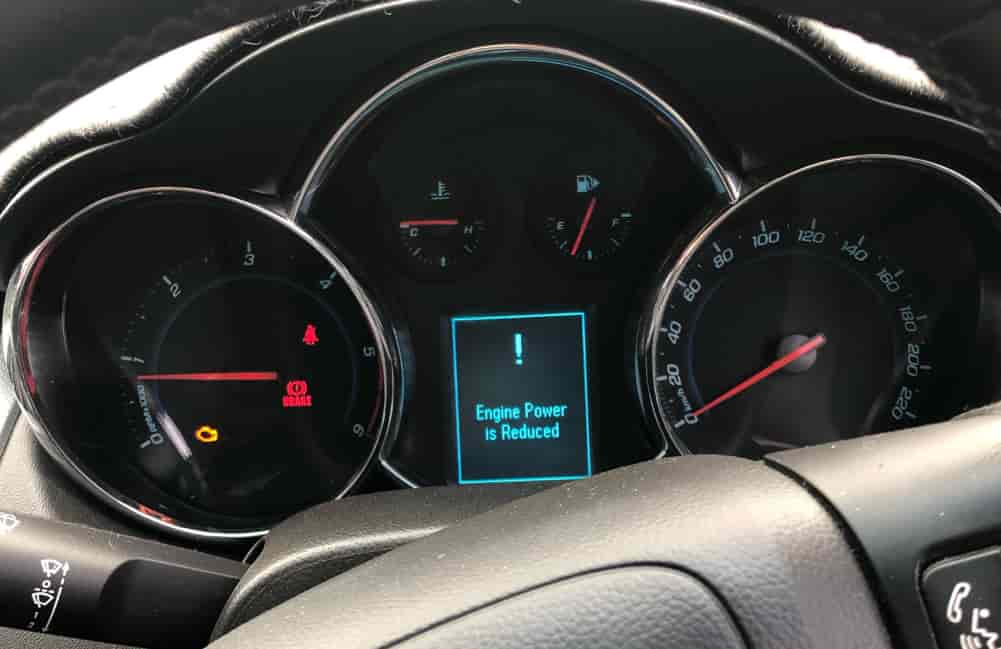
WHAT IS CHEVY CRUZE ENGINE POWER REDUCED?
The “Chevy Cruze Engine Power Reduced” warning describes a protective mode built into the vehicle’s engine control system. Chevrolet designed this mode to limit engine performance when the system detects a fault. The car does this to prevent further damage to critical components.
This condition usually connects to the engine control unit, also called the ECU. The ECU constantly monitors signals from sensors across the engine system. It checks air intake, throttle position, fuel delivery, and other key data. When the ECU receives abnormal or conflicting signals, it reacts immediately.
In many cases, the ECU activates limp mode. Limp mode reduces engine power and limits acceleration. The car may still run, but it will not perform normally. The system restricts speed and throttle response to protect the engine from stress.
Drivers often notice that the car feels slow or unresponsive. The accelerator may not react as expected. The vehicle may also struggle to climb hills or maintain highway speed. These changes happen because the ECU intentionally blocks full power output.
This safety feature does not indicate permanent engine failure. Instead, it signals that the system has detected a problem that needs attention. The issue may come from sensors, wiring, or the throttle system. In some cases, a software glitch in the ECU can also trigger the warning.
Understanding this mode helps drivers avoid panic. The system does not shut the car down completely. It only reduces performance to keep the engine safe until the root cause is diagnosed and fixed.
MAIN CAUSES OF CHEVY CRUZE ENGINE POWER REDUCED
The “Chevy Cruze Engine Power Reduced” warning appears when the engine control system detects abnormal performance in key components. The engine control unit immediately limits power to protect the engine and transmission. This condition usually comes from several common failure points rather than a single issue.
One of the most frequent causes is a throttle body problem. The throttle body controls the airflow entering the engine, and when it becomes dirty, stuck, or electronically faulty, the airflow signal becomes inaccurate. This leads to poor throttle response and reduced acceleration because the ECU cannot regulate air intake correctly.
Another common cause is a faulty accelerator pedal sensor. This sensor sends information about how much the driver presses the gas pedal. If the signal becomes weak or incorrect, the ECU cannot understand the driver’s request for power. As a result, the system reduces engine output and activates limp mode to prevent unsafe operation.
The mass air flow sensor can also trigger this issue. This sensor measures the amount of air entering the engine to help calculate fuel delivery. When it becomes dirty or damaged, it sends incorrect readings. The ECU reacts by limiting engine performance because it cannot maintain proper air fuel balance.
Electrical wiring issues are another important factor. Loose connections, corrosion, or damaged wires can interrupt communication between sensors and the ECU. Even small signal interruptions can trigger reduced engine power because the system treats missing data as a potential risk.
In some cases, the ECU itself may develop software glitches. Voltage drops or system errors can cause incorrect interpretations of normal sensor data. When this happens, the ECU may mistakenly activate limp mode until the system is reset or reprogrammed.
SYMPTOMS OF CHEVY CRUZE ENGINE POWER REDUCED
The “Chevy Cruze Engine Power Reduced” warning often comes with clear driving symptoms that affect both performance and safety. Most drivers notice a sudden loss of power while driving. The car no longer accelerates as expected, and pressing the gas pedal does not produce the usual response. This creates a weak and sluggish driving experience, especially during overtaking or merging into traffic.
Another common symptom is limited speed. The vehicle may refuse to go beyond a certain speed even when the accelerator is fully pressed. This happens because the engine control unit restricts power output to protect the system. As a result, the car may struggle on highways or when climbing hills.
Drivers also report delayed throttle response. The engine reacts slowly after pressing the pedal, which makes the car feel unresponsive. In some cases, the vehicle may jerk slightly or hesitate during acceleration. These signs indicate that the throttle system or sensor signals are not working correctly.
The check engine light often appears along with the warning message. This light signals that the ECU has detected a fault in the engine system. However, in some situations, the warning may appear without a check engine light, which makes diagnosis more difficult.
Another key symptom is the activation of limp mode. In this state, the vehicle limits performance to a safe level. The car remains drivable, but it cannot deliver normal power. This mode helps prevent further damage but also confirms that the system has detected a serious issue.
Recognizing these symptoms early allows drivers to take action before the problem becomes more severe. Ignoring these signs can lead to increased damage and higher repair costs over time.
IS IT SAFE TO DRIVE WITH CHEVY CRUZE ENGINE POWER REDUCED?
Many drivers ask whether it is safe to continue driving when the “Chevy Cruze Engine Power Reduced” warning appears. The answer depends on the severity of the issue and how the car behaves in real conditions. In most cases, the vehicle can still move, but it will not perform normally.
The reduced power mode exists to protect the engine. The system limits speed and acceleration to prevent further damage. Because of this, you can drive the car for a short distance if needed. For example, you may move the vehicle to a nearby repair shop or a safe location. However, this should only be a temporary solution.
Driving with reduced engine power becomes risky in certain situations. The car may not respond quickly when you press the accelerator. This creates danger when merging into traffic or overtaking other vehicles. Limited speed can also become a problem on highways where consistent power is necessary.
You should stop driving immediately if you notice severe symptoms. These include strong jerking, unusual engine noises, or the car struggling to stay running. In these cases, continuing to drive may cause serious engine damage or lead to a breakdown.
Even when the car still runs, ignoring the warning can increase repair costs. A small sensor issue can turn into a larger system failure if left unresolved. Early diagnosis helps prevent more expensive repairs and keeps the vehicle reliable.
The safest approach is to treat this warning as urgent. Drive only when necessary and arrange a proper inspection as soon as possible. Taking quick action protects both your safety and the long term health of your Chevy Cruze.
HOW TO DIAGNOSE CHEVY CRUZE ENGINE POWER REDUCED
Diagnosing the “Chevy Cruze Engine Power Reduced” issue requires a step by step approach. The goal is to identify the exact cause instead of guessing and replacing parts unnecessarily. A proper diagnosis helps save both time and repair costs.
The first step is to use an OBD2 scanner. This tool reads error codes stored in the engine control unit. These codes point to specific problems such as sensor failure, throttle issues, or airflow errors. Common codes often start with “P” and relate to engine performance. Reading these codes gives you a clear starting point.
After retrieving the codes, inspect the throttle body. Check for dirt buildup or signs of sticking. A dirty throttle body can restrict airflow and trigger reduced power mode. Cleaning it carefully may restore normal function in some cases.
Next, check the accelerator pedal sensor. Press the pedal slowly and observe how the engine responds. If the response feels delayed or inconsistent, the sensor may send incorrect signals. This issue often leads to poor acceleration and limp mode activation.
You should also inspect the mass air flow sensor. Look for dirt or contamination on the sensor surface. Cleaning the sensor with proper spray can improve accuracy. If the readings remain unstable, replacement may be necessary.
Electrical connections require close attention as well. Check wiring around the engine bay for loose connectors, corrosion, or damaged insulation. Even minor wiring faults can interrupt signals between components and the ECU.
Finally, consider the ECU itself. In some cases, a simple reset can solve the issue. Disconnecting the battery for a short time may clear temporary faults. If the problem continues, the ECU may need professional reprogramming.
A systematic diagnosis helps you find the real cause of the problem. This approach avoids unnecessary repairs and ensures that the correct solution is applied.
COMPLETE FIX GUIDE FOR CHEVY CRUZE ENGINE POWER REDUCED
Fixing the “Chevy Cruze Engine Power Reduced” issue depends on the root cause identified during diagnosis. A structured approach helps restore normal performance without wasting time or money on unnecessary repairs.
Start with a basic ECU reset. Disconnect the car battery for about ten to fifteen minutes, then reconnect it. This process can clear temporary faults and reset the engine control system. In some cases, the warning disappears if the issue was caused by a minor glitch.
Next, clean the throttle body. Remove any carbon buildup that may restrict airflow. Use a proper throttle body cleaner and ensure the component moves smoothly. A clean throttle body improves air intake and often restores normal acceleration.
If the problem persists, inspect and replace faulty sensors. The accelerator pedal sensor and mass air flow sensor are common failure points. Replacing these components can quickly resolve incorrect signal issues that trigger reduced power mode.
You should also repair any damaged wiring. Check connectors and cables around the engine. Fix loose or corroded connections to restore stable communication between components and the ECU. Electrical reliability plays a critical role in engine performance.
In some situations, the ECU may require a software update or reprogramming. This step usually needs professional equipment. A technician can update the system to ensure it processes sensor data correctly.
If none of these solutions fix the issue, a full diagnostic at a repair shop is necessary. Some problems involve deeper mechanical or electronic faults that require specialized tools.
Taking the correct repair steps based on diagnosis ensures long term reliability. Addressing the issue early helps prevent more serious damage and keeps your Chevy Cruze running smoothly.
PREVENTION TIPS TO AVOID CHEVY CRUZE ENGINE POWER REDUCED
Preventing the “Chevy Cruze Engine Power Reduced” issue is possible with consistent maintenance and early attention to warning signs. Many of the common causes come from wear, dirt buildup, or weak electrical connections. A proactive approach helps reduce the risk of sudden power loss.
Regular throttle body cleaning plays an important role in prevention. Over time, carbon deposits build up and restrict airflow. Cleaning this component every 20,000 to 30,000 kilometers helps maintain smooth engine response and stable performance.
You should also keep sensors in good condition. The mass air flow sensor and accelerator pedal sensor must send accurate data to the engine control unit. Periodic inspection and cleaning can prevent incorrect readings. Replacing worn sensors early is often cheaper than dealing with a larger system failure later.
Using high quality fuel helps maintain proper combustion and reduces deposits inside the engine. Poor fuel quality can affect sensor accuracy and lead to unstable engine performance. Consistent fuel quality supports long term reliability.
Electrical connections should not be ignored. Check wiring and connectors in the engine bay for corrosion or looseness. Stable electrical signals are essential for proper communication between components. Even small connection issues can trigger reduced power mode.
It is also important to respond quickly to warning lights. The check engine light often appears before serious problems develop. Addressing these early signals prevents escalation and protects the engine from damage.
Simple maintenance habits can make a significant difference. Keeping the system clean, monitoring sensor performance, and acting early on warning signs will help you avoid the “engine power reduced” issue and maintain a smooth driving experience.
CONCLUSION
The “Chevy Cruze Engine Power Reduced” warning can feel alarming at first, especially when it affects performance so suddenly. However, this issue is often a protective response from the engine control system rather than a sign of immediate engine failure. The vehicle reduces power to prevent damage, which gives you time to identify and fix the problem before it becomes more serious.
In most cases, the root cause comes from common components such as the throttle body, sensors, or electrical connections. These parts play a critical role in how the engine delivers power. When one of them fails or sends incorrect data, the ECU reacts by limiting performance. Understanding this process helps you stay calm and take the right steps instead of guessing.
Early diagnosis is the key to avoiding high repair costs. Using an OBD2 scanner, checking airflow components, and inspecting wiring can quickly narrow down the issue. Simple fixes such as cleaning the throttle body, replacing a faulty sensor, or resetting the ECU can often restore normal performance.
Ignoring the warning can lead to bigger problems over time. Reduced power affects not only driving comfort but also safety in real situations like overtaking or highway driving. Taking action early protects both your vehicle and your driving experience.
If you are currently facing the “Chevy Cruze Engine Power Reduced” issue, start with a basic inspection and do not delay proper diagnosis. Addressing the problem at the right time ensures your Chevy Cruze remains reliable, efficient, and safe on the road.