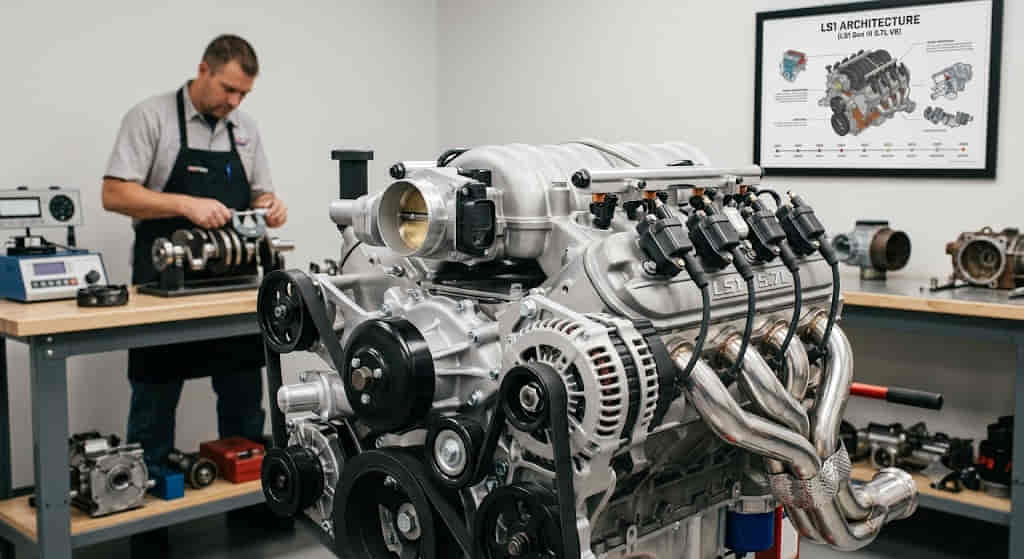
The LS1 engine was installed in several General Motors performance cars, including the Chevrolet Corvette C5, Chevrolet Camaro Z28 and SS, Pontiac Firebird Formula and Trans Am, and Pontiac GTO. In Australia, selected Holden Commodore and Monaro models also used the LS1 5.7-liter V8. These vehicles are among the best-known factory applications of the engine, which became popular for its combination of V8 performance, lightweight construction, and potential for modification.
The LS1 belongs to General Motors’ Generation III small-block V8 engine family and first appeared in the 1997 Chevrolet Corvette. However, not every vehicle in a model line came with an LS1. Engine availability depended on the model year, trim level, market, and factory configuration. For example, a performance-oriented Camaro could use the LS1, while another version from the same generation might have a different engine.
Identifying which cars have LS1 engines therefore requires more than checking a vehicle’s model name. This guide covers the major factory-equipped Chevrolet, Pontiac, and Holden applications, explains the relevant model-year differences, and describes how to distinguish an original LS1-equipped vehicle from one that received an LS1 engine swap. If you are researching a used performance car, looking for a suitable project vehicle, or verifying an engine’s original application, understanding these distinctions will help you identify the correct models.
What Cars Came With the LS1 Engine From the Factory?
The GM LS1 engine came from the factory in several performance vehicles produced by Chevrolet, Pontiac, and Holden. Its best-known North American applications include the Chevrolet Corvette C5, Chevrolet Camaro Z28 and SS, Pontiac Firebird Formula and Trans Am, and Pontiac GTO from the 2004–2006 model years. In Australia, selected Holden Commodore and Monaro performance models also used the 5.7-liter LS1 V8. These applications made the LS1 a significant engine across both American sports cars and Australian performance vehicles.
The Chevrolet Corvette C5 was the first production vehicle to introduce the LS1, beginning with the 1997 model year. Chevrolet subsequently offered the engine in selected fourth-generation Camaro models, particularly the Z28 and SS. These cars combined a front-mounted V8 with rear-wheel drive, making them popular choices for drivers interested in traditional American performance. However, the exact engine configuration depends on the model year and trim, so the presence of a Camaro or Corvette badge alone does not confirm that a particular car has an LS1.
Pontiac also used the LS1 in selected Firebird Formula and Trans Am models. These fourth-generation performance cars shared important mechanical components with the Camaro but had distinct styling and trim configurations. The Pontiac GTO sold in North America from 2004 through 2006 also featured the LS1 before later model years transitioned to a different engine. When identifying a specific GTO, the model year is especially important because vehicles carrying the same name did not use the same engine throughout the entire production run.
Outside North America, Holden fitted the LS1 to selected Commodore and Monaro models in Australia. These vehicles extended the engine’s factory applications beyond Chevrolet and Pontiac and remain relevant to enthusiasts researching Australian V8 performance cars. Availability varied by model series, performance grade, and year, so each application should be verified against the vehicle’s original specifications.
The key distinction is that the LS1 was a factory engine option only for particular models and configurations. Other vehicles may now have an LS1 because a previous owner installed one, but that does not make them factory-equipped LS1 models. To establish whether a car originally came with this engine, verify its model year, trim, market specification, and vehicle documentation rather than relying on the model name alone.
Read more: 6.7 Cummins Valve Adjustment
Which Chevrolet Models Used the LS1 Engine?
Chevrolet installed the LS1 5.7-liter V8 in two of its best-known performance car lines: the fifth-generation Corvette and selected fourth-generation Camaro models. The Corvette C5 introduced the engine for the 1997 model year, while the Camaro Z28 and SS received the LS1 for the 1998 model year. These applications helped establish the LS1 as a major engine in Chevrolet’s modern performance lineup, combining V8 power with an aluminum engine block and a compact small-block design.
The Chevrolet Corvette C5 used the LS1 throughout its early production years, including coupe and convertible configurations. The engine was a defining feature of this Corvette generation, distinguishing it from earlier Corvettes equipped with different small-block engines. The LS1 remained associated with the C5 through the 2004 model year, although specifications and output ratings varied according to the year and vehicle configuration. Buyers researching a used C5 should verify the specific model year and original engine documentation, particularly if the car has undergone modifications or an engine replacement.
The fourth-generation Chevrolet Camaro also offered the LS1 in performance-oriented versions. The Z28 received the engine beginning in 1998, and the SS used an LS1-based configuration as well. These models shared the Camaro’s rear-wheel-drive platform but differed in equipment, styling, and performance-related details. The LS1 helped make late fourth-generation Camaros popular among enthusiasts interested in V8 performance and aftermarket upgrades. However, not every Camaro from this generation had an LS1, because other trims and earlier model years used different engines.
The most reliable way to confirm a Chevrolet’s original LS1 configuration is to match its model year and trim with the factory specifications for that vehicle. A Corvette C5 or a late fourth-generation Camaro Z28 or SS is a strong starting point for research, but the model badge alone is not conclusive proof. Vehicle identification information, original build records where available, and engine identification details can help establish whether the car retains its factory-installed LS1 or has received a replacement engine.
Which Pontiac Models Came With the LS1 Engine?
Pontiac used the LS1 5.7-liter V8 in several performance models, most notably the fourth-generation Firebird Formula, Firebird Trans Am, and the 2004–2006 Pontiac GTO sold in North America. These vehicles used the LS1 to deliver V8 performance in different body styles, from the Firebird’s sporty coupe and convertible configurations to the GTO’s rear-wheel-drive performance coupe. However, the exact engine fitted to a Pontiac depends on its model year, trim level, and original market specification.
The Pontiac Firebird Formula was one of the key LS1 applications. In the fourth-generation Firebird lineup, the Formula combined the LS1 V8 with a performance-focused configuration while maintaining a more understated appearance than the Trans Am. The engine offered strong low-speed torque and broad power delivery, making the Formula attractive to drivers who wanted V8 performance without the Trans Am’s more distinctive exterior styling. When researching a Formula, it is important to confirm the model year and original engine specification because earlier Firebirds used different powertrains.
The Pontiac Firebird Trans Am also received the LS1 during the later years of the fourth-generation model. Although the Formula and Trans Am shared the same basic vehicle platform, their styling, equipment, and available performance packages differed. Some Trans Am versions included additional performance-oriented features, but these details varied by year and configuration. A Trans Am badge is therefore a useful starting point for identifying an LS1-equipped car, not definitive proof that the original engine remains installed.
The Pontiac GTO sold from 2004 through 2006 is another important LS1 application. The 2004 and 2005 GTO models used the 5.7-liter LS1, while the 2006 model transitioned to the larger 6.0-liter LS2 V8. This distinction matters when comparing GTO model years because the vehicle name remained unchanged even though the engine specification changed. Buyers looking specifically for an LS1-powered GTO should pay particular attention to the 2004 and 2005 model years and verify the vehicle’s factory configuration.
To confirm whether a Pontiac originally came with an LS1, check the model year, trim, original vehicle records, and engine identification information where available. The Firebird Formula, Firebird Trans Am, and early fifth-generation-era GTO are useful starting points, but factory specifications should determine the final identification. This approach also helps distinguish an original LS1-equipped Pontiac from one that has received an engine swap or other major modification.
Which Holden Models Used the LS1 V8?
Holden installed the LS1 5.7-liter V8 in selected Australian performance models, particularly the Commodore and Monaro. These vehicles extended the LS1’s factory applications beyond North American sports cars and muscle cars, giving Australian buyers access to GM’s Generation III small-block V8 in both four-door sedans and performance coupes. However, not every Holden Commodore or Monaro came with an LS1. Engine availability depended on the model series, performance grade, production year, and original market specification.
The Holden Commodore received the LS1 in selected performance-oriented variants of the VT and VX generations and subsequent related models. Versions such as the Commodore SS and higher-performance HSV derivatives used LS1-based configurations during the relevant production periods. The engine provided strong V8 torque and supported the performance character associated with these models. Nevertheless, Commodore specifications varied across trim levels, and some versions used different engines. Identifying an LS1-equipped Commodore therefore requires checking the precise model series and variant rather than relying solely on the Commodore name.
The Holden Monaro also became an important LS1 application in Australia. The modern Monaro coupe, reintroduced in the early 2000s, was offered with the 5.7-liter LS1 V8 in selected versions. Its rear-wheel-drive layout and coupe body made it a distinctive alternative to the Commodore sedan while sharing important mechanical components with Holden’s broader vehicle lineup. Some export-market versions were sold under different branding, so buyers researching a particular car should verify its original market, model year, and factory engine specification.
Holden performance vehicles require careful identification because the Commodore and Monaro names cover multiple generations and configurations. HSV models, in particular, may have model-specific engine tuning or other mechanical differences, so their specifications should be checked individually rather than assumed to match every standard Holden variant. Original sales literature, manufacturer specifications, and vehicle records can help establish whether a particular car was factory-equipped with the LS1.
For anyone researching Australian LS1 vehicles, the most useful starting point is a specific Commodore or Monaro performance variant from the relevant production period. Confirming the exact series, trim, and model year helps distinguish factory LS1 applications from vehicles equipped with another V8 or modified after leaving the factory. This is especially important when evaluating used cars, restoring an original vehicle, or checking whether an advertised LS1 configuration is accurate.
What Model Years Had the LS1 Engine?
The LS1 engine appeared in production vehicles from the 1997 model year onward, beginning with the Chevrolet Corvette C5. It was subsequently introduced in selected Chevrolet Camaro and Pontiac Firebird models for the 1998 model year and used in other GM performance vehicles during the following years. The exact production period depended on the vehicle, market, and trim level, so there is no single model-year range that applies to every LS1-equipped car.
The Chevrolet Corvette C5 is the clearest starting point when identifying LS1 model years. Chevrolet introduced the LS1 in the 1997 Corvette, and the engine remained part of the C5 lineup through the 2004 model year. This makes the C5 an important reference for buyers seeking a factory-installed LS1. Even so, a specific Corvette should be checked against its original engine specification because used vehicles may have undergone engine replacements or other modifications.
For the Chevrolet Camaro and Pontiac Firebird, the LS1 became available for the 1998 model year in selected performance versions, including the Camaro Z28 and SS and the Firebird Formula and Trans Am. These applications continued during the final years of the fourth-generation Camaro and Firebird. The Pontiac GTO followed a different timeline: North American models from 2004 and 2005 used the LS1, while the 2006 GTO switched to the 6.0-liter LS2. This change illustrates why the vehicle’s model year matters even when the nameplate remains the same.
Australian Holden applications also varied by model series and production year. Selected Commodore and Monaro performance models used the LS1 during the relevant production periods, but their exact availability depended on the vehicle variant and market. Export versions may also have been sold under different names, making it important to confirm the original model specification rather than rely on a badge alone.
When researching an LS1-equipped car, use the model year as the starting point, then verify the trim level and factory engine details. Manufacturer specifications, original build records where available, and vehicle identification information can help establish the correct configuration. This process is more reliable than assuming that every vehicle from a particular generation used the LS1.
How Can You Tell If a Car Has the Original LS1 Engine?
To determine whether a car originally came with an LS1 engine, verify its model year, trim level, factory specifications, and available vehicle records. A Chevrolet Corvette C5, Camaro Z28 or SS, Pontiac Firebird Formula or Trans Am, or selected Holden performance model may be a suitable starting point, but the model name alone does not prove that the vehicle was factory-equipped with an LS1. Manufacturers offered different engines across model years and trims, and previous owners may have replaced the original engine.
The vehicle identification number (VIN) can help establish a car’s original configuration when interpreted using the correct manufacturer documentation or a reliable model-specific VIN reference. Depending on the vehicle and model year, the VIN and related production records may help identify the original engine family or factory specification. However, a VIN does not necessarily reveal the identity of the engine currently installed. For that reason, it should be considered alongside other evidence rather than treated as conclusive proof of the engine’s present condition.
Engine identification information can provide another important source of evidence. GM LS1 engines have identifying markings and casting information that can help establish the engine’s type and production details. A qualified technician or knowledgeable specialist can compare these details with the expected specifications for the vehicle. Because components may have been replaced during repairs or modifications, an individual marking should not automatically be interpreted as proof that the engine is original to the car.
Original build documentation, service records, and previous ownership records can strengthen the identification process. For example, a Corvette’s factory documentation may support an LS1 configuration, while service invoices may indicate whether the engine was replaced later. If the documentation confirms that the vehicle originally came with an LS1 but the installed engine has different identification details, further investigation may be necessary to determine whether it is a replacement unit.
The most reliable conclusion comes from combining the vehicle’s original factory specification with the identification details of the engine currently installed. This distinction is important when buying a used performance car, checking originality for a restoration, or evaluating a vehicle advertised as numbers-matching. A car can still have an LS1 even if the engine has been replaced, but confirming that it retains its original factory engine requires stronger evidence than simply identifying the engine family.
What Is the Difference Between a Factory LS1 Car and an LS1 Swap?
A factory LS1 car is a vehicle that left the production facility with the LS1 engine installed as part of its original configuration, while an LS1 swap is a vehicle that received the engine after leaving the factory. This distinction matters when identifying LS1 applications because many vehicles can be modified to accept a GM LS-series engine, even if they were never offered with the LS1 originally. A Chevrolet Corvette C5 equipped with its factory LS1 and an older vehicle converted to use an LS1 may share the same engine family, but they are not equivalent factory applications.
Factory-equipped vehicles include selected Chevrolet Corvette C5 models, fourth-generation Camaro Z28 and SS versions, Pontiac Firebird Formula and Trans Am models, and certain Holden performance vehicles. These cars were engineered and sold with the LS1 in specific model years and configurations. Their original engine installation can often be supported by factory specifications, vehicle identification information, build documentation, or service records. Verifying this history is particularly important when originality affects a vehicle’s value or restoration requirements.
An LS1 swap involves installing the engine in a vehicle that did not originally have that engine configuration. Enthusiasts may choose an LS1 because of its compact small-block design, V8 performance, and aftermarket support. However, a successful swap can require changes to engine mounts, wiring, the engine management system, cooling, fuel delivery, exhaust, and transmission compatibility. The exact work depends on the recipient vehicle and the components selected for the conversion.
The presence of an LS1 under the hood therefore does not automatically establish that a vehicle was factory-equipped with one. A modified car may use an LS1 while retaining its original exterior appearance, and an originally LS1-equipped car may have received a replacement engine during its lifetime. These situations need to be distinguished when evaluating a used vehicle, checking its history, or researching its original specifications.
To confirm the difference, compare the vehicle’s factory configuration with the engine currently installed. Original production records and model-specific documentation help establish what the car had when new, while engine identification details help identify the current unit. This approach provides a clearer picture of whether the vehicle is an original LS1 application, an LS1-powered conversion, or a factory LS1 car with a replacement engine.
How Is the LS1 Different From Other GM LS Engines?
The LS1 differs from other GM LS engines in its displacement, design specifications, factory applications, and production history. It is a 5.7-liter (346-cubic-inch) V8 belonging to General Motors’ Generation III small-block engine family. Later engines, including the LS2 and LS3, continued the LS platform with different displacements and technical revisions. Understanding these differences helps buyers identify the correct engine when researching a vehicle, comparing specifications, or checking whether a car retains its original powertrain.
The LS1 debuted in the 1997 Chevrolet Corvette C5 and later appeared in selected Chevrolet Camaro, Pontiac Firebird, Pontiac GTO, and Holden performance models. The LS2 followed in applications such as the 2005–2007 Chevrolet Corvette and the 2006 Pontiac GTO. Although the LS1 and LS2 share important design characteristics, they are distinct engine variants, and the 2006 GTO is a useful example of why model-year verification matters: the earlier GTO models used the LS1, while the 2006 model used the LS2.
The LS3 is another related engine, introduced later in vehicles including the 2008 Chevrolet Corvette. With a displacement of 6.2 liters, the LS3 differs from the LS1 in both size and specific engine components. These differences affect factory specifications and application compatibility, so an LS3-equipped vehicle should not be identified as an LS1 car simply because both engines belong to the broader GM LS family.
For vehicle identification, the most important distinction is the exact engine code and original factory configuration, rather than the general LS name. Chevrolet, Pontiac, and Holden used different LS-family engines across model years and trim levels. A vehicle’s badge or body style cannot establish which engine it originally received, particularly when engine swaps are common among performance cars.
When researching an LS1 vehicle, verify the model year, trim, factory engine specifications, and available vehicle records. This prevents confusion between the LS1 and later variants such as the LS2 and LS3. It also helps distinguish a factory LS1 application from a vehicle that has been modified to use a different LS-family engine.