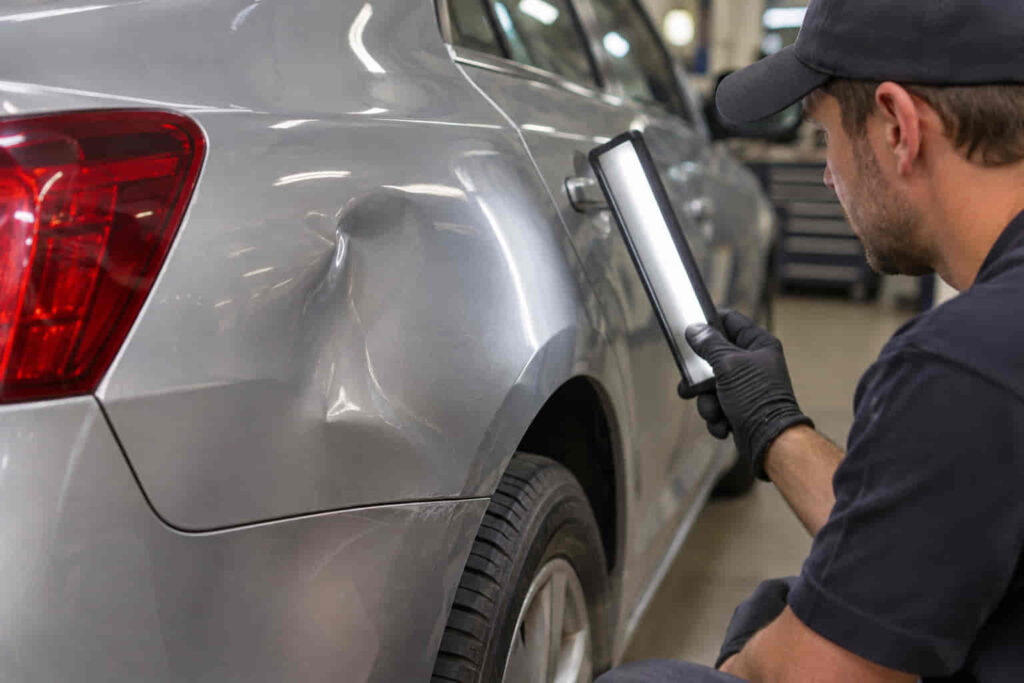
Repairing a car dent typically costs $75 to $2,500 or more in the United States, depending on the dent’s size, depth, location, and paint condition. Small dents with intact paint generally cost $75–$250 to repair using paintless dent repair (PDR), while larger dents requiring conventional bodywork and repainting can cost $300–$1,500 or more. Severe damage involving multiple panels or panel replacement can push the total repair cost beyond $2,500. These figures are general estimates, and actual prices vary by vehicle and repair shop.
The cost of car dent repair depends on how much work is required to restore the damaged panel. Paintless dent repair is generally less expensive because technicians reshape the metal without applying body filler or repainting the surface. However, dents with cracked paint, sharp creases, stretched metal, or difficult access may require traditional collision repair. For example, a shallow door dent with undamaged paint may qualify for PDR, while a similar-sized dent along a sharp body line may require additional labor or refinishing.
Repair costs also vary between vehicle panels, repair facilities, and geographic locations. Insurance coverage, deductibles, and the possibility of replacing a damaged panel can further affect the amount an owner pays.
This guide explains car dent repair costs by dent size, repair method, panel location, and damage severity, along with insurance considerations and ways to obtain an accurate repair estimate.
How Much Does It Cost to Repair a Car Dent?
Car dent repair typically costs between $75 and $2,500 or more in the United States, with most minor dents costing approximately $75–$300 when the original paint remains intact. Medium-sized dents generally cost $150–$600, while larger dents requiring conventional bodywork and repainting can cost $500–$1,500 or more. Severe damage involving stretched metal, multiple panels, or panel replacement may exceed $2,500. These ranges are estimates rather than fixed prices because repair costs depend on the damage and the procedure required to restore the vehicle.
The primary cost difference comes from the repair method. Paintless dent repair (PDR) removes eligible dents by carefully reshaping the damaged metal without disturbing the factory paint. Because the process avoids body filler, sanding, and refinishing, it generally requires fewer materials and less labor than traditional collision repair. For example, a shallow parking lot dent on a car door may cost around $100–$200 to repair using PDR, provided the technician can access the damaged area and the paint has not cracked.
Traditional dent repair becomes necessary when the damage cannot be corrected adequately through PDR. This process may involve reshaping the panel, applying body filler, preparing the surface, and repainting the affected area. Repainting increases costs because the technician must match the vehicle’s original color and finish, sometimes blending paint into adjacent panels to achieve a consistent appearance. A dent that initially appears minor can therefore cost several hundred dollars more if the paint is damaged or the metal has developed a sharp crease.
The final price also depends on the repair facility’s labor rates, the vehicle’s construction, and the accessibility of the damaged panel. Aluminum body panels, reinforced sections, and dents located behind structural components may require specialized tools or additional disassembly. Consequently, two dents of similar dimensions can have substantially different repair costs. A professional inspection is the most reliable way to determine whether PDR, conventional bodywork, or panel replacement offers the appropriate repair.
How Much Does Car Dent Repair Cost by Dent Size?
Small car dents generally cost $75–$250 to repair, medium dents cost approximately $150–$600, and large dents can cost $500–$1,500 or more. However, dent size alone does not determine the price. Depth, metal deformation, paint damage, and the location of the impact are equally important because they affect the amount of labor and the repair method required.
Small dents measuring approximately one inch or less are often the least expensive to repair when they are shallow and the factory paint remains undamaged. These dents commonly result from shopping carts, minor parking lot impacts, or small objects striking a body panel. A technician may be able to remove a simple round dent using PDR without repainting the surface. However, a small dent with a sharp crease or cracked paint may require conventional repair, making it more expensive than a larger but shallower dent.
Medium dents, roughly one to four inches across, generally require more extensive metal reshaping. Their repair costs commonly fall between $150 and $600, depending on whether the paint remains intact and whether the technician can reach the back of the panel. For example, a three-inch dent in the center of a door may qualify for PDR if the metal has not stretched significantly. A similarly sized dent near a reinforced door edge may require additional disassembly or conventional bodywork, increasing the repair price.
Large dents exceeding approximately four inches often involve more pronounced metal deformation and a greater risk of paint damage. Repairing these dents may cost $500–$1,500 or more when body filler, sanding, refinishing, or paint blending is necessary. If the impact has damaged a panel’s mounting points, structural supports, or adjacent components, the repair may become substantially more expensive. In severe cases, replacing the affected panel may provide a more practical solution than attempting to restore heavily distorted metal.
Dent depth and shape can influence repair cost more than diameter. A broad, shallow dent with smooth edges may respond well to PDR, while a narrow crease can be difficult to remove because the metal has been sharply displaced. Technicians therefore assess the entire damage pattern rather than measuring width alone. Understanding this distinction helps vehicle owners interpret repair estimates and explains why online price ranges cannot replace an inspection of the actual damage.
Read more: how much is an inspection sticker in texas
How Much Does Paintless Dent Repair Cost?
Paintless dent repair (PDR) typically costs $75–$300 for minor dents in the United States, while larger or more complex dents can cost $300–$800 or more. The final price depends on the dent’s size, depth, location, and accessibility. PDR is generally the least expensive professional method for removing dents when the factory paint remains intact and the metal has not been excessively stretched.
Paintless dent repair works by gradually restoring the damaged panel to its original shape without sanding, body filler, or repainting. Technicians use specialized metal rods, leverage tools, and glue-pulling systems to apply controlled pressure to the affected area. This process preserves the original factory finish and eliminates several labor-intensive steps required in conventional body repair. For example, a shallow door ding caused by another vehicle’s door may cost approximately $100–$200 to remove through PDR, while a larger dent along a body line may require additional precision and labor.
The accessibility of the damaged area has a significant effect on PDR pricing. A dent located in the center of an accessible door panel is generally easier to repair than one positioned near a reinforced edge, wheel arch, or structural support. Technicians may need to remove interior trim, lighting assemblies, or other components to reach the back of the damaged metal. When direct access is unavailable, glue-pulling techniques may provide an alternative, although their suitability depends on the paint condition and the panel’s construction.
PDR is most effective on dents with smooth contours and undamaged paint. Sharp creases, heavily stretched metal, cracked paint, and damage near certain panel edges can limit the effectiveness of the procedure. Aluminum panels may also require additional skill because their material properties differ from conventional steel body panels. A technician must evaluate the deformation before confirming whether PDR can restore the surface to an acceptable condition. Attempting PDR on unsuitable damage may leave visible distortion and create the need for conventional bodywork.
Paintless dent repair is usually cheaper than traditional dent repair because it avoids refinishing materials and reduces the number of repair operations. However, the lowest quoted price does not necessarily represent the best repair option. A qualified PDR technician should assess whether the original panel shape can be restored without compromising the finish. When the paint is damaged or the metal cannot be reshaped adequately, conventional repair may be necessary despite its higher cost.
How Much Does It Cost to Fix a Dent With Paint Damage?
Repairing a car dent with paint damage generally costs $300–$1,500 or more, depending on the severity of the dent, the extent of the damaged finish, and the amount of refinishing required. Minor dents with localized scratches may fall toward the lower end of this range, while larger dents with cracked paint, exposed metal, or damage extending across multiple panels can cost substantially more. Paint damage increases the repair price because restoring the vehicle requires both metal correction and surface refinishing.
Traditional dent repair begins with evaluating the panel’s deformation and the condition of the surrounding paint. The technician reshapes the metal using appropriate pulling or straightening equipment, then prepares the surface for refinishing. Depending on the remaining imperfections, the process may include a thin application of body filler, sanding, primer, color-matched paint, and clear coat. Each stage requires labor, materials, and controlled application to produce a durable finish. For example, a dented fender with cracked paint may require several hundred dollars in additional refinishing work compared with an otherwise similar dent that qualifies for PDR.
The type of paint damage also affects the repair procedure. Surface scratches limited to the clear coat may be corrected through polishing or localized refinishing, provided the dent itself can be repaired appropriately. Deeper scratches that penetrate the color coat or expose bare metal generally require more extensive preparation and repainting. Exposed steel must be treated properly to reduce the risk of corrosion, while cracked paint around a dent must be removed or repaired before a new finish is applied. Covering damaged paint without correcting the underlying surface can lead to visible defects or premature coating failure.
Vehicle paint color and finish complexity can further increase the cost. Metallic, pearl, and multi-stage finishes require careful color matching because differences in pigment distribution and application technique can remain visible after repair. Body shops may blend new paint into adjacent panels to create a consistent appearance, increasing both material consumption and labor time. For example, repairing a dent near the edge of a door may require refinishing the door and blending the adjacent fender if a satisfactory color match cannot be achieved within the damaged panel alone.
The cost of repairing a dent with paint damage depends on the complete restoration process rather than the dent’s dimensions alone. A small crease with fractured paint may require more work than a larger shallow dent with an intact finish. Before approving repairs, vehicle owners should request an estimate that separates metal repair, surface preparation, painting, materials, and any necessary panel removal. This breakdown makes it easier to compare body shop quotes and understand why conventional dent repair costs more than paintless dent removal.
What Factors Affect the Cost of Car Dent Repair?
The cost of car dent repair depends on seven primary factors: dent size, depth, location, paint condition, panel material, accessibility, and labor rates. These factors determine whether a technician can use paintless dent repair (PDR) or must perform conventional bodywork and refinishing. A shallow dent with intact paint generally costs less to repair than a sharp crease that has stretched the metal, even when both dents cover a similar surface area.
Dent size and depth directly affect the amount of reshaping required. Small, shallow dents typically involve limited metal displacement and may be corrected with basic PDR techniques. Deeper dents create greater deformation and can stretch the metal beyond its original shape, making restoration more difficult. For example, a three-inch shallow dent on a flat door panel may cost less than a one-inch crease along a reinforced body line. The crease concentrates deformation into a narrow area, requiring more precise correction and potentially conventional body repair.
Paint condition is another major pricing factor because damaged finishes require additional repair operations. When the factory paint remains intact, PDR may restore the panel without sanding, body filler, or repainting. Cracked paint, deep scratches, and exposed metal require surface preparation and refinishing to restore appearance and corrosion protection. A dent that could otherwise be repaired for approximately $150 through PDR may cost several hundred dollars more when the panel needs repainting and color blending.
Panel location and accessibility influence labor time. Dents in open, relatively flat sections of a door or hood are generally easier to access than damage near reinforced edges, wheel arches, or internal supports. Technicians may need to remove interior trim, headlights, wheel well liners, or other components before reaching the damaged area. Restricted access can also prevent the use of PDR tools, requiring an alternative repair method. These additional operations increase labor charges even when the visible dent is relatively small.
The panel’s material affects repair complexity. Steel panels are commonly repaired using established metalworking and PDR techniques, while aluminum panels may require specialized tools and different reshaping methods. Plastic bumper covers behave differently from metal panels because they can deform, crack, or lose their original contour after an impact. The repair procedure must match the material and damage type to avoid weakening the component or producing an unstable finish.
Vehicle make, model, and local labor rates further influence the final estimate. Luxury vehicles, specialty finishes, and panels with complex construction may require additional repair time or more expensive materials. Labor charges also vary between geographic markets and repair facilities. For example, a body shop operating in a high-cost metropolitan area may quote more for the same repair than a shop in a smaller market because of differences in operating expenses and labor rates.
A professional dent repair estimate reflects the complete repair procedure rather than the visible damage alone. Technicians evaluate the panel’s shape, material, finish, and accessibility before determining the necessary labor and materials. Comparing estimates based on identical repair procedures helps vehicle owners understand price differences and avoid choosing an incomplete repair solely because it has a lower initial quote.
How Much Does It Cost to Fix a Dent in Different Car Panels?
Repairing a dent in a car door, hood, fender, bumper, or quarter panel can cost approximately $75–$1,500 or more, depending on the panel’s construction and the extent of the damage. Minor dents on accessible metal panels often qualify for PDR and fall toward the lower end of this range. Dents involving damaged paint, restricted access, cracked plastic, or extensive metal deformation generally require more expensive conventional repairs.
Car door dent repair commonly costs approximately $75–$500 for minor to moderate damage, although larger dents requiring repainting can exceed this range. Doors are frequent locations for parking lot dents because nearby vehicles, shopping carts, and other objects can strike their outer surfaces. A shallow dent in the center of a door may be repaired using PDR, while damage near the door edge or handle can be more difficult to access. Removing door trim or working around internal reinforcement increases labor time, particularly when the dent crosses a sharp body line.
Hood dent repair often costs $100–$600 for relatively minor damage, with severe dents or repainting increasing the total. Hood panels have broad surfaces that can make shallow dents suitable for PDR, but internal bracing may restrict access to certain areas. Aluminum hoods may also require specialized techniques. For example, a small dent on an accessible steel hood may be corrected without repainting, while a deep dent near a reinforced section may require conventional bodywork or replacement if the panel cannot be restored properly.
Fender dent repair generally ranges from $100–$800 for repairable damage. Front fenders are often easier to remove or replace than welded body panels, but dents around wheel arches can involve sharp contours and stretched metal. Repairing these areas may require additional shaping and refinishing. A shallow fender dent with intact paint may qualify for PDR, while a sharply creased wheel arch with cracked paint may require filler, sanding, and repainting.
Bumper dent repair typically costs $150–$600 for minor to moderate damage, although replacement and refinishing can raise the total substantially. Most modern passenger vehicles use plastic bumper covers rather than conventional sheet-metal bumpers, so their repair methods differ from metal dent removal. Heat-assisted reshaping may correct certain deformations, but cracks, torn mounting tabs, and damaged attachment points can make replacement necessary. An impact may also damage components behind the cover, including reinforcement structures or parking sensors, which must be evaluated separately.
Quarter panel dent repair often costs $150–$1,000 or more because quarter panels are commonly integrated into the vehicle’s body structure. Unlike many front fenders, a quarter panel generally cannot be removed as a simple bolt-on component. Severe damage may require extensive metal repair, welding, refinishing, or specialized replacement procedures. For example, a shallow dent behind a rear door may qualify for PDR, while a deep crease extending into the wheel opening can require substantial bodywork and paint blending.
Panel accessibility, construction, and repair method explain why dent repair prices vary across different vehicle locations. A small dent on an accessible door panel may be inexpensive to remove, while a similarly sized dent on a reinforced quarter panel can require significantly more labor. Vehicle owners should request a panel-specific estimate that identifies the proposed repair method, refinishing requirements, and any necessary component removal before comparing prices.
Does Car Insurance Cover Dent Repair Costs?
Car insurance can cover dent repair costs when the damage results from an event covered by the vehicle owner’s policy. Collision coverage generally applies to dents caused by accidents involving another vehicle or an object, while comprehensive coverage typically applies to hail, falling objects, vandalism, and certain other non-collision events. Liability insurance does not pay to repair damage to the policyholder’s own vehicle. The amount an insurer pays depends on the policy’s coverage terms, deductible, and approved repair estimate.
Collision coverage can help pay for dent repairs resulting from an at-fault accident, such as backing into a pole or striking another vehicle. Comprehensive coverage generally applies when a dent results from an event outside a collision, such as hail damaging the hood or a tree branch falling onto the roof. If another driver causes the damage, that driver’s property damage liability coverage may pay for the repair, subject to fault determination and policy limits. For example, a car door dent caused by another driver opening their door into a parked vehicle may be handled through the responsible driver’s insurance when liability can be established.
The insurance deductible determines how much the vehicle owner must pay before applicable first-party coverage contributes to the repair. If a covered dent repair costs $1,200 and the policy has a $500 deductible, the insurer would generally pay $700 while the owner pays $500, assuming the entire repair is covered and no other limitations apply. If the same repair costs $400, filing a claim under a policy with a $500 deductible would generally provide no payment because the repair amount is below the deductible. Deductibles commonly apply to collision and comprehensive claims, although the exact amount depends on the policy.
Filing an insurance claim is not always the most economical option for minor dent damage. A small dent that costs $150 to remove through paintless dent repair may be less expensive to pay for directly than to submit under a policy with a $500 deductible. Claims can also affect future premiums depending on the insurer, state regulations, accident circumstances, and claims history. However, the effect is not automatic, and comprehensive claims may be treated differently from at-fault collision claims. Vehicle owners should compare the repair estimate with their deductible and review their policy before deciding whether to file.
Insurance companies may require photographs, a damage assessment, or an inspection before authorizing repairs. The insurer’s estimate may also differ from the body shop’s initial quote if hidden damage becomes apparent during disassembly. In those situations, the repair facility may submit a supplemental estimate for additional covered work. For example, a dented bumper cover may conceal damaged mounting brackets or parking sensors that are not visible during the first inspection. The final covered repair amount depends on the insurer’s review and the applicable policy provisions.
Car insurance is most financially useful for dent repairs when the covered repair cost substantially exceeds the deductible. Minor cosmetic dents are often practical to repair out of pocket, while extensive hail damage, collision damage, or repairs involving multiple panels may justify an insurance claim. Reviewing coverage, obtaining a professional estimate, and calculating the expected out-of-pocket expense helps vehicle owners choose the most appropriate payment method.
Can You Fix a Car Dent Yourself for Less Money?
DIY car dent repair can cost approximately $10–$150 for basic tools and materials, making it cheaper than professional repair when the damage is minor and suitable for home treatment. Simple suction tools, glue-pulling kits, and basic dent removal equipment are widely available, but their effectiveness depends on the dent’s shape, location, and paint condition. Professional paintless dent repair generally provides more predictable results because technicians use specialized tools and controlled metalworking techniques.
Small, shallow dents on accessible panels offer the best opportunity for DIY repair. A suction cup may help move a broad, smooth depression outward, while a glue-pulling kit can apply controlled pulling force to certain painted metal surfaces. These methods are less effective on sharp creases, stretched metal, dents along reinforced body lines, and damage with cracked paint. For example, a shallow dent in the center of a steel door may respond to a basic pulling tool, while a narrow crease near the door edge is unlikely to return to its original shape without professional metalworking.
DIY repair costs vary according to the equipment required. Basic suction tools may cost approximately $10–$30, while consumer glue-pulling kits commonly range from $20–$80. More extensive kits with multiple tabs, pulling bridges, and finishing tools can cost $50–$150 or more. These prices represent approximate equipment costs rather than guaranteed repair expenses. A low-cost kit may be sufficient for one simple dent, but purchasing additional tools or correcting an unsuccessful attempt can eliminate the expected savings.
The primary risk of DIY dent repair is creating additional damage that increases the cost of professional restoration. Excessive pulling force can produce raised areas, distort surrounding metal, or damage the paint finish. Glue-pulling techniques may also remove poorly adhered or previously repaired paint, particularly when the surface has been refinished. Applying uncontrolled heat can damage paint or nearby plastic components. For example, a dent that originally qualified for a $150 PDR repair may require several hundred dollars in conventional bodywork if an attempted home repair cracks the paint or creates additional deformation.
DIY methods also have limitations when damage involves aluminum panels, complex body contours, or components with restricted access. Modern vehicle panels are engineered with specific materials, reinforcements, and attachment methods that affect how they respond to reshaping. Attempting to force a dent outward without understanding the panel’s construction can leave permanent high spots or uneven reflections. Damage involving bumper sensors, structural components, or sharp metal creases should be evaluated by a qualified repair professional rather than treated as a simple cosmetic repair.
DIY dent repair is most appropriate for small, shallow cosmetic dents with intact paint and minimal metal deformation. It offers potential savings when the repair is straightforward and the owner accepts the possibility of an imperfect result. For larger dents, sharp creases, damaged paint, or valuable factory finishes, professional PDR or conventional body repair is generally the more reliable option. Comparing the cost of a professional estimate with the price of tools and the risk of additional damage helps determine whether a home repair is worthwhile.
Is It Cheaper to Repair or Replace a Dented Car Panel?
Repairing a dented car panel is generally cheaper than replacing it when the damage is cosmetic, the panel remains structurally sound, and the metal can be restored without extensive labor. Minor dents repaired through paintless dent repair (PDR) typically cost $75–$300, while conventional body repairs can range from $300–$1,500 or more. Panel replacement may cost $500–$2,500 or more after accounting for parts, installation, and refinishing. The most economical option depends on the severity of the damage, replacement part availability, and the labor required for each procedure.
Paintless dent repair is usually the least expensive option when the original paint remains intact and the metal has not been significantly stretched. The technician reshapes the existing panel without removing large amounts of material or applying a new finish. For example, repairing a shallow dent on a car door through PDR may cost approximately $150, while replacing the entire door would require purchasing a replacement assembly or shell, transferring components, aligning the panel, and potentially repainting it. These additional operations make replacement difficult to justify for minor cosmetic damage.
Traditional body repair becomes more appropriate when the dent includes cracked paint, sharp creases, or moderate metal deformation that cannot be corrected through PDR. A technician may straighten the damaged area, apply body filler where appropriate, and refinish the panel. Although this process costs more than PDR, it can remain less expensive than replacement when the panel is repairable. However, extensive metal stretching or damage across several body lines can require enough labor that replacing a removable panel becomes the more economical choice.
The type of body panel strongly influences the repair-versus-replacement decision. Front fenders, hoods, and many doors are attached with removable fasteners, allowing technicians to replace them without cutting into the vehicle’s body structure. Quarter panels are generally welded into the body and require more complex replacement procedures. Removing and installing a quarter panel may involve cutting, welding, corrosion protection, seam sealing, and refinishing adjacent surfaces. Consequently, repairing a moderately damaged quarter panel may be more economical than replacing it, even when a comparable dent on a removable front fender would justify replacement.
Replacement costs also depend on whether the repair facility uses original equipment manufacturer (OEM), aftermarket, or recycled parts. OEM components are designed for the specific vehicle but may carry higher purchase prices. Aftermarket and recycled components may reduce parts expenses, although fitment, condition, availability, and manufacturer repair requirements must be evaluated. A replacement panel may still require painting because its finish does not match the vehicle. Additional costs can arise when technicians must transfer wiring, trim, sensors, or other attached components.
Safety considerations can outweigh the lowest repair price. Damage affecting structural supports, crash-management components, or manufacturer-designated replacement areas must be evaluated according to the vehicle manufacturer’s repair procedures. Cosmetic reshaping is not an acceptable substitute for a required structural repair. For example, an impact that dents a bumper cover and damages the reinforcement behind it may require replacement of the affected safety components even if the visible plastic cover appears repairable.
The cheaper option is determined by comparing the complete repair estimate with the complete replacement estimate, not simply the price of a new panel. Labor, refinishing, parts, alignment, corrosion protection, and any required electronic system procedures must be included. When the panel is structurally sound and repair labor remains reasonable, repairing it usually preserves more of the original vehicle and costs less. When damage is extensive or repair labor exceeds the practical cost of replacement, installing a suitable replacement panel may provide better value.
How Can You Get an Accurate Car Dent Repair Estimate?
The most accurate car dent repair estimate comes from a professional inspection that identifies the dent’s size, depth, paint condition, panel material, and required repair method. Online pricing guides provide useful starting ranges, but they cannot reliably determine whether a specific dent qualifies for paintless dent repair or requires conventional bodywork. A qualified PDR technician or auto body shop can assess the damage and prepare an estimate based on the labor, materials, and procedures needed to restore the vehicle.
Vehicle owners should document the damage before requesting a quote. Clear photographs taken from several angles help show the dent’s shape, location, and relationship to surrounding body lines. Images taken under angled lighting can reveal surface distortion that is difficult to see in direct light. However, photographs may not show stretched metal, damage behind a panel, or the full extent of paint cracking. For example, a shallow-looking dent near a wheel arch may conceal deformation around an internal reinforcement, making an in-person inspection necessary before the repair price can be confirmed.
The repair estimate should identify whether the technician recommends PDR, conventional dent repair, or panel replacement. Each method involves different labor and material requirements. A PDR quote generally focuses on the complexity of metal reshaping and access to the damaged area. A conventional repair estimate may include metal straightening, body filler, sanding, primer, paint materials, refinishing labor, and color blending. Replacement estimates should account for the part itself, installation, refinishing, and the transfer or adjustment of attached components.
Obtaining estimates from two or three qualified repair facilities can help owners evaluate pricing differences. However, the quotes must describe comparable repair procedures to provide a meaningful comparison. One shop may recommend PDR for a dent with intact paint, while another may propose conventional repair and repainting. These estimates are not directly equivalent because they involve different techniques, labor requirements, and potential outcomes. Comparing the proposed methods, expected finish quality, and warranty terms is more useful than choosing the lowest amount without reviewing the scope of work.
Owners should also ask whether the estimate includes all necessary labor and materials or whether additional charges may arise after disassembly. Hidden damage can change the final repair cost, particularly after a collision involving a bumper, door, or reinforced body panel. For example, a dented bumper cover may initially appear to require only cosmetic repair, but removing it could reveal damaged mounting brackets or sensor components. A reputable repair facility should explain the possibility of supplemental charges and obtain authorization before performing additional work.
Repair quality and warranty coverage are important when evaluating an estimate. Paintless dent repair should restore the panel’s appearance without unnecessarily disturbing the original finish, while conventional repairs should address surface preparation, paint matching, and corrosion protection. Owners should confirm whether the facility provides a workmanship warranty and whether that warranty covers paint defects or other repair-related problems. The shop’s experience with the vehicle’s material and damage type is particularly relevant for aluminum panels, complex body lines, and specialty paint finishes.
A reliable car dent repair estimate should clearly explain the damage, recommended repair method, expected cost, and conditions that could change the final price. Minor dents with intact paint may be repaired economically through PDR, while deeper dents, damaged finishes, and structural concerns require more extensive evaluation. By documenting the damage, comparing equivalent repair procedures, and reviewing the complete scope of work, vehicle owners can make an informed decision without paying for unnecessary repairs or overlooking essential restoration steps.