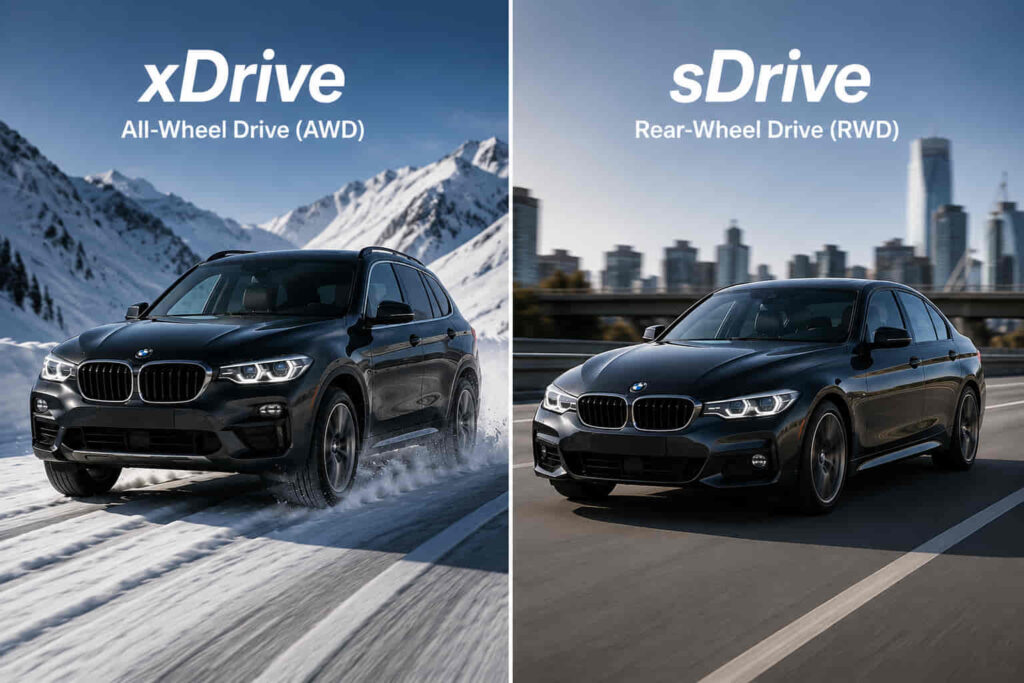
The main difference between BMW xDrive and sDrive is the drivetrain configuration: xDrive is BMW’s all-wheel-drive system, while sDrive sends driving power through one axle instead of using an all-wheel-drive setup. Depending on the BMW model and platform, an sDrive vehicle can be rear-wheel drive or front-wheel drive, so sDrive should not be treated as another name for rear-wheel drive across the entire BMW lineup.
That drivetrain difference affects how each configuration delivers power and uses available traction. xDrive can distribute driving force through an all-wheel-drive system, which can be useful when traction conditions change. An sDrive configuration relies on one driven axle and does not provide the same all-wheel-drive capability. However, drivetrain layout is only one part of traction. Tire type, tire condition, temperature, and road surface still determine how much grip is available between the vehicle and the road.
Choosing between BMW xDrive vs sDrive therefore involves more than deciding whether all-wheel drive is better. The comparison also includes driving conditions, efficiency, drivetrain complexity, and how much AWD capability matters for the owner’s typical use. This article explains seven key differences between BMW xDrive and sDrive to clarify how each drivetrain works, where their practical advantages differ, and which configuration better matches a buyer’s driving requirements.
What is the main drivetrain difference between BMW xDrive and sDrive?
The main drivetrain difference between BMW xDrive and sDrive is that xDrive uses an all-wheel-drive configuration, while sDrive sends driving power through a single axle. This distinction determines which wheels can receive driving force and establishes the mechanical foundation for differences in traction, vehicle behavior, drivetrain complexity, and efficiency.
BMW xDrive is designed around an all-wheel-drive drivetrain. Instead of relying exclusively on one driven axle, the system can use both axles as part of delivering engine or motor output to the road. This gives the drivetrain more options for using available tire grip when operating conditions change. The exact xDrive architecture and control strategy can differ according to BMW model and platform, so one mechanical layout should not be assumed to apply identically to every xDrive vehicle.
BMW sDrive uses a two-wheel-drive configuration in which one axle provides the driving force. Importantly, sDrive does not universally mean rear-wheel drive. Some BMW models use sDrive with a rear-wheel-drive layout, while other platforms can use a front-wheel-drive configuration. The sDrive designation therefore identifies the absence of the xDrive all-wheel-drive configuration more reliably than it identifies one specific driven axle across every BMW model.
This drivetrain distinction has practical consequences, but it does not establish that one configuration is automatically superior. xDrive provides AWD capability, while sDrive uses a simpler one-driven-axle arrangement. Whether that difference creates meaningful value depends on the specific vehicle, driving environment, traction requirements, and buyer priorities.
For this reason, the first step when comparing BMW xDrive vs sDrive is to identify the actual model and drivetrain configuration rather than relying only on the badge. xDrive answers whether the BMW uses an all-wheel-drive system; sDrive identifies a two-wheel-drive configuration, while the specific model determines whether its driven axle is at the front or rear.
How do BMW xDrive and sDrive distribute driving power differently?
BMW xDrive and sDrive distribute driving power differently because xDrive can deliver driving force through an all-wheel-drive system, while sDrive directs that force through one driven axle. This difference becomes particularly relevant when the tires do not all have the same amount of available grip.
With xDrive, drivetrain control can manage power distribution within the AWD system according to the vehicle’s design and operating conditions. If traction conditions change, the drivetrain has access to driven wheels across both axles rather than relying exclusively on one axle to transmit driving force. This capability is one reason xDrive becomes relevant when buyers evaluate traction in variable road conditions.
sDrive concentrates propulsion through its driven axle. On a rear-wheel-drive sDrive BMW, the rear wheels provide the driving force, while a front-wheel-drive sDrive application uses the front wheels. In either case, the defining comparison with xDrive is that sDrive does not use both axles as an AWD drivetrain for propulsion.
Power distribution should not be reduced to one fixed front-to-rear percentage for every xDrive BMW. Different models, platforms, powertrains, and xDrive implementations can use different drivetrain architectures and control strategies. A torque-distribution figure that accurately describes one BMW therefore should not be presented as a universal specification for the entire xDrive lineup.
The effect of power distribution also depends on the traction available at the tires. Sending driving force to additional wheels can help the drivetrain use available grip, but it cannot create grip where the tire-road interface does not provide it. A vehicle on unsuitable or severely worn tires remains limited by those tires regardless of the number of driven wheels.
The functional relationship is therefore xDrive → AWD power distribution across the drivetrain, while sDrive → power delivery through one driven axle. This difference creates the basis for the next comparison: whether xDrive’s ability to use additional driven wheels provides a meaningful traction advantage over sDrive under real driving conditions.
Read more: BMW xDrive vs. iDrive
Does BMW xDrive provide more traction than sDrive?
BMW xDrive can provide a traction advantage over sDrive because the all-wheel-drive system can use driven wheels across both axles, while sDrive delivers driving force through only one axle. This difference becomes most relevant when available grip varies across the tires. By having more driven wheels available for propulsion, xDrive gives the drivetrain additional opportunities to transfer driving force to the road.
The advantage comes from power distribution rather than from xDrive creating additional tire grip. Every acceleration, braking, and cornering force ultimately passes through the contact patches between the tires and road surface. If a tire has limited grip because of snow, ice, standing water, low temperature, or excessive wear, the drivetrain cannot eliminate that physical limitation. xDrive can manage how driving force is distributed, but the tires determine how much of that force can be transferred to the road.
This distinction explains why xDrive can be useful when accelerating on a low-traction surface. An sDrive BMW relies on the available grip at its driven axle to transmit propulsion. An xDrive BMW can use its AWD drivetrain to involve both axles according to the system’s operating strategy, giving the vehicle more options for using the traction available across its driven wheels.
Traction should therefore not be treated as a binary comparison in which xDrive “has grip” and sDrive does not. Vehicle weight, tire specification, tire condition, road surface, temperature, stability-control systems, and driving inputs all influence the result. Two otherwise different BMWs cannot be ranked accurately on traction from the xDrive or sDrive badge alone.
The practical difference is that xDrive provides AWD capability that can improve the use of available traction during propulsion, while sDrive relies on one driven axle. Whether that advantage matters significantly depends on the conditions in which the BMW is driven and, especially, the tires connecting it to the road.
Is BMW xDrive better than sDrive in snow and rain?
BMW xDrive generally provides a stronger drivetrain advantage than sDrive when accelerating in snow or other low-traction conditions because it can distribute driving force through an all-wheel-drive system. When one area of the road offers less grip than another, having driven wheels across both axles gives the drivetrain more options for transferring propulsion than a one-driven-axle sDrive configuration.
Snow also demonstrates why drivetrain and tire performance must be evaluated separately. xDrive can help the vehicle use available traction, but it cannot compensate completely for tires that are inappropriate for the temperature and surface. A properly equipped sDrive BMW can therefore perform better in some winter situations than an xDrive BMW using unsuitable tires. The AWD badge alone does not determine winter capability.
Rain creates a similar relationship. Wet pavement reduces the traction available between the tires and road, and xDrive can assist with power delivery when the vehicle is accelerating under reduced-grip conditions. However, tire tread condition, tire design, speed, standing water, and driver input remain important. xDrive does not prevent hydroplaning because hydroplaning concerns the tire’s ability to maintain contact with the road through water rather than simply how many wheels receive driving force.
Braking is another important distinction. The traction advantage of AWD during propulsion should not be interpreted as a proportional reduction in braking distance. Both xDrive and sDrive vehicles depend on tire-road grip and the braking system when decelerating. All-wheel drive does not allow a BMW to ignore the traction limits imposed by snow, ice, or wet pavement.
For a buyer, the value of xDrive therefore increases when the vehicle regularly operates in conditions where additional driven-wheel capability is useful, such as recurring snow or variable low-traction surfaces. That does not make sDrive inherently unsuitable for rain or winter driving. The complete configuration, especially appropriate tires, matters more than evaluating the drivetrain badge in isolation.
The meaningful comparison is xDrive versus sDrive for propulsion under reduced traction, not xDrive versus the laws of tire grip. xDrive can provide an AWD advantage when putting power down, while both configurations remain dependent on tires, road conditions, and appropriate driving inputs for accelerating, cornering, and stopping safely.
Is BMW sDrive more efficient than xDrive?
BMW sDrive can be more efficient than a comparable xDrive configuration because a two-wheel-drive drivetrain generally requires fewer components to deliver power to the driven wheels. xDrive adds the hardware needed for all-wheel-drive operation, which can increase vehicle weight and introduce additional drivetrain losses. However, this does not mean every sDrive BMW automatically uses less fuel or energy than every xDrive BMW.
The most meaningful efficiency comparison is between sDrive and xDrive versions of the same or closely related BMW model. Engine or electric powertrain, vehicle weight, wheel and tire specifications, aerodynamics, transmission calibration, and test conditions can all affect consumption. Comparing an sDrive version of one model with an unrelated xDrive vehicle would therefore provide little evidence that drivetrain configuration alone caused the difference.
Weight is one mechanism behind the potential efficiency difference. An xDrive vehicle needs additional drivetrain hardware to transmit driving force through an all-wheel-drive configuration. Moving this additional mass requires energy, while the drivetrain itself contains more components through which power must travel. A comparable sDrive configuration can avoid some of that additional hardware because propulsion is delivered through only one axle.
The trade-off is that the additional xDrive hardware exists for a functional reason. xDrive provides AWD capability and can offer a traction advantage when driving force needs to be transferred under changing grip conditions. A buyer should therefore interpret any efficiency difference as part of a broader drivetrain trade-off rather than treating lower consumption as the only measure of which configuration is better.
Actual efficiency should ultimately be checked for the specific BMW being considered. The useful relationship is sDrive → simpler two-wheel-drive power delivery → potential weight and efficiency advantage, while xDrive → additional AWD capability → additional drivetrain hardware. The size of the difference depends on the specific vehicle rather than the xDrive or sDrive badge alone.
Does BMW xDrive have more drivetrain complexity than sDrive?
Yes, BMW xDrive generally has greater drivetrain complexity than a comparable sDrive configuration because xDrive requires additional hardware to deliver and manage driving force through an all-wheel-drive system. sDrive sends propulsion through one driven axle, so it does not require the same AWD architecture to distribute power through both axles.
This difference increases the number of drivetrain components involved in xDrive operation. The exact architecture varies by BMW model and platform, so the same component arrangement should not be assumed across every xDrive vehicle. The important comparison is structural: providing AWD capability requires systems that a comparable one-driven-axle configuration does not need for the same purpose.
Greater mechanical complexity also creates additional components whose condition can matter during long-term ownership. That does not establish that an xDrive BMW will necessarily fail more frequently or cost more to repair than every sDrive equivalent. Reliability depends on the specific drivetrain design, maintenance history, mileage, operating conditions, previous repairs, and current component condition. More components describe mechanical complexity; they do not prove future failure.
This distinction becomes particularly important when buying a used BMW. An xDrive badge should not by itself be interpreted as evidence of an expensive drivetrain problem, just as an sDrive badge does not guarantee a vehicle will require fewer repairs. Service history and an inspection of the actual vehicle provide stronger evidence about ownership risk than drivetrain designation alone.
The complexity difference should instead be considered alongside the benefit that creates it. xDrive uses additional drivetrain architecture to provide AWD capability and greater flexibility in distributing driving force. sDrive eliminates the need for that AWD configuration and relies on one driven axle. The buyer is therefore comparing additional drivetrain capability and complexity with a simpler two-wheel-drive configuration, not simply comparing a reliable system with an unreliable one.
For ownership decisions, this difference becomes meaningful when combined with actual driving requirements. If AWD capability provides regular value because of the conditions in which the BMW is used, the additional xDrive architecture serves a clear purpose. If that capability provides little practical benefit for the owner, sDrive can offer a more straightforward drivetrain configuration without adding an AWD system that the driver does not specifically need.
Should you choose BMW xDrive or sDrive?
You should choose BMW xDrive when all-wheel-drive capability provides meaningful value for your driving conditions, while sDrive can be the better choice when you do not need AWD and prefer a simpler two-wheel-drive configuration. Neither drivetrain is universally better. The right choice depends on where the vehicle will be driven, how frequently it encounters reduced-traction conditions, and which drivetrain attributes matter most to the owner.
xDrive becomes more relevant when a BMW regularly operates in snow, on slippery inclines, or under other conditions where distributing driving force through an AWD system can improve the use of available traction. Because both axles can participate in propulsion, xDrive provides more drivetrain flexibility than an sDrive configuration that sends power through one axle. This advantage is primarily about putting driving force to the road rather than eliminating every limitation associated with poor weather.
Tires remain critical regardless of drivetrain choice. An xDrive BMW still depends on the tire-road contact patches for acceleration, cornering, and braking. AWD cannot create grip that unsuitable or worn tires do not provide, and it does not eliminate braking limitations on snow, ice, or wet pavement. Buyers who choose xDrive for winter conditions should therefore consider the drivetrain and tires as complementary parts of the vehicle’s traction capability.
sDrive makes more sense when AWD capability provides limited practical value for the owner’s normal driving environment. Because sDrive sends driving force through one axle, it avoids the additional AWD architecture required by xDrive. Depending on the specific BMW, this can contribute to differences in vehicle weight, efficiency, drivetrain complexity, and driving characteristics. The actual size of those differences must still be evaluated at model level rather than assumed from the sDrive badge alone.
Driving preference can also influence the decision, particularly because sDrive does not identify one universal drivetrain layout. Depending on the BMW model and platform, an sDrive vehicle can be rear-wheel drive or front-wheel drive. Buyers interested in a particular driving characteristic should therefore verify the actual drivetrain of the model they are considering instead of assuming that every sDrive BMW behaves like a traditional rear-wheel-drive BMW.
For a used BMW, current condition can be more important than the theoretical advantages of either configuration. A well-maintained xDrive vehicle with documented service history can represent a better purchase than a neglected sDrive example, while choosing xDrive solely because it appears more capable can add drivetrain complexity that a particular owner does not need. The drivetrain badge should therefore be evaluated together with maintenance history, condition, tires, intended use, and the specific model.
The BMW xDrive vs sDrive decision ultimately comes down to capability versus requirement. xDrive provides all-wheel-drive capability and greater flexibility in using available traction through driven wheels across both axles. sDrive uses one driven axle and offers a more straightforward drivetrain configuration for buyers who do not require AWD. If changing or low-traction driving conditions are a regular part of ownership, xDrive has a clearer functional advantage. If AWD provides little practical benefit, sDrive can be the more appropriate configuration without being an inferior version of the vehicle.