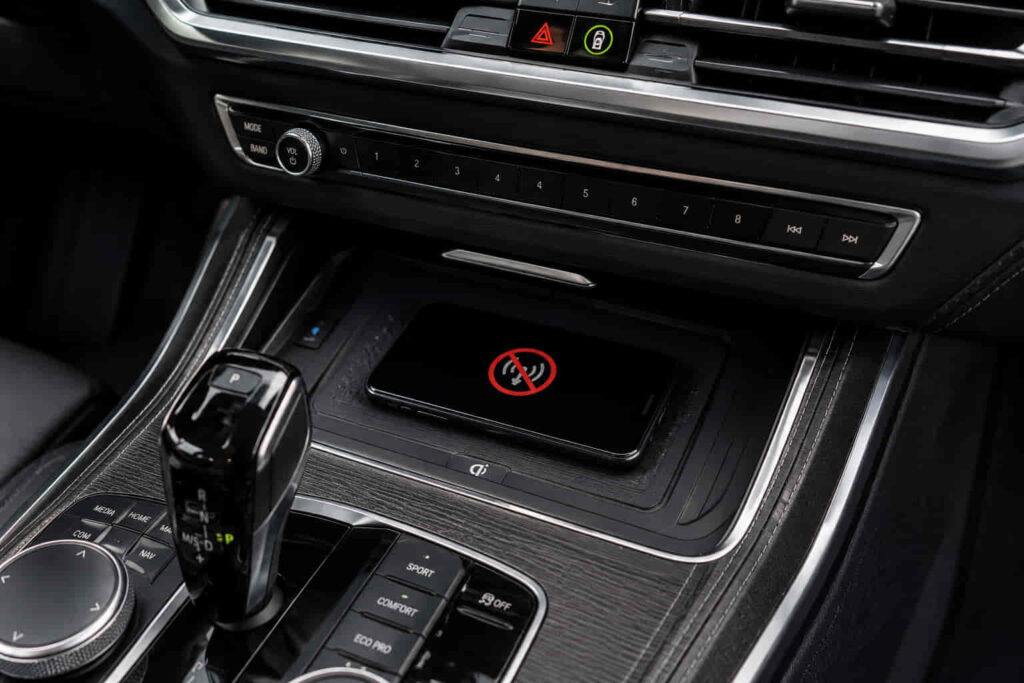
BMW wireless charging can stop working when the phone is incompatible with the charging system, positioned incorrectly, obstructed by a case or accessory, overheated, or when the vehicle-side charging system develops a fault. A phone sitting on the BMW wireless charging tray does not automatically mean that wireless charging should start. The phone, charging surface, and vehicle system must all operate under compatible conditions.
The first step is to determine whether the problem comes from the phone or the BMW charging tray. A compatible phone that charges normally on another wireless charger but does not charge in the BMW points toward the vehicle-side charging path. Conversely, if the same phone fails on multiple wireless chargers, the phone or its accessories deserve attention before the BMW charging tray is diagnosed.
There are 7 main reasons a BMW wireless charger may not work. The most common troubleshooting areas are phone compatibility, charging-coil positioning, phone cases or accessories, excessive heat, the phone’s own charging state, vehicle electronics, and a defective charging tray or related hardware. The correct diagnosis should move from the easiest variables to isolate toward the vehicle-side components rather than assuming that the charging pad is defective.
This approach follows the Algorithmic Authorship principle of giving the answer directly, removing contextless wording, and using specific causal relationships instead of vague explanations.
Is Your Phone Compatible With BMW Wireless Charging?
Your phone must support a compatible wireless-charging function for the BMW wireless charging tray to charge it. The charging tray cannot compensate for a smartphone that does not support the required wireless-charging technology, so compatibility should be checked before assuming the BMW charging hardware has failed.
Wireless charging requires the phone and charging tray to establish the appropriate charging connection between their coils. When the phone does not support the required wireless-charging standard or its implementation is incompatible with the vehicle’s charging system, placing the device on the tray will not produce normal charging behavior. The BMW charging tray itself can therefore appear functional even though the phone does not begin charging.
Compatibility should be tested before moving into deeper vehicle troubleshooting. If a compatible smartphone charges normally on the BMW tray while the original phone does not, the evidence points toward the original phone, its case, accessories, or device-side charging behavior rather than immediately toward a BMW hardware failure. This comparison isolates the phone from the vehicle and makes the diagnostic process more reliable.
The practical rule is simple: confirm that the smartphone supports the wireless-charging function expected by the BMW before diagnosing the charging tray. A phone that lacks compatible wireless charging cannot be used to prove that the BMW wireless charging system is defective.
Is Your Phone Positioned Correctly on the BMW Charging Tray?
Incorrect phone positioning can prevent a BMW wireless charging tray from establishing a reliable charging connection because the phone’s charging coil needs to align appropriately with the charging area. A phone can appear to be sitting on the tray while still being positioned poorly enough that charging does not start or repeatedly interrupts.
Wireless charging transfers energy over a short distance between charging coils. Moving the phone away from the intended charging area increases the separation or misalignment between those coils, reducing the ability of the system to establish and maintain charging. Movement during driving can make the problem intermittent because the phone may briefly reach a usable position and then move away from it.
The correct diagnostic approach is to place the phone centrally and securely on the designated charging surface, then observe whether the charging indication appears and remains active. If charging starts only when the phone is moved to a particular position, positioning is a stronger explanation than an immediate hardware failure.
This test also helps separate a simple placement issue from a persistent vehicle-side problem. If a compatible phone charges consistently when correctly positioned, the BMW wireless charging tray is performing its basic charging function. If the phone remains correctly positioned but never charges, the investigation should move to other variables such as the case, temperature, phone condition, or charging hardware.
Can a Phone Case Stop BMW Wireless Charging?
A phone case can interfere with BMW wireless charging when it creates too much distance, contains unsuitable materials, or has accessories that interfere with the charging connection. The phone may support wireless charging and be positioned correctly, yet still fail to charge because the case or an attached accessory changes the conditions between the phone and charging tray.
Wireless charging depends on energy transfer between coils located inside the charging surface and the smartphone. A thick case increases the physical separation between those components, while metallic elements or certain magnetic accessories can interfere with the charging field. The result can be a complete failure to start charging, intermittent charging, or charging that stops when the phone moves slightly.
The simplest way to isolate this cause is to remove the phone case and any attached accessory before testing the BMW charging tray again. If the phone begins charging normally without the case, the charging system and smartphone are less likely to be the primary problem. The case or accessory has changed the conditions required for wireless power transfer.
This test is more useful than immediately replacing the charging tray because it separates an external obstruction from a vehicle-side failure. A compatible phone that charges correctly after its case and accessories are removed indicates that the physical setup was interfering with wireless charging rather than proving that the BMW charging hardware was defective.
Can Overheating Make BMW Wireless Charging Stop?
Excessive heat can cause wireless charging to slow down or stop temporarily because charging generates heat and smartphones can limit charging when their temperature becomes too high. A BMW wireless charging problem that appears only after the phone has been charging for a period of time therefore requires a different diagnosis from a phone that never starts charging when it is cool.
Wireless charging transfers energy through an electromagnetic field, and that process produces heat in both the charging environment and the device. The phone’s own thermal-management system can respond when its temperature rises beyond an acceptable operating range. Depending on the device, charging may slow, pause, or stop until the temperature returns to a suitable level.
Heat can become more noticeable when the phone is already warm from direct sunlight, navigation, intensive applications, or a high ambient temperature. A phone inside a thick case can also have more difficulty dissipating heat. This can create an intermittent symptom in which the BMW charger appears to work normally at first and then stops charging as the phone becomes warmer.
The diagnostic distinction is straightforward. If charging resumes after the phone has cooled and the same phone charges normally when temperature is controlled, heat is a stronger explanation than a permanently failed BMW charging tray. If charging consistently fails even when the phone is cool, correctly positioned, and free from an obstructive case, the investigation should move toward the phone’s charging system or the BMW’s charging hardware.
Can BMW Wireless Charging Stop Because of the Phone or Charging State?
The phone itself can interrupt wireless charging because of its battery condition, software behavior, thermal protection, or another device-side charging condition. A BMW wireless charging tray that works with one compatible phone but not another should therefore not immediately be diagnosed as a vehicle fault.
A smartphone controls important parts of its own charging process. It can reduce or stop wireless charging when the battery reaches a particular charging state, when the device becomes too warm, or when its operating system detects a condition that requires charging to be limited. These behaviors can make the BMW charging tray appear inconsistent even though the tray is still supplying wireless power.
The most useful diagnostic test is to change only one variable at a time. If the same BMW tray successfully charges another compatible smartphone, the original phone becomes the primary area to investigate. Conversely, if the original phone charges normally on another compatible wireless charger but consistently fails on the BMW tray, the vehicle-side charging environment becomes more relevant.
This comparison prevents unnecessary replacement of the BMW charging hardware. A charging problem that follows the phone across different wireless chargers is more likely to originate from the phone, while a problem that remains with the BMW tray across multiple compatible phones points more strongly toward the vehicle-side system.
Can a BMW Electronic or Software Problem Affect Wireless Charging?
A vehicle-side electronic or software condition can affect BMW wireless charging because the charging tray operates as part of the vehicle’s electronic and power environment. However, an iDrive or other electronic problem should not automatically be assumed to be the cause whenever wireless charging stops working.
The wireless charging function depends on more than the physical charging surface. The vehicle must provide the appropriate electrical conditions and operate the charging function correctly. A problem affecting the relevant power supply, electronic control, communication, or charging module can therefore prevent the tray from functioning even when the smartphone itself is compatible and correctly positioned.
The diagnostic sequence should first eliminate simpler variables. A compatible phone should be tested without an obstructive case, positioned correctly, and allowed to cool before a vehicle-side electronic problem becomes the primary explanation. If the same BMW tray then fails with more than one compatible phone, the evidence becomes stronger for investigating the vehicle rather than repeatedly changing phone settings.
The presence of another electronic symptom can provide additional context, but it does not establish causation by itself. A frozen iDrive display, for example, does not automatically mean that the wireless charging tray has failed for the same reason. The relevant charging system must be isolated and tested rather than assuming that every BMW electronic symptom has one common cause.
Is the BMW Wireless Charging Tray Itself Faulty?
The BMW wireless charging tray itself becomes a stronger suspect when a compatible phone remains unable to charge after positioning, case, temperature, and phone-side causes have been eliminated. A single failed charging attempt is not enough to prove that the tray is defective because several phone-side and environmental conditions can produce the same symptom.
The most useful diagnostic approach is to isolate the variables. A compatible phone should be tested in the correct charging position, without an obstructive case or accessory, and under normal temperature conditions. Testing another compatible phone on the same BMW tray provides an additional comparison. If multiple compatible phones fail under the same conditions while those phones charge normally elsewhere, the evidence increasingly points toward the BMW charging system.
A vehicle-side problem can involve the charging tray itself or another part of the electrical path that supplies and controls the charging function. This distinction matters because replacing the tray without testing the surrounding system can leave the actual cause unresolved. The diagnostic objective is therefore to establish whether the failure follows the phone or remains with the vehicle.
A persistent failure across compatible phones after basic variables have been eliminated justifies vehicle-side inspection. At that point, the problem has moved beyond simple phone positioning or accessory troubleshooting and requires the BMW charging system to be evaluated.
How Can You Fix BMW Wireless Charging Not Working?
The appropriate fix for BMW wireless charging not working depends on the cause, so troubleshooting should begin with the phone and charging setup before moving to vehicle-side diagnosis. A compatible phone should first be positioned correctly on the charging tray, with unnecessary cases or accessories removed and excessive heat eliminated as variables.
If the phone still does not charge, testing another compatible smartphone provides a useful isolation step. If the second phone charges, the original device becomes the primary area for investigation. If neither phone charges on the BMW tray but both work on other wireless chargers, the vehicle-side charging system becomes more likely to be responsible.
This approach avoids replacing components based solely on the dashboard symptom or the absence of a charging indication. The same visible symptom can originate from different parts of the charging chain, so each variable should be isolated before moving to the next diagnostic level.
The correct troubleshooting sequence is therefore phone compatibility → positioning → case or accessory → temperature → alternative phone → BMW charging system. This sequence moves from conditions that are easy to test toward vehicle-side hardware without assuming the most expensive explanation first.
Why Does BMW Wireless Charging Work Intermittently?
BMW wireless charging can work intermittently when the phone repeatedly moves out of the optimal charging position, becomes too warm, or encounters changing conditions that interrupt wireless power transfer. An intermittent symptom therefore requires attention to what changes between successful and unsuccessful charging attempts.
Phone movement is particularly relevant because wireless charging depends on the relative position of the phone and charging surface. A phone that begins charging while stationary can stop when movement changes the alignment between the charging coils. Heat can create another pattern in which charging starts normally and then pauses after the device becomes warmer.
A phone case or accessory can make the system more sensitive to these conditions by increasing the distance between the charging components or introducing interference. Removing the case and keeping the phone correctly positioned can therefore help determine whether the intermittent behavior is caused by the physical charging setup.
If charging repeatedly stops despite stable positioning, normal temperature, and a compatible phone, the investigation should move toward the vehicle-side system. Intermittent charging becomes more significant when the same behavior occurs under controlled conditions rather than only during movement or heat buildup.
Can You Use a USB Cable If BMW Wireless Charging Does Not Work?
A USB cable can provide an alternative charging method when BMW wireless charging is unavailable, provided the BMW and phone support the applicable wired charging connection. Wired charging and wireless charging use different physical paths, so successful USB charging can also provide useful diagnostic information.
If the phone charges normally through USB but not through the BMW wireless tray, the phone’s basic ability to receive electrical power is less likely to be the problem. The investigation can then focus more closely on the wireless charging function, its positioning conditions, and the vehicle-side charging hardware.
The reverse comparison is also useful. If the phone fails to charge through both the BMW wireless tray and an appropriate wired connection, the problem may extend beyond the wireless charging system. The phone’s charging port, battery condition, power source, or another device-side issue may require attention.
USB charging should therefore be treated as both an alternative and a diagnostic comparison. It does not repair a failed wireless charging tray, but it can help determine whether the charging problem is isolated to the wireless path.
Does BMW Wireless Charging Affect Apple CarPlay or Android Auto?
BMW wireless charging and smartphone connectivity functions such as Apple CarPlay or Android Auto are separate functions, so a problem with wireless charging does not automatically indicate a connectivity problem. A phone can connect successfully to the vehicle while failing to charge on the wireless tray.
Wireless charging transfers electrical energy to the phone, while CarPlay and Android Auto provide vehicle-to-phone connectivity for supported applications and functions. They can operate in the same vehicle without depending on the same physical charging process. A successful connection therefore does not prove that the wireless charging system is functioning.
This distinction is useful when diagnosing a BMW because owners may see the phone connected to the vehicle and assume that all phone-related functions are operating normally. If CarPlay or Android Auto works but the battery percentage does not increase on the charging tray, the charging path should be investigated separately.
The same principle applies in reverse. A phone that fails to connect to the vehicle may still charge wirelessly. Connectivity and charging symptoms should therefore be diagnosed independently unless evidence shows that a common vehicle-side electronic fault affects both functions.
How Do You Know Whether the Phone or BMW Is Causing the Charging Problem?
You can isolate the source of a BMW wireless charging problem by changing the phone and charging environment separately and observing which part the failure follows. This is more reliable than assuming the BMW tray is defective because the phone does not charge.
The strongest comparison uses another compatible phone on the same BMW charging tray. If the second phone charges normally, the original phone, case, accessory, software state, or device-side charging behavior becomes more likely. If the second phone also fails while both phones charge normally on other wireless chargers, the BMW charging system becomes the stronger suspect.
The opposite comparison is also useful. Testing the original phone on another compatible wireless charger determines whether the phone can receive wireless power outside the BMW. If it works elsewhere but consistently fails in the BMW, the problem is less likely to be the phone’s basic wireless-charging capability.
This creates a simple diagnostic relationship: if the problem follows the phone, investigate the phone; if the problem stays with the BMW tray across compatible phones, investigate the vehicle. This evidence-based isolation reduces unnecessary component replacement and gives the repair process a clear starting point.
When Should You Have the BMW Wireless Charging System Inspected?
You should have the BMW wireless charging system inspected when a compatible phone consistently fails to charge after correct positioning, case removal, temperature control, and phone-side testing have been completed. At that point, repeated attempts to reposition the phone or restart unrelated systems are unlikely to provide additional diagnostic value.
The strongest reason for inspection is a repeatable vehicle-side pattern. If multiple compatible phones charge normally elsewhere but none will charge on the BMW tray under controlled conditions, the charging tray, its power supply, or another related vehicle component requires further evaluation.
A persistent failure should also be distinguished from an intermittent interruption caused by heat or phone movement. If charging works normally when the phone is cool and correctly positioned, the system may be responding to operating conditions rather than suffering from a permanent hardware failure. If it never charges under controlled conditions, a vehicle-side fault becomes more plausible.
The diagnostic journey should therefore end with inspection rather than repeated resets when the basic variables have been eliminated. The objective is to identify the failed part or condition responsible for the charging failure, not simply to make the charging indicator appear temporarily.