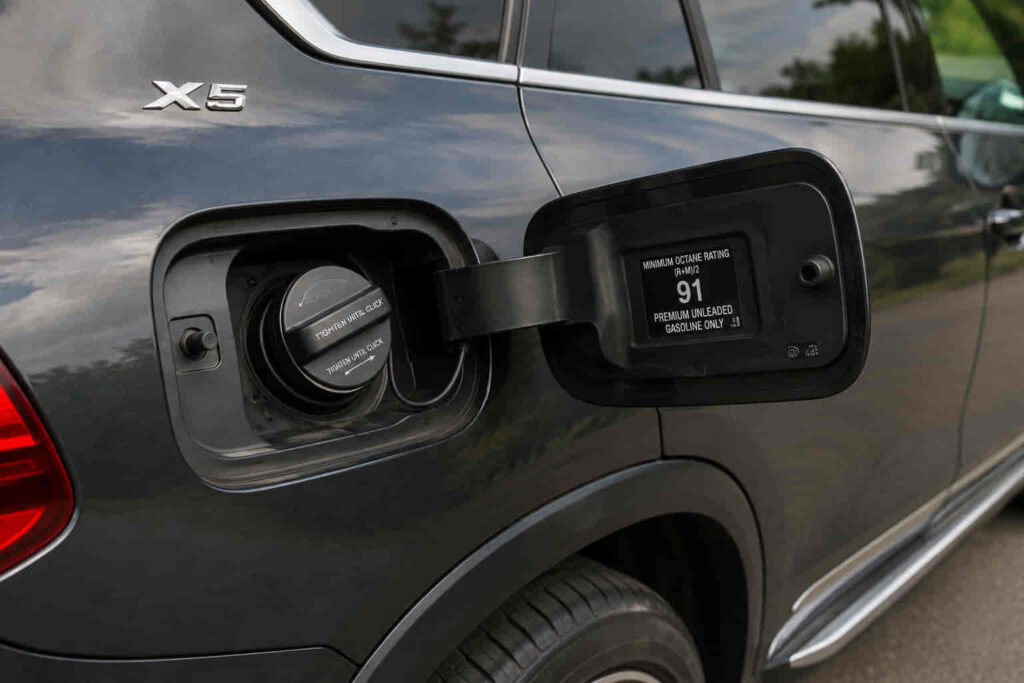
The correct gas type for a BMW X5 depends on the specific model, engine, and market, but current U.S.-specification gasoline X5 models are designed around gasoline fuel, with BMW recommending premium fuel for the X5. BMW’s current X5 specifications identify gasoline powertrains as well as a plug-in hybrid configuration, while BMW states that premium fuel is recommended for the X5.
The term “BMW X5 gas type” can refer to two different questions: whether the vehicle uses gasoline or another fuel, and which gasoline grade or octane rating is appropriate. Those questions should not be treated as identical. The answer can also change when comparing different X5 model years, engines, generations, or markets. BMW’s current U.S. lineup, for example, includes the X5 xDrive40i, X5 xDrive50e plug-in hybrid, and other X5 variants, showing why the exact vehicle specification matters.
There are 7 important things to understand before choosing fuel for a BMW X5. The most important are identifying the engine and model year, distinguishing gasoline from fuel grade, understanding BMW’s premium-fuel recommendation, checking the required octane, and verifying the specification for the exact vehicle. BMW provides digital owner’s manuals searchable by VIN, which is the most precise way to confirm vehicle-specific information when the fuel requirement is uncertain.
Does Every BMW X5 Use the Same Gas Type?
No, you should not assume every BMW X5 has exactly the same fuel requirement because the X5 has been sold with different engines, powertrains, model years, and market specifications. The current U.S.-market X5 lineup, for example, includes gasoline-powered variants and the X5 xDrive50e plug-in hybrid, while BMW separately states that the recommended fuel should be confirmed from the vehicle-specific Owner’s Manual.
The important distinction is between the X5 nameplate and the specific powertrain inside the vehicle. An X5 xDrive40i and an X5 M60i are both X5 models, but they use different engines. BMW’s current technical specifications identify the xDrive40i with a 3.0-liter six-cylinder gasoline engine and the M60i with a 4.4-liter eight-cylinder gasoline engine. The X5 xDrive50e adds a plug-in hybrid powertrain while still using a gasoline engine.
Model year and market also matter because BMW can change engine and fuel specifications between generations or regional versions. This is why a fuel recommendation found for an older X5 should not automatically be applied to a newer vehicle. BMW specifically directs owners to the Owner’s Manual for model-specific fuel recommendations, and its digital manuals can be accessed by entering the vehicle’s 17-digit VIN.
For SEO and practical accuracy, the correct answer to “BMW X5 gas type” is therefore not one universal fuel grade. The correct sequence is identify the X5 model year and engine, determine whether the vehicle uses gasoline or another powertrain, and then confirm the fuel specification for that exact vehicle.
Does the BMW X5 Engine Determine the Required Fuel?
The BMW X5 engine is one of the key factors used to determine the vehicle’s required fuel specification. The X5 badge alone does not provide enough information to determine the appropriate gasoline grade because different X5 engines can have different fuel requirements and performance specifications.
The engine determines how the combustion system is designed to operate, including the fuel characteristics expected by BMW. This is why BMW’s fuel guidance tells owners to check the Owner’s Manual for model-specific recommendations rather than applying one fuel rule to every BMW. BMW also states that the recommended fuel grade is found on the fuel filler flap, providing a vehicle-specific reference at the point where fuel is added.
The current U.S. X5 specifications demonstrate why engine identification matters. The X5 xDrive40i uses a 2,998 cc six-cylinder gasoline engine, while the X5 M60i uses a 4,395 cc eight-cylinder gasoline engine. Both are gasoline X5 models, but they are different powertrains with different engine specifications. BMW also lists the X5 M as a gasoline-powered model, further reinforcing that the model badge alone is not the complete fuel specification.
This creates an important distinction between fuel type and fuel grade. Identifying an X5 as gasoline-powered answers the first question, but it does not automatically answer which octane rating should be selected at the pump. The engine-specific specification must be checked before choosing the fuel grade. For an exact BMW X5 fuel answer, engine and model-year identification should come before any recommendation about regular or premium gasoline.
Read more: How to Reset BMW Computer
Does a Gasoline BMW X5 Require Premium Gas?
BMW recommends premium gasoline for its U.S.-market gasoline X5 models, but the exact fuel requirement should still be confirmed for the specific vehicle. BMW’s current X5 specifications identify gasoline-powered models such as the X5 xDrive40i and X5 M60i, while BMW’s fuel guidance directs owners to the vehicle-specific fuel recommendation rather than treating every BMW as having one universal fuel specification.
The important distinction is that gasoline is the fuel type, while premium is a fuel grade. Saying that a BMW X5 uses gasoline does not by itself answer whether the engine is designed around regular or premium gasoline. Octane rating describes the fuel’s resistance to knock, so the appropriate grade depends on the engine specification and the manufacturer’s recommendation.
BMW provides the fuel recommendation in more than one vehicle-specific location. BMW USA states that the recommended fuel grade can be found on the fuel filler flap and in the Owner’s Manual. Its digital Owner’s Manual system also allows owners to retrieve vehicle-specific information using the vehicle identification number. This makes the vehicle itself a more reliable reference than a generic X5 fuel recommendation found online.
For a gasoline-powered X5, premium gasoline should therefore be treated as the recommended choice for the applicable U.S. specification rather than assuming that every fuel grade will provide identical operating characteristics. The correct approach is to identify the exact X5 engine and follow the fuel grade specified by BMW for that vehicle.
What Octane Gas Does a BMW X5 Take?
The appropriate octane for a BMW X5 should be determined from the fuel specification for the specific engine and market rather than from the X5 badge alone. BMW’s U.S. fuel guidance identifies the recommended fuel grade through the vehicle’s fuel-filler information and Owner’s Manual, which makes the exact vehicle specification the primary reference.
Octane and fuel type answer different questions. A gasoline X5 requires gasoline as its fuel type, while the octane number identifies the grade of that gasoline. An owner therefore needs both pieces of information: first establish that the vehicle is a gasoline-powered X5, then use BMW’s specified octane requirement for that particular vehicle.
This distinction becomes especially important when comparing X5 variants. The current U.S. lineup includes different gasoline engines, including the six-cylinder X5 xDrive40i and V8-powered X5 M60i. BMW’s specifications identify their different engine configurations, so a fuel recommendation should be tied to the exact powertrain rather than generalized from the X5 nameplate.
The safest way to confirm the required octane is to check the fuel-filler flap or the vehicle-specific Owner’s Manual. BMW provides digital manuals through its owner resources using the vehicle’s VIN, allowing the fuel information to be matched to the actual X5 rather than to a similar model. When the exact octane is uncertain, use the specification for the specific vehicle instead of guessing from the model name.
Is Regular Gas Safe for a BMW X5?
Whether regular gasoline is appropriate for a BMW X5 depends on the fuel specification for the exact vehicle, but BMW recommends premium fuel for the current U.S.-market X5. BMW’s current X5 model page explicitly states that premium fuel is recommended to keep the X5 running at its best.
The important distinction is between using gasoline and using the recommended gasoline grade. A gasoline-powered X5 still requires the appropriate octane level for its engine. Choosing a lower-grade fuel simply because it is also gasoline ignores the specification BMW provides for the vehicle.
BMW places the recommended fuel grade in two particularly useful locations: the fuel-filler flap and the vehicle-specific Owner’s Manual. BMW’s official fuel-quality guidance also states that owners should refer to the Owner’s Manual for important information about the fuel recommended for their vehicle. This is especially useful for older X5 models, different engines, or vehicles originally sold outside the U.S.
The practical rule is therefore straightforward: do not determine whether regular gas is appropriate from the “X5” badge alone. Check the fuel-filler information or the Owner’s Manual for the specific vehicle. If the vehicle specifies premium fuel, premium should be the normal choice rather than assuming that regular gasoline is an equivalent substitute.
How Can You Check the Correct Gas Type for Your BMW X5?
The most reliable way to check the correct gas type for a BMW X5 is to use the vehicle-specific fuel information on the fuel-filler flap or in the Owner’s Manual. BMW specifically provides these sources because fuel requirements can depend on the individual vehicle rather than only the X5 model name.
The fuel-filler flap provides a convenient reference at the exact point where fuel is added. The Owner’s Manual provides broader vehicle-specific information and can clarify the applicable fuel recommendation for that particular X5. BMW USA’s Digital Owner’s Manual system allows owners to enter the vehicle’s 17-digit VIN to retrieve the manual for supported model years.
The My BMW App can also provide access to the vehicle’s Owner’s Manual through Profile → Help & Contact → Driver’s Guide, when the applicable BMW Driver’s Guide functionality is available. This is useful when the physical manual is not available and the owner needs to verify the fuel specification before refueling.
BMW’s current U.S. X5 information also states that premium fuel is recommended, while its broader fuel guidance emphasizes using the fuel grade specified for the individual vehicle. When there is any uncertainty, identify the exact X5 model and engine, then verify the fuel specification from BMW’s vehicle-specific documentation rather than relying on a generic online answer.
What Happens If You Put the Wrong Gas in a BMW X5?
What happens after putting the wrong fuel in a BMW X5 depends on whether the mistake involves the wrong gasoline grade or an entirely different fuel type. Using a gasoline grade with an octane level that does not match BMW’s recommendation is different from putting diesel into a gasoline X5, so the two situations should not be treated as the same fuel problem.
An incorrect gasoline grade concerns the fuel’s octane specification. BMW recommends premium fuel for current U.S.-market X5 models, and the vehicle-specific fuel recommendation should be checked through the fuel-filler information or Owner’s Manual. This is primarily a fuel-grade issue, whereas gasoline-versus-diesel misfueling changes the actual type of fuel entering the engine and fuel system.
Putting the wrong fuel type into the vehicle requires a more cautious response. If a gasoline X5 has been filled with diesel, continuing to drive can move the incorrect fuel farther through the fuel system and engine. The appropriate action is to stop and obtain the correct fuel-system guidance rather than attempting to compensate by adding gasoline or repeatedly starting the vehicle.
This distinction is also why the phrase “BMW X5 gas type” should not be reduced to a single word such as “premium.” The complete fuel specification involves the fuel type and the required fuel grade, while the correct response to a misfueling event depends on what was actually added to the vehicle.
Is BMW X5 Gasoline the Same as Petrol?
Yes, gasoline and petrol refer to the same basic fuel type; the difference is primarily regional terminology. “Gasoline” is the term commonly used in the United States, while “petrol” is widely used in other English-speaking markets.
This distinction matters when researching BMW X5 fuel specifications because BMW documentation and search results can use different terminology depending on the market. A query for “BMW X5 petrol” and a query for “BMW X5 gasoline” can therefore refer to the same fuel category even though the words look different.
The terminology should not be confused with fuel grade. Gasoline or petrol identifies the fuel type, while octane identifies the fuel’s resistance to knock and helps define the appropriate grade for the engine. A BMW X5 owner therefore needs to determine both the applicable fuel type and the specified fuel grade.
For a U.S.-market gasoline X5, BMW’s current specifications identify gasoline-powered variants and recommend premium fuel. For an individual vehicle, however, the fuel-filler flap and Owner’s Manual remain the appropriate references for confirming the exact specification.
Does BMW X5 Fuel Type Change by Model Year?
BMW X5 fuel availability and requirements can change across model years because BMW has introduced different generations, engines, and powertrains over the X5’s production history. A fuel recommendation for one X5 generation should therefore not automatically be transferred to another model year.
The X5 name has remained the same while its powertrain lineup has evolved. BMW’s current U.S. X5 range includes gasoline engines and a plug-in hybrid model, while previous generations and markets have included different engine configurations. This creates a direct relationship between model year → generation → engine → fuel specification.
This distinction is particularly important when researching a used BMW X5. The model badge may identify the vehicle as an X5, but it does not identify the exact engine or market specification. A used X5 from an earlier generation can therefore require a different fuel reference than a current X5.
The most reliable way to resolve model-year differences is to identify the exact vehicle and consult its BMW documentation. BMW USA’s digital Owner’s Manual system supports vehicle-specific information through the vehicle’s VIN, providing a more precise reference than applying a current X5 specification to an older vehicle.
Does BMW X5 xDrive Change the Gas Type?
The xDrive designation does not by itself determine the BMW X5’s fuel type because xDrive identifies BMW’s all-wheel-drive system rather than the engine’s fuel specification. The engine and specific vehicle configuration are more relevant when determining what fuel the X5 requires.
An X5 can carry an xDrive designation while using different engines or powertrains. BMW’s current U.S. specifications, for example, include the gasoline-powered X5 xDrive40i and X5 xDrive50i/related variants across its lineup. The common xDrive designation describes the drivetrain configuration, not a universal gasoline or octane requirement.
This distinction prevents a common specification error: using one vehicle badge as a shortcut for another vehicle attribute. The same principle applies to M Sport, trim level, wheel configuration, and other equipment names. These labels do not necessarily determine the fuel grade required by the engine.
For fuel selection, the correct path remains X5 model → model year → engine/powertrain → fuel specification. If the vehicle is an xDrive model, that designation should not replace checking the actual engine-specific fuel information.
Does BMW X5 M Use the Same Gas as Other X5 Models?
The BMW X5 M should be treated as its own engine-specific fuel application rather than assuming its fuel requirement is identical to every other X5. BMW identifies the X5 M as a high-performance gasoline-powered model with a distinct engine configuration, so its fuel specification should be verified against the X5 M’s own documentation.
The reason is straightforward: the X5 M is not simply an equipment package applied to every X5 engine. Its high-performance powertrain has different engine specifications from models such as the X5 xDrive40i. The fuel requirement should therefore follow the engine and vehicle specification rather than the shared “X5” name.
This is another example of why the exact model matters when answering BMW X5 Gas Type. A statement about the fuel used by an xDrive40i should not automatically be presented as a specification for an X5 M, M60i, or plug-in hybrid X5.
When the fuel requirement is uncertain, the vehicle-specific Owner’s Manual and fuel-filler information provide the appropriate confirmation. BMW’s digital manual system can also be searched by VIN for supported vehicles.
Does BMW X5 Fuel Type Affect Performance or Fuel Economy?
Using the fuel specification intended for the BMW X5 engine helps the vehicle operate according to the manufacturer’s intended fuel requirements, while using an inappropriate fuel grade can affect how the engine operates under conditions where fuel quality matters. Fuel type and fuel grade should therefore be considered part of the engine specification rather than simply a purchasing preference.
Octane is particularly relevant to gasoline engines because it describes the fuel’s resistance to knock. The engine management system is designed around the fuel characteristics specified for that powertrain. BMW’s recommendation for premium fuel on current U.S.-market X5 models therefore represents an engine-related specification rather than simply a recommendation based on fuel price or vehicle luxury status.
Fuel economy should not be reduced to a simple claim that premium fuel automatically produces better mileage in every driving situation. Actual fuel consumption also depends on driving conditions, vehicle load, temperature, tire pressure, drivetrain, and driving style. The more useful conclusion is that the correct fuel specification should be followed first; fuel economy comparisons should come afterward.
The same principle applies to performance. A fuel grade that does not match the manufacturer’s recommendation can change the conditions under which the engine operates, particularly in an engine designed around a specific octane requirement. Correct fuel specification is therefore the baseline for evaluating the X5’s intended performance and fuel economy.
Can You Mix Different Gasoline Octane Grades in a BMW X5?
Different gasoline octane grades are still gasoline, but mixing grades does not change the BMW X5’s underlying fuel requirement. The resulting mixture has a fuel characteristic between the two grades depending on their proportions, so adding a different grade should not be treated as a way to redefine what fuel the engine requires.
The more important question is whether the resulting fuel meets the specification for the specific X5. BMW recommends premium fuel for current U.S.-market X5 models, and the vehicle-specific recommendation should be confirmed through the fuel-filler flap or Owner’s Manual.
This is different from putting a completely different fuel type into the vehicle. Mixing gasoline grades is an octane-grade question, while gasoline-versus-diesel misfueling is a fuel-type problem with a substantially different risk profile. Treating these situations as equivalent can lead to the wrong response.
If there is uncertainty about the fuel already in the tank, the safest approach is to identify exactly what was added and compare it with the vehicle-specific fuel requirement. Do not use mixing different grades as a substitute for following BMW’s specified fuel grade.
When Should You Check the BMW X5 Fuel Specification?
You should check the BMW X5 fuel specification whenever you are uncertain about the vehicle’s engine, model year, market, or required fuel grade. The safest reference is the information provided for the exact vehicle rather than a generic statement about all BMW X5 models.
This is particularly useful when buying a used X5, driving an unfamiliar X5, importing one from another market, borrowing someone else’s vehicle, or comparing different X5 generations. In each case, the shared X5 name does not guarantee an identical powertrain or fuel specification.
BMW provides the recommended fuel grade on the fuel-filler flap and in the Owner’s Manual, while its Digital Owner’s Manual system can provide vehicle-specific documentation using the VIN for supported models. These references eliminate much of the uncertainty created by generic online fuel recommendations.
The final decision process is therefore simple: identify the exact X5, identify its engine or powertrain, confirm the fuel type, and verify the recommended fuel grade or octane before refueling. This approach answers BMW X5 Gas Type accurately without assuming that every X5 uses identical fuel specifications.