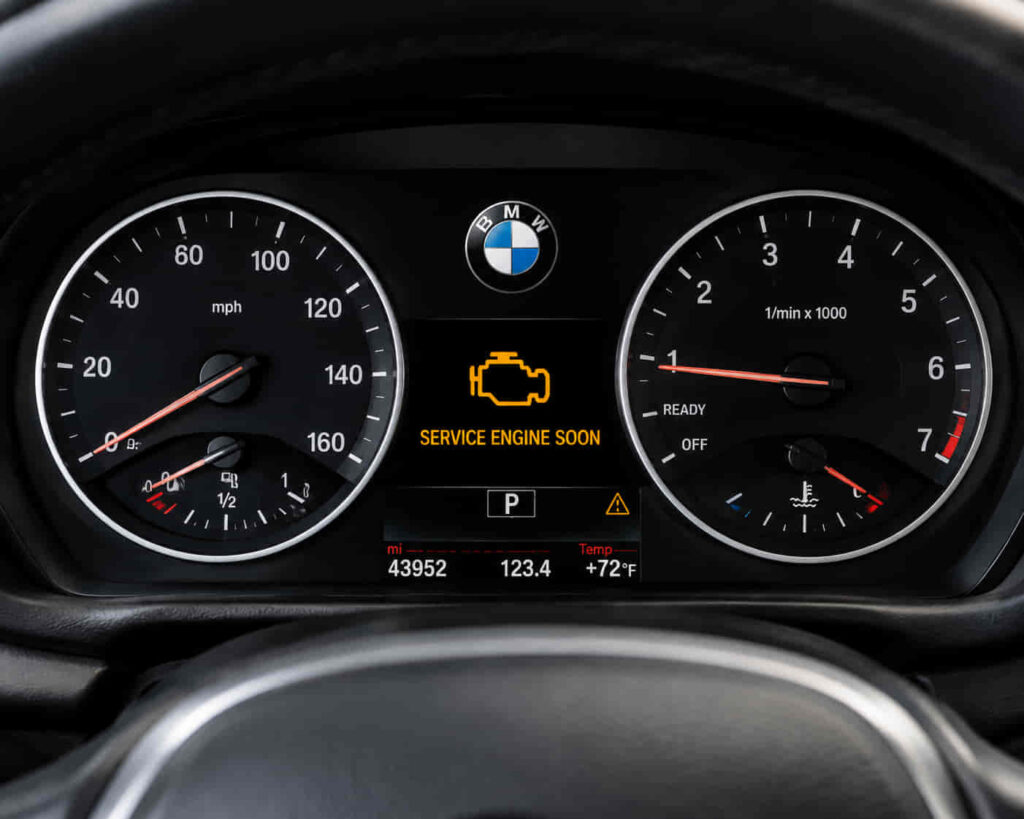
The BMW Service Engine Soon light indicates that the vehicle has detected an engine or emissions-related condition that requires inspection. This warning is part of the BMW engine management system, which continuously monitors operating conditions through sensors, control modules, and diagnostic calculations to ensure the engine operates within expected parameters.
A common misunderstanding is that the BMW Service Engine Soon warning means the engine is about to fail. The warning does not identify a specific damaged component and does not automatically indicate a major mechanical problem. Instead, it means the vehicle has detected an abnormal condition that requires further diagnosis.
The BMW engine control system follows a specific process when this warning appears. Sensors monitor engine operation, the Digital Motor Electronics (DME) evaluates the information, and if the system detects values outside the expected range, it stores diagnostic information and activates the warning.
The cause behind a BMW Service Engine Soon light can vary significantly. Problems with ignition components, fuel delivery, oxygen sensors, emissions systems, airflow measurement, electrical voltage, or communication between control modules can all trigger the same warning message.
Understanding the difference between the warning and the actual fault is essential. The light itself is only an indication that the vehicle has identified a condition requiring attention. The stored fault codes and diagnostic testing reveal which system is responsible.
This guide explains the common causes of BMW Service Engine Soon light, what systems can trigger the warning, how to determine the severity, and why proper diagnosis is more effective than simply resetting the light.
Can Ignition Problems Trigger BMW Service Engine Soon?
Ignition problems can trigger the BMW Service Engine Soon warning when combustion inside the engine becomes inconsistent or falls outside the expected operating range. The engine control system depends on stable combustion to maintain performance, fuel efficiency, and emissions control, so ignition-related issues are monitored closely by the BMW DME.
The ignition system includes components such as spark plugs and ignition coils that work together to create the spark needed for combustion. When a spark plug becomes worn or an ignition coil begins to weaken, the engine may experience incomplete combustion, misfires, rough operation, or reduced performance.
The connection between ignition problems and the Service Engine Soon warning comes from how BMW monitors engine behavior. The DME evaluates combustion quality through sensor data and operating calculations. If the system detects repeated misfires or abnormal combustion patterns, it can store diagnostic trouble codes and activate the warning light.
An ignition-related warning does not automatically mean that the engine has suffered major damage. In many cases, the issue involves normal wear components that require replacement during the vehicle’s service life. However, ignoring repeated misfires can create additional problems, including increased stress on emissions components and reduced engine efficiency.
Diagnosing ignition-related BMW Service Engine Soon warnings requires identifying whether the issue comes from spark plugs, ignition coils, fuel delivery, or another combustion-related system. Replacing ignition parts without confirming the cause may remove the symptom temporarily while allowing the actual fault to continue.
Can Fuel System Problems Cause BMW Service Engine Soon?
Fuel system problems can cause a BMW Service Engine Soon warning when the engine cannot maintain the correct fuel delivery required for stable combustion. BMW engines rely on precise fuel management, and even small deviations in fuel pressure or injection performance can affect engine operation.
The fuel system controls how fuel is delivered to the combustion chambers under different driving conditions. Components such as fuel injectors, fuel pumps, and fuel pressure control systems work together to maintain the correct air-fuel mixture. When one of these components does not perform correctly, the engine control system may detect abnormal operating conditions.
A fuel-related Service Engine Soon warning does not automatically identify one failed fuel component. Similar symptoms can result from several conditions, including incorrect fuel pressure, injector performance issues, mixture imbalance, or another engine-management problem affecting combustion.
The reason BMW activates the warning is to inform the driver that the engine is not operating within the expected parameters. The vehicle may continue running normally in some situations, but the stored fault information is needed to determine whether the issue affects performance, emissions, or long-term reliability.
Proper diagnosis of fuel-related BMW Service Engine Soon warnings requires analyzing fault codes, fuel system data, and engine operating conditions together. This approach prevents unnecessary replacement of fuel components when the actual cause comes from another system.
Read more: BMW B48 Engine Problems
Can Oxygen Sensor or Emissions Problems Trigger BMW Service Engine Soon?
Oxygen sensor and emissions system problems can trigger a BMW Service Engine Soon warning because BMW continuously monitors exhaust performance to ensure the engine operates efficiently and within emissions requirements. The engine management system uses information from oxygen sensors and related components to adjust fuel delivery, combustion efficiency, and emissions control.
Oxygen sensors measure the amount of oxygen present in the exhaust stream and provide feedback to the engine control module. This information allows the DME to adjust the air-fuel mixture and maintain proper engine operation. When an oxygen sensor provides inaccurate information or an emissions-related component does not perform correctly, the system may detect values outside the expected range.
A Service Engine Soon warning caused by an emissions issue does not automatically mean the catalytic converter or another expensive component has failed. The warning can result from several related conditions, including sensor aging, exhaust leaks, fuel mixture problems, or another engine issue affecting exhaust readings.
This is why replacing emissions components based only on the warning light can lead to unnecessary repairs. The diagnostic process must identify whether the sensor is reporting a real component failure or detecting a problem created by another part of the engine system.
Diagnosing BMW Service Engine Soon warnings related to emissions requires reviewing stored fault codes, sensor data, fuel system operation, and exhaust-related information. Understanding the complete relationship between combustion, exhaust monitoring, and engine management helps identify the actual cause.
Can Air Intake Problems Cause BMW Service Engine Soon?
Air intake problems can trigger a BMW Service Engine Soon warning when the engine receives incorrect airflow information or when the air entering the engine does not match the expected operating conditions. Modern BMW engines depend on accurate airflow measurement because the DME uses this information to calculate fuel delivery, ignition timing, and overall engine performance.
The intake system includes components responsible for controlling and measuring incoming air, including airflow sensors, throttle components, and intake passages. If there is an air leak, incorrect sensor reading, or airflow restriction, the engine management system may detect an imbalance between the expected and actual operating conditions.
An intake-related warning does not automatically mean that one specific intake component has failed. Symptoms such as rough idle, hesitation, reduced efficiency, or warning lights can result from several different conditions involving airflow, fuel mixture, ignition, or sensor data.
The reason BMW activates the Service Engine Soon warning is that incorrect airflow information can affect combustion quality and emissions performance. The DME responds by monitoring the condition and storing diagnostic information for further inspection.
Proper diagnosis of air intake-related BMW Service Engine Soon warnings requires checking airflow measurements, intake system condition, sensor performance, and stored fault codes. Identifying the actual source of the airflow problem prevents unnecessary replacement of unrelated components.
Can Battery Voltage Problems Cause BMW Service Engine Soon?
Electrical instability and low battery voltage can contribute to BMW Service Engine Soon warnings because modern BMW vehicles rely on stable electrical power for accurate engine management and communication between control modules. The engine control system depends on consistent voltage to process sensor information, control components, and maintain reliable operation.
BMW vehicles use multiple electronic modules that communicate continuously during engine operation. The Digital Motor Electronics (DME) receives information from sensors, controls engine functions, and coordinates with other systems. When voltage becomes unstable, modules may record incorrect values, communication errors, or temporary faults that can activate warning messages.
A battery-related Service Engine Soon warning does not automatically mean the battery is the only problem. The cause may involve battery condition, alternator performance, electrical connections, or another issue affecting the vehicle’s power supply. This is why replacing the battery immediately after seeing a warning light may not resolve the underlying condition.
Electrical problems can create confusing symptoms because several vehicle systems depend on the same power network. A voltage issue may affect sensor readings, module communication, and engine management decisions, causing warnings that appear unrelated to the original electrical condition.
Diagnosing voltage-related BMW Service Engine Soon warnings requires checking battery condition, charging system performance, stored fault codes, and electrical communication. Confirming the electrical condition helps prevent unnecessary replacement of engine components when the actual issue is power instability.
Can Engine Sensors Cause BMW Service Engine Soon?
Engine sensor problems can trigger a BMW Service Engine Soon warning when the engine control system receives inaccurate information about operating conditions. BMW engines depend on multiple sensors to monitor temperature, pressure, airflow, oxygen levels, and other factors required for precise engine management.
The DME uses sensor information to calculate fuel delivery, ignition timing, emissions control, and overall engine operation. When a sensor provides incorrect data, the control system may make incorrect adjustments or detect that the engine is not operating within expected parameters.
A sensor-related Service Engine Soon warning does not always mean the sensor itself has failed. Wiring problems, damaged connectors, voltage issues, contamination, or another component affecting the measured system can create similar diagnostic results. A fault code pointing to a sensor only identifies where the system detected abnormal information, not always the final failed component.
This distinction is important because replacing sensors without proper testing can result in unnecessary repairs. The correct diagnosis requires understanding the relationship between the sensor reading, the affected engine system, and the actual operating condition of the vehicle.
Diagnosing BMW Service Engine Soon warnings caused by sensor problems requires reviewing fault codes, live data, wiring conditions, and related system performance. The goal is to determine whether the sensor is the root cause or simply reporting a problem created elsewhere.
Can Software or ECU Problems Trigger BMW Service Engine Soon?
Software or ECU communication problems can trigger a BMW Service Engine Soon warning when the engine control system cannot correctly process information or coordinate vehicle systems. Modern BMW vehicles rely heavily on electronic control modules, and proper communication between these modules is required for accurate engine management.
The Digital Motor Electronics (DME) acts as the central control unit for engine operation. It receives information from sensors, evaluates operating conditions, and controls systems responsible for fuel delivery, ignition, airflow, and emissions management. If the DME detects inconsistent data, communication interruptions, or abnormal system behavior, it can store diagnostic information and activate the Service Engine Soon warning.
A software-related warning does not automatically mean that the ECU itself has failed. The issue may involve outdated software, communication errors, incorrect sensor information, voltage instability, or another system affecting how control modules exchange information.
This distinction is important because replacing electronic control modules is a major repair decision. Proper diagnosis must confirm whether the problem comes from the ECU, software condition, communication network, or another component creating incorrect information.
Diagnosing BMW Service Engine Soon warnings related to software or ECU problems requires retrieving fault codes, identifying affected modules, and verifying communication between vehicle systems. The warning message provides the starting point, while diagnostic data reveals the actual cause.
Can You Drive With BMW Service Engine Soon Light On?
You may be able to drive with a BMW Service Engine Soon light on, but the severity depends on the vehicle’s behavior, warning condition, and the underlying cause. The warning indicates that the vehicle has detected a condition requiring inspection, but it does not provide enough information to determine the exact level of risk.
A steady Service Engine Soon light with normal engine operation may indicate a condition that requires diagnosis but does not immediately prevent driving. However, additional symptoms such as rough running, reduced power, unusual noises, overheating, smoke, or flashing warning indicators suggest that the issue requires more urgent attention.
The difference between these situations depends on what triggered the warning. A minor sensor issue and a serious engine-management problem can produce a similar warning message, but their impact on vehicle operation can be very different.
Continuing to drive without understanding the cause can allow some problems to become more severe. For example, unresolved misfires can affect emissions components, while fuel or airflow problems can reduce engine efficiency and performance.
A BMW Service Engine Soon warning should be treated as a signal for diagnosis rather than ignored completely. Checking the stored fault information and evaluating vehicle symptoms provides the most accurate way to determine whether continued driving is appropriate.
How Do You Diagnose BMW Service Engine Soon Light?
BMW Service Engine Soon diagnosis begins by retrieving stored Diagnostic Trouble Codes (DTCs) and identifying which engine or emissions system triggered the warning. The warning light itself does not identify the failed component, so proper diagnosis requires analyzing the information stored inside the vehicle’s control modules.
The diagnostic process starts with scanning the vehicle, reviewing fault codes, and determining which system reported abnormal operation. The next steps involve testing the related components, checking live operating data, and confirming whether the suspected system is actually responsible for the warning.
A common mistake is replacing parts based only on symptoms or a single fault code. For example, an oxygen sensor code does not always mean the sensor itself has failed. The code may indicate that another condition, such as a fuel mixture problem or exhaust issue, is affecting sensor readings.
BMW-specific diagnostic tools can provide deeper access to vehicle modules and manufacturer-specific information compared with basic generic scanners. This is especially useful when multiple systems interact or when the warning returns after previous repairs.
The correct diagnostic sequence is: retrieve fault codes → identify affected system → test possible causes → repair the root problem → verify operation. This approach prevents unnecessary repairs and ensures the warning is properly resolved.
How Is BMW Service Engine Soon Different From Check Engine Light?
BMW Service Engine Soon and Check Engine Light are closely related because both indicate that the vehicle’s engine management system has detected an abnormal condition, but the exact terminology can vary depending on the BMW model and market.
Both warnings are connected to the vehicle’s diagnostic system and require fault-code analysis to determine the underlying cause. They can relate to similar systems, including engine operation, emissions control, sensors, fuel management, and electronic control functions.
The important distinction is that the warning message itself does not explain the severity or exact cause. Whether the vehicle displays “Service Engine Soon” or another engine warning message, the correct next step is diagnosis rather than assuming a specific component has failed.
The diagnostic process remains the same:
warning appears → fault information is stored → system is tested → root cause is identified
Understanding the relationship between BMW Service Engine Soon and Check Engine Light helps prevent confusion and encourages proper troubleshooting instead of unnecessary part replacement.
Does Resetting BMW Service Engine Soon Fix the Problem?
Resetting the BMW Service Engine Soon light does not repair the condition that caused the warning to appear. Clearing the warning only removes the stored notification temporarily, while the original fault may still exist within the engine or emissions system.
The warning appears because the DME detected an abnormal operating condition. If the cause remains unresolved, the vehicle can detect the same issue again and reactivate the warning after completing its monitoring process.
For example, resetting a warning caused by a misfire will not repair a failing ignition coil or fuel-related problem. Similarly, clearing a sensor-related fault will not correct an underlying airflow, wiring, or electrical issue.
A reset can be useful after a successful repair because it allows the vehicle to confirm that the original fault condition has been resolved. However, using reset as the first solution only removes the symptom without addressing the cause.
BMW Service Engine Soon should be diagnosed and repaired before resetting the warning. The goal is not simply to turn off the light but to restore correct engine system operation.
Why Does BMW Service Engine Soon Light Keep Coming Back?
A BMW Service Engine Soon light that repeatedly returns usually means that the original fault condition has not been fully resolved or another related problem is still affecting vehicle operation.
A recurring warning provides valuable diagnostic information because it confirms that the vehicle continues to detect abnormal conditions. This can happen when a repair addresses only the visible symptom, when a component replacement does not solve the actual cause, or when multiple related issues exist.
For example, clearing a warning caused by incorrect fuel mixture without fixing the underlying airflow or fuel delivery problem will usually result in the warning returning. The same principle applies to sensor faults, ignition issues, and electrical problems.
Repeated resets without diagnosis can delay the correct repair and may allow a smaller issue to develop into a more expensive problem.
A returning BMW Service Engine Soon warning indicates that the vehicle still requires proper diagnosis to identify and correct the root cause.
When Should BMW Service Engine Soon Be Diagnosed Professionally?
Professional diagnosis is recommended when the BMW Service Engine Soon warning returns, appears with performance changes, or cannot be explained through basic checks. Because the warning can involve multiple engine and emissions systems, accurate diagnosis requires more than simply reading the dashboard message.
Professional evaluation is especially important when the vehicle experiences symptoms such as reduced power, rough operation, unusual noises, multiple warning lights, or repeated fault codes. These conditions indicate that the engine management system continues detecting an abnormal condition.
The correct diagnostic path is:
warning appears → retrieve fault codes → identify affected system → test components → repair cause → verify operation
This process prevents unnecessary replacement of expensive parts and ensures that the actual problem is corrected.
BMW Service Engine Soon is a diagnostic warning, not a final diagnosis. Understanding how the warning system works allows owners to identify problems earlier and choose the correct repair approach.