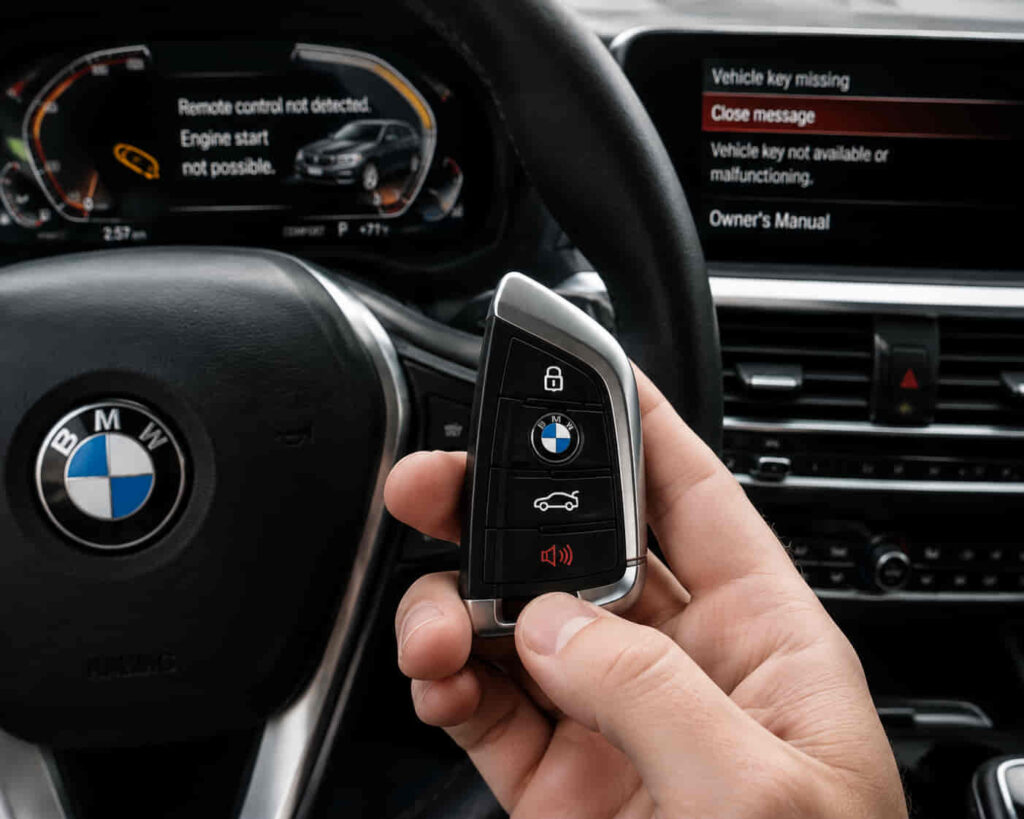
A BMW key fob that stops working after a battery change usually indicates a communication problem between the remote key and the vehicle rather than a simple battery issue. Replacing the battery restores the power source inside the key, but the remote system still depends on multiple components working together to transmit, receive, and authenticate the signal correctly.
The BMW key fob system consists of several connected elements, including the battery, internal circuit board, transmitter, vehicle receiver antenna, and body control modules such as CAS, FEM, or BDC depending on the BMW model generation. When the driver presses a button, the key sends a wireless signal to the vehicle, which then verifies the command before activating functions such as door locking, unlocking, or Comfort Access operation.
A common misunderstanding is that installing a new battery should always restore key fob operation. In reality, a new battery only solves one possible cause. The key may still fail because of incorrect battery installation, poor battery contact, internal circuit damage, lost synchronization, receiver problems, or communication issues within the vehicle’s access system.
The failure symptoms can also vary. Some BMW owners may experience a key fob that completely stops responding, while others may notice intermittent operation, reduced range, or a vehicle that does not recognize the remote even though the key appears to function normally.
The correct diagnostic approach is to identify where the communication failure occurs. The problem may exist inside the key fob, between the key and vehicle receiver, or within the electronic modules responsible for recognizing and authorizing the key.
This guide explains the common causes of BMW Key Fob Not Working After Battery Change, how the key communication system operates, how to diagnose each possible failure, and when synchronization, programming, or professional repair is required.
Can Incorrect Battery Installation Cause BMW Key Fob Problems?
Incorrect battery installation can prevent a BMW key fob from working because the transmitter inside the remote cannot receive the correct electrical power required to send a signal. Although replacing the battery is a common first step when a key fob stops responding, the replacement process must be completed correctly for the remote system to function.
BMW key fobs are designed to operate with specific battery types, and the battery must be installed with the correct polarity. If the positive and negative sides are reversed, the circuit board will not receive power even though the battery itself is new. The same problem can occur when the wrong battery specification is installed because the remote may not receive the voltage required for stable operation.
A battery replacement issue does not always mean the new battery is defective. The problem may come from incorrect installation, a battery that does not match the original specification, or damage caused during the replacement process. For example, forcing the battery into position or opening the key housing incorrectly can affect internal components.
The symptoms of incorrect battery installation are usually immediate. The BMW key fob may stop responding completely, the buttons may not activate any function, or the remote range may become extremely limited because the transmitter is not receiving stable power.
Diagnosing this type of BMW key fob problem requires checking battery type, installation direction, voltage output, and physical condition of the battery compartment. Confirming the basic power supply prevents unnecessary replacement or programming when the actual issue is simply incorrect battery installation.
Can Poor Battery Contact Cause BMW Key Fob Not Working?
Poor battery contact can cause BMW key fob failure because the remote requires a stable electrical connection between the battery and the internal circuit board. Even when the correct battery is installed in the correct position, the key fob may not operate if the contact points cannot transfer power consistently.
Inside the key fob, small metal contacts connect the battery to the electronic circuit. Over time, these contacts may become dirty, bent, loose, or damaged. During battery replacement, the contacts can also be moved accidentally, preventing the battery from sitting securely against the connection points.
A poor connection can create intermittent key fob problems rather than a complete failure. The remote may work occasionally, stop responding after movement, have reduced operating range, or function only when the battery is pressed into a certain position.
This type of issue is different from a completely failed key fob because the internal transmitter may still be functional. The problem exists in the power delivery path between the battery and the electronic components that control signal transmission.
Diagnosing BMW key fob contact problems requires inspecting the battery compartment, checking contact pressure, cleaning connection points, and verifying stable electrical supply to the transmitter circuit. Restoring proper battery contact can resolve the issue without replacing the key or performing additional programming.
Read more: BMW Level Control Malfunction
Can BMW Key Fob Circuit Damage Cause Failure After Battery Change?
Internal key fob damage can prevent BMW remote operation even after installing a new battery because the transmitter circuit may no longer be able to generate and send a valid signal to the vehicle. The battery provides electrical power, but the key fob still depends on the internal circuit board, transmitter chip, and electronic components to communicate with the vehicle access system.
The BMW key fob contains sensitive electronic components that control signal transmission and authentication. Damage to the circuit board, transmitter component, or internal connections can interrupt communication even when the battery voltage is correct. This type of failure can happen because of physical impact, water exposure, damaged solder joints, or problems that occur while opening the key housing during battery replacement.
A damaged key fob circuit does not always create a complete failure immediately. Some keys may continue working intermittently because certain internal connections still function under specific conditions. The remote may work at short range, respond inconsistently, or stop working completely after additional use.
This problem is different from a simple battery replacement issue because the key has sufficient power but cannot convert that power into a usable communication signal. Testing the transmitter function is necessary to determine whether the key is actually sending a signal.
Diagnosing BMW key fob circuit problems requires checking transmitter output, inspecting the internal components, and comparing the key’s behavior with another working remote when available. Confirming a hardware failure prevents unnecessary troubleshooting of the vehicle when the problem exists inside the key itself.
Can BMW Key Fob Lose Synchronization After Battery Change?
BMW key synchronization issues can affect remote operation when the key fob and vehicle no longer communicate correctly after a battery replacement or electrical interruption. The key fob and vehicle access system must exchange valid information before the car accepts commands such as locking, unlocking, or activating Comfort Access functions.
The BMW access system uses electronic modules such as CAS, FEM, or BDC depending on the vehicle generation to manage key recognition and authorization. These modules store information that allows the vehicle to identify approved keys. If communication between the key and vehicle becomes interrupted, the remote may stop responding even though the battery and internal electronics are working.
Replacing a battery does not normally erase key programming, but certain situations can create synchronization problems. Electrical interruptions, incorrect replacement procedures, module communication issues, or existing key-related faults may cause the vehicle to stop recognizing remote commands.
A synchronization-related problem often creates different symptoms from a dead key. The key may still contain valid electronic information but fail to control remote functions. In some cases, the vehicle may start normally because the immobilizer function and remote locking system operate through different communication processes.
Diagnosing BMW key synchronization problems requires checking key recognition, vehicle module information, remote communication, and whether the key requires synchronization or programming. Correctly identifying a communication issue prevents unnecessary replacement of a functional key fob.
Can BMW Receiver or Comfort Access Problems Cause Key Fob Failure?
BMW receiver or Comfort Access problems can prevent a key fob from working because the vehicle may not be able to receive or process the signal sent by the remote key. The key fob system depends on communication between the transmitter inside the key and electronic components inside the vehicle that detect, verify, and respond to the signal.
BMW vehicles use multiple antennas and control modules to manage remote access functions. Depending on the model generation, systems such as CAS, FEM, or BDC modules process key information and control functions such as door locking, unlocking, and Comfort Access operation. If the receiver system cannot detect the key signal correctly, the vehicle may appear to ignore the remote even when the key fob itself is working.
A vehicle-side receiver problem does not automatically mean the key fob is defective. The issue may involve damaged antenna components, communication faults, wiring problems, module errors, or interference affecting signal recognition. This is why replacing the key immediately may not solve the problem if the vehicle is unable to receive the signal.
Receiver or Comfort Access failures often create specific symptoms. The key may work when placed close to the vehicle but fail at normal distance, multiple remote functions may stop working, or the vehicle may fail to detect the key despite a correctly installed battery.
Diagnosing BMW key fob communication problems requires checking remote signal transmission, vehicle receiver operation, Comfort Access components, and body control module data. Identifying whether the failure comes from the key or the vehicle access system is essential before replacing expensive components.
Can BMW Vehicle Battery Problems Affect Key Fob Operation?
BMW vehicle battery problems can affect key fob operation because the vehicle access system requires stable electrical power to operate receiver modules and process key communication signals. The remote key does not communicate with the vehicle independently; the car must have functioning electronic modules that can receive and authenticate the incoming signal.
The CAS, FEM, or BDC modules responsible for key recognition depend on consistent power supply from the vehicle battery. When battery voltage becomes unstable, these modules may experience communication problems, enter protective modes, or fail to respond correctly to key commands.
A vehicle battery problem does not automatically mean the key fob is defective. The remote may be functioning correctly while the vehicle lacks the electrical stability required to process the signal. Low voltage conditions can also affect other electronic systems, creating multiple unrelated warnings or intermittent behavior.
Battery-related key recognition problems may appear after the vehicle has been parked for a long period, after a weak battery event, or when the electrical system experiences unstable voltage. The key may work normally at one time and fail at another depending on the vehicle’s power condition.
Diagnosing BMW key fob issues related to vehicle battery problems requires checking battery voltage, charging system performance, module communication, and stored electrical faults. Confirming the vehicle’s electrical condition helps prevent unnecessary replacement or programming of a working key fob.
Can Key Programming Problems Cause BMW Remote Failure?
Key programming problems can prevent BMW remote operation when the vehicle does not have valid authorization information to recognize and communicate with the key fob. BMW key systems use encrypted communication between the remote key and vehicle modules to ensure that only approved keys can control vehicle access functions.
The key authorization process involves electronic modules such as CAS, FEM, or BDC depending on the BMW model generation. These modules store information that allows the vehicle to identify registered keys and determine whether incoming signals should be accepted. If the authorization data is missing, corrupted, or incorrectly configured, the remote may fail to operate even with a new battery installed.
A programming-related issue does not automatically mean that the key must be replaced. The problem may involve lost synchronization, module communication errors, incorrect key registration, or previous programming attempts that were not completed correctly. Proper diagnosis is required before adding a new key or replacing existing components.
Key programming problems often appear after specific situations, such as replacing electronic modules, attempting to add additional keys, or dealing with communication faults between the key and vehicle systems. The remote may fail to unlock the vehicle, the vehicle may not recognize the key, or only certain key functions may operate.
Diagnosing BMW key programming problems requires checking key authorization data, module communication, stored faults, and whether the key is correctly registered with the vehicle. Confirming the programming status helps determine whether synchronization, reprogramming, or component replacement is required.
Why Does BMW Key Fob Lock But Not Unlock?
A BMW key fob that locks the vehicle but does not unlock it usually indicates that the remote system is partially functioning but a specific command, receiver function, or vehicle access component is not responding correctly. Because locking and unlocking functions use related but separate control processes, one function can fail while another continues to operate.
The key fob sends different commands depending on which button is pressed. The vehicle receives these signals through its access control system and activates the appropriate door lock functions. If only unlocking fails, the issue may involve button wear, signal processing, door lock actuators, or communication problems affecting that specific function.
This symptom does not automatically mean the key fob battery is weak. A low battery usually affects overall signal strength, while a single failed function may indicate a problem with the button circuit, vehicle module logic, or door locking system.
The cause can also vary depending on whether the problem affects one key or all available keys. If only one key fails, the issue is more likely related to that specific remote. If multiple keys have the same problem, the vehicle-side access system may require inspection.
Diagnosing BMW key fob lock and unlock problems requires checking remote button operation, key signal transmission, vehicle receiver response, and door lock system performance. Identifying whether the failure is inside the key or vehicle prevents replacing a functional remote unnecessarily.
Why Does BMW Key Fob Work Sometimes After Battery Change?
A BMW key fob that works intermittently after a battery change usually indicates an unstable connection, inconsistent signal transmission, or communication issue between the key and vehicle. Intermittent operation often means the system is not completely failed but cannot maintain reliable communication.
One common cause is poor battery contact inside the key fob. If the battery connection changes with movement or pressure, the transmitter may receive inconsistent power and send unreliable signals. Other possible causes include a damaged internal circuit, weak transmitter performance, or problems with the vehicle receiver system.
Intermittent key operation can also occur when the remote signal is weaker than expected. Factors such as internal component wear, antenna reception problems, or electrical interference can reduce communication reliability even after installing a new battery.
This type of problem is more difficult to diagnose than a complete failure because the key may appear normal during testing. A temporary working condition does not necessarily mean the system is repaired.
Diagnosing an intermittent BMW key fob problem requires checking battery stability, transmitter performance, signal reception, and vehicle module communication. Finding the reason for inconsistent operation prevents repeated battery replacement without solving the actual cause.
How Do You Reset BMW Key Fob After Battery Change?
Resetting or synchronizing a BMW key fob after a battery change can help resolve certain communication issues, but it does not repair damaged key hardware or vehicle access system failures. The purpose of synchronization is to restore communication between the remote key and the vehicle when the system temporarily loses recognition.
A synchronization procedure may be useful when the key has power but remote functions do not respond correctly after battery replacement. The process allows the vehicle and key to re-establish communication, depending on the BMW model and key system generation.
However, resetting the key does not fix problems caused by a damaged circuit board, failed transmitter, faulty receiver antenna, vehicle module issue, or incorrect key programming. If the same problem returns after synchronization, further diagnosis is required.
A common mistake is assuming every BMW key problem after battery replacement requires a reset. Many failures are caused by simple issues such as incorrect battery installation, poor contact, or physical key damage.
BMW key fob reset should be considered a troubleshooting step rather than a complete repair solution. The correct repair depends on identifying whether the issue comes from the key, communication system, or vehicle electronics.
How Do You Diagnose BMW Key Fob Not Working After Battery Change?
Diagnosing BMW Key Fob Not Working After Battery Change requires determining whether the failure occurs inside the key, during wireless communication, or within the vehicle access system. Because the remote system involves both the key and vehicle electronics, replacing the key immediately may not address the actual cause.
The diagnostic process begins by confirming the basic conditions of the key, including battery type, installation direction, contact quality, and physical condition. If the key has proper power, the next step is evaluating whether it transmits a valid signal and whether the vehicle receives that signal correctly.
Vehicle-side diagnosis involves checking receiver operation, CAS/FEM/BDC module communication, stored faults, and authorization information. BMW-specific diagnostic equipment can provide information that basic tools cannot access.
A common mistake is focusing only on the key battery because the problem appeared after replacement. The timing may be related, but the actual cause can involve synchronization, internal damage, or a vehicle communication issue.
The correct BMW key fob diagnostic sequence is: verify battery → inspect contacts → test key signal → check vehicle receiver → scan access modules → synchronize or program if required → verify operation.
Can You Start BMW If Key Fob Is Not Working?
A BMW may still be able to start even when the key fob remote functions are not working because remote access and vehicle immobilizer recognition use different communication processes. The ability to lock or unlock the vehicle remotely does not always determine whether the engine can recognize the key.
BMW vehicles include security systems that verify key authorization before allowing engine operation. Depending on the model and key system, the vehicle may still recognize the key when it is placed in a specific location or when the remote is physically close to the vehicle receiver.
A key fob with failed buttons does not automatically mean the vehicle cannot detect the key. However, if the vehicle cannot authenticate the key through the immobilizer system, starting the vehicle may not be possible.
Understanding the difference between remote functions and immobilizer recognition helps prevent incorrect diagnosis. A key can have a remote communication problem while the security authorization system remains functional.
Diagnosing BMW starting problems related to key recognition requires checking both remote functions and immobilizer communication rather than focusing only on the key fob buttons.
How Much Does BMW Key Fob Repair or Replacement Cost?
BMW key fob repair or replacement costs depend on whether the issue involves a simple battery/contact problem, internal key damage, synchronization, programming, or complete key replacement. The correct repair approach depends on identifying whether the failure exists inside the remote or within the vehicle access system.
Minor issues such as incorrect battery installation or poor contact may require only simple correction. More complex problems involving damaged circuits, key authorization, or programming require additional diagnosis and specialized equipment.
Replacing a BMW key fob without confirming the cause can create unnecessary expense, especially when the original key may only have a communication or synchronization issue.
The final repair requirement depends on the condition of the key, the vehicle’s access modules, and whether the system requires synchronization or programming.
BMW key fob repair costs are determined by the diagnosed cause rather than the symptom of the remote not working after battery replacement.
When Should BMW Key Fob Problems Be Diagnosed Professionally?
Professional diagnosis is recommended when a BMW key fob remains inactive after battery replacement, multiple keys fail, the vehicle does not recognize the key, or programming appears necessary. These situations indicate that the problem may involve more than the battery inside the remote.
A professional evaluation becomes especially important when the issue involves CAS, FEM, or BDC modules, Comfort Access functions, or key authorization systems. These components require specialized diagnostic information to determine whether the problem exists in the key or vehicle electronics.
The correct diagnostic process identifies the communication path between the key and vehicle by checking the remote signal, receiver operation, module data, and key authorization status. This prevents unnecessary replacement of expensive keys or electronic components.
The correct repair path is:
battery replaced → key still fails → verify key power → test communication → identify failed system → repair or synchronize → confirm operation
BMW Key Fob Not Working After Battery Change is a communication symptom, not a specific component diagnosis. Understanding the relationship between the key transmitter, vehicle receiver, access modules, and authorization system is essential for restoring reliable remote operation.