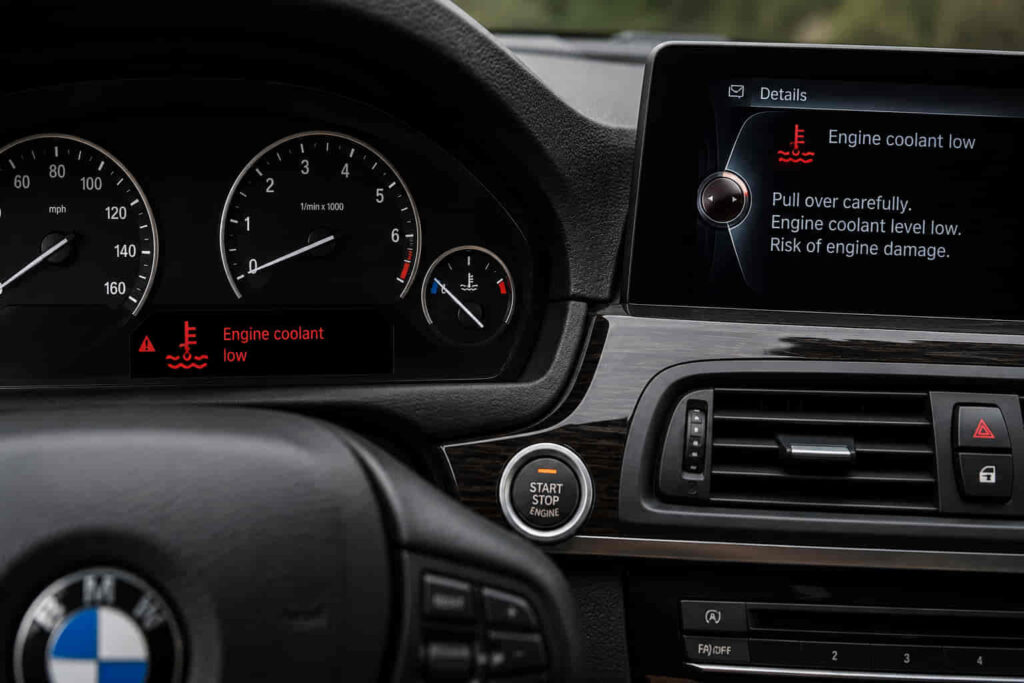
BMW Engine Coolant Low means the vehicle has detected that the coolant level inside the engine cooling system is below the required range, indicating possible coolant loss, leakage, or a cooling system problem that requires inspection. Coolant plays a critical role in maintaining engine temperature by absorbing heat from the engine and transferring it through the radiator to prevent overheating.
The BMW engine cooling system is designed as a sealed system that maintains a specific coolant level and pressure during operation. When the coolant level drops, the vehicle’s sensors can detect the change and display a warning message to alert the driver before excessive heat damages engine components.
A low coolant warning does not always mean the engine has an immediate failure, but it should never be ignored. A small coolant loss may result from aging components, while continuous coolant loss can indicate problems such as a leaking expansion tank, damaged hoses, failing water pump, or thermostat issues.
Modern BMW engines, including the B48, B58, N55, and S55, rely on precise thermal management systems to maintain performance and efficiency. Because these engines operate with advanced cooling technology, maintaining the correct coolant level is essential for protecting internal components.
This guide explains why BMW coolant levels become low, the symptoms that indicate cooling system problems, how to diagnose the cause, repair options, costs, and preventive maintenance methods to avoid overheating-related engine damage.
Why Is My BMW Engine Coolant Level Low?
A BMW engine coolant level becomes low when coolant escapes from the cooling system, when components lose their ability to maintain pressure, or when a system failure prevents proper coolant circulation. Because the BMW cooling system is designed as a closed circuit, a noticeable drop in coolant level usually indicates an underlying problem that needs to be identified.
One of the most common causes is a coolant leak. The cooling system contains multiple connections, hoses, seals, and plastic components that are exposed to repeated heat cycles. Over time, these parts can become brittle, develop cracks, or lose sealing ability, allowing coolant to escape slowly.
The coolant expansion tank is a frequent failure point on many BMW models. BMW uses an expansion tank to store coolant and manage pressure changes as the engine temperature rises and falls. Plastic aging, cracks, or damaged caps can cause coolant loss and trigger a low coolant warning.
Cooling hoses can also contribute to coolant loss. Hoses carry coolant between the engine, radiator, and other cooling components, and constant exposure to heat and pressure can weaken the material over time. A small leak may not create a visible puddle because coolant can evaporate when it contacts hot engine components.
The water pump and thermostat are also important parts of the BMW thermal management system. A failing water pump may reduce coolant circulation, while a malfunctioning thermostat may prevent the engine from regulating temperature correctly. These failures can create abnormal pressure conditions that contribute to coolant loss or overheating.
Some BMW owners may notice coolant levels dropping slightly over a long period due to normal system behavior, but frequent coolant top-ups are not considered normal. A healthy BMW cooling system should maintain its coolant level between service intervals.
For example, a BMW that requires coolant every few weeks may have a hidden leak, while a vehicle that has maintained the same coolant level for months is more likely operating normally.
What Are the Symptoms of Low Coolant in a BMW?
Low coolant in a BMW can cause warning messages, temperature changes, overheating symptoms, unusual smells, and visible signs of coolant loss. These symptoms indicate that the cooling system may no longer have enough coolant volume or pressure to maintain proper engine temperature.
The most direct symptom is the “Engine Coolant Level Low” warning message appearing on the instrument cluster. BMW uses coolant level sensors to monitor the expansion tank and alert the driver when the coolant falls below the expected level.
Engine temperature changes are another important warning sign. A BMW with insufficient coolant may experience unstable temperature regulation because the cooling system cannot efficiently transfer heat away from the engine. In severe cases, the engine temperature may rise quickly and create an overheating condition.
A sweet chemical smell after driving can indicate coolant escaping from the system. Coolant contains additives that produce a distinctive odor, and this smell may become noticeable when a small leak reaches hot engine surfaces.
Visible coolant residue or wet areas around the engine bay can also indicate a leak. Dried coolant often leaves colored deposits around the expansion tank, hoses, radiator connections, or other cooling components.
Reduced cabin heater performance can also occur because the heating system uses engine coolant to produce warm air. If coolant circulation is reduced, the heater may produce inconsistent temperatures.
Ignoring these symptoms can lead to more serious problems. Excessive heat can damage components such as the cylinder head gasket, engine seals, and internal engine parts.
For example, a BMW showing a coolant warning but maintaining normal temperature may have an early leak, while a BMW with a coolant warning combined with rising temperature requires immediate attention to prevent engine damage.
Can You Drive a BMW With Low Coolant?
Driving a BMW with low coolant can be risky because insufficient coolant may prevent the engine cooling system from controlling temperature correctly and can lead to overheating or severe engine damage. The level of risk depends on how low the coolant is, whether there is an active leak, and whether the engine temperature remains within the normal operating range.
Coolant is responsible for absorbing heat generated during combustion and transferring that heat away from the engine. When coolant levels drop, the system has less capacity to remove heat, which can cause engine temperatures to rise beyond the designed operating range.
Short-distance driving may be possible in some situations when the coolant level is only slightly below the recommended range and the engine temperature remains normal. However, continuing to drive without identifying the cause of coolant loss can allow a minor issue to develop into a major repair.
Overheating is one of the biggest risks associated with low coolant. Excessive engine temperature can damage critical components, including the cylinder head gasket, cylinder head, seals, and other internal engine parts. Modern BMW engines use precise tolerances, so overheating can create expensive mechanical problems.
A coolant warning should be treated differently depending on the symptoms. A vehicle showing only a low coolant warning requires inspection, while a BMW showing rising temperature, steam, warning lights, or unusual engine behavior should be stopped immediately.
The safest approach is to check the coolant level when the engine is completely cool and inspect for visible leaks before continuing operation. Adding coolant may temporarily restore the correct level, but it does not repair the underlying cause if coolant is escaping.
For example, a BMW with a slow expansion tank leak may continue operating for a short period after coolant is added, but driving for an extended time without repairing the leak increases the possibility of overheating.
How Do You Diagnose BMW Coolant Problems?
Diagnosing BMW coolant problems requires checking coolant level, inspecting the cooling system for leaks, testing system pressure, and evaluating components responsible for coolant circulation and temperature control. A correct diagnosis is important because adding coolant without finding the cause may only temporarily hide the problem.
The first step is checking the coolant level when the engine is cold. BMW cooling systems operate under pressure when hot, so opening the coolant reservoir while the engine is warm can be unsafe. The coolant level should be compared with the manufacturer’s recommended range.
A visual inspection is then performed to identify obvious signs of coolant loss. Technicians check areas around the expansion tank, hoses, radiator connections, water pump, and thermostat housing for leaks, residue, or damaged components.
A cooling system pressure test is one of the most effective diagnostic methods. This test applies controlled pressure to the system to identify leaks that may not be visible during normal operation. Small leaks can often be detected by observing pressure loss or locating coolant traces.
The water pump and thermostat also require inspection because they control coolant circulation and temperature regulation. A water pump failure may reduce coolant movement through the engine, while a thermostat problem can prevent proper temperature control.
Modern BMW vehicles also use electronic sensors and control modules to monitor cooling performance. Diagnostic scanning tools can identify temperature-related faults and provide additional information about possible system failures.
A complete diagnosis focuses on finding the source of coolant loss rather than only correcting the low level. This prevents repeated coolant loss and protects the engine from future overheating.
For example, if a BMW repeatedly displays a coolant warning after coolant is added, a pressure test may reveal a cracked expansion tank or leaking hose that would not be solved by simply refilling the reservoir.
Read more: Are BMW 3 Series Reliable
How Do You Fix BMW Engine Coolant Low Problems?
Fixing BMW Engine Coolant Low problems requires repairing the cause of coolant loss, restoring the correct coolant level, and ensuring the cooling system can maintain proper pressure and temperature control. Simply adding coolant may remove the warning temporarily, but it does not solve the underlying issue if the system has a leak or component failure.
If the coolant level is low because of normal service requirements or a minor level adjustment, adding the correct BMW-approved coolant mixture can restore the system to the proper level. However, frequent coolant loss indicates that further inspection is necessary because a healthy cooling system should not continuously lose coolant.
Expansion tank replacement is a common repair on some BMW models because plastic cooling components can become weak after repeated exposure to heat cycles. A cracked reservoir or damaged cap can allow coolant to escape and prevent the system from maintaining the correct pressure.
Coolant hose replacement may be required when leaks develop from aging rubber components or damaged connections. Hoses play an important role in maintaining coolant circulation between the engine, radiator, and other cooling components.
Water pump and thermostat replacement are more complex repairs because these components directly control coolant movement and temperature regulation. A failing water pump can reduce coolant circulation, while a faulty thermostat can prevent the engine from maintaining the correct operating temperature.
After any cooling system repair, the system must be properly refilled and bled to remove trapped air. Air pockets inside the cooling system can reduce circulation and create inaccurate temperature readings.
For example, replacing a leaking expansion tank may solve a slow coolant loss issue, but replacing only the coolant without repairing the leak will usually cause the warning to return.
How Much Does BMW Coolant Repair Cost?
BMW coolant repair costs vary depending on the failed component, vehicle model, labor requirements, and the complexity of the cooling system problem. A simple coolant refill is relatively inexpensive, while repairs involving major cooling components can require significantly more labor and parts.
A coolant inspection and diagnostic service is often the first expense because technicians need to identify whether the problem comes from a leak, failed component, or another cooling system issue. Accurate diagnosis prevents unnecessary replacement of parts that are still functioning correctly.
Minor repairs, such as replacing a damaged hose or coolant reservoir cap, are generally less expensive because the components are easier to access and require less labor. However, repairs involving the expansion tank, water pump, or thermostat can cost more because these components may require additional disassembly.
Water pump replacement is usually one of the more expensive cooling system repairs because BMW engines often use electronically controlled pumps and require careful installation procedures. Thermostat replacement can also involve significant labor depending on the engine design.
The exact repair cost depends on the BMW model and engine type. A BMW 3 Series with a B48 engine may have different repair requirements compared with a BMW X5 using a larger engine configuration.
Maintenance history also affects total ownership cost. A cooling system that receives regular inspections can reveal small leaks before they develop into overheating problems requiring more expensive repairs.
For example, repairing a small coolant leak early may prevent engine overheating, while continuing to drive with low coolant could result in major engine repairs.
How Can You Prevent BMW Coolant Problems?
Preventing BMW coolant problems requires regular cooling system inspections, proper maintenance, and early attention to warning signs before they develop into overheating conditions. Because BMW engines rely on precise thermal management, maintaining the cooling system is essential for long-term reliability.
Regularly checking coolant levels helps identify changes before they become serious. A coolant level that repeatedly drops indicates that the system should be inspected rather than continuously refilled.
Replacing aging cooling system components can also reduce the risk of unexpected failures. Expansion tanks, hoses, and other plastic components naturally deteriorate over time due to heat exposure and pressure changes.
Following the recommended coolant service schedule helps maintain proper protection against corrosion, temperature changes, and system contamination. Using the correct coolant specification is important because BMW cooling systems are designed around specific fluid requirements.
Monitoring warning signs is another important prevention method. Coolant smells, visible residue, temperature fluctuations, or repeated dashboard warnings should be investigated early.
Preventive maintenance is especially important for turbocharged BMW engines because they generate significant heat and depend on effective cooling performance. Engines such as the B48, B58, N55, and S55 require reliable thermal management to maintain performance and durability.
For example, a BMW owner who regularly inspects coolant levels and replaces aging cooling components can reduce the risk of overheating and avoid costly engine damage.