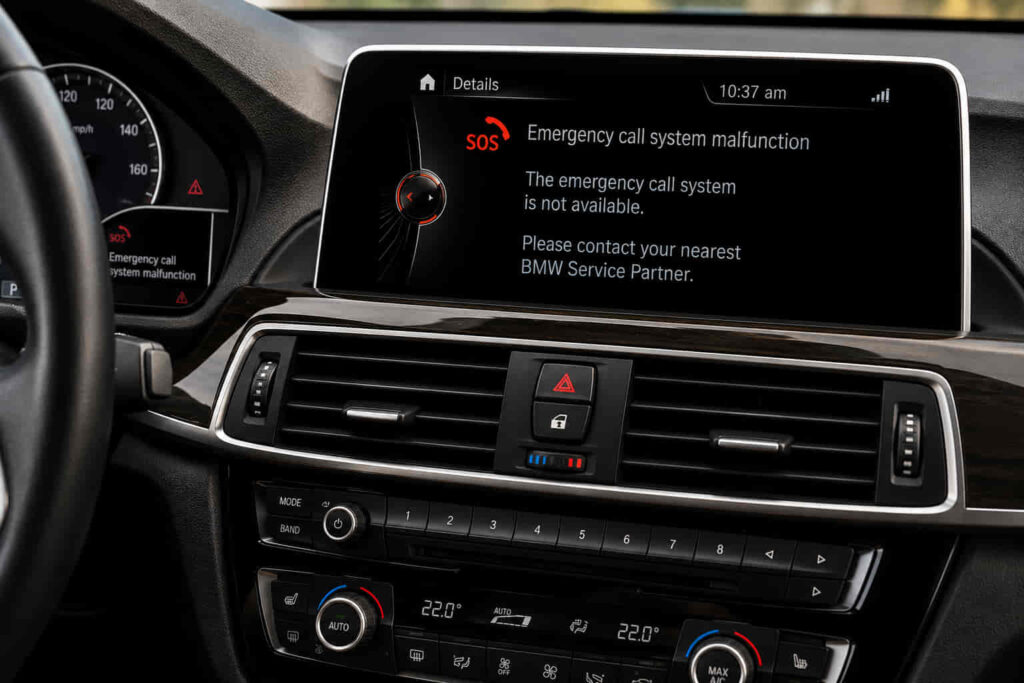
A BMW Emergency Call System Malfunction means the vehicle has detected a problem that can affect the emergency-call or related telematics system. Depending on the BMW model, production year, and equipment, the fault can involve backup power for the emergency-call system, the vehicle’s electrical supply, telematics or communication hardware, antenna and connectivity components, wiring, or software. The warning identifies a system malfunction, but it does not by itself confirm which component has failed.
This warning is different from an engine or transmission malfunction because it primarily concerns communication and emergency-call functionality rather than the drivetrain. However, it should not simply be ignored. If the affected system cannot communicate as designed, emergency-call functions may be unavailable or impaired when they are needed. A warning that disappears after restarting the vehicle also does not necessarily prove that the underlying problem has been repaired, especially if the message later returns.
Diagnosing a BMW Emergency Call System Malfunction should therefore follow the communication chain rather than immediately replacing a module or attempting repeated resets. Backup power and vehicle voltage provide the electrical foundation, while the telematics hardware, antenna or connectivity path, wiring, and software support system operation. This article explains seven causes of the warning, how each one can affect emergency-call functionality, and when a recurring malfunction requires vehicle-specific diagnosis.
Can a failing emergency-call backup battery cause the BMW warning?
Yes, a failing emergency-call backup battery can cause a BMW Emergency Call System Malfunction on vehicles equipped with a telematics system that uses a dedicated backup power source. The backup battery is designed to support relevant emergency communication functions if normal vehicle power becomes unavailable. When the system detects that this backup power source can no longer meet its expected operating requirements, it can register a fault and display an emergency-call warning.
The backup battery serves a different purpose from the BMW’s main vehicle battery. Emergency-call functionality is designed around the need for communication during situations in which normal vehicle power may be interrupted or compromised. A dedicated backup power source gives the telematics system an additional means of maintaining required functionality. As that battery ages or loses its ability to provide the expected electrical output, system monitoring can identify the condition as a malfunction.
This failure can create a situation in which the vehicle otherwise appears to operate normally. The engine may start, infotainment functions may remain available, and no obvious drivetrain symptom may occur because the fault is located within the emergency communication system rather than the propulsion system. The dashboard warning can therefore be the primary indication that the backup-power function requires attention.
However, the presence of the warning does not prove that the backup battery is defective. BMW emergency-call architectures vary by model, equipment, and production period, and other electrical or communication faults can generate a similar symptom. Diagnosis should use vehicle-specific fault information to determine whether the backup power source is actually responsible before a battery or telematics component is replaced.
Replacing a confirmed failed backup battery addresses the power-source fault, but simply clearing the warning does not. If the system continues detecting inadequate backup power, the malfunction can remain or return after the warning state is reset. The correct diagnostic relationship is emergency-call warning → identify backup-power fault → confirm the affected component → repair the fault → verify system operation.
Can a weak BMW battery cause an Emergency Call System Malfunction?
A weak main vehicle battery or unstable electrical supply can contribute to a BMW Emergency Call System Malfunction because the telematics system depends on the vehicle’s electrical network for normal operation. Electronic modules require appropriate power and communication conditions, so an electrical-supply problem can affect systems beyond starting the engine.
The main vehicle battery must be distinguished from the dedicated emergency-call backup battery. The vehicle battery supplies the broader electrical system during applicable operating states, while the emergency-call backup power source serves a specific supporting role on systems equipped with one. A fault in either power domain can therefore affect telematics operation through a different mechanism.
Electrical supply deserves greater diagnostic attention when the emergency-call warning appears alongside other electrical symptoms. Starting difficulties, several apparently unrelated warning messages, intermittent electronic functions, or evidence of charging-system problems can indicate that the malfunction is part of a broader electrical condition rather than an isolated telematics failure. In that situation, testing the vehicle’s electrical supply provides more useful evidence than immediately replacing the emergency-call module.
A weak battery is not the only electrical possibility. The charging system must maintain the required electrical conditions while the vehicle operates, and power or ground delivery to the relevant module must also remain intact. Replacing the main battery without confirming its condition can therefore fail to solve the warning when the actual problem lies elsewhere in the electrical path.
The opposite diagnostic result is equally useful. If the main battery, charging operation, power supply, and relevant electrical conditions test correctly while the Emergency Call System Malfunction continues to return, diagnosis should move toward the telematics system itself rather than repeatedly blaming the vehicle battery. Electrical testing is a process for eliminating or confirming a fault domain, not a universal BMW emergency-call reset.
Read more: BMW Transmission Malfunction Reset
Can a telematics or communication module fault trigger the warning?
Yes, a fault in the BMW telematics or communication hardware can trigger an Emergency Call System Malfunction because this hardware forms part of the communication chain required for emergency-call functions. If the relevant module cannot operate, communicate with other vehicle systems, or perform an expected telematics function, the vehicle can detect the abnormal condition and display the warning.
The telematics hardware acts as an interface between vehicle information and external communication functions supported by the emergency-call system. Depending on the BMW model, production period, and equipment, the exact module architecture can differ. This is why one module name, location, or replacement procedure should not be applied universally to every BMW displaying the same warning.
A module-related problem can also affect functions beyond the warning message itself. If several communication or connected functions associated with the same vehicle system become unavailable at the same time, that symptom pattern can provide additional diagnostic context. However, simultaneous function loss still does not prove that the module itself requires replacement because a module can stop communicating when its power supply, ground, wiring, network connection, or another supporting component is faulty.
Diagnostic fault information is therefore important before replacing telematics hardware. A technician can determine whether the relevant module communicates with the vehicle, whether power and network conditions are present, and whether stored faults point toward an internal module problem or another part of the system. This distinction prevents a system-level communication failure from being incorrectly diagnosed as an automatically failed module.
Module replacement can also involve more than physically installing another component. Depending on the specific BMW system, vehicle configuration and replacement component, programming or configuration procedures may be required for proper integration. The repair path should therefore follow the architecture and diagnostic requirements of the specific vehicle rather than a generic BMW emergency-call repair procedure.
The correct relationship is Emergency Call System Malfunction → verify communication and electrical conditions → identify the affected telematics hardware → confirm the failure mechanism → repair and configure the system as required. A warning alone establishes that the system detected a problem; it does not establish that the communication module is the component that must be replaced.
Can antenna or connectivity problems affect the BMW Emergency Call System?
Yes, antenna or connectivity problems can affect a BMW Emergency Call System when they interrupt the communication or location-related functions required by the vehicle’s telematics architecture. The emergency-call system depends on more than a functioning control module. Relevant information and communication must also travel through the supporting connection path for the system to operate as designed.
An antenna-related fault creates a different failure mechanism from an internally defective telematics module. The communication hardware may remain operational while a problem elsewhere in the signal path prevents the system from obtaining or transmitting information correctly. Depending on the vehicle architecture, this can make antenna components, connections, or related communication paths relevant during diagnosis.
Connectivity conditions also need to be interpreted carefully. Temporary poor network availability in a particular location does not automatically prove that the BMW has a defective antenna or communication module. An intermittent external connection and a persistent vehicle-side malfunction are different diagnostic states. A warning that repeatedly occurs across normal operating locations provides different evidence from a temporary loss of service in an area with limited connectivity.
Location-related functionality can also form part of the broader emergency communication context on equipped vehicles. For an emergency service to receive useful vehicle or location information, the relevant systems must be able to generate, route, and communicate that information according to the vehicle’s design. A failure anywhere along that path can affect system functionality even if other infotainment features continue to operate normally.
Diagnosis should consequently evaluate the communication chain rather than assuming that poor connectivity means the antenna must be replaced. The relevant module, antenna path, electrical connections, vehicle network, and available fault information provide separate pieces of evidence. Testing which part of that chain is failing helps distinguish an external connectivity condition from a vehicle-side hardware problem.
The key distinction is telematics hardware → processes and manages communication, while antenna/connectivity components → support the path required for that communication. Either area can contribute to a BMW Emergency Call System Malfunction, but the same dashboard warning does not mean they require the same repair.
Can damaged wiring or connectors cause an emergency-call malfunction?
Yes, damaged wiring or poor electrical connections can cause a BMW Emergency Call System Malfunction when they interrupt the power, ground, signal, or network communication required by the telematics system. A communication module can be functional internally and still become unavailable to the rest of the vehicle if the electrical path connecting it to supporting systems is compromised.
This distinction matters because the emergency-call system operates as a network of related components rather than as one isolated module. Power must reach the relevant electronics, electrical grounds must remain reliable, and communication signals must travel between components according to the vehicle’s architecture. An open circuit, damaged connector, poor contact, or wiring problem within one of these paths can therefore produce a system-level malfunction even when the telematics hardware itself has not failed.
Intermittent electrical connections can make diagnosis more difficult because the warning may not remain present continuously. Movement, vibration, moisture, temperature changes, or changes in electrical load can alter the behavior of an already compromised connection. A malfunction that appears intermittently therefore requires evidence from stored faults and electrical testing rather than the assumption that a warning which temporarily disappears has repaired itself.
The relationship between wiring and module diagnosis is especially important when communication with the relevant telematics hardware is lost. A module that does not respond during a diagnostic scan is not automatically a failed module. The same symptom can occur if the module lacks its required power or ground, or if the network path used to communicate with it has been interrupted. Confirming these supporting conditions helps separate a connection fault from an internal hardware failure.
Repair should consequently target the confirmed electrical fault rather than the dashboard message. Replacing a functioning communication module while leaving a damaged connection unresolved can result in the same BMW Emergency Call System Malfunction returning. The diagnostic relationship is module communication failure → verify power, ground, connectors, wiring, and network path → isolate the failed connection or component → repair → verify system communication.
Can BMW software cause an Emergency Call System Malfunction?
Yes, a software or control-system problem can contribute to a BMW Emergency Call System Malfunction when the telematics system does not initialize, communicate, or perform an expected function correctly. Software should be considered one possible fault domain rather than a universal explanation, because the same warning can also result from backup-power, electrical, communication-hardware, antenna, or wiring problems.
A temporary system state can sometimes change after the vehicle or relevant electronic systems initialize again. If the warning disappears after a restart, this provides evidence that system state may have influenced the symptom, but it does not prove that the underlying cause was exclusively software-related. A recurring warning indicates that the triggering condition has either remained present or occurred again.
A software update or programming procedure is also different from a basic restart. Restarting reloads the current system state, whereas programming or updating changes the software environment used by the relevant module. Neither procedure should be presented as a guaranteed repair unless diagnosis indicates that software or configuration is actually responsible for the malfunction.
This distinction prevents repeated resets from masking the diagnostic pattern. If an Emergency Call System Malfunction disappears temporarily and then returns under similar conditions, recurrence provides useful evidence. Stored fault information, module communication status, electrical supply, and the behavior of related telematics functions can help determine whether the problem belongs to the software layer or another part of the communication chain.
Software diagnosis must also remain vehicle-specific. BMW models and production periods can use different telematics architectures and software configurations, so a reset or programming procedure appropriate for one system should not automatically be applied to another. The vehicle’s configuration and diagnostic information should determine the appropriate software action.
The correct distinction is restart → reinitialize the existing system state; programming or update → change the software state; diagnosis → determine why the malfunction occurred; repair → correct the confirmed failure mechanism. If the warning continues to return after relevant software and electrical conditions have been evaluated, the diagnostic process should move toward identifying the persistent system fault rather than repeatedly attempting to make the message disappear.
What should you do if the BMW Emergency Call System Malfunction keeps returning?
If the BMW Emergency Call System Malfunction keeps returning, the vehicle should be diagnosed for the underlying telematics, electrical, communication, or software fault rather than repeatedly resetting the warning. A recurring message indicates that the system has detected the malfunction again after the previous warning disappeared or the electronic systems were reinitialized. At this stage, recurrence itself becomes useful diagnostic evidence.
The first objective is to determine which part of the emergency-call system is reporting the fault. Vehicle-specific diagnostic information can help establish whether the problem is associated with backup power, electrical supply, telematics hardware, communication paths, antenna-related components, or another monitored condition. A dashboard warning identifies the affected system at a broad level, while diagnostic data provides the additional context required to narrow the failure domain.
The pattern of related symptoms can provide further evidence. If the emergency-call warning appears together with broader electrical problems, power-supply diagnosis becomes more relevant. If other communication or connected functions associated with the telematics system are also unavailable, attention can shift toward communication hardware, its electrical supply, or the vehicle network. An isolated but recurring warning can still require diagnosis because the system may detect a fault that is not immediately visible through other vehicle functions.
A warning that temporarily disappears after restarting the BMW should be interpreted in the same way. Restarting can change the current electronic state, but it does not establish that backup power, wiring, antenna components, communication hardware, or software is functioning correctly. If the warning returns, repeatedly restarting the vehicle provides less diagnostic value than identifying the conditions under which the malfunction is being detected.
Repair should follow the confirmed failure mechanism. A failed backup-power component requires a different correction from an unstable vehicle electrical supply, damaged connection, antenna-path problem, software condition, or defective communication module. Replacing components based only on the warning can therefore increase repair cost without resolving the actual fault. The system architecture and repair requirements should also be matched to the specific BMW because telematics equipment can differ across models and production periods.
Verification after repair is equally important. Making the dashboard warning disappear confirms only that the message is no longer being displayed at that moment; it does not by itself demonstrate that all required emergency-call functionality has been restored. Verification should follow the appropriate diagnostic procedure for the vehicle and should not involve placing an unnecessary emergency call simply to test the system.
The correct troubleshooting sequence is BMW Emergency Call System Malfunction → identify the affected fault domain → verify backup and vehicle power → evaluate telematics communication and connectivity → inspect relevant electrical paths → assess software when applicable → repair the confirmed fault → verify system operation. This distinction separates warning removal from actual repair and ensures that the objective is restoring the emergency-call system rather than simply clearing the message.