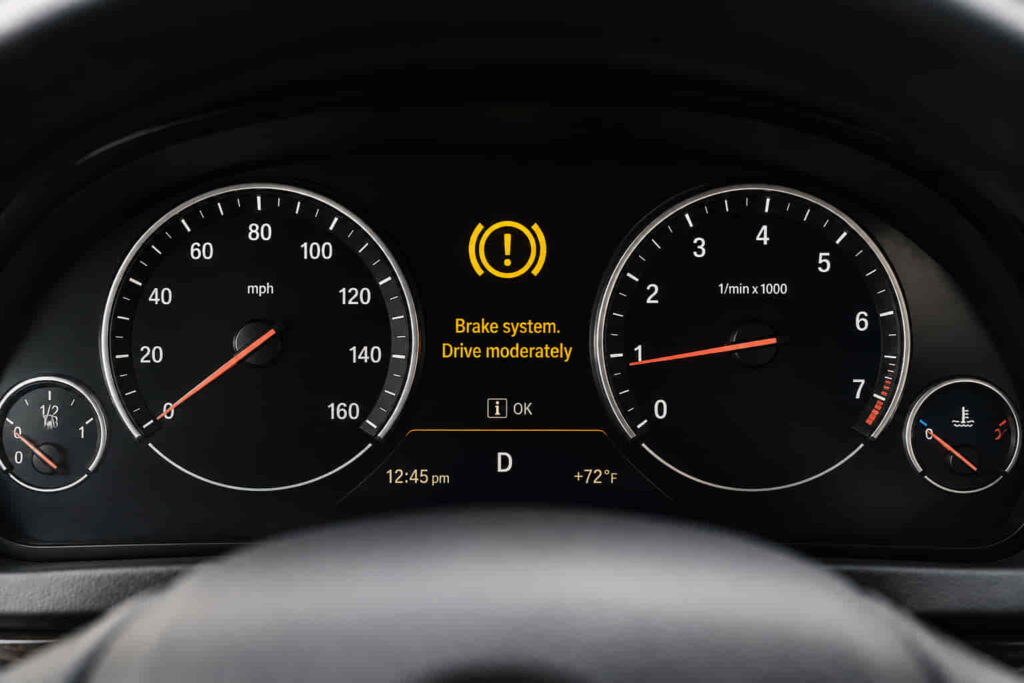
The BMW “Brake System: Drive Moderately” warning indicates that the vehicle has detected a condition involving the braking system that requires attention. The message alone does not identify the failed component or confirm one specific repair. The cause must be determined from the accompanying warning information, changes in braking behavior, and vehicle diagnostics rather than by repeatedly restarting the car or attempting to clear the message.
There are 7 main areas to investigate when a BMW displays a Brake System: Drive Moderately warning. Depending on the vehicle and the fault detected, the issue may involve a brake-related condition, a sensor or control input, an ABS or stability-control function, an electrical problem, or another component involved in brake assistance and monitoring. These possibilities do not carry the same level of risk, which makes diagnosis more important than treating every BMW brake warning as the same fault.
Because the braking system directly affects vehicle control, the first priority is determining whether braking performance has changed. A warning that appears while the brakes continue to behave normally requires a different response from a warning accompanied by abnormal pedal behavior or reduced braking performance. The following sections explain the possible causes, how they affect the BMW brake system, and when the warning requires immediate escalation rather than another reset attempt.
Can a Brake Fluid or Hydraulic Problem Trigger the BMW “Drive Moderately” Warning?
A brake fluid or hydraulic-system problem can contribute to a BMW brake warning when the condition affects the braking system’s ability to generate, maintain, or monitor the hydraulic pressure required for normal braking. However, the “Brake System: Drive Moderately” message alone does not confirm low brake fluid or identify a hydraulic component as the cause. The warning must be interpreted together with other vehicle messages, brake-pedal behavior, and diagnostic information.
Hydraulic pressure is fundamental to conventional service-brake operation. When the driver presses the brake pedal, braking force must be transmitted through the hydraulic system to the wheel brakes. A loss of fluid, an abnormal hydraulic condition, or a fault involving components responsible for hydraulic brake operation can therefore affect braking performance and trigger additional warning information when the vehicle detects the condition.
Brake fluid level also needs to be interpreted rather than treated as an isolated repair target. Adding fluid without identifying why the level is abnormal does not establish that the brake system has been repaired. A change in fluid level can require inspection of the braking system and its components, particularly when the vehicle also displays a brake-system warning. The diagnostic goal is to identify the condition responsible for the warning rather than simply make the warning disappear.
Pedal behavior provides important safety context. A brake pedal that suddenly feels substantially different, requires unusual effort, travels abnormally, or is accompanied by reduced braking performance represents a different situation from a warning with no noticeable change in braking. When braking performance is abnormal, continuing to drive merely because the message says “Drive Moderately” is not an appropriate interpretation of the warning. The braking condition takes priority over attempts to reset or clear the message.
Can Worn Brake Components Cause a BMW Brake System Warning?
Worn brake components can produce brake-related warnings on a BMW, but normal brake wear should not automatically be identified as the cause of a “Brake System: Drive Moderately” message. BMW vehicles can monitor service-related brake conditions separately from faults affecting braking or electronically controlled brake functions, so the exact warning displayed matters when determining the underlying problem.
Brake pads are designed to wear as friction material is consumed during braking. A brake wear monitoring system can alert the driver when service is required, but a brake-pad service indication and a brake-system malfunction warning do not necessarily describe the same condition. Replacing pads solely because a broader brake-system warning appears can therefore result in repairing a component that was not responsible for the message.
The same distinction applies to other mechanical brake components. Physical wear, damage, or a condition affecting normal brake operation can require service, but the warning itself does not identify which component should be replaced. Inspection must establish whether the friction components and related hardware are within acceptable condition and whether their state corresponds with the warning information stored by the vehicle.
This distinction prevents two diagnostic errors. The first is assuming every BMW brake warning means the brake pads are worn. The second is assuming a recent brake service eliminates every possible brake-system fault. A vehicle can have acceptable friction components while another monitored brake function has a problem. The warning message, physical brake condition, braking behavior, and diagnostic information must agree before brake wear is identified as the cause of the “Drive Moderately” warning.
Can a Brake Sensor Problem Cause the “Drive Moderately” Message?
A brake-related sensor or input fault can contribute to a BMW brake-system warning when the vehicle receives missing, implausible, or inconsistent information needed to monitor or control a braking function. However, the “Brake System: Drive Moderately” message does not identify a particular sensor as defective. Diagnostic information is required to determine whether the warning originates from an input problem, another brake component, or the control system that processes the data.
Modern BMW braking functions depend on information exchanged between mechanical components, sensors, and electronic control systems. Sensors provide operating data that control modules use to determine vehicle and braking conditions. When required information is unavailable or does not correspond with other expected values, a related control function may become limited and the vehicle can generate warning information rather than continue relying on data it considers unreliable.
This mechanism explains why replacing a sensor based only on the dashboard message is not a reliable diagnosis. A stored fault associated with a sensor circuit does not always prove that the sensor itself is physically defective because wiring, connectors, power supply, communication, or another related condition can affect the signal reaching the control module. The diagnostic process must determine whether the input is actually incorrect and why it became incorrect before a component is replaced.
The distinction is especially important when the brakes still appear to operate mechanically but an electronically managed function is limited. A driver may interpret normal pedal response as proof that the entire brake system is functioning normally, even though a monitored or assisted function has recorded a fault. The warning should therefore be evaluated according to the specific vehicle messages and diagnostic results rather than cleared on the assumption that a temporary sensor error caused it.
Can an ABS or DSC Fault Trigger a BMW Brake System Warning?
An ABS or DSC-related fault can be associated with BMW brake-system warnings because these systems use braking and vehicle-dynamics information to support wheel-slip and stability control. A fault affecting one of these functions does not necessarily mean that all mechanical braking has been lost, but it can mean that an electronic braking or stability function is limited or unavailable. The exact effect depends on the fault and the warning information displayed by the specific BMW.
The Anti-lock Braking System and Dynamic Stability Control perform different functions from the basic friction brakes even though they interact with braking. Conventional braking generates the force used to slow the vehicle. ABS manages wheel behavior during braking conditions where wheel lock is a concern, while DSC uses vehicle and wheel information to intervene when the system detects conditions relevant to stability. This distinction explains how a BMW can retain basic braking capability while simultaneously reporting a fault in an electronically controlled braking function.
A control-system fault can also generate more than one warning because ABS and stability functions share information with other vehicle systems. The presence of several related messages therefore provides diagnostic context, but it does not identify the failed component by itself. Fault information must be read in combination with the symptoms and the systems affected before determining whether the problem originates from a sensor, electrical circuit, control unit, or another component in the braking-control network.
Drivers should not interpret retained basic braking as permission to ignore an ABS or DSC-related brake warning. Losing or limiting an electronic assistance function can change how the vehicle responds under conditions where that function would normally intervene. The appropriate response is to distinguish basic brake operation from the affected assistance function, moderate vehicle operation only when the vehicle’s warning instructions and actual braking behavior permit it, and diagnose the underlying fault rather than treating disappearance of the warning as proof of repair.
Read more: BMW App Not Updating
Can a Wheel-Speed Sensor Problem Affect the BMW Brake System?
A wheel-speed sensor problem can affect BMW braking and stability-control functions because ABS and DSC depend on wheel-speed information to determine how individual wheels are behaving. When the system cannot obtain reliable wheel-speed data, functions that depend on that input can become limited and related warnings may appear. However, the “Brake System: Drive Moderately” message alone does not prove that a wheel-speed sensor has failed.
Wheel-speed information allows electronically controlled systems to compare wheel behavior while the vehicle is moving and braking. ABS uses this information when managing wheel slip during braking, while DSC uses wheel and vehicle data when determining whether stability intervention is required. A missing or implausible wheel-speed signal can therefore affect more than one function because the same input can be used by several interconnected control systems.
This relationship explains why a wheel-speed-related problem can be accompanied by multiple warnings rather than one isolated message. The diagnostic focus should be the input path rather than immediately replacing the sensor. A sensor can be one possible source of incorrect data, but wiring, connectors, signal integrity, or another condition affecting communication can produce a related fault. Diagnostic information must identify which wheel or signal is affected and whether the sensor itself is responsible.
A wheel-speed fault also illustrates why basic braking and electronically assisted braking functions should be evaluated separately. The driver may still be able to slow the vehicle using the mechanical and hydraulic brakes while ABS or stability-related assistance is limited. That does not make the warning irrelevant. The loss of a supporting function can change vehicle behavior in conditions where electronic intervention would normally occur, so the underlying input fault should be diagnosed rather than repeatedly cleared.
Can a Low-Voltage or Electrical Problem Cause a BMW Brake Warning?
An electrical or voltage-related fault can contribute to BMW brake-system warnings when electronically controlled braking functions do not receive the power, communication, or operating conditions they require. This does not mean that every “Brake System: Drive Moderately” warning indicates a weak battery. Electrical supply is one diagnostic area to consider when the warning occurs alongside evidence of broader electronic or control-system problems.
Modern braking systems combine hydraulic and mechanical components with electronic control modules, sensors, actuators, and communication networks. These electronically managed functions depend on an adequate electrical supply and reliable communication. If operating voltage or electrical communication falls outside the conditions required by a control system, the vehicle can record faults or restrict functions that depend on that system.
The surrounding symptoms help determine whether an electrical condition deserves greater diagnostic attention. Several unrelated electronic warnings appearing together, problems occurring around a low-voltage event, or multiple control systems reporting communication faults create a different diagnostic pattern from one isolated brake-related fault. Even then, the pattern indicates that the electrical system should be tested; it does not establish that the battery is automatically the failed component.
Replacing or charging the battery solely to make a BMW brake warning disappear is therefore not a complete diagnostic strategy. The electrical system must be evaluated to determine whether voltage is actually abnormal and whether the brake-related fault resulted from that condition. If electrical operation is normal but the “Drive Moderately” warning persists, diagnosis should return to the braking system, its inputs, and its control or assistance functions. A low-voltage condition can explain a warning only when diagnostic evidence connects the electrical problem to the affected brake system.
Can a Brake Control or Assistance Fault Trigger “Drive Moderately”?
A brake control or assistance fault can trigger a BMW brake-system warning when a function responsible for controlling, supporting, or monitoring braking cannot operate as intended. The “Brake System: Drive Moderately” message does not identify the failed component by itself, so a control or assistance fault should be confirmed through the accompanying vehicle messages, braking symptoms, and diagnostic information.
BMW braking combines mechanical and hydraulic braking with electronically managed functions. These systems do not all perform the same task. The hydraulic brakes generate braking force, while control and assistance functions can manage or support how that braking force is applied under specific operating conditions. A fault affecting an assistance function can therefore change braking characteristics without necessarily producing a complete loss of the vehicle’s basic ability to slow down.
This distinction matters when evaluating pedal behavior. A fault affecting brake assistance can require the driver to apply braking differently or can limit a function that normally supports braking performance. The exact effect depends on which system is affected, so the dashboard warning should not be converted into a component diagnosis without further evidence. A diagnostic scan can identify stored fault information, while physical inspection and system testing establish whether the problem lies in a control component, assistance function, electrical connection, sensor input, or another part of the braking system.
A control or assistance fault should not be addressed by clearing the warning and continuing to drive as if the repair were complete. Removing a stored message does not restore a malfunctioning component. The underlying brake-system condition must be identified and corrected before normal operation can be confirmed.
What Does “Brake System: Drive Moderately” Mean on a BMW?
“Brake System: Drive Moderately” means the BMW has detected a brake-related condition and is instructing the driver to modify vehicle operation while the condition is addressed. “Drive Moderately” describes the action requested from the driver; it is not the name or diagnosis of the underlying fault.
This distinction explains why searching the warning text does not produce one universal failed component. A hydraulic condition, electronically controlled braking problem, sensor/input issue, or another brake-related fault can create different diagnostic circumstances. The warning establishes that the braking system requires attention, while additional vehicle messages and fault information help identify what requires attention.
The phrase “Drive Moderately” should also not be interpreted as unconditional permission to continue driving. The instruction must be considered together with the vehicle’s other warnings and actual braking behavior. A vehicle that displays the message while braking normally presents a different risk condition from one with a significant change in brake-pedal response or braking performance.
For that reason, the warning should lead to evaluation rather than an immediate reset attempt. Determine whether braking behavior has changed, review any additional messages displayed by the vehicle, and diagnose the affected system. The objective is to establish why BMW generated the warning rather than simply remove the text from the display.
Can You Drive a BMW With the “Brake System: Drive Moderately” Warning?
Do not assume a BMW is safe to continue driving solely because the warning includes the words “Drive Moderately.” Whether continued operation is appropriate depends on the accompanying vehicle instructions and whether the brakes continue to respond normally. A noticeable reduction or significant change in braking performance requires a more cautious response than an isolated warning with normal brake behavior.
Braking response is the primary practical distinction because the brake system directly controls the vehicle’s ability to slow and stop. A pedal that behaves substantially differently from normal, braking that requires unusual effort, or an apparent reduction in stopping capability indicates that the condition is affecting more than the warning display. Continuing to drive under those circumstances can increase the distance or effort required to control the vehicle.
An isolated warning with apparently normal braking does not establish that the vehicle has no fault. Electronic braking, ABS, DSC, or another assistance function can be impaired while basic braking remains available. The driver may not notice the limitation during ordinary low-demand braking, but the affected function may matter under conditions where the system would normally intervene.
The safest interpretation is therefore conditional. Follow the vehicle-specific warning instructions and treat any deterioration in braking performance as a reason to stop relying on “Drive Moderately” as permission to continue. A brake-system warning requires diagnosis even when the vehicle still appears to brake normally.
Will Restarting the BMW Clear the Brake System Warning?
Restarting a BMW may cause a temporary brake-system warning to disappear, but a cleared message does not prove that the underlying condition has been repaired. Restarting changes the vehicle’s operating session and allows control systems to perform new checks, but it does not physically repair a defective brake component, restore a failed sensor, or correct a persistent hydraulic problem.
A warning that disappears after restart provides diagnostic information rather than confirmation of repair. The condition may have been temporary, or the fault may not be present during the next system check. If the same condition occurs again, the warning can return because the underlying cause was never removed.
This is particularly important when a warning is intermittent. Electrical connections, sensor signals, voltage conditions, and control-system faults can appear under specific operating circumstances and then disappear temporarily. An intermittent warning should therefore be documented and diagnosed when it recurs rather than dismissed simply because the dashboard becomes clear after restarting the vehicle.
Restarting is consequently different from repairing. Warning disappearance describes the current display state; repair describes correction of the condition that generated the warning. Treating those outcomes as equivalent can leave a brake-related fault unresolved.
Can You Reset the BMW “Brake System: Drive Moderately” Warning?
A BMW “Brake System: Drive Moderately” warning should not be reset as a substitute for diagnosing and correcting the condition that triggered it. If a repair or service procedure requires a reset afterward, that reset is part of completing the procedure rather than the repair itself.
Clearing fault information can remove visible evidence of a detected problem without changing the mechanical, hydraulic, sensor, electrical, or control-system condition responsible for it. If that condition remains present, the vehicle can detect it again and restore the warning. This is why repeated code clearing is not an effective repair strategy for a persistent brake-system fault.
Diagnosis should come before reset. The relevant vehicle messages, braking behavior, stored diagnostic information, and physical condition of the braking system provide the evidence needed to identify the affected function. Once the underlying fault has been corrected, the appropriate vehicle-specific service or verification procedure can be completed when required.
This sequence separates warning management from fault repair. The purpose of diagnosis is not merely to turn off a dashboard message; it is to restore the affected braking function and verify that the system operates normally.
How Is a BMW “Brake System: Drive Moderately” Warning Diagnosed?
A BMW “Brake System: Drive Moderately” warning is diagnosed by combining the warning context, actual braking behavior, stored fault information, and inspection or testing of the system identified by that evidence. The warning text alone is not sufficient to select a replacement component.
The diagnostic process starts with the conditions surrounding the warning. Whether the message appeared during startup, while driving, after another electrical warning, or together with ABS or DSC messages can change which systems deserve attention. Brake-pedal behavior and braking performance add another layer of evidence because they help distinguish an apparent assistance or control-system issue from a condition that directly affects braking response.
Diagnostic trouble codes can then narrow the investigation to a system, circuit, signal, or component group. A code should be interpreted as evidence of where the vehicle detected an abnormal condition rather than automatic proof that the named component requires replacement. For example, an abnormal sensor signal can originate from the sensor itself or from the wiring, connection, electrical supply, or another condition affecting the input.
The final diagnosis comes from confirming the fault with appropriate inspection and testing. This evidence-based sequence prevents unnecessary component replacement and reduces the chance that a warning is temporarily cleared while the actual brake-system problem remains.
When Should You Stop Driving a BMW With a Brake System Warning?
Stop driving when a BMW brake-system warning is accompanied by a significant change in braking performance, abnormal brake-pedal behavior, or a vehicle instruction that requires you to stop. A brake warning should not be treated like a non-critical convenience-system fault because deterioration in braking can directly affect the ability to slow and control the vehicle.
The decision should be based on braking condition rather than the warning phrase alone. A pedal that suddenly behaves substantially differently, braking that requires abnormal effort, or noticeably reduced stopping performance indicates that normal braking operation cannot be assumed. Continuing to drive in that state increases exposure to a condition in which the vehicle may not respond as expected when braking demand increases.
Even when braking appears normal, a persistent warning still requires diagnosis because an electronic assistance or stability-related function may be unavailable without being obvious during ordinary driving. The absence of a noticeable symptom therefore does not prove that every braking function is operating normally.
The correct sequence is recognize the warning, evaluate braking behavior, follow the vehicle-specific instruction, diagnose the affected system, repair the confirmed fault, and verify normal brake operation. This resolves the cause rather than treating disappearance of the “Brake System: Drive Moderately” message as the objective.