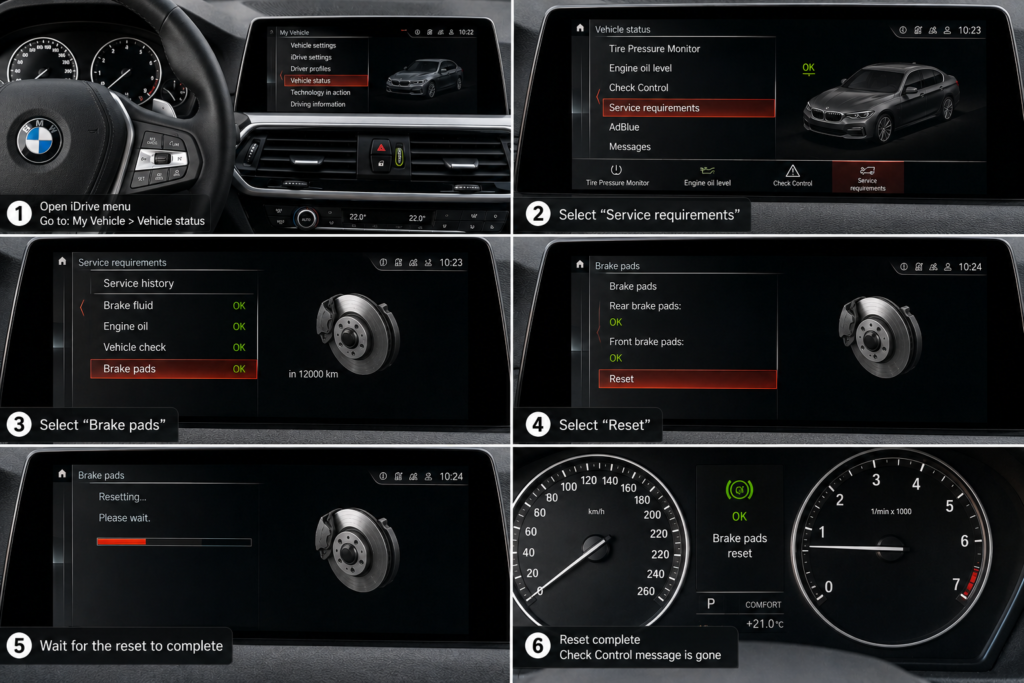
BMW brake sensor reset usually refers to resetting the brake-related Condition Based Service (CBS) information after the required brake maintenance has been completed. It does not mean repairing the brake sensor itself or resetting the entire BMW brake system. BMW’s technical documentation explains that brake pad wear sensors monitor brake-pad condition, while CBS uses brake-wear information to determine the remaining service interval and display the front or rear brake service status.
The distinction matters because a BMW brake warning can involve two separate elements: the physical wear sensor and the CBS service information stored by the vehicle. On BMW systems using a single-stage wear sensor, the sensor circuit opens when the wear limit is reached, causing the control module to recognize the condition and activate the brake pad warning. BMW states that the wear sensor should be replaced when the brake pads are replaced, followed by resetting the corresponding CBS data.
A reset therefore should normally follow completed brake maintenance rather than substitute for it. If the sensor is damaged, the brake pads remain worn, or the vehicle detects another brake-related fault, resetting the service information alone will not correct the underlying condition.
There are 7 important things to know about BMW brake sensor reset, including what the sensor actually monitors, how CBS reset works, when the sensor needs replacement, why reset procedures vary between BMW generations, how to verify a successful reset, and what to do when the brake warning returns.
Does a BMW Brake Sensor Need to Be Reset After Brake Pad Replacement?
The BMW brake service information should be reset after the applicable brake-pad maintenance has been completed, while the physical brake pad wear sensor should be replaced when the brake pads are replaced. BMW technical training documentation explicitly states that wear sensors should be replaced with the brake pads and that the corresponding CBS data should then be reset.
The reason is that the sensor and CBS perform different functions. The wear sensor monitors the brake-pad wear condition through its electrical circuit. On BMW systems using a single-stage sensor, the sensor contains a conductor loop; when that loop is broken at the wear limit, the control module recognizes an open circuit and activates the brake-pad warning.
Replacing the brake pads without addressing the sensor can therefore leave the vehicle with an unresolved wear-sensor condition. Conversely, resetting the CBS service information without performing the required brake maintenance does not restore brake-pad thickness or repair a damaged sensor circuit.
The correct service relationship is worn brake pads → replace brake pads and applicable wear sensor → reset the corresponding CBS brake-service data → verify the service status. BMW’s technical material also emphasizes that CBS reset is intended to follow the maintenance operation rather than substitute for it.
What Is the Difference Between a BMW Brake Sensor Reset and a CBS Reset?
A BMW brake sensor reset and a CBS reset are related but are not technically the same operation. The brake wear sensor is a physical component that detects a defined wear condition, while the Condition Based Service system stores and displays the vehicle’s calculated maintenance information. The reset updates the CBS service status after the required brake work has been completed.
BMW’s technical documentation describes CBS as a system that calculates and manages service items, while brake-pad wear is associated with sensor information and CBS brake-service data. This creates two distinct layers in the brake-service process: the sensor provides wear information, while CBS manages the service interval and its displayed status.
The distinction becomes particularly important when a BMW displays a brake service warning. Clearing or resetting the CBS value does not repair an open sensor circuit. BMW documentation specifically states that when a single-stage wear-sensor loop is broken, the control module recognizes an open circuit and activates the brake-pad warning.
The practical relationship is therefore brake sensor → wear condition → CBS information → service reset. A BMW brake sensor reset should not be described as simply “resetting the sensor,” because the sensor itself is not repaired or electronically reset by changing the CBS service value.
Can You Reset BMW Brake Service Without Replacing the Brake Sensor?
A BMW CBS brake-service reset does not replace a brake pad wear sensor that has reached its wear limit or has an open circuit. The reset changes the stored service information, while the sensor remains a physical part of the brake-wear monitoring system. BMW technical documentation explains that when the wear-sensor circuit is interrupted at the specified wear condition, the control module recognizes an open circuit and activates the brake-pad warning.
The distinction is important after brake-pad replacement. If the old sensor has already reached its wear limit, installing new brake pads without replacing the applicable sensor can leave the vehicle with the same electrical wear condition. Resetting the CBS value does not reconnect a broken sensor circuit or restore a damaged component.
BMW’s brake-service documentation therefore connects brake-pad replacement, wear-sensor replacement, and CBS reset as related maintenance operations. The reset is performed after the required maintenance rather than being used to bypass the physical condition of the brake system.
The correct diagnostic relationship is worn brake pads → sensor reaches wear condition → brake maintenance → applicable sensor replacement → CBS reset. If the warning remains after the reset, the next step is to determine whether the sensor, its circuit, or another brake-related system is still reporting a fault.
How Do You Reset the BMW Brake Service Warning?
The BMW brake-service reset procedure depends on the vehicle generation and instrument cluster, so there is no single button sequence that applies to every BMW. BMW technical training material describes CBS reset functions that can be accessed through the instrument cluster on applicable vehicles, while the exact menu structure and operating method vary by vehicle generation.
On supported BMW systems, the reset process generally involves accessing the vehicle’s CBS/service information, selecting the relevant brake service item, and confirming the reset after the brake maintenance has been completed. BMW documentation for applicable vehicles describes entering the relevant service/reset mode through the instrument cluster and using the vehicle’s control input to select the service item.
The important point is that the front brake and rear brake service items are managed as separate CBS information, so the correct brake service entry must be selected. Resetting the wrong service item does not update the brake interval that generated the warning.
The procedure also should not be confused with clearing diagnostic trouble codes. A CBS reset updates maintenance information; a diagnostic scan identifies active or stored faults. If the brake warning remains after the correct CBS reset, repeating the reset is not a substitute for checking the sensor circuit and brake system.
How Do You Know if the BMW Brake Sensor Reset Worked?
A BMW brake sensor reset has worked when the applicable CBS brake-service item accepts the reset and the brake-service information changes to the expected status without an immediate recurring warning. The reset should be verified through the vehicle’s service information rather than assuming that the procedure succeeded simply because the reset command was accepted.
BMW’s CBS system manages individual maintenance items and calculates service information based on vehicle operating conditions. For brake pads, the system uses wear information to determine the remaining service requirement. After the required brake maintenance has been completed, the corresponding CBS data can be reset so the vehicle begins calculating the new service interval.
The physical brake system must also correspond to the reset. If new brake pads and the applicable wear sensor have been installed correctly, a successful CBS reset should not immediately reproduce the original brake-service warning. If the warning returns immediately, the reset itself is not sufficient evidence that the brake system is functioning correctly.
The correct verification sequence is completed brake maintenance → applicable sensor condition verified → correct CBS brake item reset → service status checked → warning monitored for recurrence. This distinction prevents a temporary disappearance of the message from being mistaken for a successful repair.
Why Won’t the BMW Brake Sensor Reset?
A BMW brake sensor reset can fail when the vehicle still detects an invalid brake-service condition, a worn or incorrectly installed sensor, an open sensor circuit, or another fault affecting the CBS brake-service information. Resetting the service interval cannot correct a physical problem that continues to generate the warning.
The brake wear sensor is part of an electrical monitoring circuit. BMW technical documentation explains that, on systems using a single-stage wear sensor, the circuit opens when the sensor reaches its specified wear limit, allowing the control module to recognize the wear condition and activate the brake-pad warning. If the circuit remains open after brake service, a CBS reset does not repair that electrical condition.
Incorrect sensor installation can produce a similar result. The new brake pad may be correctly installed while the sensor or its connection is not properly positioned or connected. In that situation, resetting the CBS information changes the maintenance data but does not remove the electrical condition detected by the vehicle.
Another possibility is that the warning is not actually a CBS service reminder. BMW has multiple brake-related monitoring and control functions, so an ABS, brake-system, or other diagnostic fault should not be treated as a simple service-interval problem.
If the BMW brake sensor reset is rejected or the warning immediately returns, the correct next step is to identify the specific fault rather than repeatedly attempting the same reset. The sensor, wiring, brake condition, CBS data, and relevant diagnostic information should be evaluated in relation to the actual warning.
Does a BMW Brake Sensor Reset Clear the Brake Warning?
A BMW CBS reset can clear a brake-service warning when the required brake maintenance has been completed correctly, but it does not clear every brake-system fault. The reset updates the applicable Condition Based Service information; it does not repair a defective wear sensor, worn brake component, or active brake-system fault.
BMW’s CBS system manages service information for individual maintenance items, including brake-related service. After the required maintenance is performed, the corresponding CBS data can be reset so the vehicle begins calculating the next service interval.
This creates an important distinction between a service reminder and a fault warning. A CBS brake-service message can be related to the calculated maintenance interval, while an open brake-wear sensor circuit can cause the vehicle to detect a physical electrical condition. BMW documentation explains that a broken wear-sensor circuit can activate the brake-pad warning, so resetting the service interval does not repair that circuit.
The same principle applies to other brake-related warnings. An ABS or brake-system fault is not automatically a CBS service reminder and should not be treated as something that can be solved by resetting the maintenance interval.
The correct relationship is brake maintenance → sensor condition → CBS service data → reset → verification. If the brake warning remains after the correct reset, the underlying condition needs to be identified rather than repeatedly clearing the service information.
Do You Need to Replace the BMW Brake Sensor When Changing Brake Pads?
The applicable BMW brake pad wear sensor should be replaced when the brake pads are replaced if the sensor has reached its wear condition. BMW technical training documentation specifically connects brake-pad replacement with replacement of the wear sensor and subsequent CBS reset.
The reason is that the sensor is designed to provide information about brake-pad wear through its electrical circuit. Once the sensor has reached its specified wear condition, its circuit can change state and the vehicle can recognize that the brake pads require service. Installing new pads while leaving a triggered sensor in place does not restore the sensor’s original condition.
The sensor also needs to be installed correctly. A new brake pad does not automatically mean that the monitoring circuit is functioning correctly. The sensor connection and associated wiring must provide the expected electrical signal before the CBS reset can be considered complete.
The practical service sequence is therefore replace worn brake pads → replace the applicable wear sensor → verify the sensor circuit → reset the corresponding CBS brake service → verify the warning is resolved. The exact sensor configuration varies by BMW model and brake system, so the vehicle-specific service procedure remains important.
Is the BMW Front Brake Sensor Reset Different From the Rear Brake Reset?
BMW front and rear brake service information can be managed as separate CBS service items, so resetting the correct brake service item matters. A front-brake service reset should not be treated as a universal reset for every brake-related maintenance counter.
BMW’s CBS system is designed to manage individual service items and calculate their service requirements separately. This allows the vehicle to display different remaining service information for different maintenance areas, including brake-related service.
The distinction becomes important after replacing only one axle’s brake pads. If the front brake pads and sensor were replaced, the corresponding front brake service item should be selected for reset. Resetting an unrelated service item does not update the maintenance information associated with the serviced brakes.
This is also why a generic instruction such as “reset the BMW brake sensor” can be misleading. The vehicle may contain separate front and rear brake service information, and the exact terminology shown in the instrument cluster depends on the BMW generation.
The correct approach is to identify which brake service was performed and reset the corresponding CBS item.
Can You Reset BMW Brake Service Without a Scan Tool?
Some BMW vehicles allow applicable CBS brake-service information to be reset through the instrument cluster without a separate diagnostic scanner, while other vehicles or fault conditions may require diagnostic equipment. The available procedure depends on the vehicle generation and its instrument-cluster implementation.
BMW technical training material documents CBS reset functions that can be accessed through the instrument cluster on applicable vehicles, including a procedure involving the vehicle’s control input to select and reset a service item. This means a scan tool is not universally required simply to reset a routine CBS service interval.
However, a CBS reset and diagnostic scan perform different functions. The instrument-cluster procedure can update the maintenance status, while diagnostic equipment can retrieve fault information and identify problems affecting the sensor circuit or brake-control system.
This distinction matters when a reset fails. If the BMW accepts the CBS reset and the service information updates normally, a dedicated diagnostic scanner may not be necessary for that specific maintenance operation. If the reset is rejected or the warning returns, diagnostic equipment becomes more useful because the problem may no longer be a simple service-interval issue.
Can ISTA Reset the BMW Brake Sensor?
BMW diagnostic equipment such as ISTA can be used for vehicle-specific diagnosis and supported service functions, but its role should be distinguished from the simple CBS reset available on some BMW instrument clusters. A diagnostic system communicates with the vehicle’s control modules and can provide information that is not available from the dashboard service menu alone.
This becomes useful when the brake sensor warning does not behave as expected after maintenance. A diagnostic system can help determine whether the vehicle is reporting a sensor-circuit problem, another brake-related fault, or a condition affecting the CBS data.
The benefit is therefore not simply that ISTA “resets the sensor.” The diagnostic system provides a deeper view of the vehicle’s electronic condition, allowing the technician to connect the warning with the relevant control module and stored fault information.
CBS reset is a maintenance operation; ISTA-based diagnosis is a diagnostic operation. They can be used together when necessary, but they should not be described as the same procedure.
Why Does the BMW Brake Warning Come Back After Reset?
A BMW brake warning can return after a successful CBS reset when the underlying sensor, brake, wiring, or electronic condition remains unresolved. A reset changes service information, but it cannot repair a physical component or an active electrical fault.
If the wear sensor was not replaced when required, the vehicle can continue to detect the same wear condition. BMW explains that the wear sensor’s electrical circuit can open at the specified wear limit, which causes the control module to recognize the condition and activate the brake-pad warning.
A warning can also return when the new sensor is incorrectly installed or its electrical connection is faulty. In that situation, the brake pads may be new and the CBS counter may have been reset correctly, but the vehicle still receives an invalid sensor signal.
Another possibility is that the displayed warning is associated with a different brake-related system rather than CBS. If ABS, brake-system, or other diagnostic warnings appear at the same time, the problem should be evaluated as a broader brake-system fault.
A recurring warning is therefore evidence that the reset did not address the root condition. The correct next step is to identify the active fault instead of repeatedly resetting the CBS service item.
When Should a BMW Brake Sensor Warning Be Diagnosed Professionally?
A BMW brake sensor warning should be professionally diagnosed when the reset repeatedly fails, the warning returns immediately, the sensor has already been replaced, or other brake-related warnings appear. These conditions indicate that the problem may extend beyond a normal CBS service reset.
Professional diagnosis becomes particularly important when the brake warning is accompanied by abnormal braking behavior, ABS warnings, or other indications that the vehicle’s braking system may not be operating normally. A CBS reset is designed to update maintenance information, not to establish that the complete brake system is safe or mechanically sound.
The diagnostic process should distinguish between brake-pad condition, wear-sensor condition, sensor wiring, CBS service data, and other brake-control faults. This prevents unnecessary replacement of components when the actual problem is an electrical circuit or unrelated brake-system fault.
The correct diagnostic journey is therefore complete the required brake maintenance → replace the applicable wear sensor → reset the correct CBS service item → verify the warning → diagnose any persistent fault. If the warning continues after these steps, repeated resets provide little additional value.