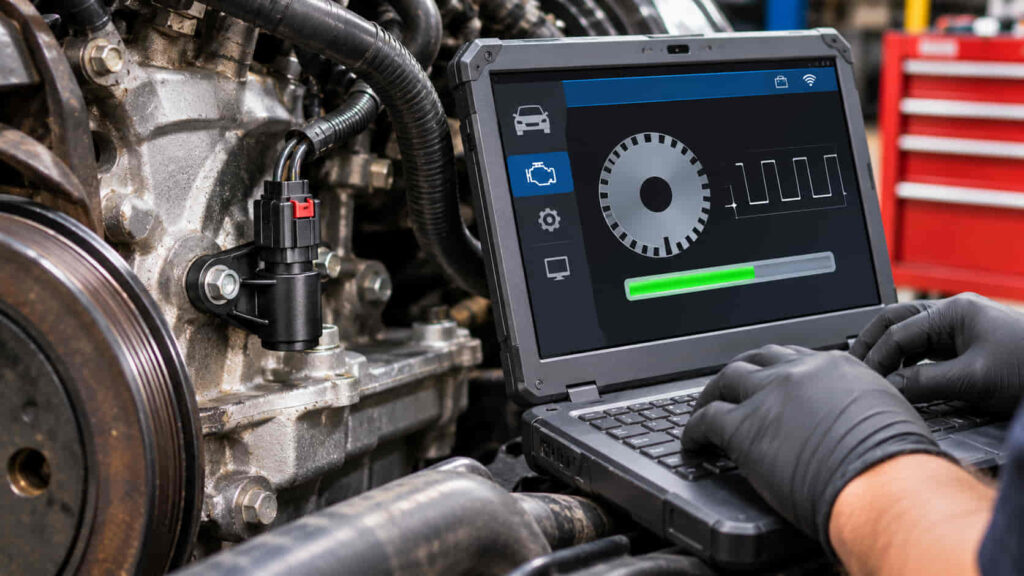
Crankshaft Position Sensor Relearn: Complete Procedure, Tools & Troubleshooting
A crankshaft position sensor relearn is a calibration procedure that allows a vehicle’s engine control module (ECM) or powertrain control module (PCM) to recognize small variations in the crankshaft position signal. The procedure helps the computer distinguish normal crankshaft speed fluctuations from those caused by engine misfires.
A crankshaft position sensor relearn may be necessary after replacing the crankshaft position sensor, crankshaft, reluctor wheel, harmonic balancer, engine assembly, or engine control module. However, the exact requirements depend on the vehicle manufacturer, engine, model year, and type of repair.
On many General Motors vehicles, the procedure is called Crankshaft Position Variation Learn or CASE Relearn. Ford uses the term Misfire Monitor Neutral Profile Correction for certain applications, while Honda refers to CKP Pattern Learn.
Some vehicles require a bidirectional diagnostic scan tool to complete the relearn, while others support a manufacturer-defined driving procedure. There is no universal method that works on every vehicle.
On certain GM engines, the technician must activate the relearn function using a compatible scan tool and briefly increase engine speed until the ECM initiates a calibrated fuel cutoff. The accelerator must be released immediately when instructed.
Other manufacturers use controlled acceleration or deceleration events to learn crankshaft position variations.
Because the procedures differ significantly, a generic instruction to disconnect the battery, let the engine idle, or drive at highway speed is not a reliable solution for every vehicle.
A missing crankshaft position relearn may trigger diagnostic trouble code P0315, which generally indicates that the crankshaft position variation values have not been learned. Certain older GM vehicles may instead display P1336.
However, codes such as P0335 and P0336 can indicate actual crankshaft sensor signal or circuit problems. These conditions require mechanical or electrical diagnosis rather than simply performing a relearn.
Understanding the difference is essential for avoiding unnecessary sensor replacement, incorrect engine repairs, and persistent check engine lights.
This guide explains how crankshaft position sensor relearn works, when it is required, the seven main steps involved, manufacturer-specific differences, diagnostic trouble codes, scan tool requirements, repair costs, and common reasons the procedure fails.
What Is a Crankshaft Position Sensor Relearn?
A crankshaft position sensor relearn is an electronic calibration that teaches the ECM or PCM the normal timing variations present in the crankshaft position sensor signal.
The crankshaft position sensor monitors crankshaft rotation.
It detects reference points as a toothed wheel, reluctor ring, or another position-sensing component rotates with the crankshaft.
The sensor sends electrical signals to the engine computer.
These signals help determine crankshaft position and rotational speed.
The information is essential for controlling ignition timing, fuel injection, and other engine functions.
However, no crankshaft or reluctor wheel is manufactured with absolutely perfect geometry.
Small differences in tooth spacing, component position, and mechanical tolerances can influence the timing between sensor pulses.
The engine computer must account for these variations when monitoring combustion.
A misfire can cause a temporary change in crankshaft rotational speed.
Without accurate compensation, the ECM may confuse normal mechanical variation with an actual misfire.
The relearn procedure allows the computer to establish reference values for the installed crankshaft and sensor arrangement.
These values are stored in the control module’s memory.
The engine computer then uses them to improve misfire detection and other relevant monitoring functions.
The relearn does not physically adjust the crankshaft or reposition the sensor.
It updates the electronic reference information used by the engine control system.
How Does the Crankshaft Position Sensor Work?
The crankshaft position sensor measures crankshaft rotation by detecting changes associated with a reluctor wheel or another rotating reference component.
The crankshaft converts the pistons’ reciprocating movement into rotational motion.
The engine computer must know the position and speed of this rotation to coordinate combustion.
Many engines use a toothed reluctor wheel attached to the crankshaft.
As the wheel rotates, its teeth and reference gaps pass the crankshaft position sensor.
The sensor generates an electrical signal corresponding to those events.
Depending on the engine, the sensor may use magnetic induction, a Hall-effect design, or another electronic sensing method.
The ECM interprets the signal to determine engine speed and crankshaft position.
This information works alongside camshaft position sensor data.
Together, these signals help the engine computer identify the correct combustion timing and cylinder events.
If the crankshaft position signal disappears, the engine may stall or fail to start.
However, this is different from a missing relearn calibration.
A sensor can produce a valid signal while the ECM still lacks the variation compensation values required for accurate misfire monitoring.
Therefore, crankshaft sensor replacement and crankshaft sensor relearn are two separate operations.
The first restores or maintains the physical sensor signal.
The second establishes the required electronic calibration.
Why Is a Crankshaft Position Sensor Relearn Necessary?
The relearn procedure is necessary on applicable vehicles because small changes in the relationship between the sensor and rotating components can affect crankshaft speed interpretation.
The engine computer monitors changes in crankshaft rotational speed to identify possible misfires.
During normal combustion, each cylinder contributes torque to the crankshaft.
If a cylinder misfires, its contribution changes.
The ECM may detect a corresponding speed fluctuation.
However, manufacturing tolerances can also influence the measured pulse intervals.
A crankshaft position variation relearn helps the ECM separate these normal characteristics from actual combustion irregularities.
This becomes especially important after components are replaced.
A new crankshaft position sensor may sit in a slightly different physical position.
A replacement crankshaft or reluctor wheel may have different mechanical characteristics.
Replacing the engine control module may also remove the previously stored calibration.
Certain transmission or engine repairs can disturb the relationship between the rotating parts and sensor signals.
The required relearn depends on how the manufacturer designed the monitoring system.
On some vehicles, the computer learns the necessary information during normal operation.
On others, a technician must command the calibration with a diagnostic scan tool.
The purpose is to restore accurate engine monitoring, not to compensate for a defective sensor or damaged reluctor wheel.
When Is a Crankshaft Position Sensor Relearn Required?
A crankshaft position sensor relearn is commonly required after specific engine or electronic repairs, but the manufacturer determines which operations trigger the requirement.
General Motors service information identifies crankshaft sensor replacement as a common reason for performing the procedure.
The same applies to certain crankshaft replacements, engine assembly replacements, and repairs that disturb the relationship between the crankshaft and its position sensor.
Replacing the harmonic balancer or another relevant rotating component may also require recalibration.
An ECM replacement or programming operation can create a similar requirement.
Ford identifies crankshaft sensor replacement, trigger wheel repairs, engine timing work, and certain engine or transmission removals as possible reasons for its Misfire Monitor Neutral Profile Correction procedure.
Honda provides CKP pattern learning procedures for specific engines and service operations.
However, not every vehicle requires recalibration after each repair.
Some control modules retain learned values through ordinary battery disconnection.
Others can establish new values through prescribed driving conditions.
Therefore, the correct decision should come from the vehicle’s service manual.
If a crankshaft sensor has been replaced and the check engine light remains illuminated, the diagnostic trouble codes should be read before attempting another repair.
A relearn may be necessary, but sensor wiring or mechanical faults should also be considered.
Read more: Ford 302 Torque Specs Guide
Step 1: Identify the Vehicle and Correct Relearn Procedure
The first step is identifying the vehicle’s manufacturer, model, engine, and production year so the correct crankshaft position relearn procedure can be selected.
Different manufacturers use different control strategies.
Even vehicles from the same company may require different procedures.
For example, an older GM engine may use a CASE relearn routine with a specific fuel cutoff speed.
A newer GM engine may use a different diagnostic menu and additional prerequisite checks.
A Ford vehicle may require Misfire Monitor Neutral Profile Correction.
A Honda may use CKP Pattern Learn.
Certain Nissan applications can use controlled driving conditions to evaluate crankshaft signal variation.
These procedures should not be combined.
The vehicle identification number can help establish the exact engine configuration.
A professional repair information system can then identify the correct calibration procedure.
The technician should also confirm which component was replaced.
Replacing a crankshaft position sensor is different from replacing a camshaft position sensor.
The applicable service instructions may require different calibration routines.
A generic online procedure should not be used merely because it worked on another vehicle with the same number of cylinders.
Correct identification prevents unnecessary work and reduces the risk of using the wrong engine speed or operating conditions.
Step 2: Check Diagnostic Trouble Codes
Before performing a crankshaft position sensor relearn, use a compatible diagnostic scan tool to check for stored or active engine control trouble codes.
The relearn should not be treated as the first solution to every starting or misfire complaint.
A malfunctioning sensor may produce an invalid signal.
An electrical fault can prevent the engine computer from identifying crankshaft position correctly.
A damaged reluctor wheel can also interfere with the signal.
Therefore, existing diagnostic codes must be evaluated.
Code P0315 commonly indicates that crankshaft position variation values have not been learned.
However, P0335 generally points toward a crankshaft position sensor circuit problem.
P0336 can indicate a signal range or performance problem.
Certain manufacturer-specific versions of P1336 also involve crankshaft or camshaft position relationships.
The exact meaning of P1336 must be checked for the vehicle.
A GM engine with a missing relearn may display P1336 in older applications.
A Ford vehicle can use P1336 for a different diagnostic condition.
The mechanic should review all codes before proceeding.
Some GM service procedures specifically require other sensor or engine temperature faults to be corrected before the relearn can run.
Clearing trouble codes without diagnosing their causes may temporarily extinguish the warning light but will not restore a missing or defective crankshaft signal.
Step 3: Inspect the Crankshaft Sensor and Related Components
The crankshaft position sensor and its associated wiring should be inspected before calibration to confirm that the ECM receives a valid signal.
The sensor must be installed correctly.
Its connector should be fully seated.
The wiring harness must not have damaged insulation, loose terminals, or corrosion.
Certain sensors also require a specific relationship with the reluctor wheel.
An incorrect air gap can interfere with signal quality.
Metal debris or foreign material near the sensor may also create problems.
The reluctor wheel itself must be inspected when damage is suspected.
A broken tooth, bent ring, or incorrect installation can cause abnormal pulse patterns.
An engine with incorrect mechanical timing may also produce sensor correlation problems.
These conditions cannot be corrected through electronic relearning alone.
The ECM can compensate for certain normal manufacturing variations.
It cannot restore a missing reluctor tooth or repair an open electrical circuit.
A diagnostic scan tool can help monitor whether the engine computer recognizes crankshaft speed.
On a vehicle with a crankshaft sensor circuit failure, engine RPM data may be missing or abnormal during cranking.
However, the exact interpretation depends on engine architecture.
An oscilloscope may be useful when diagnosing intermittent or distorted sensor signals.
Once the related components are confirmed to be functioning normally, the calibration procedure can be attempted.
Step 4: Prepare the Vehicle for the Relearn
Most scan-tool-controlled crankshaft relearn procedures require the vehicle to be secured and the engine to reach specified operating conditions before calibration begins.
The exact requirements vary.
For many GM applications, the engine must reach normal operating temperature.
A representative modern GM service procedure requires coolant temperature above 70°C, equivalent to 158°F.
However, other applications may use different thresholds.
The battery and charging system must also provide adequate voltage.
Certain GM procedures specify that ignition voltage must exceed 11 volts.
The vehicle should be positioned according to the manufacturer’s safety instructions.
For stationary procedures, this generally includes selecting Park or Neutral and applying the parking brake.
Wheel chocks may also be required.
The service brake requirements must come from the exact vehicle procedure because some diagnostic routines specify different brake-pedal conditions during different stages.
The air-conditioning system or other accessories may need to be switched off.
The scan tool should be connected to the diagnostic connector.
Before proceeding, the technician should review all instructions displayed by the tool.
Some relearn routines briefly command or require high engine speeds.
These procedures should only be performed by someone familiar with the relevant safety precautions.
An engine with abnormal noise, low oil pressure, overheating, or an unresolved mechanical fault should not be subjected to a high-RPM relearn attempt.
Step 5: Activate the Crankshaft Position Relearn Function
On vehicles that require commanded calibration, the technician must use a diagnostic scan tool capable of accessing the manufacturer’s crankshaft variation learning function.
A basic OBD-II code reader may not provide this capability.
The scan tool must support the specific vehicle’s service functions.
On many GM vehicles, the function appears as Crankshaft Position Variation Learn, CKP Variation Learn, or CASE Relearn.
The exact menu structure depends on the diagnostic platform.
For one documented 2020 Chevrolet Silverado HD application, the service procedure identifies a path through Engine Control Module diagnostics, Configuration/Reset Functions, Learn Functions, and Crankshaft Position Variation Learn.
However, other GM vehicles may present a different menu.
Ford’s applicable procedure is called Misfire Monitor Neutral Profile Correction.
Ford’s 2016 service communication identifies a path through the IDS Powertrain and Service Functions menus.
Honda’s diagnostic system provides a CRANK PATTERN adjustment function for relevant applications.
The technician must select the procedure intended for the exact engine.
After activation, the diagnostic tool checks whether the operating conditions are satisfied.
The procedure may be blocked when certain fault codes are present.
The technician should correct the indicated problem rather than attempt to bypass the tool’s conditions.
Once the system is ready, the scan tool provides instructions for completing the calibration.
Step 6: Perform the Manufacturer-Specified Learning Event
The actual learning event may involve a controlled engine-speed increase, a prescribed deceleration, or another operating sequence determined by the manufacturer.
For certain GM engines, the relearn function briefly requires increasing engine speed to a calibrated fuel cutoff point.
A CARDONE technical guide describes approximately 4,000 RPM for one representative GM procedure, but it also states that the correct RPM depends on the vehicle.
Other GM applications use different thresholds.
Therefore, 4,000 RPM is not a universal crankshaft relearn speed.
The operator must follow the actual service instructions and scan tool prompts.
When the commanded fuel cutoff occurs, the throttle must be released immediately.
Failing to release the accelerator can result in an unintended engine speed increase after control returns to the driver.
This can damage the engine or create a safety hazard.
Ford’s procedure may involve a different operating sequence.
Certain Ford vehicles use a commanded neutral profile learning routine, while older Ford systems may use specified closed-throttle deceleration events.
Honda also has model-specific CKP pattern learning procedures.
Some require the manufacturer’s diagnostic equipment.
Others permit learning during a controlled driving sequence.
The correct approach depends on the engine and transmission.
The vehicle should never be driven aggressively on a public road merely to reproduce a generic internet procedure.
Any road-based calibration must be performed safely, legally, and under the exact conditions specified by the manufacturer.
Step 7: Confirm the Relearn Was Successful
The final step is confirming that the engine control module has accepted the crankshaft position variation calibration and that no related diagnostic problems remain.
A successful relearn should produce an appropriate confirmation.
Many diagnostic scan tools display a status message indicating that the procedure has been completed.
Certain GM applications report that the crankshaft position variation has been learned during the current ignition cycle.
However, the exact message depends on the control module and tool.
The manufacturer may also require the ignition to be switched off for a specified period after learning.
This can allow the calibration information to be stored correctly.
Honda’s procedure provides another example.
In a documented Honda service bulletin, technicians are instructed to perform CKP Pattern Clear and CKP Pattern Learning through i-HDS.
The procedure then includes an ignition-off stage and a specified SCS mode operation.
These steps should not be transferred to vehicles using different systems.
After the relearn, the technician should verify whether code P0315 or another relevant calibration fault has been resolved.
The engine should start and operate normally.
If a misfire is still present, the underlying cause must be diagnosed.
A successful relearn does not guarantee that ignition coils, spark plugs, injectors, timing components, or other mechanical systems are functioning properly.
The repair is complete only when the necessary calibration is stored and the original complaint has been properly addressed.
GM Crankshaft Position Sensor Relearn Procedure
Many Chevrolet, GMC, Buick, and Cadillac vehicles require a scan-tool-controlled Crankshaft Position Variation Learn after certain crankshaft sensor, engine, or ECM repairs.
The procedure is often called CASE Relearn.
Its purpose is to store crankshaft variation compensation values in the engine control module.
These values support accurate misfire detection.
On applicable GM vehicles, the technician begins by checking for diagnostic trouble codes.
Certain faults can prevent calibration.
The engine must also satisfy the relevant temperature and electrical requirements.
The vehicle is secured according to the service instructions.
A compatible scan tool is then used to command the CKP variation learn routine.
Some applications require the engine to be accelerated to a calibrated fuel cutoff point.
However, the required speed is not identical across all GM engines.
The accelerator must be released immediately at the specified point.
The scan tool then indicates whether the procedure has succeeded.
General Motors service information for a 2020 Silverado HD also includes a brake pedal position sensor learning prerequisite before accessing the crankshaft variation learn function.
This illustrates why a model-specific procedure is essential.
An older 5.3L gasoline engine may not follow the same steps as a newer Duramax diesel.
The exact vehicle’s service manual remains the primary authority.
Chevy Silverado Crankshaft Position Sensor Relearn
Chevrolet Silverado crankshaft position sensor relearn requirements depend on the engine generation, model year, and repairs performed.
Silverado trucks have been equipped with several engine families.
These include the 4.8L, 5.3L, 6.0L, and 6.2L gasoline V8 engines, along with multiple Duramax diesel configurations.
Their crankshaft position sensor systems are not identical.
For example, the 2008 Silverado 1500 5.3L service information identifies a scan-tool-controlled crankshaft position variation learning procedure.
The routine requires checking for diagnostic trouble codes and satisfying specified operating conditions.
The technician then follows the scan tool instructions.
After successful learning, the relevant status should indicate completion.
However, a newer Silverado can have different menu paths and prerequisite checks.
The 2020 Silverado HD service information identifies the engine control module’s Learn Functions menu.
The procedure is also associated with certain voltage, coolant temperature, and diagnostic code requirements.
This means owners should not automatically use a 2008 procedure on a 2020 truck.
The correct method must be selected using the vehicle identification and engine configuration.
A Silverado that continues displaying a crankshaft sensor circuit code after replacement may have a wiring or reluctor problem.
A relearn cannot correct a missing or invalid crankshaft signal.
GMC Sierra Crankshaft Position Sensor Relearn
GMC Sierra trucks generally follow the applicable GM crankshaft position variation learning strategy for their installed engine, but the exact instructions depend on the vehicle generation.
The Sierra shares several powertrain families with Chevrolet Silverado trucks.
However, the engine identification must still be confirmed.
A 5.3L gasoline V8 and a 6.6L Duramax diesel require different service information.
Some engines require a commanded variation learn after crankshaft sensor replacement.
The procedure may also be necessary following certain engine or crankshaft repairs.
A compatible GM diagnostic tool or an aftermarket scan tool with the correct service function is required for the applications that use a commanded relearn.
However, the tool must explicitly support the vehicle.
Simply being able to read GMC diagnostic trouble codes does not guarantee access to the CKP relearn function.
The technician should also verify the crankshaft sensor signal before starting calibration.
An incorrectly installed sensor, damaged connector, or reluctor problem can prevent successful learning.
When the diagnostic routine completes, the scan tool should confirm the result.
Any remaining fault codes should be evaluated.
A Sierra with persistent misfires may require additional ignition, fuel, or mechanical diagnosis even after the crankshaft variation calibration has been completed.
Ford Crankshaft Position Sensor Relearn
Ford uses a crankshaft variation learning strategy called Misfire Monitor Neutral Profile Correction on certain vehicles.
This procedure is associated with the engine computer’s ability to recognize normal crankshaft signal variations.
Ford Service Message SSM 45788 describes situations in which the misfire monitor profile may need to be relearned after engine or transmission repairs.
The message identifies crankshaft sensor replacement, trigger wheel repairs, engine timing work, and certain engine or transmission removals as possible triggers.
Ford also explains that the learned profile is not simply erased through an ordinary battery disconnection on the affected vehicles.
A Keep Alive Memory clear is required as part of the applicable service strategy.
Ford’s IDS diagnostic system provides the relevant service function.
The documented path includes Powertrain, Service Functions, and Misfire Monitor Neutral Profile Correction.
The technician then follows the tool’s instructions.
However, the exact procedure depends on the vehicle.
Older Ford systems can use learning strategies involving controlled closed-throttle deceleration.
Newer systems may use a commanded diagnostic routine.
The term neutral profile correction should not be interpreted as proof that every Ford model uses an identical stationary procedure.
If the misfire monitoring profile remains unlearned, the computer may set relevant diagnostic codes or fail to monitor misfires correctly.
The proper service procedure must be completed for the specific engine.
Honda Crankshaft Position Sensor Relearn
Honda uses the term CKP Pattern Learn for the crankshaft position calibration procedure required after certain engine or sensor repairs.
The procedure helps the engine computer establish its crankshaft position reference pattern.
Honda Diagnostic System, commonly called HDS, provides the appropriate service functions for supported vehicles.
The newer i-HDS platform performs similar functions on compatible models.
A documented Honda service bulletin instructs technicians to select CRANK PATTERN from the adjustment menu.
The procedure includes CRANK PATTERN CLEAR followed by CRANK PATTERN LEARNING.
The scan tool then guides the remaining operations.
However, not every Honda vehicle requires clearing the stored pattern after every minor repair.
Some Honda service manuals distinguish between operations that require a pattern clear and those that only require a new learning event.
Certain models also provide a learning procedure without HDS.
For example, some Civic service information describes warming the engine and performing a controlled deceleration sequence within specified engine-speed ranges.
However, the correct ranges vary according to engine and transmission configuration.
A procedure for a 2008 Honda Fit should not automatically be used on a 2025 Civic.
The owner or technician should verify the service instructions for the exact vehicle.
A successful CKP pattern learn should be confirmed before completing the repair.
Nissan Crankshaft Position Sensor Relearn
Nissan crankshaft position relearn requirements vary by model and engine, and some applications use controlled driving conditions to establish or verify crankshaft position variation values.
Nissan uses electronically controlled crankshaft and camshaft position sensing systems.
The ECM evaluates these signals to determine engine position and operating speed.
Certain Nissan vehicles can display P0315 when the crankshaft position variation information has not been learned correctly.
However, the correct procedure depends on the engine.
For example, service information for the 2020–2025 Nissan Sentra describes a P0315 confirmation procedure involving normal operating temperature and controlled closed-throttle deceleration.
The procedure specifies particular vehicle speed conditions.
However, those values should not be transferred to another Nissan engine.
A Nissan Altima, Sentra, Frontier, or Rogue can use a different engine and control strategy.
Some Nissan procedures require CONSULT diagnostic equipment for particular adjustments or programming functions.
Other relearn functions can occur through prescribed engine operation.
An owner should not assume that replacing every Nissan crankshaft sensor requires an identical scan-tool routine.
Likewise, simply idling the engine may not perform the required learning function.
If P0315 appears together with P0335, Nissan service information directs technicians to diagnose P0335 first in the applicable Sentra example.
This is important because the ECM must receive a valid crankshaft signal before it can use that signal for reliable calibration.
Can You Perform a Crankshaft Position Sensor Relearn Without a Scanner?
A crankshaft position sensor relearn can be performed without a scan tool on certain vehicle applications, but many GM and Ford systems require a diagnostic tool capable of commanding the appropriate calibration function.
The difference depends on manufacturer design.
A relearn performed through a driving sequence may allow the ECM to gather the required information during specified deceleration events.
Certain Honda vehicles provide such a procedure.
However, the correct driving conditions must be followed.
Other vehicles require a scan tool to place the ECM into learning mode.
For example, many GM CASE relearn procedures use an electronic service command.
Without that command, simply increasing the engine speed may not initiate the learning routine.
A basic code reader cannot necessarily issue the command.
Ford’s neutral profile correction may also require access to a dedicated service function.
The availability of an aftermarket tool should be verified for the exact vehicle.
Some professional diagnostic platforms support a broad range of special functions.
Others support only selected models.
The correct question is not whether a tool can read the vehicle’s trouble codes.
It is whether the tool can execute the required CKP relearn procedure for that specific engine.
If the function is unavailable, an appropriately equipped professional repair facility may be required.
Does Disconnecting the Battery Reset the Crankshaft Sensor?
Disconnecting the battery does not reliably perform a crankshaft position sensor relearn, and it should not be considered a universal replacement for the manufacturer’s calibration procedure.
A battery disconnection can clear certain learned values in some vehicle systems.
However, many modern engine control modules store important calibration information in nonvolatile memory.
This information can remain available even when battery power is removed.
Ford Service Message 45788 specifically explains that the affected misfire profile data is no longer cleared simply by disconnecting the battery.
The service message identifies a Keep Alive Memory clear and the appropriate profile correction routine.
Honda service information also describes calibration data storage behavior that depends on the system and procedure.
Therefore, a battery reset cannot be relied upon to initiate or complete every CKP relearn.
Disconnecting the battery may also create additional work.
Certain vehicles may require an idle relearn, window initialization, steering angle calibration, or other procedures after power is interrupted.
However, these are separate from crankshaft position variation learning.
The correct approach is to identify the required engine calibration and perform it directly.
If the manufacturer’s procedure requires a scan tool, battery disconnection should not be used as a substitute.
Does the Crankshaft Position Sensor Relearn Itself?
Some vehicles can learn crankshaft position variation information automatically under defined operating conditions, while others require an explicit scan-tool command.
The ability to learn automatically depends on how the ECM software is designed.
Certain systems monitor crankshaft speed during normal deceleration or other specified conditions.
If those conditions are satisfied, the computer can establish the necessary reference values.
However, the process may not occur during ordinary idling.
The vehicle may need to reach a specified engine speed and then decelerate with the throttle closed.
The transmission mode and operating temperature can also affect the procedure.
Other vehicles use a dedicated service routine.
In those applications, the ECM does not simply learn the information because the owner drives for several miles.
A specific command must first enable the learning operation.
Therefore, a vehicle that appears to run normally after crankshaft sensor replacement may still need a prescribed calibration.
The absence of a check engine light is useful but not always sufficient proof that the required service procedure has been completed.
The correct method should be verified against the engine’s manufacturer instructions.
If the vehicle supports automatic learning, the technician should still confirm that the calibration has been stored and that the relevant diagnostic monitors operate normally.
What Is Diagnostic Trouble Code P0315?
P0315 is an OBD-II diagnostic trouble code commonly described as Crankshaft Position System Variation Not Learned.
The code indicates that the engine computer does not have acceptable learned variation information for the crankshaft position signal.
This can occur after certain repairs.
The crankshaft position sensor may have been replaced.
The ECM may have been reprogrammed.
The engine or related rotating components may also have been removed or replaced.
However, P0315 does not automatically prove that the sensor itself is defective.
The engine computer may simply require the specified relearn.
The code can also occur when the system is unable to establish valid calibration information because of a mechanical or electrical problem.
GM service information identifies possible causes involving sensor signal quality, reluctor wheel condition, incorrect sensor clearance, or other related faults.
Therefore, diagnosis should begin by reviewing the actual service conditions.
If the sensor signal is valid and the only issue is missing learned values, performing the correct relearn may resolve the problem.
If the procedure repeatedly fails, the technician should investigate the underlying cause.
Replacing the sensor again without testing may create unnecessary expense.
What Is the Difference Between P0315 and P0335?
P0315 generally indicates missing crankshaft variation calibration, while P0335 indicates a crankshaft position sensor circuit problem.
This distinction is essential for accurate diagnosis.
P0315 is associated with learned calibration values.
The ECM may still receive a normal crankshaft position signal.
However, it lacks the compensation data needed for certain monitoring functions.
P0335 involves the crankshaft sensor circuit.
Depending on the vehicle, the ECM may detect that the expected crankshaft signal is missing or invalid.
This can cause hard starting, stalling, or a no-start condition.
A relearn cannot restore an electrical signal that is absent because of damaged wiring or a defective sensor.
Therefore, P0335 should generally be investigated before attempting calibration when both codes are present.
The exact diagnostic priority depends on the manufacturer’s service information.
Nissan’s Sentra P0315 diagnostic instructions provide an example.
They direct technicians to diagnose P0335 first when the two codes are present together.
GM also identifies specific crankshaft sensor fault codes that must not be active before certain relearn procedures can run.
The repair strategy should distinguish an actual signal fault from missing calibration data.
What Does Code P1336 Mean After Replacing a Crankshaft Sensor?
P1336 has manufacturer-specific meanings, and on certain older GM applications it can indicate that the crankshaft position variation relearn has not been completed.
Older GM diagnostic information commonly associates P1336 with crankshaft variation learning.
The code may appear after replacing the crankshaft position sensor or engine computer.
In those applications, a successful CASE relearn can resolve the calibration condition.
However, the same numerical code does not have an identical interpretation across all manufacturers.
Ford may use P1336 for crankshaft and camshaft position range or performance conditions.
Therefore, the vehicle manufacturer and exact diagnostic code description must be checked.
An owner should not perform a GM CASE relearn simply because a Ford vehicle displays P1336.
The code may indicate a different mechanical or electrical fault.
The technician should also review related diagnostic trouble codes.
A crankshaft-to-camshaft correlation problem may involve incorrect mechanical timing.
The timing chain, camshaft position sensor, or associated wiring may require inspection.
An electronic recalibration cannot repair a timing system that has been assembled incorrectly.
The correct diagnosis depends on the manufacturer’s definitions and testing procedures.
Can a Crankshaft Position Relearn Fix a Misfire?
A successful crankshaft position relearn can correct certain false misfire indications caused by missing calibration values, but it cannot repair an actual combustion problem.
The engine computer uses crankshaft speed variation to help detect misfires.
If its learned reference values are incorrect or missing, normal crankshaft behavior may be interpreted incorrectly.
A proper relearn can improve the accuracy of this monitoring.
Ford specifically identifies misfire-related fault codes that can occur when the neutral profile information has not been relearned after certain repairs.
However, an actual misfire has a different cause.
A damaged spark plug may fail to ignite the mixture.
A defective ignition coil can produce a similar problem.
A fuel injector fault can reduce or interrupt fuel delivery.
Low compression, incorrect valve timing, and other mechanical defects can also cause misfires.
These problems remain after electronic calibration.
Therefore, the mechanic should distinguish a false misfire detection condition from an actual rough-running engine.
If the vehicle continues misfiring after successful relearning, further diagnosis is necessary.
The presence of a misfire code alone does not establish that the crankshaft sensor needs replacement.
A complete diagnostic evaluation can prevent unnecessary parts replacement.
Why Does the Crankshaft Position Relearn Fail?
A crankshaft position sensor relearn can fail when the required operating conditions are not met or when the ECM detects an invalid crankshaft signal or another related fault.
Incorrect engine temperature is one common reason.
Certain procedures require the coolant temperature to reach a minimum threshold.
Low battery voltage can also prevent calibration.
The scan tool may refuse to begin the procedure if the ECM detects an unresolved sensor fault.
A crankshaft sensor circuit problem can interfere with learning.
Camshaft position sensor faults may create similar restrictions.
Mechanical problems must also be considered.
An incorrectly installed reluctor wheel can produce abnormal pulse timing.
A damaged reluctor tooth may prevent the ECM from calculating acceptable variation values.
Excessive crankshaft runout or another mechanical defect can influence the signal.
A poor electrical connection may also introduce intermittent errors.
On the documented 2020 Silverado HD procedure, GM identifies foreign material, incorrect air gap, low voltage, worn crankshaft bearings, crankshaft damage, reluctor misalignment, and electromagnetic interference as possible causes to investigate when learning fails.
These examples demonstrate that an unsuccessful relearn is not necessarily a scan tool problem.
The technician should evaluate the specific failure condition before repeating the routine.
Repeated unsuccessful attempts without diagnosis may waste time and increase the risk of unnecessary engine stress.
Can a Bad Crankshaft Sensor Prevent the Relearn?
Yes. A defective crankshaft position sensor can prevent successful calibration because the ECM must receive a valid signal to calculate the required variation values.
A sensor may fail electrically.
Its internal components may also become unreliable when exposed to heat or vibration.
The wiring connector can develop poor contact.
A damaged harness may interrupt the signal intermittently.
However, not every crankshaft position fault originates inside the sensor.
An incorrectly positioned sensor can create a similar problem.
A damaged reluctor wheel can also affect signal quality.
The ECM may recognize engine speed but still detect abnormal pulse timing.
A technician should therefore examine the complete signal path.
This can involve checking the wiring, connectors, sensor supply voltage, ground, and output signal where applicable.
The correct tests depend on whether the sensor uses a magnetic or Hall-effect design.
An oscilloscope may be helpful for evaluating complex signal patterns.
Replacing the sensor repeatedly without confirming the problem can become expensive.
The correct repair must restore a reliable signal.
Afterward, the manufacturer-required relearn can be performed if the service procedure calls for it.
Can a Crankshaft Sensor Cause a No-Start Condition?
Yes. A failed crankshaft position sensor or related circuit can cause an engine to crank without starting because the ECM may lack the position information required to control fuel injection or ignition.
The crankshaft position signal is fundamental to modern engine management.
The ECM uses it to coordinate combustion events.
Without reliable crankshaft position information, certain engines cannot establish normal injection or ignition timing.
The engine may crank for an extended period.
It may also stall unexpectedly.
However, a missing crankshaft variation relearn is not necessarily the cause of a no-start condition.
Many vehicles can start and run even when the calibration required for accurate misfire monitoring has not been completed.
Therefore, a no-start complaint should not automatically be attributed to a missing relearn.
The technician should verify whether the ECM recognizes engine speed during cranking.
Relevant sensor and wiring fault codes should also be checked.
Fuel delivery, ignition, security authorization, and mechanical timing may require additional diagnosis.
If the engine cannot start because the crankshaft signal is missing, a relearn routine that requires a running engine cannot be completed.
The signal problem must be repaired first.
How Long Does a Crankshaft Position Sensor Relearn Take?
A crankshaft position sensor relearn may take only a short period once the engine is warmed up and the required diagnostic equipment is connected, but the total service time depends on vehicle-specific prerequisites.
Some scan-tool-controlled routines involve a brief calibration event.
However, the engine may need to reach normal operating temperature first.
The technician must also check diagnostic codes.
If another fault is present, the relearn may be blocked until the problem is repaired.
A driving-based procedure can require repeated controlled operating events.
The time needed depends on traffic, road conditions, and the manufacturer’s requirements.
Some vehicles may also require an ignition-off period before the learned information is stored.
Therefore, there is no universal relearn duration.
The actual calibration event should not be confused with the complete diagnostic appointment.
If the crankshaft sensor replacement was performed correctly and no additional faults remain, the relearn may be relatively straightforward.
However, a failed routine can require substantial troubleshooting.
A damaged reluctor wheel or incorrect sensor installation may turn a simple calibration into a more extensive repair.
The repair shop should identify the required work rather than guarantee completion within a fixed time for every vehicle.
How Much Does a Crankshaft Position Sensor Relearn Cost?
A professional crankshaft position sensor relearn may cost roughly $95–$200 in the United States for a straightforward service, although some shops include it in the original sensor replacement labor.
This is a general budgeting range rather than a universal service price.
For example, one independent mobile diagnostic provider advertises crankshaft sensor relearn services starting at $95, excluding its standard service call.
Other diagnostic equipment providers describe professional relearn expenses in a higher range.
The final cost depends on vehicle manufacturer, local labor rates, and required equipment.
A GM vehicle that needs a relatively straightforward CASE relearn may have a different service cost from a vehicle requiring additional calibration or diagnostic work.
A dealership may charge a diagnostic or minimum labor fee.
An independent specialist may use a different pricing structure.
The cost also changes when the procedure fails.
If the technician discovers a damaged sensor connector, incorrect reluctor installation, or another fault, the repair can become substantially more expensive.
Crankshaft sensor replacement is a separate service.
Therefore, a quotation should distinguish the sensor, installation labor, relearn, and any diagnostic charges.
The most economical approach is often to confirm the required calibration when scheduling the original repair.
This can avoid an unnecessary second service visit.
Can a Basic OBD-II Scanner Perform a CKP Relearn?
A basic OBD-II code reader usually cannot perform a commanded crankshaft position sensor relearn unless it specifically supports the required manufacturer service function.
Many inexpensive scanners can retrieve and clear diagnostic trouble codes.
They may also display engine speed, coolant temperature, and other operating information.
However, these capabilities are different from commanding an electronic calibration.
A crankshaft variation learn may require bidirectional communication with the ECM.
The scan tool must send the appropriate command and monitor the response.
Some professional aftermarket diagnostic platforms support these functions.
However, coverage can vary by manufacturer, model, engine, and production year.
A device advertised as an advanced scanner may still lack support for a particular CKP relearn.
The owner should confirm the tool’s exact compatibility before purchasing it.
Manufacturer systems such as GM-compatible service platforms, Ford IDS, or Honda i-HDS may be needed for certain procedures.
Other vehicles may support the relearn through an independent professional tool.
The diagnostic function should be identified by its exact name.
Reading P0315 is not the same as being able to execute the calibration required to resolve it.
What Is the Difference Between CKP Relearn and Idle Relearn?
A crankshaft position sensor relearn and an idle relearn are different engine control procedures that address different stored operating information.
The CKP relearn establishes reference values associated with crankshaft position signal variation.
Its primary purpose often involves accurate engine speed interpretation and misfire detection.
An idle relearn focuses on the engine computer’s control of idle speed.
After cleaning or replacing a throttle body, disconnecting the battery, or performing certain engine control repairs, the ECM may need to establish updated idle airflow values.
This is a separate calibration.
Some vehicles require both procedures after major engine work.
However, completing one does not automatically complete the other.
Honda’s documented repair procedures provide an example.
The service bulletin includes CKP Pattern Clear and Learn followed by a separate idle speed inspection.
If idle speed is outside the required specification, an additional PCM idle learn may be necessary.
This demonstrates that the functions are independent.
An engine that idles normally may still have a missing crankshaft pattern learn.
Likewise, a successful CKP relearn will not necessarily correct an electronic throttle or idle control problem.
The technician should identify which calibration is required.
What Is the Difference Between CKP and CMP Relearn?
CKP refers to the crankshaft position sensor, while CMP refers to the camshaft position sensor, and their associated calibration or synchronization procedures are not always interchangeable.
The crankshaft position sensor detects crankshaft rotation.
The camshaft position sensor provides information about the camshaft’s rotational position.
Together, the signals help the engine computer identify combustion events.
However, the relationship between them can be affected by mechanical timing components.
A timing chain problem may alter camshaft position relative to crankshaft position.
A sensor fault can also disrupt the expected correlation.
Certain vehicles have separate camshaft adaptation or synchronization procedures.
Others manage the relationship through electronic diagnostics without requiring a manual relearn after every sensor replacement.
Therefore, a CKP variation learn should not be confused with a camshaft position synchronization procedure.
The exact requirement depends on engine design.
A diagnostic trouble code involving camshaft-to-crankshaft correlation may indicate incorrect timing.
Electronic calibration will not repair a timing chain installed incorrectly.
The technician should identify whether the problem involves missing calibration, a sensor circuit fault, or an actual mechanical relationship error.
Correctly distinguishing these conditions is essential for avoiding unnecessary sensor replacement.
Is a Crankshaft Position Sensor Relearn Safe to Do at Home?
A crankshaft position sensor relearn may be suitable for experienced DIY mechanics when the manufacturer provides an appropriate procedure and the necessary tools are available.
However, some procedures introduce significant risks.
Certain GM relearns involve increasing engine speed to a calibrated fuel cutoff point.
An error during this process can cause excessive engine speed.
The vehicle must also remain secured.
The correct transmission position, braking requirements, and safety precautions must be followed.
An engine that has recently undergone major mechanical repairs may require additional inspection before any high-speed operation.
Oil pressure and cooling system performance must be normal.
The procedure should not be attempted when the engine has severe mechanical noise or an unresolved lubrication problem.
Driving-based relearns present different concerns.
They must be performed on a suitable road under safe and legal conditions.
A technician should not attempt an aggressive deceleration routine in heavy traffic.
The exact driving instructions should be obtained from the manufacturer’s service information.
An experienced DIY owner with the right scan tool may be able to complete certain procedures.
However, a professional repair shop is the better choice when the engine has unresolved fault codes or the required routine involves unfamiliar high-RPM operations.
Common Crankshaft Position Sensor Relearn Mistakes
The most common crankshaft position relearn mistakes involve using the wrong vehicle procedure, skipping prerequisite diagnostics, relying on battery disconnection, and failing to verify successful calibration.
One major mistake is assuming that every manufacturer uses the same relearn process.
GM, Ford, Honda, and Nissan employ different strategies.
Even vehicles from the same manufacturer may have different requirements.
Another mistake is attempting calibration with active sensor circuit faults.
The engine computer needs valid crankshaft position information.
A damaged wire or reluctor wheel cannot be corrected through relearning.
Improper engine temperature is another cause of failure.
Certain systems require the engine to reach a specified coolant temperature.
The correct battery voltage must also be present.
Using an incompatible scan tool creates additional problems.
A tool that reads codes may not support the required service function.
Following an incorrect RPM target is particularly dangerous.
The calibrated fuel cutoff speed depends on the vehicle.
The accelerator must be released immediately when the procedure requires it.
Finally, a technician should confirm completion.
Clearing the check engine light is not sufficient proof that the variation values have been learned.
The repair should be verified using the appropriate status information and diagnostic checks.
How to Prevent Crankshaft Position Sensor Problems
Preventing crankshaft position sensor problems involves maintaining the wiring and electrical system, protecting the sensor from contamination, and correcting mechanical problems that can affect its signal.
The sensor operates near rotating engine components.
Heat, vibration, and environmental contamination can influence long-term reliability.
Wiring harnesses should remain properly secured.
Damaged insulation can expose circuits to moisture or electrical interference.
Connectors should be inspected when related diagnostic trouble codes appear.
Engine oil or coolant leakage can also affect nearby electrical components.
However, the specific risks depend on sensor location.
Some sensors are mounted near the crankshaft pulley.
Others are positioned near the transmission bellhousing.
The correct sensor installation procedure is important.
A replacement sensor must be compatible with the engine.
The mounting surface should be clean.
The specified air gap must be maintained where applicable.
The reluctor wheel should also remain undamaged.
Mechanical timing repairs should follow the engine manufacturer’s instructions.
Incorrect assembly can create sensor correlation problems.
Finally, any required relearn should be completed after the relevant repair.
This helps restore accurate engine monitoring and prevents avoidable calibration-related diagnostic codes.
Is Crankshaft Position Sensor Relearn Always Necessary After Replacement?
A crankshaft position sensor relearn is necessary after replacement only when required by the particular manufacturer’s service procedure, although many GM and certain Ford and Honda applications explicitly call for it.
The replacement process varies between engines.
On some vehicles, the sensor can be replaced and the ECM continues operating using existing calibration information.
On others, the changed sensor relationship requires new reference values.
Certain control modules also learn the required information automatically during a specified driving cycle.
However, this should not be assumed without documentation.
A vehicle may start and run normally after sensor replacement but still require a calibration to enable accurate misfire monitoring.
Ford’s service information demonstrates this distinction.
A missing neutral profile learn can interfere with the misfire monitor even when the engine is capable of running.
GM also identifies missing variation compensation values as a cause of P0315.
Therefore, the correct approach is to review the service information for the exact vehicle.
If the relearn is required, it should be completed and verified.
If it is not required, performing an unrelated routine is unnecessary and may introduce avoidable complications.
Final Verdict: How Do You Perform a Crankshaft Position Sensor Relearn?
A crankshaft position sensor relearn restores the engine computer’s reference information for normal crankshaft signal variation, helping the ECM or PCM interpret engine speed accurately and identify misfires correctly.
The process begins by identifying the vehicle and its engine.
The correct manufacturer service procedure must then be selected.
Diagnostic trouble codes should be checked.
Crankshaft sensor wiring, connector condition, and reluctor wheel integrity must also be verified when necessary.
The engine is prepared according to the required temperature, electrical, and safety conditions.
If the vehicle requires a commanded calibration, a compatible bidirectional diagnostic scan tool is used to activate the learning routine.
The technician then performs the manufacturer-specified operating event.
On certain GM vehicles, this involves a controlled engine-speed increase and calibrated fuel cutoff.
Ford uses Misfire Monitor Neutral Profile Correction for relevant applications.
Honda provides CKP Pattern Learn procedures, while certain Nissan models use defined driving conditions for learning or diagnostic confirmation.
However, none of these methods should be copied directly to a different vehicle without confirming compatibility.
After the learning event, the scan tool or appropriate diagnostic procedure must verify that calibration was completed.
Codes such as P0315 may indicate missing learned values.
However, P0335 and P0336 can indicate genuine sensor signal problems that require separate repair.
Disconnecting the battery or clearing trouble codes does not provide a universal substitute for relearning.
The most reliable crankshaft position sensor relearn procedure is the one specified for the vehicle’s exact manufacturer, model year, engine, and control system.
Using the correct diagnostic equipment and completing the required verification helps restore accurate engine monitoring, prevents unnecessary sensor replacement, and reduces the risk of repeated check engine light problems.