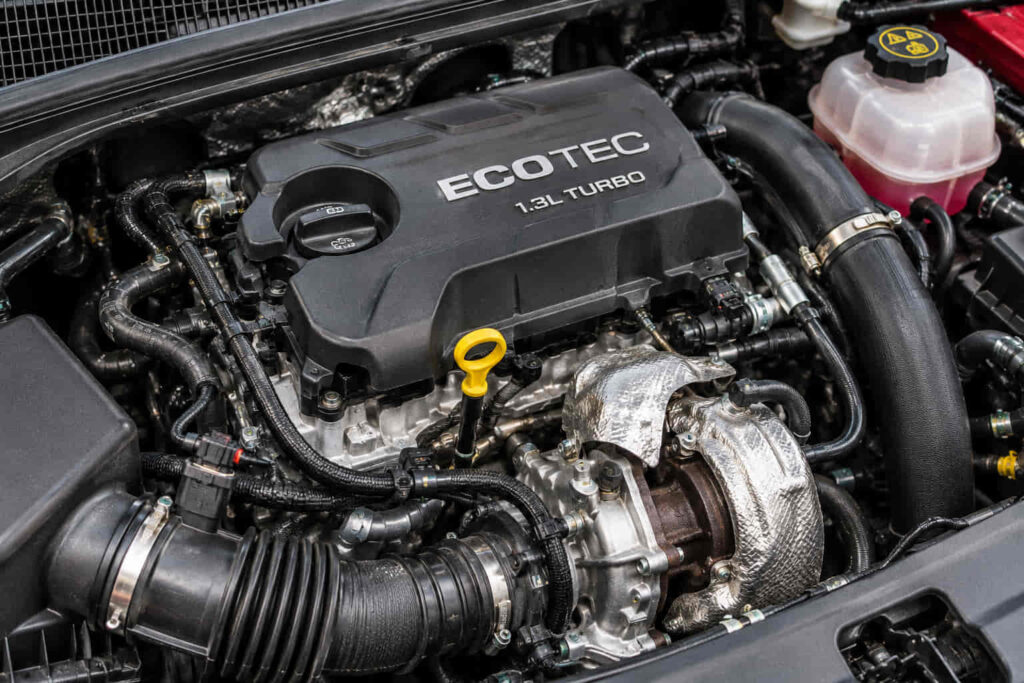
The most important 1.3L Ecotec Turbo engine problems to investigate include turbocharger underboost, camshaft timing control faults, coolant control valve errors, fuel system leaks, and engine oil leaks. General Motors has published technical service information addressing these conditions on certain Chevrolet Trailblazer and Buick Encore GX vehicles equipped with the 1.3-liter turbocharged three-cylinder engine, identified by the engine code L3T.
However, not every reported problem represents a widespread engine defect. Some issues apply to specific model years, operating conditions, or small groups of vehicles. For example, GM documented a cylinder head bolt service update affecting only six identified U.S. vehicles in 2021, while other bulletins describe diagnostic procedures for problems that may occur under particular circumstances.
The 1.3L Ecotec Turbo produces approximately 155 horsepower and 174 lb-ft of torque in North American applications. Its aluminum engine construction, direct gasoline injection, turbocharger, and electronically controlled valve timing allow a small engine to deliver useful low-speed torque and competitive fuel economy.
This design also introduces several components that require proper maintenance and diagnosis. A malfunctioning coolant control valve can trigger a check engine light, a leak in the charge-air system can cause reduced boost pressure, and a problem with the camshaft actuator can affect idle stability.
Understanding the difference between documented service issues, normal engine characteristics, and potential long-term wear is essential for diagnosing problems and evaluating reliability.
This guide examines the 1.3L Ecotec Turbo’s known technical concerns, symptoms, diagnostic trouble codes, repair considerations, maintenance requirements, and expected durability.
What Is the GM 1.3L Ecotec Turbo Engine?
The GM 1.3L Ecotec Turbo, commonly identified by the engine code L3T, is a turbocharged 1.3-liter inline-three gasoline engine developed for compact General Motors vehicles.
The engine belongs to GM’s modern small-displacement turbocharged engine family.
It uses three cylinders arranged in a straight line, with dual overhead camshafts and four valves per cylinder.
The cylinder block and cylinder head are made from aluminum to help control engine weight.
Its fuel system uses gasoline direct injection, delivering fuel directly into the combustion chambers.
A turbocharger increases the amount of air entering the cylinders, allowing the small-displacement engine to generate more power and torque than an equivalent naturally aspirated configuration.
In the 2024 Buick Encore GX, GM lists a bore of 79 mm and a stroke of 91 mm.
The engine produces 155 horsepower at 5,600 RPM and 174 lb-ft of torque at 1,600 RPM.
These specifications demonstrate the engine’s emphasis on low-speed torque.
The combination of turbocharging and direct injection helps the engine deliver responsive acceleration without requiring a larger four-cylinder or V6 powerplant.
However, turbocharging, electronic valve timing, and advanced cooling controls introduce mechanical and electronic systems that must function correctly.
A malfunction affecting one of these systems can cause reduced power, rough running, warning lights, or other symptoms even when the engine’s pistons and crankshaft remain mechanically healthy.
For reliability research, the L3T engine code is more useful than the general Ecotec name because General Motors uses that name for several unrelated engine configurations.
Which Vehicles Use the 1.3L Ecotec Turbo Engine?
The 1.3L Ecotec Turbo L3T is used primarily in the Chevrolet Trailblazer and Buick Encore GX in the North American market.
The engine appeared in the Buick Encore GX beginning with the 2020 model year.
The Chevrolet Trailblazer introduced the same engine option for the 2021 model year.
Both vehicles are compact crossovers designed to provide a balance of efficiency, interior space, and everyday performance.
The L3T remained available in the 2026 Chevrolet Trailblazer.
Chevrolet lists the 1.3-liter turbocharged three-cylinder as an available engine producing 155 horsepower and 174 lb-ft of torque.
The 2026 Buick Encore GX also uses the 1.3-liter turbocharged Ecotec engine.
The transmission configuration varies according to the vehicle.
Front-wheel-drive versions have commonly used a continuously variable transmission, while all-wheel-drive configurations use a nine-speed automatic transmission.
This distinction matters when diagnosing hesitation, vibration, or inconsistent acceleration.
A transmission problem can sometimes feel like an engine performance issue.
Outside North America, related 1.3-liter GM turbo engines have appeared in other vehicle applications.
However, those engines may have different calibrations, emissions systems, or accessory configurations.
Therefore, the exact engine code, production year, and market should be confirmed before applying a service bulletin or ordering replacement parts.
The 1.3L L3T should also not be confused with the smaller 1.2-liter Ecotec Turbo used in certain Trailblazer, Encore GX, Trax, and Envista vehicles.
Read more: Chevy 350 Engine Rebuild
Is the 1.3L Ecotec Turbo a Reliable Engine?
The 1.3L Ecotec Turbo can provide dependable everyday operation when maintained correctly, but several documented service concerns deserve attention, particularly on certain early-production vehicles.
The engine’s reliability cannot be evaluated accurately through one owner complaint or isolated repair.
A comprehensive reliability assessment would require verified failure-rate information across large numbers of vehicles with comparable mileage and operating conditions.
Such information is not publicly available in a form that establishes one definitive failure rate for every L3T production year.
Nevertheless, General Motors has published technical communications covering several specific conditions.
These include camshaft actuator control faults, coolant flow control valve problems, charge-air cooler icing in extreme cold, and fuel leakage concerns in certain early vehicles.
More recent technical information also addresses turbocharger underboost diagnostics and potential oil leakage from the turbocharger return pipe gasket.
These documents confirm that the conditions are relevant to diagnosis.
However, a service bulletin is not proof that every vehicle equipped with the engine will experience the described problem.
The engine’s basic construction also matters.
Its timing chain distinguishes it from the smaller 1.2L Ecotec engine that uses an oil-immersed timing belt in certain applications.
This difference is important because concerns about deterioration of the 1.2L engine’s timing belt should not automatically be applied to the 1.3L L3T.
For prospective buyers, the most useful information is the vehicle’s maintenance history, current condition, diagnostic records, and whether applicable service updates have been completed.
1.3L Ecotec Turbocharger Underboost Problems
Turbocharger underboost is an important 1.3L Ecotec Turbo diagnostic concern because insufficient boost pressure can trigger a check engine light, reduce engine power, and cause poor acceleration.
The turbocharger uses exhaust gas energy to compress intake air.
The engine control module monitors boost-related operating conditions to determine whether the system is providing the expected performance.
When actual boost pressure is lower than expected, diagnostic trouble code P0299 may be stored.
Drivers may notice that the vehicle accelerates more slowly than normal.
The engine may feel weak when climbing hills or accelerating onto a highway.
In some cases, the vehicle may enter a reduced-power operating mode.
However, P0299 does not automatically mean the turbocharger assembly has failed.
A leak in the intake system can reduce the pressure delivered to the engine.
Damaged hoses, loose clamps, defective connections, or charge-air cooler problems may cause similar symptoms.
The turbocharger’s wastegate control system and associated sensors also require evaluation.
GM issued engineering information PIE0831 for certain 2024 and 2025 Buick Encore GX and Chevrolet Trailblazer models equipped with the 1.3L L3T.
The document addresses vehicles experiencing P0299 and instructs technicians to inspect relevant air induction components while collecting diagnostic information.
This demonstrates that the code must be investigated systematically rather than immediately treated as proof of turbocharger failure.
An accurate diagnosis compares commanded and actual boost, examines intake system integrity, and checks the relevant control components.
Replacing an expensive turbocharger without identifying the cause of underboost can result in an unnecessary repair.
Can the 1.3L Ecotec Turbo Lose Power in Cold Weather?
Yes. GM has documented charge-air cooler icing as a possible cause of reduced performance in certain 1.3L Ecotec Turbo vehicles operating in extremely cold temperatures.
The charge-air cooler, commonly called an intercooler, reduces the temperature of air compressed by the turbocharger.
Cooler intake air helps improve air density and supports efficient combustion.
However, moisture can accumulate within the charge-air system under certain conditions.
When temperatures become extremely low, this moisture may freeze.
GM’s January 2022 TechLink publication specifically identifies certain 2020–2022 Buick Encore GX and 2021–2022 Chevrolet Trailblazer vehicles equipped with the 1.3L L3T engine as potentially affected.
The article describes conditions occurring at approximately 0°F, or minus 18°C, and below.
Drivers may experience hesitation, reduced acceleration, or other performance issues during the first several minutes of operation.
The symptoms may become less noticeable as the vehicle warms.
GM identifies several possible diagnostic codes, including P0299, P0234, P0236, P0300, and P00C7.
The exact code depends on how the icing affects airflow and engine operation.
In some situations, accumulated moisture can be drawn into the engine during acceleration and contribute to a misfire.
This condition is climate-dependent.
It should not be treated as the likely explanation for reduced power in warm weather without supporting diagnostic evidence.
When investigating cold-weather power loss, technicians should consider ambient temperature, operating history, charge-air system condition, and relevant manufacturer guidance.
1.3L Ecotec Camshaft Actuator Problems
Camshaft actuator oil control valve faults are among the better-documented early 1.3L Ecotec Turbo concerns, with GM identifying potential sticking or binding that can produce rough operation and reduced engine power.
The engine uses electronically controlled camshaft timing.
This system adjusts valve timing according to operating conditions to support performance and efficiency.
Oil control components help manage the mechanisms responsible for changing camshaft position.
A fault in these components can interfere with the intended valve timing.
GM issued service update A202304840 for certain 2020–2021 Buick Encore GX and 2021 Chevrolet Trailblazer vehicles equipped with the L3T engine.
The update identified a condition involving the center bolt of the camshaft actuator oil control valve.
The bolt could stick or bind.
If the condition occurred, the engine could run roughly, produce reduced power, and illuminate the malfunction indicator lamp.
Diagnostic trouble codes P0011 or P0014 could be stored.
The update instructed dealers to inspect the affected vehicles and perform the necessary repair when the condition was present.
This service update was directed at specified dealer-inventory vehicles and had a defined program period.
It should not be interpreted as evidence that every L3T engine has defective camshaft actuators.
For a vehicle displaying P0011 or P0014, the diagnostic process should examine oil condition, actuator operation, related sensors, and mechanical timing.
Replacing components without confirming the root cause may not correct the problem.
Why Does the 1.3L Ecotec Turbo Have a Rough Idle?
A rough idle on the 1.3L Ecotec Turbo can result from camshaft timing faults, ignition problems, fuel delivery issues, intake air leaks, or other conditions that interfere with stable combustion.
An inline-three engine has a different vibration pattern from a conventional inline-four.
Some vibration is therefore part of its normal mechanical character.
However, unusually strong shaking, inconsistent engine speed, or persistent misfires should not be dismissed as normal three-cylinder behavior.
The engine control module monitors several operating parameters to maintain idle stability.
Camshaft timing is one of these parameters.
GM’s service information for early L3T applications identifies camshaft control faults as a potential cause of unstable idle.
A malfunctioning camshaft oil control valve can interfere with the intended valve timing.
Ignition problems can create similar symptoms.
A worn spark plug or defective ignition coil may prevent one cylinder from firing consistently.
Fuel injector problems can also cause uneven combustion.
A vacuum or intake air leak may disturb the mixture calculated by the engine control system.
The diagnostic process should begin by checking stored trouble codes and related operating data.
If a specific cylinder misfire is present, ignition and fuel system components should be tested before assuming internal engine damage.
A mechanical compression test may be appropriate when the cause remains unclear.
The important distinction is between normal three-cylinder vibration and a genuine combustion or engine management problem.
1.3L Ecotec Coolant Control Valve Problems
Coolant flow control valve faults are a documented 1.3L Ecotec Turbo concern that can cause a check engine light and diagnostic codes such as P26BB or P1098 on certain applications.
The modern L3T cooling system uses electronically controlled components to manage coolant movement under different operating conditions.
This allows the engine to regulate temperature more precisely than a basic cooling system relying only on a conventional thermostat.
However, the system introduces additional electronic and mechanical control components.
The coolant flow control valve must respond correctly to commands from the engine control module.
If the valve does not operate as expected, the vehicle may store a diagnostic trouble code.
GM issued preliminary service information PIP5675 addressing P1098 and P26BB on several GM engine families, including certain early L3T applications.
The document explains that these codes may sometimes be associated with software behavior rather than a confirmed mechanical valve failure.
It therefore advises technicians to perform the appropriate diagnosis before replacing the valve.
A later diagnostic communication also identifies possible contamination or corrosion in the coolant control valve’s electrical connections.
This is an important distinction.
A diagnostic code involving the coolant valve does not automatically establish that the valve itself must be replaced.
The electrical connector, wiring, module control, and physical valve operation may all require inspection.
If a malfunction is confirmed, the appropriate repair may involve the control valve or another affected component.
Proper diagnosis helps avoid unnecessary parts replacement.
Can the 1.3L Ecotec Turbo Overheat?
The 1.3L Ecotec Turbo can overheat if coolant circulation, system pressure, radiator operation, or temperature control is compromised, but an overheating complaint must be diagnosed before assuming an internal engine defect.
An engine’s cooling system removes excess heat generated during combustion.
The small turbocharged L3T operates under significant thermal demands because it produces substantial power from a compact displacement.
Its turbocharger also generates considerable heat.
Adequate coolant circulation is therefore essential.
Problems involving coolant level, coolant flow control, hoses, radiator operation, or other components may affect engine temperature.
GM’s December 2021 TechLink publication describes diagnostic code P3075, indicating insufficient coolant flow, on certain GM vehicles including 1.3L L3T-equipped Encore GX and Trailblazer applications.
The publication explains that low coolant or trapped air can cause the condition.
It specifically advises technicians not to replace the coolant pump automatically when these circumstances are present.
Instead, the cooling system should be pressure-tested for leaks.
Any leaks should be repaired, and the cooling system should be filled and serviced according to the specified procedure.
This matters because trapped air can interfere with temperature regulation even when the coolant pump itself functions correctly.
An engine that repeatedly overheats should not continue to be driven.
Excessive temperature can damage cylinder head gaskets, sealing components, and other internal parts.
The underlying cooling system fault should be identified before the vehicle returns to normal service.
1.3L Ecotec Fuel Rail and Gasoline Leak Problems
Fuel leakage is an important safety-related concern documented for certain early L3T applications, and a strong gasoline smell from the engine compartment should be investigated immediately.
The 1.3L Ecotec Turbo uses gasoline direct injection.
This system delivers fuel at high pressure to injectors mounted in the engine.
A high-pressure fuel pump, fuel rail, and connecting pipes support the injection process.
Because the system operates at elevated pressure, leaks require careful diagnosis and professional handling.
In November 2020, GM published preliminary information PIP5765 for certain 2020–2021 Buick Encore GX and 2021 Chevrolet Trailblazer vehicles equipped with the 1.3L L3T.
The document addresses complaints involving gasoline odor from the engine compartment.
GM identifies possible leakage from the fuel rail and provides inspection instructions covering the pump, connecting lines, injector connections, and fuel rail end cap.
The bulletin also warns about the fuel rail’s noise-insulating foam.
If this foam becomes contaminated with engine fluids, it must be replaced because the condition can create a fire risk.
This warning makes fuel odor different from a minor drivability complaint.
A vehicle with a suspected active gasoline leak should not be driven until the leak has been safely evaluated.
The engine should be shut off, and the vehicle should be kept away from ignition sources.
High-pressure fuel system components should not be loosened while the system remains pressurized.
A qualified technician should follow GM’s specified depressurization and repair procedures.
1.3L Ecotec Turbo Oil Leak Problems
Engine oil leakage can occur around the turbocharger oil return pipe and other sealing locations, with GM issuing a diagnostic bulletin for the turbocharger return pipe gasket on certain 2025 L3T vehicles.
The turbocharger depends on engine oil for lubrication.
Oil is supplied to the turbocharger bearing assembly and then returned to the engine.
The return connection must remain properly sealed.
A damaged gasket can allow oil to escape around the turbocharger return pipe.
GM published preliminary information PIP6063 in May 2025 for the 2025 Buick Encore GX and Chevrolet Trailblazer equipped with the 1.3L L3T.
The document identifies oil leakage at the turbocharger oil return pipe gasket.
GM instructs technicians to clean the area and verify that the leakage originates from the gasket sealing surface.
If the gasket is damaged or fails to make proper contact, replacement is the specified corrective action.
This is significant because oil visible near the turbocharger does not necessarily indicate failure of the turbocharger’s internal bearings.
The source may be an external sealing component.
Other engine oil leak locations may include the cylinder head cover, timing cover, oil pan, or associated seals.
The correct repair depends on identifying where the oil first escapes.
Oil that accumulates on surrounding components can make a leak appear to originate somewhere other than its actual source.
Significant oil leakage should be repaired promptly because low oil level can threaten engine and turbocharger lubrication.
Are Loose Cylinder Head Bolts a Common 1.3L Ecotec Problem?
GM documented a loose cylinder head outer bolt condition on a very small number of 2021 L3T vehicles, but the available service update does not establish a widespread cylinder head bolt problem across the engine family.
In June 2021, General Motors issued service update A212334670.
The update applied to certain 2021 Buick Encore GX and Chevrolet Trailblazer vehicles equipped with the 1.3L L3T.
GM reported that the affected vehicles may have cylinder head outer bolts that were not tightened during production.
The corrective procedure involved checking and tightening the affected fasteners.
However, the scope of the update is important.
GM’s dealer communication identified only six involved vehicles in the United States.
This is a narrowly defined manufacturing concern rather than evidence that most L3T engines have improperly tightened cylinder heads.
A buyer should therefore avoid treating every 2021 vehicle as though it has the condition.
The appropriate action is to check the vehicle’s identification number and service history.
If the vehicle was part of the affected population, dealership records can help establish whether the update was completed.
A vehicle that experiences unexplained coolant leakage, oil leakage, or compression problems should still receive normal mechanical diagnosis.
However, the existence of this service update does not justify removing or retightening cylinder head bolts on unrelated engines without manufacturer instructions.
The correct engine-specific service procedure must always be followed.
Does the 1.3L Ecotec Turbo Have Timing Chain Problems?
The 1.3L Ecotec Turbo L3T uses a timing chain, not the oil-immersed timing belt associated with the smaller 1.2L Ecotec Turbo LIH engine.
This is one of the most important distinctions when researching problems with newer Chevrolet and Buick three-cylinder engines.
The 1.2L and 1.3L engines may be installed in the same vehicle models, but they use different timing drive arrangements.
The 1.2L LIH uses a timing belt operating in engine oil.
The L3T uses a timing chain.
The 2024 Chevrolet Trailblazer maintenance schedule specifically identifies timing belt and oil pump drive belt replacement for the 1.2L LIH at 150,000 miles or 15 years, whichever comes first.
It does not apply that same timing belt replacement requirement to the 1.3L L3T.
Therefore, reports involving deterioration of the 1.2L timing belt should not automatically be described as 1.3L Ecotec problems.
However, a timing chain is not a component that can never wear.
Chain tensioners, guides, sprockets, and variable valve timing components can develop problems under certain conditions.
A persistent metallic rattle, abnormal camshaft correlation code, or other timing-related symptom requires diagnosis.
The cause may involve a control valve, sensor, lubrication problem, or mechanical timing component.
There is not sufficient evidence to classify widespread timing chain failure as a universal defect of the L3T engine.
The most important preventive measures are using the correct oil and maintaining proper engine lubrication.
Can Carbon Buildup Affect the 1.3L Ecotec Turbo?
Carbon buildup on intake valves is a possible long-term concern with direct-injection gasoline engines, including the L3T, but the presence of direct injection alone does not establish an unusually high failure rate for this particular engine.
Traditional port fuel injection sprays gasoline into the intake ports before the fuel enters the combustion chambers.
In many of those designs, fuel helps wash deposits from the rear surfaces of the intake valves.
Gasoline direct injection works differently.
Fuel enters directly into the combustion chamber.
As a result, intake valve surfaces may not receive the same fuel-washing effect.
Over time, oil vapor and other combustion-related deposits can accumulate in the intake tract and on valve surfaces.
The amount of buildup depends on engine design, crankcase ventilation, operating conditions, and maintenance.
If deposits become substantial, they can disturb airflow.
Symptoms may include rough idle, hesitation, misfires, or reduced performance.
However, these symptoms are not specific to carbon buildup.
Ignition, fuel delivery, and air induction problems must also be considered.
A mechanic may inspect the intake valves using appropriate equipment when other diagnostic tests suggest a deposit-related problem.
Cleaning methods should be chosen according to the engine’s design.
Aggressive chemical treatments or unapproved mechanical cleaning can create additional risks.
Preventive maintenance should focus on the correct engine oil, functioning crankcase ventilation components, and proper servicing.
There is no established universal mileage at which every L3T engine requires intake valve cleaning.
Does the 1.3L Ecotec Turbo Have Excessive Oil Consumption?
Oil consumption should be monitored on the 1.3L Ecotec Turbo, but it would be inaccurate to claim that every L3T engine has a documented excessive oil consumption defect.
Small turbocharged engines operate with tightly controlled piston rings, crankcase ventilation systems, and lubrication passages.
Some engine oil consumption can occur during normal operation.
However, the amount should remain consistent with the manufacturer’s guidance.
Unexpectedly rapid oil loss requires investigation.
One possible cause is an external leak.
Oil may escape from a gasket, seal, or turbocharger oil return connection.
Another possibility is internal oil consumption.
Worn piston rings, cylinder damage, or valve sealing issues can allow oil to enter the combustion process.
Crankcase ventilation problems can also influence oil movement.
The turbocharger’s lubrication system must be considered when oil is found in the intake or exhaust system.
However, a light oil film inside certain intake passages does not automatically prove that the turbocharger has failed.
The technician should examine the complete system.
Owners should check the engine oil level according to the procedure in the owner’s manual.
Any repeated need to add substantial quantities of oil should be documented.
Low oil level can reduce lubrication to the turbocharger and internal engine components.
The correct repair depends on identifying whether the loss results from leakage, internal consumption, or another problem.
Can the 1.3L Ecotec Turbo Cause Misfires?
The 1.3L Ecotec Turbo can develop misfires when ignition, fuel delivery, airflow, or valve timing is disturbed, but a misfire code does not identify one specific failed component.
Diagnostic trouble code P0300 indicates that the engine control module has detected a random or multiple-cylinder misfire condition.
Individual-cylinder misfire codes may provide more specific information.
A misfire occurs when combustion does not proceed as intended in one or more cylinders.
Worn spark plugs and ignition coil problems are common diagnostic considerations for gasoline engines.
A defective fuel injector or abnormal fuel pressure can also disturb combustion.
The L3T’s electronically controlled camshaft system introduces another possible cause.
If camshaft timing deviates significantly from the intended position, the engine may run unevenly.
Intake system leaks and incorrect airflow measurements can create additional problems.
Extreme cold introduces another potential condition.
GM’s charge-air cooler icing guidance explains that accumulated moisture may enter the engine during certain acceleration conditions and contribute to P0300.
However, this explanation applies to specific cold-weather circumstances.
It should not be treated as the default diagnosis for every misfire.
A proper inspection begins with a scan of the stored fault codes and relevant engine data.
The technician should evaluate ignition, fuel delivery, airflow, and mechanical compression as indicated by the symptoms.
Replacing all ignition coils or fuel injectors without confirming the problem may not correct the underlying fault.
What Does a P0299 Code Mean on the 1.3L Ecotec?
P0299 indicates that the engine control system has detected lower-than-expected turbocharger boost pressure under the conditions being monitored.
The code is frequently described as turbocharger underboost.
However, the turbocharger is only one part of the boost system.
Compressed air must travel through the charge-air system before entering the engine.
A damaged hose, loose connection, or leaking intercooler can reduce delivered boost pressure.
The engine’s sensors must also report accurate information.
A defective pressure sensor or associated electrical fault may affect the control module’s interpretation of boost conditions.
The wastegate system regulates exhaust gas flow through the turbocharger.
If it does not operate correctly, the turbocharger may fail to produce the expected pressure.
GM’s engineering communication for 2024 and 2025 L3T vehicles specifically directs attention to air induction system inspection when investigating P0299.
This is important because turbocharger replacement can be expensive.
A correct diagnosis should confirm the actual cause before major components are replaced.
P0299 may also be accompanied by reduced acceleration or a check engine light.
If the engine has severe power loss, unusual mechanical noise, or another serious symptom, the vehicle should be inspected promptly.
The appropriate repair depends on whether the problem involves an air leak, control component, sensor, turbocharger, or another system.
What Do P0011 and P0014 Mean on the 1.3L Ecotec?
P0011 and P0014 are associated with camshaft timing performance and can indicate that the engine’s variable camshaft timing system is not operating as expected.
The L3T uses camshaft control technology to adjust valve timing according to engine operating conditions.
The intake and exhaust camshafts must respond correctly to commands from the engine control module.
When the actual timing differs from the commanded position beyond the system’s allowable limits, diagnostic trouble codes may be stored.
P0011 generally relates to intake camshaft timing performance.
P0014 generally relates to exhaust camshaft timing performance.
GM’s early L3T service update identifies a specific camshaft actuator oil control valve center bolt condition that could lead to these codes.
However, the presence of P0011 or P0014 does not prove that this exact component has failed.
Oil condition and lubrication pressure can influence camshaft actuator operation.
Sensors, wiring, and internal timing components may also affect the system.
The technician should evaluate the engine’s oil condition, commanded and actual camshaft positions, and relevant actuator controls.
A mechanical timing inspection may be necessary when the electronic components appear to function correctly.
Accurate diagnosis is important because replacing a sensor will not correct a mechanical timing problem, and replacing a timing chain will not necessarily resolve an electronic control fault.
What Do P26BB, P1098, and P3075 Mean?
P26BB and P1098 are associated with coolant control system operation, while P3075 indicates a condition involving insufficient coolant flow.
These codes are particularly relevant because the L3T uses electronically managed coolant circulation.
P26BB may indicate that the coolant control system is not responding as intended.
P1098 is associated with a coolant control valve position-related electrical or performance condition.
GM’s service guidance for certain early L3T vehicles identifies possible software-related behavior and electrical connection concerns.
It therefore instructs technicians to diagnose the system before automatically replacing the valve.
P3075 is associated with coolant flow that is lower than expected.
GM has documented that low coolant or trapped air can produce this code on certain applications.
The company specifically advises technicians to inspect for coolant leaks and air in the system rather than assuming the coolant pump has failed.
These codes can have different root causes.
An electrical connector problem may require a different repair from a mechanical valve fault.
Low coolant may originate from an external leak.
Trapped air may indicate that the system was not filled correctly after previous service.
A correct diagnosis should evaluate coolant level, system pressure, electrical connections, commanded valve operation, and related sensor data.
The vehicle should not be driven with uncontrolled overheating or a serious coolant leak.
Does the 1.3L Ecotec Turbo Have Start-Stop System Problems?
Some owners may experience concerns involving the automatic engine start-stop system, but these symptoms do not necessarily indicate a failure inside the 1.3L Ecotec engine.
Automatic start-stop technology temporarily shuts down the engine under selected operating conditions.
The system restarts the engine when the vehicle needs propulsion or when other operating requirements are met.
Its behavior depends on battery condition, engine temperature, climate control demand, vehicle operating conditions, and electronic control logic.
A weak battery may affect start-stop availability or restart performance.
The system may also remain disabled when the engine has not reached the required operating temperature.
A fault elsewhere in the vehicle can influence whether the engine is allowed to stop automatically.
These conditions should not automatically be described as internal engine problems.
Likewise, a rough restart can involve ignition, fuel delivery, battery condition, or engine control behavior.
The technician should evaluate the relevant diagnostic codes and system information.
Replacing engine components without determining whether the problem originates in the start-stop system may create unnecessary expense.
For owners, the important distinction is between normal system operation and a genuine malfunction.
A system that does not activate under certain conditions may be behaving as designed.
However, unexpected stalling, repeated restart failure, or a persistent warning message requires professional diagnosis.
How Can You Diagnose 1.3L Ecotec Turbo Problems?
The most effective way to diagnose a 1.3L Ecotec Turbo problem is to connect the observed symptom with the relevant diagnostic codes, live engine data, and manufacturer service information before replacing parts.
The process begins with identifying the exact engine and vehicle configuration.
The L3T must not be confused with the 1.2L LIH or LBP engines.
A scan tool can retrieve stored and pending diagnostic trouble codes.
However, fault codes describe conditions detected by the engine control module rather than directly identifying every failed component.
For example, P0299 indicates an underboost condition.
It does not establish whether the cause is a turbocharger, charge-air leak, sensor, or control system problem.
Likewise, P0011 and P0014 indicate camshaft timing-related faults but may result from several causes.
A cooling system code requires checking coolant level, valve operation, electrical connections, and possible trapped air.
Fuel odor requires immediate attention because gasoline leakage presents a potential fire hazard.
Oil leakage should be traced to its source rather than assuming the most expensive nearby component has failed.
Vehicle identification information can help determine whether a GM service update applies.
The technician should consult the current manufacturer service instructions and verify any relevant bulletin revisions.
A systematic approach reduces unnecessary parts replacement and helps distinguish a minor external component fault from serious internal engine damage.
How Much Do 1.3L Ecotec Turbo Repairs Cost?
The cost of repairing a 1.3L Ecotec Turbo depends on the failed component, diagnostic work, labor rate, vehicle model year, and whether warranty or special coverage applies.
A simple electrical connector repair may cost much less than replacing a complete turbocharger.
Some coolant control problems may be resolved by correcting low coolant, trapped air, or a wiring fault.
Other cases may require replacing the coolant control valve.
Similarly, a turbocharger underboost code might result from a relatively inexpensive hose or connection problem.
Replacing the entire turbocharger before confirming the cause can add substantial unnecessary cost.
A damaged turbocharger oil return gasket is another example.
GM’s 2025 diagnostic information identifies a gasket sealing issue as a possible cause of an oil leak near the turbocharger.
If the leak is limited to that gasket, replacing the complete turbocharger would not be the appropriate first step.
More extensive repairs can become expensive.
High-pressure fuel system components require specialized service procedures.
Cylinder head work or major internal engine repairs can involve significant labor.
Exact prices vary by region and repair facility.
A reliable estimate should specify the diagnosed failure, parts required, labor hours, and any associated repairs.
Owners should also check whether the vehicle remains within its applicable warranty period.
For known service concerns, a Chevrolet or Buick dealer can determine whether the vehicle identification number is associated with an applicable service update or coverage program.
A technical service bulletin does not automatically mean that every repair will be performed without charge.
Warranty eligibility depends on the actual coverage and the vehicle’s individual history.
What Oil Does the 1.3L Ecotec Turbo Require?
For the 2024 Chevrolet Trailblazer equipped with the 1.3L L3T, GM specifies full-synthetic SAE 0W-20 engine oil meeting the dexos1 specification.
The owner’s manual identifies the approved oil standard and viscosity.
It also specifies an approximate oil capacity of 4.5 liters, equivalent to 4.8 US quarts, when the oil filter is replaced.
The same capacity applies to the published front-wheel-drive and all-wheel-drive 1.3L Trailblazer configurations.
Correct oil is particularly important because the engine uses a turbocharger and electronically controlled camshaft timing components.
The turbocharger depends on a reliable supply of lubricant.
The camshaft control system also uses engine oil in its operation.
Using oil that does not meet the required specification can affect engine protection and system performance.
The owner’s manual advises against adding unapproved oil additives or performing engine oil system flushes.
It also states that the engine oil life monitoring system determines oil change timing according to operating conditions.
Drivers should follow the applicable maintenance instructions and avoid operating the engine with an oil level outside the acceptable range.
The exact specification should always be confirmed using the manual corresponding to the vehicle’s model year and market.
The 1.3L engine’s 0W-20 requirement should not be confused with the different viscosity specified for certain 1.2L Ecotec applications.
How Often Should You Change Oil in the 1.3L Ecotec Turbo?
The 1.3L Ecotec Turbo should receive oil and filter changes according to GM’s Oil Life System and the maintenance instructions for the specific vehicle.
GM’s Oil Life System uses operating information to estimate when the oil requires replacement.
Factors include engine operation, temperature, and driving conditions.
Consequently, the interval can vary substantially between vehicles.
A driver who frequently makes short trips may receive an oil change reminder sooner than someone who drives long highway distances under moderate conditions.
Turbocharged engines also operate under significant thermal demands.
Maintaining clean, correctly specified oil helps protect the turbocharger, engine bearings, timing components, and camshaft control mechanisms.
However, frequent oil changes are not a substitute for using the approved specification.
A lower-quality or incorrectly formulated lubricant does not become suitable simply because it is replaced more often.
The oil level should be checked between services.
Any repeated or unexplained loss should be investigated.
Owners should also ensure the correct filter is installed.
The 2024 Trailblazer owner’s manual identifies the ACDelco PF66 as the specified oil filter for the 1.3L L3T application.
The engine oil life monitor must be reset after the oil has actually been changed.
Resetting the monitor without performing the service can create an inaccurate maintenance record.
For drivers operating under severe conditions, the owner’s manual should be consulted for any additional maintenance requirements.
Does the 1.3L Ecotec Turbo Require Premium Gas?
The North American 1.3L Ecotec Turbo is designed for the fuel grade specified by GM for the particular vehicle, and premium gasoline should not be assumed necessary solely because the engine is turbocharged.
Turbocharging increases intake air density and allows a small engine to generate substantial torque.
However, fuel requirements depend on engine calibration, combustion chamber design, and the manufacturer’s knock control strategy.
Modern engines use sensors and electronic controls to manage combustion under different conditions.
The correct gasoline octane requirement should be taken from the owner’s manual.
Using a higher-octane fuel than required does not automatically eliminate mechanical problems.
It will not repair a leaking fuel rail, damaged coolant control valve, defective turbocharger control system, or worn ignition component.
Fuel quality remains important.
Contaminated gasoline can interfere with injection system operation.
A clogged injector or abnormal fuel delivery may produce hesitation or misfires.
Because the L3T uses direct gasoline injection, fuel system repairs require the appropriate pressure management procedures.
The fuel system should not be opened without following manufacturer instructions.
For ordinary ownership, the best approach is to use the recommended fuel and maintain the engine according to its service schedule.
Performance tuning or significant engine modifications may introduce different fuel requirements, but those conditions should not be confused with the specifications for a stock engine.
How Long Does the 1.3L Ecotec Turbo Engine Last?
There is no manufacturer-confirmed universal lifespan for the 1.3L Ecotec Turbo, and claims that every L3T engine lasts a specific number of miles should be treated cautiously.
Engine longevity depends on multiple factors.
The cylinder block, crankshaft, pistons, bearings, turbocharger, fuel injection system, and cooling components all contribute to dependable operation.
Some components may require repair before the engine’s main rotating assembly develops significant wear.
For example, a coolant control valve problem does not necessarily indicate that the engine is approaching the end of its mechanical life.
Likewise, a turbocharger underboost code may result from an external air leak rather than damaged pistons or bearings.
This distinction matters when evaluating long-term reliability.
A properly maintained engine can remain mechanically healthy despite experiencing occasional sensor or control system faults.
However, neglected oil changes, overheating, and repeated low-oil operation can reduce durability.
High mileage alone does not establish internal condition.
A vehicle that has accumulated substantial highway mileage may experience different wear from one driven primarily on short trips.
The engine’s maintenance history is therefore essential.
Oil consumption, compression, coolant condition, abnormal noises, and diagnostic records provide useful information about its current state.
Claims that the L3T is guaranteed to reach 150,000 or 200,000 miles are not supported by a universal manufacturer guarantee.
The practical goal is to maintain correct lubrication, cooling, fuel delivery, and engine management while addressing faults promptly.
Are Early 1.3L Ecotec Turbo Engines Less Reliable?
Some of the more clearly documented L3T service concerns apply to early-production vehicles, but this does not establish that every early engine is unreliable or that every newer engine is free from problems.
The 2020 and 2021 model years are important because several manufacturer communications address vehicles from this period.
GM’s camshaft actuator oil control valve service update covered certain early Encore GX and Trailblazer applications.
A separate preliminary information document addressed fuel odor associated with possible fuel rail leakage.
Another service update involved improperly tightened cylinder head outer bolts on six identified 2021 U.S. vehicles.
Cooling system diagnostic guidance also covered certain early applications.
These records are useful when purchasing a used vehicle because they identify issues worth checking.
However, the vehicle’s identification number determines whether a particular update applies.
Later model years have their own documented service information.
For example, GM published engineering guidance concerning P0299 underboost on certain 2024 and 2025 L3T vehicles.
It also issued a 2025 bulletin concerning potential leakage from the turbocharger oil return pipe gasket.
These newer documents do not prove that later engines are less reliable.
They show that manufacturer diagnostic support continues as vehicles accumulate service experience.
The best comparison considers the exact model year, repair history, software status, and current mechanical condition.
A well-maintained early vehicle with completed service updates may be a better purchase than a newer example with neglected maintenance or unresolved warning lights.
What Should You Check Before Buying a Used 1.3L Ecotec Turbo?
Before buying a used Chevrolet Trailblazer or Buick Encore GX with the 1.3L Ecotec Turbo, check the engine code, service records, coolant system condition, turbocharger performance, and any open manufacturer recalls or service campaigns.
The engine should be identified accurately.
The 1.3L L3T has different components and maintenance requirements from the 1.2L Ecotec.
A cold start can provide useful information.
The engine should start normally without extended cranking, persistent misfires, or abnormal mechanical noise.
Some three-cylinder vibration is normal, but excessive shaking should be investigated.
A road test should evaluate acceleration and boost response.
Significant hesitation or reduced power may justify scanning for P0299 or other related codes.
The engine compartment should be inspected for oil leakage and gasoline odor.
A strong fuel smell is a serious concern and should be addressed before the vehicle is driven further.
The coolant level and condition should also be checked.
Evidence of repeated coolant loss or overheating requires investigation.
A diagnostic scan can identify stored or pending trouble codes that may not currently illuminate the dashboard warning light.
Maintenance records should confirm that the correct oil specification was used.
For early-production vehicles, dealership records can help establish whether relevant service updates were completed.
The buyer should also distinguish engine concerns from transmission behavior.
A front-wheel-drive vehicle with a CVT may feel different from an all-wheel-drive version with a conventional nine-speed automatic.
A qualified pre-purchase inspection is valuable because a single warning light may be associated with several possible causes.
Is the 1.3L Ecotec Turbo Better Than the 1.2L Ecotec?
The 1.3L Ecotec Turbo offers greater factory horsepower and torque than the 1.2L version in the current Chevrolet Trailblazer, and it uses a different timing drive design.
For the 2026 Trailblazer, Chevrolet lists the standard 1.2L turbocharged three-cylinder at 137 horsepower and 162 lb-ft of torque.
The available 1.3L produces 155 horsepower and 174 lb-ft.
This provides an additional 18 horsepower and 12 lb-ft of torque.
Both engines are designed for compact vehicles with an emphasis on efficiency.
However, their mechanical construction differs.
The 1.2L LIH uses an oil-immersed timing belt.
The 1.3L L3T uses a timing chain.
This is an important long-term maintenance distinction.
The owner’s manual specifies a timing belt and oil pump drive belt service interval for the 1.2L LIH.
That specific belt service requirement does not apply to the L3T.
However, timing chain construction alone does not prove that the 1.3L will always outlast the 1.2L.
The engines also have different oil specifications in certain applications.
For the 2024 Trailblazer, GM specifies SAE 0W-20 for the 1.3L and SAE 5W-30 for the 1.2L.
Their oil capacities and oil filters also differ.
Therefore, maintenance recommendations and repair bulletins should not be transferred between the two engines without verifying the exact engine code.
For buyers who want the stronger factory output and prefer the 1.3L’s timing chain arrangement, the larger engine may be more attractive.
Is the 1.3L Ecotec Turbo Worth Buying?
The 1.3L Ecotec Turbo can be a reasonable choice for a compact crossover when the vehicle has a good service history, no unresolved mechanical faults, and a satisfactory inspection.
Its main advantages include compact engine packaging, useful low-speed torque, and competitive fuel economy.
The 155-horsepower output is suitable for normal commuting and highway driving in vehicles such as the Trailblazer and Encore GX.
However, buyers should understand the tradeoffs associated with a small modern turbocharged engine.
The turbocharger, direct-injection fuel system, and electronic coolant and camshaft controls introduce additional components compared with a simpler naturally aspirated engine.
These systems contribute to efficiency and performance but can also increase diagnostic and repair complexity.
The documented GM service information provides useful guidance.
Turbocharger underboost, camshaft control problems, coolant valve faults, fuel leakage, and oil return gasket leakage should be investigated when the corresponding symptoms appear.
However, these problems do not justify assuming that every vehicle equipped with the engine is defective.
Maintenance history is particularly important.
A vehicle that has received correct oil changes and appropriate repairs is generally more attractive than one with repeated warning lights and incomplete service records.
The overall vehicle also matters.
Transmission condition, suspension wear, electrical systems, and ownership costs should be considered alongside engine reliability.
For a used vehicle, the strongest purchasing decision is based on documented condition rather than engine reputation alone.
How Can You Prevent Common 1.3L Ecotec Turbo Problems?
The most effective preventive measures for the 1.3L Ecotec Turbo are maintaining the correct engine oil, keeping the cooling system healthy, inspecting for leaks, and addressing warning lights before a minor problem becomes more serious.
Proper lubrication is essential.
The turbocharger and internal engine components depend on clean oil with the correct viscosity and performance approval.
For the 2024 Trailblazer L3T, GM specifies full-synthetic SAE 0W-20 meeting dexos1 requirements.
Oil changes should follow the manufacturer’s maintenance system and applicable service instructions.
The oil level should also be checked between services.
Cooling system maintenance is equally important.
Low coolant, leaks, or trapped air can affect temperature control.
An engine that repeatedly overheats should be inspected promptly.
Fuel odor should never be ignored.
A suspected gasoline leak requires immediate attention because it can create a fire hazard.
The engine’s electronic systems should also be monitored.
A persistent check engine light may indicate an underboost condition, camshaft timing fault, coolant control issue, or another problem.
Accurate diagnosis can prevent unnecessary parts replacement.
The intake and charge-air systems should remain properly sealed.
Damaged hoses or loose connections can interfere with turbocharger performance.
Drivers operating in extreme cold should be aware of GM’s charge-air cooler icing guidance for affected vehicles.
Finally, manufacturer service updates and recalls should be checked by VIN.
A vehicle-specific record is more reliable than assuming an update applies to every model year.
Final Verdict: What Are the Most Important 1.3L Ecotec Turbo Engine Problems?
The most important 1.3L Ecotec Turbo engine problems to investigate are turbocharger underboost, camshaft actuator control faults, coolant flow control issues, fuel system leakage, and oil leaks. These concerns are supported by specific General Motors technical communications for certain L3T-equipped Chevrolet Trailblazer and Buick Encore GX vehicles.
Turbocharger underboost can trigger P0299 and cause weak acceleration.
However, a boost leak or control system fault may produce the same code without requiring turbocharger replacement.
Camshaft actuator problems can cause rough idle, reduced power, and codes such as P0011 or P0014.
Certain early vehicles were included in a service update addressing possible oil control valve center bolt binding.
Coolant control valve problems can produce P26BB or P1098, while low coolant or trapped air may contribute to P3075.
GM specifically advises technicians to diagnose these conditions rather than automatically replacing the coolant pump or valve.
Fuel leakage is a more urgent concern.
GM’s early L3T service information identifies possible leakage around the fuel rail, which can create a fire hazard.
The company also published guidance for an oil leak involving the turbocharger oil return pipe gasket on certain 2025 vehicles.
A small number of 2021 vehicles received a service update for loose cylinder head outer bolts, but that campaign should not be characterized as a widespread problem affecting all L3T engines.
The 1.3L’s timing chain is another important distinction because the smaller 1.2L Ecotec uses an oil-immersed timing belt in relevant applications.
The 1.3L Ecotec Turbo is not automatically an engine to avoid, but buyers and owners should pay close attention to its fuel, cooling, turbocharging, and camshaft control systems.
Using the correct engine oil, maintaining the cooling system, diagnosing trouble codes accurately, and verifying vehicle-specific service history can reduce avoidable repair risks.
Ultimately, the most reliable way to judge a 1.3L Ecotec Turbo is to evaluate the exact model year, engine code, maintenance records, and current mechanical condition rather than assuming that every reported problem affects the entire engine family.