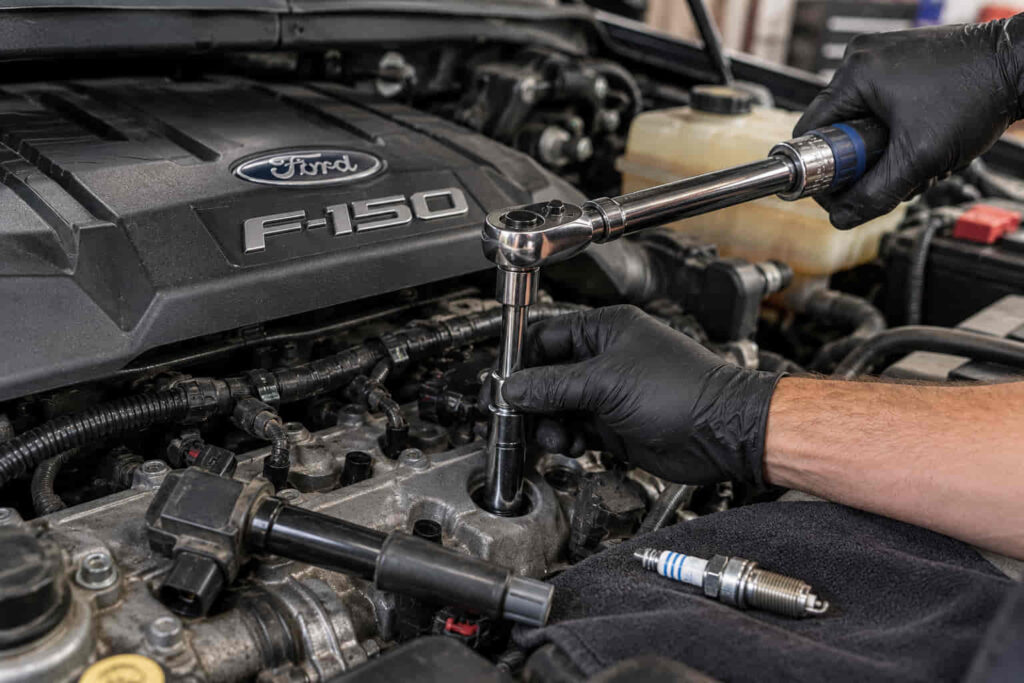
Ford F150 spark plug torque specs are important when replacing or servicing spark plugs because the correct installation torque affects spark plug sealing, heat transfer, thread engagement, and the ability to remove the plug during future maintenance. On the Ford F-150, however, there is no single spark plug torque specification that applies to every truck. The correct value depends on the engine, model year, spark plug design, cylinder head material, and the specific Ford service information for that application.
Using the correct torque is therefore more than simply tightening a spark plug until it feels secure. An under-torqued spark plug can fail to seal correctly or transfer heat as intended, while an over-torqued plug can damage the spark plug threads, cylinder head, or plug itself. For this reason, Ford F150 spark plug torque specifications should always be matched to the exact engine and application before installation.
What Are Ford F150 Spark Plug Torque Specs?
Spark plug torque specification is the recommended tightening force applied when installing a spark plug into the cylinder head. Torque is normally expressed in pound-feet or pound-inches in U.S. service information, although the equivalent value may also be expressed in Newton-meters.
The specification establishes the clamping force needed between the spark plug and cylinder head without applying excessive load to the plug or threaded hole. Because the spark plug sits directly in the engine’s combustion environment, proper installation affects sealing, heat transfer, ignition reliability, and long-term serviceability.
For a Ford F-150, the correct specification should be identified from the engine-specific service information rather than assumed from another F-150 engine. A 5.0L V8, 3.5L EcoBoost, 2.7L EcoBoost, 3.3L V6, or another engine application may use different spark plugs and different installation requirements.
Why Spark Plug Torque Matters on a Ford F150
Spark plug installation creates a mechanical connection between the plug and the cylinder head while the engine operates through repeated combustion cycles, temperature changes, vibration, and pressure fluctuations. The plug must remain securely seated throughout these conditions.
If the spark plug is installed below the required torque, the plug may not seat correctly against its sealing surface. Excessive tightening creates a different risk because spark plug threads and aluminum cylinder heads can be damaged by excessive clamping force.
The correct torque also helps maintain consistent installation between cylinders. When all spark plugs are installed according to the specified procedure, the ignition system has a more predictable mechanical foundation and future plug removal is less likely to become unnecessarily difficult.
Ford F150 Spark Plug Torque Specs by Engine
The most important point when looking up Ford F150 spark plug torque specs is that the engine determines the relevant specification. The same model name does not guarantee the same spark plug design or torque requirement.
Ford F-150 engines have changed significantly across model generations. Naturally aspirated V6 and V8 engines, turbocharged EcoBoost engines, and newer powertrains can use different spark plug designs, thread dimensions, sealing arrangements, and installation procedures.
For that reason, a torque value found for one F-150 engine should not automatically be transferred to another engine. The correct approach is to identify the truck’s model year, engine, spark plug part number or application, and the applicable Ford service specification before tightening the plug.
This distinction is especially important when working across different F-150 generations. A specification that is correct for an older 5.0L V8 does not necessarily apply to a later 5.0L V8 simply because both engines carry the same displacement designation.
How to Identify the Correct Spark Plug Torque
The most reliable way to determine the correct Ford F150 spark plug torque specification is to start with the exact vehicle configuration. The model year and engine should be identified first, followed by the spark plug application.
The spark plug itself can provide another important reference point. Spark plug manufacturers publish installation information for their products, and the recommended installation method can depend on whether the plug uses a gasket-style sealing surface or another design. The plug manufacturer’s instructions should be considered together with the vehicle manufacturer’s service information.
This prevents a common mistake in spark plug installation: selecting a torque value based only on the thread diameter. Thread size alone does not establish the correct installation torque because sealing design, materials, plug construction, and manufacturer requirements also influence the specification.
Should You Use Anti-Seize on Ford F150 Spark Plugs?
Anti-seize should not automatically be applied to Ford F-150 spark plug threads. Modern spark plugs and manufacturer installation procedures may specify installation without additional thread lubricant.
Adding anti-seize changes the friction characteristics of the threaded connection. If a torque specification was established for clean, dry threads, applying lubricant can change the actual clamping force produced by the same torque value.
This is why spark plug installation should follow the instructions associated with the specific plug and engine rather than treating anti-seize as a universal requirement. The same principle applies to other installation products such as thread compounds and lubricants.
Should Spark Plug Threads Be Lubricated?
Spark plug thread condition is part of the installation equation. The threads should be clean and free from contamination that could interfere with proper seating or torque application.
The correct procedure depends on the specific Ford engine and spark plug application. Some plugs are designed to be installed dry, while other applications may have different manufacturer instructions. Applying a lubricant that is not specified can alter the relationship between torque and clamping force.
The goal is not simply to make the plug easier to install. The goal is to reproduce the installation conditions under which the specified torque is valid.
How to Install Ford F150 Spark Plugs Correctly
Before installation, the engine should be prepared according to the applicable service procedure, and the area around each spark plug should be kept clean. Dirt or debris entering the spark plug opening can create problems inside the cylinder and interfere with proper seating.
The replacement spark plug should be inspected before installation. The plug must be the correct application, and its electrode and ceramic insulator should not be damaged. If the spark plug has a pre-set gap, the manufacturer’s instructions should be followed rather than assuming that every plug should be manually adjusted.
The plug should be started by hand so the threads engage correctly. This is particularly important with aluminum cylinder heads because cross-threading can cause significant damage. The plug should then be tightened using the specified installation procedure and an accurate torque wrench when the service information provides a torque value.
The ignition coil or plug wire assembly should be reinstalled correctly after the plug is secured. The final inspection should confirm that the connector is fully seated, the ignition component is properly positioned, and nothing has been left inside the spark plug well.
What Happens If a Ford F150 Spark Plug Is Over-Torqued?
Over-torquing a spark plug creates mechanical stress that can damage either the spark plug or the cylinder head. Because many modern engine cylinder heads use aluminum, damaged spark plug threads can become a much larger repair than the original maintenance job.
Excessive torque can also make future spark plug removal difficult. In severe cases, improper installation can contribute to damaged threads, cracked components, or other mechanical problems.
A torque wrench is therefore more useful than relying on feel. The resistance felt while tightening a spark plug is affected by thread condition, friction, sealing surfaces, and tool position, making hand-feel an unreliable substitute for the specified procedure.
Read more: Ford F150 Leveling Spacer Install Steps
What Happens If a Ford F150 Spark Plug Is Under-Torqued?
An under-torqued spark plug may not seat correctly against its intended sealing surface. The result can include abnormal combustion-related symptoms, leakage around the plug, changes in heat transfer, or progressive loosening under engine operation.
The exact symptoms depend on the engine and the severity of the installation problem. A loose spark plug can also create a mechanical and ignition problem that becomes more serious if the vehicle continues to operate without correction.
For this reason, a spark plug should not be left at a partially tightened position simply because the engine starts and runs normally. Correct installation is part of the repair itself.
Ford F150 Spark Plug Torque and Spark Plug Gap
Spark plug torque and spark plug gap are separate specifications. Torque determines how the spark plug is mechanically installed in the cylinder head, while gap determines the distance across which the ignition spark must travel between the electrodes.
Both can affect ignition performance, but they should not be confused with one another. A correctly torqued spark plug can still have an incorrect gap, and a correctly gapped plug can still be installed with improper torque.
When replacing plugs, both specifications should therefore be verified for the exact F-150 engine and spark plug application.
Do Ford F150 Spark Plugs Need a Specific Installation Sequence?
The basic installation concept is consistent: the correct plug is selected, the threads are engaged carefully, the plug is seated using the applicable procedure, and the final tightening is performed according to the specified torque or installation method.
However, the detailed procedure can vary between Ford engines. Access to the rear cylinders, ignition coil removal, debris removal, engine temperature requirements, and other service steps may differ depending on the F-150 configuration.
This is another reason why a generic spark plug replacement procedure should not replace engine-specific service information.
When Should Ford F150 Spark Plugs Be Replaced?
Spark plug replacement intervals depend on the engine, model year, spark plug type, operating conditions, and Ford’s maintenance schedule for the vehicle.
Spark plugs can also require attention when the engine develops symptoms associated with ignition problems. Misfires, rough running, poor acceleration, reduced fuel economy, difficult starting, or an illuminated check-engine light can all justify diagnostic inspection, although none of these symptoms automatically proves that the spark plugs are the cause.
Spark plug condition should therefore be evaluated alongside ignition coils, fuel delivery, engine compression, air intake, and diagnostic trouble codes when an engine performance problem occurs.
Ford F150 Spark Plug Torque Specs and Maintenance Accuracy
The most important principle is to treat spark plug torque as an engine-specific service specification rather than a universal F-150 number. Ford has produced the F-150 with multiple engines and generations, and the applicable spark plug design and installation procedure can change accordingly.
A reliable repair process connects the vehicle identification, engine configuration, spark plug application, installation instructions, and torque specification before the plug is tightened. This approach reduces the risk of cross-threading, improper sealing, damaged cylinder-head threads, and inconsistent spark plug installation.
When the exact specification is uncertain, the correct solution is to verify the vehicle-specific Ford service information or the installation instructions supplied for the exact spark plug rather than relying on a generic value from another F-150 application.
FAQ About Ford F150 Spark Plug Torque Specs
What is the Ford F150 spark plug torque specification?
There is no single torque value that applies to every Ford F-150. The correct specification depends on the model year, engine, spark plug design, and applicable service information.
Can I use the same torque specification on every F150 engine?
No. Different F-150 engines can use different spark plugs and installation requirements. Always verify the specification for the exact engine and application.
Can I tighten F150 spark plugs by hand without a torque wrench?
A torque wrench is the preferred method when a specific torque specification is provided. Tightening by feel does not reliably reproduce a known clamping force.
Should I use anti-seize on F150 spark plug threads?
Do not assume that anti-seize is required. Follow the installation instructions for the specific spark plug and engine because adding lubricant can change the friction characteristics of the threaded connection.
Does spark plug torque affect engine performance?
Correct torque helps ensure proper spark plug seating, sealing, and mechanical stability. Incorrect torque can contribute to installation-related problems, but engine performance also depends on spark plug gap, ignition components, fuel delivery, compression, and other systems.
Does the spark plug gap have anything to do with torque?
They are separate specifications. Spark plug gap controls the electrode distance for the ignition spark, while torque controls how the plug is mechanically installed in the cylinder head. Both should be correct for the specific F-150 application.