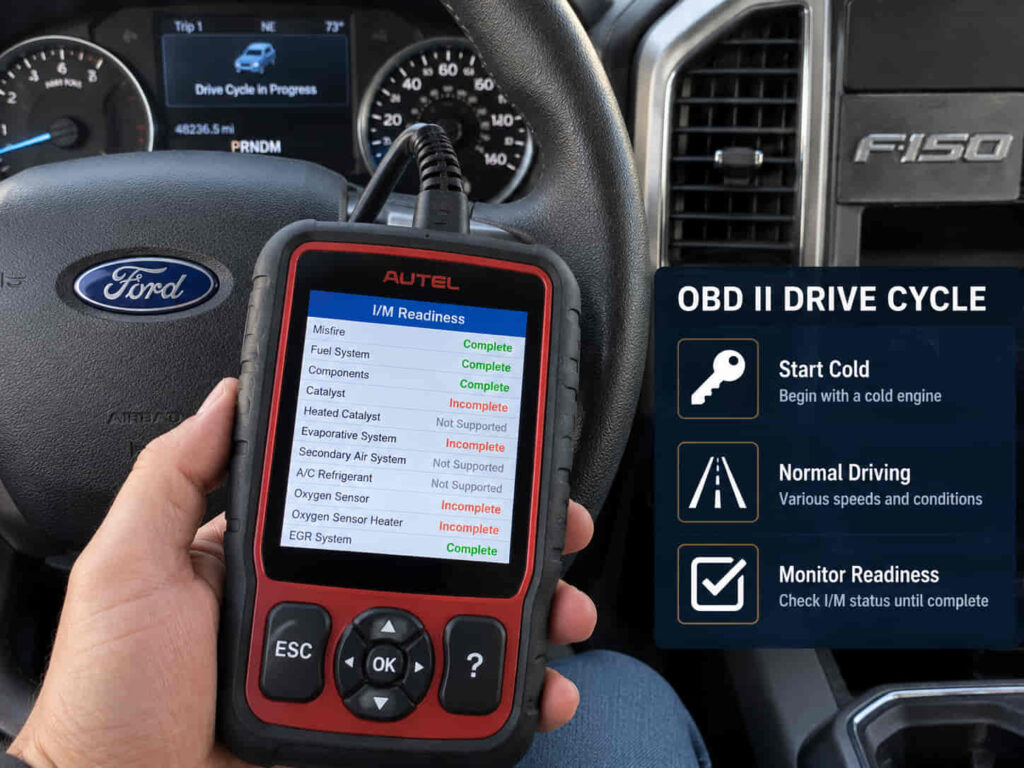
A Ford F-150 OBD-II drive cycle is a sequence of engine and driving conditions used to allow the onboard diagnostic system to run emissions-related self-tests and update the vehicle’s readiness monitors. Completing the drive cycle becomes important when one or more supported monitors show Not Ready or Incomplete, particularly after diagnostic trouble codes have been cleared or stored diagnostic information has been reset.
Simply driving the F-150 for a specific number of miles does not guarantee that every readiness monitor will complete. The powertrain control module must encounter the operating conditions required for each supported monitor to run its test. These conditions can involve a cold start, engine warm-up, periods of steady-speed driving, acceleration, deceleration, and other monitor-specific enable criteria. Vehicle configuration and operating conditions therefore matter more than mileage alone.
A completed drive cycle is especially important before an emissions inspection because a check engine light that remains off does not by itself confirm that the OBD-II system is ready for testing. This guide explains when a Ford F-150 needs an OBD-II drive cycle, how the drive cycle is completed, how to check readiness monitor status, and why monitors such as the EVAP monitor may remain Not Ready after normal driving.
What Is a Ford F-150 OBD-II Drive Cycle?
A Ford F-150 OBD-II drive cycle is a controlled combination of engine operation and driving conditions that gives the powertrain control module an opportunity to run supported emissions-related diagnostic monitors. The purpose is not to reset the OBD-II system. The drive cycle provides the operating conditions required for diagnostic tests to run so that applicable readiness monitors can change from Not Ready or Incomplete to Ready or Complete.
Readiness monitors are used by the OBD-II system to determine whether specific emissions-related systems have completed their required self-tests. A monitor cannot report a completed test until its enable criteria have been satisfied and the diagnostic routine has actually run. This is why starting the engine and driving normally for a short distance does not necessarily complete every monitor.
A drive cycle combines different operating states because individual diagnostic routines do not all run under the same conditions. Cold-start operation, engine warm-up, acceleration, steady-speed driving and deceleration can provide different conditions for the PCM to evaluate emissions-related systems. The required conditions can also depend on the F-150’s model year, engine, powertrain calibration and supported monitors, so one driving sequence should not automatically be treated as a universal procedure for every Ford F-150.
The practical measure of drive-cycle completion is therefore readiness status rather than distance traveled. A truck that has covered substantial mileage can still have an incomplete monitor when its enable criteria have not occurred. Conversely, a monitor can become Ready once its required diagnostic test has successfully run. Checking OBD-II readiness data is the reliable way to determine which tests have completed.
When Does a Ford F-150 Need an OBD-II Drive Cycle?
A Ford F-150 needs an OBD-II drive cycle when supported readiness monitors are Not Ready or Incomplete and the PCM needs appropriate operating conditions to run those diagnostic tests again. This situation commonly becomes relevant after stored diagnostic information has been cleared or interrupted and before an emissions inspection that evaluates OBD-II readiness.
Clearing diagnostic trouble codes is one situation in which readiness becomes important. Removing stored codes and turning off the check engine light should not be treated as proof that the vehicle has completed its emissions self-tests. The PCM still needs opportunities to execute the applicable monitor routines. Until those tests run, the scanner can report one or more supported monitors as Not Ready even when no warning light is currently illuminated.
An interruption to PCM power can create a similar reason to check readiness status. After battery-related work or another event that affects stored diagnostic information, the correct approach is to inspect the vehicle’s current I/M readiness data rather than assume that the truck is immediately ready for an emissions inspection. If applicable monitors are incomplete, appropriate operating conditions must occur before their status can be updated.
A drive cycle can also be necessary after an emissions-related repair when readiness information has been reset as part of diagnosis or repair. In this situation, the drive cycle has two connected purposes: it allows applicable monitors to run again and provides evidence about whether the repaired system can complete its diagnostic test without the fault returning. A monitor that completes and a diagnostic fault that does not return provide different information from simply erasing a previous code.
The need for a drive cycle should therefore be established from OBD-II data rather than mileage, time since repair, or the absence of a check engine light. If the supported monitors already report Ready or Complete, repeatedly performing additional drive cycles does not make them more ready. If one or more monitors remain Not Ready, the next step is to determine which operating conditions have not yet been satisfied or whether another issue is preventing the monitor from completing.
Read more: Ford F150 EcoBoost Exhaust Manifold Leak
What Should You Do Before Starting a Ford F-150 OBD-II Drive Cycle?
Before starting a Ford F-150 OBD-II drive cycle, confirm the current readiness status, check for active diagnostic faults, and make sure the vehicle can meet the operating conditions required for its supported monitors. Performing repeated drive cycles without checking these conditions can add mileage without giving an incomplete monitor the opportunity to run.
An OBD-II scanner should first be used to identify which supported readiness monitors are Ready and which remain Not Ready or Incomplete. This establishes a baseline before additional driving begins. It also prevents unnecessary repetition when most monitors have already completed and only one monitor still requires its enable criteria. A monitor reported as Not Supported should be distinguished from one reported as Not Ready because the two statuses do not describe the same condition.
Diagnostic trouble codes also need to be considered before attempting to force monitor completion. A readiness monitor requires the PCM to execute its diagnostic routine under acceptable operating conditions. If an unresolved fault interferes with that process, additional driving does not correct the underlying problem. Clearing the code repeatedly can also be counterproductive because resetting diagnostic information can require the relevant monitors to run again.
The vehicle should then be allowed to encounter the starting and operating conditions needed by its diagnostic strategy. A cold start can be relevant to portions of the monitoring process because the PCM can observe system behavior as the engine transitions from its initial temperature toward normal operating temperature. Starting a drive cycle with an engine that has already been fully warmed may therefore fail to reproduce conditions required by a monitor that needs a cold-start phase.
Fuel level and normal vehicle operation can also matter, particularly when an incomplete monitor has specific enable criteria. The key principle is that readiness tests are conditional. The PCM does not complete a monitor simply because the engine has accumulated additional running time. Preparing for the drive cycle means creating an opportunity for the required diagnostic routines to run rather than trying to reach an arbitrary mileage target.
How Do You Complete a Ford F-150 OBD-II Drive Cycle?
To complete a Ford F-150 OBD-II drive cycle, operate the truck through the cold-start, warm-up, acceleration, steady-speed, deceleration, and normal-driving conditions needed for its supported emissions monitors to run, then verify readiness status with an OBD-II scanner. The exact enable criteria can vary by model year, engine and calibration, so monitor completion is the final measure of success rather than completion of one universal driving sequence.
The cycle can begin after the vehicle has been allowed to cool sufficiently for diagnostic routines that depend on cold-start conditions. Start the engine and allow it to enter normal operation without immediately treating aggressive acceleration as a shortcut to readiness. During the initial phase, the PCM receives information from multiple sensors while the engine and emissions systems move from their starting conditions toward normal operating temperature. This transition can provide diagnostic conditions that cannot be reproduced when the engine is already fully warm.
The next portion of the drive should include controlled acceleration into normal road operation. Acceleration changes engine load, airflow, fueling and exhaust conditions, giving the PCM a different operating state from idle. The objective is not maximum acceleration. The objective is to move the vehicle through realistic operating conditions without interrupting the diagnostic process with unnecessary aggressive inputs.
A period of relatively steady driving should follow once normal road speed has been reached. Steady-speed operation allows engine load and other parameters to remain within a narrower range than they do during repeated acceleration and braking. This creates conditions under which applicable emissions-related diagnostic routines may be able to execute. Highway or open-road driving can be useful for producing a sustained operating state, but simply spending a long period at highway speed does not guarantee that every monitor will complete.
Deceleration adds another operating condition to the sequence. When traffic and road safety permit, allowing the truck to transition naturally from cruising toward a lower speed changes throttle, engine load and exhaust conditions. The PCM can use operating states that differ from acceleration or steady cruising for portions of its diagnostic strategy. This is one reason a drive cycle should not be reduced to a recommendation to drive a fixed number of highway miles.
Normal mixed driving can continue after these phases to give remaining supported monitors additional opportunities to encounter their enable criteria. Some monitors may complete during the same trip, while another can remain incomplete because its specific conditions have not yet occurred. Repeating only one phase of the drive is less useful when the incomplete monitor requires a different combination of temperature, load, fuel level or operating state.
The drive cycle should end with verification rather than assumption. Connect an OBD-II scanner and inspect the I/M readiness information after the vehicle has completed the appropriate operating sequence. A supported monitor that changes from Not Ready to Ready indicates that its required diagnostic routine has run. If one monitor remains incomplete while the others have completed, troubleshooting should shift toward the enable criteria and system associated with that monitor instead of repeating the entire sequence indefinitely.
This distinction is especially important for the Ford F-150 because drive-cycle completion is an OBD-II diagnostic result, not a mileage milestone. A truck can be driven a substantial distance without completing a particular monitor when the required conditions never occur. The most efficient procedure therefore combines appropriate driving conditions with scanner verification, allowing each subsequent drive to target the remaining readiness problem rather than starting over without diagnostic evidence.
How Long Does a Ford F-150 OBD-II Drive Cycle Take?
A Ford F-150 OBD-II drive cycle takes as long as necessary for the supported readiness monitors to encounter their required operating conditions and complete their diagnostic tests, so completion cannot be determined by one universal number of miles or minutes. A single trip may provide enough conditions for several monitors to become Ready, while another monitor can remain Incomplete until a later trip provides its specific enable criteria.
Mileage alone is an unreliable measure because the PCM evaluates operating conditions rather than the odometer. Driving continuously at one speed can accumulate substantial distance while exposing the vehicle to a relatively narrow range of engine loads and operating states. A drive that includes a cold start, warm-up, acceleration, steady-speed operation and appropriate deceleration creates a broader range of conditions in which different diagnostic routines may run.
The same principle explains why two Ford F-150 trucks can require different amounts of driving before their readiness status is complete. Model year, engine configuration, emissions calibration, starting conditions and the monitor that remains incomplete can change the result. A truck waiting only for one monitor does not have the same diagnostic situation as a truck whose readiness information has just been reset and has multiple incomplete monitors.
Repeated short trips do not necessarily accelerate the process either. A trip contributes to readiness only when it creates conditions relevant to an incomplete diagnostic test. Likewise, extending a highway drive indefinitely is inefficient when the remaining monitor requires a condition that steady cruising does not provide. The useful question is therefore not simply how many miles the F-150 has traveled, but which monitor remains Not Ready and whether that monitor has been given an opportunity to run.
The most accurate endpoint is visible in the vehicle’s OBD-II data. Check I/M readiness with a compatible scanner after the drive cycle instead of estimating completion from elapsed time or distance. When the required supported monitors report Ready or Complete, additional mileage is not needed simply to satisfy the concept of a drive cycle. When a monitor remains Not Ready, the next drive should address its missing enable conditions or determine whether a fault is preventing completion.
Which OBD-II Readiness Monitors Need to Complete on a Ford F-150?
The OBD-II readiness monitors that need to complete on a Ford F-150 are the emissions-related monitors supported by that specific vehicle configuration, and their status should be checked individually rather than assuming every possible OBD-II monitor applies to every F-150. Model year, engine, emissions equipment and calibration determine which monitors the PCM supports.
Readiness information generally distinguishes between a monitor that has completed its diagnostic test and one that has not yet completed it. Scan tools can display these states using terms such as Ready and Complete or Not Ready and Incomplete. The wording can differ between scan tools, but the diagnostic distinction remains important: a completed supported monitor has run its required self-test, while an incomplete supported monitor has not yet finished the applicable test since its readiness information was reset.
A third status, Not Supported, has a different meaning. It indicates that the particular monitor is not applicable to the vehicle’s OBD-II configuration. Not Supported should therefore not be interpreted as a failed monitor, and additional driving will not convert an unsupported monitor into Ready. Separating Not Ready from Not Supported prevents unnecessary drive-cycle attempts aimed at a diagnostic function the vehicle does not use.
Depending on the specific F-150 configuration, readiness information can include emissions-related monitoring associated with systems such as the catalytic converter, oxygen sensors, oxygen-sensor heaters and evaporative emissions system. The important diagnostic step is to read the monitor list reported by the truck itself. That data identifies which monitoring functions are supported and which of those have actually completed.
Readiness monitors should also be distinguished from diagnostic trouble codes. A monitor marked Ready does not mean that the component or system can never have a fault; it means the relevant diagnostic routine has completed under its required conditions. Likewise, Not Ready does not by itself mean the corresponding component has failed. It means the required diagnostic test has not yet reached a completed readiness state.
This distinction becomes especially important before an emissions inspection. The objective is not to make every monitor name displayed by a scanner say Ready regardless of whether the vehicle supports it. The objective is to determine the status of the supported monitors and compare that readiness condition with the requirements of the applicable emissions inspection program. Because inspection rules can vary by jurisdiction, readiness status and local inspection requirements should be treated as two related but separate pieces of information.
How Long Does a Ford F-150 OBD-II Drive Cycle Take?
A Ford F-150 OBD-II drive cycle takes as long as necessary for the supported readiness monitors to encounter their required operating conditions and complete their diagnostic tests, so completion cannot be determined by one universal number of miles or minutes. A single trip may provide enough conditions for several monitors to become Ready, while another monitor can remain Incomplete until a later trip provides its specific enable criteria.
Mileage alone is an unreliable measure because the PCM evaluates operating conditions rather than the odometer. Driving continuously at one speed can accumulate substantial distance while exposing the vehicle to a relatively narrow range of engine loads and operating states. A drive that includes a cold start, warm-up, acceleration, steady-speed operation and appropriate deceleration creates a broader range of conditions in which different diagnostic routines may run.
The same principle explains why two Ford F-150 trucks can require different amounts of driving before their readiness status is complete. Model year, engine configuration, emissions calibration, starting conditions and the monitor that remains incomplete can change the result. A truck waiting only for one monitor does not have the same diagnostic situation as a truck whose readiness information has just been reset and has multiple incomplete monitors.
Repeated short trips do not necessarily accelerate the process either. A trip contributes to readiness only when it creates conditions relevant to an incomplete diagnostic test. Likewise, extending a highway drive indefinitely is inefficient when the remaining monitor requires a condition that steady cruising does not provide. The useful question is therefore not simply how many miles the F-150 has traveled, but which monitor remains Not Ready and whether that monitor has been given an opportunity to run.
The most accurate endpoint is visible in the vehicle’s OBD-II data. Check I/M readiness with a compatible scanner after the drive cycle instead of estimating completion from elapsed time or distance. When the required supported monitors report Ready or Complete, additional mileage is not needed simply to satisfy the concept of a drive cycle. When a monitor remains Not Ready, the next drive should address its missing enable conditions or determine whether a fault is preventing completion.
Which OBD-II Readiness Monitors Need to Complete on a Ford F-150?
The OBD-II readiness monitors that need to complete on a Ford F-150 are the emissions-related monitors supported by that specific vehicle configuration, and their status should be checked individually rather than assuming every possible OBD-II monitor applies to every F-150. Model year, engine, emissions equipment and calibration determine which monitors the PCM supports.
Readiness information generally distinguishes between a monitor that has completed its diagnostic test and one that has not yet completed it. Scan tools can display these states using terms such as Ready and Complete or Not Ready and Incomplete. The wording can differ between scan tools, but the diagnostic distinction remains important: a completed supported monitor has run its required self-test, while an incomplete supported monitor has not yet finished the applicable test since its readiness information was reset.
A third status, Not Supported, has a different meaning. It indicates that the particular monitor is not applicable to the vehicle’s OBD-II configuration. Not Supported should therefore not be interpreted as a failed monitor, and additional driving will not convert an unsupported monitor into Ready. Separating Not Ready from Not Supported prevents unnecessary drive-cycle attempts aimed at a diagnostic function the vehicle does not use.
Depending on the specific F-150 configuration, readiness information can include emissions-related monitoring associated with systems such as the catalytic converter, oxygen sensors, oxygen-sensor heaters and evaporative emissions system. The important diagnostic step is to read the monitor list reported by the truck itself. That data identifies which monitoring functions are supported and which of those have actually completed.
Readiness monitors should also be distinguished from diagnostic trouble codes. A monitor marked Ready does not mean that the component or system can never have a fault; it means the relevant diagnostic routine has completed under its required conditions. Likewise, Not Ready does not by itself mean the corresponding component has failed. It means the required diagnostic test has not yet reached a completed readiness state.
This distinction becomes especially important before an emissions inspection. The objective is not to make every monitor name displayed by a scanner say Ready regardless of whether the vehicle supports it. The objective is to determine the status of the supported monitors and compare that readiness condition with the requirements of the applicable emissions inspection program. Because inspection rules can vary by jurisdiction, readiness status and local inspection requirements should be treated as two related but separate pieces of information.
Why Is the Ford F-150 EVAP Monitor Not Ready?
A Ford F-150 EVAP monitor can remain Not Ready when the operating and environmental conditions required for the PCM to run the evaporative emissions diagnostic test have not been satisfied. Unlike a monitor that can complete during commonly encountered engine operation, the EVAP monitor can depend on a narrower combination of enable criteria. As a result, normal driving or additional highway mileage does not necessarily make an incomplete EVAP monitor change to Ready.
The evaporative emissions system controls and monitors fuel vapors rather than allowing them to escape directly into the atmosphere. To evaluate that system, the PCM must perform its diagnostic routine under conditions in which the results can be considered valid. Vehicle operation, fuel-system conditions, temperature-related conditions, and other calibration-specific criteria can influence when that diagnostic routine is permitted to run. The exact criteria can differ by model year, engine, and calibration, so one set of EVAP conditions should not be presented as universal for every Ford F-150.
Fuel level is relevant to EVAP diagnostics because the amount of fuel and vapor space in the tank affects the conditions under which the system is evaluated. However, an incomplete EVAP monitor should not automatically be interpreted as evidence that the fuel level is the only problem. It is one potential enable condition within a larger diagnostic strategy, and the vehicle’s specific service information should be used when exact criteria are required.
An EVAP monitor that remains Not Ready while other supported monitors become Ready provides useful diagnostic information. It shows that the broader drive cycle has allowed other self-tests to run, while the EVAP diagnostic routine still lacks a required condition or has not completed. At that point, repeatedly performing the same highway drive is less useful than focusing on the EVAP monitor’s specific enable criteria.
The status also needs to be separated from an actual EVAP fault. Not Ready means the diagnostic test has not completed; it does not mean the EVAP system has failed the test. A diagnostic trouble code or other test evidence is required to establish a specific EVAP malfunction. Maintaining this distinction prevents an incomplete readiness monitor from becoming an unsupported diagnosis of a purge valve, vent valve, leak, fuel cap, or another EVAP component.
Does Disconnecting the Battery Reset Ford F-150 Readiness Monitors?
Disconnecting the battery can cause OBD-II readiness information on a Ford F-150 to require re-establishment when the interruption clears or affects the PCM’s stored diagnostic information. The practical response after battery service is to check I/M readiness with an OBD-II scanner instead of assuming that the monitors retained their previous completed status.
This explains why a Ford F-150 can operate normally after battery replacement or electrical work but still not be ready for an emissions inspection. Engine operation and readiness status describe different conditions. The truck can start, idle, accelerate, and drive normally while one or more supported emissions monitors still need to run their diagnostic routines.
The PCM cannot restore a monitor to Ready merely because the battery has been reconnected. The applicable diagnostic test needs another opportunity to operate under its enable criteria. Cold-start operation, warm-up, changing engine loads, steady driving, deceleration, and monitor-specific conditions can therefore become relevant again after stored readiness information has been affected.
The amount of driving required afterward is not determined by the battery replacement itself. It depends on which supported monitors require completion and how quickly their operating conditions occur. Checking readiness before beginning additional driving and checking it again afterward provides more useful information than assuming that a fixed number of miles will restore every monitor.
This distinction is especially valuable when battery work occurs shortly before an emissions inspection. A truck with no check engine light should not automatically be considered inspection-ready immediately after a power interruption. Its actual readiness data should be checked first.
Does Clearing Trouble Codes Reset the Ford F-150 Drive Cycle?
Clearing diagnostic trouble codes can reset emissions readiness information on a Ford F-150, requiring applicable OBD-II monitors to complete their diagnostic tests again before they report Ready. Erasing a DTC is therefore different from proving that the underlying fault has been repaired and different again from completing the vehicle’s readiness monitors.
These three states should remain separate during diagnosis. A diagnostic trouble code records information about a detected fault, the check engine light communicates a warning state to the driver, and readiness monitors indicate whether applicable emissions self-tests have completed. Changing one state does not automatically establish the condition of the other two.
This distinction matters after a repair. Clearing the original fault code can be part of the diagnostic process, but the vehicle must then operate under conditions that allow the relevant monitor to run again. If the monitor completes without the fault returning, that result provides more diagnostic information than simply observing that the check engine light remained off immediately after the codes were erased.
Repeatedly clearing codes can delay this verification process. Each reset can remove readiness progress that the vehicle subsequently needs to establish again. A driver attempting to prepare an F-150 for an emissions inspection should therefore avoid treating code clearing as a shortcut to readiness. An extinguished warning light does not replace completed monitor data.
The correct endpoint remains the same throughout the process: inspect the I/M readiness information with an OBD-II scanner. When the applicable supported monitors have completed and no unresolved diagnostic problem prevents the required testing, the OBD-II system provides measurable evidence of readiness rather than relying on mileage or dashboard appearance alone.
Can a Ford F-150 Pass an Emissions Test With a Monitor Not Ready?
Whether a Ford F-150 can pass an emissions test with one or more readiness monitors Not Ready depends on the inspection rules that apply in the jurisdiction where the vehicle is tested. OBD-II readiness identifies whether supported emissions diagnostic tests have completed, while the inspection program determines how many incomplete monitors, if any, are permitted. A universal pass-or-fail rule should therefore not be applied to every Ford F-150 or every emissions testing location.
Before an inspection, the most useful step is to read the truck’s I/M readiness data with an OBD-II scanner. A supported monitor shown as Ready or Complete has finished its applicable diagnostic routine. A supported monitor shown as Not Ready or Incomplete has not yet completed that test. A monitor shown as Not Supported should be interpreted separately because it does not represent an incomplete diagnostic test for that vehicle.
The check engine light should not be used as the only indication that the F-150 is ready for inspection. A truck can have no illuminated check engine light while one or more supported monitors remain incomplete, particularly after diagnostic trouble codes have been cleared or readiness information has been reset. The absence of a warning light and the completion of OBD-II readiness monitors are related diagnostic conditions, but they are not interchangeable.
When a monitor remains Not Ready, the next action should depend on why it is incomplete. If readiness was recently reset, the vehicle may need additional operation under the conditions required for that monitor to run. If most monitors have completed but the same monitor remains incomplete after appropriate driving, troubleshooting should focus on that monitor’s enable criteria and any vehicle condition that may prevent its diagnostic routine from completing. Repeatedly clearing codes immediately before an inspection can restart this process rather than make the vehicle ready sooner.
Local inspection requirements should then be compared with the F-150’s actual readiness status. Some inspection programs can apply different readiness requirements based on vehicle or regulatory criteria, so the acceptable number of incomplete monitors should be verified for the location where the truck will be tested. This prevents a local emissions rule from being incorrectly presented as a universal OBD-II requirement.
The complete Ford F-150 OBD-II drive-cycle process therefore ends with verification rather than a predetermined mileage target. Appropriate engine and driving conditions give the PCM opportunities to run its emissions self-tests, while an OBD-II scanner shows whether those tests have actually completed. If a supported monitor remains Not Ready, identifying its missing enable conditions or an underlying diagnostic problem is more effective than continuing to drive an arbitrary number of miles.