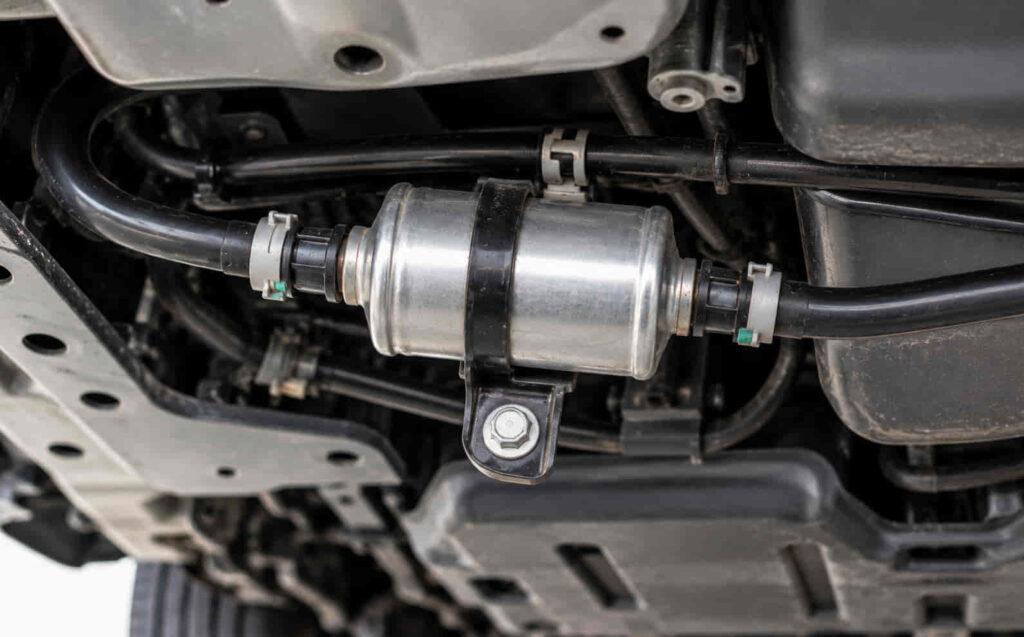
The Honda CR-V uses fuel filtration to prevent contaminants from reaching critical fuel-system components, but the location and serviceability of the fuel filter depend on the model year and fuel-system design. This distinction matters because not every CR-V uses a conventional, separately replaceable fuel filter that can be found under the hood or along an exposed fuel line. On some configurations, the filtration component is associated with the fuel pump or fuel tank assembly, which changes both its location and the appropriate service approach.
A fuel filter must remove contaminants while allowing enough fuel to reach the engine under different operating demands. If the filtration path becomes significantly restricted, available fuel delivery can be affected and the vehicle may develop symptoms such as hesitation, reduced power, or starting and running problems. These symptoms do not confirm a clogged fuel filter by themselves because fuel pump faults, injector problems, electrical issues, and other engine conditions can produce similar behavior.
Correct Honda CR-V fuel filter maintenance therefore starts by identifying the vehicle’s specific filter configuration. From there, the filter’s location, symptoms of restriction, diagnostic evidence, and serviceability determine whether fuel filter replacement is actually required. This guide explains each part of that process and helps distinguish a genuine fuel filter problem from other fuel-delivery faults.
Does a Honda CR-V Have a Fuel Filter?
Yes, a Honda CR-V has fuel filtration within its fuel delivery system, but that does not mean every model year has a conventional fuel filter designed to be replaced as a separate maintenance item. The important distinction is between the function of filtering fuel and the physical design of the filtration component. A CR-V must prevent harmful contaminants from reaching downstream fuel-system components, but Honda can accomplish that function through different fuel-system configurations.
This distinction explains why an owner may search the engine compartment or fuel line and fail to find a recognizable external fuel filter. Depending on the model year and fuel-system design, filtration can be associated with the fuel tank, fuel pump, or fuel pump module rather than installed as an easily accessible standalone component. The absence of an obvious external filter therefore does not mean that the vehicle sends unfiltered fuel directly to the engine.
Filter design also determines how the component is serviced. A separately serviceable fuel filter can have a different replacement strategy from a filtration element incorporated into a larger fuel-system assembly. For this reason, a generic recommendation to replace the Honda CR-V fuel filter at a fixed mileage should not be applied across all model years without checking the applicable maintenance and service information.
The correct starting point is therefore the specific CR-V model year and fuel-system configuration. Every Honda CR-V requires fuel filtration, but the location, construction, accessibility, and separate serviceability of the fuel filter are configuration-dependent. Establishing those attributes prevents an owner from searching for a component that may not exist as a conventional standalone filter on that particular vehicle.
Where Is the Fuel Filter Located on a Honda CR-V?
The Honda CR-V fuel filter location depends on the model year and fuel-system design, and on configurations without a conventional external filter, the filtration component can be associated with the in-tank fuel pump or fuel pump module. This is why a universal instruction such as looking under the hood or following the fuel line cannot accurately identify the fuel filter on every CR-V.
The location follows the architecture of the fuel delivery system. Fuel begins in the tank, passes through the applicable pumping and filtration components, travels through the fuel delivery path, and ultimately reaches the engine’s fuel-injection system. When filtration is incorporated near or within the fuel pump assembly, the relevant component is located at the fuel tank rather than appearing as a separate filter in the engine compartment.
This design difference also changes what “fuel filter replacement” means. Finding the filtration element does not automatically establish that Honda intended it to be replaced independently from the surrounding assembly. On a configuration where the filter is integrated with other fuel-system components, serviceability must be established before purchasing a standalone replacement filter or attempting to locate external fuel-line connections.
Model year is therefore essential when identifying an exact Honda CR-V fuel filter location. Two vehicles carrying the same CR-V name can use different fuel-system arrangements because component design changes across generations and powertrain configurations. An exact location should be matched to the applicable vehicle rather than extrapolated from another CR-V year.
The practical answer is to identify the Honda CR-V model year first and then determine whether its fuel filter is a separate component or part of the fuel tank and pump assembly. That distinction establishes both where the filter is located and whether it can be serviced independently.
Read more: Honda CRV AC Compressor Noise
What Does the Honda CR-V Fuel Filter Do?
The Honda CR-V fuel filter removes contaminants from the fuel supply before they can reach sensitive downstream components in the fuel delivery system. Its function is not simply to trap debris; it must also maintain sufficient fuel flow so the engine receives the amount of fuel required under different operating conditions.
Contaminants can enter the fuel supply through the fuel itself or accumulate within the fuel storage and delivery environment. The filtration element creates a controlled barrier that captures unwanted particles while allowing gasoline to continue through the system. This helps protect components that depend on controlled fuel delivery, including the fuel pump and fuel injectors, although the exact position of the filter relative to these components depends on the CR-V’s fuel-system design.
Fuel flow is the second part of the filter’s function. An effective filter must provide filtration without creating excessive restriction. As contamination accumulates in a serviceable filtration element or another restriction develops in the fuel path, the available flow can decrease. The effect becomes more important when the engine requires a greater volume of fuel because the delivery system must respond to changing engine demand.
This relationship explains why a significantly restricted fuel filter can produce drivability symptoms. If fuel cannot move through the filtration path at the required rate, the engine may not receive adequate fuel delivery under the affected operating condition. Hesitation or reduced power under increased demand can therefore be consistent with fuel restriction, but the same symptoms can also result from a weak fuel pump, injector problems, or faults outside the fuel system.
The Honda CR-V fuel filter therefore performs two connected functions: controlling fuel contamination and maintaining an adequate flow path through the filtration system. A problem becomes relevant to engine performance when the filter or filtration path can no longer perform those functions within the requirements of the fuel delivery system.
Does a Honda CR-V Fuel Filter Need to Be Replaced?
Whether a Honda CR-V fuel filter needs to be replaced depends on the model year, fuel-system design, filter serviceability, and applicable maintenance information rather than one universal replacement interval. A separately serviceable filter and a filtration component integrated into a fuel pump or tank assembly do not necessarily have the same maintenance requirements.
This distinction is important when evaluating mileage-based replacement advice. A recommendation to change a fuel filter every fixed number of miles may apply to a particular vehicle design, but it should not automatically be transferred to every Honda CR-V generation. If the applicable filter is not specified as a routine standalone maintenance item, replacing it solely because the vehicle has reached an arbitrary mileage can result in unnecessary service.
Replacement becomes a different decision when diagnosis confirms that the filtration path is restricted and is interfering with fuel delivery. In that situation, the objective is not preventive replacement based only on mileage; it is correction of a confirmed fuel-system problem. The repair must still match the vehicle’s design because a separately replaceable filter can require a different service approach from an integrated filtration component.
Fuel contamination can also change the service context. If contamination has entered the fuel system, replacing one filtration component without identifying the extent and source of the contamination may not resolve the complete problem. The condition of the fuel delivery system must therefore be considered alongside the filter rather than treating replacement as an isolated maintenance action.
The correct Honda CR-V fuel filter replacement decision is based on the specific vehicle configuration and evidence that service is required. Model-year-specific maintenance information determines scheduled service requirements, while diagnostic evidence determines whether restriction or contamination requires repair outside normal maintenance.
What Are the Symptoms of a Clogged Honda CR-V Fuel Filter?
A clogged Honda CR-V fuel filter can cause hesitation, reduced engine power, difficult starting, unstable engine operation, or other drivability problems when the restriction prevents the fuel system from supplying enough fuel for the engine’s operating demand. These symptoms become diagnostically meaningful when they correspond with evidence of restricted fuel delivery rather than simply appearing at the same time.
The underlying mechanism is fuel-flow restriction. As the filtration path becomes increasingly restricted, the fuel delivery system must move fuel through a smaller effective flow path. A minor restriction may produce little noticeable change when fuel demand is low, while a more significant restriction can become apparent during acceleration or higher engine load because the engine requires greater fuel delivery under those conditions.
Hesitation and reduced power are therefore relevant symptoms when they become more pronounced as engine demand increases. The vehicle may respond normally during lighter operation but struggle to deliver expected acceleration when more fuel is required. This pattern is consistent with a fuel-supply limitation, although it does not identify the fuel filter as the source without further diagnosis.
Starting or unstable running problems can occur when restriction becomes severe enough to interfere with the fuel delivery needed for reliable engine operation. However, these symptoms have broad diagnostic overlap. A weak fuel pump, injector fault, electrical problem, ignition problem, air-metering issue, or another engine-management condition can produce similar behavior. Replacing the fuel filter based only on a hard-start or rough-running complaint can therefore leave the actual fault unresolved.
Symptom combinations provide stronger context than an isolated complaint. For example, hesitation that repeatedly occurs under increased load together with evidence of inadequate fuel delivery supports a fuel-system investigation more strongly than hesitation alone. Diagnosis must then determine whether the restriction is actually located at the filtration component or whether another part of the fuel delivery system is responsible.
Clogged Honda CR-V fuel filter symptoms should therefore be interpreted as evidence of a possible fuel-delivery restriction, not proof of a failed filter. The symptom identifies the operating problem; fuel-system diagnosis identifies the component causing it.
Can a Clogged Fuel Filter Cause a Honda CR-V to Lose Power?
Yes, a sufficiently restricted Honda CR-V fuel filter can contribute to loss of engine power because the restriction can limit the amount of fuel available when engine demand increases. The connection between the filter and power loss is strongest when the vehicle performs acceptably under lower demand but develops hesitation or reduced acceleration as greater fuel delivery is required.
Acceleration increases the engine’s operating demand, which requires the fuel system to respond accordingly. If the filtration path allows adequate flow at lower demand but cannot support the required delivery as demand rises, the limitation becomes more noticeable during acceleration or load. The driver experiences the result as weak response, hesitation, or an inability to produce the expected power.
This mechanism also explains why fuel-filter restriction does not necessarily create identical symptoms at all times. Restriction severity and operating demand interact. A partially restricted fuel path may still support certain operating conditions, while a more severe restriction can interfere with a wider range of engine operation. The point at which symptoms appear therefore provides diagnostic context about the conditions under which fuel delivery becomes inadequate.
Power loss is not specific to a clogged fuel filter. A weak fuel pump can also reduce available fuel delivery, while injector, ignition, airflow, sensor, exhaust, or engine-control problems can affect acceleration through different mechanisms. The presence of reduced power should therefore direct diagnosis toward the systems capable of producing the symptom rather than directly toward fuel filter replacement.
A clogged fuel filter becomes a credible cause of Honda CR-V power loss when diagnostic evidence connects the performance problem to restricted fuel delivery and then localizes that restriction to the filtration path. This distinction separates a symptom-based assumption from a component-level diagnosis and provides the evidence needed to decide whether fuel filter service is appropriate.
How Can You Tell a Bad Fuel Filter From a Fuel Pump Problem?
A bad Honda CR-V fuel filter is distinguished from a fuel pump problem by determining whether inadequate fuel delivery comes from a restriction in the filtration path or from the pump’s inability to supply fuel as required. Both faults can produce hesitation, reduced power, difficult starting, or unstable engine operation, so symptoms alone cannot reliably identify which component is responsible.
A restricted fuel filter affects delivery by limiting the path through which fuel must flow. The fuel pump may still operate, but the restriction prevents the system from delivering the required amount of fuel under affected operating conditions. This limitation can become more noticeable as engine demand increases because acceleration and higher load require the fuel system to support greater delivery.
A weak or failing fuel pump produces a different underlying problem. Instead of an adequate pump pushing fuel through an excessively restricted filtration path, the pump itself cannot provide the required delivery. The resulting engine behavior can look similar because both conditions ultimately affect the amount of fuel available to the engine. This shared outcome explains why reduced power or hard starting cannot identify the failed component without additional evidence.
Fuel-delivery behavior provides the connection between the symptom and the cause. If diagnosis confirms inadequate delivery, the next question is whether a restriction is preventing normal flow or the pump cannot provide the required output. The vehicle’s fuel-system configuration also matters because the filter and pump can be physically associated within the same assembly on some Honda CR-V applications, making component-level diagnosis more important than relying on their physical proximity.
Replacing a filter without confirming restriction can leave a weak fuel pump unresolved. Replacing a pump without identifying an actual filtration restriction can create the same problem in reverse. The correct distinction is therefore based on the mechanism causing inadequate fuel delivery: restriction points toward the filtration path, while insufficient pumping capability points toward the fuel pump.
How Do You Diagnose a Clogged Honda CR-V Fuel Filter?
A clogged Honda CR-V fuel filter is diagnosed by confirming the drivability symptom, establishing that fuel delivery is inadequate under the affected operating condition, and determining that the limitation comes from the filtration path rather than the fuel pump, injectors, electrical system, or another engine fault. Diagnosis should confirm restriction before fuel filter replacement is selected as the repair.
The process begins with the conditions under which the symptom occurs. Hesitation during acceleration, reduced power under load, or starting problems provide different diagnostic information from a symptom that occurs randomly and cannot be reproduced. Establishing a repeatable operating pattern helps determine whether the problem is consistent with a fuel-delivery limitation and identifies when the system needs to be evaluated.
The next requirement is evidence that fuel delivery is actually involved. Similar drivability symptoms can originate from ignition, airflow, electronic control, or mechanical engine problems, so the presence of hesitation does not justify moving directly to the fuel filter. Diagnosis must first connect the engine behavior to the fuel supply before separating the individual components within that system.
Once a fuel-delivery problem is established, the restriction must be localized. Fuel pressure and delivery behavior can provide diagnostic evidence when evaluated using the correct specifications and procedures for the applicable Honda CR-V. The objective is to determine whether fuel is being restricted through the filtration path or whether another component, such as the fuel pump, is unable to perform its function. This distinction converts a general fuel-system symptom into a component-specific diagnosis.
The model year and filter configuration must then be considered. If the filtration component is integrated into the fuel pump or tank assembly, diagnosis cannot assume that a conventional external filter can simply be removed and replaced. The applicable system design determines which component is serviceable and what repair follows after the restriction has been confirmed.
A Honda CR-V fuel filter should therefore be classified as clogged only when diagnostic evidence connects the vehicle’s symptoms to inadequate fuel delivery and identifies the filtration path as the source of that limitation. This approach prevents unnecessary filter replacement and separates a confirmed restriction from other fuel-system faults that produce similar symptoms.
How Do You Replace a Honda CR-V Fuel Filter?
Honda CR-V fuel filter replacement depends on the model year, fuel-system design, and whether the filtration component is separately serviceable or integrated into a larger fuel pump or tank assembly. The correct repair therefore begins by identifying the exact filter configuration rather than assuming every CR-V has an external filter that can be removed and replaced independently.
When the vehicle uses a separately serviceable fuel filter, replacement targets that component after diagnosis or applicable maintenance information establishes that service is required. The replacement part must match the specific vehicle configuration because fuel-system connections, filter construction, and installation location can differ between applications. Replacing a filter based only on visual similarity or another CR-V model year can result in an incorrect repair.
An integrated filtration design requires a different approach. If the applicable filtration element is incorporated into the fuel pump module or another assembly and is not intended to be serviced separately, the repair decision must follow the serviceability of that assembly. In this situation, searching for a standalone Honda CR-V fuel filter replacement procedure can be misleading because the physical filter may not correspond to an independently replaceable maintenance part.
The condition that caused the service requirement should also be considered. If diagnosis identifies simple restriction at a serviceable filter, replacing the restricted component addresses the confirmed flow limitation. If fuel contamination is present elsewhere in the system, changing only the filter may not address the complete cause because contaminated fuel can affect additional parts of the delivery path.
Fuel-system service also requires appropriate procedures because gasoline is flammable and the fuel delivery system can retain pressure. The applicable service information should determine how the system is accessed, depressurized, disconnected, reassembled, and checked after repair rather than using one generic procedure across all Honda CR-V configurations.
Honda CR-V fuel filter replacement is therefore a configuration-specific repair, not a universal maintenance procedure. The correct replacement targets the component confirmed to require service and follows the design of the specific fuel system instead of assuming every CR-V uses the same standalone filter.
What Happens If You Do Not Replace a Restricted Fuel Filter?
If a Honda CR-V has a genuinely restricted fuel filter and the restriction is not corrected, available fuel delivery can remain limited and drivability problems can become more noticeable as the restriction interferes with engine demand. The consequence comes from continued fuel-flow limitation, not simply from the age or mileage of the filter.
A restriction that initially affects higher-demand operation may first appear as hesitation or reduced acceleration. The engine requires greater fuel delivery as operating demand increases, so a filtration path that supports lower-demand operation may become inadequate under heavier load. If the restriction progresses, the range of operating conditions affected by inadequate fuel delivery can increase.
More severe fuel-delivery limitation can contribute to starting or running problems when the system can no longer provide the required fuel supply consistently. The exact symptom depends on the degree of restriction and the operating condition in which available delivery becomes insufficient. This progression explains why a vehicle can initially show performance problems only during acceleration before developing more persistent drivability symptoms.
However, these consequences apply to a confirmed restricted filtration path, not every Honda CR-V fuel filter that has accumulated mileage. A filter or filtration component that is functioning correctly and is not specified for routine standalone replacement should not automatically be treated as overdue or clogged simply because the vehicle has reached a particular mileage.
Ignoring a suspected restriction without diagnosis creates a second problem: the actual fault may be somewhere else. A weak fuel pump, injector problem, electrical fault, or another engine condition can continue producing the same symptoms while an unnecessary fuel filter replacement delays identification of the real cause.
The important maintenance decision is therefore to correct a confirmed fuel-delivery restriction rather than replacing the Honda CR-V fuel filter solely as a reaction to nonspecific symptoms. When restriction is verified, addressing it restores the intended fuel-delivery path; when it is not verified, further diagnosis is required before selecting the repair.
Can You Drive a Honda CR-V With a Clogged Fuel Filter?
Whether you can continue driving a Honda CR-V with a clogged fuel filter depends on the severity of the restriction and how strongly it affects fuel delivery and engine operation. A suspected minor restriction and a confirmed restriction causing severe hesitation, significant power loss, difficult starting, or unstable engine operation do not represent the same drivability condition.
A partially restricted filtration path may allow enough fuel delivery during lower-demand operation while becoming inadequate when the engine requires more fuel. This can explain a vehicle that appears to run normally during light driving but hesitates or loses power during stronger acceleration. Continuing to drive does not remove the restriction, and the underlying fuel-delivery limitation remains whenever operating demand exceeds what the restricted path can support.
More severe symptoms require greater attention because predictable engine response can be affected. If the Honda CR-V hesitates substantially, loses power under acceleration, struggles to remain running, or becomes increasingly difficult to start, the fuel-delivery problem should be diagnosed rather than treated as a minor maintenance issue. Reliable acceleration depends on the engine receiving the required fuel supply when demand changes.
Turning the symptom into a fuel-filter diagnosis still requires evidence. Similar drivability problems can result from a weak fuel pump, injector faults, ignition problems, airflow faults, electrical issues, or other engine-management conditions. Continuing to drive while assuming the filter is responsible can delay repair of a different underlying problem.
The practical decision should therefore be based on symptom severity and confirmed diagnosis rather than the label “clogged fuel filter” alone. If fuel restriction is confirmed, correcting the restriction restores the intended fuel-delivery path. If the source has not been confirmed, diagnosis should determine why fuel delivery or engine performance is being affected before a replacement component is selected.
How Can You Reduce Honda CR-V Fuel Filter and Fuel System Problems?
Honda CR-V fuel filter and fuel-system problems can be reduced by following the maintenance requirements for the specific model year, addressing fuel contamination and drivability symptoms early, and repairing confirmed fuel-delivery faults instead of replacing components based on assumptions. The objective is to preserve both clean fuel delivery and sufficient fuel flow throughout the system.
Fuel quality and contamination directly affect the filtration environment. The filter exists to prevent unwanted material from continuing through the fuel delivery path, but excessive contamination can increase the amount of material the filtration system must capture. When contaminated fuel is suspected, the condition should be evaluated as a fuel-system issue rather than assuming that replacing one filter automatically resolves every affected component.
New drivability symptoms should also be investigated according to the conditions in which they occur. Hesitation during acceleration, reduced power under load, difficult starting, or unstable operation can provide evidence of a fuel-delivery problem, but they can also originate outside the fuel system. Early diagnosis separates an actual filtration restriction from fuel pump, injector, electrical, ignition, airflow, or engine-control faults before unnecessary parts are replaced.
Maintenance decisions should follow the applicable Honda CR-V configuration rather than a universal fuel filter replacement interval. A separately serviceable filter may have different requirements from a filtration element integrated into a fuel pump or tank assembly. Identifying the model year and system design establishes whether the filter is a routine service component and how it should be addressed when a restriction is confirmed.
The same component-specific approach should continue after a repair. If fuel delivery and engine performance return to normal after the confirmed restriction is corrected, the repair has addressed the relevant fault. If hesitation, power loss, starting problems, or other symptoms remain, further diagnosis is necessary because replacing one filtration component does not eliminate other possible causes.
Reducing future Honda CR-V fuel filter problems ultimately depends on maintaining the correct fuel-system configuration, responding to contamination or performance changes early, and confirming the failed component before replacement. This approach protects fuel delivery while avoiding unnecessary service based solely on mileage or nonspecific engine symptoms.