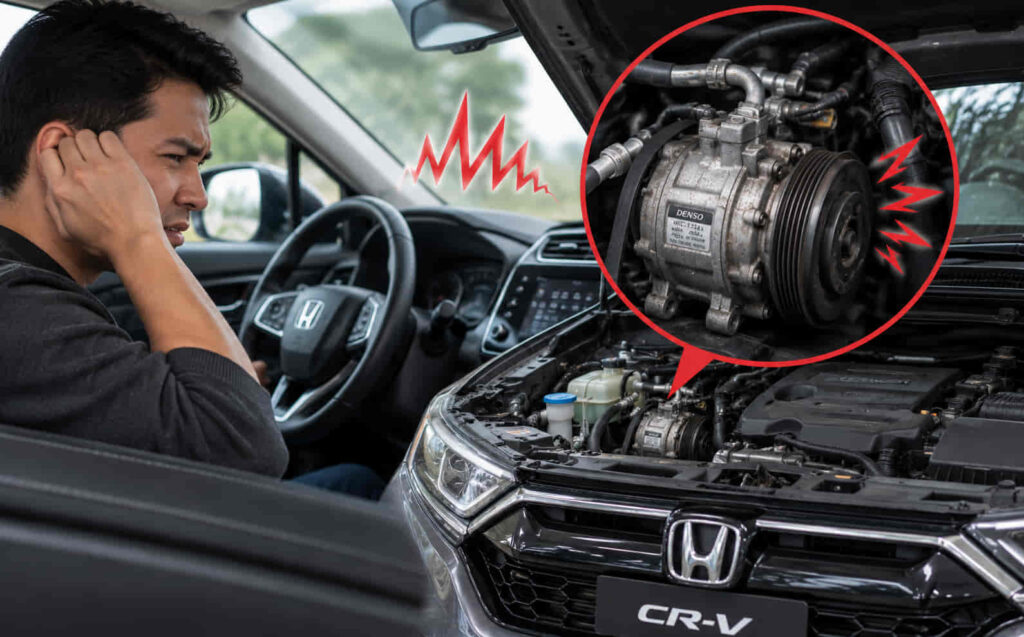
Honda CR-V AC compressor noise can come from the compressor itself or from related components such as the compressor clutch, pulley, bearing, or belt-drive system. An abnormal grinding, rattling, squealing, or repetitive clicking sound can indicate a mechanical problem, but the sound alone does not confirm that the compressor needs replacement. The operating condition in which the noise appears is equally important for diagnosis.
A noise that starts or changes when the A/C is turned on provides a useful clue because the load and operating state of the air-conditioning system change at that moment. However, components located around the compressor can produce similar sounds, and some noises may continue even when the A/C is not actively cooling. Identifying whether the sound occurs with the A/C on, with the A/C off, during changes in engine speed, or together with reduced cooling performance helps narrow the possible source.
Correct diagnosis therefore requires more than identifying a “bad compressor sound.” This guide explains what different Honda CR-V AC compressor noises can indicate, why the noise may appear when the A/C is activated, and how compressor noise can be distinguished from clutch, pulley, bearing, or belt-related noise. It also covers diagnosis, repair and replacement decisions, the consequences of ignoring abnormal noise, and ways to reduce the risk of future A/C compressor problems.
What Does Honda CR-V AC Compressor Noise Mean?
Honda CR-V AC compressor noise means an abnormal sound is being produced by the compressor or a component operating around the compressor, but the noise does not by itself prove that the compressor has failed. The compressor, clutch, pulley, bearing, drive belt, and nearby belt-drive components operate close to one another, so a sound heard from the compressor area must be localized before the failed component can be identified.
The condition in which the noise occurs provides important diagnostic information. If the sound begins or changes when the A/C is switched on, the change suggests a relationship with compressor operation or the additional load created when the air-conditioning system is active. If the same sound remains present with the A/C off, a component that continues rotating with the engine, such as a pulley, bearing, belt, or related drive component, also needs to be considered.
The character of the sound provides another layer of evidence. Grinding can indicate metal-to-metal contact or mechanical deterioration somewhere in the compressor assembly or related rotating components, while rattling can be associated with looseness, wear, or internal mechanical movement. Squealing more strongly directs attention toward a slipping or loaded belt-drive component, although the sound still needs to be traced to its actual source. Clicking must be interpreted according to its frequency and operating condition because a single change in sound associated with A/C engagement is different from persistent or abnormal repetitive clicking.
Cooling performance helps connect the noise to the broader A/C condition. Abnormal compressor-area noise combined with weak or lost cooling provides more diagnostic information than noise alone because both mechanical operation and A/C performance are affected. However, poor cooling still does not confirm compressor failure; refrigerant problems, electrical faults, and other A/C components can reduce cooling without being the source of the mechanical noise.
The meaning of Honda CR-V AC compressor noise therefore depends on three factors: what the sound is like, when it occurs, and which component is actually producing it. Diagnosis becomes more reliable when these factors are evaluated together instead of treating any noise near the compressor as evidence that the entire compressor must be replaced.
Read more: Honda CRV Sunroof Leak
What Does a Bad Honda CR-V AC Compressor Sound Like?
A failing Honda CR-V AC compressor can produce abnormal grinding, rattling, or other persistent mechanical noises, but no single sound confirms compressor failure without identifying its source. The most useful diagnostic clue is how the sound changes when the A/C compressor is operating compared with when the A/C is off. A noise that appears specifically under compressor load points toward a different group of possible problems than a noise that continues whenever the engine is running.
Grinding is a significant mechanical sound because it indicates that rotating components are no longer moving smoothly. If grinding begins or becomes substantially stronger when the compressor operates, internal compressor wear becomes a relevant possibility. However, a damaged pulley bearing or another rotating component near the compressor can create a similar sound. The source must therefore be localized before grinding is attributed to the compressor internals.
Rattling can indicate looseness, wear, or abnormal movement within the compressor assembly or surrounding hardware. Its diagnostic value increases when the noise repeatedly changes with A/C operation or engine speed. A rattle heard throughout engine operation, regardless of whether the A/C is cooling, requires investigation of components that continue moving when the compressor itself is not actively loaded.
Squealing generally directs diagnosis toward friction or slippage in the belt-drive system rather than automatically proving internal compressor damage. Compressor load can make an existing belt, pulley, tensioner, or bearing problem more noticeable when the A/C turns on. This explains why a squeal that begins with A/C operation can still originate outside the compressor itself.
Clicking requires additional context because engagement-related sounds and abnormal repetitive clicking do not have the same diagnostic meaning. A brief sound associated with a change in compressor or clutch operating state should not automatically be classified as compressor failure. Persistent clicking, rapid cycling accompanied by poor cooling, or a new mechanical clicking sound should instead be evaluated together with compressor operation and A/C performance.
A bad compressor sound becomes meaningful diagnostic evidence when the sound is abnormal, repeatable, linked to compressor operation, and localized to the compressor itself. Without those relationships, grinding, rattling, squealing, or clicking should be treated as clues rather than proof that the Honda CR-V needs a new AC compressor.
What Causes a Honda CR-V AC Compressor to Make Noise?
Honda CR-V AC compressor noise can result from internal compressor wear, clutch or pulley problems, bearing deterioration, belt-drive faults, or operating conditions that place abnormal load on the compressor system. These causes can produce sounds in the same area of the engine compartment, which is why identifying the failed component is necessary before choosing a repair.
Internal compressor wear can create noise when moving components no longer operate smoothly under load. As mechanical surfaces deteriorate, the compressor can develop grinding, rattling, or other abnormal sounds that become more apparent while it is working. When this noise is accompanied by declining A/C performance and testing localizes the sound inside the compressor, internal failure becomes a stronger diagnosis than noise alone would provide.
The clutch, pulley, and bearing can create compressor-area noise without the same internal failure mechanism. The pulley participates in the belt-drive system, while the clutch controls the mechanical relationship between the drive system and compressor operation on configurations that use this arrangement. Wear or damage in these components can therefore create noise near the compressor even when the sound does not originate from the compressor’s internal pumping mechanism.
Belt-drive problems can become more noticeable when the A/C adds load to the system. A slipping belt, abnormal pulley resistance, or a related tensioning problem can produce squealing or other friction-related noise as operating conditions change. Because the noise may begin at the same moment the A/C is switched on, it can easily be mistaken for compressor failure unless the belt-drive components are evaluated separately.
A/C system operating conditions also matter because the compressor is designed to work within specific refrigerant and pressure conditions. A system fault can change compressor load or operation, but refrigerant condition should not be used as a universal explanation for every compressor noise. The correct diagnosis must establish both the A/C system condition and the mechanical source of the sound.
The cause of Honda CR-V AC compressor noise is therefore the mechanical or operating failure producing the sound, not simply the fact that the noise appears when the A/C is used. Separating internal compressor wear from clutch, pulley, bearing, and belt-drive problems prevents the symptom from being converted directly into an unnecessary compressor replacement.
Why Does My Honda CR-V Make Noise When the AC Is Turned On?
A Honda CR-V can make noise when the A/C is turned on because compressor operation changes the mechanical load on the A/C and belt-drive system, making a compressor, clutch, pulley, bearing, or belt problem more noticeable. The moment the noise begins is useful diagnostic evidence, but it does not identify the failed component by itself.
When the A/C system requests compressor operation, the mechanical conditions around the compressor change. A component that remains relatively quiet under lower load can begin rattling, grinding, or squealing when that load increases. This explains why an existing bearing or belt-drive problem may first become obvious when the driver turns on the air conditioning even though the compressor internals are not necessarily the source.
A noise that appears only while the compressor is operating gives internal compressor or engagement-related problems greater diagnostic relevance. For example, grinding that repeatedly begins under compressor operation and disappears when that operating state ends provides a stronger relationship between the noise and the loaded A/C component. The relationship still needs to be confirmed by localizing the sound because nearby rotating parts can react to the same change in load.
A squeal that starts when the A/C is activated can follow a different mechanism. Increased mechanical resistance can expose belt slippage, inadequate belt tension, pulley resistance, or bearing deterioration that was less noticeable before the additional load appeared. In this situation, the timing makes the noise seem compressor-specific even though the sound can originate elsewhere in the belt-drive system.
Changes in cooling performance provide additional context. If abnormal noise begins with A/C operation while cooling simultaneously becomes weak or inconsistent, diagnosis should evaluate both the mechanical sound and the A/C system condition. Neither symptom should be used to prove the other: weak cooling does not automatically establish compressor failure, and compressor-area noise does not automatically explain poor cooling.
Noise that starts when a Honda CR-V A/C is turned on should therefore be diagnosed according to what changes at that moment and which component produces the sound. The timing narrows the diagnostic field; localization identifies the actual source.
How Can You Tell AC Compressor Noise From Pulley or Belt Noise?
You can distinguish Honda CR-V AC compressor noise from pulley or belt noise by comparing when the sound occurs, how it changes with compressor operation, and whether it can be localized to the compressor internals or another rotating component. This distinction matters because replacing the compressor will not correct a noise produced by a pulley, bearing, belt, or tensioning component.
A pulley or bearing-related noise can remain present while the engine is running even when the A/C is not actively cooling, depending on the compressor and drive configuration. The reason is that parts of the accessory drive can continue rotating independently of whether the compressor is performing its active compression function. A sound that remains substantially unchanged with the A/C off therefore requires investigation beyond the compressor internals.
Internal compressor noise has a stronger relationship with the compressor’s loaded operating state. If a grinding or rattling sound repeatedly develops or becomes substantially worse when compressor operation begins, the compressor becomes a more relevant suspect. Localization remains essential because the same load change can increase stress on the belt, pulley, bearing, or tensioner and make those components louder at the same moment.
Belt noise has a different acoustic and mechanical pattern. Squealing or chirping can result when the belt does not move normally across the accessory-drive system or when another component creates abnormal resistance. A noise that changes with engine speed or appears when A/C load is introduced can therefore involve the belt system without requiring internal compressor failure.
The clutch and pulley area can further complicate diagnosis because it is physically close to the compressor housing. Noise from this area may sound as though it comes from the compressor even when the internal compression mechanism is not responsible. Identifying whether the noise originates at the clutch or pulley area, inside the compressor, or elsewhere along the accessory drive prevents physical proximity from being mistaken for component failure.
The most reliable distinction comes from combining operating condition with sound localization. A noise associated specifically with compressor operation directs diagnosis toward the compressor or engagement system, while noise that persists independently of active A/C operation increases the relevance of pulley, bearing, belt, and related drive components. The failed part should be confirmed before a Honda CR-V AC compressor replacement is considered.
How Do You Diagnose Honda CR-V AC Compressor Noise?
Honda CR-V AC compressor noise is diagnosed by reproducing the sound, identifying the operating condition in which it occurs, localizing the noise to a specific component, and comparing that evidence with A/C performance. The objective is to determine whether the sound originates inside the compressor or from the clutch, pulley, bearing, belt, tensioner, or another nearby component before any part is replaced.
The first diagnostic distinction is whether the noise changes when A/C operation changes. A sound that appears or becomes significantly stronger when the compressor operates establishes a relationship with A/C load. A sound that continues with little change when the A/C is off requires greater attention to components that can continue rotating with the engine. Comparing these operating states provides more information than evaluating the sound only while the A/C is running.
The next requirement is sound localization. Several rotating components occupy the same area of the engine compartment, so hearing grinding, rattling, or squealing near the compressor does not establish which one is producing it. Inspection must narrow the sound to the compressor itself or another component in the accessory-drive and compressor assembly. This step is particularly important when pulley or bearing noise is transmitted through surrounding hardware and appears to come from the compressor housing.
A/C performance should then be evaluated alongside the mechanical noise. Abnormal sound combined with reduced cooling can indicate that the problem affects compressor operation, but poor cooling has other possible causes and should not be treated as independent proof of internal compressor damage. The diagnostic relationship becomes stronger when abnormal compressor operation, localized mechanical noise, and an A/C performance problem occur together.
The character of the noise provides supporting evidence after the operating condition and location are established. Grinding localized to the compressor under load suggests a different mechanical problem from belt squealing that begins when A/C load increases. Likewise, rattling inside the compressor assembly has a different repair implication from noise traced to the pulley or tensioner.
A Honda CR-V AC compressor should be diagnosed as the noise source only when the evidence connects the abnormal sound specifically to compressor operation or internal mechanical condition. Establishing that connection prevents a symptom heard in the compressor area from being converted directly into an unnecessary compressor replacement.
Does a Noisy Honda CR-V AC Compressor Need to Be Replaced?
A noisy Honda CR-V AC compressor needs replacement when diagnosis confirms internal compressor failure or damage that cannot be corrected by repairing an external component. Noise alone is not sufficient reason to replace the compressor because clutch, pulley, bearing, belt, or tensioner problems can create similar sounds in the same area.
Confirmed internal grinding or severe mechanical noise that follows compressor operation gives compressor replacement greater relevance because the failure exists within the component responsible for compressing and circulating refrigerant. If the compressor can no longer operate mechanically as intended, addressing an external belt or pulley does not correct the internal failure. The repair decision must therefore follow the location of the damaged component.
A different repair is appropriate when testing traces the noise outside the compressor internals. If the sound originates from a serviceable clutch, pulley, bearing, belt, tensioner, or another accessory-drive component, replacing the entire compressor may leave the actual noise source unresolved. Component configuration and serviceability can vary, so the applicable repair procedure must determine whether the affected part can be serviced separately.
Cooling performance also should not be used as the sole replacement criterion. A Honda CR-V can have weak A/C cooling because of refrigerant loss, electrical problems, airflow problems, or faults elsewhere in the system. Compressor replacement becomes justified when diagnosis connects the compressor itself to the mechanical failure rather than simply combining a noise complaint with poor cooling.
The severity and progression of the noise provide additional context but still require confirmation. A new sound that rapidly becomes louder, persistent grinding, or evidence that a rotating component is no longer moving correctly warrants prompt diagnosis because the underlying mechanical condition may be progressing. A brief or intermittent sound should likewise be identified rather than automatically classified as normal or as evidence of compressor failure.
The replacement decision should therefore answer one question: is the compressor itself the confirmed failed component? If the answer is yes and the internal failure requires replacement, installing the correct compressor becomes part of the repair. If the answer is no, the repair should target the clutch, pulley, bearing, belt-drive component, or other confirmed source instead.
How Is Honda CR-V AC Compressor Noise Fixed?
Honda CR-V AC compressor noise is fixed by repairing or replacing the specific component confirmed to be producing the abnormal sound. If diagnosis identifies internal compressor damage, compressor replacement may be required. If the noise originates from the clutch, pulley, bearing, belt, tensioner, or another related component, the repair should address that component instead of automatically replacing the compressor.
Internal compressor failure requires a different repair path from an external belt-drive problem because the noise originates inside the component that performs the compression function. Grinding, rattling, or another severe mechanical sound localized to the compressor under operation can indicate internal deterioration when supported by diagnosis. Replacing the failed compressor removes the mechanical source of the noise, but the A/C system must also be serviced according to the applicable procedure because the compressor is part of the refrigerant circuit.
A clutch, pulley, or bearing problem should be treated according to the configuration and serviceability of the affected assembly. These components operate immediately around the compressor and can transmit noise through the same area, which makes them easy to mistake for internal compressor failure. When one of these components is confirmed as the source, the repair decision should follow that finding rather than the apparent location of the sound.
Belt-drive noise requires the same diagnostic discipline. Squealing that becomes noticeable when A/C load increases can result from abnormal belt movement, pulley resistance, tensioning problems, or another accessory-drive condition. Replacing the compressor without correcting the actual belt-drive failure can leave the original sound unchanged.
The A/C system should be evaluated again after the mechanical repair. The absence of the original noise confirms one part of the repair, while normal cooling operation provides additional evidence that the system is functioning as intended. If cooling remains weak after the noise source has been corrected, further A/C diagnosis is required because more than one problem may be present.
A complete repair eliminates the confirmed source of the Honda CR-V AC compressor noise and verifies that the A/C system operates correctly afterward. The correct repair can therefore range from addressing an external drive component to replacing the compressor itself, depending on where diagnosis locates the failure.
Can You Drive a Honda CR-V With AC Compressor Noise?
Whether you should continue driving a Honda CR-V with AC compressor noise depends on the source and severity of the sound, because a minor unidentified noise and severe mechanical grinding do not represent the same condition. A vehicle may remain drivable when the problem is limited to the air-conditioning system, but abnormal noise should be diagnosed before assuming that continued operation is harmless.
A mild sound that has not yet been identified provides less information about mechanical risk than a loud grinding, binding, or rapidly worsening noise. Severe mechanical sounds indicate that a rotating component may not be operating normally. If the affected component interacts with the accessory-drive system, the problem can extend beyond loss of cabin cooling, which makes identifying the source more important than simply deciding whether the A/C still produces cold air.
The relationship between the noise and A/C operation also matters. If the abnormal sound appears only when the A/C system requests compressor operation, avoiding unnecessary A/C use can prevent repeatedly reproducing that operating condition until the source is inspected. This does not repair the problem, and it should not be treated as a permanent solution.
A noise that continues even when the A/C is off requires additional attention because the source may involve a pulley, bearing, belt, tensioner, or another component that continues moving while the engine runs. In that situation, switching off the air conditioning may not remove the mechanical condition responsible for the sound.
Cooling performance is not a sufficient measure of whether continued driving is appropriate. An A/C system can still produce cold air while a mechanical component is deteriorating, just as poor cooling can occur without a severe mechanical compressor failure. The safest diagnostic distinction is therefore based on the failed component and the severity of its mechanical condition, not simply on whether the Honda CR-V can still cool the cabin.
What Happens If You Ignore Honda CR-V AC Compressor Noise?
Ignoring Honda CR-V AC compressor noise can allow the underlying mechanical problem to progress, potentially leading to louder noise, reduced A/C performance, or failure of the affected component. The exact consequence depends on whether the original sound comes from the compressor itself or from a related clutch, pulley, bearing, belt, or tensioning component.
Internal compressor wear can become more significant as the compressor continues operating under load. A grinding or rattling sound associated with internal mechanical deterioration indicates that moving components are no longer operating as intended. Continued operation does not correct that wear, and deterioration can eventually prevent the compressor from performing its compression function correctly. Cooling performance may then decline or stop as the mechanical condition progresses.
Noise from an external rotating component follows a different failure path. A deteriorating pulley or bearing can become progressively louder or develop greater resistance, while a belt-drive problem can continue producing friction, vibration, or abnormal movement. Because these components can interact mechanically with the accessory-drive system, the consequence is not always limited to reduced A/C cooling. The specific risk depends on which component is damaged and how that component is integrated into the vehicle’s drive system.
Waiting for the A/C to stop cooling completely is therefore not a reliable way to judge the severity of compressor-area noise. Mechanical deterioration can exist while the system still produces cold air, and cooling loss can also result from faults unrelated to the noise. A new sound, a rapidly worsening sound, persistent grinding, or evidence of abnormal rotation provides a stronger reason for prompt diagnosis than cabin temperature alone.
The main consequence of ignoring Honda CR-V AC compressor noise is allowing an unidentified mechanical fault to continue operating without knowing how it may progress. Early diagnosis establishes whether the problem is limited to a serviceable external component or involves the compressor itself, allowing the repair to target the failure before additional deterioration changes the scope of the problem.
How Can You Reduce the Risk of Future Honda CR-V AC Compressor Problems?
The risk of future Honda CR-V AC compressor problems can be reduced by addressing abnormal A/C operation early, maintaining related belt-drive components, and repairing confirmed system faults instead of continuing to operate the system with unresolved symptoms. Compressor reliability depends not only on the compressor itself but also on the operating conditions and mechanical components that support its function.
New mechanical noises should be investigated before they become persistent or severe. A small change in sound can provide an early indication that a bearing, pulley, belt-drive component, or compressor assembly is no longer operating normally. Identifying the source at this stage makes it possible to distinguish an external component problem from internal compressor deterioration rather than waiting until the A/C loses cooling performance.
The accessory-drive system also deserves attention because the compressor operates within that mechanical environment. Belt condition, pulley movement, bearing condition, and proper tensioning affect how rotational force reaches compressor-related components. A fault in this system can create noise when A/C load changes and can be incorrectly interpreted as compressor failure if the surrounding components are not inspected.
A/C performance problems should also be diagnosed rather than masked by repeatedly operating or recharging a system without identifying the underlying fault. Refrigerant loss, abnormal system pressures, electrical faults, airflow problems, and mechanical compressor issues require different repairs. Correctly identifying the problem keeps the compressor operating under the conditions intended for the system and avoids replacing components that are not responsible for the symptom.
After an A/C repair, verifying both mechanical operation and cooling performance helps confirm that the original problem has been resolved. If abnormal noise remains after one component is repaired, the remaining sound should be diagnosed separately instead of assuming it is normal. Likewise, restoring cooling without addressing an existing mechanical noise does not establish that the compressor area is functioning correctly.
Preventing Honda CR-V AC compressor problems ultimately depends on early diagnosis and component-specific repair. Treating grinding, rattling, squealing, clicking, reduced cooling, and other A/C symptoms as diagnostic evidence rather than isolated problems makes it easier to identify the actual failure and avoid unnecessary compressor replacement.