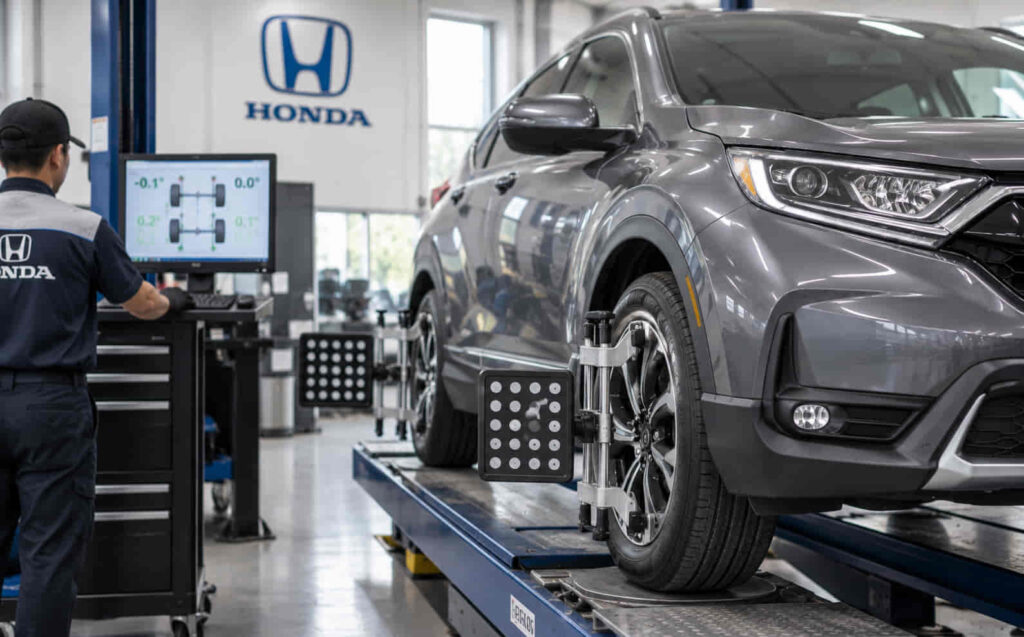
Honda CR-V wheel alignment is the process of measuring and, where applicable, adjusting wheel and suspension geometry so the vehicle operates within the specified alignment settings. Alignment primarily involves angles such as camber, caster, and toe, which describe how the wheels are positioned relative to the vehicle and road. Correct alignment helps maintain predictable steering behavior, appropriate tire contact with the road, and even tire wear.
A Honda CR-V may need an alignment check when it begins pulling to one side, the steering wheel remains off-center while traveling straight, or the tires develop abnormal wear patterns. These symptoms do not automatically confirm incorrect wheel alignment. Tire pressure differences, tire condition, road surface, and worn or damaged steering and suspension components can create similar behavior. Measuring the alignment and inspecting related components is therefore necessary before adjustment.
Wheel alignment can also become relevant after a significant pothole or curb impact, certain steering or suspension repairs, or when tire wear indicates a change in wheel geometry. This guide explains Honda CR-V wheel alignment symptoms, camber, caster and toe, common causes of alignment problems, tire wear, diagnosis, the alignment service process, service timing, and cost factors. It also explains when tire or suspension work should be followed by an alignment check and how proper maintenance can help preserve alignment and tire life.
What Is Honda CR-V Wheel Alignment?
Honda CR-V wheel alignment is the measurement and adjustment of wheel and suspension geometry according to the applicable alignment specifications for the vehicle. The service determines whether the wheels are positioned at the intended angles relative to the vehicle, each other, and the road. Alignment therefore concerns wheel geometry rather than physically adjusting the tire itself.
Wheel position is controlled by the relationship between the wheels and suspension and steering components. Parts such as control arms, tie rods, struts, ball joints, and related mounting points help establish this geometry. When an adjustable alignment angle moves outside its specified range, the direction or contact pattern of a wheel can change even when the tire itself has no structural defect.
Correct wheel alignment supports predictable steering because the wheels need to follow the intended direction while the vehicle travels. An alignment problem can contribute to an off-center steering wheel, directional pulling, or altered steering behavior. These symptoms still require diagnosis because tire pressure, tire condition, road characteristics, and worn steering or suspension components can produce similar effects.
Alignment also affects how the tires contact the road. Incorrect wheel angles can concentrate wear on particular areas of the tread or cause the tire to scrub as it rolls. Continued operation under those conditions can shorten usable tire life even when the tires were properly inflated when installed.
A wheel alignment service should therefore be understood as a measurement-based steering and suspension geometry service. The vehicle is measured against the specifications applicable to its configuration, and adjustments are made only where the design provides an adjustment and the measured condition requires correction. This distinction is important because not every Honda CR-V alignment angle is necessarily adjusted during every alignment service.
What Are Camber, Caster and Toe on a Honda CR-V?
Camber, caster, and toe are alignment angles used to describe different aspects of wheel and steering geometry on a Honda CR-V. Each angle measures a different relationship, so one cannot be used as a substitute for another. Their applicable specifications and available adjustments depend on the specific CR-V model year and suspension configuration.
Camber describes the inward or outward tilt of a wheel when viewed from the front of the vehicle. A wheel with excessive deviation from its intended camber position can change how the tire tread contacts the road. When the condition is significant or persists over time, the resulting contact pattern can contribute to uneven wear across the tire.
Caster describes the steering-axis angle when the vehicle is viewed from the side. It is related to steering stability and the way the steering system behaves as the vehicle travels and the wheels return toward the straight-ahead position. Caster is therefore an alignment measurement even though it describes steering geometry differently from the visible wheel tilt associated with camber.
Toe describes the direction the wheels point relative to each other when viewed from above. A toe condition outside the applicable specification can cause the tires to scrub across the road surface rather than roll in the intended direction. Because this effect occurs repeatedly as the vehicle travels, incorrect toe can contribute to accelerated or irregular tread wear.
These three measurements should be interpreted together rather than treated as three independent repair targets. A Honda CR-V alignment check establishes the measured geometry first and compares those values with the applicable specifications. The technician can then determine which condition is outside specification and which adjustment is available for that vehicle.
Camber, caster, and toe also should not be assumed to have identical adjustment capability on every Honda CR-V. Suspension design and model configuration determine which angles have factory-provided adjustment and how they are corrected. If a measurement is outside specification but the affected angle has no normal adjustment provision, the underlying suspension condition, component position, wear, or physical damage may require further investigation rather than forcing an alignment adjustment.
Understanding these angles establishes the mechanical basis for Honda CR-V wheel alignment. Camber describes wheel tilt, caster describes steering-axis geometry, and toe describes the directional relationship between wheels. Their measured condition helps explain why an alignment problem can appear through tire wear, steering behavior, or both.
Read more: Honda CRV Exhaust System
What Are the Signs That a Honda CR-V Needs a Wheel Alignment?
The main signs that a Honda CR-V may need a wheel alignment include pulling to one side, an off-center steering wheel, uneven tire wear, and changes in steering behavior. These symptoms indicate that wheel alignment should be checked, but they do not confirm misalignment by themselves. Tire pressure, tire condition, road characteristics, and steering or suspension faults can create similar symptoms.
An off-center steering wheel is a useful alignment indicator when the Honda CR-V is traveling straight on an appropriate road surface. If the steering wheel consistently sits to one side while the vehicle maintains a straight path, the relationship between the steering position and wheel geometry may require measurement. The symptom should be evaluated consistently rather than judged from a single moment on a sloped or uneven road.
Pulling or drifting to one side can also lead to an alignment inspection. Incorrect alignment can contribute to directional behavior when the wheel angles cause the vehicle to favor one direction. However, unequal tire pressure, differences in tire condition, tire-related forces, road crown, and steering or suspension problems can also cause or influence pulling. An alignment measurement is therefore necessary before adjustment is treated as the solution.
Uneven tire wear provides physical evidence that the tire is not wearing uniformly, but the wear pattern must be interpreted correctly. Alignment angles outside their intended range can change tread contact or create scrubbing as the tire rolls. Tire pressure, worn suspension components, tire condition, and other mechanical factors can also alter wear patterns. Replacing the tires without identifying the underlying cause can allow abnormal wear to develop again.
Changes in steering behavior can provide another reason to inspect the vehicle. If the Honda CR-V begins to feel different when maintaining a straight path or requires steering correction that was not previously necessary, wheel alignment is one condition to evaluate. The steering and suspension systems should also be considered because worn or damaged components can affect wheel position and make an alignment adjustment alone insufficient.
The correct interpretation is therefore symptom → inspection → measurement → confirmed alignment condition. Pulling, uneven tire wear, and an off-center steering wheel indicate when a Honda CR-V should be evaluated, while actual alignment measurements establish whether wheel geometry is outside the applicable specifications.
Why Does a Honda CR-V Wheel Alignment Go Out?
Honda CR-V wheel alignment can move outside specification when an impact, worn or damaged steering or suspension component, component replacement, or physical change in suspension geometry alters the position of the wheels. Alignment is determined by mechanical geometry, so a change in the components or mounting relationships that establish that geometry can change alignment measurements.
A significant pothole or curb impact can affect alignment when the force changes wheel or suspension geometry. The result depends on impact severity and which components absorb the force. A minor road impact does not automatically mean the vehicle is misaligned, while a stronger impact followed by pulling, an off-center steering wheel, or altered steering behavior provides a clearer reason for an alignment and mechanical inspection.
Worn steering or suspension components can also affect wheel position. Tie rods, control arms, ball joints, struts, bushings, and related mounting points contribute to controlling wheel and suspension geometry. Excessive wear or damage can allow movement that prevents the wheel from maintaining its intended position. In this condition, adjusting alignment without correcting the mechanical fault may not produce a stable result.
Steering or suspension repairs can change alignment when the repaired component influences wheel geometry or its mounting position. Removing and replacing a geometry-related component can alter the relationship between the wheel, steering system, and suspension. Alignment measurement after applicable repairs verifies whether the resulting geometry remains within specification rather than assuming that installation automatically restored the previous settings.
Physical damage creates a different alignment problem from normal adjustment. A bent component, displaced mounting point, or damaged wheel-related structure can produce measurements that cannot necessarily be corrected through standard alignment adjustments. When an angle remains outside specification despite the available adjustment range, the underlying mechanical condition needs to be identified.
Alignment should therefore not be treated as a setting that simply becomes incorrect at a predictable mileage. Honda CR-V wheel alignment changes when the geometry controlling wheel position changes or when measurement confirms that an adjustable angle is outside specification. This is why symptoms, impacts, steering or suspension condition, and previous repairs provide more useful service context than mileage alone.
Can Poor Wheel Alignment Cause Uneven Tire Wear on a Honda CR-V?
Poor wheel alignment can cause uneven tire wear on a Honda CR-V because incorrect wheel angles change how the tire tread contacts and moves across the road surface. Camber and toe conditions are particularly relevant to tread wear because they can concentrate load on part of the tire or create continuous scrubbing as the wheel rolls. However, uneven wear does not automatically prove that the vehicle is misaligned.
Camber affects the relationship between the tire and road by changing the wheel’s inward or outward tilt. When camber is sufficiently outside the applicable specification, one area of the tread can carry a different load from another. Continued driving under that condition can produce greater wear toward one side of the tire rather than distributing wear evenly across the tread.
Incorrect toe affects tire wear through a different mechanism. When the wheels point inward or outward beyond the specified relationship, the tires can scrub laterally as they roll forward. This repeated movement can accelerate tread wear and create an irregular wear pattern. Because the effect continues over distance, a toe problem that remains uncorrected can reduce the usable life of otherwise serviceable tires.
Alignment is not the only cause of abnormal tread wear. Incorrect tire pressure changes the tire’s contact pattern, while worn or damaged steering and suspension components can allow wheel movement that affects both alignment and tire wear. Tire condition, rotation history, and mechanical faults can also influence the pattern. The wear itself therefore provides diagnostic evidence but does not identify the cause without additional inspection.
The wear pattern should be evaluated together with alignment measurements and the condition of related components. If the Honda CR-V has uneven tire wear and an alignment angle is measured outside specification, the underlying reason for that measurement should also be considered. A simple adjustment may correct an adjustable alignment condition, while worn or damaged suspension components may need repair before alignment can remain stable.
Correcting alignment also does not reverse tire wear that has already occurred. Alignment can address the geometry responsible for continued abnormal wear, but it cannot restore tread material that has already been removed. This is why early identification matters: the objective is to correct the cause before the wear progresses far enough to shorten tire service life substantially.
The relationship is therefore wheel geometry → tire contact or scrubbing → wear pattern → alignment measurement → correction of the underlying condition. This sequence explains why uneven tire wear is a strong reason to check Honda CR-V wheel alignment without treating every worn tire as proof that an alignment service is required.
Why Does a Honda CR-V Pull to One Side?
A Honda CR-V can pull to one side because of wheel alignment, tire pressure or tire condition, road characteristics, braking forces, or a steering and suspension problem. Alignment is one possible cause rather than a universal explanation, so the vehicle should be evaluated before an alignment adjustment is used as the repair.
An alignment-related pull can occur when wheel geometry creates unequal directional forces as the vehicle travels. Camber or caster differences can be relevant to directional behavior depending on the measured condition and applicable specifications. The important diagnostic point is that the alignment measurements must support the symptom rather than assuming that pulling automatically means an angle is incorrect.
Tires can produce similar directional behavior even when alignment measurements are acceptable. A pressure difference changes how the tires interact with the road, while differences in tire condition or tire-related forces can cause the vehicle to favor one direction. Tire pressure and condition should therefore be checked before an alignment problem is confirmed.
Road surface also affects how a vehicle tracks. Roads are not always completely level, and surface slope or crown can influence the direction in which a vehicle tends to move. A Honda CR-V that appears to drift on one road but tracks differently on another does not provide the same diagnostic evidence as a consistent pull under comparable driving conditions.
Braking-related problems create another distinction. If the vehicle pulls primarily while the brakes are applied, the symptom needs to be evaluated in the context of the braking system rather than attributed immediately to wheel alignment. The timing of the pull is diagnostically important because a constant directional problem and a braking-specific directional problem can originate from different mechanisms.
Steering and suspension faults can also alter vehicle tracking. Worn or damaged tie rods, control arms, ball joints, bushings, struts, or related components can change wheel position or allow unwanted movement. Performing an alignment without correcting a component that cannot maintain the intended geometry can result in measurements that change again after the service.
A Honda CR-V that pulls to one side should therefore be evaluated through the relationship tire condition + road behavior + steering and suspension condition + alignment measurement. Wheel alignment becomes the appropriate correction when measurement confirms that geometry is contributing to the symptom and the mechanical components are capable of maintaining the corrected position.
How Is Honda CR-V Wheel Alignment Checked?
Honda CR-V wheel alignment is checked by evaluating tire and related mechanical conditions, measuring the vehicle’s wheel angles with alignment equipment, and comparing the measurements with the specifications applicable to that vehicle. The measurement determines whether alignment is actually outside specification and which angle requires attention rather than relying only on symptoms such as pulling or uneven tire wear.
Tire condition and pressure provide important context before alignment measurements are interpreted. A pressure difference or abnormal tire condition can affect vehicle behavior and create symptoms that resemble an alignment problem. Existing tire wear should also be examined because its location and pattern can provide evidence about how the tire has been contacting the road, although the pattern alone cannot identify the exact alignment condition.
The steering and suspension system also needs attention when there is evidence of wear, damage, or excessive movement. Components that control wheel position must be mechanically capable of maintaining alignment. If a tie rod, ball joint, control arm, bushing, strut-related component, or mounting point has excessive movement or physical damage, adjusting wheel angles before correcting the mechanical problem may not produce a stable result.
Alignment equipment is then used to measure the relevant wheel geometry. Sensors or targets associated with the alignment system allow measurements such as camber, caster, and toe to be evaluated according to the vehicle and equipment procedure. These measurements create objective data that can be compared with the applicable Honda CR-V specifications.
The measured values need to be interpreted rather than simply classified as “good” or “bad.” An angle outside specification establishes that the geometry requires attention, but it does not always explain why the condition exists. The technician must determine whether the measurement can be corrected through the available adjustment or whether wear, damage, component position, or another mechanical condition is responsible.
Final diagnosis therefore follows the relationship vehicle condition → tire and mechanical inspection → alignment measurement → specification comparison → identification of the required correction. This process distinguishes a confirmed Honda CR-V wheel alignment problem from steering or tire symptoms that originate elsewhere.
How Is a Honda CR-V Wheel Alignment Performed?
A Honda CR-V wheel alignment is performed by measuring the current wheel angles, adjusting the applicable alignment points where required and permitted by the vehicle design, and verifying that the final measurements meet the specifications for the vehicle. The service is measurement-driven, so adjustments should respond to measured geometry rather than be made simply because the vehicle has entered the shop for an alignment.
The Honda CR-V is positioned on alignment equipment that allows its wheel geometry to be measured accurately. The alignment system establishes the current relationship of the wheels and provides values for the relevant angles. The technician compares these measurements with the specifications corresponding to the vehicle configuration before determining what adjustment is required.
Adjustment depends on both the measured condition and the suspension design. Toe is commonly an important alignment measurement, while the availability and method of camber or caster adjustment depend on the applicable vehicle configuration. An angle should not be assumed to have a normal adjustment simply because the alignment equipment displays its measurement.
If an angle is outside specification and cannot be corrected through the available adjustment range, the underlying mechanical condition requires investigation. Worn components, bent parts, altered mounting positions, or physical damage can prevent normal adjustment from restoring the specified geometry. Alignment service cannot compensate reliably for a component that no longer controls wheel position correctly.
The steering wheel position also needs to correspond with the corrected wheel geometry. An alignment should not be considered complete merely because one displayed measurement has moved into specification while the steering wheel remains incorrectly positioned during straight-ahead travel. The relationship between steering position and wheel direction forms part of the final operating condition.
After the necessary adjustments are made, the wheel angles are measured again. Final measurements verify whether the correction achieved the intended geometry and provide a comparison with the initial condition. This verification is important because the purpose of the service is not simply to move an adjustment point but to establish a measured result.
Honda CR-V wheel alignment therefore follows a defined sequence of measurement → specification comparison → applicable adjustment → mechanical investigation when necessary → final measurement. This explains why a proper alignment service is different from automatically changing wheel angles whenever the vehicle pulls or develops uneven tire wear.
Does a Honda CR-V Need a Two-Wheel or Four-Wheel Alignment?
Whether a Honda CR-V requires a two-wheel or four-wheel alignment depends on its suspension geometry, measurable alignment angles, and the service procedure applicable to the specific vehicle rather than simply whether the CR-V has front-wheel drive or all-wheel drive. Drivetrain layout and alignment type describe different vehicle characteristics, so AWD should not automatically be interpreted as a requirement for four-wheel adjustment.
A two-wheel or front-end alignment focuses primarily on the geometry of the front wheels. This approach can be appropriate when the service procedure and vehicle design require adjustment at the front and the rear geometry does not require or provide the same type of correction. However, evaluating only the front wheels without considering the vehicle’s overall geometry can provide incomplete information when rear-wheel position influences how the vehicle tracks.
A four-wheel alignment measures the relationship of all four wheels and provides a more complete view of vehicle alignment. Rear measurements can establish how the rear wheels are positioned relative to the vehicle centerline and front-wheel direction. This information helps the technician determine whether the front wheels are being aligned in the correct relationship with the vehicle as a whole rather than evaluated as an isolated pair.
Measurement and adjustment should also be distinguished. A four-wheel alignment measurement does not mean every wheel will receive an adjustment. Some measured angles may already be within specification, while others may not have a factory-provided adjustment on the specific Honda CR-V configuration. The technician adjusts only the applicable points required to correct the measured condition.
This distinction is especially important when a measurement is outside specification but cannot be restored through normal adjustment. The cause can involve worn or damaged suspension components, physical deformation, or a changed mounting relationship. Expanding the number of wheels measured does not correct a mechanical fault that prevents the vehicle from maintaining the specified geometry.
The appropriate Honda CR-V alignment service should therefore be selected according to vehicle configuration + complete alignment measurement + applicable specifications + available adjustments. Whether the CR-V is FWD or AWD alone does not determine the correct service. Measuring the relevant geometry first provides a more accurate basis for deciding what needs to be adjusted.
When Should You Get a Honda CR-V Wheel Alignment?
A Honda CR-V should have its wheel alignment checked when it develops alignment-related symptoms, after a significant wheel or suspension impact, following applicable steering or suspension repairs, or when abnormal tire wear indicates that wheel geometry should be measured. Alignment is better treated as a condition-based service than as an adjustment that automatically becomes necessary after a universal mileage interval.
An off-center steering wheel, consistent directional pulling, or a noticeable change in straight-line steering behavior provides a reason to check alignment. These symptoms still need to be separated from tire and mechanical problems. Measuring the wheel angles establishes whether alignment contributes to the condition instead of replacing diagnosis with an automatic adjustment.
Uneven tire wear is another important reason for an alignment check. If one section of the tread is wearing differently from another, wheel geometry should be considered together with tire pressure, tire condition, and suspension condition. Detecting an alignment problem before the wear becomes severe can help prevent the same pattern from continuing across the remaining tread life or appearing prematurely on replacement tires.
A significant pothole or curb impact can also justify inspection when the event is followed by changed steering behavior, visible damage, or other alignment symptoms. Impact forces can affect wheel and suspension geometry, but every pothole encounter does not automatically change alignment. The condition after the impact determines whether measurement and mechanical inspection are necessary.
Steering and suspension work can create another alignment checkpoint because components in these systems help establish wheel position. When a repair changes or disturbs a geometry-related component, measuring alignment afterward can confirm whether the wheels remain within the applicable specifications. The requirement depends on which component was serviced and how that repair interacts with wheel geometry.
Alignment should also be checked when a previous adjustment does not remain stable. If measurements are corrected but the Honda CR-V quickly develops the same steering or tire-wear symptoms again, the underlying condition may involve worn components, physical damage, or another factor that prevents the geometry from remaining in position. Repeated alignment without identifying that cause does not provide a durable correction.
Honda CR-V wheel alignment timing should therefore follow symptoms, tire-wear evidence, significant impacts, relevant repairs, and measured vehicle condition rather than mileage alone. This approach avoids unnecessary alignment services while identifying geometry problems early enough to protect steering behavior and tire life.
Does a Honda CR-V Need an Alignment After Replacing Tires?
A Honda CR-V does not automatically need a wheel alignment simply because new tires have been installed, but an alignment check is appropriate when the old tires show abnormal wear, the vehicle has steering symptoms, or there is evidence that wheel geometry may be outside specification. Tire replacement and wheel alignment address different conditions: replacing tires restores the tire components, while alignment measures and corrects wheel and suspension geometry.
Installing new tires does not by itself change camber, caster, or toe. If the Honda CR-V was properly aligned before the tire replacement and no steering or suspension problem is present, the act of removing the old tires and installing new ones does not automatically create a misalignment. This distinction prevents wheel alignment from being treated as a mandatory consequence of every tire purchase.
The condition of the removed tires can nevertheless provide a strong reason to check alignment. Uneven wear across the tread can indicate that wheel geometry, tire pressure, suspension condition, or another factor affected how the previous tires contacted the road. Installing new tires without identifying the cause allows the same condition to continue if incorrect alignment was responsible for the original wear.
Existing steering symptoms also matter. If the Honda CR-V pulled consistently, had an off-center steering wheel, or displayed abnormal steering behavior before the tires were replaced, new tires should not be expected to correct a confirmed alignment problem. Conversely, tire-related forces can contribute to pulling, so the vehicle’s behavior after tire replacement still needs to be evaluated rather than automatically attributed to alignment.
An alignment check can therefore protect the investment in new tires when there is evidence that geometry may be incorrect. The purpose is not to align the vehicle because the tires are new; it is to confirm that the conditions controlling tire contact and wear are appropriate for the replacement tires.
The correct relationship is tire replacement does not automatically require alignment, but abnormal previous tire wear or existing alignment symptoms justify measurement. This approach connects the service to vehicle condition rather than treating tire installation and wheel alignment as inseparable procedures.
Does a Honda CR-V Need an Alignment After Suspension Repairs?
A Honda CR-V may need a wheel alignment after suspension or steering repairs when the serviced component affects wheel position, steering geometry, or the mounting relationships used to establish alignment. The requirement depends on the component replaced and the repair performed rather than on the general fact that suspension work occurred.
Suspension components help determine where the wheel sits relative to the vehicle. Control arms, struts, ball joints, bushings, and related mounting points can influence wheel geometry directly or through their relationship with other components. When a repair changes one of these relationships, alignment measurement can establish whether camber, caster, toe, or another relevant value remains within specification.
Steering repairs can also affect alignment. Tie rods are directly related to wheel direction and toe, so work that changes their effective position can change the resulting alignment measurement. The alignment should therefore be evaluated according to the geometry affected by the repair rather than assuming that correct installation alone guarantees the previous wheel position.
Component replacement can also reveal a pre-existing alignment problem. A worn suspension component may have allowed excessive movement before it was replaced, making previous alignment measurements unreliable or unstable. Once the mechanical fault is corrected, measuring the vehicle establishes the geometry produced by the repaired suspension in its current condition.
Not every suspension repair affects alignment to the same degree. A component that does not alter wheel geometry creates a different service requirement from replacing a part that locates the wheel or controls steering position. The applicable repair procedure and the component’s mechanical relationship with wheel position determine whether alignment measurement should follow the repair.
Alignment should also come after necessary mechanical repairs rather than being used to compensate for worn or damaged components. If a component cannot hold the wheel in a stable position, an alignment adjustment may change the measurement temporarily without correcting the mechanical cause. Restoring the suspension or steering system first allows the subsequent alignment to represent the vehicle’s actual repaired geometry.
The relationship is therefore suspension or steering repair → effect on wheel geometry → alignment measurement → adjustment when required. A Honda CR-V does not need alignment merely because any suspension component was serviced, but repairs that influence wheel position or steering geometry provide a clear reason to verify alignment before the vehicle returns to normal use.
How Much Does Honda CR-V Wheel Alignment Cost?
Honda CR-V wheel alignment typically costs about $134 to $196 based on current U.S. RepairPal estimates, but the actual price depends on model year, location, labor rates, service facility, and whether the vehicle needs mechanical repairs before it can be aligned. RepairPal lists the service primarily as a labor expense and notes that taxes, fees, location, and related repairs can change the final bill.
Location can create a meaningful difference in the quoted price. Kelley Blue Book, for example, lists a fair repair range of $107 to $153 for a 2022 Honda CR-V in one San Antonio ZIP code, while its estimate for a 2021 CR-V in a Sacramento ZIP code is $146 to $208. These figures should be treated as location-specific examples rather than a universal Honda CR-V alignment price.
The alignment itself is only one part of the potential repair cost. If inspection identifies a worn tie rod, damaged control arm, loose ball joint, bent component, or another steering or suspension fault, that mechanical problem may need to be repaired before the vehicle can hold the correct geometry. RepairPal similarly notes that suspension damage from impacts such as potholes or curbs can require component replacement before alignment is completed.
The service scope also affects what the customer is paying for. Measuring all four wheels, identifying the relevant angles, making the available adjustments, and verifying final measurements requires alignment equipment and technician labor. A quoted alignment price therefore should not be interpreted as the cost of replacement parts because a normal alignment is primarily a measurement and adjustment procedure.
A low alignment quote can become a larger repair bill when the measured angles cannot be brought into specification through normal adjustment. In that situation, the additional expense is caused by the underlying mechanical condition rather than by alignment alone. The technician may need to identify and repair the component that is preventing the wheel from reaching or maintaining the required position.
For budgeting purposes, $134 to $196 is a useful current U.S. reference range for Honda CR-V wheel alignment, not a guaranteed price for every vehicle or location. The most relevant estimate is one based on the CR-V model year, local labor market, service facility, and mechanical condition at the time of inspection.
Can You Drive a Honda CR-V With Poor Wheel Alignment?
A Honda CR-V can remain drivable with a minor alignment deviation, but continuing to drive with confirmed poor alignment can accelerate tire wear and affect steering behavior. The more important distinction is whether the vehicle has an alignment adjustment issue alone or a damaged steering or suspension component that is allowing the geometry to change.
When incorrect alignment changes the tire’s contact with the road, continued driving allows the abnormal wear mechanism to continue. Incorrect toe, for example, can make a tire scrub as it rolls, while an incorrect camber condition can change how load is distributed across the tread. The vehicle may continue moving normally enough for everyday driving while tire life is progressively reduced.
Steering behavior provides another reason not to ignore a confirmed alignment problem. A Honda CR-V that consistently pulls, requires repeated steering correction, or has a steering wheel that remains off-center during straight travel should be inspected rather than driven indefinitely under the assumption that the condition is harmless. These symptoms can originate from alignment, tires, steering components, suspension components, or a combination of conditions.
The situation becomes more important after a substantial pothole strike, curb impact, or collision. An impact that changes alignment can also damage suspension or steering components. RepairPal notes that significant impact-related alignment changes can be accompanied by suspension damage that requires repair before alignment can be completed successfully.
A vehicle with loose, unstable, or significantly changed steering should therefore not be treated as a routine alignment appointment without considering mechanical damage. Alignment equipment can measure wheel geometry, but it cannot make a damaged component structurally sound. Mechanical inspection must identify whether the wheels can be held securely in their intended positions before adjustment becomes the primary solution.
The practical distinction is minor alignment deviation versus possible mechanical damage. A small confirmed alignment error primarily creates concerns about steering behavior and progressive tire wear, while severe or sudden steering changes after an impact can indicate a broader steering or suspension problem that requires prompt diagnosis. Correcting the underlying condition early prevents an alignment problem from becoming repeated tire wear or an unsuccessful alignment service.
How Can You Help Keep a Honda CR-V Properly Aligned?
You can help keep a Honda CR-V properly aligned by maintaining correct tire pressure, monitoring tire wear and steering behavior, avoiding severe wheel impacts when possible, repairing worn steering or suspension components, and checking alignment when vehicle condition indicates that the geometry may have changed. Alignment cannot be preserved through one maintenance action because wheel position depends on the condition of the tires, steering system, suspension, and the components that establish wheel geometry.
Regular tire inspection provides one of the clearest ways to identify a developing problem. Tread that begins wearing differently across the tire can indicate a change in tire contact with the road. Because incorrect pressure and tire condition can also create abnormal wear, the pattern should be evaluated together with tire pressure and vehicle behavior rather than interpreted as automatic proof of misalignment.
Maintaining the specified tire pressure also helps separate tire-related behavior from alignment symptoms. Underinflation or pressure differences between tires can change how the Honda CR-V tracks and how its tread contacts the road. Correct pressure does not prevent suspension geometry from changing after an impact or component failure, but it removes one variable that can contribute to irregular tire wear and directional behavior.
Steering changes should be investigated when they become consistent. An off-center steering wheel, repeated pulling under comparable road conditions, or a noticeable change in straight-line tracking provides a reason to inspect the tires, steering system, suspension, and alignment. Detecting the condition early can limit continued tire wear if incorrect geometry is responsible.
Potholes and curb impacts deserve attention when the impact is substantial or followed by a change in vehicle behavior. Avoiding severe impacts reduces the forces transmitted through the wheel and suspension, but not every pothole requires an immediate alignment service. A significant impact followed by pulling, abnormal steering position, visible damage, or new tire-wear behavior provides stronger evidence that inspection and alignment measurement are appropriate.
Steering and suspension condition is equally important because alignment adjustments depend on components that can maintain the specified wheel position. Worn tie rods, control arms, ball joints, bushings, struts, or damaged mounting points can allow geometry to change. Repairing these faults before final alignment prevents the adjustment from being used as a temporary correction for a mechanical problem.
Alignment should also be verified after repairs that affect wheel or steering geometry when the applicable repair procedure requires or supports that check. Replacing a component that locates the wheel can establish a different mechanical relationship from the worn or damaged part it replaced. Measuring the vehicle afterward confirms the resulting geometry instead of assuming that the new component automatically places every alignment angle within specification.
Keeping a Honda CR-V properly aligned therefore depends on maintaining the systems that control wheel position and responding to evidence that the geometry has changed. Tire wear, steering behavior, impacts, and steering or suspension repairs provide practical checkpoints for alignment measurement. This condition-based approach helps preserve predictable steering and even tire wear without treating wheel alignment as an automatic service at an arbitrary mileage interval.