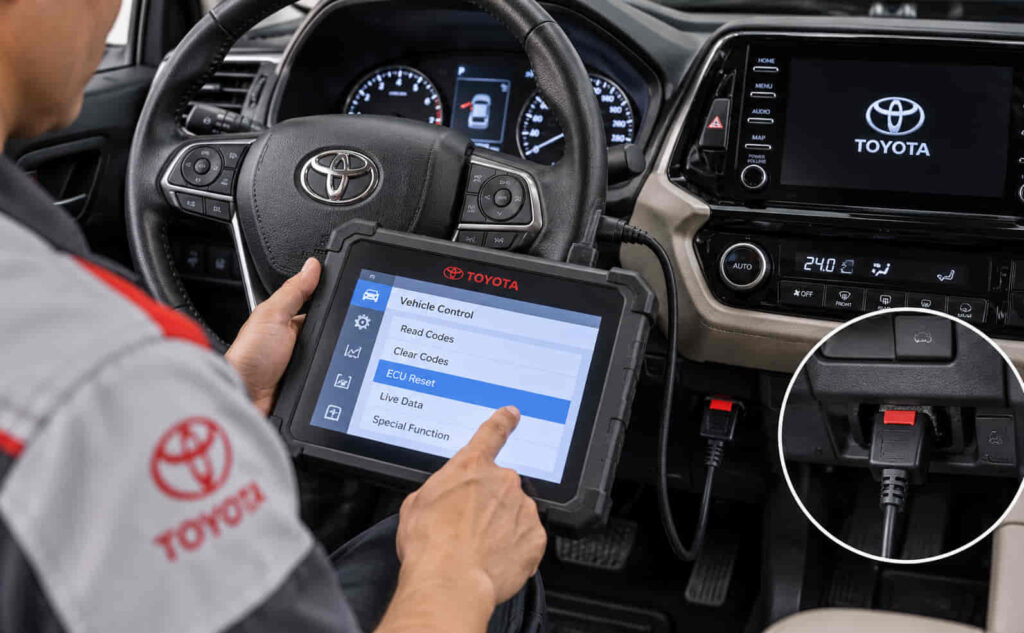
A Toyota ECU reset clears or reinitializes specific stored or learned information in an applicable control module, but the exact result depends on the Toyota model, ECU, and reset method. On many vehicles, drivers use the term “ECU reset” to describe disconnecting the 12-volt battery or clearing diagnostic information with an OBD-II scan tool. These procedures are not identical, and neither should be treated as a universal repair for an engine, transmission, sensor, wiring, or drivability problem.
Toyota vehicles can contain multiple electronic control units responsible for functions such as engine management, transmission control, braking, stability control, and body electronics. Resetting power to the vehicle therefore does not necessarily erase the same information from every module. Depending on the model and procedure, a reset may affect learned operating values, diagnostic information, or settings that must be restored or relearned afterward. It does not normally replace the ECU’s programmed calibration with new software.
This guide explains what a Toyota ECU reset does, when resetting is appropriate, how battery-disconnect and scan-tool methods differ, and what may happen when the vehicle begins relearning operating values. It also explains how to determine whether a reset actually solved the original problem or merely cleared a warning that will return when the ECU detects the fault again.
What Does a Toyota ECU Reset Do?
A Toyota ECU reset returns specific stored or learned information to an initial state, but it does not erase the ECU’s factory programming or repair the fault that caused a vehicle problem. The exact effect depends on which Toyota control module is involved and how the reset is performed. Disconnecting the 12-volt battery, clearing diagnostic information with a scan tool, performing an initialization procedure, and reprogramming an ECU are different operations even though drivers sometimes describe all of them as an “ECU reset.”
The engine control module continuously uses sensor inputs and operating conditions to control functions such as fuel delivery, ignition, electronic throttle operation, emissions monitoring, and other engine-management processes. Some information is learned or adjusted as the vehicle operates. When a procedure clears applicable learned information, the ECU can temporarily return to baseline control values and then establish new learned values as operating conditions are encountered again.
This explains why a Toyota can behave differently immediately after certain reset procedures. Idle characteristics, throttle response, or other adaptive behavior may change while the applicable control system establishes operating information again. The exact relearning behavior is model-specific, so a change after reset should not automatically be interpreted as a new ECU failure.
A reset can also affect diagnostic information, depending on the method used. Diagnostic trouble codes and related emissions-monitoring information can be cleared through an appropriate diagnostic procedure. Once this information is erased, the ECU must monitor the relevant systems again. If the original fault remains present, the ECU can detect it again and store another DTC. Clearing a P0171 lean-system code, for example, does not repair an intake leak, fuel-delivery problem, or sensor fault responsible for the lean condition.
This distinction is particularly important for the Check Engine Light. Turning the light off by clearing diagnostic information changes the current warning state; it does not establish that the engine is operating correctly. If the monitoring criteria are satisfied and the underlying malfunction remains, the ECM can detect the condition again and illuminate the warning.
An ECU reset should also not be confused with ECU reprogramming. Resetting changes applicable stored, learned, or diagnostic states, whereas reprogramming changes the software or calibration installed in the control module. A battery disconnect cannot install an updated Toyota calibration, and clearing DTCs with an OBD-II scanner does not rewrite ECU firmware.
The term “Toyota ECU reset” therefore describes a result too broadly to define one universal procedure. The correct method depends on what needs to be reset. Clearing a diagnostic code, reinitializing a learned value, restoring power after battery service, and performing a manufacturer-specified ECU procedure each have different objectives.
A Toyota ECU reset should ultimately be understood as a controlled change to applicable ECU information or operating state, not as a repair by itself. Its value comes from using the correct reset procedure for a specific diagnostic or service purpose and then confirming that the vehicle operates normally afterward.
When Should You Reset a Toyota ECU?
A Toyota ECU should be reset when a reset or initialization is part of the correct service procedure, when applicable learned information needs to be re-established, or when diagnostic information is intentionally being cleared after the underlying problem has been addressed. Resetting the ECU simply because the vehicle has a warning light or drivability problem can remove useful diagnostic evidence without correcting the cause.
One appropriate situation occurs after a confirmed repair when stored diagnostic information needs to be cleared and the system must be monitored for recurrence. If a failed component or circuit has been repaired, clearing the applicable DTC allows the technician to determine whether the control system detects the fault again. The important sequence is diagnosis, repair, clearing, and verification rather than clearing the code first and assuming the repair is complete.
A reset or initialization can also be appropriate when a Toyota service procedure specifically requires it after component replacement or maintenance. Electronic control systems can use learned or initialized information associated with installed components. When the applicable repair procedure instructs the technician to reset, initialize, or relearn that information, completing the procedure becomes part of the repair rather than an optional attempt to improve vehicle behavior.
Battery service creates another context in which drivers encounter ECU relearning even when resetting the ECU was not their original objective. Disconnecting or replacing the 12-volt battery interrupts power to vehicle systems, and applicable stored or learned information can be affected. After power is restored, some systems may need to re-establish operating values or complete initialization procedures. The exact effects depend on the Toyota model, model year, powertrain, and control architecture.
A Toyota ECU reset is less appropriate when the vehicle has an undiagnosed Check Engine Light. The stored DTC and associated diagnostic information help identify which system detected an abnormal condition. Erasing that evidence before reading it can make troubleshooting less efficient, especially when the malfunction is intermittent and does not immediately return.
The same principle applies to mechanical and electrical failures. Resetting the ECU cannot seal an intake vacuum leak, restore fuel pressure, repair damaged wiring, replace a failed oxygen or air-fuel ratio sensor, correct low compression, or repair an internally damaged control module. A temporary improvement after reset does not prove that the reset repaired one of these faults; it may only mean that learned values or fault status were temporarily cleared.
Repeated resetting is particularly weak as a troubleshooting strategy. If a warning or drivability symptom returns after the ECU has been reset, the recurrence is evidence that the vehicle still contains a condition the control system can detect or that requires further diagnosis. Resetting it again repeats the state change without establishing why the condition returned.
The decision to reset should therefore follow the diagnostic objective. If the objective is to retrieve fault information, codes should normally be read before they are erased. If the objective is to complete a repair procedure, the Toyota-specific procedure should determine whether reset, initialization, or relearning is required. If the objective is to fix an unexplained engine problem, diagnosis should identify the fault before a reset is treated as the solution.
Toyota ECU reset is most useful as part of a defined diagnostic, repair, or relearning procedure rather than as a first response to every warning light or drivability symptom. Knowing why the ECU is being reset determines which method should be used and what must be checked afterward to confirm that the vehicle is operating correctly.
Read more: Toyota Highlander Brake Power Low
What Is the Difference Between Resetting, Relearning, and Reprogramming a Toyota ECU?
Resetting, relearning, and reprogramming a Toyota ECU are different procedures because each one changes a different part of the control module’s operating state. Resetting clears or reinitializes applicable information, relearning allows the control system to establish required operating values again, and reprogramming changes the software or calibration stored in the module. Treating these terms as interchangeable can lead to an incorrect procedure and an incorrect diagnosis.
A Toyota ECU reset generally affects information that the applicable control system is designed to clear or initialize. Depending on the ECU and procedure, this can involve diagnostic information, learned values, or another stored operating state. The purpose is to return that information to a defined condition so the control system can continue operating or begin learning again. A reset does not automatically return every electronic module in the vehicle to a factory-new state.
Relearning occurs after applicable information has been reset, lost, or intentionally initialized. During relearning, the control system establishes values it needs for normal operation based on sensor inputs and specified operating conditions. This is why some Toyota vehicles can exhibit different idle or drivability behavior after power has been disconnected. The ECU may be operating from initial values while the applicable learning process is completed.
Relearning is not necessarily a single manual procedure. Some values can be established as the vehicle operates under the required conditions, while other systems can require a specific initialization or learning procedure. The correct process depends on the Toyota model, model year, engine, transmission, control module, and component that was serviced. A generic instruction to “drive for 50 miles after resetting the ECU” should therefore not be treated as a universal Toyota relearn procedure.
Reprogramming changes a different layer of ECU operation. The control module contains software and calibration data that determine how it processes inputs and controls the systems connected to it. Reprogramming, sometimes described as reflashing, writes applicable software or calibration data to the ECU using the required diagnostic equipment and procedure. Disconnecting the battery cannot perform this operation because removing power does not install new calibration data.
This distinction becomes important when a Toyota requires an updated calibration to address a specific condition. Repeatedly disconnecting the battery will not substitute for a manufacturer-specified ECU software update. In the same way, reprogramming should not be performed merely because a Check Engine Light is illuminated unless diagnosis and applicable service information establish that programming is part of the repair.
Clearing diagnostic trouble codes is another operation frequently described as an ECU reset. A scan tool can instruct an applicable control module to erase diagnostic information, but this does not necessarily clear every learned value or initialize every system. If the physical fault remains, the ECU can detect the condition again and store the DTC after the required monitoring conditions occur.
The four concepts should therefore remain separate throughout diagnosis. Clearing removes applicable diagnostic information, resetting returns specified information or states to an initial condition, relearning establishes required operating values, and reprogramming changes ECU software or calibration. One procedure cannot automatically substitute for another.
Understanding these distinctions also determines what should happen after the procedure. A code-clearing operation should be followed by verification that the repaired fault does not return. A reset that affects learned values may require relearning. A reprogramming procedure may require specified initialization or post-programming checks. The service objective determines which operation is necessary.
A Toyota ECU should therefore be reset, relearned, or reprogrammed according to the function that actually needs to change. Using the correct terminology is not merely technical wording; it prevents a temporary clearing procedure from being mistaken for a repair or a software update.
How Do You Reset a Toyota ECU?
You reset a Toyota ECU by using the reset procedure appropriate for the specific Toyota model, control module, and service objective rather than applying one universal sequence to every vehicle. Depending on what needs to be accomplished, the procedure can involve interrupting 12-volt power, using a compatible diagnostic scan tool to clear applicable information, or performing a Toyota-specified initialization or reset function.
Before resetting anything, the reason for the reset should be established. If the Toyota has a Check Engine Light or drivability problem, diagnostic trouble codes should be retrieved before they are erased. The codes identify which monitored system detected the abnormal condition and can preserve valuable evidence for an intermittent fault. Resetting first can remove part of the information needed to determine why the vehicle developed the problem.
The vehicle configuration should then be identified. Toyota has used different engine-management systems across model years and powertrains, and modern vehicles contain multiple ECUs rather than one electronic unit controlling every function. An engine ECU procedure should therefore not be assumed to reset transmission, ABS, stability-control, hybrid, body, or immobilizer information in the same way.
If the objective is to clear engine diagnostic information after a repair, an appropriate scan tool provides a controlled method because it communicates with the relevant ECU and requests the supported diagnostic function. This approach also allows the technician to read the DTCs before clearing them and then check whether they return. It is more diagnostically informative than disconnecting the battery solely to make a warning light disappear.
A battery power interruption is another procedure commonly called a Toyota ECU reset. Disconnecting the 12-volt battery removes power from applicable systems, which can affect volatile or learned information depending on vehicle design. However, the procedure can affect more than the engine ECU, and it should not be assumed to erase every code, learned value, or module state on every Toyota.
The battery method also creates practical consequences outside engine management. Depending on the vehicle, power interruption can affect settings or systems that require initialization after power is restored. This is one reason the correct model-specific service information should be checked before deliberately disconnecting the battery as a reset technique.
After any reset, the next step is verification rather than assuming success because a warning has disappeared. The engine should operate normally, the relevant systems should complete any required initialization or relearning, and diagnostic information should be checked when appropriate. If the same DTC or symptom returns, the condition that produced it has not been resolved merely by resetting the ECU.
The procedure should also stop being repeated once recurrence establishes that a fault remains. For example, if a Check Engine Light is cleared and returns after the ECM runs the applicable monitor, another reset only begins the same cycle again. Diagnosis must identify the sensor, circuit, air/fuel condition, emissions component, mechanical problem, or other cause represented by the diagnostic evidence.
The correct Toyota ECU reset method is therefore determined by what you intend to reset and why. Battery disconnection can interrupt power to applicable modules, a scan tool can perform supported diagnostic reset or clearing functions, and Toyota-specific procedures can handle initialization or learning requirements. The next step is to choose the appropriate method without confusing temporary memory clearing with an actual repair.
How Do You Reset a Toyota ECU by Disconnecting the Battery?
A Toyota ECU can be power-reset on applicable vehicles by disconnecting the 12-volt battery, but battery disconnection should not be treated as a universal ECU reset procedure for every Toyota model. Removing battery power interrupts the electrical supply to control modules that depend on that circuit. Depending on the vehicle and ECU design, this can clear or alter certain learned values, diagnostic information, or temporary operating states, while other information remains stored in non-volatile memory.
Before disconnecting the battery, diagnostic information should be retrieved if the Toyota has a Check Engine Light or an unresolved drivability problem. Stored DTCs provide evidence about the system that detected the fault. Removing power before recording that information can make an intermittent problem harder to diagnose because some useful fault information may no longer be available afterward.
The vehicle should be switched off before battery service begins, and the correct battery-disconnection procedure for the exact model should be followed. The negative battery terminal is commonly disconnected during 12-volt battery service because separating the ground connection isolates the battery from the vehicle electrical system when performed correctly. However, Toyota hybrids, vehicles with additional power-management systems, and newer electronic architectures can have model-specific precautions that take priority over a generic battery-reset method.
Disconnecting the battery does not instantly transform the ECU into a factory-programmed state. Software and calibration data are designed to remain stored without normal battery power. The information affected by power loss is instead determined by how each control module stores diagnostic, learned, and temporary data. This is why battery disconnection should not be described as “erasing everything from the ECU.”
The required disconnection time should also not be generalized across all Toyota vehicles. Online instructions frequently specify fixed periods such as 10, 15, or 30 minutes, but one universal waiting period cannot define how every Toyota control module handles retained information. If a specific service procedure requires power interruption for a defined period, that procedure should determine the timing.
After reconnecting the battery, the terminal connection must be secure and the vehicle should be checked for normal operation. Systems affected by the loss of 12-volt power may need initialization or may require operating conditions that allow learned information to be established again. The exact post-disconnection behavior depends on the Toyota model and equipment rather than on the engine ECU alone.
A change in idle immediately after battery reconnection does not automatically indicate that the ECU has been damaged. If applicable learned engine-control information was lost, the ECM may need to establish operating values again. However, persistent rough idle should not automatically be attributed to relearning because intake leaks, throttle-body conditions, sensor faults, fuel-delivery problems, and mechanical faults can produce similar symptoms.
Battery disconnection is also a poor method for hiding an unresolved Check Engine Light. If the underlying malfunction remains, the ECM can detect it again when the required monitoring conditions occur. The warning can therefore disappear after power restoration and return later. That sequence shows why clearing the visible symptom is different from correcting the detected fault.
The procedure becomes particularly inappropriate when repeated battery disconnections are used instead of diagnosis. Each reset can remove or alter information while leaving the physical problem unchanged. A Toyota that repeatedly restores the same DTC or drivability symptom requires fault diagnosis rather than another power interruption.
Disconnecting the 12-volt battery is therefore one possible Toyota ECU power-reset method, not a universal repair procedure. It should be used only when battery disconnection is appropriate for the vehicle and service objective, with diagnostic information preserved beforehand and any required initialization or relearning completed after power is restored.
Can You Reset a Toyota ECU With an OBD2 Scanner?
You can perform certain Toyota ECU reset and clearing functions with a compatible OBD-II scan tool, but the functions available depend on the scanner and the Toyota control system being accessed. A basic code reader may only retrieve and clear generic engine-related diagnostic trouble codes, while a Toyota-capable diagnostic tool can provide access to additional modules, data, tests, and supported initialization or reset functions.
The most common scanner operation is clearing diagnostic trouble codes after they have been recorded and the relevant fault has been repaired. The scan tool communicates with the ECU and requests that applicable diagnostic information be erased. This can turn off the Check Engine Light when the conditions for clearing it are satisfied, but it does not physically repair the component or circuit that caused the code.
For example, if an ECM stores a fault because a monitored sensor circuit is outside its expected operating condition, clearing the DTC removes the stored diagnostic state. If the abnormal circuit remains, the ECM can detect it again and restore the code. The scanner has therefore reset diagnostic information, not repaired the sensor, connector, wiring, or other root cause.
A scan tool offers an important diagnostic advantage over immediately disconnecting the battery because the existing codes can be read before they are erased. Live data and other available diagnostic information can also help determine whether the problem is currently active. This preserves the relationship between the symptom, DTC, and operating condition before the system is reset.
Not every OBD-II scanner can access every Toyota ECU. Generic OBD-II functionality primarily standardizes access to emissions-related powertrain diagnostics. Toyota vehicles can also contain separate control modules for transmission, ABS, stability control, airbags, body systems, hybrid functions, and other systems. Accessing manufacturer-specific functions can require a tool that supports those Toyota systems rather than a basic generic code reader.
This distinction matters when a menu option is labeled “reset.” One reset function may clear engine diagnostic information, while another can initialize a specific learned value or execute a manufacturer-supported service function. The label alone does not mean that the scanner is performing a complete reset of every ECU in the vehicle.
A scanner also cannot substitute for ECU reprogramming merely by clearing codes. Reprogramming requires the appropriate software, calibration file, communication procedure, and equipment for the specific control module. Erasing a DTC takes seconds because it changes diagnostic information; installing ECU calibration is a different operation with a different technical objective.
Using a scan tool becomes most useful when reset is integrated into the diagnostic sequence. The technician can retrieve the original DTC, evaluate the system, repair the confirmed cause, clear the applicable diagnostic information, and then monitor whether the code returns. This creates a before-and-after comparison that a blind battery disconnect does not provide.
A successful code clear should therefore be judged by what happens afterward. If the Toyota operates normally and the repaired fault does not return when its monitor runs again, the repair has been verified. If the same code or symptom returns, repeatedly pressing “erase codes” only repeats the reset without addressing the malfunction.
An OBD-II scanner can reset applicable Toyota diagnostic information and, with sufficient Toyota-specific capability, perform additional supported reset or initialization functions. The correct scanner function depends on the ECU and service objective, and clearing a code should always remain separate from diagnosing and repairing the condition that caused it.
Does a Toyota ECU Need to Relearn After a Reset?
A Toyota ECU may need to relearn certain operating values after a reset or loss of 12-volt power, but not every Toyota requires the same relearn procedure. Whether relearning occurs depends on which control module was reset, which information was lost or initialized, and how the specific Toyota system is designed. Some values can be established automatically during normal operation, while other functions can require a defined initialization or learning procedure.
The engine control module continually adjusts engine operation using information from sensors and previous operating conditions. Depending on the system, learned values can help the ECM account for differences in engine operation, component condition, environmental conditions, and other variables. If applicable learned information is cleared, the ECM begins operating without the same adaptive history and must establish the relevant values again.
This is one reason a Toyota can behave differently immediately after the battery has been disconnected. Idle speed or engine response may temporarily differ from the behavior present before power was removed. The change does not by itself prove that the ECU was damaged during battery service. It can reflect the control system operating while applicable learned information is being re-established.
However, relearning should not become the default explanation for every symptom that appears after a reset. A persistent rough idle, stalling condition, hesitation, or warning light can indicate an underlying problem that the previous learned values partially compensated for or that became noticeable after the reset. An intake leak, abnormal throttle-body condition, sensor fault, fuel-delivery problem, wiring fault, or mechanical engine problem will not be repaired simply by allowing the ECU more time to learn.
The type of information involved also matters. Engine-control learning should not automatically be treated as transmission learning, and neither should be confused with initialization required by another vehicle system. A modern Toyota can contain numerous control modules with different memory strategies and service procedures. Disconnecting the 12-volt battery therefore does not create one universal “whole vehicle relearn.”
Diagnostic monitoring also resumes after applicable information has been cleared. If emissions-related diagnostic information has been erased, readiness monitors may need to run again under their required operating conditions. This process is different from the ECU learning an engine-control value. A vehicle can therefore be operating normally while some diagnostic monitors have not yet completed.
The same distinction applies to a Check Engine Light that remains off immediately after reset. The absence of the light does not prove that relearning has repaired the original fault. The ECM may simply not have encountered the conditions required to run the relevant monitor again. If the fault remains, the DTC and warning can return after those conditions are satisfied.
Relearning should therefore be evaluated by system behavior rather than by a fixed mileage assumption. Statements that every Toyota ECU needs exactly 50 or 100 miles to relearn oversimplify different control strategies. One learned value may stabilize quickly under the correct operating conditions, while a diagnostic monitor may require a specific combination of temperature, speed, load, and operating state before it can complete.
A Toyota ECU needs relearning only for the applicable values or functions affected by the reset, and the correct process depends on the exact vehicle and system. Normal operation may complete some learning automatically, while Toyota service information should be followed whenever a specific initialization or relearn procedure is required.
How Do You Relearn a Toyota ECU After a Reset?
You relearn a Toyota ECU after a reset by restoring normal operating conditions and completing any initialization or learning procedure specified for the exact Toyota model and system. There is no single sequence of idling for a fixed number of minutes and then driving a fixed number of miles that can be guaranteed to relearn every Toyota ECU.
The process begins after the 12-volt electrical supply has been restored correctly. Battery terminals and related connections must provide stable power because relearning cannot compensate for an unstable electrical system. If the original reset followed battery replacement or electrical repair, verifying the power supply first prevents a voltage problem from being mistaken for unsuccessful ECU learning.
The engine should then be evaluated for normal basic operation. If the vehicle starts and runs without a serious drivability problem, the ECM can begin establishing applicable operating information as the required conditions occur. Engine temperature, throttle position, load, airflow, fuel control, and other inputs can change during operation, giving the control system the information required for its adaptive strategy.
Idle is one operating condition that can receive attention after a reset, but an arbitrary idle period should not be presented as a universal Toyota procedure. If the exact vehicle has a manufacturer-specified idle learning or initialization process, that process should be followed. If no manual procedure is specified for the affected function, the control system may establish applicable values through normal operation.
Driving can provide additional operating conditions that stationary idling cannot reproduce. Changes in engine load, vehicle speed, throttle input, deceleration, and operating temperature allow the ECU to encounter a wider range of conditions. This does not mean that driving randomly for a predetermined distance guarantees completion. The required learning or monitoring conditions depend on the function being evaluated.
A drive cycle has a more specific diagnostic meaning when emissions readiness is involved. After diagnostic information has been cleared, emissions monitors may show a not-ready status until their enabling criteria have been satisfied. Those criteria can require particular engine temperatures and operating conditions. Completing readiness monitoring is therefore not the same task as simply allowing the engine to relearn idle behavior.
Symptoms during the relearn period should also be judged by severity and persistence. A minor temporary change in idle behavior after loss of learned information can have a different significance from repeated stalling, severe hesitation, or a returning Check Engine Light. Significant or persistent symptoms require diagnosis rather than repeated attempts to force a relearn.
If a DTC returns during or after the relearning period, the code provides evidence that the ECU has detected an abnormal condition again. Clearing the code and restarting the relearn process will not correct the component, circuit, air/fuel condition, emissions fault, or mechanical problem responsible for the detection. The returning fault should become the next diagnostic target.
Relearning is also not a substitute for initialization after a repair that specifically requires a service procedure. If Toyota service information calls for a scan-tool utility, component initialization, calibration, or another defined operation, ordinary driving should not be assumed to perform the same function. The required procedure exists because the control system needs a particular reference or state before normal operation can be verified.
The relearn process is complete when the affected system operates normally and any required initialization or learning conditions have been satisfied. Verification can include stable engine operation, normal response, appropriate diagnostic status, and the absence of returning faults under the conditions that previously produced the problem.
Toyota ECU relearning after a reset should therefore be based on the function that actually lost or initialized information, not on a universal time or mileage formula. Restore stable electrical power, follow model-specific initialization requirements when applicable, allow the ECU to encounter the necessary operating conditions, and investigate any fault or significant symptom that continues after the process.
How Do You Know a Toyota ECU Reset Was Successful?
A Toyota ECU reset is successful when the intended information has been reset, the affected system completes any required relearning or initialization, and the original fault does not return under the conditions that previously triggered it. A warning light disappearing immediately after a reset is not sufficient evidence because clearing diagnostic information can temporarily remove the warning before the ECU has tested the system again.
The first measure of success depends on why the ECU was reset. If the objective was to clear diagnostic information after repairing a confirmed fault, the relevant DTC should clear and remain absent after the ECU monitors the repaired system again. If the objective was to reset applicable learned information, the vehicle should return to normal operation as the required values are established again. The verification criteria must match the purpose of the reset.
Engine operation provides useful evidence after a reset that affects learned engine-control information. The engine should start reliably and progress toward normal idle and drivability behavior as applicable learning occurs. Temporary differences immediately after power restoration can have less diagnostic significance than symptoms that persist after the vehicle has reached normal operating conditions.
A returning Check Engine Light provides stronger evidence than the temporary absence of one. When diagnostic information is erased, the ECM begins monitoring the applicable systems again. Some faults can be detected quickly, while others require specific enabling conditions before the relevant monitor runs. A light that remains off for the first few minutes after a reset therefore does not prove that the original problem has disappeared.
Stored and pending DTCs can provide a more precise verification. If the original repair corrected the underlying condition, the same fault should not repeatedly return when its detection criteria are met. If the ECU records the same DTC again, the reset itself worked as an information-clearing operation, but the vehicle problem was not repaired. This distinction separates successful resetting from successful troubleshooting.
Emissions readiness status should also be interpreted separately. Clearing applicable emissions-related diagnostic information can reset readiness monitors to a not-ready state. The monitors must then complete their tests under the required operating conditions. A Toyota can run normally while one or more monitors are still incomplete, so an incomplete readiness monitor does not automatically indicate an unsuccessful ECU reset.
The same principle applies when the reset follows battery service. Normal electrical power should be confirmed after reconnection because unstable voltage can create new control-system problems or interfere with initialization. Secure battery connections and normal charging-system operation provide the electrical foundation required before post-reset behavior can be evaluated accurately.
Verification should reproduce the original complaint whenever practical. If the vehicle previously developed a fault only during cold startup, acceleration, extended driving, or another repeatable condition, normal operation at idle alone does not prove that the problem has been resolved. The relevant operating condition must occur again before the absence of the fault becomes meaningful evidence.
A reset should therefore have two separate outcomes when it is part of a repair. The requested ECU state or diagnostic information should be reset correctly, and the repair that preceded the reset should prevent the original malfunction from being detected again. Achieving only the first outcome means the procedure was completed, not that the underlying vehicle problem was fixed.
The strongest confirmation of a successful Toyota ECU reset is normal system operation after any required relearning, combined with diagnostic evidence that the original fault does not return. Verification should be based on ECU behavior and vehicle operation rather than on the dashboard remaining clear immediately after the reset.
How Long Should You Disconnect the Battery to Reset a Toyota ECU?
There is no single battery-disconnection time that should be treated as the correct Toyota ECU reset procedure for every model. Fixed recommendations such as 10, 15, or 30 minutes are commonly repeated in generic reset instructions, but the information affected by loss of battery power depends on the control module, vehicle architecture, and Toyota service procedure rather than on one universal waiting period.
Disconnecting the battery removes the normal 12-volt supply from applicable vehicle circuits. What happens afterward depends on how each module stores information. Some operating information can be volatile or affected by loss of power, while other diagnostic, calibration, identification, or programmed information can remain stored without battery voltage. Waiting longer does not automatically erase information that was designed to remain in non-volatile memory.
This is why the objective of the battery disconnect matters more than selecting an arbitrary number of minutes. If the battery is being disconnected as part of a specific Toyota service procedure, the specified procedure should determine the sequence and timing. If the objective is simply to erase a Check Engine Light, using a diagnostic scan tool after retrieving the codes provides more control over the information being cleared.
A longer battery disconnect also does not make the procedure a deeper ECU reset. Leaving the battery disconnected for an hour cannot reprogram the ECU, repair corrupted hardware, replace a calibration, or fix a sensor or mechanical fault. The module either loses the information affected by power interruption or retains information designed to survive it.
The vehicle itself can also make a generic waiting-time recommendation inappropriate. Toyota models span conventional gasoline, hybrid, and other electrical architectures, and newer vehicles can contain numerous interconnected control modules. Battery service can therefore involve precautions and post-reconnection requirements that are unrelated to how long the engine ECU remains without power.
Post-reset initialization deserves more attention than extending the waiting period. After the battery is reconnected, applicable systems may need to initialize or relearn information before normal behavior is restored. If a Toyota-specific procedure requires an initialization step, completing that step has greater technical value than leaving the battery disconnected for an additional arbitrary period.
A persistent problem after reconnection should not be interpreted as evidence that the battery was disconnected for too little time. If a DTC, rough idle, warning light, or drivability symptom returns, the next question is whether an underlying fault remains or a required initialization has not been completed. Repeating the same battery disconnect for progressively longer periods does not diagnose either condition.
The correct Toyota ECU reset time is therefore the time and procedure specified for the exact vehicle and service operation when Toyota provides one, not a universal 10-, 15-, or 30-minute rule. The objective should be to reset the intended information safely and complete the required post-reset procedure, rather than maximizing the amount of time the vehicle remains disconnected from its battery.
Does Disconnecting the Battery Clear Toyota ECU Codes?
Disconnecting the 12-volt battery can clear or affect some diagnostic information on certain Toyota vehicles, but it should not be assumed to erase every DTC from every ECU. Toyota vehicles contain multiple control modules, and the way diagnostic information is retained depends on the module, model year, powertrain, and type of fault. Some information can be affected by loss of battery power, while other information can remain stored because the control module uses non-volatile memory.
This distinction matters because a modern Toyota does not have one memory location containing every vehicle fault. The ECM monitors engine and emissions-related systems, while separate ECUs can monitor systems such as ABS, stability control, airbags, body electronics, hybrid functions, and other vehicle operations. Disconnecting the battery therefore should not be interpreted as a guaranteed method for clearing all diagnostic information throughout the vehicle.
Even when battery disconnection clears an engine-related DTC or causes the Check Engine Light to turn off, it does not remove the condition that originally caused the ECU to store the code. The ECM evaluates sensor signals and operating conditions after power is restored. If the same malfunction remains and the required detection criteria occur again, the ECU can store the fault again.
For example, an air/fuel-related DTC caused by an intake leak will not be repaired by removing battery power. The code can temporarily disappear if applicable diagnostic information is cleared, but the unmetered air entering the engine remains. Once the ECM monitors the air/fuel condition again and determines that the fault criteria are satisfied, diagnostic information can be stored again.
Battery disconnection can also remove information that would have helped diagnose the original complaint. A stored DTC identifies a monitored fault area, while related diagnostic data can provide context about the conditions under which the ECU detected it. Erasing this information before retrieving it can make an intermittent problem more difficult to reproduce and diagnose.
A scan tool provides a more controlled approach when the objective is specifically to work with diagnostic trouble codes. The technician can first retrieve the stored and pending DTCs, record relevant diagnostic information, complete the repair, and then use the supported clear function. The same systems can subsequently be checked to determine whether the original fault returns.
Clearing emissions-related diagnostic information can also affect readiness status. After applicable information has been erased, the ECM may need to run its emissions monitors again before they report complete. This means a vehicle can have no illuminated Check Engine Light while still showing incomplete readiness monitors. The absence of a warning immediately after battery disconnection should therefore not be interpreted as proof that every monitored system has passed its diagnostic test.
Repeated battery disconnection is particularly ineffective when the same DTC returns. Recurrence establishes that the ECU can still detect the abnormal condition after the reset. At that point, the diagnostic priority should move from clearing memory to determining why the monitored value, circuit, component, or system continues to fall outside the expected operating condition.
Disconnecting a Toyota battery can affect applicable ECU diagnostic memory, but it is not a reliable universal method for clearing every Toyota code. Codes should be retrieved before power is intentionally removed, and a returning DTC should be diagnosed rather than repeatedly erased.
Will a Toyota ECU Reset Turn Off the Check Engine Light?
A Toyota ECU reset can turn off the Check Engine Light when the procedure clears the diagnostic information responsible for commanding the light, but it will not permanently keep the light off if the underlying fault remains. The distinction is important because extinguishing the warning and repairing the malfunction are two separate outcomes.
The Check Engine Light is part of the vehicle’s diagnostic response to conditions detected by the engine or emissions control system. When the ECM determines that applicable fault criteria have been satisfied, it can store diagnostic information and illuminate the warning according to its monitoring logic. Clearing the relevant information can change the warning state, but it does not change the physical condition of a defective component or circuit.
A scan-tool reset demonstrates this difference clearly. If a technician erases an applicable DTC, the Check Engine Light can turn off even though no component has been repaired. The ECM then begins evaluating the affected system again. If the fault is still present, the code and warning can return once the required detection conditions are satisfied.
The warning does not always have to return immediately. Different diagnostic monitors operate under different enabling conditions. Engine temperature, vehicle speed, engine load, startup state, and other operating parameters can determine when a particular monitor runs. A Toyota can therefore travel for a period after an ECU reset before the ECM has enough evidence to detect the same fault again.
This delay explains why a temporary disappearance of the Check Engine Light can be misleading. If the light previously appeared because of a repeatable electrical, emissions, air/fuel, sensor, or mechanical fault, resetting the ECU changes the diagnostic state without repairing that mechanism. The true test is whether the relevant monitor can run again without detecting the malfunction.
A Check Engine Light that returns after reset should therefore be treated as diagnostic evidence. The returning DTC identifies the system in which the ECM continues to detect an abnormal condition. Resetting the ECU for a second or third time provides little additional value unless the procedure is being used as part of a controlled diagnostic test.
The same logic applies when the light remains off but the original drivability symptom continues. Rough idle, hesitation, poor acceleration, abnormal fuel consumption, or another symptom can remain even when diagnostic information has been cleared. The absence of the warning does not override physical evidence that the vehicle is still operating abnormally.
A successful repair produces a different sequence. The underlying fault is diagnosed and corrected first, the applicable diagnostic information is then cleared when appropriate, and the vehicle is operated under conditions that allow the ECU to monitor the repaired system again. If normal operation continues and the fault does not return, the absence of the Check Engine Light becomes meaningful verification rather than a temporary result of memory clearing.
A Toyota ECU reset can therefore switch off the Check Engine Light, but only repairing the underlying fault can prevent a fault-related warning from returning when the ECM detects the same condition again. ECU reset should be used as part of diagnosis and repair verification, not as a method for permanently hiding an unresolved Check Engine Light.
Can Resetting a Toyota ECU Fix Rough Idle?
Resetting a Toyota ECU can change rough-idle behavior when the symptom is related to learned engine-control values, but it does not repair the mechanical, electrical, air, fuel, or sensor fault responsible for a persistent rough idle. The result depends on why the engine is idling poorly. A temporary improvement after an ECU reset is therefore diagnostic information, not proof that the ECU itself was the cause.
The ECM continuously adjusts engine operation using sensor inputs and applicable learned values. When those learned values are cleared, the control system can return to initial operating values and begin adapting again. If previous learned information was contributing to abnormal behavior after a component or operating condition changed, resetting the applicable values can alter the way the engine idles.
The opposite can also happen after battery disconnection. A Toyota that idled normally before losing ECU learned information can initially idle differently after power is restored. This does not mean that the reset failed. The ECM may need to establish applicable operating values again as the engine reaches the required conditions.
Throttle-body condition is particularly important when rough idle appears after learned information has been cleared. The engine-management system controls airflow according to the hardware and sensor information available to it. If deposits or another physical condition have changed actual airflow, previously learned control values may have compensated for part of that difference. Clearing those values can make the underlying airflow condition more noticeable until the system relearns or the physical problem is corrected.
An intake leak creates a different mechanism. Air entering the engine through an unintended path changes the air/fuel condition the ECM must control. Resetting learned values cannot seal that leak. The ECU may begin adapting again, but the physical source of unmetered air remains and can continue producing unstable idle, fuel-trim changes, or diagnostic trouble codes.
Sensor, ignition, fuel-delivery, and mechanical faults follow the same principle. A malfunctioning sensor can provide incorrect information after a reset just as it did before the reset. A misfire caused by an ignition problem remains a misfire. Inadequate fuel delivery or an engine mechanical problem also remains present regardless of whether learned ECU information has been cleared.
The duration of the rough idle provides useful context. A temporary change immediately after battery reconnection has a different diagnostic meaning from an engine that repeatedly stalls or continues to idle poorly after normal operating conditions have been reached. Persistent or severe symptoms should move the process toward diagnosis rather than repeated resets.
Diagnostic trouble codes should also be checked when rough idle continues. Misfire, air/fuel, sensor, throttle, and other engine-management faults can provide evidence about the affected system. Clearing those codes repeatedly removes diagnostic information without correcting the condition that caused the ECM to record it.
A Toyota ECU reset can influence rough idle when learned control values are involved, but it should not be considered a general rough-idle repair. If normal idle does not return after the applicable relearning process, the intake, throttle, ignition, fuel, sensor, electrical, and mechanical systems should be diagnosed according to the actual symptoms and DTCs.
Does a Toyota ECU Reset Affect the Transmission?
A Toyota ECU reset can affect applicable transmission-related learned or control information on some vehicles, but disconnecting the battery or resetting the engine ECU should not be assumed to reset every transmission adaptation on every Toyota. The result depends on the vehicle’s control architecture, transmission, model year, and reset procedure.
Toyota powertrain control can involve engine and transmission functions that exchange information continuously. Engine torque, throttle position, vehicle operating conditions, and transmission control must work together to produce the intended drivability. Depending on the system design, applicable control units can also use learned information to account for operating characteristics over time.
When relevant learned information is reset, transmission behavior can temporarily differ while the control system establishes applicable values again. A driver may therefore notice a change in shift behavior after certain power interruptions or service procedures. That observation alone does not prove that the transmission has developed a mechanical failure.
However, “ECU reset” is too broad to establish exactly which transmission information was erased. Some Toyota vehicles integrate powertrain control functions differently from others, while newer vehicles can use separate or interconnected control modules. A generic battery disconnect should therefore not be described as a guaranteed method for performing a complete Toyota transmission adaptation reset.
Transmission relearning should also be separated from engine ECU relearning. A procedure intended to establish engine idle or fuel-control values does not automatically satisfy a transmission initialization or learning requirement. If a Toyota service procedure specifies a transmission reset, initialization, or learning operation after repair, that specific procedure determines what must be performed.
Resetting learned information also cannot repair physical transmission damage. Worn friction components, hydraulic pressure problems, valve-body faults, solenoid failures, damaged wiring, low or incorrect fluid condition, and internal mechanical failures remain present after adaptive information has been cleared. A temporary change in shift quality does not eliminate those mechanisms.
This distinction becomes particularly important when a reset is attempted to correct harsh shifting. If adaptive information is involved, shift behavior can change after the applicable values are reset and relearned. If the harsh shift results from a hydraulic, electrical, or mechanical fault, the symptom can remain or return as soon as the transmission operates under the conditions that expose the problem.
Diagnostic information should therefore be retrieved before attempting repeated resets. A transmission-related DTC can identify a monitored circuit or operating condition that requires testing. Erasing that information before diagnosis can make an intermittent shifting problem harder to trace.
A returning transmission symptom after reset is evidence that further evaluation is required. The control system may have completed enough operation to encounter the same abnormal condition again, or the underlying hardware problem may never have disappeared. Repeatedly clearing learned information can change behavior temporarily without establishing whether the transmission is mechanically and electronically healthy.
Toyota ECU reset can affect transmission behavior when the applicable control system or learned information is involved, but it is not a universal transmission repair or relearn procedure. Model-specific service information should determine whether transmission initialization or learning is required, while persistent shift problems should be diagnosed rather than repeatedly reset.
Does Resetting a Toyota ECU Affect the Immobilizer or Keys?
A routine Toyota ECU reset or 12-volt battery disconnect does not normally mean that the vehicle’s immobilizer keys have been erased, because ECU memory reset and key registration are different functions. However, the exact behavior depends on the Toyota model, model year, immobilizer architecture, and control module involved. ECU replacement, immobilizer replacement, or certain initialization procedures can require additional registration or synchronization that a normal power reset does not perform.
Toyota immobilizer systems use registered identification information to determine whether an authorized key or electronic key is present before allowing the required vehicle-starting functions. That security relationship is different from engine-control information such as adaptive values or diagnostic trouble codes. Removing normal 12-volt power should therefore not be described as the same operation as deliberately deleting or registering immobilizer keys.
This distinction explains why replacing or disconnecting a 12-volt battery is fundamentally different from replacing an ECU involved in vehicle authorization. A battery disconnect interrupts electrical power. ECU or immobilizer replacement can introduce a different module whose stored identification or synchronization information must correspond with other components in the vehicle. When replacement changes part of that security relationship, a Toyota-specific registration or initialization procedure may be required.
The term “ECU reset” can create confusion because Toyota vehicles contain multiple ECUs. Resetting engine diagnostic information with an OBD-II scanner does not automatically reset the immobilizer system. Similarly, clearing a Check Engine Light should not unregister keys because the diagnostic operation and security registration serve different purposes.
Problems after battery reconnection should therefore be identified by symptom rather than immediately assuming that the key has lost programming. Low battery voltage, an insecure battery connection, an initialization issue, key recognition problems, or another electrical condition can prevent normal starting behavior. Each mechanism requires different testing.
If the vehicle does not recognize a previously functioning key after ECU, immobilizer, smart-key, or related control-module replacement, repeating a battery disconnect is unlikely to complete a registration process that requires diagnostic communication. The applicable Toyota service procedure should determine whether initialization, synchronization, or key registration is necessary.
Security-related procedures also should not be confused with engine ECU relearning. Allowing the engine to idle or driving the vehicle can establish certain operating values when applicable, but ordinary driving is not a substitute for a required immobilizer registration procedure. The two systems learn different information for different purposes.
A normal Toyota ECU reset should therefore be separated conceptually from immobilizer and key programming. Battery disconnection or engine-code clearing can affect applicable control information without intentionally erasing registered keys, while replacement or service involving security-related ECUs can require a specific Toyota initialization or registration procedure.
When Should You Diagnose the Toyota Instead of Resetting the ECU?
You should diagnose the Toyota instead of resetting the ECU when a warning, DTC, starting problem, rough idle, stalling condition, transmission symptom, or other malfunction persists or returns after the applicable reset. Recurrence means that changing ECU memory or operating state has not removed the condition responsible for the symptom.
A returning Check Engine Light is one of the clearest examples. Clearing the DTC can temporarily turn the light off, but the ECM begins monitoring the vehicle again afterward. If the same fault criteria are satisfied, the ECU can store the code again. The correct next step is to use that diagnostic information to test the affected system rather than erase it repeatedly.
Persistent drivability symptoms require the same approach even when no warning light is currently illuminated. Rough idle, hesitation, stalling, poor acceleration, abnormal shifting, or difficult starting can result from mechanical, electrical, air, fuel, ignition, sensor, or control-system faults. Resetting learned information cannot physically correct those failures.
Diagnosis is also preferable before the first reset when useful fault information is already available. Stored and pending DTCs, operating data, and the circumstances under which the problem occurred can narrow the diagnostic path. Disconnecting the battery or clearing codes before recording that evidence can remove information that would otherwise help identify an intermittent problem.
Electrical problems should not be repeatedly reset either. A weak 12-volt battery, excessive resistance at a connection, poor ground, damaged wiring, or unstable charging voltage can affect ECU operation and generate multiple symptoms. Restoring power temporarily does not repair the electrical condition. Voltage and circuit integrity must be measured under the conditions in which the problem occurs.
The same rule applies when an ECU itself is suspected. An internal control-module hardware failure, damaged circuit, or software/calibration issue cannot be confirmed merely because a battery reset failed to solve the problem. Power supply, grounds, inputs, outputs, communication circuits, DTCs, and applicable service information should be evaluated before an expensive ECU is condemned.
Repeated resets can also create misleading evidence. A symptom may temporarily improve because adaptive values were cleared, only to return as the ECU begins responding to the same underlying condition again. The temporary improvement can make the reset appear successful even though it has only changed how the control system reacts to an unresolved fault.
A reset becomes useful again after diagnosis when the repair procedure calls for it. Once the defective component, circuit, mechanical condition, or software issue has been corrected, applicable diagnostic information can be cleared and required learned values can be initialized or re-established. The vehicle can then be tested under the conditions that originally produced the problem.
The practical boundary is simple: reset the Toyota ECU when a defined service or diagnostic objective requires a reset, but diagnose the vehicle when the same fault or symptom persists or returns. A reset changes applicable information inside the control system; diagnosis identifies why the vehicle generated that information in the first place.