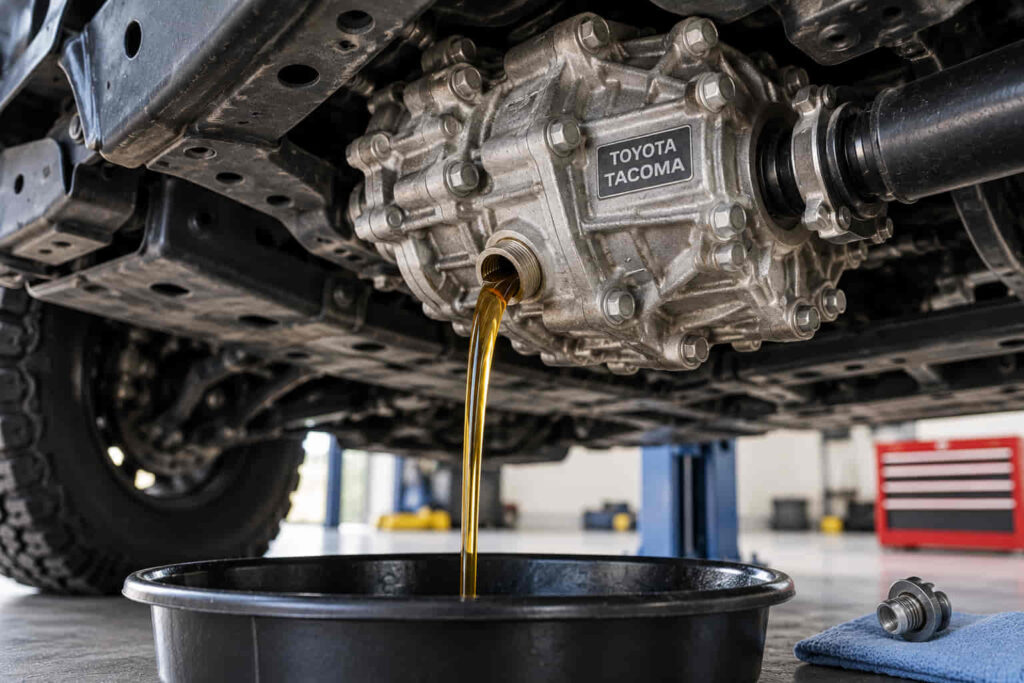
A Toyota Tacoma transfer case fluid change replaces the lubricant inside the transfer case to maintain proper lubrication of the gears and other internal drivetrain components. The service applies to Tacoma models equipped with a transfer case, particularly 4WD configurations, and should be performed using the fluid specification and service procedure for the exact model year and configuration.
Transfer case fluid is not the same as transmission fluid or differential oil. The transfer case is a separate component within the 4WD drivetrain, so its lubricant has its own specification and fill procedure. Using the wrong fluid or establishing an incorrect fluid level can prevent the transfer case from receiving the lubrication it requires.
The correct service also depends on more than mileage. Model year, drivetrain configuration, operating conditions, and the manufacturer’s maintenance schedule determine when the fluid should be inspected or replaced. Off-road use, towing, water exposure, and other demanding conditions can also affect drivetrain maintenance requirements.
This guide explains when a Toyota Tacoma transfer case fluid change is needed, what type of fluid the transfer case uses, how to determine the correct capacity, and how the fluid is drained and refilled. It also explains how to check the final fluid level, identify signs of a transfer-case problem, and avoid common mistakes that can turn a routine drivetrain service into a mechanical problem.
What Is a Transfer Case on a Toyota Tacoma?
The transfer case is a drivetrain component that distributes engine torque to the drive axles in applicable four-wheel-drive Toyota Tacoma configurations. It sits downstream of the transmission and changes how power is routed through the 4WD system. Because it contains gears and other moving components that require lubrication, the transfer case uses a specified fluid that is separate from the transmission fluid and differential oil.
The transfer case becomes relevant when a Tacoma is equipped with a four-wheel-drive system that uses this component to manage power between the front and rear drivetrains. In a conventional 4WD arrangement, the transmission sends power into the transfer case, where the selected drivetrain mode determines how that power is delivered through the applicable output paths. This makes the transfer case an active mechanical part of the drivetrain rather than simply a housing for another fluid.
Its lubricant protects the internal components as they operate under torque. Gears and bearings experience mechanical loads whenever the drivetrain transfers power, and the fluid provides lubrication that helps reduce friction and control wear. Maintaining the correct fluid condition therefore supports the mechanical operation of the transfer case over the vehicle’s service life.
The transfer case should not be confused with the differentials. The front and rear differentials perform separate functions by allowing differences in wheel speed between wheels on the same axle while transmitting torque to those wheels. The transfer case operates at another point in the drivetrain and has its own lubricant specification and service requirements.
The transfer case is also different from the transmission. The transmission changes the relationship between engine speed and output speed and provides the vehicle’s available gear ratios, while the transfer case manages power distribution within the applicable four-wheel-drive system. Because these components perform different mechanical functions, their fluids and maintenance procedures should not automatically be treated as interchangeable.
This distinction matters during a Toyota Tacoma transfer case fluid change because using a transmission or differential fluid simply because it is already available in the garage does not establish compatibility. Toyota specifies the appropriate lubricant for the transfer case according to the applicable vehicle configuration. The exact specification should therefore be verified before the old fluid is drained.
The transfer case also contains fill and drain points that allow its lubricant to be serviced. During a fluid change, the old lubricant is removed through the appropriate drain opening and the specified replacement fluid is introduced through the fill opening. The final fluid level must be established according to the applicable service procedure rather than relying only on an estimated quantity.
A Tacoma transfer case is therefore best understood as a separate, lubricated drivetrain assembly within the 4WD system. Knowing its location and function establishes why transfer case fluid requires its own specification, why its service should not be combined blindly with transmission or differential service, and why the exact Tacoma configuration matters before beginning maintenance.
When Should You Change Toyota Tacoma Transfer Case Fluid?
The correct interval for a Toyota Tacoma transfer case fluid change depends on the model year, drivetrain configuration, maintenance schedule, and operating conditions. There is no single mileage number that should automatically be applied to every Tacoma because Toyota’s maintenance requirements can differ between vehicle generations and service conditions.
Toyota maintenance documentation can distinguish normal operation from special operating conditions. For example, Toyota’s maintenance information for applicable Tacoma models identifies additional transfer-case oil replacement requirements under demanding conditions such as driving on dirt roads, sandy roads, muddy roads, or roads with frequent water crossings. These conditions place greater demands on drivetrain components and can change the appropriate maintenance schedule.
Off-road use is particularly relevant because the transfer case may operate under conditions that differ substantially from ordinary paved-road driving. Frequent operation in mud, sand, or other demanding terrain can expose drivetrain components to higher loads, contamination risks, and water intrusion. A Tacoma used primarily on pavement therefore should not automatically be assigned the same service pattern as a truck regularly used in severe conditions.
Water exposure deserves separate attention because a transfer case that has been exposed to significant water intrusion may require inspection beyond a routine mileage-based service. Water contamination can change the lubricant’s ability to protect internal components and can contribute to corrosion or inadequate lubrication. If the vehicle has experienced a significant water crossing or suspected fluid contamination, the applicable Toyota maintenance guidance should be followed rather than waiting for the next ordinary service interval.
Towing and other heavy-use conditions should also be evaluated according to the maintenance schedule for the specific Tacoma. A truck that regularly operates under high drivetrain loads can experience different service demands from one used for light commuting. The relevant Toyota maintenance guide determines whether those conditions trigger additional inspection or replacement requirements.
The age and mileage of the vehicle still matter, but mileage alone should not be used as a universal answer. Toyota’s maintenance schedule for the specific model year provides the authoritative baseline, while the truck’s actual operating environment determines whether special-service provisions apply.
The fluid’s condition can also provide evidence when a transfer case is being inspected. Unusual contamination, evidence of water intrusion, or a significant change in lubricant condition can justify further evaluation. However, fluid appearance by itself should not replace the manufacturer’s maintenance schedule or a proper inspection of the transfer case.
Owners who are unsure whether their Tacoma requires a transfer case fluid change should first identify the exact model year and drivetrain configuration and then consult the corresponding Toyota maintenance documentation. This approach is more reliable than applying an interval found for a different Tacoma generation, engine, or 4WD system.
The key maintenance principle is therefore straightforward: change Tacoma transfer case fluid according to the service requirements for the exact vehicle, with additional attention to severe operating conditions. A fixed interval copied from another Tacoma can be misleading, while the correct model-specific maintenance schedule provides the appropriate starting point for deciding when service is due.
Read more: Toyota RAV4 Rattling Noise When Accelerating
What Transfer Case Fluid Does a Toyota Tacoma Use?
The correct transfer case fluid for a Toyota Tacoma depends on the model year and 4WD configuration, so the fluid should be identified from the applicable Toyota Owner’s Manual or service information before the transfer case is drained. Toyota treats transfer-case lubricant as a specific drivetrain fluid rather than a generic substitute for transmission fluid or differential oil.
For applicable Tacoma configurations, Toyota has specified Toyota Genuine Transfer Gear Oil LF or an equivalent meeting the required specification. For example, Toyota documentation for the 2024 Tacoma identifies Toyota Genuine Transfer Gear Oil LF or an equivalent of matching quality and specifies SAE 75W as the recommended viscosity for the transfer case. That specification should not be copied automatically to another Tacoma generation without checking its documentation.
The reason fluid specification matters is that the transfer case contains gears and other components operating under drivetrain load. The lubricant must provide the characteristics required by the particular transfer case design, including appropriate viscosity and performance properties. A fluid that happens to be marketed as “gear oil” is not automatically an acceptable substitute simply because it has a similar viscosity.
Transmission fluid should not be selected merely because it is already being used elsewhere in the vehicle. The transmission and transfer case perform different mechanical functions and can require different lubricants. The same principle applies to front and rear differential oil. Toyota’s documentation identifies transfer-case oil separately from differential lubrication requirements, reinforcing that these systems should be serviced according to their individual specifications.
Fluid terminology can also create confusion when researching aftermarket products. A bottle labeled “75W” or “gear oil” does not by itself establish compatibility with a specific Tacoma transfer case. The complete specification, quality requirement, and vehicle application need to match the Toyota requirement. When an aftermarket equivalent is used, its documentation should explicitly support the applicable Toyota specification rather than relying on a general claim that it is suitable for trucks.
Model year is particularly important because Tacoma drivetrain designs and service specifications can change. Toyota provides model-specific Owner’s Manuals and Warranty & Maintenance Guides through Toyota Owners, including separate documentation for the 2026 Tacoma. This makes the exact vehicle identification the first step before purchasing fluid.
The safest approach is therefore to identify the Tacoma’s model year, drivetrain, and applicable transfer-case specification before buying fluid. If the owner’s manual calls for Toyota Genuine Transfer Gear Oil LF or an equivalent, the replacement product should explicitly meet that requirement. Matching the specification is more important than choosing a fluid based only on viscosity or the word “synthetic” on the label.
Using the correct fluid also prevents a common DIY mistake: treating every drivetrain lubricant as interchangeable. A Tacoma transfer case fluid change is a component-specific service, so the fluid selected should be the one specified for that transfer case rather than whatever gear or transmission lubricant happens to be available.
How Much Transfer Case Fluid Does a Toyota Tacoma Need?
The amount of fluid required for a Toyota Tacoma transfer case depends on the exact transfer-case design and vehicle configuration. Capacity should therefore be treated as a model-specific reference rather than a universal quantity for every Tacoma. Toyota provides the applicable capacity in the specifications for the relevant vehicle.
Toyota documentation illustrates why configuration matters. In an older Tacoma owner’s manual, the transfer-case capacity differs between automatic- and manual-transmission configurations, with separate reference quantities provided for each. That documentation lists 1.1 qt. for the automatic-transmission configuration and 1.5 qt. for the manual-transmission configuration, while specifying Toyota Genuine Transfer Gear Oil LF or equivalent and SAE 75W. These figures are examples from that specific documentation, not universal specifications for every Tacoma.
Capacity and fill level are related but should not be treated as exactly the same concept. The published capacity represents the approximate amount associated with the transfer case, while the service procedure establishes the final fluid level. If the transfer case is being serviced on a level vehicle, the correct fill procedure determines when the lubricant has reached the required level.
This distinction becomes important during a DIY fluid change. Buying exactly the published capacity does not mean the technician should pour the entire container into the transfer case without checking the applicable procedure. The amount removed can differ from the nominal capacity because of residual fluid, vehicle position, previous service, or other conditions. The final level must be established using the specified procedure.
A fluid capacity can also differ when the underlying drivetrain configuration changes. Transmission type, transfer-case design, model year, and other configuration attributes can affect the applicable specification. This is why a capacity found in a forum post for a different Tacoma should not override the owner’s manual or service information for the vehicle being serviced.
The quantity should therefore be confirmed before starting the job. Knowing the required capacity helps ensure enough fluid is available, but it should be used together with the correct fluid specification and fill-level procedure. These three pieces of information form a single service relationship: the correct fluid must be used, enough fluid must be available, and the transfer case must ultimately contain the specified amount at the correct level.
If the actual quantity required during service is substantially different from what the technician expects, that difference should not simply be ignored. It can indicate that the vehicle configuration was misidentified, the transfer case was not completely drained, the fill procedure was performed incorrectly, or another condition needs investigation. The published capacity is a useful reference point, not permission to bypass the final level check.
For this reason, a reliable Toyota Tacoma transfer case fluid change should always begin with the exact model-year specification. Toyota’s current Owner’s Manual system allows owners to select their specific Tacoma and access the corresponding manual and maintenance information. Using that vehicle-specific documentation eliminates the most common capacity error: applying a correct number from the wrong Tacoma.
The practical rule is simple: determine the exact Tacoma configuration first, confirm its transfer-case fluid specification and reference capacity, and then use the applicable fill-level procedure. This approach is more accurate than relying on a single capacity number intended for a different generation or drivetrain.
What Tools Do You Need to Change Tacoma Transfer Case Fluid?
A Toyota Tacoma transfer case fluid change requires the correct replacement fluid, suitable tools for accessing the transfer-case plugs, a way to collect the old lubricant, and equipment that allows the truck to remain safely supported and level during the service. The exact socket sizes, plug design, fluid specification, and torque requirements depend on the Tacoma model year and configuration, so those details should be verified before starting the job.
The replacement fluid is the most important item because the transfer case requires a specific lubricant. For applicable Tacoma configurations, Toyota has specified Toyota Genuine Transfer Gear Oil LF or an equivalent meeting the required specification. The exact fluid requirement should be confirmed for the vehicle being serviced rather than assuming that a fluid used on another Tacoma is compatible.
A fluid transfer pump or similar filling device is also useful because the transfer case fill opening is not designed for simply pouring fluid from a bottle directly into the housing. The pump allows the specified lubricant to be introduced through the fill opening in a controlled manner and makes it easier to stop when the correct fluid level has been reached.
A suitable drain container is required to capture the old fluid. The container should have enough capacity for the transfer-case lubricant and should be positioned so that fluid does not spill onto surrounding drivetrain components. Used gear oil should also be handled and disposed of according to applicable local requirements rather than released onto the ground or into household drains.
The Tacoma needs to remain securely supported during the service. More importantly, the vehicle must be positioned according to the applicable fill-level procedure because the transfer case’s final fluid level depends on vehicle position. Using an improperly supported or significantly tilted vehicle can result in an incorrect level even when the technician adds the nominal capacity.
A torque wrench is appropriate when the service information specifies a torque value for the drain and fill plugs. Correct torque helps maintain the intended sealing and prevents the common mistake of either leaving a plug insufficiently tightened or applying excessive force that can damage threads or the plug itself. The correct torque value should come from the service information for the exact Tacoma rather than a generic specification.
A replacement sealing washer, gasket, or other applicable sealing component may also be required depending on the transfer-case design. If Toyota specifies replacement of a sealing component during the service, the new component should be installed rather than assuming that the old one can be reused indefinitely.
Basic inspection materials can also improve the service. A clean rag allows the plug and surrounding housing to be cleaned before reinstallation, while a light can help identify leakage, damaged components, or contamination around the transfer case. These items do not replace mechanical diagnosis, but they make it easier to verify the condition of the serviced area.
The tools should be assembled before the transfer case is drained because the vehicle should not be left with an empty transfer case while the technician searches for an incompatible tool or replacement fluid. Confirming the fluid specification, access to both service openings, required sealing components, and vehicle-support equipment before starting reduces the risk of an incomplete service.
The preparation stage is therefore part of the transfer case fluid change itself. Correct fluid, correct access tools, safe vehicle support, appropriate filling equipment, and the applicable torque and sealing requirements establish the conditions needed to perform the service without introducing a new drivetrain problem.
How Do You Change Toyota Tacoma Transfer Case Fluid?
A Toyota Tacoma transfer case fluid change begins by identifying the correct transfer-case specification for the exact vehicle and safely accessing the transfer case while keeping the truck positioned appropriately for the service. The old lubricant is then drained, the condition of the removed fluid and service openings is inspected, and the transfer case is refilled with the specified lubricant until the required fluid level is reached.
The fill opening should be addressed before the transfer case is drained. This is an important service precaution because draining the old lubricant first can leave the vehicle with an empty transfer case if the fill plug cannot subsequently be removed. Confirming that the fill access can be opened provides assurance that the replacement fluid can actually be installed after the old lubricant has been removed.
Once fill access has been confirmed, the drain area can be prepared. The collection container should be positioned below the drain opening, and the surrounding area should be cleaned sufficiently to prevent dirt from entering the service opening. The transfer case should be at the condition specified by the applicable service procedure because fluid temperature can influence how the lubricant drains and how the service should be performed.
The drain plug can then be removed so the old lubricant can flow out of the transfer case. The fluid should be allowed to drain appropriately rather than reinstalling the plug while a significant amount of old lubricant remains inside. The removed fluid can provide useful information about the condition of the transfer case because excessive contamination, unusual debris, or evidence of water intrusion may indicate a condition that requires further inspection.
The drain plug itself should also be examined. Metal particles or abnormal debris on the plug can provide evidence that internal components have experienced wear, although the presence of a small amount of normal wear material should not automatically be interpreted as a failed transfer case. The plug’s sealing surface and threads should also be checked before it is reinstalled.
After the transfer case has drained, the drain plug should be reinstalled using the applicable sealing component and torque specification. The exact specification must come from the service information for the Tacoma being serviced. The objective is to create a reliable seal without damaging the plug, housing, or threads.
Replacement fluid is then introduced through the fill opening. The fluid must match the transfer-case specification for the exact Tacoma. For example, Toyota documentation for applicable Tacoma configurations specifies Toyota Genuine Transfer Gear Oil LF or an equivalent meeting the required quality, but that specification should still be verified against the model year being serviced.
The transfer case should be filled according to the specified level procedure rather than simply assuming that the published capacity is the amount that must always be poured into the housing. Capacity figures are reference quantities, while the fill procedure establishes the actual service level. Keeping the vehicle positioned correctly is therefore important during this stage.
Once the specified level has been reached, the fill plug should be installed using the applicable sealing and torque requirements. The area around both service openings should then be cleaned so that any subsequent fluid residue can be distinguished from a new leak. This makes post-service inspection more reliable.
The completed service should include a leak check and appropriate verification of the drivetrain. If the Tacoma has an abnormal 4WD symptom, vibration, or drivetrain noise that prompted the fluid service, replacing the lubricant does not automatically establish that the underlying problem has been repaired. The vehicle should be evaluated according to the original symptom rather than assuming that every drivetrain issue was caused by old fluid.
A proper Tacoma transfer case fluid change is therefore more than draining one lubricant and adding another. The correct fluid must be confirmed, fill access must be established before draining, the old fluid should be inspected, the plugs must be correctly sealed, and the final fluid level must be verified according to the exact vehicle procedure. These steps protect the transfer case while also providing an opportunity to identify evidence of a separate drivetrain problem.
Why Should You Open the Fill Plug Before Draining the Transfer Case?
The fill plug should be confirmed removable before the Toyota Tacoma transfer case is drained because the transfer case must be refillable after the old fluid has been removed. If the fill plug is seized, damaged, or otherwise inaccessible and the technician has already drained the lubricant, the vehicle can be left with an empty transfer case and no practical way to restore the required fluid level.
The fill plug can become difficult to remove because of corrosion, contamination, excessive previous tightening, or damage to the plug or surrounding threads. These conditions are easier to address while the transfer case still contains its existing lubricant because the vehicle has not yet been placed in a condition where its drivetrain lubrication has been removed.
This step also confirms that the correct service openings have been identified. A transfer case contains both drain and fill points, and confusing the openings can create an incomplete or incorrect service. Confirming the fill point before draining establishes the correct service path and reduces the risk of starting the procedure based on an incorrect assumption about the component.
The plug should be loosened using the appropriate tool and access method for the exact Tacoma configuration. Excessive force should not be used simply because the plug is difficult to remove. Damaging the plug head or transfer-case threads can turn a routine fluid change into a more complicated repair.
Once fill access has been confirmed, the technician can proceed with draining the old lubricant. This sequence creates an important safeguard: the vehicle is not left without transfer-case fluid unless there is already a confirmed method for installing the replacement lubricant.
The same principle applies when a professional shop performs the service. Experienced technicians typically establish access to the fill point as part of their preparation because a service procedure should be planned around the complete drain-and-refill process rather than treating drainage as an isolated operation.
Confirming the fill plug first does not mean the plug should remain removed throughout the entire draining process. It establishes that the opening is serviceable, after which the technician can follow the applicable procedure for draining and refilling the transfer case.
How Do You Drain Old Tacoma Transfer Case Fluid?
Draining old Toyota Tacoma transfer case fluid begins with positioning the vehicle safely and correctly, placing an appropriate collection container below the drain opening, and removing the applicable drain plug. The lubricant should then be allowed to drain sufficiently before the plug is inspected and reinstalled according to the vehicle-specific service procedure.
The vehicle’s position matters because the transfer case will later need to be filled to a specified level. The truck should therefore be supported in a manner that follows the applicable service requirements while providing enough access to the transfer case. Working underneath an inadequately supported vehicle creates unnecessary safety risk and can also make accurate fluid-level service more difficult.
The drain container should be positioned before the plug is removed because transfer-case lubricant can flow quickly once the opening is exposed. The surrounding area should be reasonably clean so that dirt does not enter the transfer case when the plug is removed.
As the old lubricant drains, its condition can provide useful evidence about the transfer case. Normal used lubricant may appear darker than fresh fluid because it has been exposed to heat, gears, and operating conditions. More concerning findings include significant metallic debris, unusual contamination, or evidence that water has entered the housing.
Fluid appearance should not be used as the sole basis for diagnosing internal transfer-case damage. Gear oil can change appearance during normal service, and a small amount of wear material does not automatically establish component failure. However, excessive metal particles or other abnormal contamination justify closer inspection, particularly if the Tacoma also has drivetrain noise, vibration, difficulty engaging 4WD, or another abnormal symptom.
The drain plug should be inspected while the fluid is draining. Its sealing surface, threads, and any applicable magnetic portion should be checked for damage or abnormal debris. A damaged plug can compromise the seal after the service, while excessive metallic material can provide evidence that the transfer case deserves additional mechanical evaluation.
The old lubricant should be allowed to drain according to the applicable procedure rather than rushing to reinstall the drain plug. The objective is to remove the used lubricant that the service is intended to replace while avoiding contamination of the surrounding area.
After drainage is complete, the drain plug and its applicable sealing component should be prepared for reinstallation. If the manufacturer specifies a new washer or gasket, it should be replaced rather than assuming that the existing sealing component will provide the same sealing performance indefinitely.
The drain plug should then be installed using the torque specification applicable to the exact Tacoma. Torque should not be guessed from a generic transfer case or differential specification because the transfer-case housing and plug design can vary between vehicle configurations.
Draining the fluid is therefore also an inspection opportunity. The technician is not only removing old lubricant but also examining its condition, checking the service opening, and looking for evidence that the transfer case has a problem beyond routine fluid deterioration.
How Do You Refill a Toyota Tacoma Transfer Case?
A Toyota Tacoma transfer case is refilled by introducing the specified lubricant through the fill opening until the applicable fluid-level requirement is reached. The replacement fluid must match the specification for the exact Tacoma model year and configuration, and the vehicle must be positioned according to the applicable service procedure so the final level is accurate.
The replacement fluid should be prepared before the old fluid is drained. Toyota has specified transfer-case lubricant separately from transmission and differential fluids, and applicable Tacoma documentation identifies Toyota Genuine Transfer Gear Oil LF or an equivalent meeting the required specification. The exact requirement should always be confirmed against the vehicle being serviced rather than copied from another Tacoma.
A fluid pump makes the refill process more controlled because the transfer-case fill opening is positioned in a way that can make direct pouring impractical. The pump allows the technician to introduce lubricant gradually and observe when the specified level has been reached.
The published capacity should be treated as a reference rather than an instruction to pour the entire quantity into the transfer case without checking the level. Capacity can vary according to model year and configuration, and the actual service procedure determines when the housing contains the appropriate amount of lubricant.
Maintaining the correct vehicle position is particularly important during refill. If the Tacoma is positioned at an angle, the fluid may reach the fill opening before the transfer case contains the intended level, or the technician may add an incorrect amount because the opening no longer represents the specified reference position.
The fill process should also avoid introducing dirt or other contaminants into the transfer case. The fill opening and surrounding area should be kept clean, and the pump or filling equipment should be suitable for the specified lubricant. Mixing an unknown residual fluid with the replacement lubricant should also be avoided whenever the applicable service procedure requires a specific fluid.
Once the required level is reached, the fill plug should be installed using the applicable sealing and torque specification. The surrounding housing should then be cleaned so that any remaining fluid residue does not make a later leak inspection difficult.
A transfer case that accepts less or substantially more fluid than expected should not simply be forced to match a generic capacity number. Such a discrepancy can result from a different vehicle configuration, incomplete drainage, incorrect vehicle positioning, or an error in identifying the applicable specification. The vehicle-specific service information should resolve the discrepancy before the service is considered complete.
After the refill, the transfer case should be checked for leakage around the drain and fill plugs. The vehicle should also be evaluated for any drivetrain symptoms that existed before the service. Fresh fluid can restore the correct lubricant condition, but it cannot repair a mechanically damaged gear, bearing, bearing surface, or other failed internal component.
The purpose of refill is therefore not simply to replace the number of quarts that came out of the transfer case. The correct fluid must be used, the vehicle must be positioned correctly, the specified level must be established, the service plugs must seal correctly, and the completed system must be checked for leaks and abnormal operation.
How Do You Check the Transfer Case Fluid Level After a Fluid Change?
The Toyota Tacoma transfer case fluid level should be checked according to the service procedure for the exact model year and drivetrain configuration. The goal is not simply to confirm that a certain quantity of fluid was poured into the housing, but to establish the correct final level with the vehicle positioned as required by the manufacturer.
Vehicle position is important because the fill opening provides the reference point for the fluid level. If the Tacoma is significantly tilted during the procedure, the fluid can reach the opening before the transfer case contains the intended amount, or the technician may add too much fluid while trying to compensate for the incorrect position. Keeping the vehicle level as required by the service procedure therefore supports an accurate final fill.
The correct replacement fluid must already have been identified before the level is checked. A transfer case filled with the wrong lubricant is not made correct by reaching the appropriate physical level. Fluid specification and fluid quantity are separate requirements, and both must be satisfied for the service to be considered complete.
During refill, the lubricant is introduced through the fill opening until the specified level is reached. The technician should follow the applicable Toyota procedure rather than relying on an arbitrary measurement from the outside of the housing. The published capacity is useful for estimating how much fluid should be available, but the final level remains the important service result.
Once the required level has been established, the fill plug should be installed with the applicable sealing component and torque specification. The plug should provide a secure seal without being overtightened. Excessive torque can damage threads or the housing, while insufficient torque can allow lubricant to escape.
The area surrounding the drain and fill plugs should then be cleaned. This makes it possible to identify a new leak after the service rather than confusing fresh leakage with fluid that was spilled during the refill process. A clean housing provides a much more reliable baseline for post-service inspection.
A leak check should be performed after the service and again after the vehicle has been operated as appropriate. Fluid appearing around a plug can indicate an improperly installed sealing component, incorrect torque, damaged threads, or another sealing problem. A leak should be investigated rather than simply wiped away.
The transfer case should also be evaluated for any symptoms that existed before the fluid change. If the Tacoma had abnormal drivetrain noise, vibration, difficulty engaging 4WD, or another mechanical symptom, fresh lubricant does not automatically prove that the underlying problem has been corrected. The service may improve lubricant condition while an unrelated mechanical fault remains.
The final verification should therefore establish four conditions: the specified fluid was used, the final level was established correctly, the service openings remain sealed, and the transfer case operates without a new or worsening abnormal symptom. These checks turn the fluid replacement from a simple drain-and-fill operation into a complete maintenance procedure.
What Are the Signs That a Toyota Tacoma Transfer Case Needs Service?
A Toyota Tacoma transfer case may need service when there is evidence of fluid leakage, abnormal drivetrain noise, unusual vibration, contamination, or a problem operating the four-wheel-drive system. These symptoms do not automatically mean that the transfer case fluid is the cause, because mechanical wear, damaged components, seals, electrical controls, and other drivetrain faults can produce similar behavior.
Fluid leakage is one of the most direct signs that the transfer case deserves inspection. Lubricant around a drain plug, fill plug, seal, or transfer-case housing indicates that the source of the fluid loss should be identified. A small leak can gradually reduce the available lubricant, while a more substantial leak can create a lubrication problem that affects internal components.
Abnormal noise is another important symptom. A transfer case that produces whining, grinding, clunking, or other unusual mechanical sounds during 4WD operation or acceleration should be evaluated rather than assuming that the noise is simply old fluid. Lubricant condition can influence drivetrain operation, but a persistent mechanical noise may indicate gear, bearing, chain, bearing-surface, or other component wear.
Vibration can also provide evidence of a drivetrain problem. If vibration occurs specifically when the Tacoma engages or operates in a particular 4WD mode, the transfer case and related drivetrain components may require inspection. However, driveshafts, universal joints, differentials, wheels, tires, and other rotating components can produce similar symptoms, so the vibration must be localized before assigning responsibility to the transfer case.
Difficulty engaging or disengaging the 4WD system is another reason for diagnosis. The transfer case is part of the mechanism that establishes the selected drivetrain mode, but an engagement problem does not automatically indicate a fluid problem. Electrical controls, actuators, sensors, mechanical components, and operating conditions can all affect 4WD engagement.
The condition of the removed fluid can provide additional evidence during maintenance. Significant metallic debris, unusual contamination, or evidence of water intrusion deserves attention because these findings can indicate conditions beyond ordinary lubricant aging. Fluid inspection becomes especially valuable when the Tacoma has a history of demanding off-road use or water exposure.
A transfer case that has been exposed to deep water should receive particular attention if there is reason to suspect water entered the housing. Water contamination can reduce the lubricant’s ability to protect internal components and can accelerate corrosion. In that situation, waiting for a normal mileage interval may not be appropriate if the manufacturer’s service guidance calls for inspection or replacement under the applicable conditions.
The absence of symptoms does not necessarily mean that a scheduled service can be ignored. Preventive maintenance is intended to address lubricant condition before a component develops an obvious drivability problem. A transfer case can remain quiet and operational while its lubricant still reaches the service requirement established by the manufacturer’s maintenance schedule.
The correct interpretation is therefore to separate service requirement from failure symptom. A Tacoma may need a routine transfer case fluid change even when it operates normally, while a Tacoma with noise, leakage, vibration, or 4WD problems may require mechanical diagnosis rather than simply a fluid replacement.
When a symptom appears, the most useful approach is to determine whether it changes with 4WD mode, vehicle speed, acceleration, temperature, or other operating conditions. That information helps distinguish a transfer-case lubrication issue from a broader drivetrain fault and prevents a routine fluid change from being used as a substitute for proper diagnosis.
What Happens If You Never Change Tacoma Transfer Case Fluid?
If Toyota Tacoma transfer case fluid is never changed when the manufacturer’s maintenance schedule requires replacement, the lubricant can remain in service beyond its intended maintenance interval and may gradually lose some of its ability to protect the internal drivetrain components. The transfer case continues to operate under gear and bearing loads, so lubricant condition directly affects the environment in which those components operate.
Transfer case fluid is exposed to mechanical shear, heat, and contact with moving drivetrain components during normal operation. Over time, the lubricant can accumulate wear material and other contaminants. The rate at which these changes occur depends on vehicle use, so a Tacoma used regularly for demanding off-road driving can experience different service conditions from one used primarily for normal road transportation.
Severe operating conditions can make neglected maintenance more significant. Frequent operation on dirt, sand, mud, or through water can place additional demands on the transfer case and may be specifically addressed by Toyota’s maintenance guidance. Water exposure is particularly important because contamination can reduce the lubricant’s protective properties and create conditions that promote corrosion inside the drivetrain.
As lubricant condition deteriorates, internal components can experience a less favorable lubrication environment. Gears and bearings depend on the lubricant to reduce friction and manage the heat and loads generated during operation. If lubrication becomes inadequate or contaminated, component wear can increase over time, potentially contributing to abnormal noise or other drivetrain symptoms.
Neglected fluid does not automatically mean that the transfer case has been damaged. A Tacoma can exceed a maintenance interval without immediately developing a noticeable failure, and an abnormal noise cannot be attributed to old fluid without diagnosis. The important distinction is between maintenance deterioration and confirmed mechanical damage.
This distinction also explains why replacing fluid after a long interval is not necessarily a repair for an existing transfer-case fault. If the transfer case already has worn gears, damaged bearings, excessive internal play, or another mechanical problem, fresh lubricant cannot restore the damaged component to its original condition. The fluid change can restore the lubricant condition while the mechanical fault remains.
The condition of the old fluid can provide useful evidence when service is finally performed. Excessive metallic material, significant contamination, or evidence of water intrusion should prompt additional inspection, particularly when the Tacoma has also developed noise, vibration, or 4WD operating problems.
Following the manufacturer’s maintenance schedule is therefore a preventive measure rather than a response to failure. The objective is to maintain the lubricant before deterioration becomes part of a larger drivetrain problem. For Tacoma owners who regularly operate in demanding conditions, the applicable severe-service requirements are particularly important because the normal maintenance schedule may not represent the full service needs of the vehicle.
The best approach is to use the exact Tacoma model-year maintenance guide as the baseline and then account for the actual conditions in which the truck operates. Avoiding transfer case fluid changes indefinitely does not provide a maintenance benefit; it simply allows the lubricant to remain in service beyond the point specified for replacement.
Is Tacoma Transfer Case Fluid the Same as Differential Fluid?
No. Toyota Tacoma transfer case fluid and differential fluid serve different drivetrain components and should not be treated as interchangeable. The transfer case distributes power within the four-wheel-drive system, while the differentials perform separate functions at the axles. Because the components have different mechanical designs and operating requirements, Toyota specifies their lubricants separately.
The transfer case receives power from the transmission and manages its distribution through the applicable 4WD drivetrain. The front and rear differentials, by contrast, transfer torque to the wheels while allowing the wheels connected to the same axle to rotate at different speeds when the vehicle turns. These different mechanical functions explain why each assembly can have its own lubricant specification.
Toyota maintenance documentation reflects this separation. Transfer-case oil is identified as a separate service item from front and rear differential oil in applicable Tacoma documentation. The transfer case therefore should not be filled with whatever gear oil is being used for a differential simply because both components contain gears.
Fluid viscosity alone is also not enough to establish compatibility. Two products can have similar viscosity descriptions while having different formulation or performance requirements. The correct fluid must meet the specification for the component and vehicle configuration being serviced.
This distinction becomes particularly important during a drivetrain maintenance session because a Tacoma may require service for more than one lubricant. A technician working on the transfer case should identify the transfer-case specification independently from the front differential and rear differential specifications. Servicing one component does not automatically service the others.
The same principle applies to transmission fluid. The transmission and transfer case occupy different positions in the drivetrain and perform different functions. Even when both components are connected mechanically, their lubricants should be selected according to the specifications for their individual assemblies.
The fluid capacity also cannot be transferred from one component to another. A published transfer-case capacity applies to the transfer case, while differential capacity applies to the applicable differential. Using the capacity from another drivetrain component can produce either an underfilled or overfilled assembly.
Confusing these fluids can therefore create a preventable maintenance error. Before starting a Toyota Tacoma transfer case fluid change, the technician should verify the exact transfer-case fluid specification and distinguish it from the specifications for the transmission and differentials.
The simplest rule is that transfer case fluid belongs to the transfer case, differential fluid belongs to the differential, and transmission fluid belongs to the transmission. The correct product should always be determined from the exact Tacoma model-year and configuration rather than from the general category of the lubricant.
Can You Change Toyota Tacoma Transfer Case Fluid Yourself?
Yes, a Toyota Tacoma transfer case fluid change can be performed as a DIY maintenance procedure when the owner has the correct vehicle-specific information, appropriate tools, safe vehicle-support equipment, and sufficient mechanical experience. The basic operation is straightforward because it involves draining the existing lubricant and refilling the transfer case through its service openings, but accuracy and safety are essential.
The first requirement is identifying the exact Tacoma configuration. The owner needs to know which transfer-case fluid specification, capacity, sealing requirements, and torque specifications apply to the vehicle. This is especially important when working across different Tacoma model years because a procedure or specification that is correct for one generation may not apply to another.
Safe vehicle support is the most important physical consideration. The technician needs sufficient access to the transfer case while keeping the truck securely supported. The vehicle’s position can also affect the final fluid level, so the support arrangement must be compatible with the manufacturer’s fill-level procedure rather than simply maximizing access underneath the truck.
The correct fluid and filling equipment should be available before the old lubricant is drained. A transfer pump is generally useful because it allows the replacement lubricant to be introduced through the fill opening in a controlled manner. Having the correct fluid available before starting also prevents the truck from being left with an empty transfer case while the owner searches for the required lubricant.
The service itself requires attention to the fill plug, drain plug, sealing components, and final fluid level. The fill opening should be confirmed accessible before the old fluid is removed, and the drain and fill plugs should be installed using the applicable sealing and torque requirements. The final level must be established according to the vehicle-specific procedure rather than based solely on how much fluid was purchased.
Inspection is another advantage of performing the service carefully. The old lubricant can reveal contamination or unusual metal debris, while the transfer-case housing and plugs can be checked for leakage or damage. If the removed fluid contains significant abnormal material or the transfer case has existing drivetrain symptoms, the owner should recognize that the vehicle may require diagnosis beyond a routine fluid change.
DIY service becomes less appropriate when the vehicle cannot be safely supported, the correct fluid specification is uncertain, the fill plug cannot be removed, or the transfer case already exhibits serious mechanical symptoms. A seized plug, damaged threads, suspected water contamination, or abnormal grinding and drivetrain behavior can turn a routine maintenance procedure into a repair requiring professional equipment and diagnosis.
A professional inspection is also preferable when the owner cannot establish the correct fluid level or torque specifications for the exact Tacoma. Guessing at these values introduces unnecessary risk because an incorrectly serviced transfer case can develop leakage or lubrication problems even when the original maintenance issue was minor.
For an experienced DIY owner with the correct documentation and equipment, the procedure is manageable. The important part is not the physical act of removing and adding fluid but controlling the variables that determine whether the service is correct: vehicle configuration, fluid specification, vehicle position, sealing, torque, and final fluid level.
A Toyota Tacoma transfer case fluid change should therefore be considered a reasonable DIY task only when the owner can perform the complete procedure safely and accurately. When those conditions are not available, paying for a professional service is preferable to risking an incorrect fluid, improper level, damaged plug, or unsafe work underneath the truck.
What Should You Check After Changing Tacoma Transfer Case Fluid?
After changing Toyota Tacoma transfer case fluid, the service should be verified by checking the fluid level, sealing surfaces, leakage, and the operation of the 4WD drivetrain. A fluid change is not complete simply because the transfer case has received new lubricant. The final condition must confirm that the correct fluid was installed at the correct level and that the service did not introduce a leak or other drivetrain problem.
The drain and fill plugs should be inspected first. Each plug needs to be installed with the applicable sealing component and torque specification for the exact Tacoma configuration. The surrounding area should be clean enough to distinguish fresh leakage from lubricant that may have spilled during the service. A new wet area around a plug after operation indicates that the seal or installation requires further inspection.
The final fluid level should also be confirmed according to the applicable Toyota service procedure. This is particularly important because transfer-case capacity is a reference quantity rather than a substitute for the actual fill-level procedure. A truck that received the expected amount of fluid can still have an incorrect level if the vehicle was positioned improperly or the wrong specification was applied.
The condition of the transfer case should then be evaluated during operation. If the Tacoma previously had no abnormal drivetrain symptoms, the vehicle should continue to operate normally after the service. If the fluid change was performed because of noise, vibration, 4WD engagement problems, or another symptom, those conditions should be reassessed rather than assuming that fresh lubricant automatically resolved the underlying cause.
The 4WD system deserves particular attention on applicable Tacoma models. A fluid change services the lubrication inside the transfer case, but it does not repair an electrical, mechanical, actuator, differential, driveshaft, or other drivetrain fault. If 4WD operation remains abnormal after the fluid change, the problem should be diagnosed according to the specific symptom instead of repeating the fluid replacement.
The old fluid findings should also remain part of the service record when they were unusual. Significant metal debris, evidence of water contamination, or an unexpected fluid condition can indicate that the transfer case needs further inspection. Fresh lubricant should not be used to conceal evidence of an existing mechanical problem.
A short post-service inspection can also establish whether the plugs remain sealed after the transfer case has reached normal operating conditions. Heat, vibration, and drivetrain operation can expose a sealing problem that was not immediately visible while the vehicle was stationary. Checking the serviced area after operation therefore provides stronger verification than inspecting it only immediately after the refill.
If the Tacoma develops a new leak, abnormal noise, vibration, difficulty operating the 4WD system, or another drivetrain symptom after the service, the vehicle should be inspected again. These symptoms can indicate an installation problem, incorrect fluid level, incorrect fluid specification, or a pre-existing mechanical fault that was not caused by the fluid change.
The final verification should therefore answer four questions: Is the correct transfer-case fluid installed? Is the fluid at the correct level? Are the drain and fill points sealed without leakage? Does the drivetrain operate normally? When all four conditions are satisfied, the Toyota Tacoma transfer case fluid change has been completed as a maintenance procedure rather than merely performed as a drain-and-fill operation.
For future maintenance, the service should be recorded with the Tacoma’s model year, mileage, drivetrain configuration, fluid specification, and date of replacement. This creates a reliable maintenance history and makes it easier to determine when the next service is due according to the applicable Toyota schedule and the conditions in which the truck is operated.