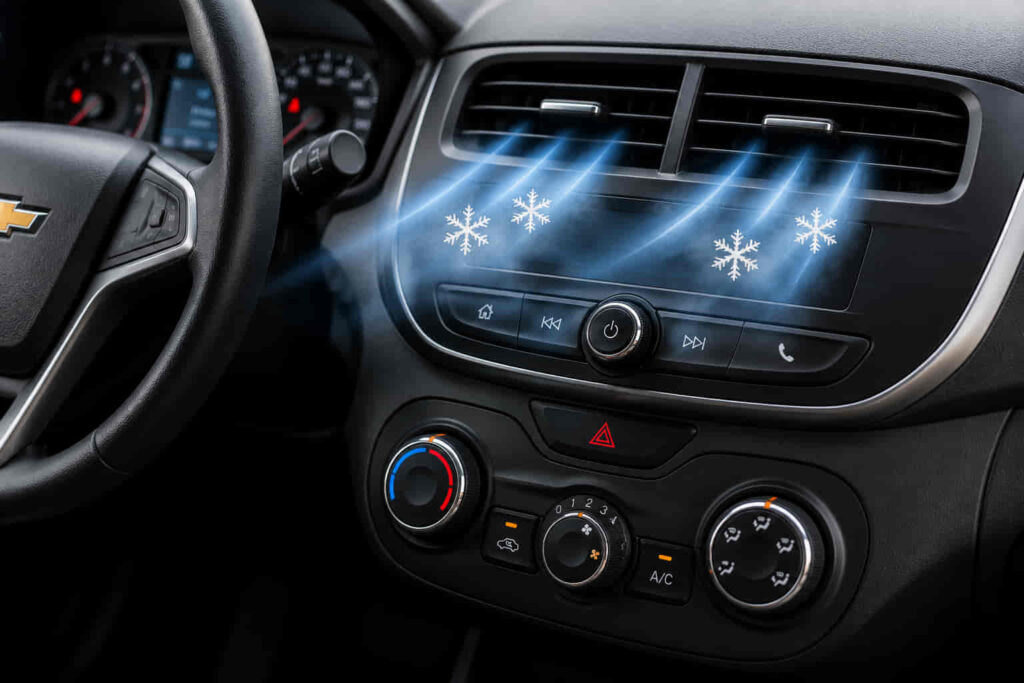
A Chevrolet AC that is not blowing cold air usually indicates a problem somewhere within the vehicle’s air conditioning system rather than a single failed component. While many drivers immediately assume the refrigerant is low, weak cooling can also result from a failing compressor, a refrigerant leak, restricted airflow, electrical faults, or HVAC control issues. Identifying the actual cause is essential because each fault affects the cooling cycle differently, and replacing the wrong part often leads to unnecessary repair costs without restoring cabin comfort.
The Chevrolet air conditioning system operates as a closed refrigeration circuit that relies on every major component working together. The compressor pressurizes the refrigerant, the condenser releases heat, the expansion device lowers refrigerant pressure, and the evaporator absorbs heat from the cabin air before the blower distributes cooled air through the vents. If any stage of this process is interrupted, vent temperatures rise even though the air conditioner appears to be operating normally.
This guide explains the ten most common reasons a Chevrolet AC is not blowing cold air, how each problem develops, and the symptoms that help distinguish one fault from another. It also covers practical inspection methods that owners can perform before visiting a repair shop, identifies situations requiring professional diagnosis, and outlines the most effective repair solutions for popular Chevrolet models such as the Cruze, Malibu, Equinox, Silverado, Traverse, and Tahoe. By understanding how the entire HVAC system functions, you can diagnose cooling problems more accurately, avoid replacing unnecessary parts, and restore consistent air conditioning performance with the appropriate repair approach.
Why Is Your Chevrolet AC Not Blowing Cold Air?
A Chevrolet AC that is not blowing cold air is usually caused by a fault somewhere in the air conditioning system rather than a single failed component. The most common causes include low refrigerant, refrigerant leaks, a failing compressor, restricted airflow through the condenser, electrical faults, or HVAC control issues. Because every component in the system depends on the others, a problem in one area can reduce or completely eliminate cooling performance.
The Chevrolet air conditioning system works by transferring heat from inside the cabin to the outside environment through a closed refrigeration cycle. The AC compressor pressurizes the refrigerant and sends it to the condenser, where heat is released into the outside air. The refrigerant then passes through the expansion valve or orifice tube, rapidly drops in pressure, and enters the evaporator. As cabin air flows across the evaporator core, the refrigerant absorbs heat from the air before returning to the compressor to repeat the cycle. When any part of this process is interrupted, the system can no longer remove heat efficiently, causing the vents to blow warm or only slightly cool air.
Cooling performance also depends on several supporting components that are often overlooked during diagnosis. The blower motor must move sufficient air across the evaporator, the condenser fan must remove heat from the refrigerant, and the HVAC blend door must direct air through the evaporator instead of allowing heated air to mix into the cabin. Even if the compressor and refrigerant are functioning correctly, a faulty blend door actuator or clogged cabin air filter can create the impression that the air conditioner has stopped cooling.
Modern Chevrolet vehicles continuously monitor the air conditioning system through multiple sensors and electronic control modules. Refrigerant pressure sensors, ambient temperature sensors, engine coolant temperature sensors, and HVAC control modules communicate with the engine control module to determine when the compressor should engage. If any sensor detects abnormal operating conditions, such as excessively high refrigerant pressure, low pressure caused by refrigerant loss, or engine overheating, the control module may temporarily disable compressor operation to protect the system from further damage. As a result, the air conditioner may suddenly stop producing cold air even though the compressor itself has not failed.
The exact cause can also vary between Chevrolet models because different vehicles use different compressor designs, refrigerant capacities, condenser layouts, and HVAC configurations. Chevrolet Cruze models, for example, are frequently associated with refrigerant leaks around the condenser, while larger SUVs and pickup trucks may experience compressor wear after extended service due to higher cooling demands. Understanding these model-specific patterns allows technicians to narrow down the diagnosis more efficiently instead of replacing parts through trial and error.
Rather than assuming the system only needs a refrigerant recharge, diagnosing the root cause should always begin with identifying which stage of the refrigeration cycle has failed. Confirming refrigerant pressure, compressor engagement, condenser airflow, electrical operation, and HVAC controls provides a complete picture of system health and prevents unnecessary repairs. This systematic approach not only restores cooling performance more effectively but also reduces the risk of repeated failures caused by overlooking the original fault.
Is Low Refrigerant the Most Common Cause of Weak Cooling?
Yes, low refrigerant is the most common reason a Chevrolet AC loses its cooling performance, but refrigerant does not disappear under normal operating conditions. An automotive air conditioning system is a sealed circuit designed to circulate refrigerant continuously throughout its service life. If refrigerant pressure becomes low, the system almost always has a leak somewhere within the circuit. Simply recharging the refrigerant without identifying the leak may restore cold air temporarily, but the cooling performance will gradually decline again as refrigerant escapes.
Refrigerant plays a critical role in heat transfer. As it circulates through the compressor, condenser, expansion valve, and evaporator, it repeatedly changes between liquid and gas states to absorb heat from the cabin and release it outside the vehicle. When refrigerant volume falls below the manufacturer’s specified level, the evaporator cannot absorb enough heat, and the compressor struggles to maintain the required operating pressures. The result is noticeably warmer air from the vents, especially during hot weather, heavy traffic, or extended idling when the air conditioning system is under greater demand.
One of the earliest symptoms of low refrigerant is that the air conditioner still produces cool air while driving at highway speeds but becomes noticeably warmer when the vehicle is stopped. Higher engine speed and stronger airflow across the condenser help compensate for reduced refrigerant capacity, temporarily improving cooling efficiency. Once the vehicle is idling, condenser efficiency decreases, refrigerant pressure becomes unstable, and the cabin temperature rises quickly. This operating pattern is often the first indication that refrigerant pressure is no longer within the designed range.
As refrigerant pressure continues to decrease, additional symptoms begin to appear. The compressor clutch may engage and disengage every few seconds because the low-pressure switch continuously protects the compressor from operating without adequate lubrication. Drivers may also notice inconsistent vent temperatures, longer cabin cooling times, or a hissing sound immediately after switching off the air conditioner as pressure equalizes within the system. In more severe cases, the compressor may fail to engage entirely because the pressure sensor prevents operation to avoid internal compressor damage.
Many Chevrolet owners assume that adding more refrigerant is a complete solution, but this approach rarely addresses the underlying problem. Over 90% of low refrigerant conditions originate from small leaks that develop over time in components such as the condenser, compressor shaft seal, service ports, evaporator, or flexible refrigerant hoses. These leaks may be too small to leave visible oil stains yet large enough to reduce system pressure over several months. Without repairing the leak first, every recharge simply replaces refrigerant that will eventually escape again.
An accurate diagnosis requires measuring both high-side and low-side system pressures with professional manifold gauges rather than estimating refrigerant levels by vent temperature alone. Pressure readings allow technicians to determine whether the system is undercharged, overcharged, or experiencing restrictions elsewhere in the refrigeration cycle. Many repair facilities also inject ultraviolet dye or use electronic refrigerant leak detectors to identify leaks that cannot be seen during a visual inspection. This diagnostic process prevents unnecessary compressor replacement and ensures the correct repair is performed before the refrigerant is recharged.
Ignoring low refrigerant can eventually damage one of the most expensive components in the air conditioning system. Refrigerant also carries compressor oil throughout the system, providing lubrication for internal moving parts. As refrigerant escapes, oil circulation decreases, increasing friction, operating temperature, and compressor wear. What begins as a minor refrigerant leak can ultimately lead to compressor seizure, contaminating the entire AC system with metal debris and significantly increasing repair costs. For this reason, identifying and repairing the source of refrigerant loss is always more cost-effective than repeatedly topping off the system.
Could a Refrigerant Leak Prevent the AC From Cooling?
Yes, a refrigerant leak is one of the most common reasons a Chevrolet AC stops blowing cold air because the system cannot maintain the pressure required for effective heat transfer. Unlike engine oil or coolant, refrigerant circulates inside a sealed system and is not consumed during normal operation. Any measurable loss of refrigerant indicates that the system has developed a leak, regardless of whether cooling performance has only slightly decreased or has stopped completely.
Most refrigerant leaks begin as microscopic openings that gradually enlarge with age, vibration, and thermal expansion. Chevrolet air conditioning systems operate under high pressure and experience constant temperature fluctuations every time the compressor cycles on and off. Over thousands of heating and cooling cycles, rubber seals harden, aluminum components expand and contract, and hose connections become more susceptible to leakage. Because refrigerant escapes slowly in many cases, drivers often notice weaker cooling over several months rather than an immediate loss of air conditioning.
The condenser is one of the most vulnerable components because it sits behind the front grille and is continuously exposed to road debris, moisture, salt, and small stone impacts. Even a tiny puncture or corrosion spot can allow refrigerant to escape gradually. Compressor shaft seals also wear over time due to continuous rotation, while O-rings located at hose connections naturally lose elasticity as they age. On higher-mileage Chevrolet vehicles, evaporator leaks become more common because moisture trapped inside the HVAC housing accelerates corrosion on the evaporator core, although these leaks are more difficult to detect because the component is hidden behind the dashboard.
A leaking system rarely loses cooling performance all at once. During the early stage, the air conditioner may still produce cold air shortly after startup but struggle to maintain cabin temperature during long drives or high ambient temperatures. As refrigerant pressure continues to decrease, compressor cycling becomes more frequent because the low-pressure sensor repeatedly disengages the compressor to prevent damage. Eventually, refrigerant pressure falls below the minimum operating threshold, preventing compressor engagement altogether and leaving the vents blowing only ambient-temperature air.
Several visual and operational symptoms can help identify a refrigerant leak before specialized testing begins. Oily residue around refrigerant line fittings, compressor connections, or the condenser often indicates that compressor oil is escaping together with refrigerant. Bubbling sounds behind the dashboard immediately after switching off the engine, inconsistent vent temperatures, or frost developing on specific refrigerant lines may also suggest pressure imbalance caused by refrigerant loss. However, the absence of visible signs does not rule out a leak because many leaks occur in concealed areas or are too small to leave noticeable traces.
Professional diagnosis relies on confirming both refrigerant pressure and the exact leak location rather than replacing components based on symptoms alone. Technicians typically recover the remaining refrigerant, evacuate the system, and perform pressure testing before introducing ultraviolet dye or using an electronic leak detector capable of sensing extremely small refrigerant concentrations. UV dye becomes visible under ultraviolet light after circulating through the system, making it easier to identify leaks at hose fittings, condensers, compressors, or evaporators that cannot be located through visual inspection alone. This systematic approach prevents unnecessary component replacement and ensures the repair addresses the actual source of refrigerant loss.
Repairing the leaking component is always more effective than repeatedly adding refrigerant. A recharge without leak repair only restores cooling temporarily because refrigerant continues escaping through the same damaged area. Over time, repeated refrigerant loss also reduces compressor lubrication because refrigerant carries compressor oil throughout the system. Insufficient lubrication increases internal wear, raises operating temperatures, and can eventually lead to compressor failure, transforming an inexpensive seal or condenser repair into a complete air conditioning system overhaul. Identifying the leak early therefore protects both cooling performance and the long-term reliability of the Chevrolet HVAC system.
Can a Faulty AC Compressor Stop the Air From Getting Cold?
Yes, a faulty AC compressor can completely prevent a Chevrolet air conditioning system from producing cold air because it is responsible for circulating refrigerant through the entire refrigeration cycle. Without adequate compressor pressure, refrigerant cannot move efficiently between the condenser and evaporator, making heat transfer impossible regardless of how much refrigerant remains inside the system.
The compressor functions as the heart of the air conditioning system by drawing in low-pressure refrigerant vapor from the evaporator and compressing it into a high-pressure, high-temperature gas before sending it to the condenser. This pressure difference drives the entire cooling process. If the compressor cannot generate sufficient pressure, refrigerant no longer changes state efficiently inside the evaporator, causing the air from the vents to remain warm even though every other component appears to operate normally.
Compressor failure rarely occurs without warning. One of the earliest symptoms is intermittent cooling, where the air conditioner blows cold air for several minutes before gradually becoming warm. As internal components wear, compressor efficiency declines, reducing the pressure difference required for effective cooling. Drivers may also hear grinding, rattling, squealing, or knocking noises whenever the air conditioner is engaged. These sounds often indicate worn bearings, damaged pistons, or internal mechanical failure that continues to worsen if the compressor remains in operation.
In many Chevrolet models, the compressor itself may still be mechanically sound while the compressor clutch fails to engage. The clutch connects the compressor pulley to the compressor shaft whenever cooling is requested. If the clutch coil burns out, the clutch plate wears excessively, or the air gap exceeds specification, the pulley continues spinning with the engine while the compressor remains stationary. From the driver’s perspective, the air conditioner appears to be operating normally because the blower continues moving air through the vents, yet no refrigerant compression occurs and cooling disappears completely.
Electrical faults can produce symptoms that closely resemble compressor failure. A blown fuse, defective relay, damaged wiring harness, failed pressure sensor, or malfunctioning HVAC control module may prevent power from reaching the compressor clutch even though the compressor itself is fully functional. Modern Chevrolet vehicles continuously monitor refrigerant pressure and engine operating conditions. If the control module detects refrigerant pressure outside the safe operating range or excessive engine temperature, it automatically disables compressor engagement to prevent internal damage. Confirming electrical operation before replacing the compressor therefore eliminates unnecessary repairs and significantly reduces diagnostic costs.
Technicians diagnose compressor condition by evaluating system pressures together with compressor operation rather than relying on noise or vent temperature alone. When the compressor is functioning correctly, manifold gauge readings show a clear pressure difference between the high-pressure and low-pressure sides of the system. If both pressures remain nearly equal while the compressor is engaged, the compressor is no longer producing sufficient compression internally. Conversely, abnormal pressure readings combined with a stationary compressor clutch often indicate an electrical or clutch-related problem instead of complete compressor failure.
Once internal compressor damage occurs, replacing only the compressor is not always sufficient. A failing compressor frequently releases fine metal particles into the refrigerant circuit, contaminating the condenser, expansion valve, hoses, and evaporator. If these contaminants remain inside the system, they can quickly damage the replacement compressor. For this reason, professional repairs often include flushing the refrigerant lines, replacing the receiver-drier or accumulator, installing a new expansion device when necessary, and evacuating the system before recharging it with the manufacturer’s specified refrigerant and compressor oil. This comprehensive repair restores cooling performance while minimizing the risk of repeated compressor failure.
Read more: Chevrolet Audio Not Working
Can a Dirty Condenser Reduce Cooling Performance?
Yes, a dirty or restricted condenser can significantly reduce the cooling performance of a Chevrolet air conditioning system because it cannot release heat efficiently. The condenser is responsible for removing the heat absorbed from the cabin before the refrigerant returns to the evaporator. If airflow through the condenser becomes restricted, refrigerant temperature and pressure remain too high, preventing the refrigeration cycle from operating at maximum efficiency.
The condenser is mounted at the front of the vehicle, directly behind the grille and in front of the radiator. This location allows outside air to flow across its aluminum fins while the vehicle is moving or when the radiator cooling fan is operating. As high-pressure refrigerant exits the compressor, it enters the condenser in a hot gaseous state. Heat is transferred through the condenser fins into the surrounding air, allowing the refrigerant to condense into a high-pressure liquid before reaching the expansion valve. If heat cannot escape quickly enough, the refrigerant remains excessively hot, reducing the amount of cooling available inside the cabin.
Because of its exposed position, the condenser is constantly subjected to environmental contamination. Road dust, mud, insects, leaves, cottonwood seeds, plastic debris, and even bent cooling fins gradually reduce the amount of air passing through the condenser core. In coastal regions or areas where road salt is commonly used during winter, corrosion can further damage the thin aluminum tubes and fins, reducing both heat transfer efficiency and structural integrity. Even when the refrigerant circuit remains completely sealed, external contamination alone can noticeably decrease cooling performance.
A restricted condenser usually produces symptoms that become more obvious under heavy cooling demand. Drivers often notice that the air conditioner performs reasonably well during cool mornings but struggles during hot afternoons when ambient temperatures exceed 30°C (86°F). The air may initially feel cold after startup but gradually becomes warmer as refrigerant pressure increases. Cooling performance also tends to decline while the vehicle is stationary because airflow depends almost entirely on the radiator cooling fan instead of vehicle speed.
High condenser temperatures place additional stress on the compressor. As discharge pressure rises, the compressor must work harder to circulate refrigerant throughout the system, increasing engine load and internal operating temperatures. Modern Chevrolet vehicles continuously monitor refrigerant pressure through dedicated pressure sensors. If condenser efficiency becomes severely compromised and pressure exceeds safe operating limits, the engine control module may temporarily disengage the compressor to prevent damage. Drivers often interpret this safety function as intermittent compressor failure when the underlying issue is insufficient heat dissipation.
Inspection of the condenser should always be part of a complete AC diagnosis. Dirt accumulation, bent fins, oil residue indicating refrigerant leaks, and physical damage caused by stones or road debris should all be evaluated before replacing expensive components. Cleaning the condenser with low-pressure water and compressed air often restores airflow without damaging the delicate aluminum fins. If corrosion has perforated the refrigerant tubes or a large section of the fins has deteriorated, replacement becomes the only reliable solution because both cooling efficiency and refrigerant containment have already been compromised.
Maintaining a clean condenser improves more than cabin comfort. Lower refrigerant pressure reduces compressor workload, improves fuel efficiency during air conditioner operation, extends compressor life, and allows the HVAC system to achieve its designed cooling capacity even during extreme summer temperatures. Preventive condenser maintenance therefore represents one of the simplest and most cost-effective methods of preserving long-term Chevrolet AC performance.
Can a Blocked Cabin Air Filter Cause Weak Airflow?
Yes, a clogged cabin air filter can make a Chevrolet air conditioner feel much less effective even when the refrigeration system is operating normally. Unlike refrigerant-related failures, a blocked cabin air filter does not reduce the temperature of the evaporator itself. Instead, it restricts the amount of air passing through the evaporator, preventing enough cooled air from reaching the passenger compartment.
The cabin air filter serves as the first line of defense against airborne contaminants entering the HVAC system. Dust, pollen, mold spores, road debris, soot, and fine particulate matter are trapped within the filter media before air reaches the blower motor and evaporator. As these contaminants accumulate over time, airflow resistance increases steadily. Eventually, the blower motor can no longer push sufficient air through the evaporator core, causing the vents to produce weak airflow even when the blower speed is set to its highest setting.
Reduced airflow changes the way occupants perceive air conditioning performance. The evaporator may still reach the correct operating temperature, but the limited air volume prevents rapid removal of cabin heat. Drivers often assume the refrigerant level is low because the interior takes much longer to cool than before. In reality, the refrigeration system may be functioning exactly as designed while the airflow restriction prevents efficient heat exchange between the cabin air and the evaporator surface.
A severely clogged cabin air filter can also create secondary problems within the HVAC system. Reduced airflow allows the evaporator core to become excessively cold because less warm cabin air passes across its surface. Under humid conditions, moisture on the evaporator fins may freeze into ice, further restricting airflow and causing vent output to decrease even more. Once the air conditioner is switched off and the ice melts, airflow temporarily returns, creating an intermittent cooling complaint that closely resembles more complex refrigerant-related issues.
Several warning signs indicate that the cabin air filter requires replacement. Airflow gradually weakens across all fan speed settings, unpleasant odors become noticeable when the HVAC system starts, windshield defogging becomes less effective, and dust may accumulate more rapidly inside the cabin. Drivers who frequently travel on unpaved roads, through heavy urban traffic, or in regions with high pollen concentrations often experience faster filter contamination than those driving primarily on clean highways.
Replacing the cabin air filter is one of the simplest maintenance procedures for a Chevrolet HVAC system, yet it is frequently overlooked. Most manufacturers recommend replacement at regular service intervals, but actual replacement frequency should also consider driving environment and seasonal conditions. Installing a clean filter immediately restores airflow, reduces strain on the blower motor, improves evaporator efficiency, and enhances overall cabin air quality. Although replacing the filter will not resolve refrigerant leaks or compressor failures, it often restores the strong airflow necessary for the air conditioning system to deliver its full cooling performance.
Can Cooling Fan Problems Affect AC Performance?
Yes, cooling fan problems can significantly reduce Chevrolet AC performance because the condenser depends on continuous airflow to remove heat from the refrigerant. While vehicle speed naturally forces air through the condenser during highway driving, the cooling fan becomes the primary source of airflow whenever the vehicle is idling, moving slowly, or operating in stop-and-go traffic. If the fan cannot maintain adequate airflow, refrigerant pressure rises rapidly and the air conditioning system loses its ability to produce consistently cold air.
The cooling fan operates whenever additional condenser cooling is required, especially during hot weather or heavy engine loads. As compressed refrigerant leaves the compressor, it enters the condenser carrying a large amount of heat extracted from the passenger cabin. The fan pulls outside air across the condenser fins, allowing that heat to dissipate before the refrigerant continues through the expansion device. Without sufficient airflow, the refrigerant remains excessively hot, preventing it from condensing into a high-pressure liquid efficiently. This interruption weakens the entire refrigeration cycle and reduces cooling capacity inside the vehicle.
One of the most recognizable symptoms of a cooling fan problem is that the air conditioner performs normally while driving at highway speeds but quickly loses cooling efficiency when the vehicle stops at traffic lights or remains parked with the engine running. Natural airflow generated by vehicle movement temporarily compensates for the failed fan. Once the vehicle becomes stationary, condenser temperature rises, refrigerant pressure increases, and vent temperatures gradually become warmer. Many drivers incorrectly suspect low refrigerant or compressor failure because the cooling appears inconsistent, when the actual problem is insufficient condenser airflow.
Cooling fan failures can originate from several different components rather than the fan motor alone. A worn electric motor may rotate slowly or stop completely, while damaged fan blades reduce airflow even if the motor continues operating. Faulty relays, blown fuses, defective temperature sensors, damaged wiring, or failed fan control modules can also prevent the fan from activating when condenser temperatures rise. On certain Chevrolet models equipped with multiple cooling fans, the failure of only one fan may still reduce overall cooling performance under high ambient temperatures without immediately causing engine overheating.
As condenser temperature continues to increase, the engine control module monitors refrigerant pressure through dedicated pressure sensors. If pressure exceeds the manufacturer’s safety limits, the control module may temporarily disengage the AC compressor to prevent damage to the compressor, hoses, and other refrigerant components. Drivers often notice that cold air suddenly disappears for several minutes before returning once refrigerant pressure falls again. This protective strategy is functioning correctly, but it also indicates that the cooling fan system requires immediate diagnosis.
Professional diagnosis includes verifying fan operation at different engine temperatures and AC operating conditions rather than simply confirming whether the fan spins. Technicians evaluate fan activation commands from the engine control module, electrical voltage supplied to the motor, current draw, relay performance, and sensor feedback while simultaneously monitoring refrigerant pressures. This complete diagnostic approach identifies whether the airflow problem originates from mechanical failure, electrical malfunction, or electronic control issues.
Maintaining proper cooling fan operation protects more than the air conditioning system. Stable condenser temperatures reduce compressor workload, maintain optimal refrigerant pressure, improve fuel efficiency during AC operation, and extend the service life of multiple HVAC components. Addressing cooling fan problems early therefore prevents both declining cabin comfort and significantly more expensive air conditioning repairs.
Can a Blend Door Actuator Keep the Air Warm?
Yes, a faulty blend door actuator can cause warm air to come from the vents even when the Chevrolet air conditioning system is producing properly chilled air. Unlike refrigerant leaks or compressor failures, this problem does not affect refrigerant circulation. Instead, it prevents the HVAC system from directing cooled air into the passenger compartment, making the air conditioner appear ineffective although the refrigeration system itself continues operating normally.
Inside the HVAC housing, the blend door regulates how much air passes through the evaporator and how much passes through the heater core before entering the cabin. Electric actuators controlled by the climate control module continuously adjust the position of this door according to the temperature selected by the driver. When the actuator functions correctly, cooled air from the evaporator reaches the vents whenever maximum air conditioning is requested. If the actuator becomes stuck, loses calibration, or suffers an internal gear failure, heated air may continue mixing with cooled air, causing the vent temperature to remain much warmer than expected.
Blend door actuator failure usually develops gradually rather than occurring instantly. Drivers may first notice that one side of the cabin feels colder than the other, particularly on Chevrolet models equipped with dual-zone automatic climate control. As the internal gears continue wearing, temperature differences become more pronounced until one or both sides of the vehicle consistently blow warm air regardless of the selected climate control settings. This symptom frequently leads owners to suspect refrigerant loss even though refrigerant pressure remains completely normal.
Mechanical wear is one of the most common causes of actuator failure. The small plastic gears inside the actuator experience thousands of movement cycles throughout the vehicle’s lifetime. Over time, individual gear teeth can crack or wear away, preventing the actuator from accurately positioning the blend door. Electric motor failure, damaged position sensors, wiring faults, or software calibration errors may produce similar symptoms because the climate control module can no longer determine the exact location of the air distribution doors.
Certain operating symptoms strongly indicate a blend door problem instead of a refrigeration issue. Repetitive clicking noises behind the dashboard immediately after starting the engine or changing temperature settings often occur when damaged gears repeatedly skip while attempting to reposition the door. Drivers may also notice that changing the temperature setting has little or no effect, or that the airflow temperature changes unexpectedly without any adjustment to the climate control system. These symptoms point toward airflow management problems rather than failures within the refrigerant circuit.
Diagnosing the blend door actuator involves more than simply replacing the actuator assembly. Professional technicians verify actuator movement using diagnostic scan tools capable of communicating with the HVAC control module, perform calibration procedures after replacement, and inspect the blend door itself for binding or physical damage. If the blend door cannot move freely due to mechanical obstruction inside the HVAC housing, replacing the actuator alone will not permanently solve the problem.
Because the blend door actuator directly controls cabin temperature, even a perfectly functioning compressor cannot compensate for an incorrectly positioned blend door. Confirming proper HVAC door operation should therefore be an essential part of any Chevrolet air conditioning diagnosis before refrigerant is recharged or expensive refrigeration components are replaced. Identifying this relatively inexpensive fault early often prevents unnecessary repairs while restoring normal cooling performance much more efficiently.
Can Electrical Problems Prevent the Chevrolet AC From Cooling?
Yes, electrical faults can completely disable a Chevrolet air conditioning system even when every mechanical component remains in good condition. Modern Chevrolet vehicles rely on multiple electronic control modules, sensors, relays, and electrical circuits to manage compressor operation. If any part of this control network fails or detects abnormal operating conditions, the system may prevent the compressor from engaging to protect both the engine and the air conditioning components.
Unlike older vehicles where the compressor engaged almost immediately after pressing the AC button, modern Chevrolet HVAC systems perform several safety checks before activating the compressor clutch. The Engine Control Module (ECM), Body Control Module (BCM), and HVAC Control Module continuously exchange information regarding engine temperature, refrigerant pressure, outside air temperature, engine load, throttle position, and battery voltage. Only when every operating parameter falls within the manufacturer’s specifications will the compressor receive authorization to operate.
A blown fuse or defective AC relay is one of the simplest electrical failures but can produce symptoms identical to compressor failure. The relay acts as a high-current switch that supplies power to the compressor clutch whenever cooling is requested. If the relay contacts wear out or the fuse protecting the circuit opens due to excessive current, the compressor receives no electrical power despite being mechanically functional. Because these components are inexpensive and easily accessible, they should always be inspected before considering compressor replacement.
Pressure sensors also play a critical role in compressor operation. Chevrolet air conditioning systems monitor both excessively low and excessively high refrigerant pressure. If refrigerant pressure falls below the minimum operating threshold due to a leak, the low-pressure protection strategy prevents compressor engagement to avoid lubrication failure. Conversely, excessive pressure caused by restricted condenser airflow or an overcharged system triggers high-pressure protection, temporarily disabling compressor operation until pressure returns to a safe range. In both situations, the compressor itself remains undamaged, but electrical control logic intentionally prevents it from operating.
Temperature sensors can produce similar symptoms. Ambient temperature sensors, evaporator temperature sensors, and engine coolant temperature sensors continuously provide information to the control modules. Incorrect sensor readings may convince the control system that operating conditions are unsafe or that cabin cooling is unnecessary. A faulty evaporator temperature sensor, for example, may falsely indicate evaporator freezing, causing repeated compressor cycling that reduces cooling performance even though the evaporator remains well above freezing.
Electrical diagnosis requires more than checking whether battery voltage reaches the compressor. Professional technicians verify communication between electronic control modules, inspect live sensor data using diagnostic scan tools, perform circuit voltage drop testing, and evaluate fault codes stored within the HVAC and engine management systems. Modern Chevrolet vehicles often record Diagnostic Trouble Codes (DTCs) related to pressure sensors, temperature sensors, communication networks, or actuator faults long before complete system failure occurs. Reading these codes significantly reduces diagnostic time while preventing unnecessary replacement of expensive mechanical components.
Because electronic controls have become deeply integrated into modern HVAC systems, diagnosing electrical faults systematically is essential before replacing compressors, condensers, or expansion valves. Confirming that the compressor is receiving the correct electrical command often identifies the true source of the problem while avoiding repairs that do not address the underlying fault.
Could a Faulty Expansion Valve or Orifice Tube Restrict Cooling?
Yes, a faulty expansion valve or clogged orifice tube can significantly reduce Chevrolet AC cooling because these components regulate refrigerant flow into the evaporator. Even if refrigerant pressure and compressor operation remain within specification, improper refrigerant metering disrupts the refrigeration cycle and prevents efficient heat absorption inside the evaporator.
After leaving the condenser as a high-pressure liquid, refrigerant must pass through a metering device before entering the evaporator. Depending on the Chevrolet model, this component may be either a Thermal Expansion Valve (TXV) or a Fixed Orifice Tube. Both devices perform the same essential function by creating a controlled pressure drop that allows refrigerant to expand rapidly, lowering its temperature before it absorbs heat from cabin air.
A partially restricted expansion device limits refrigerant flow into the evaporator. As refrigerant volume decreases, only part of the evaporator participates in heat exchange while the remaining surface contributes little or no cooling. Drivers often notice that the air conditioner still produces cool air but struggles to maintain cabin comfort during high ambient temperatures. Vent temperatures fluctuate, cooling capacity decreases, and compressor operating pressures become abnormal despite adequate refrigerant charge.
Restrictions frequently develop because contaminants circulate within the refrigerant system. Internal compressor wear may release microscopic metal particles, deteriorated seals can introduce debris, and moisture entering the system during improper servicing may combine with refrigerant oil to form acidic deposits. These contaminants accumulate inside the narrow passages of the expansion valve or orifice tube, gradually reducing refrigerant flow. In severe cases, ice formation caused by excessive moisture can temporarily block refrigerant movement until the system warms again, creating intermittent cooling complaints.
Pressure readings provide valuable clues during diagnosis. A restricted expansion device often produces unusually high pressure on the high side while simultaneously creating excessively low pressure on the low side. Frost may appear on refrigerant lines immediately before the restriction because refrigerant expands prematurely instead of inside the evaporator. Although these symptoms resemble low refrigerant in some situations, pressure analysis allows experienced technicians to distinguish between insufficient refrigerant quantity and restricted refrigerant flow.
Replacing the expansion device alone is rarely sufficient if contamination caused the restriction. The entire refrigerant circuit should be inspected for compressor damage, moisture contamination, and debris before installing new components. Flushing refrigerant lines, replacing the receiver-drier or accumulator, evacuating the system, and recharging with the specified refrigerant and compressor oil ensure that the replacement expansion device operates under clean conditions. This comprehensive repair prevents recurring restrictions while restoring the system’s designed cooling efficiency.
How Do Chevrolet Models Differ in Common AC Problems?
Although every Chevrolet air conditioning system operates according to the same refrigeration principles, common failures vary by model because of differences in component design, packaging, operating conditions, and vehicle usage. Understanding these patterns allows technicians to prioritize inspections and shorten diagnostic time without assuming that every Chevrolet experiences identical AC problems.
Chevrolet Cruze models frequently develop condenser leaks after extended exposure to road debris and vibration. Because the condenser sits close to the front grille, even minor stone impacts can damage the thin aluminum tubes and gradually reduce refrigerant pressure. Higher-mileage Cruze vehicles may also experience compressor clutch wear and deteriorated O-ring seals that contribute to slow refrigerant loss.
Chevrolet Malibu models commonly experience electronic HVAC issues in addition to normal refrigerant-related faults. Blend door actuators and climate control actuators are subjected to frequent movement, making gear wear more common as vehicle mileage increases. Drivers often report temperature differences between the driver and passenger sides even though compressor performance remains normal.
Chevrolet Equinox vehicles are frequently operated as family SUVs in urban environments where prolonged idling and stop-and-go traffic place additional demands on condenser airflow. Cooling fan performance, condenser cleanliness, and refrigerant pressure become especially important under these operating conditions. Reduced airflow at idle often produces customer complaints that disappear once the vehicle reaches highway speeds.
Chevrolet Silverado trucks typically accumulate high operating hours through towing, commercial use, and heavy-duty driving. These demanding conditions increase compressor workload, accelerate clutch wear, and expose the condenser to greater amounts of dust, mud, and road debris. Trucks operating on construction sites or unpaved roads often require more frequent condenser cleaning and cabin air filter replacement to maintain peak cooling performance.
Larger Chevrolet SUVs such as the Traverse and Tahoe present additional diagnostic considerations because many models incorporate rear air conditioning systems. Longer refrigerant lines, additional expansion devices, and rear evaporators increase overall system complexity. Refrigerant leaks, rear expansion valve restrictions, or rear blower motor faults may affect cooling in one section of the cabin while the front vents continue operating normally. Diagnosing these vehicles therefore requires evaluating both front and rear HVAC circuits rather than focusing exclusively on the primary evaporator.
Recognizing model-specific failure patterns does not replace systematic diagnosis, but it provides valuable context that improves repair efficiency. Every Chevrolet should still undergo complete pressure testing, electrical diagnosis, airflow inspection, and leak detection before any component is replaced.
How Can You Diagnose a Chevrolet AC Problem Before Visiting a Repair Shop?
A basic inspection can often identify whether the problem involves airflow, refrigerant circulation, electrical control, or mechanical failure before professional diagnosis begins. While specialized equipment is required to confirm refrigerant pressure and recover refrigerant safely, several observations can help narrow the likely cause of poor cooling performance.
Begin by evaluating how the air conditioner behaves under different driving conditions. Compare vent temperatures while the vehicle is stationary and again while driving at highway speed. Cooling that improves significantly at higher speeds often indicates condenser airflow problems or cooling fan malfunction rather than compressor failure. Next, observe whether the compressor clutch engages when the air conditioner is switched on. If the clutch never engages, the fault may involve electrical controls, pressure sensors, relays, or insufficient refrigerant pressure.
Airflow should also be evaluated independently from cooling performance. Weak airflow across all blower speed settings commonly points toward a clogged cabin air filter or blower motor issue, whereas strong airflow combined with warm air usually indicates refrigerant, compressor, or HVAC control problems. Listen carefully for abnormal sounds such as clicking behind the dashboard, grinding from the compressor, or repeated compressor cycling, as these noises frequently identify the affected component before more advanced testing begins.
A visual inspection can reveal additional clues. Oil residue around refrigerant fittings, damaged condenser fins, disconnected electrical connectors, loose drive belts, or obvious wiring damage should never be overlooked. Although these observations cannot confirm every diagnosis, they often identify visible faults that explain declining cooling performance without requiring extensive disassembly.
Professional diagnosis remains essential whenever refrigerant recovery, pressure testing, electronic fault code analysis, or leak detection becomes necessary. However, performing these simple inspections first provides valuable information that helps both vehicle owners and technicians understand where the most likely problem exists.
When Should You Stop Driving and Have the AC Inspected Immediately?
Some air conditioning symptoms indicate that continued operation may cause significantly more damage than the original fault. Compressor grinding noises, burning odors, repeated compressor clutch engagement every few seconds, visible smoke, damaged drive belts, or rapidly increasing engine temperature all require immediate inspection because they may indicate severe mechanical or electrical failure.
Ignoring these warning signs can transform relatively inexpensive repairs into complete HVAC system replacement. A compressor operating with insufficient lubrication may release metal debris throughout the refrigerant circuit, while overheating caused by cooling fan failure can affect both the air conditioning system and engine cooling performance simultaneously. Addressing these symptoms immediately minimizes repair costs while reducing the likelihood of secondary component damage.
How Can You Prevent Chevrolet AC Problems?
Routine preventive maintenance is the most effective way to preserve Chevrolet air conditioning performance and reduce the likelihood of expensive repairs. Most major AC failures develop gradually rather than suddenly, allowing regular inspections to identify early signs of wear before complete component failure occurs.
Maintaining proper condenser cleanliness, replacing the cabin air filter at recommended service intervals, inspecting refrigerant lines for oil residue, and operating the air conditioner periodically throughout the year all contribute to longer system life. Running the air conditioner during cooler months keeps compressor seals lubricated, circulates compressor oil throughout the refrigerant circuit, and reduces the likelihood of seal shrinkage that may eventually cause refrigerant leaks.
Annual HVAC inspections provide additional protection because refrigerant pressure, compressor operation, condenser efficiency, cooling fan performance, and electronic controls can all be evaluated before noticeable cooling loss develops. Preventive maintenance not only improves passenger comfort but also extends the service life of expensive components such as the compressor, condenser, and evaporator.
What Does It Cost to Repair a Chevrolet AC That Is Not Cold?
Repair costs vary according to the failed component, the Chevrolet model, labor rates, and the amount of system contamination discovered during diagnosis. Minor repairs such as replacing a cabin air filter, AC relay, or fuse generally represent the lowest repair costs because they require minimal labor and inexpensive parts. Refrigerant leak repairs become more expensive because technicians must recover refrigerant, repair the leak, evacuate the system, and recharge it according to manufacturer specifications.
Compressor replacement is typically the most expensive repair because it often requires replacement of additional components such as the receiver-drier or accumulator, expansion valve or orifice tube, and contaminated refrigerant oil. If internal compressor failure has distributed metal debris throughout the refrigerant circuit, flushing the system and replacing contaminated components further increases repair costs. Rear air conditioning systems installed on larger Chevrolet SUVs may also require additional labor due to longer refrigerant lines and more complex HVAC layouts.
Obtaining an accurate repair estimate therefore depends on professional diagnosis rather than symptoms alone. Two vehicles producing the same warm airflow may require entirely different repairs depending on whether the underlying cause is a clogged cabin air filter, a refrigerant leak, a failed compressor, an electrical fault, or an HVAC control issue. A systematic inspection identifies the root cause, prevents unnecessary parts replacement, and ensures that repair costs are directed toward the component actually responsible for the loss of cooling.