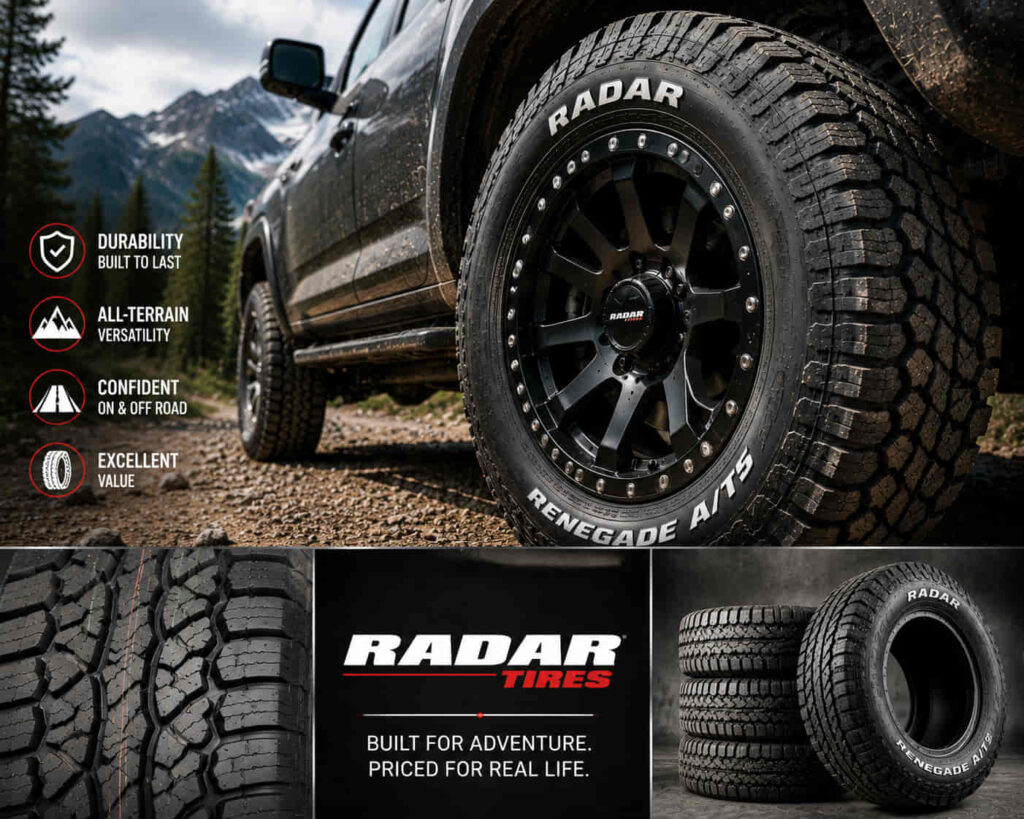
Radar tires can be a good option for drivers who need affordable SUV and truck tires with dependable traction, practical durability, and versatile performance across different road conditions. The brand focuses on providing value-oriented tire solutions for passenger vehicles, crossovers, pickup trucks, and off-road applications where drivers want capability without the higher cost of premium tire brands.
Unlike premium manufacturers that compete through advanced tire technology, motorsport development, and specialized performance products, Radar focuses on delivering practical features that matter to everyday drivers. These include road stability, traction, durability, and flexibility for different driving environments.
The quality of Radar tires depends on the specific model and intended use. Highway-oriented tires are designed for comfortable daily driving, while products such as the Radar Renegade series focus more on all-terrain and off-road capability. Choosing the correct tire category is important because aggressive tread designs often improve off-road traction while creating different comfort and noise characteristics on paved roads.
Radar tires are particularly attractive to SUV owners, pickup truck drivers, and outdoor enthusiasts who need tires capable of handling mixed conditions. They provide an alternative for drivers who want stronger performance than standard passenger tires without moving into premium-priced off-road options.
However, Radar tires are not designed to be the best choice for every driving situation. Drivers who require maximum track performance, extreme winter capability, or professional-grade off-road performance may need specialized tires from brands focused on those conditions.
For example, a Jeep or pickup truck owner who regularly drives on gravel roads and trails may find Radar tires provide strong value, while a luxury SUV owner prioritizing quiet highway comfort may prefer a more road-focused tire.
This guide explains Radar tire quality, performance, safety, durability, SUV and truck compatibility, advantages, limitations, and whether Radar tires are worth buying.
Who Makes Radar Tires?
Radar tires are produced under the Radar Tires brand, a global value-focused tire brand developed by Omni United that provides replacement tires for passenger vehicles, SUVs, pickup trucks, and off-road applications. The brand has positioned itself in the competitive replacement tire market by focusing on practical performance, durability, and affordable pricing.
Understanding who makes Radar tires is important because brand background helps determine its market position. Radar is not positioned as a premium tire manufacturer competing directly with brands such as Michelin, Bridgestone, or Toyo. Instead, the brand focuses on delivering usable performance for drivers who need reliable tires without paying premium prices.
Radar develops tires across several categories, including touring tires, all-terrain tires, and mud-terrain tires. Each category is designed for different driving environments. Highway-focused models prioritize comfort and stability, while products in the Renegade series are designed for SUVs, trucks, and drivers who need stronger traction on challenging surfaces.
The quality of Radar tires depends on the specific model, construction design, tread pattern, and intended application. A tire designed for daily highway driving will have different characteristics compared with an aggressive all-terrain or mud-terrain tire.
For example, a commuter driving a crossover mainly on paved roads may benefit from a Radar touring or highway tire, while a pickup truck owner who frequently explores trails may consider a Radar Renegade all-terrain model for additional traction and durability.
How Do Radar Tires Perform on Different Road Conditions?
Radar tires provide versatile performance across different road conditions, with their strongest capabilities appearing in SUV, truck, and mixed-terrain applications. The brand offers different tire designs that allow drivers to choose between highway comfort, all-terrain flexibility, and more aggressive off-road traction.
On dry pavement, Radar tires provide stable handling and predictable traction for everyday driving. The tread design and tire construction help maintain road contact during acceleration, braking, and cornering, which is important for heavier vehicles such as SUVs and pickup trucks.
Wet-road performance depends on the specific Radar model. All-terrain and highway tires use tread grooves designed to help remove water from the contact area, improving traction during normal rainfall. However, aggressive off-road tires may prioritize loose-surface performance over maximum wet-weather refinement.
Highway driving characteristics vary depending on the tire category. Radar’s road-focused models are designed to provide stability and comfort for daily commuting, while more aggressive Renegade models may produce additional road noise because of their larger tread blocks and stronger off-road design.
On gravel, dirt, and muddy surfaces, Radar’s all-terrain and mud-terrain tires provide stronger capability compared with standard highway tires. Their deeper tread patterns and reinforced designs help improve traction when vehicles encounter uneven or loose terrain.
For example, a Jeep Wrangler or pickup truck used for weekend outdoor activities may benefit from Radar all-terrain tires because they provide a balance between pavement usability and off-road capability, while a vehicle used almost entirely for highway commuting may be better matched with a quieter road-focused tire.
Are Radar Tires Safe in Wet and Dry Conditions?
Radar tires can provide safe performance in normal wet and dry driving conditions when the correct tire model is selected and proper maintenance is followed. Like other tire brands, safety depends on factors such as tread design, tire condition, vehicle weight, driving environment, and how the tires are used.
On dry roads, Radar tires are designed to provide stable traction and predictable handling for everyday driving. This is especially important for SUVs and pickup trucks because these vehicles have higher weight and require tires that can maintain consistent control during acceleration, braking, and cornering.
The tread design plays an important role in wet-weather safety. Radar highway and all-terrain tires use grooves and channels that help move water away from the contact patch, allowing the tire to maintain better contact with wet pavement. This helps support traction during normal rain conditions.
However, different Radar tire categories have different safety characteristics. An all-terrain tire designed for mixed surfaces will prioritize traction on gravel and dirt, while a highway tire will focus more on comfort and predictable pavement handling. Choosing the wrong tire type for the driving environment can reduce overall performance.
Maintenance is also a major factor in tire safety. Correct tire pressure, regular tire rotation, proper alignment, and timely replacement of worn tires help maintain braking ability and vehicle stability.
For example, a pickup truck owner using Radar all-terrain tires for commuting and occasional trail driving may find the balance of traction and road performance suitable, while a driver living in an area with severe winter conditions may need a dedicated winter tire.
How Long Do Radar Tires Last?
Radar tires can provide reasonable durability for their intended applications, but their lifespan depends on the tire model, driving conditions, vehicle type, and maintenance habits. Tires designed for SUVs, trucks, and off-road use experience different stresses compared with standard passenger car tires.
Highway and touring-oriented Radar tires are designed to provide balanced wear characteristics for drivers who spend most of their time on paved roads. These tires focus on maintaining comfort, stability, and consistent performance throughout normal daily use.
All-terrain and mud-terrain Radar tires have different durability priorities. Models such as the Radar Renegade series use stronger construction and deeper tread designs to handle rough surfaces, gravel, and uneven terrain. However, frequent off-road use can accelerate wear compared with normal highway driving.
Vehicle weight also affects tire lifespan. SUVs and pickup trucks place greater loads on tires, especially when carrying cargo, towing, or driving on challenging surfaces. Selecting a tire with the correct load rating is important for maintaining durability.
Driving habits have a direct impact on tread life. Aggressive acceleration, hard braking, incorrect tire pressure, and poor alignment can create uneven wear and shorten the useful life of any tire.
For example, a crossover owner using Radar highway tires mainly for commuting may experience longer tread life compared with a truck owner who frequently drives through mud, rocks, and rough terrain.
Are Radar Tires Good for SUVs and Trucks?
Radar tires are a suitable option for many SUV and truck owners who need affordable tires with practical traction, durability, and versatility across different driving conditions. The brand’s product range is particularly relevant for vehicles that require stronger construction and more capability than standard passenger cars.
SUV owners often need tires that can handle a combination of city driving, highway travel, and occasional outdoor conditions. Radar’s all-terrain products provide additional traction compared with standard highway tires while maintaining enough usability for everyday roads.
Pickup truck owners can also benefit from Radar tires because trucks often require stronger sidewalls, higher load capacity, and improved durability. These characteristics are important for drivers who use their vehicles for outdoor activities, hauling, or mixed road conditions.
Radar Renegade models are especially relevant for drivers who want more aggressive styling and improved off-road capability. The deeper tread patterns and stronger construction help improve traction on surfaces such as mud, gravel, and dirt.
However, Radar tires are not designed for every truck application. Drivers who use their vehicles for heavy commercial hauling, extreme off-road competition, or maximum towing demands may require specialized heavy-duty tires.
For example, a Jeep owner who enjoys weekend trails may find Radar all-terrain tires provide strong value, while a commercial truck operator carrying heavy loads every day may need a tire specifically engineered for industrial use.
Read more: Are Cosmo Tires Good
What Are the Advantages of Radar Tires?
The main advantages of Radar tires are affordable pricing, versatile product options, strong SUV and truck compatibility, and practical performance across different driving environments. The brand is designed for drivers who want reliable tire capability without paying the higher prices commonly associated with premium off-road and truck tire manufacturers.
One of Radar’s biggest strengths is value. SUV and truck tires, especially all-terrain and mud-terrain models, can become expensive when drivers choose established premium brands. Radar provides an alternative for customers who need additional traction and durability while maintaining a more controlled budget.
Another advantage is product variety. Radar offers tires for different applications, including passenger vehicles, highway driving, all-terrain use, and mud-terrain conditions. This allows drivers to select a tire based on how they actually use their vehicles instead of choosing a single design that may not match their needs.
Radar also performs well in the SUV and truck segment because many of its products focus on durability and traction. Features such as aggressive tread patterns, reinforced construction, and deeper tread blocks help support drivers who regularly encounter gravel roads, dirt surfaces, and outdoor environments.
The brand is particularly attractive to Jeep owners, pickup truck drivers, and outdoor enthusiasts who need a balance between daily usability and occasional off-road capability.
For example, a truck owner who uses their vehicle for commuting during the week and camping trips on weekends may find Radar all-terrain tires provide a practical combination of road comfort, traction, and affordability.
What Are the Limitations of Radar Tires?
The main limitations of Radar tires are lower premium brand recognition, reduced refinement compared with some higher-priced competitors, and performance differences between tire categories. These limitations are important because tire selection should depend on the driver’s priorities and expected usage.
One limitation is brand reputation. Companies such as Michelin, BFGoodrich, Toyo, and Falken have decades of experience building strong recognition in performance and off-road segments. Radar competes primarily through value and accessibility rather than premium brand positioning.
Another limitation is highway comfort on aggressive models. All-terrain and mud-terrain tires use larger tread blocks and stronger patterns to improve traction on loose surfaces. These features can create additional road noise and a firmer ride compared with highway-focused tires.
Performance differences between models are also important. A highway tire, all-terrain tire, and mud-terrain tire are designed for different environments. A driver choosing an aggressive off-road tire for mostly highway driving may experience unnecessary noise and reduced comfort.
Radar tires are also not designed for every extreme application. Drivers who participate in professional off-road events, require maximum winter traction, or operate vehicles under severe commercial conditions may need specialized tires designed specifically for those situations.
For example, a weekend off-road enthusiast may appreciate the aggressive capability of a Radar Renegade model, while a luxury SUV owner focused on a quiet and refined highway experience may prefer a premium touring tire.
Are Radar Tires Worth Buying?
Radar tires are worth buying for drivers who need affordable SUV, truck, and off-road tires with practical traction, durability, and versatility. The brand provides strong value for customers who want additional capability without moving into the highest-priced tire categories.
Radar is especially suitable for drivers who use Jeeps, SUVs, and pickup trucks for mixed conditions. Owners who drive on highways, gravel roads, dirt paths, and occasional trails can benefit from the brand’s focus on all-terrain performance.
The best value comes from selecting the correct Radar model for the vehicle and driving environment. A highway-focused tire is better suited for daily commuting, while an all-terrain or mud-terrain tire is more appropriate for drivers who frequently encounter rough surfaces.
However, buyers should understand the trade-offs before purchasing. Drivers who prioritize luxury comfort, ultra-low road noise, maximum fuel efficiency, or the highest level of premium tire technology may find other brands better suited to their expectations.
For example, a Jeep Wrangler owner looking for affordable trail capability may find Radar tires provide excellent value, while a driver using a high-end SUV mainly for highway travel may prefer a more refined tire option.
Overall, Radar tires offer a practical balance of affordability, durability, and capability. They are a strong choice for drivers who prioritize function, versatility, and value over premium brand reputation.
Are Radar Tires Good?
Radar tires can be a good choice for drivers who need affordable SUV and truck tires with dependable traction, practical durability, and versatile performance across different road conditions. The brand focuses on providing value-oriented tire solutions for drivers who want additional capability without paying the premium prices associated with well-known off-road tire manufacturers.
Radar’s strongest advantage is its balance between cost and performance. The brand provides options for passenger vehicles, SUVs, pickup trucks, and off-road applications, allowing drivers to choose tires based on their actual driving environment. This makes Radar especially relevant for owners who need flexibility between highway driving and occasional outdoor use.
However, Radar tires are not designed to satisfy every type of driver. Those who prioritize maximum comfort, premium refinement, extreme winter performance, or professional-level off-road capability may require specialized tires from manufacturers focused on those areas.
The best purchasing decision depends on matching the tire model with the vehicle and intended use. A Jeep, SUV, or pickup truck used for commuting, recreational driving, and occasional trails can benefit from Radar’s combination of traction and affordability, while vehicles used in demanding conditions may require more specialized solutions.
Overall, Radar tires provide a practical balance of affordability, durability, and capability. They are a worthwhile option for drivers who value functional performance, versatility, and cost efficiency over premium brand recognition.