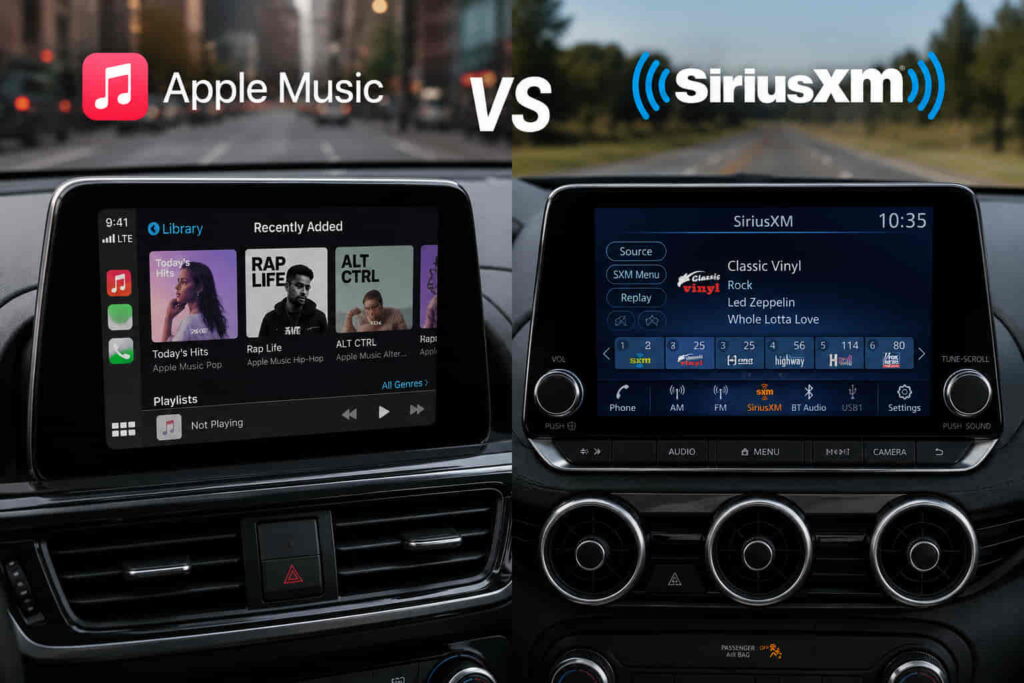
Apple Music and SiriusXM are two of the most recognizable audio entertainment services in North America, but they are designed to solve different listening needs. Apple Music focuses on on-demand music streaming, giving subscribers instant access to millions of songs, albums, curated playlists, and advanced audio technologies such as Lossless Audio and Spatial Audio. SiriusXM, in contrast, combines satellite radio with internet streaming to deliver live music channels, exclusive talk shows, sports broadcasts, comedy, news, and celebrity-hosted programming that cannot always be replicated by traditional streaming platforms.
Choosing between these services requires more than comparing subscription prices. The value of each platform depends on how you consume audio content, where you listen most often, and whether you prioritize complete control over your music library or prefer professionally curated live programming. A commuter who spends several hours driving every day may benefit more from uninterrupted live radio coverage, while someone who frequently creates playlists and listens offline is likely to gain more value from a comprehensive music streaming library.
This comparison examines the ten most important differences between Apple Music and SiriusXM, including music selection, live radio, audio quality, pricing, personalization, in-car experience, and overall value. By understanding how each platform performs across these categories, you can identify the subscription that best matches your listening habits instead of paying for features you may never use.
What Is the Difference Between Apple Music and SiriusXM?
The biggest difference between Apple Music and SiriusXM is that Apple Music is an on-demand music streaming service, while SiriusXM is primarily a live radio entertainment platform that combines satellite broadcasting with internet streaming. This distinction determines how users discover content, interact with their subscriptions, and consume audio throughout the day. Although both platforms provide access to music, they are built around different listening experiences rather than competing feature for feature.
Apple Music gives subscribers complete control over what they hear and when they hear it. Users can search for specific artists, albums, songs, or playlists and begin playback immediately without waiting for scheduled programming. This model is designed for listeners who want unlimited access to an extensive music catalog, personalized recommendations, offline downloads, and seamless synchronization across Apple devices. Because every track is available on demand, users can create their own listening experience instead of relying on programmed radio schedules. This approach also supports advanced listening technologies such as Lossless Audio and Spatial Audio, making Apple Music particularly attractive to users who value sound quality and flexibility.
SiriusXM follows a fundamentally different model by emphasizing professionally curated live channels instead of unlimited on-demand playback. Rather than asking listeners to choose every song individually, SiriusXM organizes content into hundreds of genre-specific music stations alongside sports broadcasts, breaking news, comedy, politics, business programming, and celebrity-hosted talk shows. Many of these channels feature live DJs, exclusive interviews, artist takeovers, and event coverage that create a traditional radio experience enhanced by nationwide satellite coverage. As a result, subscribers often discover new music through curated programming instead of algorithmic recommendations.
The difference becomes even more apparent when considering how each service fits into everyday routines. Apple Music is designed for intentional listening, where users actively search for favorite albums, build playlists for workouts, study sessions, or travel, and manage their personal music libraries. SiriusXM is optimized for passive listening, allowing subscribers to tune into continuous programming without deciding what to play next. This makes it particularly popular among commuters, long-distance drivers, and listeners who enjoy live personalities, sports commentary, or news updates throughout the day.
Another defining distinction lies in the type of content each platform considers its primary value proposition. Apple Music invests heavily in expanding its music catalog, improving recommendation algorithms, and enhancing audio fidelity. SiriusXM differentiates itself through exclusive programming agreements, premium talk shows, live sports rights, and dedicated channels that cannot always be found on traditional music streaming services. For many subscribers, these exclusive broadcasts become the primary reason to maintain a SiriusXM subscription rather than access to music alone.
Understanding these differences is more important than comparing individual features because the two services are designed around different user expectations. Apple Music excels when listeners want complete control over music playback, extensive library access, and high-quality audio streaming. SiriusXM delivers greater value for users who prefer curated live entertainment, exclusive radio programming, and uninterrupted listening during daily commutes or extended road trips. Choosing between them ultimately depends on whether your priority is controlling every song you hear or enjoying professionally programmed audio content without having to make that decision yourself.
Read more: SiriusXM Travel Link
Which Service Has the Better Music Library?
Apple Music has the better music library for users who want unlimited on-demand access, while SiriusXM offers a stronger curated listening experience through genre-based radio channels rather than a traditional song catalog. Although both services allow subscribers to discover new artists and enjoy millions of hours of audio entertainment, their content libraries are organized around fundamentally different consumption models. Understanding this distinction is more valuable than comparing the total number of available songs because the listening experience is shaped by how content is delivered rather than by library size alone.
Apple Music provides access to a catalog containing more than 100 million songs that users can search, stream, and download at any time. Every album, single, and playlist is organized for immediate playback, allowing subscribers to move freely between artists, genres, release years, and moods without restrictions. This extensive catalog makes Apple Music suitable for listeners who want complete control over their music collections, whether they are revisiting classic albums, exploring newly released tracks, or building personalized playlists for different activities. The platform continuously expands its catalog through licensing agreements with major and independent record labels, ensuring that new releases become available shortly after publication.
The size of Apple’s library also improves music discovery because users can navigate beyond mainstream releases into live recordings, deluxe editions, remastered albums, soundtracks, and international music catalogs. Instead of limiting recommendations to popular tracks, Apple Music combines editorial playlists with machine learning to introduce artists that match individual listening behavior. As users interact with songs, albums, and playlists, recommendation accuracy improves, creating a personalized ecosystem that evolves over time instead of relying solely on fixed programming schedules.
SiriusXM approaches music differently by replacing a searchable song library with professionally curated radio channels. Rather than selecting individual tracks whenever they want, subscribers tune into stations dedicated to specific genres, decades, artists, or musical themes. These channels operate continuously with experienced DJs, themed programming, exclusive performances, and artist interviews that create an experience similar to premium broadcast radio. Because programming is curated by music experts instead of being assembled entirely by algorithms, listeners often encounter songs they would not have searched for independently, making music discovery feel more organic and less predictable.
This programming model creates a different kind of value that cannot be measured by catalog size alone. A listener who enjoys classic rock, country, jazz, hip-hop, or electronic music can simply select a dedicated SiriusXM channel and continue listening without creating playlists or managing a personal library. The service becomes especially useful during long drives or work sessions where uninterrupted entertainment is more important than choosing every individual song. Instead of asking, “What should I play next?” SiriusXM answers that question through continuous professionally programmed broadcasts.
When comparing overall library quality, Apple Music delivers greater versatility because every song is available on demand, making it easier to revisit favorite albums, explore niche genres, and organize a personal collection without limitations. SiriusXM delivers greater consistency for listeners who prefer curated experiences, exclusive music programming, and radio-style entertainment that requires little interaction. Neither approach is universally superior, but for users evaluating the breadth, accessibility, and flexibility of a music library, Apple Music offers a significantly more comprehensive solution, while SiriusXM excels as a destination for curated listening rather than unlimited music access.
Which Platform Offers Better Live Radio and Exclusive Content?
SiriusXM offers significantly better live radio and exclusive programming than Apple Music because live broadcasting is the foundation of its service rather than an additional feature. While Apple Music includes live radio stations and original shows, its primary focus remains on on-demand music streaming. SiriusXM, by contrast, is built around continuous live entertainment that combines music, sports, news, comedy, politics, and celebrity-hosted programming into a single subscription.
Live radio is where SiriusXM creates its strongest competitive advantage. Instead of relying entirely on playlists or recommendation algorithms, the platform operates hundreds of professionally programmed channels that broadcast around the clock. Subscribers can switch between commercial-free music stations, live sports coverage, breaking news, financial reporting, comedy specials, and talk radio without interrupting the listening experience. Because many channels are hosted by experienced radio personalities, DJs, musicians, and industry experts, the content feels dynamic rather than automatically generated. This human element creates an experience that traditional music streaming services rarely replicate.
Another distinguishing factor is SiriusXM’s investment in exclusive content partnerships. The platform secures broadcasting rights for professional sports leagues, nationally recognized talk-show hosts, and artist-dedicated channels that are unavailable on most competing streaming services. Live interviews, concert recordings, special event coverage, and limited-time artist takeovers encourage subscribers to return regularly because the programming changes throughout the day. Unlike an on-demand catalog that remains relatively static until new releases appear, SiriusXM continuously refreshes its schedule through real-time broadcasts and exclusive programming events.
Apple Music approaches live content from a different perspective. Rather than replacing traditional radio, it complements its streaming catalog with a small collection of global radio stations, including Apple Music 1, Apple Music Hits, and Apple Music Country. These stations feature live DJs, artist interviews, curated playlists, and music-focused discussions that help listeners discover new releases and emerging artists. Because these broadcasts are integrated into the broader Apple Music ecosystem, users can seamlessly transition between live programming and their personal libraries without leaving the application.
However, Apple’s live programming primarily supports music discovery instead of functioning as a comprehensive radio network. Most listeners use Apple Music to search for specific songs, save albums, build playlists, and receive personalized recommendations, while live stations serve as editorial content that enriches the overall experience. The service offers significantly less coverage of sports, politics, business, comedy, and general news than SiriusXM, making it less suitable for subscribers who rely on audio entertainment throughout the day instead of listening exclusively to music.
The difference becomes even more apparent during daily commutes and long-distance travel. SiriusXM allows drivers to move between music, traffic updates, weather reports, live sporting events, and breaking news without changing applications or searching for new content. Continuous broadcasting keeps listeners engaged with minimal interaction, which is particularly valuable when driving or multitasking. Apple Music performs better in situations where users already know what they want to hear and prefer selecting albums or playlists rather than following scheduled programming.
For listeners whose priority is exclusive music releases, Apple Music remains highly competitive through artist collaborations, editorial playlists, and early access to selected content. However, if the definition of exclusive content extends beyond music to include live sports, national news, political commentary, comedy, celebrity interviews, and premium talk radio, SiriusXM delivers a substantially broader entertainment ecosystem. The platform transforms a music subscription into a comprehensive live audio service, making it the stronger choice for users who value real-time programming over complete control of individual song selection.
Which Service Has Better Audio Quality?
Apple Music delivers better audio quality than SiriusXM because it supports lossless streaming, high-resolution lossless playback, and Spatial Audio with Dolby Atmos, while SiriusXM prioritizes reliable live broadcasting over audiophile-grade sound. Although both services provide a satisfying listening experience for most users, they are optimized for different objectives. Apple Music is engineered to reproduce recordings as accurately as possible, whereas SiriusXM is designed to maintain stable, uninterrupted broadcasts across satellite and internet connections.
Apple Music has invested heavily in high-fidelity audio technologies to differentiate itself from traditional streaming platforms. Every subscriber gains access to Lossless Audio without paying an additional fee, allowing compatible devices to stream tracks with significantly more detail than standard compressed audio. For listeners using wired headphones, external digital-to-analog converters (DACs), or premium speaker systems, lossless playback preserves subtle elements such as instrument separation, vocal clarity, dynamic range, and recording depth. These improvements become particularly noticeable in genres like classical music, jazz, acoustic performances, and studio-produced pop recordings where production quality is a defining characteristic.
Another major advantage is Apple’s implementation of Spatial Audio powered by Dolby Atmos. Instead of reproducing music through conventional left and right stereo channels, Spatial Audio creates a three-dimensional listening environment that places vocals and instruments around the listener. When supported by compatible headphones or home theater equipment, songs can sound wider, more immersive, and closer to the original studio mix. Apple continues to expand its Dolby Atmos catalog, encouraging artists and producers to release immersive versions of both new and existing albums. As a result, subscribers receive not only higher-resolution audio but also an alternative listening experience that traditional stereo streaming cannot replicate.
Audio quality also benefits from Apple’s tightly integrated hardware ecosystem. Devices such as the iPhone, iPad, Mac, Apple TV, and compatible AirPods automatically optimize playback settings, making advanced audio technologies accessible without requiring extensive manual configuration. Users can switch seamlessly between devices while maintaining synchronized playback, downloaded music, and personalized preferences. This ecosystem improves consistency across different listening environments, whether using wireless earbuds during a commute or dedicated speakers at home.
SiriusXM approaches audio quality from a different perspective because its primary objective is delivering dependable live programming rather than maximizing recording fidelity. Satellite broadcasting requires efficient compression techniques to transmit hundreds of simultaneous channels across a nationwide network, and internet streaming is similarly optimized for reliability instead of lossless playback. Consequently, SiriusXM does not provide lossless audio or immersive formats comparable to Dolby Atmos. Music remains clear and enjoyable for everyday listening, but subtle recording details, instrument separation, and dynamic range are generally less pronounced than on Apple Music.
This design choice reflects the nature of SiriusXM’s content rather than a technical limitation alone. Subscribers often switch rapidly between music channels, sports broadcasts, news coverage, talk shows, and live events while driving or multitasking. In these situations, uninterrupted reception and consistent playback are more valuable than studio-grade sound reproduction. A live baseball game, political discussion, or breaking news update does not require lossless encoding to deliver its primary value, which is timely information and continuous accessibility.
The difference becomes most noticeable when using high-end audio equipment. Premium headphones, wired studio monitors, and advanced home audio systems reveal the additional detail preserved in Apple Music’s lossless catalog, allowing listeners to hear subtle background instruments, vocal textures, and production nuances that compressed broadcasts may not fully reproduce. Conversely, when listening through standard car speakers, portable Bluetooth devices, or during daily commuting, the practical difference narrows because environmental noise often limits the benefits of higher-resolution audio.
For listeners who consider sound quality a decisive factor, Apple Music offers one of the strongest audio experiences available among mainstream music streaming services. Its combination of Lossless Audio, High-Resolution Lossless support, and Spatial Audio creates a listening environment that appeals to both casual subscribers and dedicated music enthusiasts. SiriusXM remains an excellent platform for live entertainment, but its emphasis on continuous broadcasting means audio fidelity supports the programming rather than serving as the platform’s primary competitive advantage.
Which Subscription Costs Less?
Apple Music generally costs less for users seeking unlimited music streaming, while SiriusXM offers a wider range of subscription tiers whose value depends on access to live radio, exclusive programming, and premium entertainment rather than music alone. Comparing the monthly price without considering the included features creates an incomplete picture because each platform is built around a different business model. Apple Music charges primarily for access to a comprehensive music library, whereas SiriusXM prices its plans according to the level of live content, channel availability, and listening platforms included in each subscription.
Apple Music follows a straightforward pricing structure that is easy for consumers to understand. Subscribers can choose between Individual, Student, Family, and Apple One plans depending on their needs. Every paid tier includes access to the same core music catalog of more than 100 million songs, offline downloads, curated playlists, personalized recommendations, Lossless Audio, and Spatial Audio. Unlike some streaming competitors that reserve premium audio quality for higher-priced subscriptions, Apple includes its advanced audio technologies across standard memberships, increasing the overall value of each plan. This transparent pricing model allows subscribers to select a plan based on household size rather than feature limitations.
The Family plan significantly improves cost efficiency for households with multiple listeners because several users can maintain separate libraries, recommendations, and listening histories under a single subscription. Students also benefit from reduced monthly pricing while receiving access to the same music catalog and premium audio features available to Individual subscribers. For users already invested in Apple’s ecosystem, bundling Apple Music with services such as iCloud+, Apple TV+, Apple Arcade, and Apple Fitness+ through Apple One can further reduce the effective monthly cost across multiple subscriptions.
SiriusXM adopts a more flexible pricing strategy because its service extends beyond music streaming. Subscription options vary according to channel selection, satellite access, internet streaming capabilities, in-car compatibility, and premium programming. Some plans focus primarily on vehicle listening through factory-installed satellite receivers, while others expand access to mobile devices, smart speakers, connected televisions, and web browsers. Premium tiers typically include the largest collection of music channels alongside live sports, exclusive talk shows, comedy, news programming, and special event broadcasts that are unavailable on entry-level packages.
This tiered approach means SiriusXM subscribers often choose a plan based on where and how they listen rather than simply how much content they want. A driver who spends several hours on the road each day may find substantial value in uninterrupted nationwide satellite coverage, exclusive sports broadcasts, and continuously curated radio stations. In that scenario, paying more than a standard music streaming subscription can be justified because the service replaces multiple forms of entertainment with a single platform. Conversely, listeners who only want on-demand music may find themselves paying for live programming they rarely use, reducing the overall return on their subscription.
Long-term value also depends on promotional pricing and renewal policies. SiriusXM frequently introduces introductory offers that provide discounted access during the first subscription period, particularly for new customers and owners of compatible vehicles. While these promotions can make the service highly competitive initially, subscribers should evaluate the standard renewal price to understand the long-term cost of ownership. Apple Music, by comparison, maintains a more consistent pricing model, allowing users to predict their recurring monthly expenses without relying heavily on promotional discounts.
When subscription value is measured solely by unlimited music access, Apple Music delivers a stronger cost-to-feature ratio. Subscribers receive an extensive music library, premium audio quality, offline listening, and personalized recommendations within a simple pricing structure that remains consistent across devices. SiriusXM becomes the better financial choice only when subscribers actively use its exclusive ecosystem of live radio, sports coverage, celebrity-hosted shows, news networks, and specialty channels. Rather than asking which service is objectively cheaper, consumers should evaluate which subscription includes the features they will actually use every week, because unused premium content quickly reduces the perceived value of any monthly plan.
Which Platform Has Better Personalization?
Apple Music provides better personalization than SiriusXM because its recommendation system continuously learns from individual listening behavior, while SiriusXM relies primarily on professionally curated programming rather than algorithm-driven content discovery. Although both services help users discover new artists and songs, they use entirely different methods to recommend content. Apple Music adapts to each subscriber’s preferences over time, whereas SiriusXM emphasizes human curation that delivers the same high-quality programming to every listener tuned into a specific channel.
Apple Music builds its personalization engine around individual listening habits. Every interaction, including songs played, albums saved, playlists created, artists followed, tracks skipped, and listening duration, contributes to a continuously evolving recommendation profile. Instead of generating generic suggestions, the platform analyzes these behavioral signals to identify patterns that reflect a user’s musical interests. As listening history expands, recommendations become increasingly relevant because the algorithm understands not only preferred genres but also favorite artists, production styles, moods, and listening contexts.
This adaptive learning system powers several discovery features throughout the application. Personalized playlists are refreshed regularly to introduce new releases, rediscover forgotten favorites, and recommend artists that share musical characteristics with previously played content. Rather than relying solely on popularity rankings, Apple Music balances editorial selections with machine-learning predictions, helping listeners move naturally from familiar music toward related artists they may never have discovered independently. This combination of human expertise and algorithmic analysis creates a recommendation experience that improves with continued use.
Personalization also extends beyond recommendations into the overall user experience. Apple Music synchronizes listening history, playlists, downloaded albums, and playback progress across compatible devices, allowing subscribers to continue listening without interruption whether they switch between an iPhone, Mac, iPad, Apple Watch, or Apple TV. Because every device contributes to the same listening profile, recommendations remain consistent regardless of where music is played. This unified ecosystem strengthens personalization by treating every listening session as part of a single continuous experience instead of isolated interactions across different devices.
SiriusXM approaches personalization from a fundamentally different direction. Rather than asking algorithms to predict what each subscriber wants to hear next, the platform encourages listeners to explore professionally curated channels organized by genre, decade, artist, mood, or entertainment category. Each station is programmed by music experts, producers, and experienced radio hosts who determine playlists, scheduling, and featured content. As a result, music discovery is driven more by editorial judgment than by behavioral data collected from individual users.
This curation-first model offers advantages that algorithmic systems cannot always reproduce. Because programming decisions are made by people with deep knowledge of specific genres, listeners are often introduced to songs that fall outside predictable recommendation patterns. A classic rock station, for example, may combine iconic hits with overlooked album tracks, live recordings, and artist interviews that provide broader musical context. This creates a listening experience that feels similar to traditional radio while maintaining the consistency expected from a premium subscription service.
However, SiriusXM delivers less individualized customization than Apple Music. Two subscribers listening to the same channel generally hear identical programming regardless of their personal listening history. Although users can save favorite channels and access selected on-demand content, the platform does not continuously reshape its recommendations around individual behavior in the same way that modern music streaming services do. For listeners who enjoy actively building personal music libraries and receiving increasingly accurate recommendations over time, this limitation becomes more noticeable as their listening preferences evolve.
The difference between the two platforms reflects their broader design philosophies. Apple Music assumes that every subscriber wants a unique listening experience shaped by personal taste, while SiriusXM assumes that expert curation creates a valuable shared experience that does not require constant algorithmic adjustment. Neither philosophy is inherently better, but they serve different audiences. Listeners who expect recommendations to become smarter with every session will find Apple Music substantially more personalized, whereas those who trust experienced DJs and curated programming over recommendation algorithms may appreciate SiriusXM’s editorial approach.
Which Service Works Better in the Car?
SiriusXM provides a better in-car listening experience for drivers who prioritize uninterrupted live entertainment, while Apple Music is the stronger choice for users who prefer complete control over their music library through smartphone integration. The difference is not simply about audio quality or content availability. It comes from how each platform is designed to function during driving, where convenience, connectivity, and minimal interaction become more important than advanced playback features.
SiriusXM was originally built around the automotive industry, making vehicles its primary listening environment rather than an extension of a mobile application. Millions of new vehicles are equipped with factory-installed SiriusXM receivers that allow drivers to access music, sports, news, weather, comedy, and talk radio immediately after activating a subscription. Because satellite signals cover vast geographic areas, drivers can continue listening across highways, rural regions, mountains, and interstate routes without depending on cellular coverage. This nationwide consistency makes SiriusXM particularly valuable for commuters, professional drivers, and travelers who regularly drive long distances where mobile network performance may fluctuate.
Continuous programming further enhances the driving experience because it reduces the need for driver interaction. Instead of searching for albums, switching playlists, or selecting individual songs, subscribers simply choose a preferred channel and allow professionally curated programming to continue throughout the journey. Music stations, live sports broadcasts, breaking news, financial updates, and entertainment shows transition naturally from one segment to another, enabling drivers to stay informed or entertained while keeping their attention focused on the road. This passive listening model aligns well with safe driving habits because fewer manual inputs are required during playback.
Apple Music approaches in-car listening from a smartphone-first perspective. Rather than relying on dedicated satellite hardware, the service integrates with Apple CarPlay, allowing drivers to access their music library through the vehicle’s infotainment display. Once connected, users can browse playlists, search for artists, continue recently played albums, and receive personalized recommendations using a familiar interface that mirrors the Apple ecosystem. Voice control through Siri further simplifies navigation by enabling drivers to request songs, albums, playlists, or artists without touching the display, reducing distractions while maintaining full control over playback.
The strength of Apple Music lies in personalization rather than continuous broadcasting. Every playlist, downloaded album, and listening preference remains synchronized across devices, allowing users to begin listening on an iPhone before entering the vehicle and continue seamlessly through CarPlay. Offline downloads also provide a practical advantage in areas with weak mobile reception because previously saved music remains fully accessible without consuming additional mobile data. This flexibility appeals to users who prefer selecting exactly what they want to hear instead of relying on scheduled radio programming.
Connectivity requirements create one of the most significant practical differences between the two services. SiriusXM’s satellite infrastructure allows compatible vehicles to receive live broadcasts independently of mobile internet coverage, making the service exceptionally reliable during cross-country travel or in remote locations. Apple Music depends primarily on internet streaming for its full catalog, although offline downloads reduce this limitation for saved content. In urban environments with stable cellular networks, this difference may be barely noticeable, but it becomes increasingly important during extended road trips where network availability changes frequently.
The ideal platform also depends on the driver’s listening habits. Someone who enjoys following live sports events, national news, traffic updates, or talk radio throughout the day is likely to gain greater value from SiriusXM because these broadcasts continue uninterrupted regardless of changing locations. A listener who prefers carefully curated playlists, newly released albums, personalized recommendations, and high-quality music playback will generally find Apple Music more satisfying, especially when paired with Apple CarPlay and voice controls.
Ultimately, SiriusXM delivers the superior automotive entertainment platform because its infrastructure, programming model, and nationwide coverage were designed specifically for in-vehicle listening. Apple Music remains an outstanding companion for drivers who want complete ownership of their listening experience and already rely on Apple’s connected ecosystem. The better choice depends less on the vehicle itself than on whether the journey is centered around live radio or personal music streaming.
Which Platform Is Better for Different Types of Users?
The better platform depends on how you consume audio content because Apple Music and SiriusXM are designed for different listening habits rather than the same audience. Apple Music is built for users who want complete control over their music library and personalized recommendations, while SiriusXM targets listeners who prefer professionally curated live programming, exclusive broadcasts, and uninterrupted entertainment. Understanding your daily listening routine is more important than comparing individual features because the best subscription is the one that aligns with how you actually spend your time.
Daily music listeners will generally benefit more from Apple Music because the service provides immediate access to virtually any song, album, or playlist without scheduling limitations. Users can create personalized playlists for work, exercise, travel, or relaxation while discovering new artists through recommendation algorithms that continuously adapt to their listening behavior. The ability to download music for offline playback and synchronize libraries across multiple Apple devices further enhances the experience for subscribers who spend several hours each day listening to music. Instead of adapting to a broadcaster’s schedule, listeners build an entirely personalized music collection that evolves alongside their preferences.
Frequent drivers often gain greater value from SiriusXM because continuous live programming reduces the need to interact with the infotainment system while driving. Drivers can switch between commercial-free music channels, live sports coverage, traffic updates, weather reports, financial news, and talk radio without searching for specific content or managing playlists. Satellite broadcasting also provides consistent nationwide coverage in many areas where mobile data connections become unreliable. For commuters, truck drivers, sales professionals, and travelers who spend extended periods on the road, this combination of uninterrupted reception and professionally curated programming creates a more convenient listening experience than traditional music streaming.
Families may find Apple Music to be the more practical subscription because its Family Plan allows multiple household members to maintain separate listening histories, recommendations, playlists, and downloaded libraries under a single account. Each user receives personalized music suggestions without influencing the preferences of other family members, making the service suitable for households with diverse musical tastes. Parents can enjoy classical music, teenagers can stream contemporary pop, and children can access age-appropriate playlists while sharing the same subscription. This individualized experience increases the overall value of the service because personalization remains unique for every member of the household.
Students also tend to benefit more from Apple Music due to its affordable educational pricing and emphasis on portable, on-demand listening. College students frequently alternate between studying, commuting, exercising, and social activities, making flexible music access more valuable than scheduled radio programming. Personalized playlists for concentration, relaxation, or fitness, combined with offline downloads for campuses with inconsistent internet connectivity, create an experience that fits naturally into student life. Integration across smartphones, tablets, laptops, and smart speakers further supports learning and entertainment without requiring additional subscriptions.
Podcast enthusiasts and talk radio fans may find the decision less straightforward because the two platforms prioritize spoken-word content differently. Apple Music primarily complements its music ecosystem with selected radio shows and artist interviews, while SiriusXM positions spoken entertainment as one of its core strengths. Subscribers interested in political commentary, business analysis, comedy programs, celebrity interviews, live sports discussions, and breaking news receive a significantly broader selection through SiriusXM’s extensive network of dedicated talk channels. The service transforms passive listening into a continuous source of information and entertainment rather than simply filling the space between songs.
The choice ultimately depends on which listening experience delivers greater long-term value. Apple Music is the stronger solution for users who prioritize music discovery, playlist creation, premium audio quality, and complete playback control. SiriusXM becomes the better investment for listeners who enjoy curated radio, exclusive live broadcasts, and diverse entertainment beyond music alone. Rather than identifying a universally superior platform, comparing your daily habits with the strengths of each service provides the most reliable way to select the subscription that will remain valuable long after the initial trial period.
What Are the Biggest Pros and Cons of Apple Music?
Apple Music’s greatest strengths are its extensive on-demand music library, premium audio technologies, and personalized listening experience, while its biggest limitations stem from a relatively smaller focus on live entertainment and non-music programming. For users comparing Apple Music with SiriusXM, evaluating these advantages and disadvantages provides a clearer understanding of whether the platform aligns with long-term listening habits instead of focusing on individual features alone.
Apple Music’s most significant advantage is the level of control it gives subscribers over their listening experience. Every song, album, playlist, and artist can be accessed immediately without waiting for scheduled broadcasts or curated programming. This unrestricted access transforms the platform into a personal music collection rather than a traditional radio service. Whether users want to replay a newly released album, revisit classic recordings, or organize playlists for specific activities, the entire catalog remains available whenever they choose. This flexibility makes Apple Music particularly attractive to listeners who actively engage with music instead of consuming whatever happens to be playing.
Another major strength is the platform’s commitment to audio quality. Apple Music includes Lossless Audio, High-Resolution Lossless support, and Spatial Audio with Dolby Atmos as standard subscription features rather than premium upgrades. These technologies preserve greater recording detail and create a more immersive listening environment, particularly when paired with compatible headphones, external DACs, or high-end speaker systems. For music enthusiasts who value production quality, instrument separation, and studio-level sound reproduction, Apple Music offers one of the strongest audio experiences among mainstream streaming services without requiring additional subscription fees.
Personalization further strengthens Apple’s competitive position. Recommendation algorithms continuously analyze listening behavior to refine suggested albums, artists, playlists, and new releases. As subscribers interact with the platform over time, the recommendation engine becomes increasingly accurate because it recognizes patterns in musical preferences rather than relying solely on genre classifications. Combined with expert editorial playlists, this adaptive discovery system helps users explore new music naturally while maintaining relevance to their established tastes. The result is an ecosystem that evolves alongside individual listening habits instead of remaining static.
Integration across Apple’s hardware ecosystem represents another practical advantage that extends beyond music streaming. Subscribers can begin listening on an iPhone, continue on a Mac, switch to an Apple Watch during exercise, and finish playback through Apple TV or HomePod without losing synchronization. Playlists, downloads, recommendations, and playback history remain consistent across devices, creating a seamless experience that encourages continuous engagement. For consumers already invested in Apple’s products and services, this ecosystem integration significantly increases the platform’s overall convenience.
Despite these strengths, Apple Music is not designed to replace every form of audio entertainment. One of its primary limitations is the relatively limited emphasis on live programming compared with dedicated radio services such as SiriusXM. Although Apple Music includes live stations like Apple Music 1 and offers artist interviews and exclusive broadcasts, the service remains fundamentally centered on music streaming. Users seeking continuous sports coverage, breaking news, political commentary, financial programming, or nationally syndicated talk shows may find the available live content insufficient for their daily listening needs.
Another consideration is that Apple Music delivers its greatest value within Apple’s ecosystem. While the application is available on Android, Windows, smart televisions, gaming consoles, and other platforms, some features integrate more naturally with Apple devices. Technologies such as Siri voice control, automatic device synchronization, Spatial Audio optimization, and ecosystem continuity are most seamless for users who already own multiple Apple products. Consumers using a mixed-device environment may still enjoy the service, but they may not experience its full ecosystem advantages.
Apple Music is therefore best suited for subscribers whose primary objective is unlimited access to music supported by industry-leading audio quality and intelligent personalization. Its limitations become noticeable only when users expect the service to function as a comprehensive live entertainment platform comparable to satellite radio. For listeners whose daily routine revolves around albums, playlists, music discovery, and premium sound reproduction, Apple Music remains one of the most complete streaming services available. However, those who regularly consume live sports, national news, talk radio, or continuously scheduled broadcasts may find its music-first approach less comprehensive than platforms specifically designed around live programming.
What Are the Biggest Pros and Cons of SiriusXM?
SiriusXM’s greatest strengths are its exclusive live programming, nationwide satellite coverage, and diverse entertainment ecosystem, while its biggest drawbacks include limited on-demand music control and lower audio fidelity compared with premium music streaming services. Unlike platforms designed primarily for music streaming, SiriusXM positions itself as a comprehensive audio entertainment service that combines music, sports, news, comedy, politics, and talk radio into a single subscription. This broader focus makes the platform highly valuable for some listeners but less appealing for those who simply want unlimited access to their favorite songs.
The platform’s most significant advantage is its live programming. SiriusXM broadcasts hundreds of professionally curated channels that operate continuously throughout the day, eliminating the need for subscribers to search for songs or build playlists. Every channel is managed by experienced programmers, DJs, or radio personalities who create themed listening experiences around specific genres, decades, artists, or entertainment topics. This human-led approach introduces listeners to new music naturally while maintaining the spontaneity that has traditionally defined radio. Instead of depending on algorithms to predict the next track, subscribers enjoy content selected by professionals with deep knowledge of their respective formats.
Exclusive content further strengthens SiriusXM’s competitive position. The platform has built long-term relationships with major sports organizations, well-known entertainers, journalists, comedians, and influential public figures to produce programming that cannot always be found on conventional music streaming platforms. Subscribers gain access to live play-by-play sports broadcasts, exclusive artist-hosted channels, celebrity interviews, political discussions, financial news, and entertainment shows that update continuously throughout the day. Because much of this content is broadcast live, listeners receive timely information and unique programming rather than simply replaying archived recordings.
Another major strength is the platform’s nationwide coverage through satellite technology. Unlike internet-based streaming services that rely on stable mobile networks, SiriusXM delivers consistent reception across highways, rural communities, and remote travel routes where cellular connectivity may be unreliable. This infrastructure makes the service particularly attractive to commuters, long-haul truck drivers, outdoor travelers, and anyone who spends significant time driving across different regions. Continuous access to music and live programming without buffering or network interruptions remains one of SiriusXM’s defining advantages over internet-only streaming platforms.
SiriusXM also appeals to listeners seeking variety beyond music. A single subscription provides access to multiple forms of audio entertainment, allowing users to move seamlessly from commercial-free music channels to live sporting events, breaking news, comedy specials, business analysis, weather updates, and political commentary. This diversity transforms the service into an all-in-one entertainment platform rather than simply another music application. Subscribers who enjoy alternating between different types of programming often find greater long-term value because the platform satisfies multiple listening needs throughout the day.
Despite these strengths, SiriusXM has several limitations that become apparent when compared with modern on-demand streaming services. The most noticeable drawback is the lack of complete playback control. While the platform includes selected on-demand content depending on the subscription plan, its primary listening experience revolves around scheduled broadcasts rather than unrestricted song selection. Users cannot instantly access every album or track whenever they choose, making the service less suitable for listeners who enjoy building personal playlists, replaying favorite songs, or exploring extensive music catalogs at their own pace.
Audio quality represents another area where SiriusXM trails premium streaming platforms. Because satellite broadcasting prioritizes efficient transmission and uninterrupted nationwide coverage, music is compressed more aggressively than high-resolution streaming services. Most listeners using standard vehicle speakers or portable Bluetooth devices will still experience clear and enjoyable sound, but premium headphones and high-end home audio systems reveal less detail, reduced dynamic range, and lower overall fidelity than services offering lossless audio formats. For audiophiles who value studio-quality recordings, this difference can significantly influence subscription decisions.
Pricing may also be a consideration for some consumers. SiriusXM offers multiple subscription tiers with varying levels of access to satellite broadcasting, internet streaming, premium channels, and exclusive programming. While this flexibility allows users to choose plans that match their needs, it can also make comparing subscriptions more complicated than services with straightforward pricing structures. Subscribers interested primarily in on-demand music may ultimately pay for premium live content they rarely use, reducing the overall value of the subscription.
SiriusXM is therefore best suited for listeners who view audio entertainment as more than music alone. Its combination of curated radio, exclusive broadcasts, nationwide coverage, and continuously updated programming creates an experience that few traditional streaming services attempt to replicate. However, users who prioritize unlimited song selection, personalized playlists, advanced audio quality, and complete playback control will generally find a dedicated music streaming platform such as Apple Music to be the more practical long-term solution.
Which Service Should You Choose?
You should choose Apple Music if your priority is unlimited on-demand music, premium audio quality, and personalized recommendations, while SiriusXM is the better choice if you value live radio, exclusive programming, and continuous entertainment during daily commutes or long-distance travel. Neither platform is objectively better because they are designed to satisfy different listening behaviors. The right subscription depends on how you consume audio rather than which service offers the longest feature list.
Apple Music is the stronger option for listeners who actively engage with music throughout the day. Subscribers who enjoy searching for specific albums, creating custom playlists, discovering emerging artists, and replaying favorite tracks whenever they want will benefit from its extensive catalog of more than 100 million songs. The platform also delivers excellent long-term value for users invested in the Apple ecosystem, where seamless synchronization across iPhone, iPad, Mac, Apple Watch, Apple TV, and HomePod creates a consistent listening experience. Combined with Lossless Audio, High-Resolution Lossless, and Spatial Audio, Apple Music appeals to listeners who consider sound quality and playback flexibility essential parts of a premium streaming service.
SiriusXM becomes the better investment for users whose listening habits extend beyond music. Drivers, commuters, sports enthusiasts, and talk radio fans often spend hours consuming live programming instead of selecting individual songs. SiriusXM’s professionally curated channels, nationwide satellite coverage, exclusive celebrity programming, live sports broadcasts, breaking news, and entertainment shows provide continuous content that requires little interaction from the listener. This passive listening model is particularly valuable when driving because users can remain entertained without repeatedly searching for new music or managing playlists.
The decision also depends on where you spend most of your listening time. People who primarily listen through smartphones, wireless headphones, smart speakers, or home entertainment systems typically gain more value from Apple Music because every feature is designed around personal music streaming. Those who spend significant time behind the wheel often appreciate SiriusXM’s satellite infrastructure, which delivers reliable reception across urban centers, rural highways, and remote travel routes where mobile data coverage may fluctuate. In these environments, uninterrupted access to live programming can be more valuable than maintaining complete control over every song.
Budget considerations should focus on overall value rather than monthly subscription price alone. Apple Music provides a predictable pricing structure with access to its complete music catalog, premium audio features, offline listening, and personalized recommendations included in every standard subscription. SiriusXM offers multiple subscription tiers that vary according to channel availability, satellite access, streaming features, and premium programming. While introductory promotions can make SiriusXM highly competitive, long-term value depends on whether subscribers actively use its exclusive sports, news, talk radio, and entertainment content. Paying for features that remain unused ultimately reduces the benefit of any subscription regardless of its advertised price.
The comparison ultimately reflects two different philosophies of audio entertainment. Apple Music gives listeners complete ownership of their listening experience through unlimited song selection, intelligent personalization, and industry-leading audio technologies. SiriusXM removes much of that decision-making by delivering expertly curated live programming that combines music with news, sports, comedy, and exclusive broadcasts in a single service. Neither approach replaces the other because each satisfies a different expectation of what an audio subscription should provide.
For most users whose primary goal is streaming music, building playlists, and discovering new artists, Apple Music is the more comprehensive and future-proof choice. Its expansive library, superior audio quality, and intelligent recommendation system make it one of the strongest music streaming services available today. However, for listeners who prefer turning on a channel and enjoying professionally curated entertainment throughout the day, SiriusXM remains the better platform thanks to its unmatched live programming, exclusive content, and dependable in-car experience. Choosing the service that aligns with your daily listening habits will deliver far greater satisfaction than selecting one based solely on price or technical specifications.