How to Remove Rust From a Car Frame: Step-by-Step Guide
Removing rust from a car frame involves cleaning the affected area, removing corrosion with a wire brush, grinder, or chemical rust remover, and applying a protective coating to prevent further oxidation. Surface rust can usually be removed at home, while severe corrosion that weakens the vehicle’s structural components requires professional inspection and repair.
The correct rust removal method depends on the severity of corrosion, the condition of the underlying metal, and the accessibility of the affected frame sections. Light surface rust can be removed with a wire brush or sandpaper, whereas thicker rust deposits may require mechanical abrasion or abrasive blasting. Rust converters can treat certain areas of remaining corrosion, but they cannot restore metal that has already deteriorated.
Proper preparation is essential because rust develops when exposed steel reacts with oxygen and moisture. Removing visible corrosion without protecting the exposed metal allows oxidation to resume, particularly on vehicles exposed to road salt, rain, and humid conditions. Applying a compatible primer and corrosion-resistant chassis coating helps protect the cleaned frame against future deterioration.
This guide explains how to remove rust from a car frame step by step, identify different levels of corrosion, select appropriate tools, treat exposed metal, and determine when structural damage makes professional repair necessary.
How Do You Remove Rust From a Car Frame?
To remove rust from a car frame, clean the affected metal, remove corrosion using a wire brush, abrasive tool, or chemical rust remover, and protect the exposed surface with a compatible primer and rust-resistant coating. The removal method depends on whether the frame has surface rust, scale rust, or structural corrosion. Surface rust can be treated without replacing metal, while corrosion that has significantly weakened the frame requires professional assessment.
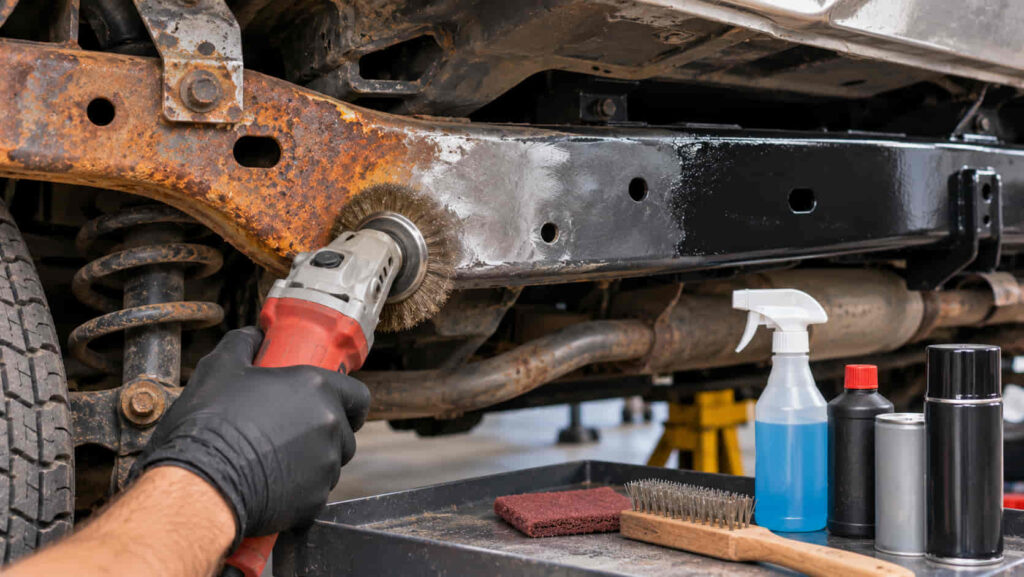
Start by inspecting the frame rails, crossmembers, suspension mounting points, and areas where moisture accumulates. Remove dirt, grease, and road salt to expose the corroded surfaces. Once the frame is clean and dry, use a wire brush or abrasive pad to remove loose rust and deteriorated paint. A drill-mounted wire brush or suitable abrasive tool can clean thicker rust deposits from accessible areas, provided the underlying metal remains structurally sound.
After mechanical cleaning, inspect the metal for remaining corrosion, deep pitting, and perforations. A compatible chemical rust remover can dissolve residual rust in areas that mechanical tools cannot reach. Rust converters provide a different treatment by chemically transforming certain remaining iron oxides into a more stable surface. Neither treatment replaces metal lost through corrosion, and both must be used according to the manufacturer’s surface preparation and coating instructions.
Finish by removing dust and contaminants, allowing the metal to dry completely, and applying a corrosion-resistant primer followed by a compatible chassis coating. Exposed steel begins oxidizing again when moisture and oxygen reach its surface, making prompt protection essential. Frame cavities and enclosed sections may also require an appropriate cavity wax because external paint cannot protect internal surfaces.
How Can You Tell How Bad the Rust Is on a Car Frame?
Car frame rust falls into three practical categories: surface rust, scale rust, and penetrating rust. These categories describe progressively more serious corrosion, although the visible appearance of rust alone cannot establish whether a frame remains structurally safe. The location of corrosion, remaining metal thickness, and condition of load-bearing components determine whether cleaning is sufficient or professional repair is necessary.
Surface rust appears as orange or reddish-brown discoloration on exposed steel without obvious flaking, deep pitting, or metal loss. It develops when moisture and oxygen react with iron, forming iron oxides on the metal surface. This type of corrosion commonly occurs where paint or protective coatings have been scratched or worn away. Surface rust can generally be removed using a wire brush, sandpaper, or suitable rust remover before the cleaned metal is primed and painted.
Scale rust develops when corrosion progresses beneath the original surface and creates rough, flaky layers of iron oxide. As rust occupies a greater volume than the original iron, expanding corrosion products can lift paint, separate protective coatings, and expose additional metal to moisture. Scale rust frequently appears around frame seams, crossmembers, and areas where road salt or debris accumulates. Removing loose rust reveals the condition of the remaining steel, but deep pitting or substantial material loss requires further evaluation before applying protective coatings.
Penetrating rust occurs when corrosion has consumed enough metal to create holes, severe thinning, or weakened structural sections. Warning signs include perforated frame rails, deteriorated suspension mounting points, cracked or separating metal, and extensive corrosion around welded connections. These conditions can reduce the frame’s ability to withstand driving loads and collision forces. A heavily corroded frame should be inspected by a qualified automotive repair professional before further driving or repair work.
The distinction between cosmetic and structural corrosion is essential because rust removal eliminates corrosion products but does not restore lost steel thickness or structural strength. A frame that looks cleaner after grinding or blasting may still be unsafe if corrosion has damaged its load-bearing sections. Structural integrity must be established before selecting a DIY rust removal method.
Read more: how to remove rust on a car
What Tools and Materials Do You Need to Remove Rust From a Car Frame?
The essential tools for removing rust from a car frame include a wire brush, sandpaper, abrasive cleaning tools, a degreaser, and a suitable rust removal product. Corrosion-resistant primer and chassis paint are also necessary to protect the exposed steel after cleaning. The specific equipment depends on the severity of rust, the accessibility of the affected areas, and the condition of the underlying metal.
A hand wire brush removes loose surface rust from accessible frame sections, while a drill-mounted wire wheel provides faster cleaning across larger areas. Sandpaper and abrasive pads help remove remaining oxidation and prepare the metal for protective coatings. For thicker rust deposits, an angle grinder fitted with an appropriate abrasive attachment can remove corrosion more aggressively. However, excessive grinding removes sound metal along with rust, making power tools unsuitable for frame sections with significant thinning or structural damage.
Chemical rust removers are useful for treating residual corrosion in irregular surfaces, seams, and areas that mechanical tools cannot clean effectively. Phosphoric-acid-based products react with iron oxides, while chelating rust removers dissolve corrosion through a different chemical process. Rust converters are not equivalent to rust removers because they are designed to react with remaining rust rather than eliminate it completely. Product selection must account for the manufacturer’s application instructions, surface compatibility, and required preparation before priming.
Protective materials include a suitable metal primer, corrosion-resistant chassis paint, and cavity wax for enclosed frame sections. Epoxy primers provide a protective barrier when applied to properly prepared substrates, while compatible topcoats help resist moisture, road debris, and environmental exposure. Safety equipment is equally important because mechanical rust removal generates airborne particles, and chemical treatments introduce additional exposure risks. Appropriate eye protection, gloves, respiratory protection selected for the hazards, and adequate ventilation are necessary. Vehicle-rated jack stands or a properly rated lift are also essential when accessing the underside of a car.
How Do You Prepare a Car Frame for Rust Removal?
Preparing a car frame for rust removal involves securing the vehicle, exposing the affected frame sections, removing surface contaminants, and protecting nearby components from damage. Proper preparation improves access to corroded areas and allows rust removal products and protective coatings to contact the metal effectively.
Park the vehicle on a firm, level surface and secure it against movement before working underneath. If additional clearance is required, lift the vehicle using the manufacturer’s approved lifting points and support it with properly rated jack stands positioned at approved support locations. Never rely on a hydraulic jack alone to hold a vehicle during frame cleaning. Corrosion can weaken factory lifting points, so any questionable support area must be assessed before the vehicle is raised. A professional lift or repair facility is the safer option when suitable support points cannot be confirmed.
Once the vehicle is securely supported, inspect the frame rails, crossmembers, welded joints, and suspension mounting areas for accumulated dirt and corrosion. Remove loose mud and road debris with a brush, then clean the exposed surfaces using an automotive degreaser compatible with the surrounding materials. Road salt and other contaminants must be removed because residual deposits retain moisture and accelerate corrosion. Rinse cleaning products when required by their instructions and allow the frame to dry completely before mechanical or chemical rust treatment.
Protect nearby brake lines, fuel lines, electrical wiring, rubber bushings, and other vulnerable components before using abrasive equipment or chemical products. Wire wheels and grinders can damage hoses, wiring insulation, and protective coatings, while sparks can ignite flammable materials. Components that cannot be adequately protected may need to be moved or removed by a qualified technician before work begins. Inspect enclosed sections and drainage openings as well, since trapped moisture and debris can continue promoting corrosion after the visible frame surfaces have been cleaned.
Finally, examine the exposed metal for deep pitting, perforations, cracks, and weakened mounting points. Cleaning away dirt and loose rust often reveals deterioration that was previously concealed by debris or damaged coatings. Do not begin aggressive grinding or abrasive blasting on a frame section suspected of structural corrosion. The remaining metal must be evaluated before selecting a removal method because cleaning cannot restore the original strength of a corroded frame.
How Do You Remove Surface Rust From a Car Frame?
To remove surface rust from a car frame, use a wire brush or abrasive pad to clean the corroded steel, sand away remaining oxidation, and apply a suitable rust remover where necessary. This method works best when corrosion is limited to the metal surface and has not caused significant pitting, thinning, or structural damage. Removing surface rust before it progresses helps preserve the frame’s protective coatings and reduces further exposure to moisture.
Start by scrubbing the affected area with a stiff hand wire brush to remove loose rust, flaking paint, and surface deposits. Apply firm, controlled pressure along the exposed metal, paying particular attention to corners, welded seams, and areas where protective coatings have deteriorated. A drill-mounted wire brush can speed up cleaning on larger, accessible sections, but excessive pressure may damage surrounding coatings without removing corrosion embedded in deeper pits. Continue brushing until loose rust has been removed and the remaining metal condition can be inspected.
Sand the cleaned area with an abrasive suitable for the amount of corrosion and the required coating preparation. Coarser abrasives remove stubborn oxidation and damaged paint, while finer abrasives help prepare the surface for primer. The objective is to eliminate loose corrosion and create a clean, stable substrate without unnecessarily reducing the thickness of the frame. Deep pits, holes, or visibly weakened sections indicate that the damage extends beyond ordinary surface rust and requires further assessment rather than continued abrasion.
Chemical rust removers can treat residual oxidation that remains in shallow pits or irregular surfaces after mechanical cleaning. Apply a product compatible with automotive steel according to its specified concentration, contact time, and application method. Phosphoric-acid-based removers react with iron oxides, while chelating products bind iron from corrosion deposits. Some formulations require rinsing or neutralization, whereas others require a different cleanup procedure. Follow the manufacturer’s instructions because chemical residue or trapped moisture can interfere with primer adhesion and subsequent corrosion protection.
After treatment, inspect the cleaned surface under adequate lighting to identify remaining rust, coating residue, or corrosion concealed around seams. Remove loose particles and chemical residues as directed, then dry the metal thoroughly. Bare steel should receive a compatible corrosion-resistant primer promptly because exposure to oxygen and moisture can initiate new oxidation. Apply the recommended chassis coating after the primer has reached the manufacturer’s specified recoat stage.
Successful surface rust removal leaves a clean, stable metal surface ready for protective coating without compromising the frame’s original structural thickness. The finished repair should have continuous coating coverage, particularly around edges and previously corroded areas. However, removing visible rust does not guarantee that hidden corrosion is absent, especially inside boxed frame rails or overlapping metal sections. These areas require separate inspection and appropriate internal corrosion protection.
How Do You Remove Heavy Rust From a Car Frame?
Removing heavy rust from a car frame requires mechanical cleaning, abrasive blasting, or chemical treatment, depending on the depth of corrosion and the condition of the remaining steel. Thick rust deposits and flaking metal are more difficult to remove than surface oxidation because corrosion can extend into pits, seams, and overlapping frame sections. Before removing heavy rust, the frame must be inspected for structural deterioration, particularly around suspension mounts, crossmembers, and load-bearing frame rails.
An angle grinder fitted with a suitable wire wheel or abrasive attachment can remove thick rust deposits from accessible frame surfaces. Wire wheels dislodge loose corrosion and deteriorated coatings, while abrasive discs remove more persistent deposits. However, aggressive grinding also removes underlying steel and can further weaken sections that have already lost material through corrosion. Use controlled pressure on structurally sound areas and stop if cleaning reveals deep pitting, cracks, perforations, or substantial metal thinning. Heavy corrosion near structural connections should be evaluated professionally rather than treated through continued grinding.
Abrasive blasting provides another method for cleaning heavily rusted frame surfaces. The process propels abrasive particles against the metal to remove corrosion, old paint, and accumulated surface deposits. It can reach irregular surfaces more effectively than conventional hand tools, making it useful for frame restoration when the underlying steel is sound. However, blasting does not restore metal thickness and can damage thin or deteriorated sections. Professional operators must select suitable blasting media and pressure while protecting nearby mechanical components. Freshly blasted steel also requires prompt surface preparation and priming to prevent renewed oxidation.
Chemical rust removers can supplement mechanical cleaning when corrosion remains inside accessible pits or complex metal surfaces. Phosphoric-acid-based products react with iron oxides, while chelating formulations dissolve corrosion deposits through chemical binding. These treatments are most effective when loose scale has already been removed and the product can contact the remaining rust directly. Chemical treatment cannot reliably eliminate corrosion hidden between overlapping structural components, and rust converters cannot strengthen weakened steel. Residual chemicals must be handled according to the product instructions before applying primer or paint.
Heavy frame rust requires professional repair when corrosion has compromised the thickness, shape, or load-bearing capacity of structural components. Perforated frame rails, severely corroded suspension mounting points, and deteriorated welded connections indicate damage that surface cleaning cannot correct. A qualified repair professional must determine whether the affected section can be repaired under the vehicle manufacturer’s procedures or whether frame replacement is necessary. Covering severe corrosion with rust converter, body filler, or protective paint does not restore structural integrity.
After heavy rust has been removed from a frame confirmed to be structurally sound, the exposed steel must be cleaned, dried, and protected with a compatible corrosion-resistant coating system. Epoxy primer and suitable chassis paint help isolate the metal from moisture and oxygen, while cavity protection addresses accessible internal frame surfaces. The effectiveness of this treatment depends on the remaining metal condition, thorough surface preparation, and complete coating coverage. Heavy rust removal is successful only when the corrosion has been addressed without further weakening the frame and the cleaned surfaces are protected against renewed deterioration.
How Do You Treat a Car Frame After Removing Rust?
To treat a car frame after removing rust, clean and dry the exposed steel, apply a compatible corrosion-resistant primer, and finish with a protective chassis coating. Rust converters can also treat firmly attached residual corrosion when complete removal is impractical. The treatment must create a continuous protective barrier because exposed steel begins oxidizing again when moisture and oxygen reach its surface.
Start by removing abrasive dust, grease, and chemical residues left behind during rust removal. Use a surface cleaner compatible with the selected primer and allow the metal to dry completely. Moisture trapped beneath paint can contribute to coating failure and renewed corrosion. Inspect the prepared surface for loose rust, remaining scale, and damaged metal before applying any treatment. Areas with significant pitting or structural deterioration require further evaluation rather than simply being covered with paint.
Rust converters are designed to react with certain iron oxides and produce a more stable surface that can receive compatible protective coatings. Many formulations contain tannic acid, phosphoric acid, or other reactive ingredients that modify existing corrosion products. However, rust converters are not necessary when the steel has been completely cleaned to bare metal. They also cannot restore metal lost through corrosion. Apply a converter only to surfaces permitted by its manufacturer, and follow the specified curing time and coating requirements.
Epoxy primer is a common choice for protecting properly prepared automotive steel because it forms an adherent barrier against moisture and environmental contaminants. Its performance depends on surface cleanliness, preparation profile, application thickness, and curing conditions. Some epoxy primers require a specific topcoat or surface preparation before additional coatings can be applied. Follow the manufacturer’s technical data sheet to ensure that the primer is compatible with any previous rust treatment and the intended chassis paint.
After priming, apply a corrosion-resistant chassis coating designed for automotive underbody exposure. Suitable coatings help protect the frame against moisture, road salt, and abrasion from road debris. Apply the recommended number of coats and observe the specified drying and recoat intervals. Enclosed frame rails may require a separate cavity wax treatment because exterior coatings cannot reach internal surfaces. Avoid blocking factory drainage openings, which allow accumulated water to escape.
A properly treated car frame should have clean, stable metal beneath a continuous and compatible protective coating system. The coating must cover exposed edges, accessible seams, and previously corroded surfaces without trapping loose rust or moisture. Protective treatments slow future corrosion, but they do not repair weakened structural components or guarantee permanent rust prevention.
How Do You Prevent Rust From Returning to a Car Frame?
Preventing rust from returning to a car frame requires maintaining protective coatings, removing road salt and accumulated debris, controlling moisture exposure, and inspecting vulnerable areas regularly. Corrosion develops when steel is exposed to moisture and oxygen, while dissolved salts increase the electrical conductivity of surface moisture and accelerate the corrosion process. Reducing these exposures helps preserve the metal and extends the service life of protective coatings.
Wash the vehicle’s undercarriage after exposure to road salt, coastal spray, or muddy conditions. Salt deposits can remain trapped around frame seams, crossmembers, and suspension mounting points, where they retain moisture and promote corrosion. Rinse accessible areas thoroughly without directing high-pressure water into vulnerable electrical connections or damaged seals. Allow the undercarriage to drain and dry, and remove debris that obstructs factory drainage openings. Vehicles operated in regions where roads are frequently salted require particular attention during winter and after the salt-exposure season.
Maintain the frame’s protective coatings by checking for scratches, peeling paint, exposed steel, and damaged underbody protection. Road debris can chip chassis paint and expose small sections of metal to moisture. Repair damaged coatings promptly by cleaning the affected area, removing any new corrosion, and applying a compatible primer and protective finish. Applying additional paint over loose rust or contaminated surfaces does not provide reliable long-term protection because corrosion can continue beneath the coating.
Internal frame cavities also require attention because moisture can collect inside boxed rails and overlapping metal sections. Cavity wax formulated for automotive corrosion protection can help protect accessible internal surfaces by leaving a moisture-resistant film. Apply it according to the manufacturer’s instructions and keep drainage openings clear. External undercoating should not be used to conceal existing corrosion or structural defects, since trapped moisture and hidden deterioration can make future inspections more difficult.
Inspect the car frame during routine maintenance and after prolonged exposure to corrosive conditions. Focus on frame rails, welded seams, crossmembers, suspension mounting points, and locations where dirt or water accumulates. The appropriate inspection frequency depends on climate, driving conditions, vehicle age, and the condition of existing coatings. Vehicles exposed to road salt or persistent moisture need closer monitoring than those operated primarily in dry environments.
Long-term rust prevention depends on keeping moisture and contaminants away from exposed steel while maintaining the integrity of protective coatings. Regular cleaning, timely coating repairs, proper drainage, and inspection reduce the conditions that allow corrosion to spread. However, preventive treatments cannot reverse existing metal loss, and any newly discovered structural corrosion must be evaluated before the vehicle continues normal operation.
How Much Does It Cost to Remove Rust From a Car Frame?
Removing rust from a car frame typically costs $50–$200 for basic DIY surface rust treatment, while professional rust removal can cost several hundred to several thousand dollars. These are approximate U.S. planning estimates rather than verified national averages. Actual expenses depend on corrosion severity, the size of the affected area, labor rates, equipment requirements, and whether structural repairs are necessary.
DIY rust removal is generally less expensive because the vehicle owner performs the cleaning and coating work. A basic project may require wire brushes, abrasive materials, automotive degreaser, rust remover, primer, and protective chassis paint. Costs increase when purchasing power tools, safety equipment, or specialized corrosion treatments. For example, cleaning a small area of surface rust with hand tools requires fewer materials than treating multiple frame rails with mechanical abrasives and a complete coating system. The initial estimate may also exclude vehicle lifting equipment and tools the owner does not already possess.
Professional rust removal costs more because the service includes labor, specialized equipment, surface preparation, and protective coating application. A repair shop may use mechanical abrasion or abrasive blasting to clean heavily corroded surfaces before applying primer and chassis protection. Labor expenses increase when technicians must remove surrounding components to access hidden corrosion. The final price also depends on whether the frame can be cleaned while installed or requires extensive disassembly.
Structural corrosion introduces additional expenses because removing rust does not restore damaged steel. Repairs involving frame sections, suspension mounting points, or welded connections require professional evaluation and manufacturer-approved procedures. Extensive corrosion may make frame replacement necessary, particularly when several load-bearing areas have deteriorated. These repairs can cost substantially more than surface rust treatment because they involve structural labor, replacement components, and additional inspection requirements.
The most economical rust removal method is the one that addresses the actual condition of the frame without compromising vehicle safety. DIY cleaning is appropriate for accessible, non-structural surface corrosion, while professional treatment becomes necessary when damage extends into critical structural components. Obtaining an inspection and written repair estimate helps distinguish routine corrosion treatment from repairs that may exceed the vehicle’s practical value.
Can a Severely Rusted Car Frame Be Repaired?
A severely rusted car frame can be repaired when the damaged sections are repairable under the vehicle manufacturer’s procedures and sufficient structurally sound metal remains. However, extensive corrosion affecting frame rails, suspension mounting points, or multiple load-bearing connections may make replacement necessary. Repair feasibility depends on the frame’s construction, the location and extent of metal loss, and the availability of approved repair methods.
Structural frame repair differs from ordinary rust removal because corrosion can reduce the thickness and load-bearing capacity of steel components. Mechanical cleaning removes corrosion products but cannot replace metal consumed by oxidation. A frame with deep perforations, extensive thinning, or deteriorated welded joints may no longer withstand the loads generated during braking, cornering, and road impacts. A qualified technician must evaluate these conditions before determining whether repair is appropriate.
Welding can be used for certain frame repairs when the vehicle manufacturer permits the procedure and the remaining structure meets the required specifications. The technician must identify the frame material, assess the surrounding metal, and follow applicable repair procedures. Welding over rust, attaching reinforcement plates without an approved repair design, or joining new steel to severely weakened sections can create unreliable connections. Some vehicle frames contain high-strength steel or other materials that require specialized joining methods or prohibit particular welding repairs.
Frame replacement may be necessary when corrosion affects multiple structural sections or extends beyond approved repair limits. Replacement is also a consideration when damage involves critical mounting points or when the cost of restoring the frame approaches or exceeds the vehicle’s value. The decision requires an assessment of structural condition, replacement part availability, labor requirements, and applicable vehicle safety standards.
A severely rusted frame should not be considered repaired simply because the visible corrosion has been removed or covered with protective coatings. Structural repair must restore the vehicle to an acceptable condition under applicable manufacturer procedures and safety requirements. When the frame’s integrity is uncertain, professional inspection is necessary before the vehicle returns to normal road use.
Is It Safe to Drive a Car With Rust on the Frame?
Driving a car with surface rust on the frame is generally safe when the corrosion has not weakened the metal or affected structural components. However, severe rust that causes significant metal thinning, perforations, or deterioration around critical mounting points can compromise vehicle safety. The risk depends on the location and extent of corrosion rather than the amount of visible rust alone.
Surface rust primarily affects the outer layer of exposed steel and does not necessarily reduce the frame’s load-bearing capacity. Small areas of oxidation caused by damaged paint or protective coatings can often be cleaned and treated before corrosion progresses. However, visible appearance cannot reliably establish structural integrity, particularly when rust develops inside boxed frame rails or beneath existing coatings. A professional inspection is necessary when the condition of the underlying metal is uncertain.
Structural rust presents a greater safety concern because the frame supports essential vehicle components and distributes forces generated during acceleration, braking, cornering, and collisions. Corrosion around suspension mounting points, steering-related attachments, crossmembers, and load-bearing frame rails can weaken these connections. Severe deterioration may cause structural deformation, mounting point failure, or changes in vehicle handling. Perforations, cracks, separating metal, and extensive corrosion around welded joints are warning signs that require immediate professional assessment.
A vehicle with suspected structural frame damage should not be driven until a qualified automotive repair professional determines that it is safe. Removing loose rust, applying rust converter, or covering damaged areas with undercoating does not restore the strength of deteriorated steel. When corrosion affects critical structural sections, the appropriate solution may involve manufacturer-approved repair procedures or frame replacement.
Regular frame inspections help identify corrosion before it develops into extensive structural damage. Checking vulnerable areas after winter road-salt exposure, repairing damaged protective coatings, and maintaining proper drainage can reduce further deterioration. A rusted frame remains suitable for road use only when its structural condition meets applicable safety requirements, regardless of how clean or well-coated its exterior appears.