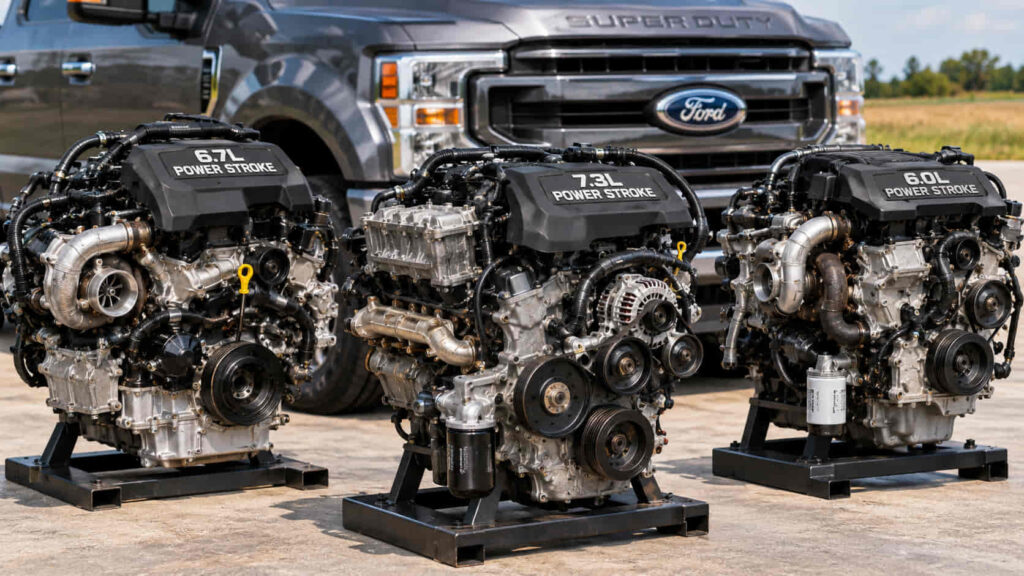
The best Ford diesel engines are the 7.3L Power Stroke for proven durability, the 6.7L Power Stroke for modern towing performance, and the 7.3L IDI for mechanical simplicity. Other worthwhile options include the older 6.9L IDI, the 3.0L Power Stroke F-150 diesel, the 3.2L Power Stroke Transit engine, and a properly repaired 6.0L Power Stroke.
Ford has offered diesel-powered trucks and commercial vehicles for decades. Its engine history includes mechanically injected indirect-injection diesels, electronically controlled Power Stroke V8 engines, modern common-rail diesels, and smaller diesel powertrains developed for light-duty pickups and commercial vans.
However, not every Ford diesel engine has the same reputation for durability.
The 7.3L Power Stroke, introduced for the 1994 model year, remains one of the most respected Ford diesel engines because of its rugged construction and strong long-term service record. Its relatively modest factory output and aging vehicle platforms are important trade-offs.
The 6.7L Power Stroke, introduced in the 2011 Super Duty, offers substantially more performance. For 2026, Ford rates the standard engine at 475 horsepower and 1,050 lb-ft of torque, while the High Output version produces 500 horsepower and 1,200 lb-ft.
Older IDI engines remain attractive for owners who value straightforward mechanical fuel injection and relatively simple repair procedures.
By comparison, the 6.0L Power Stroke requires more careful evaluation because of its known cooling, fuel injection, and cylinder head sealing concerns. The 6.4L Power Stroke also deserves caution because of its history of expensive internal and supporting-system failures.
The following ranking evaluates Ford diesel engines according to durability reputation, repairability, performance, maintenance complexity, parts availability, and suitability for different ownership goals. It is an editorial comparison rather than a manufacturer-certified reliability ranking.
What Are the Best Ford Diesel Engines?
The best Ford diesel engines are those that provide the strongest combination of durability, appropriate performance, manageable repair costs, and long-term service support for the intended vehicle.
For a classic diesel pickup, the 7.3L Power Stroke is a particularly strong choice.
It combines a heavy-duty V8 architecture with an extensive service history and a large community of independent diesel specialists.
For modern work trucks, the 6.7L Power Stroke offers a more advanced and capable powertrain.
It delivers much greater factory torque than older Ford diesels while supporting modern transmission and towing systems.
The 7.3L IDI and 6.9L IDI appeal to owners who prefer mechanical injection and fewer electronic control systems.
However, they produce considerably less power than modern engines.
The 3.0L Power Stroke is more suitable for an F-150 owner interested in diesel efficiency than for someone requiring maximum heavy-duty towing capability.
The 3.2L Power Stroke serves a different market, primarily commercial Transit vans.
Finally, the 6.0L Power Stroke can offer worthwhile performance when its mechanical condition is verified and common weaknesses have been properly addressed.
The most important consideration is matching the engine to the intended use.
A diesel suitable for a restoration project may not be the best choice for commercial towing.
Likewise, the most powerful available diesel is not necessarily the least expensive to maintain.
1. Ford 7.3L Power Stroke — Best for Proven Reliability
The 7.3L Power Stroke is the best overall choice for buyers prioritizing long-term durability, repairability, and a well-established service history.
Ford introduced the electronically controlled 7.3L Power Stroke during the 1994 model year.
The engine was developed through Ford’s relationship with International, later known as Navistar.
It uses a turbocharged, direct-injection V8 configuration with a cast-iron block and cylinder heads.
Its displacement is approximately 444 cubic inches, or 7.3 liters.
Unlike the earlier 7.3L IDI, the Power Stroke uses electronically controlled hydraulic unit injectors.
The system is commonly known as HEUI.
Engine oil is pressurized to operate the injectors, while an electronic control module manages injection events.
This design provides better fuel control and stronger performance than the older mechanically injected IDI engine.
Ford continued developing the 7.3L Power Stroke throughout its production life.
Later Super Duty configurations offered substantially more horsepower and torque than early versions.
Certain later pickup applications produced approximately 250–275 horsepower, depending on transmission and calibration.
The engine earned its reputation through sustained use in work trucks, commercial vehicles, and towing applications.
However, durability does not mean every component lasts indefinitely.
The high-pressure oil pump, injectors, sensors, and supporting fuel system can require service.
At this point, vehicle age is another important consideration.
Most 7.3L Power Stroke trucks are more than two decades old.
Corrosion, transmission condition, suspension wear, and previous modifications may influence ownership costs as much as the engine itself.
A well-maintained 7.3L Power Stroke remains an attractive used diesel, but its condition should be confirmed rather than assumed from its reputation.
Why Is the 7.3 Power Stroke So Reliable?
The 7.3L Power Stroke is widely regarded as reliable because of its heavy-duty mechanical construction, conservative original performance levels, and long-established service and repair support.
The engine was developed primarily for truck applications requiring substantial torque under load.
Its cast-iron components and robust internal construction provide a foundation for demanding work.
Compared with later diesel engines, the 7.3L also has fewer modern exhaust aftertreatment components.
It does not use the diesel particulate filter and selective catalytic reduction systems found on newer Super Duty diesels.
This reduces certain categories of emissions-system maintenance.
However, the 7.3L is not a purely mechanical engine.
Its HEUI injection system depends on electronic controls and high-pressure engine oil.
The engine also uses sensors that can fail with age.
The camshaft position sensor is a well-known example.
A defective sensor can cause stalling or starting problems.
The under-valve-cover injector harness and high-pressure oil system also deserve inspection.
Nevertheless, these problems may be easier to repair than severe internal engine failures.
Another advantage is parts availability.
Ford and aftermarket suppliers continue supporting the 7.3L Power Stroke.
The engine’s popularity means many diesel technicians are familiar with its diagnostic procedures.
However, improper tuning and neglected maintenance can still damage the engine.
Its reliability reputation should encourage careful inspection, not replace it.
Common Ford 7.3 Power Stroke Problems
The most important 7.3 Power Stroke problems to investigate include high-pressure oil leaks, injector wear, camshaft position sensor faults, fuel supply problems, and age-related oil or coolant leakage.
The HEUI system is one of the engine’s defining components.
It requires adequate engine oil pressure to operate the injectors.
If the high-pressure oil system develops excessive leakage, the engine may experience hard starting, rough running, or reduced power.
Injector problems can produce similar symptoms.
However, injectors should not be replaced without verifying fuel delivery, oil pressure, and electronic control.
Electrical faults are another consideration.
A defective camshaft position sensor can interrupt normal engine operation.
Damaged wiring or loose connections may also cause intermittent problems.
On older trucks, fuel system deterioration and oil leaks become increasingly important.
The turbocharger and intake system should also be checked for wear or damage.
However, none of these faults automatically means the engine requires rebuilding.
A 7.3L with normal compression, adequate oil pressure, and serviceable major components may remain a worthwhile repair candidate.
For used buyers, maintenance records are particularly valuable.
A truck with fewer miles but neglected service can be a worse purchase than a higher-mileage example with documented repairs.
2. Ford 6.7L Power Stroke — Best Modern Ford Diesel Engine
The 6.7L Power Stroke is the best Ford diesel engine for buyers who need modern towing capability, high factory torque, advanced powertrain controls, and continued manufacturer support.
Ford introduced the 6.7L Power Stroke for the 2011 Super Duty.
Unlike earlier Power Stroke engines sourced through the International/Navistar relationship, the 6.7L was developed and manufactured by Ford.
The engine is often identified by its Scorpion development name.
It uses a turbocharged V8 configuration with a compacted graphite iron engine block and aluminum cylinder heads.
Its modern common-rail injection system differs substantially from the HEUI equipment used on the 7.3L and 6.0L Power Stroke engines.
Ford has revised the 6.7L throughout its production history.
These updates include changes to turbocharger hardware, fuel injection equipment, engine calibration, cooling systems, and emissions controls.
The result is a diesel engine offering considerably greater performance than Ford’s older truck diesels.
For the 2026 Super Duty, the standard 6.7L Power Stroke produces 475 horsepower and 1,050 lb-ft of torque.
The High Output configuration produces 500 horsepower and 1,200 lb-ft.
These outputs make the engine suitable for demanding towing and hauling applications when installed in an appropriately configured truck.
However, high performance does not eliminate maintenance requirements.
Modern fuel injection and emissions components can be expensive to diagnose and replace.
The best ownership results depend on correct fuel, regular maintenance, and careful evaluation of the specific model year.
Ford 6.7 Power Stroke Standard vs High Output
The standard 6.7L Power Stroke and the High Output 6.7L Power Stroke share a basic engine family but offer different factory power ratings and application-specific operating characteristics.
For 2026, Ford rates the standard engine at 475 horsepower at 2,600 RPM.
Its peak torque is 1,050 lb-ft at 1,600 RPM.
The High Output version produces 500 horsepower at 2,600 RPM.
Peak torque increases to 1,200 lb-ft at 1,600 RPM.
The additional torque is particularly useful in heavy-duty towing applications.
However, maximum towing capacity depends on the complete vehicle.
Transmission configuration, axle ratio, suspension, gross combined weight rating, trailer equipment, and other factors influence the actual rating.
Ford’s 2026 towing information identifies configurations capable of towing up to 40,000 pounds with the High Output diesel when properly equipped.
That figure is not available on every F-250 or F-350.
The correct rating must be determined for the specific truck.
The High Output version is therefore the stronger choice for buyers requiring the maximum available factory performance.
However, the standard 6.7L already provides substantial torque.
For many owners, the standard configuration may offer more than enough performance.
The most suitable engine depends on the truck’s work requirements rather than horsepower alone.
Which Ford 6.7 Power Stroke Years Are Best?
Later 6.7L Power Stroke generations generally benefit from important design revisions, but no single model year can be declared the most reliable without considering the vehicle’s condition and known service history.
The 2011–2014 engines represent the first generation.
These models introduced the basic 6.7L architecture.
However, early applications have documented concerns involving their original turbocharger design and certain supporting components.
For the 2015 model year, Ford introduced major updates.
The revised turbocharger design is an important improvement.
Ford also updated engine components and supporting systems.
The 2015–2019 generation is therefore attractive to buyers who want a used Super Duty without purchasing one of the earliest 6.7L configurations.
The 2020 model year introduced another substantial update.
The engine received additional development and was paired with Ford’s 10-speed TorqShift automatic transmission in applicable pickups.
However, newer does not automatically mean problem-free.
Certain 2020–2022 6.7L vehicles became subject to Ford safety recall 24S78 because of a specific high-pressure fuel pump concern.
Buyers should check the vehicle identification number to determine whether the recall applies.
The 2023–2026 engines provide the latest power and technology, but their ultimate long-term durability record is necessarily less mature than that of older engines.
For used buyers, 2015 and newer trucks are worth considering, but maintenance history and actual condition remain essential.
Common Ford 6.7 Power Stroke Problems
Important 6.7L Power Stroke concerns include high-pressure fuel pump failure, early turbocharger problems, cooling system issues, and faults involving the diesel exhaust aftertreatment system.
The common-rail fuel injection system uses extremely precise components.
Fuel contamination or internal pump damage can create expensive repairs.
If a high-pressure pump fails and releases metal particles into the fuel system, additional components may require inspection or replacement.
However, not every pump develops this condition.
Ford’s recall 24S78 concerns certain 2020–2022 Super Duty and related medium-duty vehicles equipped with the 6.7L engine.
Ford identified a problem involving deposits associated with aged biodiesel affecting certain high-pressure fuel pump components.
The issue could cause a loss of propulsion.
This recall should be distinguished from general online claims concerning every Bosch CP4 pump.
Recall eligibility depends on the individual vehicle.
Early 6.7L engines also have a history of turbocharger-related concerns.
Ford revised the design for later production.
Modern exhaust aftertreatment components introduce additional maintenance requirements.
The diesel particulate filter, EGR system, diesel exhaust fluid equipment, and sensors must operate correctly.
A malfunction may trigger a warning or reduced-power mode.
A properly maintained 6.7L can provide strong service, but buyers should budget for the complexity of a modern heavy-duty diesel.
3. Ford 7.3L IDI Diesel — Best for Mechanical Simplicity
The Ford 7.3L IDI is one of the best diesel engines for owners who prioritize mechanical fuel injection, straightforward construction, and classic truck restoration.
Ford introduced the 7.3L indirect-injection diesel for the 1988 model year.
The engine was manufactured by International Harvester’s successor engine operations.
It is related to the earlier 6.9L IDI diesel.
However, it should not be confused with the later 7.3L Power Stroke.
The 7.3L IDI uses mechanically controlled fuel injection.
It does not rely on the electronic HEUI injection system introduced with the Power Stroke.
The engine also uses a naturally aspirated configuration in many applications.
Factory turbocharged versions became available near the end of the IDI production period.
The engine’s architecture is relatively straightforward.
Its fuel injection system includes a mechanically driven injection pump and conventional injectors.
This appeals to owners who prefer an engine that can be serviced without extensive electronic diagnostic equipment.
However, the design has limitations.
Factory horsepower and torque are substantially lower than those of the modern 6.7L Power Stroke.
Cold starting may require attention to glow plugs, fuel condition, and battery performance.
The engine is also much older than modern diesel powertrains.
Therefore, reliability depends heavily on the condition of the cooling system, fuel injection equipment, and previous maintenance.
For restoration projects and mechanically oriented owners, the 7.3L IDI remains an appealing option.
Ford 7.3 IDI vs 7.3 Power Stroke Reliability
The 7.3L IDI and 7.3L Power Stroke are different engines, despite sharing a similar displacement and appearing in Ford trucks during adjacent production periods.
The IDI uses indirect injection.
Diesel fuel is injected into a precombustion chamber rather than directly into the main combustion chamber.
The injection pump is mechanically controlled.
The Power Stroke uses direct injection with electronically controlled hydraulic unit injectors.
This arrangement provides more precise fuel control and greater performance.
The Power Stroke also uses turbocharging as an integral part of its production design.
The IDI is simpler electronically.
That can make it attractive to owners who perform their own mechanical repairs.
However, simple construction does not necessarily mean lower overall ownership costs.
A worn mechanical injection pump may still require specialist service.
Parts for older vehicles may also become difficult to obtain in some locations.
The Power Stroke offers considerably stronger factory performance and a broad aftermarket support network.
For owners who frequently tow heavy trailers, the Power Stroke is generally the more capable engine.
For a classic truck used occasionally or a restoration focused on original mechanical design, the IDI may be a better fit.
The correct comparison should consider intended use, vehicle condition, and the owner’s maintenance capabilities.
4. Ford 6.9L IDI Diesel — Best Classic Budget Diesel
The Ford 6.9L IDI is a worthwhile choice for enthusiasts seeking an early Ford diesel pickup with simple mechanical fuel injection and modest original performance.
Ford introduced the 6.9L IDI for the 1983 model year.
It was developed through the company’s relationship with International.
The engine helped establish Ford’s factory diesel pickup lineup before the Power Stroke name was introduced.
The 6.9L uses a V8 configuration and indirect diesel injection.
Its naturally aspirated design avoids some of the complexity associated with modern turbocharged engines.
Factory output was modest.
Common early specifications identify approximately 170 horsepower and 315 lb-ft of torque.
These figures are substantially lower than those of modern Super Duty diesels.
However, the engine’s value lies in its mechanical character and relative simplicity.
Fuel delivery is controlled by a mechanical injection pump.
The engine does not require a modern diesel particulate filter or selective catalytic reduction system.
However, its age creates important maintenance concerns.
Glow plugs, fuel injection equipment, cooling system components, and seals may require replacement.
A vehicle equipped with the 6.9L should also be evaluated for corrosion, drivetrain wear, and previous repairs.
The 6.9L is not the best Ford diesel for maximum towing or highway performance.
It is best suited to owners who appreciate classic trucks and understand the trade-offs of an older diesel platform.
Ford 6.9 IDI vs 7.3 IDI
The 7.3L IDI generally offers more displacement and improved factory torque potential, while the 6.9L IDI remains attractive for originality and classic diesel restoration.
Both engines belong to Ford’s pre-Power Stroke diesel history.
They share a mechanically controlled injection approach and broadly similar operating principles.
The 6.9L entered production earlier.
The 7.3L followed with increased displacement and related engineering changes.
Neither engine should be confused with the later electronic 7.3L Power Stroke.
For a truck already equipped with a healthy 6.9L, replacing it solely to gain a small performance improvement may not be economical.
However, a buyer comparing similarly priced used vehicles may prefer a sound 7.3L IDI.
The larger engine offers a useful advantage in factory output.
The condition of the fuel injection system is particularly important.
A worn mechanical injection pump or poorly functioning injectors can reduce power and starting performance.
Cooling system maintenance also matters.
Both engines are now old enough that previous repairs and component aging strongly influence reliability.
The correct purchase decision should consider the complete truck.
An excellent 6.9L example can be a better ownership proposition than a neglected 7.3L IDI.
5. Ford 3.0L Power Stroke — Best Light-Duty Diesel F-150
The 3.0L Power Stroke V6 is one of Ford’s most interesting light-duty diesel engines, designed for buyers seeking diesel torque and fuel efficiency in an F-150 rather than a heavy-duty Super Duty truck.
Ford introduced the engine in the F-150 for the 2018 model year.
It uses a 3.0-liter turbocharged V6 configuration.
The engine features a compacted graphite iron block and aluminum cylinder heads.
It also uses a forged steel crankshaft and high-pressure common-rail direct fuel injection.
Ford rated the engine at 250 horsepower and 440 lb-ft of torque.
The engine was developed to provide strong low-speed torque and competitive highway fuel economy.
Its compact size made it suitable for the lighter-duty F-150 platform.
However, this engine has a different operating role from the 6.7L Power Stroke.
The 3.0L is not intended to replace the larger engine’s heavy-duty towing capacity.
It also uses its own maintenance requirements and parts.
Ford discontinued the 3.0L Power Stroke option in the U.S. F-150 after the 2021 model year.
As a result, buyers must search the used market.
The engine’s relatively short U.S. production run is an ownership consideration because specialized parts and service knowledge may vary by location.
It remains an interesting choice for drivers who specifically want a diesel-powered half-ton pickup.
Read more: 6.0 Powerstroke Engine Rebuild
Is the Ford 3.0 Power Stroke Reliable?
The 3.0L Power Stroke can be suitable for light-duty diesel ownership, but its reliability should be evaluated through vehicle-specific maintenance history rather than assuming it shares the durability record of the 7.3L or 6.7L Power Stroke.
The engine uses modern diesel technology.
Its high-pressure fuel system requires clean fuel and correct filtration.
The turbocharger depends on proper lubrication.
Its emissions system includes a diesel particulate filter and selective catalytic reduction equipment.
These components have specific operating requirements.
Frequent short trips may be less favorable for certain diesel aftertreatment processes than sustained driving.
However, this does not mean every short-trip vehicle will experience a failure.
The actual operating conditions and system status matter.
Another consideration is service support.
The 3.0L was offered in the U.S. F-150 for a relatively short period.
Therefore, some repair facilities may have less experience with it than with Ford’s more common truck engines.
The owner should confirm parts availability and the presence of qualified diesel technicians.
A used 3.0L F-150 should be inspected for fuel system faults, turbocharger performance, exhaust aftertreatment warnings, and cooling system condition.
Its main appeal is the combination of diesel torque and a lighter pickup platform.
For heavy commercial towing, the 6.7L Super Duty remains the more appropriate choice.
6. Ford 3.2L Power Stroke — Best for Commercial Vans
The 3.2L Power Stroke inline-five is a strong choice for buyers seeking a diesel-powered Ford Transit commercial van rather than a traditional pickup truck.
Ford offered this engine in the U.S.-market Transit from 2015 through 2019.
It belongs to Ford’s broader Duratorq diesel engine family.
The engine uses five cylinders arranged in a straight line.
Its displacement is approximately 3.2 liters.
Ford’s original Transit specifications identify a cast-iron cylinder block and aluminum cylinder head.
The engine uses dual overhead camshafts and four valves per cylinder.
It also features common-rail diesel injection and turbocharging.
Ford rated the U.S. Transit version at 185 horsepower and 350 lb-ft of torque.
These figures are modest compared with modern Super Duty diesels.
However, the engine was intended for a different application.
Commercial vans benefit from predictable low-speed torque and the ability to support substantial cargo or conversion equipment within the vehicle’s rated limits.
The 3.2L was offered with a six-speed automatic transmission in the relevant U.S. Transit configurations.
For used buyers, the engine provides an alternative to gasoline-powered Transit models.
However, its service requirements are distinct from those of Ford’s V8 Power Stroke engines.
Maintenance history, emissions system condition, and parts availability should be evaluated before purchase.
Common Ford 3.2 Power Stroke Problems
Important service concerns for the Ford 3.2L Power Stroke include fuel injection system condition, turbocharger performance, emissions equipment, cooling system faults, and maintenance-related wear.
Commercial vans may accumulate substantial operating hours.
Some spend long periods idling.
Others operate with heavy payloads or frequent stop-and-go driving.
These conditions affect maintenance requirements.
The diesel particulate filter and related emissions equipment should be evaluated.
Repeated regeneration problems or warning messages may indicate a fault requiring diagnosis.
Fuel filtration is also important.
Contaminated fuel can damage precision common-rail components.
The turbocharger requires a reliable supply of clean engine oil.
Cooling system condition matters under sustained load.
However, none of these concerns proves that the 3.2L has a universal manufacturing defect.
A vehicle’s service history is more useful than its engine designation alone.
Used Transit buyers should also inspect the transmission, suspension, brakes, body condition, and any commercial upfit equipment.
A van converted into a camper may have a very different operating history from a delivery vehicle.
The 3.2L is a practical choice when its condition is documented and specialized parts support is available.
It is not a direct substitute for a Super Duty diesel intended for high-capacity trailer towing.
7. Ford 6.0L Power Stroke — Best for a Carefully Rebuilt Budget Project
The 6.0L Power Stroke can be a worthwhile Ford diesel engine for enthusiasts willing to address its documented weaknesses, but it is not the safest choice for buyers seeking minimal maintenance risk.
Ford introduced the engine during the 2003 model year.
It succeeded the 7.3L Power Stroke in Super Duty pickup applications.
The 6.0L uses a turbocharged V8 configuration with four valves per cylinder.
It also features HEUI injection and a variable geometry turbocharger.
Certain Super Duty applications produced approximately 325 horsepower and 560–570 lb-ft of torque.
These figures represented a substantial improvement over many earlier diesel trucks.
However, the engine developed a difficult reliability reputation.
Head gasket sealing problems became a major concern.
The EGR cooler and engine oil cooler can also create expensive cooling system problems.
High-pressure oil leaks may cause hard starting or no-start conditions.
The fuel injection control module and injectors require additional diagnostic attention.
Ford issued technical service information addressing several of these problems.
For example, TSB 09-8-3 outlines procedures for diagnosing coolant loss, EGR cooler leakage, restricted oil coolers, and head gasket problems.
A properly repaired 6.0L can provide useful performance.
However, the repair history must be documented.
A truck described as bulletproofed should not automatically be considered reliable without evidence of the actual work performed.
For a buyer who wants dependable transportation with little repair risk, a healthy 7.3L or later 6.7L may be a better choice.
Can a Rebuilt 6.0 Power Stroke Be Reliable?
A properly rebuilt 6.0L Power Stroke can deliver reliable service, but the result depends on the quality of internal engine work and the condition of its cooling, fuel injection, and high-pressure oil systems.
A rebuild should begin with accurate diagnosis.
The engine block, crankshaft, bearings, pistons, and cylinder heads must be inspected.
If internal wear is confirmed, the damaged components require appropriate machining or replacement.
However, rebuilding the short block alone may not correct the engine’s known supporting-system weaknesses.
The oil cooler must provide adequate heat transfer and coolant flow.
A leaking EGR cooler must be repaired using appropriate components.
Head gaskets and fasteners must be installed correctly.
Many builders use upgraded head studs during major repairs.
However, studs do not compensate for warped cylinder heads or damaged block surfaces.
The HEUI system also requires inspection.
High-pressure oil pumps, standpipes, dummy plugs, injector seals, and other components can create starting problems when they leak.
A defective FICM can produce symptoms that resemble injector failure.
The correct repair therefore involves more than replacing parts associated with common internet complaints.
A documented rebuild performed by a competent diesel specialist is more valuable than an undocumented claim that the engine has been upgraded.
The 6.0L is best approached as a project requiring careful evaluation and an adequate repair budget.
Why Is the Ford 6.4L Power Stroke Not in the Top Seven?
The 6.4L Power Stroke is not included among the top seven because its documented repair risks make it difficult to recommend over other Ford diesel engines for long-term ownership.
Ford introduced the 6.4L in Super Duty pickups for the 2008 model year.
It replaced the 6.0L and remained in production through 2010.
The engine introduced common-rail fuel injection and a compound turbocharger arrangement.
Factory output reached approximately 350 horsepower and 650 lb-ft of torque.
This was strong performance for its production period.
However, the engine developed a reputation for expensive failures.
Documented concerns include piston damage, fuel contamination, radiator leaks, and problems involving its emissions and turbocharging systems.
Fuel dilution of engine oil is a particularly important issue.
Certain regeneration conditions can allow diesel fuel to enter the crankcase.
Excessive dilution can reduce lubrication quality.
Cracked pistons and other internal failures can require extensive repairs.
The compound turbo system and related components also add repair complexity.
However, not every 6.4L engine will experience these failures.
A properly maintained example can still operate successfully.
The issue is comparative risk.
For most buyers seeking long-term durability and manageable costs, the 7.3L or a carefully selected 6.7L is generally easier to recommend.
A 6.4L should be considered only after thorough inspection and careful evaluation of possible repair expenses.
Which Ford Diesel Engine Lasts the Longest?
The 7.3L Power Stroke is widely considered one of Ford’s strongest diesel engines for long-term durability, but no engine has a guaranteed lifespan.
The 7.3L earned its reputation through extensive use in work trucks and commercial applications.
Its relatively conservative output and robust construction contributed to its popularity.
However, durability depends on maintenance and operating conditions.
The engine’s HEUI system requires clean engine oil.
Fuel filtration also matters.
An engine operated for years with inadequate lubrication can suffer internal damage regardless of its original design.
The 6.7L Power Stroke has also demonstrated strong durability potential.
However, it uses more complex fuel injection and emissions equipment.
These components can require expensive service before the engine’s main internal assembly reaches the end of its useful life.
The older IDI engines are mechanically straightforward.
However, their current age is a significant factor.
A 7.3L IDI or 6.9L IDI may have experienced decades of wear, corrosion, and previous repairs.
Some diesel engines operate for several hundred thousand miles without major internal rebuilding.
However, these examples should not be interpreted as a guaranteed average.
A realistic lifespan assessment requires information about oil consumption, compression, oil pressure, fuel system condition, operating hours, and maintenance records.
Is a Ford 7.3 or 6.7 Power Stroke Better?
The 7.3L Power Stroke is generally the better choice for classic diesel durability and mechanical repairability, while the 6.7L Power Stroke is better for modern towing performance, refinement, and factory technology.
The engines serve different generations of trucks.
The 7.3L was produced in older vehicles.
It provides strong torque for its era and has extensive aftermarket support.
Its engine management and emissions systems are simpler than those of modern diesels.
However, a 7.3L-equipped truck will generally have a much older chassis, transmission, and safety equipment.
The 6.7L provides dramatically greater factory output.
It also operates with modern automatic transmissions and integrated towing systems.
For someone frequently pulling heavy trailers, the newer platform can be much more capable.
However, the engine uses high-pressure common-rail injection and advanced exhaust aftertreatment.
Repair costs can be substantial when these components fail.
The purchase price of a newer Super Duty is also generally higher.
The correct choice depends on the owner’s needs.
For a classic restoration or occasional towing, a well-maintained 7.3L can be attractive.
For regular commercial towing and long-distance hauling, the 6.7L is usually the more practical choice.
Neither engine should be purchased without evaluating the complete truck.
Which Ford Diesel Engine Is Best for Towing?
The modern 6.7L Power Stroke is Ford’s strongest diesel option for heavy-duty towing, particularly in a properly equipped Super Duty truck.
The 2026 standard 6.7L produces 1,050 lb-ft of torque.
The High Output version produces 1,200 lb-ft.
This torque is available at relatively low engine speed.
It helps the truck manage heavy loads and maintain performance under demanding conditions.
However, maximum towing capacity is not determined by engine torque alone.
The transmission, rear axle ratio, frame, brakes, suspension, hitch, and vehicle ratings all matter.
Ford’s 2026 towing information identifies a maximum available towing rating of 40,000 pounds for a properly configured High Output Super Duty.
That maximum requires specific equipment.
The same engine in another configuration may have a substantially lower rating.
Older Ford diesels remain useful for towing.
The 7.3L Power Stroke continues to serve owners of older pickups and commercial vehicles.
However, it cannot match the factory output or integrated towing capabilities of the newest 6.7L trucks.
The 3.0L Power Stroke F-150 and 3.2L Transit engine serve different categories.
They should not be treated as substitutes for a modern heavy-duty diesel.
For maximum factory towing capability, the 6.7L High Output is the strongest Ford diesel choice in this comparison.
Which Ford Diesel Engine Is Best for Fuel Economy?
The 3.0L Power Stroke is a strong candidate for buyers prioritizing diesel efficiency in an F-150, while fuel economy comparisons between heavy-duty diesel engines require careful attention to vehicle weight and use.
Ford developed the 3.0L V6 specifically for light-duty pickup applications.
Its smaller displacement and modern injection system were intended to support competitive fuel economy.
Ford’s original introduction material targeted approximately 30 mpg on the highway for certain configurations.
However, that launch target should not be interpreted as an EPA rating for every F-150 diesel model.
Actual fuel economy depends on drivetrain configuration, tires, load, speed, and driving conditions.
The larger 6.7L Power Stroke is designed for heavier-duty work.
It produces substantially more torque but is installed in much heavier vehicles.
Comparing its fuel consumption directly with an F-150 is therefore not an equal test of engine efficiency.
Older IDI engines may have relatively simple operating systems.
However, their fuel economy is influenced by older vehicle designs and transmission technology.
A buyer should compare complete vehicles under similar conditions.
Diesel fuel cost, maintenance expenses, and purchase price should also be considered.
An engine that consumes slightly less fuel may still cost more to own if specialized repairs are frequent or expensive.
Which Ford Diesel Engines Are Cheapest to Maintain?
Older mechanically injected IDI engines can offer relatively simple maintenance, while the 7.3L Power Stroke provides a useful balance of repair support and long-term durability.
The 6.9L and 7.3L IDI engines do not use the complex electronic fuel injection systems found on modern Power Stroke diesels.
They also lack modern DPF and SCR equipment.
This reduces some repair categories.
However, age-related maintenance can offset those advantages.
Mechanical injection pumps, glow plug systems, seals, hoses, and cooling components may require service.
Replacement parts availability also varies by location.
The 7.3L Power Stroke introduces electronic HEUI injection.
This system requires specialized knowledge, but its design is well understood by many diesel repair shops.
Parts support remains comparatively strong.
The modern 6.7L Power Stroke has higher component complexity.
High-pressure fuel injection, turbocharger controls, exhaust aftertreatment, and electronic modules can create substantial repair bills.
However, newer trucks may require fewer age-related repairs than much older vehicles.
The cost comparison therefore depends on actual condition.
A healthy modern diesel can cost less to maintain over a particular ownership period than a neglected older engine.
The most economical engine is not always the simplest or oldest.
How Reliable Is the Ford 6.7 High Output Engine?
The 6.7L High Output Power Stroke offers exceptional factory performance, but its relatively recent production history means long-term reliability should not be assumed identical to older standard-output generations.
The High Output configuration is designed to produce additional horsepower and torque.
For 2026, Ford rates it at 500 horsepower and 1,200 lb-ft.
The engine is paired with modern Super Duty drivetrain and electronic systems.
However, higher output does not automatically indicate shorter engine life.
The actual durability depends on engineering specifications, operating loads, cooling, lubrication, and maintenance.
Likewise, a lower-output engine does not automatically last longer.
Ford has continued developing the 6.7L engine family over multiple generations.
The High Output configuration benefits from that broader development history.
However, the specific high-output versions have less long-term used-market history than the earliest standard 6.7L engines.
Buyers should therefore avoid treating enthusiast predictions as proven reliability data.
For someone regularly towing near the upper limits of the vehicle’s capability, the additional factory torque may provide practical benefits.
For moderate towing, the standard 6.7L may already provide sufficient performance.
The decision should account for the truck’s equipment, purchase cost, warranty, and intended operating conditions.
What Should You Check Before Buying a Used Ford Diesel?
A used Ford diesel should be evaluated through its engine generation, service history, mechanical condition, diagnostic information, and the overall condition of the truck or van.
The first step is identifying the engine.
A 7.3L IDI is different from a 7.3L Power Stroke.
A 6.0L uses different injection and cooling systems from a 6.7L.
The vehicle identification number and engine information label can help establish the configuration.
Maintenance records should then be reviewed.
Oil and fuel filter service are particularly important.
The engine should be inspected for external leaks.
A cold-start evaluation can reveal problems that become less noticeable when warm.
Excessive smoke, long cranking, or abnormal knocking deserve investigation.
The cooling system must also be checked.
Diesel engines can suffer expensive damage after severe overheating.
For electronically controlled Power Stroke engines, a compatible diagnostic scan is valuable.
Fault codes and operating data can reveal problems involving the fuel injection system, turbocharger, or exhaust aftertreatment.
A 6.0L deserves inspection of the EGR cooler, oil cooler, head sealing, and high-pressure oil system.
A 6.7L should be evaluated for fuel system contamination, emissions faults, and relevant recall status.
The transmission, suspension, brakes, frame, and body condition should also be considered.
A mechanically healthy diesel engine installed in a severely worn truck may still be an expensive purchase.
What Are the Best Ford Diesel Engines for High Mileage?
The 7.3L Power Stroke and well-maintained later-generation 6.7L Power Stroke are particularly attractive for high-mileage ownership, but their condition must be verified individually.
High mileage can indicate extensive use.
However, the type of use matters.
A truck that accumulated miles through steady highway driving may have experienced a different operating pattern from one used for short trips and prolonged idling.
Engine operating hours provide useful additional information.
Excessive idle time can increase wear and affect modern diesel aftertreatment systems without adding significant odometer mileage.
The 7.3L Power Stroke has a substantial history of high-mileage service.
However, its injection components, turbocharger, seals, and supporting systems may require maintenance as the engine ages.
The 6.7L can also provide long service life.
However, modern fuel and emissions components introduce additional costs.
Oil analysis may help identify contamination or abnormal wear when used appropriately.
A compression or cylinder leakage evaluation can also help assess internal condition.
The most useful indicator is not simply whether the truck has crossed 200,000 miles.
It is whether the engine maintains normal oil pressure, acceptable compression, proper fuel delivery, and stable operating temperatures.
Documented maintenance remains essential.
How Can You Make a Ford Diesel Engine Last Longer?
The most effective way to improve Ford diesel engine longevity is to follow the correct maintenance schedule, use approved fluids, protect the fuel system from contamination, and address abnormal operating symptoms early.
Engine oil is particularly important.
Older HEUI-equipped Power Stroke engines depend on clean oil to operate their injectors.
Modern diesels also require suitable lubrication for the turbocharger and other precision components.
The correct oil specification should be selected according to the engine’s service manual.
Fuel quality is another priority.
Water or debris in diesel fuel can damage injection components.
Fuel filters and water separators should be serviced according to the manufacturer’s requirements.
Cooling system maintenance also matters.
A leaking EGR cooler or restricted oil cooler can create serious problems in certain engines.
A modern 6.7L also depends on correctly functioning exhaust aftertreatment equipment.
DPF and SCR warnings should not be ignored.
Owners should avoid unauthorized emissions-system modifications.
These can create legal and technical problems.
Towing should remain within the truck’s published ratings.
An engine’s strong torque output does not override the limitations of its transmission, chassis, brakes, or towing equipment.
Finally, unusual noises, low oil pressure, overheating, and sudden power loss should be investigated promptly.
A minor developing fault can become much more expensive if operation continues.
Are Ford Diesel Engines Better Than Cummins or Duramax?
Ford Power Stroke, Cummins, and Duramax diesel engines all have strong applications, but their advantages depend on engine generation, vehicle platform, maintenance history, and intended use.
Ford’s 7.3L Power Stroke is widely respected for durability.
The modern 6.7L offers substantial factory power and advanced towing equipment.
Cummins is particularly associated with its inline-six diesel architecture.
The engine family has a long history in Ram heavy-duty pickups.
Duramax diesel engines use V8 layouts and have evolved through several generations in Chevrolet and GMC heavy-duty trucks.
However, comparing only engine architecture can be misleading.
A complete truck includes the transmission, transfer case, axles, suspension, cooling system, brakes, and electronic equipment.
These components significantly affect ownership.
Repair costs also vary.
A particular Cummins engine may have different fuel injection problems from a Ford Power Stroke.
A Duramax generation may have different emissions or cooling concerns.
The manufacturer’s reputation should not replace a vehicle-specific inspection.
For heavy towing, modern Ford, Ram, and GM diesel trucks all offer substantial capability.
The best choice depends on the exact model and the user’s requirements.
A well-maintained truck with appropriate service support can provide better value than a poorly maintained vehicle carrying a more desirable engine badge.
What Is the Best Ford Diesel Engine to Buy in 2026?
For a new truck in 2026, the 6.7L Power Stroke is the clear Ford diesel choice. For a used truck focused on established long-term durability, the 7.3L Power Stroke remains one of the strongest options.
Ford’s current Super Duty lineup offers the standard 6.7L and High Output 6.7L diesel configurations.
The engines provide substantial towing capability and modern electronic control.
The standard version produces 475 horsepower and 1,050 lb-ft.
The High Output produces 500 horsepower and 1,200 lb-ft.
The appropriate version depends on the truck configuration and workload.
Used buyers have more choices.
A 1999–2003 7.3L Power Stroke can be attractive because of its established reputation and parts availability.
However, a truck from this period must be inspected carefully for age-related problems.
A 2015–2019 6.7L offers important refinements over the earliest 6.7L generation.
The 2020 and newer engines provide additional technology and performance.
However, certain 2020–2022 vehicles require VIN-based recall verification for the high-pressure fuel pump concern.
A 6.0L may appeal to buyers prepared for substantial maintenance and documented repairs.
For commercial vans, the 3.2L Transit diesel serves a different market.
There is no single best engine for every owner.
The best purchase is the one that matches the intended use and has a verifiable mechanical condition.
Final Verdict: Which Ford Diesel Engine Is Best?
The 7.3L Power Stroke is the best Ford diesel engine for buyers prioritizing established reliability and repairability, while the 6.7L Power Stroke is the best modern option for maximum towing performance and factory technology.
The 7.3L Power Stroke earned its reputation through extensive service in commercial and personal-use trucks.
Its rugged construction and broad parts support remain valuable.
However, its age means the condition of the complete truck must be evaluated carefully.
The 6.7L Power Stroke provides much stronger performance.
Ford’s 2026 High Output configuration delivers 500 horsepower and 1,200 lb-ft of torque.
This makes it a leading choice for demanding towing applications when installed in a properly equipped Super Duty.
Older mechanically injected diesels still have their place.
The 7.3L IDI offers straightforward mechanical construction and useful classic diesel capability.
The 6.9L IDI is appealing for original restorations and owners seeking an early Ford diesel.
The 3.0L Power Stroke F-150 diesel serves buyers interested in a smaller light-duty powertrain.
The 3.2L Power Stroke remains relevant for diesel-powered Transit commercial vans.
A properly rebuilt 6.0L Power Stroke can also be a worthwhile option, although its known reliability concerns require careful attention.
The 6.4L Power Stroke is less attractive for most long-term buyers because of its repair history involving fuel dilution, piston damage, cooling problems, and other costly faults.
For a used Ford diesel truck, a well-maintained 7.3L Power Stroke offers one of the strongest combinations of proven durability and service support. For a modern work truck, the 6.7L Power Stroke provides the best overall performance and capability.
Ultimately, diesel engine reliability depends on more than displacement or reputation.
Maintenance records, fuel quality, operating conditions, previous modifications, and accurate inspection are essential.
Choosing the correct engine generation and buying a mechanically sound vehicle provides the best foundation for long-term Ford diesel ownership.