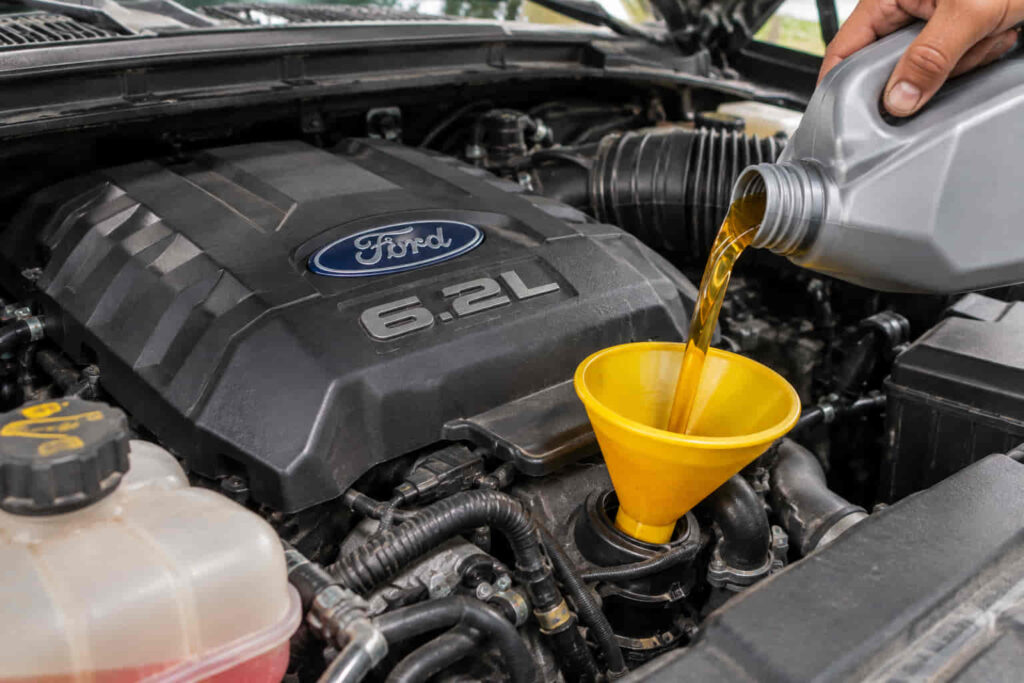
The Ford 6.2 oil capacity is 7.0 US quarts (6.6 liters) when changing the engine oil and oil filter. This specification applies to the 6.2-liter gasoline V8 used in vehicles such as the Ford F-150 SVT Raptor, F-250 Super Duty, and F-350 Super Duty. Ford’s official owner’s manuals consistently identify the seven-quart refill capacity for these applications.
However, the recommended oil viscosity depends on the vehicle’s model year. Ford specified SAE 5W-20 for the 2011–2015 F-250 and F-350 Super Duty models equipped with the 6.2L V8, while the 2016 Super Duty owner’s manual specifies SAE 5W-30. The 2022 Super Duty manual also specifies 5W-30 meeting Ford specification WSS-M2C961-A1.
For the 2014 F-150 SVT Raptor with the 6.2L V8, Ford specifies 7.0 quarts of SAE 5W-20 oil meeting WSS-M2C945-A.
These differences are important because engine oil capacity and engine oil viscosity describe separate requirements. Two Ford trucks may require the same amount of oil while specifying different viscosity grades.
Correct lubrication is essential for protecting the crankshaft bearings, camshaft components, timing chains, and other internal parts of the Ford 6.2L Boss V8. Using the correct oil and filter also helps maintain oil pressure, reduce unnecessary wear, and support reliable operation during towing or heavy-duty driving.
This guide explains Ford 6.2 oil capacity by vehicle, the correct oil grades, compatible filters, oil change procedures, maintenance intervals, and common mistakes to avoid.
How Much Oil Does a Ford 6.2 Engine Take?
The Ford 6.2L V8 takes 7.0 US quarts, equivalent to approximately 6.6 liters, during a normal engine oil and filter change.
This is the manufacturer’s published refill specification for several Ford vehicles equipped with the naturally aspirated 6.2-liter gasoline engine.
The capacity includes the oil required for the replacement oil filter.
When the old oil is drained and the filter is replaced, the lubrication system must be refilled to the correct operating level.
However, the published refill quantity is a service specification rather than a reason to ignore the dipstick.
The amount of oil that actually drains can vary slightly according to oil temperature, how long the engine is allowed to drain, and the vehicle’s position.
Some oil can remain in internal passages or on engine components.
Therefore, the final level should always be verified after the new oil has circulated and the engine has been shut off for the specified waiting period.
For a standard oil change, purchasing seven one-quart bottles provides the manufacturer’s stated refill quantity.
An owner may prefer to purchase an additional quart for future top-ups rather than assuming the engine requires more than seven quarts during the initial service.
The 7.0-quart figure should not be confused with the capacity of the 6.7L Power Stroke diesel or the 7.3L gasoline V8.
Those engines have different lubrication systems and must be serviced according to their own specifications.
Ford 6.2 Oil Capacity in Quarts and Liters
The standard Ford 6.2 oil capacity is 7.0 US quarts, approximately 6.6 liters, or 1.75 US gallons when replacing the filter.
The owner’s manual may display the capacity in quarts or liters depending on the market.
In the United States, fluid capacity is commonly expressed in US quarts.
Canadian and international documentation may emphasize liters.
The two measurements describe the same approximate refill amount.
Seven US quarts corresponds to approximately 6.62 liters.
Ford rounds this to 6.6 liters in its published documentation.
The conversion is useful when buying oil sold in metric containers.
For example, an owner purchasing one-liter bottles would need enough oil to cover the approximately 6.6-liter refill requirement.
However, the final amount added should be determined by the dipstick.
The correct measurement also depends on the engine being completely stock.
A modified Ford 6.2 equipped with a different oil pan, custom lubrication system, or other specialized components may require a different quantity.
The manufacturer’s original capacity should not automatically be applied to a modified engine.
For standard production vehicles, the seven-quart specification provides a dependable starting point.
The exact final level must remain within the approved dipstick range.
Ford F-150 6.2 Oil Capacity
The Ford F-150 equipped with the 6.2L V8 requires 7.0 quarts (6.6 liters) of engine oil with a filter change, according to Ford’s factory documentation.
The 6.2L V8 was offered in selected first-generation F-150 SVT Raptor and other F-150 configurations.
The engine was developed to provide strong naturally aspirated V8 power and torque.
Its relatively large displacement makes it suitable for demanding driving conditions.
However, the oil capacity does not increase simply because the engine produces more power than a smaller F-150 engine.
Ford’s 2013 F-150 owner’s manual identifies the 6.2L oil refill capacity as 7.0 quarts.
The same manual recommends SAE 5W-20 oil meeting Ford specification WSS-M2C945-A.
The oil filter is included in the published capacity.
The specification is different from those of certain other engines available in the same F-150 generation.
For example, the 3.5L EcoBoost and 5.0L V8 have their own oil requirements.
Owners should therefore identify the actual engine before purchasing oil.
An F-150 badge alone does not establish the correct capacity.
The vehicle’s owner’s manual and engine information should determine the service requirements.
For a factory 6.2L F-150, seven quarts is the appropriate published refill amount when the oil filter is replaced.
Ford F-150 SVT Raptor 6.2 Oil Capacity
The 2013 and 2014 Ford F-150 SVT Raptor equipped with the 6.2L V8 uses 7.0 quarts (6.6 liters) of oil, including the oil filter.
Ford provides the specification in the Raptor-specific owner’s manual supplement.
For the 2014 SVT Raptor, the supplement identifies Motorcraft SAE 5W-20 engine oil meeting WSS-M2C945-A.
The same document lists the Motorcraft FL-820S oil filter.
The 6.2L Raptor engine was designed for high-performance off-road use.
However, off-road operation can expose the lubrication system to conditions different from ordinary highway driving.
Steep terrain, sustained engine loads, dust, and elevated temperatures may influence maintenance needs.
The correct oil level is particularly important.
Operating on uneven terrain can change how oil moves within the sump.
Insufficient oil may increase the risk of inadequate lubrication under demanding conditions.
Overfilling is also undesirable because excessive oil may interfere with normal crankcase operation.
Owners should follow Ford’s dipstick checking procedure and the Raptor-specific maintenance instructions.
The published capacity is not a reason to add extra oil before off-road driving.
If the engine has been modified with a different oil pan or specialized oiling components, the applicable aftermarket instructions should be consulted.
Ford F-250 6.2 Oil Capacity
The Ford F-250 Super Duty equipped with the 6.2-liter gasoline V8 requires 7.0 US quarts (6.6 liters) of oil during an oil and filter change.
Ford’s published specifications confirm this capacity across multiple model years.
For the 2011 F-250, the owner’s guide identifies a seven-quart refill and SAE 5W-20 engine oil meeting WSS-M2C930-A.
The 2015 Super Duty owner’s manual also specifies seven quarts with SAE 5W-20 meeting WSS-M2C945-A.
However, the 2016 F-250 uses a different recommended viscosity.
Ford specifies SAE 5W-30 meeting WSS-M2C946-A.
The 2022 Super Duty manual continues to specify a seven-quart refill, using SAE 5W-30 meeting WSS-M2C961-A1.
This demonstrates that the oil quantity remained consistent in these documented applications even though the oil specifications evolved.
For owners, the most important consideration is the exact model year.
A 2013 F-250 and a 2022 F-250 may both require seven quarts, but their original published oil viscosity requirements differ.
The owner’s manual corresponding to the vehicle should take precedence over a generic Ford 6.2 oil recommendation.
Ford F-350 6.2 Oil Capacity
The Ford F-350 Super Duty with the 6.2L gasoline V8 also uses 7.0 quarts (6.6 liters) of engine oil when the oil filter is replaced.
The F-350 shares the same basic 6.2-liter engine family with the F-250.
The lubrication requirements are therefore similar in the documented factory configurations.
However, the oil specification still depends on the production year.
Earlier F-350 models commonly specify SAE 5W-20.
Later models, including the 2016 and 2022 applications, specify SAE 5W-30.
The engine may operate under demanding conditions.
F-350 trucks are often used for hauling and towing.
Heavy loads increase the work performed by the engine.
This also increases the importance of maintaining the correct oil level and following the appropriate maintenance schedule.
However, towing does not automatically change the oil refill capacity.
The published seven-quart quantity remains applicable to the standard engine unless the service documentation specifies otherwise.
Owners who frequently tow should monitor oil level and oil-life information carefully.
Any unusual oil consumption or leakage should be investigated.
The engine should not be overfilled in an attempt to provide additional protection during heavy-duty operation.
Correct oil quality, proper capacity, and appropriate service timing are more important than adding unnecessary lubricant.
Read more: Who Makes CFMOTO Engines
Ford 6.2 Oil Capacity by Model Year
Ford’s documented 6.2L gasoline V8 oil capacity remains 7.0 quarts with a filter change across the F-150 Raptor and several generations of F-250 and F-350 Super Duty applications.
The important model-year difference is often the required oil viscosity.
For the 2011 F-250 and F-350, Ford specifies seven quarts of SAE 5W-20.
The 2012 Super Duty owner’s guide continues to identify the same capacity and viscosity.
The 2013 F-150 with the 6.2L engine also uses seven quarts of 5W-20.
The 2014 F-150 SVT Raptor supplement confirms seven quarts of 5W-20.
The 2015 Super Duty owner’s manual likewise identifies SAE 5W-20.
For the 2016 Super Duty, Ford specifies seven quarts but changes the recommended viscosity to SAE 5W-30.
The 2022 Super Duty documentation identifies the same seven-quart capacity and recommends 5W-30.
These examples show why the exact year matters.
A vehicle may use the same engine displacement while requiring a different oil performance specification.
Ford’s later manuals also reflect updated oil industry standards.
However, the recommended oil should always be determined from the appropriate manual rather than selecting a lubricant based only on the engine’s age.
What Type of Oil Does the Ford 6.2 Take?
The Ford 6.2L V8 uses SAE 5W-20 or SAE 5W-30 engine oil depending on the vehicle’s production year and Ford’s published service requirements.
The correct viscosity is not identical across every model year.
For the 2011 Super Duty, Ford recommends SAE 5W-20 meeting WSS-M2C930-A.
For the 2014 F-150 SVT Raptor, the specification is SAE 5W-20 meeting WSS-M2C945-A.
The 2015 Super Duty also uses 5W-20 under its original published instructions.
For the 2016 Super Duty, the specified viscosity is SAE 5W-30 meeting WSS-M2C946-A.
For the 2022 Super Duty, Ford specifies SAE 5W-30 meeting WSS-M2C961-A1.
These Ford specifications identify more than oil thickness.
They also define performance requirements that the lubricant must satisfy.
A suitable engine oil should meet the correct Ford specification and the applicable gasoline-engine performance standards.
Motorcraft oil is Ford’s recommended brand, but another oil can be appropriate when it meets the required viscosity and technical approval.
Choosing oil based only on a label such as fully synthetic or high mileage is insufficient.
The exact specification matters.
If there is any uncertainty, the vehicle’s original owner’s manual should be consulted.
Does the Ford 6.2 Need 5W-20 or 5W-30?
The choice between 5W-20 and 5W-30 depends on the specific Ford 6.2 application, not simply on the engine’s displacement.
SAE 5W-20 and SAE 5W-30 are both multigrade engine oils.
The 5W designation relates to their cold-temperature viscosity characteristics.
The second number represents the viscosity grade at higher operating temperatures.
SAE 5W-30 is in a higher high-temperature viscosity grade than SAE 5W-20.
However, thicker oil is not automatically better for every engine.
The lubrication system, bearing clearances, internal components, and engine calibration are designed around the manufacturer’s specified lubricant.
Ford’s documentation demonstrates that the same engine family was serviced with different oil grades in different applications and production years.
For example, a 2014 Raptor specifies 5W-20.
A 2022 F-250 with the 6.2L specifies 5W-30.
The difference should not be ignored.
Using an unapproved viscosity can affect cold-start lubrication, oil circulation, fuel economy, and other operating characteristics.
Ford also warns that oil outside the specified viscosity and performance standards can affect engine durability and warranty coverage.
The correct decision is to follow the actual vehicle’s service information.
A general recommendation to use 5W-30 in every Ford 6.2 is not accurate.
Can You Use Full Synthetic Oil in a Ford 6.2?
Full synthetic oil can be used in a Ford 6.2L engine when it meets the viscosity and Ford performance specification required for the specific vehicle.
Ford has offered both synthetic blend and full synthetic Motorcraft oils for relevant applications.
The owner’s manual identifies acceptable oil specifications.
The important consideration is whether the lubricant meets those requirements.
Full synthetic oil can provide advantages involving oxidation resistance and performance across different temperatures.
However, a synthetic oil with the wrong viscosity or performance classification is not automatically suitable.
For an earlier 6.2L application requiring SAE 5W-20, the selected full synthetic oil should meet the appropriate Ford specification.
For a later Super Duty requiring SAE 5W-30, a compliant full synthetic 5W-30 can be suitable.
The use of full synthetic oil does not automatically justify extending the oil change interval beyond Ford’s maintenance requirements.
Oil condition is influenced by driving habits, engine temperature, fuel dilution, contamination, and operating load.
A truck frequently used for heavy towing may need maintenance sooner than one driven mostly under moderate highway conditions.
The oil-life monitoring system and applicable maintenance schedule should determine service timing.
Synthetic oil also cannot repair worn bearings, damaged piston rings, or mechanical problems causing low oil pressure.
Correct lubricant selection supports normal operation but does not replace necessary repairs.
Can You Use 0W-30 in a Ford 6.2?
Certain later Ford Super Duty manuals approve SAE 0W-30 as an alternative for extremely cold climates, but this does not apply automatically to every Ford 6.2L engine.
Ford’s 2022 Super Duty documentation identifies SAE 5W-30 as the standard viscosity for the 6.2L.
It also specifies an alternative SAE 0W-30 oil meeting WSS-M2C963-A1 for environments where temperatures reach approximately minus 22°F, or minus 30°C, and below.
The purpose of this alternative is to improve cold-start performance.
Extremely low temperatures affect lubricant flow and engine cranking resistance.
An approved lower winter-grade lubricant may help the engine operate correctly under these conditions.
However, the alternative oil must meet the specified Ford standard.
A generic 0W-30 product without the required approval should not automatically be considered equivalent.
Owners of earlier 6.2L engines should not assume that the same cold-weather specification applies.
Their manuals may identify different oil requirements.
For a truck operating in ordinary temperatures, the standard manufacturer-recommended oil remains the appropriate choice.
Climate-related alternatives should be selected only when they match the vehicle’s actual service documentation.
What Oil Filter Does a Ford 6.2 Use?
The Motorcraft FL-820S is the factory-listed oil filter for several Ford 6.2L gasoline V8 applications, including the F-150 SVT Raptor and F-250/F-350 Super Duty.
Ford’s 2014 Raptor supplement identifies the FL-820S as the applicable oil filter.
The 2016 Super Duty owner’s manual also lists the FL-820-S.
Ford’s 2022 Super Duty documentation identifies the same Motorcraft filter for the relevant gasoline engine application.
However, replacement filters should still be checked against the specific vehicle and model year.
A filter must have the correct thread dimensions, sealing gasket, internal valve characteristics, and operating performance.
An incorrect filter can cause leakage or inadequate filtration.
Motorcraft describes its filters as using media designed to capture abrasive particles and valves intended to maintain appropriate oil flow under specified conditions.
Anti-drainback valve design can also affect how much oil remains in the filter and certain passages after the engine is turned off.
However, the filter cannot correct a defective engine oil pump or severe bearing wear.
When replacing the filter, the old sealing gasket must be removed.
Leaving an old gasket attached to the engine can prevent the new filter from sealing correctly.
The replacement filter should be installed according to the manufacturer’s instructions.
The correct filter is essential because the published seven-quart oil capacity assumes a normal filter replacement.
Ford 6.2 Oil Capacity With and Without Filter
Ford commonly publishes the 6.2L oil refill quantity as 7.0 quarts with the filter changed, while a separate universal no-filter refill quantity is not consistently provided in the manuals examined.
This distinction matters during service.
When the oil filter is removed, the oil inside it is also discarded.
The engine therefore requires oil to refill the new filter after startup.
If the oil filter is left in place, slightly less oil may drain from the lubrication system.
However, the difference depends on the filter and engine configuration.
It would be inaccurate to assume that every Ford 6.2 always requires a specific smaller quantity without a filter change.
The final oil level should be checked using the dipstick.
Nevertheless, replacing the oil without replacing the filter is generally not the preferred routine maintenance procedure.
The filter traps contaminants produced during engine operation.
Leaving an old filter installed reduces the benefit of adding clean oil.
Ford’s normal oil service guidance is based on replacing the engine oil and filter at the appropriate interval.
For standard maintenance, the complete seven-quart service is the relevant specification.
How to Change the Oil in a Ford 6.2 Engine
Changing the oil in a Ford 6.2L V8 involves safely draining the used lubricant, replacing the oil filter, reinstalling the drain plug correctly, and refilling the engine to the specified level.
The vehicle should be parked on a level surface.
The parking brake must be applied, and the engine should be switched off.
If the truck requires lifting, it must be supported using equipment rated for its weight.
The vehicle should never be supported by a jack alone while someone is working underneath it.
The engine oil should be warm enough to drain properly but not hot enough to create an unnecessary burn risk.
A suitable drain pan should be positioned beneath the oil pan.
The drain plug is then removed carefully.
Used oil should be allowed to drain thoroughly.
The oil filter is removed using the appropriate tool when necessary.
The old filter gasket must be checked to ensure it has not remained attached to the engine.
Before installing the replacement filter, its seal should be prepared according to the filter manufacturer’s instructions.
The new filter is installed using the required tightening procedure.
The oil drain plug is reinstalled with the correct seal and torque specified for the engine and oil pan.
The engine can then be refilled using the approved oil.
The technician should add oil carefully rather than assume every last drop of the specified quantity is required before checking the level.
After startup, the engine should be inspected for leakage and normal oil pressure.
The final level must be confirmed after allowing the oil to drain back into the sump.
How to Check Ford 6.2 Oil Level Correctly
The Ford 6.2 oil level should be checked with the truck parked on level ground and the engine switched off for the waiting period specified by Ford.
The dipstick provides the actual oil level in the sump.
It is more useful than judging the amount of oil added solely from the container.
Ford’s 2011 Super Duty owner’s guide instructs owners to shut the engine off and allow approximately 15 minutes for oil to drain back into the oil pan before checking.
The dipstick is removed, wiped clean, fully reinserted, and removed again.
The oil should fall within the acceptable operating range marked on the dipstick.
If the level is within that range, additional oil may not be necessary.
If it is below the acceptable range, the correct lubricant should be added gradually.
The reading should then be checked again.
However, overfilling must be avoided.
Oil above the acceptable range can interfere with normal crankcase operation.
The oil filler cap and dipstick should be secured before the engine is operated.
These procedures are particularly important after an oil change.
The published refill quantity is approximately seven quarts, but the dipstick confirms whether the engine has reached the correct operating level.
For trucks used for heavy towing, frequent oil level checks can also help identify developing oil consumption or leakage problems.
What Happens if You Overfill a Ford 6.2 Engine?
Overfilling a Ford 6.2 can cause oil aeration, abnormal crankcase behavior, increased oil consumption, or other lubrication problems depending on the amount of excess oil.
Engine oil must remain within the correct operating range.
The sump is designed to store a specified quantity while allowing the rotating assembly and lubrication system to function normally.
If the oil level becomes too high, moving internal components may disturb the excess oil.
This can introduce air into the lubricant.
Aerated oil does not provide the same consistent lubricating characteristics as a stable supply of liquid oil.
Excess oil may also increase the amount of oil entering the crankcase ventilation system.
The engine could develop abnormal oil consumption or other symptoms.
However, the severity depends on how far the oil level exceeds the maximum mark.
A slight measurement discrepancy is different from adding several unnecessary quarts.
The appropriate response is to verify the reading on level ground using the correct procedure.
If the engine is overfilled, the excess oil should be removed before continued operation.
The oil must not be drained below the minimum level.
Adding more than seven quarts to a standard Ford 6.2 because the truck is used for towing is not an approved maintenance strategy.
The correct protection comes from using the specified oil and maintaining the proper fill level.
What Happens if the Ford 6.2 Runs Low on Oil?
Low engine oil can threaten the Ford 6.2’s crankshaft bearings, camshaft components, timing chains, and other moving parts that depend on adequate lubrication.
The lubrication system supplies pressurized oil throughout the engine.
The oil film helps separate moving metal surfaces.
When the oil level becomes excessively low, the pump may not be able to maintain consistent lubrication under certain operating conditions.
This can contribute to abnormal wear and damage.
The engine may produce ticking, knocking, or other mechanical noises.
However, these sounds have several possible causes.
A ticking noise may come from a valvetrain problem or an exhaust leak rather than low oil alone.
A deep metallic knock can indicate more serious internal wear.
An oil pressure warning requires immediate attention.
The engine should be shut off as soon as safely possible.
Continuing to drive with inadequate oil pressure can result in severe mechanical damage.
The oil level should be checked, but adding oil does not automatically correct every low-pressure problem.
A worn oil pump, blocked pickup, excessive bearing clearance, or faulty sensor can also affect pressure readings.
If oil loss is recurring, the source must be identified.
External leaks and internal oil consumption require different repairs.
Maintaining the correct oil level is one of the simplest ways to protect the Ford 6.2 V8.
How Often Should You Change Ford 6.2 Oil?
Ford 6.2 oil change intervals depend on model year, driving conditions, and the vehicle’s maintenance schedule. Many later Super Duty trucks use an Intelligent Oil-Life Monitor to determine when service is required.
For the 2022 Super Duty, Ford states that the oil-life system can indicate intervals of up to one year or 10,000 miles under suitable conditions.
However, the manual also states that owners should never exceed one year or 10,000 miles between oil changes.
Actual service intervals can be shorter.
Heavy towing, repeated idling, dusty operation, frequent short trips, and other demanding conditions can influence lubricant condition.
When the oil change message appears, Ford instructs owners to complete the service within two weeks or 500 miles.
If the oil-life monitor becomes inoperative or is reset incorrectly, the 2022 manual specifies a fallback service interval of six months or 5,000 miles.
However, these requirements belong to that model year and should not automatically be applied to all earlier Ford 6.2 engines.
Older F-150 and Super Duty models have their own maintenance schedules.
A 2011 truck should therefore be serviced according to its original documentation.
Owners who tow regularly should also check the oil level between changes.
The oil-life monitor estimates maintenance requirements but does not directly measure every possible oil leak or mechanical defect.
Does Towing Affect Ford 6.2 Oil Capacity?
Towing does not change the standard Ford 6.2 oil capacity, but it can influence engine temperature, lubricant degradation, and the appropriate oil change interval.
The 6.2L V8 was designed for applications requiring substantial torque.
In the F-250 and F-350, it may be used for carrying heavy loads and towing trailers within the truck’s rated limits.
During towing, the engine often operates at higher sustained loads.
This increases combustion heat and the work performed by the internal moving components.
The lubrication system must maintain an adequate oil film under these conditions.
However, the oil sump does not need to be overfilled.
The standard seven-quart refill remains the relevant factory specification.
The correct oil viscosity also remains determined by the model year and Ford’s instructions.
A 2014 Super Duty that specifies 5W-20 should not automatically receive 5W-30 merely because it is used for towing.
Likewise, a later truck requiring 5W-30 should receive a lubricant meeting the appropriate Ford standard.
The most effective maintenance strategy involves monitoring oil level and following the relevant severe-use maintenance requirements.
If towing causes unusually high oil consumption or repeated overheating, the truck should be inspected.
Adding more oil than specified does not correct those problems.
Ford 6.2 Oil Pressure Problems
Low oil pressure on a Ford 6.2 can result from insufficient oil level, worn internal components, an oil pump problem, or a faulty pressure-sensing system.
The engine requires adequate lubrication to protect its bearings and valve train.
Oil pressure depends on engine speed, oil temperature, internal clearances, and pump operation.
A pressure reading obtained immediately after a cold start may differ from one taken at normal operating temperature.
However, a persistent oil pressure warning should not be ignored.
The engine should be stopped as soon as safely possible.
The oil level should be checked according to the manufacturer’s procedure.
If the level is normal but the warning remains, further diagnosis is necessary.
A technician may verify the actual pressure using an appropriate test method.
This helps distinguish a defective sensor from a genuine lubrication fault.
A worn oil pump or excessive internal bearing clearance may require mechanical repair.
However, oil pressure problems should not automatically be attributed to the pump.
The engine’s oil condition, filter, and related components must also be considered.
Using a thicker lubricant outside the approved specification is not a substitute for identifying the cause of low pressure.
A properly diagnosed lubrication system problem should be corrected before the truck returns to heavy-duty operation.
Does the Ford 6.2 Have Oil Consumption Problems?
A Ford 6.2L V8 may consume some oil during operation, but abnormal or rapidly increasing consumption should be investigated rather than assumed to be normal for every engine.
Oil consumption depends on several factors.
Piston ring sealing, cylinder condition, crankcase ventilation, operating load, and engine wear can all influence how much oil is used.
Some oil loss may also come from external leakage.
A valve cover gasket or crankshaft seal may allow oil to escape without entering the combustion chamber.
Oil consumption can be more noticeable during extended high-load operation.
However, a substantial or sudden increase deserves attention.
The engine should first be inspected for external leaks.
The crankcase ventilation system and intake tract may also require examination.
If internal oil consumption is suspected, compression testing or cylinder leakage testing may help evaluate cylinder condition.
A consistently low oil level can accelerate wear.
Therefore, the engine should not be operated for extended periods without checking the dipstick when oil consumption is already known.
There is no single owner-reported consumption figure that can accurately represent every Ford 6.2 engine.
The appropriate diagnosis should use actual measurements, operating history, and Ford’s model-specific service information.
What Are Common Ford 6.2 Oil Change Mistakes?
Common Ford 6.2 oil change mistakes include using the wrong viscosity, installing an incorrect oil filter, overfilling the sump, failing to remove the old filter gasket, and neglecting to check for leaks after startup.
The first mistake is assuming that every Ford 6.2 uses the same oil grade.
The refill capacity is consistently listed as seven quarts in the documented applications, but the recommended viscosity changed between certain model years.
A 2014 Raptor uses 5W-20.
A 2022 Super Duty uses 5W-30.
Using an oil based only on a general internet recommendation can lead to the wrong selection.
Another mistake involves filter compatibility.
The Motorcraft FL-820S is specified for several applications, but the exact vehicle should still be checked.
An incorrectly installed filter can cause leakage.
Leaving the old gasket on the engine creates another sealing risk.
The drain plug should also be inspected and tightened according to the service procedure.
Excessive tightening can damage threads in the oil pan.
Insufficient tightening may allow leakage.
The final oil level must be verified.
Seven quarts is the factory refill reference, but the dipstick provides the actual operating level.
Finally, the oil-life monitor should be reset after the oil and filter have been changed.
Resetting it without completing the service can create an inaccurate maintenance record.
How Do You Reset the Ford 6.2 Oil Life Monitor?
The Ford 6.2 oil-life monitor should be reset after completing the oil and filter change so the vehicle can accurately track the next maintenance interval.
The reset method depends on the model year and instrument cluster.
Some vehicles use menu controls on the steering wheel.
Others use different information display procedures.
A later Super Duty may provide an oil-life reset option through the vehicle settings menu.
The driver selects the relevant maintenance display and follows the on-screen reset instructions.
However, the exact menu names and button sequence vary.
The owner’s manual should be used for the appropriate procedure.
The oil-life monitor does not directly measure how much oil is inside the engine.
It estimates service timing according to vehicle operating conditions and other information.
Therefore, resetting the monitor does not confirm that the correct quantity of oil was added.
The engine oil level must still be checked independently.
Likewise, resetting the reminder does not correct an oil leak or abnormal oil pressure.
The reset should be performed only after the actual oil and filter service is complete.
A vehicle’s service records should also be updated to reflect the date, mileage, oil specification, and filter used.
These records can help identify future maintenance requirements and support troubleshooting if an oil-related problem develops.
Ford 6.2 Oil Capacity vs 6.7 Power Stroke
The Ford 6.2L gasoline V8 and 6.7L Power Stroke diesel are different engines with different oil capacities and lubricant requirements.
The 6.2L is a naturally aspirated gasoline V8.
It was used in selected F-150 and Super Duty applications.
Its documented oil change capacity is seven quarts with the filter.
The 6.7L Power Stroke is a turbocharged diesel V8.
It uses a different lubrication system designed for diesel operating conditions.
Its oil capacity and viscosity requirements are not the same as those of the 6.2L gasoline engine.
Diesel engine oil also uses different performance classifications and manufacturer requirements.
This distinction is important because both engines have been available in Ford Super Duty trucks.
An owner searching for F-250 oil capacity may encounter information for several engines.
Using the capacity intended for the diesel engine in a gasoline-powered truck could result in substantial overfilling.
The correct engine should be identified before purchasing oil.
The VIN, engine information label, and owner’s manual can help establish the installed powertrain.
For the 6.2L gasoline V8, the seven-quart refill is the applicable reference.
For the 6.7L diesel, the separate Power Stroke service documentation must be followed.
Ford 6.2 Oil Capacity vs Ford 7.3 Gas V8
The Ford 6.2L Boss V8 and 7.3L Godzilla gasoline V8 are different engine families, so their oil capacity and service specifications should not be interchanged.
Ford introduced the 7.3L gasoline V8 as a higher-displacement alternative for Super Duty applications.
The engine uses a different block, cylinder head, valvetrain, and lubrication system from the 6.2L.
Although both engines operate on gasoline and are used in heavy-duty trucks, their internal designs are not identical.
A truck that has been fitted with a replacement 7.3L engine must be serviced according to that powertrain’s requirements.
The 6.2L owner’s manual capacity should not automatically be applied after an engine swap.
The same principle applies to the newer 6.8L gasoline V8 used in later Super Duty applications.
Engine displacement alone does not determine the correct oil quantity.
The design of the sump, filter, internal galleries, and lubrication system also matters.
Owners should therefore select oil and filters according to the engine actually installed in the truck.
For an original factory Ford 6.2L V8, the published refill capacity remains seven quarts.
How Much Does a Ford 6.2 Oil Change Cost?
The cost of changing oil in a Ford 6.2 depends on the oil brand, lubricant formulation, filter, local labor rates, and whether the work is completed at home or by a repair shop.
The engine’s seven-quart refill is an important cost factor.
Because the Ford 6.2 requires more oil than many small passenger-car engines, the lubricant portion of the service may cost more.
A conventional oil service includes the approved engine oil and a compatible oil filter.
The filter should meet the required performance specifications.
Additional supplies may include a drain plug gasket or seal if the service procedure requires replacement.
A DIY oil change can reduce labor expense.
However, it requires safe access under the truck, appropriate tools, and correct handling of used oil.
Professional service adds labor and shop charges.
Dealerships may also use Motorcraft parts and provide vehicle-specific inspection or service records.
The price can differ substantially between locations.
Therefore, quoting one exact cost for every Ford F-150 Raptor, F-250, and F-350 would be misleading.
The most useful comparison is the complete service price for seven quarts of approved oil, a compatible filter, and labor.
The lowest advertised price is not necessarily the best value if it excludes the additional oil required by the 6.2L engine.
Final Verdict: What Is the Ford 6.2 Oil Capacity?
The Ford 6.2L gasoline V8 requires 7.0 US quarts (6.6 liters) of engine oil when replacing the oil filter. This capacity is confirmed by Ford’s official service documentation for several F-150 SVT Raptor, F-250, and F-350 applications.
The oil quantity is straightforward, but the correct oil type requires more attention.
The 2011 F-250 and F-350 use SAE 5W-20 meeting the relevant Ford specification.
The 2014 F-150 SVT Raptor also specifies 5W-20, with WSS-M2C945-A identified in its owner’s manual supplement.
The 2015 Super Duty continues to specify 5W-20.
However, the 2016 Super Duty uses SAE 5W-30 meeting WSS-M2C946-A.
The 2022 Super Duty specifies SAE 5W-30 meeting WSS-M2C961-A1.
Certain later models also permit an approved SAE 0W-30 alternative for extremely cold climates.
For oil filtration, the Motorcraft FL-820S is a factory-listed replacement filter for several 6.2L applications.
After changing the oil and filter, the final oil level should be verified using the dipstick.
The engine should not be overfilled.
Oil changes should follow the maintenance schedule associated with the vehicle’s exact model year and operating conditions.
Heavy towing and other demanding use may justify more frequent service when indicated by Ford’s maintenance guidance.
For most owners, the answer to Ford 6.2 oil capacity is simple: seven quarts with a new filter. The most important additional step is selecting the correct SAE viscosity and Ford oil specification for the truck’s model year.
Using the approved lubricant, maintaining the correct fill level, installing a compatible filter, and following the appropriate oil change interval provide the best foundation for reliable Ford 6.2L V8 operation.