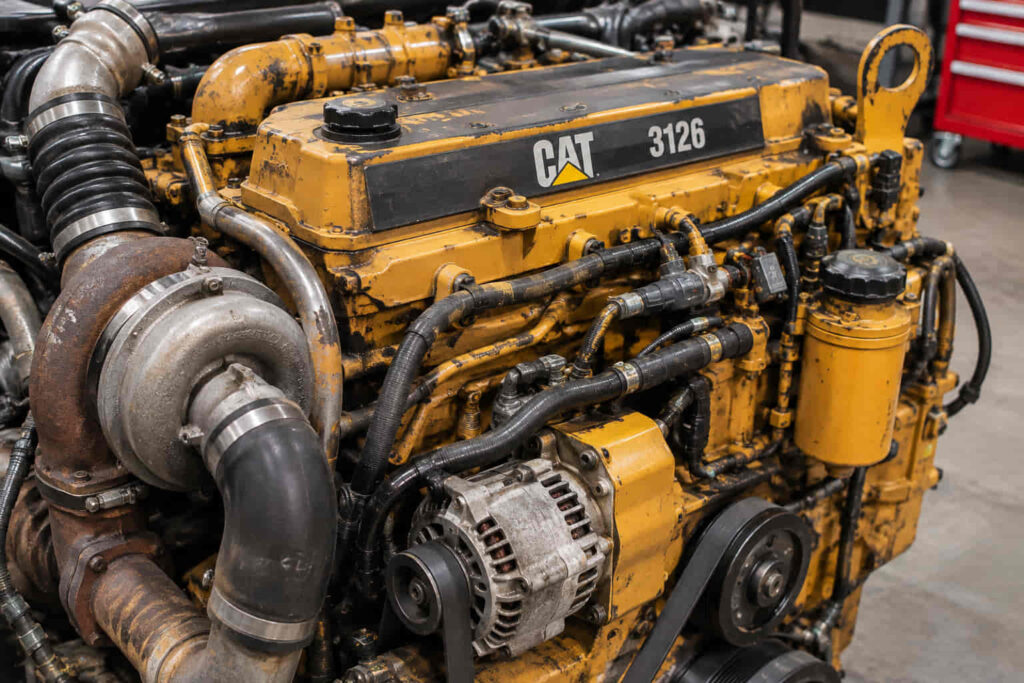
The most common 3126 CAT engine problems include HEUI high-pressure oil pump failure, leaking high-pressure oil lines, fuel injector faults, hard starting, low oil pressure, overheating, and external engine oil leaks. Other important concerns include injection actuation pressure control valve problems, damaged camshaft followers, fuel contamination, and cylinder head injector sleeve failures.
The Caterpillar 3126 is a 7.2-liter, turbocharged, inline-six diesel engine developed for medium-duty trucks, motorhomes, buses, construction equipment, and industrial applications. It replaced the older 3116 engine in many applications and introduced fully electronic control of the fuel injection system.
The engine is known for its relatively compact design, useful low-speed torque, and long service potential. However, its Hydraulically Actuated Electronically Controlled Unit Injector system, commonly called HEUI, makes engine oil condition and hydraulic pressure especially important.
Unlike conventional diesel fuel injection systems, the CAT 3126 uses pressurized engine oil to operate its fuel injectors. A problem involving the high-pressure oil pump, injector actuation pressure control valve, oil supply passages, or related sensors can therefore cause difficult starting, rough operation, and power loss.
The 3126 engine family includes the original 3126, 3126B, and 3126E versions. These engines share a similar basic architecture, but their electronic controls, components, engine ratings, and service specifications can differ.
Understanding the causes of common CAT 3126 failures, their symptoms, and the correct diagnostic approach helps owners avoid unnecessary repairs and extend engine service life.
What Is the Caterpillar 3126 Engine?
The Caterpillar 3126 is a 7.2-liter, six-cylinder, four-stroke diesel engine designed primarily for medium-duty commercial and industrial applications.
The engine uses an inline-six configuration with a cast-iron cylinder block and a turbocharger to improve airflow and power output.
Its cylinder bore measures approximately 110 mm, or 4.33 inches, while the crankshaft stroke measures 127 mm, equivalent to 5.0 inches.
The resulting displacement is approximately 439 cubic inches, or 7.2 liters.
The engine’s firing order is 1-5-3-6-2-4.
Depending on the application, the 3126 is equipped with air-to-air aftercooling and electronic controls designed to support performance and fuel efficiency.
Caterpillar’s published 3126B truck specifications identify engine ratings ranging from 175 to 330 horsepower.
The same specification sheet identifies peak torque ratings between approximately 420 and 860 lb-ft, depending on engine calibration.
However, industrial and marine configurations may have different horsepower ratings, operating speeds, and equipment arrangements.
The 3126 is particularly recognizable for its HEUI injection system.
This technology uses high-pressure engine oil to actuate electronically controlled unit injectors.
The system allows the engine control module to manage fuel delivery and injection timing electronically.
Although the design was advanced for its production period, it introduced additional diagnostic requirements.
Engine oil pressure, fuel pressure, injection actuation pressure, and electronic sensor operation all influence engine performance.
For this reason, a Caterpillar 3126 should be evaluated as a complete fuel, oil, and electronic control system rather than simply a conventional mechanical diesel engine.
What Is the Difference Between CAT 3126, 3126B, and 3126E?
The CAT 3126, 3126B, and 3126E are related 7.2-liter diesel engines that evolved through changes in electronic controls, fuel injection components, calibrations, and emissions requirements.
The original Caterpillar 3126 appeared during the late 1990s as a successor to the 3116 in many commercial applications.
It introduced electronically managed fuel injection using the HEUI system.
The 3126B followed with refinements to the engine management and supporting systems.
Caterpillar published 3126B truck engine ratings reaching 330 horsepower in certain configurations.
The 3126E represented another development of the engine family, including changes associated with later emissions requirements and electronic control systems.
Although these engines have similar displacements and operating principles, they are not completely interchangeable.
Different injector part numbers, HEUI pump configurations, sensors, wiring connections, and engine control modules may be used.
This becomes particularly important when purchasing replacement parts.
A high-pressure oil pump advertised for a 3126B should not automatically be assumed to fit every 3126E.
Likewise, an electronic control module from one engine may not be compatible with another engine’s wiring and calibration.
The exact engine serial number and arrangement number should be identified before ordering parts.
Caterpillar uses these identifiers to establish the correct configuration.
The application also matters.
A truck engine, motorhome engine, marine propulsion engine, and industrial engine may have different supporting components.
Proper identification is the first step toward an accurate diagnosis and reliable repair.
Are CAT 3126 Engines Reliable?
The Caterpillar 3126 can be a reliable medium-duty diesel engine when properly maintained, but its HEUI system and certain aging components require particular attention.
The engine has been widely used in commercial transportation, recreational vehicles, and industrial equipment.
Its inline-six architecture provides a practical foundation for diesel operation under sustained load.
The engine also benefits from Caterpillar’s established service documentation and replacement parts support.
However, reliability depends on the operating application.
A truck used for highway transportation may experience different wear from an industrial engine that operates at relatively constant speed for long periods.
A motorhome that remains parked for months may develop different maintenance concerns from a commercial vehicle used daily.
The engine’s HEUI injection system is one of its most important maintenance considerations.
It relies on clean engine oil to create the hydraulic pressure needed for injector operation.
Contaminated oil, inadequate lubrication, or internal leakage can interfere with fuel injection.
The high-pressure oil lines and related connections also deserve inspection as the engine ages.
Other problems can involve cooling system deterioration, fuel contamination, low oil pressure, and electronic sensor faults.
However, a single problem does not automatically mean the engine requires replacement.
Many 3126 complaints result from repairable supporting components rather than damage to the engine block or rotating assembly.
The most reliable examples are generally those with documented oil changes, fuel filtration maintenance, cooling system service, and prompt repairs when abnormal symptoms appear.
What Are the Most Common CAT 3126 Engine Problems?
The problems most often discussed by CAT 3126 repair specialists involve the HEUI pump, high-pressure oil supply lines, cam follower cover leaks, fuel injectors, lubrication problems, and overheating.
The high-pressure oil pump is especially important because the engine cannot operate normally unless its injectors receive adequate hydraulic pressure.
A pump that is worn or unable to maintain the required output may contribute to long cranking, rough running, and reduced power.
Leaks in the high-pressure oil circuit can produce similar symptoms.
Some early 3126 configurations used high-pressure oil hoses that could deteriorate over time.
Fuel injector failures are another concern.
Injector solenoids, internal hydraulic components, and fuel delivery mechanisms can develop faults.
A failed injector may produce misfires, uneven idle, or excessive exhaust smoke.
The fuel supply system can also become restricted or lose pressure.
A clogged filter or weak transfer pump may create power loss without any failure of the HEUI pump.
External oil leaks are frequently associated with aging gaskets around the cam follower covers.
Cooling problems are also relevant, particularly in motorhomes where radiator airflow and cooling package cleanliness can vary considerably.
Less frequent but potentially serious failures involve the engine oil pump, camshaft followers, and internal mechanical components.
These problems should be evaluated according to the engine’s symptoms and maintenance history rather than treated as inevitable failures affecting every CAT 3126.
CAT 3126 HEUI Pump Failure
HEUI high-pressure oil pump failure is one of the most important CAT 3126 engine problems because the pump supplies the hydraulic pressure required to operate the fuel injectors.
The HEUI system uses engine oil for a purpose beyond normal lubrication.
The engine’s conventional oil pump supplies lubricating oil to the high-pressure hydraulic pump.
The HEUI pump then increases oil pressure to the level required by the injectors.
The engine control module commands the desired injection actuation pressure according to engine operating conditions.
If the pump cannot provide sufficient oil pressure or flow, injector operation may become inconsistent.
The engine may crank for an extended period before starting.
It may also idle roughly, hesitate during acceleration, stall intermittently, or lose power under load.
However, these symptoms do not automatically confirm HEUI pump failure.
A leaking high-pressure oil line, defective pressure control valve, low engine oil level, or inaccurate sensor can produce similar complaints.
The correct diagnosis involves comparing commanded and actual injection actuation pressure using a compatible Caterpillar electronic service tool.
If the measured pressure cannot follow the required value, the technician must determine whether the problem involves the pump, control valve, oil supply, internal leakage, or another component.
The pump should not be replaced solely because the engine has a hard-start condition.
Accurate pressure testing can prevent expensive and unnecessary repairs.
How Does the CAT 3126 HEUI Injection System Work?
The CAT 3126 HEUI system combines high-pressure engine oil, electronically controlled unit injectors, and an engine control module to regulate diesel fuel injection.
The system differs from conventional mechanical diesel injection arrangements.
A fuel transfer pump supplies diesel fuel to the injector fuel passages at relatively low pressure.
A separate high-pressure oil pump supplies hydraulic engine oil to the injectors.
Each injector contains an electronically controlled mechanism that uses hydraulic pressure to drive a fuel plunger.
The hydraulic action multiplies pressure within the injector.
As a result, fuel can be injected into the combustion chamber at much greater pressure than the ordinary supply pressure from the transfer pump.
Caterpillar’s published HEUI technical information describes injection fuel pressures reaching approximately 21,000 psi in certain operating conditions.
However, this fuel injection pressure should not be confused with the lower hydraulic oil pressure used to actuate the injectors.
The engine control module determines injection timing and duration.
It receives information from sensors monitoring engine speed, timing, pressure, temperature, and other operating conditions.
The injection actuation pressure control valve regulates hydraulic pressure according to the module’s commands.
A pressure sensor provides feedback.
If the hydraulic system cannot build or maintain sufficient pressure, the injectors may fail to operate correctly.
This relationship explains why engine oil quality is particularly important on the 3126.
A problem in the lubrication or hydraulic injection system can affect both engine durability and fuel injection performance.
Read more: How to Fix Lifters Ticking
CAT 3126 High-Pressure Oil Line Problems
High-pressure oil line leakage is a well-documented concern on certain CAT 3126 configurations, particularly those equipped with an aging flexible oil supply hose.
The HEUI pump must deliver pressurized oil to the injector oil rail.
Depending on the engine arrangement, this connection may involve a steel line, flexible hose, or other high-pressure components.
Some 3126 engines were equipped with a braided flexible supply hose.
Over time, the hose material and connections may deteriorate.
A developing leak can allow pressurized oil to escape.
As oil pressure falls, the HEUI system may become unable to operate the injectors consistently.
The engine can develop rough running, hard starting, reduced power, or stalling.
A substantial leak may also cause rapid engine oil loss.
This is especially serious because insufficient oil can damage the engine’s crankshaft bearings and other components.
Oil spraying onto hot exhaust or turbocharger surfaces can also present a fire hazard.
Caterpillar introduced updated steel-line components for certain affected arrangements.
However, compatibility must be verified through the engine serial number and the applicable parts information.
A high-pressure oil leak should never be checked by placing a hand near a suspected leak while the engine is operating.
Pressurized fluid can penetrate the skin and cause severe injury.
The correct procedure is to stop the engine, follow the manufacturer’s pressure-relief requirements, and have the system inspected using suitable equipment.
CAT 3126 Injection Actuation Pressure Control Valve Problems
A malfunctioning injection actuation pressure control valve can cause difficult starting, rough idle, inconsistent acceleration, and reduced power in a CAT 3126.
The valve is commonly identified as the IAP control valve or IAPCV.
Its function is to regulate hydraulic oil pressure within the HEUI injection system.
The engine control module calculates the desired injection actuation pressure.
The control valve adjusts hydraulic flow to help achieve that pressure.
If the valve sticks, becomes contaminated, or develops an electrical fault, the actual pressure may differ from the commanded value.
A problem may be particularly noticeable during starting because adequate hydraulic pressure is required for the injectors to operate.
The engine may crank normally but fail to start.
It may also start and then stall.
Some arrangements can produce diagnostic information associated with injection actuation pressure faults, including codes in the 164 family.
However, the exact code interpretation depends on the engine electronic system.
A defective pressure sensor or damaged wiring can sometimes create similar symptoms.
The control valve and pump arrangement also vary between engine generations.
Certain earlier pump configurations have an externally accessible control valve.
Other designs have different serviceability requirements.
The correct repair must therefore match the installed HEUI pump.
Replacing the valve without checking hydraulic pressure, wiring, and oil condition can leave the actual problem unresolved.
CAT 3126 Hard Starting and No-Start Problems
CAT 3126 hard starting can result from inadequate injection actuation pressure, low fuel supply pressure, faulty speed and timing signals, slow cranking speed, or insufficient engine compression.
The engine must receive several essential inputs before normal combustion can begin.
The starter must rotate the crankshaft at sufficient speed.
The electronic control module must receive usable engine speed and timing information.
The fuel system must supply clean diesel at the required pressure.
The HEUI pump must develop enough hydraulic oil pressure to actuate the injectors.
If any of these requirements is missing, the engine may crank without starting.
Caterpillar’s troubleshooting information for certain early 3126 HEUI applications identifies approximately 100 RPM as an important minimum cranking speed for reliable starting.
However, this value is associated with the referenced engine configuration and should not be treated as a universal specification for every 3126B or 3126E.
Weak batteries, poor electrical connections, or a worn starter can reduce cranking speed.
Fuel system problems are another common consideration.
A restricted filter, air entering the fuel supply, or inadequate transfer pump pressure may prevent proper injection.
The hydraulic injection system also requires adequate engine oil supply.
If the engine oil level is very low or the HEUI pressure circuit contains a significant leak, the injectors may not operate normally.
The best diagnostic approach is to verify cranking speed, engine speed signals, low-pressure fuel supply, and injection actuation pressure before replacing expensive components.
Why Does a CAT 3126 Start and Then Stall?
A CAT 3126 that starts and then stalls may have unstable fuel pressure, inadequate HEUI actuation pressure, air entering the fuel system, or an intermittent electronic control problem.
A diesel engine may start briefly even when its supporting systems cannot maintain normal operation.
The fuel supply may initially provide enough fuel for combustion but lose pressure after the engine begins running.
A restricted filter or weak transfer pump can contribute to this condition.
Air entering the fuel system may also interrupt consistent delivery.
The hydraulic injection system provides another possible explanation.
The HEUI pump must maintain pressure as engine operating conditions change.
If the pressure control valve sticks or the hydraulic circuit leaks excessively, the injectors may stop operating correctly.
Electrical connections and sensors should also be evaluated.
A faulty speed or timing signal can disrupt injection control.
However, the engine control module should not be replaced merely because the engine stalls.
The diagnostic process should determine whether the module remains powered and whether it receives valid sensor information.
A scan tool compatible with the Caterpillar engine can help identify the last recorded operating conditions.
The technician should compare the pressure and timing information with the engine’s required values.
A confirmed fault in the fuel or hydraulic oil circuit should be corrected before considering major electronic component replacement.
CAT 3126 Fuel Injector Problems
Fuel injector problems can cause rough running, cylinder misfires, reduced power, abnormal exhaust smoke, and difficult starting on a Caterpillar 3126.
The engine uses electronically controlled HEUI injectors.
Each injector contains an electrical control mechanism and internal components that use high-pressure engine oil to actuate fuel injection.
The fuel side of the injector must also receive an adequate supply of clean diesel.
As a result, injector performance depends on both hydraulic oil and fuel quality.
Contaminated fuel can damage precision internal components.
Debris in the hydraulic oil system can interfere with injector operation.
Electrical faults involving injector solenoids or wiring may also prevent proper injection.
A failing injector can deliver insufficient fuel, inconsistent fuel quantities, or abnormal injection behavior.
This may produce a rough idle or a noticeable lack of power.
However, an injector problem is not always the cause of a cylinder misfire.
Low compression, incorrect valve clearance, fuel aeration, and hydraulic pressure faults can create similar symptoms.
Caterpillar troubleshooting procedures use electronic diagnostic tests to help identify injector electrical and operating problems.
A technician may also perform cylinder-specific tests and compare engine performance.
When an injector fails, the surrounding fuel and oil systems should be evaluated.
Installing a replacement injector without correcting contaminated fuel or inadequate oil pressure may result in another failure.
CAT 3126 Fuel Pressure Problems
Low fuel supply pressure can cause a CAT 3126 to lose power, misfire, hesitate, or become difficult to start even when the HEUI pump is functioning correctly.
The engine’s fuel transfer pump delivers diesel fuel through the filtration system to the unit injectors.
This is separate from the high-pressure engine oil circuit.
The distinction is important because both systems influence injection but operate differently.
A weak fuel transfer pump may fail to maintain adequate pressure under load.
A restricted fuel filter can produce a pressure drop.
Air entering the fuel system can also interfere with delivery.
Caterpillar’s troubleshooting information for certain early 3126 applications identifies approximately 58–63 psi at low idle, measured at a specified location near the secondary filter, as a reference range.
The same source identifies approximately 58–76 psi under normal load for those applications.
However, other 3126 arrangements and later service procedures may use different pressure specifications or measurement points.
The correct pressure must therefore be established using the engine serial number and applicable service manual.
An engine that produces adequate pressure at idle may still develop low fuel pressure under heavy load.
For this reason, the operating conditions used during testing matter.
The mechanic should inspect the transfer pump, filters, fuel lines, and pressure regulation components.
The problem should be corrected before replacing injectors or the HEUI pump.
Can Air in the Fuel System Cause CAT 3126 Problems?
Yes. Air entering the CAT 3126 fuel supply can cause rough running, hesitation, reduced power, hard starting, and intermittent stalling.
Diesel fuel systems are designed to deliver a continuous supply of liquid fuel.
Air bubbles disrupt consistent delivery and can interfere with injector operation.
Air may enter through loose fittings, damaged fuel lines, or leaking seals.
A restriction in the fuel supply can also create conditions that encourage air entry on the suction side.
Fuel filter housings and water separator connections are common inspection areas.
Caterpillar’s maintenance information specifically warns that certain water separator components operate under suction.
An incorrectly secured drain or connection can allow air to enter the system.
This can produce low power even when no external fuel leak is visible.
The correct diagnostic procedure may involve inspecting fuel connections and using suitable equipment to identify aeration.
However, the fuel system should not be opened unnecessarily because contamination can damage injector components.
After filter replacement or fuel system service, the engine must be primed according to the manufacturer’s instructions.
Incorrect priming can create extended cranking and additional diagnostic confusion.
If air repeatedly enters the system, the source must be repaired.
Replacing the fuel filter alone may not correct a leaking suction connection.
CAT 3126 Fuel in Coolant and Injector Sleeve Problems
Fuel contamination of engine coolant can indicate an injector sleeve problem on certain CAT 3126 applications, particularly when an injector sleeve is cracked or its sealing interface is damaged.
Injector sleeves provide an important interface between the cylinder head and fuel injector components.
They help separate fluids and maintain the required sealing arrangement.
If a sleeve becomes damaged, an unwanted fluid pathway can develop.
Caterpillar’s engine troubleshooting documentation identifies injector sleeve defects as a possible cause of fuel entering the coolant.
Potential damage includes cracking or cavitation erosion.
The manual also identifies coolant conditioner problems and air within the fuel system as factors that can contribute to certain forms of sleeve damage.
Possible symptoms include abnormal coolant contamination or changes in cooling system behavior.
However, fluid contamination must be diagnosed carefully.
Oil contamination, coolant contamination, and fuel contamination can have different causes.
A failed oil cooler may create symptoms that differ from an injector sleeve leak.
The technician should inspect the affected systems and determine which fluid is entering the other.
Replacing injector sleeves requires appropriate tools and service procedures.
The cylinder head and injector sealing surfaces must be inspected.
Correct coolant chemistry is also important because it helps protect components from corrosion and certain types of erosion.
Continuing to operate an engine with unexplained fluid contamination can increase repair costs.
CAT 3126 Low Oil Pressure Problems
Low engine oil pressure is a serious CAT 3126 problem because the engine depends on lubrication for its crankshaft bearings, camshaft components, turbocharger, and the oil supply feeding the HEUI pump.
The engine uses a conventional lubrication pump to distribute oil through its galleries.
The hydraulic injector actuation pump depends on the oil supplied through this system.
Low oil pressure can therefore affect both mechanical durability and fuel injection performance.
Possible causes include insufficient oil level, a worn oil pump, restrictions in the oil pickup, excessive bearing clearance, and other internal lubrication faults.
Certain 3126 repair specialists also identify wear involving the oil pump idler gear as a potential concern.
Such wear can contribute to lubrication problems and may generate metallic debris.
However, low pressure should not automatically be attributed to the idler gear.
The actual oil pressure must be measured using the correct diagnostic procedure.
Pressure depends on engine speed, oil temperature, and configuration.
A defective pressure sensor can also create an inaccurate dashboard indication.
If mechanical testing confirms low oil pressure, the engine should not continue operating under load.
Main bearing and connecting rod bearing damage can develop quickly when lubrication is inadequate.
The correct repair may involve the oil pump, pickup arrangement, worn internal components, or another source of pressure loss.
An oil pressure problem must be resolved before the engine is returned to service.
CAT 3126 Oil Pump Idler Gear Failure
Oil pump idler gear wear is a potentially serious CAT 3126 failure because damage in the oil pump drive can interfere with lubrication and contribute to internal engine wear.
The engine’s lubrication system uses mechanically driven components to circulate oil.
The oil pump must maintain the required flow and pressure during normal operation.
Wear involving a gear, bearing support, or associated component can affect pump performance.
If internal clearances increase or mechanical damage develops, the lubrication system may become less effective.
In severe cases, metal particles may circulate through the engine oil.
These particles can damage bearings and other precision surfaces.
Specialist discussions of the CAT 3126 identify oil pump idler gear and associated pump wear as concerns worth investigating when abnormal oil pressure is confirmed.
However, the frequency of this failure has not been established through a public manufacturer-wide failure-rate study.
It should not be assumed that every 3126 will develop this problem.
The appropriate diagnosis includes checking oil pressure, examining the oil filter for debris when indicated, and inspecting the oil pump drive components when mechanical evidence justifies disassembly.
If an oil pump requires replacement, the correct part number and any applicable design updates should be verified using Caterpillar service information.
A replacement pump must match the specific engine configuration.
Replacing the pump without inspecting bearing damage or contamination may leave serious problems unresolved.
CAT 3126 Oil Leak Problems
External engine oil leaks are common maintenance concerns on older CAT 3126 engines, particularly around aging gaskets, sealing surfaces, and high-pressure oil components.
Engine seals are exposed to years of heat, vibration, and contact with engine oil.
As these components age, they may harden or lose their ability to maintain a reliable seal.
The CAT 3126 has several areas that deserve inspection.
The cam follower covers are a known source of external leakage.
Other possible locations include the valve cover, oil pan, front and rear engine seals, turbocharger oil connections, and the HEUI hydraulic circuit.
However, the location where oil accumulates may not be the actual source.
Oil can travel along the engine block before dripping onto the ground.
A leak near the lower portion of the engine may originate from a higher gasket or connection.
The most reliable diagnostic approach is to clean the area and identify where oil first escapes.
Oil leaks should not be ignored.
A developing leak can reduce the engine oil level over time.
A high-pressure hydraulic oil leak can create a more urgent risk because of the pressure involved and the possibility of oil contacting hot surfaces.
The repair should address the actual seal, gasket, hose, or connection rather than replacing unrelated components.
Why Do CAT 3126 Cam Follower Covers Leak Oil?
Cam follower cover gasket leakage is a recognized CAT 3126 maintenance problem that can be labor-intensive to repair because of component access.
The engine uses side covers associated with the camshaft follower arrangement.
These covers provide access to mechanical components within the valvetrain system.
Gaskets seal the covers against the engine block.
As the gaskets age, they can develop leakage.
Oil may then collect along the side of the block or on surrounding components.
The leak itself may initially appear minor.
However, repairing it can require considerable labor because other engine components obstruct access.
Depending on the engine arrangement, the technician may need to remove accessories and other components before reaching the affected cover.
The cam follower components must also be handled carefully.
A gasket replacement should not disturb the mechanical arrangement unnecessarily.
The sealing surfaces must be cleaned and inspected before the new gasket is installed.
Fasteners should be tightened according to the correct service procedure.
Over-tightening can damage threads or affect sealing.
Because the labor involved may be substantial, some owners choose to combine this repair with other necessary engine work when appropriate.
However, a minor leak should not automatically justify extensive disassembly without evaluating its severity.
The decision should consider the rate of oil loss, location, safety implications, and overall engine condition.
CAT 3126 Camshaft Follower Problems
Damaged camshaft followers can cause abnormal valvetrain noise, rough operation, reduced power, and potentially extensive camshaft damage in a Caterpillar 3126.
The camshaft controls valve operation through its lobes and the associated follower and pushrod arrangement.
The followers must maintain correct contact with the camshaft.
Certain follower designs use rolling elements or bushings to support mechanical motion.
If these components wear or fail, the intended contact relationship can be disrupted.
The result may be excessive friction, abnormal mechanical noise, or reduced valve movement.
A damaged follower can also wear the corresponding camshaft lobe.
Once this occurs, replacing only the follower may not restore reliable operation.
The camshaft must be inspected.
Repair specialists identify inadequate lubrication, component wear, and incorrect valvetrain assembly as possible contributing factors.
However, rough running or noise does not automatically establish that the camshaft followers have failed.
Incorrect valve clearance, injector problems, and other mechanical conditions can produce overlapping symptoms.
The diagnosis should include the engine’s lubrication condition and mechanical valvetrain inspection.
When damage is confirmed, affected components must be repaired according to the Caterpillar service procedure.
Metal debris should also be considered because it can affect other engine components.
Prompt repair may prevent the failure from becoming a more expensive engine overhaul.
CAT 3126 Overheating Problems
CAT 3126 overheating can result from inadequate radiator airflow, coolant leaks, water pump deterioration, thermostat faults, restricted cooling components, or incorrect cooling system service.
The engine relies on coolant circulation and airflow to remove heat generated during combustion.
Its cooling system includes a water pump, temperature regulation components, oil cooler, radiator, and associated hoses.
However, the complete cooling arrangement differs according to the vehicle.
A truck with a conventional front-mounted radiator may have different airflow characteristics from a rear-engine motorhome.
Certain motorhome installations place several cooling components together.
These may include the radiator, charge-air cooler, and air-conditioning condenser.
Dust, road debris, and other contaminants can restrict airflow through the cooling package.
A cooling fan that does not operate correctly can also cause excessive temperature.
Water pump damage or thermostat problems may reduce coolant circulation.
Low coolant level creates another risk.
A leak may gradually reduce the amount of coolant available to absorb and transfer heat.
Incorrect coolant chemistry can contribute to corrosion and other long-term problems.
Overheating must be addressed promptly because excessive temperature can damage the cylinder head, head gasket, pistons, and other components.
The correct repair begins with identifying the cause rather than immediately replacing the water pump or thermostat.
Why Do CAT 3126 Motorhomes Overheat?
CAT 3126-powered motorhomes can overheat when the installed cooling package cannot provide sufficient airflow or coolant circulation under sustained load.
A motorhome often places substantial demands on the engine.
The vehicle may be heavy, carry significant equipment, and climb long grades at relatively low road speeds.
These conditions increase engine heat production.
Some rear-engine motorhomes use cooling arrangements that can be more difficult to keep clean than a conventional front-mounted truck radiator.
The radiator and charge-air cooler may accumulate road grime, dust, and debris.
Restricted airflow reduces their ability to dissipate heat.
The cooling fan also requires attention.
A fan that is incorrectly installed, fails to engage, or operates with inadequate airflow can significantly reduce cooling performance.
The thermostat and water pump must also function correctly.
A worn water pump or damaged impeller may reduce coolant circulation.
Other causes include low coolant, damaged hoses, coolant leaks, and an inaccurate temperature sensor.
The proper diagnosis should evaluate the complete cooling system under realistic operating conditions.
Engine load, vehicle speed, cooling fan behavior, and coolant temperature all matter.
A motorhome that runs normally on level highways but overheats during long climbs may have a cooling capacity or airflow problem that becomes apparent only under sustained demand.
Correcting the cooling system is more effective than attempting to compensate by reducing engine performance without addressing the underlying defect.
Can a CAT 3126 Blow a Head Gasket?
Yes. A CAT 3126 can experience head gasket failure, particularly after severe overheating or when cylinder head sealing is compromised. However, head gasket failure is not the correct explanation for every coolant loss or overheating complaint.
The head gasket seals the joint between the engine block and cylinder head.
It must contain combustion pressure while separating oil and coolant passages.
Overheating can affect the sealing surfaces.
The cylinder head may distort when exposed to excessive temperature.
Repeated abnormal combustion pressure or previous repair errors can also contribute to sealing problems.
Symptoms may include coolant loss, abnormal cooling system pressure, overheating, or reduced cylinder compression.
However, these conditions have other possible causes.
A leaking radiator, damaged hose, defective cap, or water pump problem can also reduce coolant level.
Fuel or oil contamination of coolant may originate from components other than the head gasket.
The technician should perform appropriate cooling system and mechanical testing before removing the cylinder head.
If head gasket damage is confirmed, the cylinder head and block sealing surfaces must be inspected.
A new gasket installed against a distorted or damaged surface may fail again.
The original overheating or sealing problem must also be corrected.
A proper repair addresses both the failed gasket and the condition that caused it.
CAT 3126 Turbocharger Problems
Turbocharger problems can cause power loss, excessive smoke, unusual noise, and reduced performance on a Caterpillar 3126.
The engine’s turbocharger uses exhaust gas energy to compress intake air.
This increases the amount of oxygen available for diesel combustion.
Adequate airflow allows the engine to produce its designed horsepower and torque.
However, the turbocharger depends on correct lubrication and operating conditions.
Oil contamination, inadequate oil supply, damaged bearings, and foreign object ingestion can affect durability.
A damaged compressor wheel may reduce airflow.
Restrictions in the intake or exhaust system can also affect turbocharger performance.
However, low boost pressure does not automatically mean the turbocharger has failed.
A leaking charge-air hose or damaged aftercooler connection may allow compressed air to escape.
An exhaust leak before the turbine can reduce the energy available to drive the turbocharger.
Restricted air filters can also affect engine performance.
Caterpillar troubleshooting procedures include checking the turbocharger for friction, deposits, and other damage when investigating low power.
The correct diagnostic approach evaluates intake restriction, charge-air integrity, exhaust leakage, and turbocharger condition.
Replacing an otherwise functional turbocharger without correcting an air system problem may not restore power.
CAT 3126 Sensor and ECM Problems
Electronic sensor faults can cause hard starting, intermittent stalling, poor throttle response, and reduced power on a CAT 3126 without indicating a mechanical engine failure.
The engine control module relies on information from several sensors.
These include engine speed and timing sensors, injection actuation pressure feedback, boost pressure information, coolant temperature, and other operating inputs.
The module uses this information to determine fuel injection timing and quantity.
If a critical signal is missing or inaccurate, the engine may operate poorly.
A speed or timing signal problem can interfere with starting.
An inaccurate injection actuation pressure sensor can affect hydraulic injection control.
A boost pressure sensor fault may influence fueling and engine response.
However, the ECM itself should not automatically be blamed when sensor information is abnormal.
Wiring damage, corrosion, poor grounds, or defective connectors can create similar symptoms.
Engine control module compatibility also varies between 3126 generations.
A replacement ECM must match the engine’s electronic architecture and be configured correctly.
Caterpillar Electronic Technician, commonly called Cat ET, is used for diagnostic communication and certain service operations.
The technician should inspect active and logged diagnostic codes and evaluate sensor readings.
Only after the appropriate fuel, hydraulic oil, electrical, and sensor checks should ECM replacement be considered.
A systematic approach reduces the risk of purchasing an expensive control module that does not solve the problem.
Why Does a CAT 3126 Lose Power Under Load?
CAT 3126 power loss under load can result from insufficient fuel pressure, inadequate HEUI pressure, turbocharger airflow problems, restricted filters, or incorrect electronic sensor information.
An engine may operate normally at idle but struggle when accelerating or climbing hills.
This occurs because fuel and airflow demand increase under load.
A weak fuel transfer pump may provide adequate fuel at idle but fail to maintain pressure when the engine requires greater delivery.
Restricted fuel filters can create a similar limitation.
The hydraulic injection system must also maintain sufficient pressure.
If the HEUI pump or its control system cannot meet the commanded pressure, injector performance may be reduced.
Turbocharger airflow is another important factor.
A boost leak, intake restriction, or damaged turbocharger can limit combustion efficiency.
The engine’s electronic controls may also reduce power when certain faults are detected.
Caterpillar troubleshooting information identifies injector actuation pressure, boost sensor faults, fuel aeration, and injector problems among the potential causes of low power.
The best diagnostic method is to reproduce the complaint under controlled conditions and inspect the relevant operating data.
Fuel pressure, injection actuation pressure, boost pressure, and fault codes should be evaluated together.
A truck that feels weak should not immediately receive larger injectors or a different engine calibration.
Restoring the original system’s intended performance should come first.
What Causes White, Black, or Blue Smoke on a CAT 3126?
Exhaust smoke color can help narrow CAT 3126 diagnosis, but no smoke color identifies one specific failed component with certainty.
White smoke during cold starting may indicate incomplete combustion.
Possible causes include low combustion temperature, poor injection, inadequate cranking speed, or another condition affecting ignition of the diesel fuel.
A brief amount of white smoke in very cold conditions may occur without indicating severe mechanical damage.
Persistent white smoke after warm-up requires investigation.
Black smoke generally indicates that the engine is producing more soot than expected.
This can occur when fuel delivery exceeds the available airflow or when combustion is otherwise inefficient.
A restricted air filter, charge-air leak, turbocharger fault, or injector problem may contribute.
Blue smoke is commonly associated with engine oil entering the combustion process.
Potential causes include worn piston rings, cylinder wear, valve-related oil leakage, or a turbocharger oil sealing problem.
However, oil leaks outside the combustion chamber can create visible smoke when oil contacts hot exhaust components.
The complete operating conditions must be considered.
An engine that produces black smoke only under heavy acceleration may require a different diagnosis from one that smokes continuously at idle.
Compression testing, injector evaluation, turbocharger inspection, and lubrication system checks can help identify the actual cause.
CAT 3126 Valve Adjustment Problems
Incorrect valve clearance can contribute to CAT 3126 rough running, reduced efficiency, and abnormal valvetrain operation.
The engine uses a mechanical valvetrain that requires inspection and adjustment according to its service schedule.
Caterpillar’s 3126B industrial engine manual identifies nominal intake valve clearance of 0.38 mm, equivalent to 0.015 inch.
The published exhaust clearance is 0.64 mm, equivalent to 0.025 inch.
However, these figures are from the referenced industrial engine manual.
The exact service procedure and specifications should be confirmed for the engine’s serial number and application.
Improper clearance can change the effective movement of the valves.
Excessive clearance may create noise or alter valve opening characteristics.
Insufficient clearance may prevent a valve from seating correctly under certain conditions.
The result can include reduced efficiency and increased component stress.
Caterpillar recommends an initial valve lash inspection after the early service period for many applications.
Subsequent inspections follow the applicable maintenance schedule.
The adjustment must be performed with the engine stopped and at the temperature specified in the manual.
Qualified service personnel should carry out the procedure because incorrect adjustment can reduce engine life.
Valve lash should also be considered when investigating rough running or loss of compression.
Does the CAT 3126 Have Replaceable Cylinder Liners?
The CAT 3126 is generally described as a parent-bore engine rather than a conventional wet-sleeve diesel engine, which affects how the cylinder block can be restored during overhaul.
In a parent-bore design, the cylinder bore is formed directly within the engine block casting.
This differs from a wet-liner engine that uses removable cylinder liners as part of its original construction.
The distinction matters during rebuilding.
An engine with worn cylinders may require precision boring and honing.
If the block cannot be restored using an appropriate oversize piston arrangement, specialized machine shop repairs may be considered.
Some rebuilders use machining and sleeve installation techniques where technically suitable.
However, this is not equivalent to routinely replacing factory wet cylinder liners during an in-frame overhaul.
The block must be inspected for cracks, cylinder wear, bore distortion, and adequate material before machining.
A severely damaged block may not be economical to restore.
This characteristic is one reason the 3126 is often compared with other medium-duty diesel engines when discussing overhaul costs.
However, parent-bore construction does not mean the engine cannot be rebuilt.
It means the restoration process and available options differ from those of a conventional wet-liner engine.
A professional machine shop familiar with Caterpillar diesel blocks should determine the appropriate repair.
How Long Does a CAT 3126 Engine Last?
A properly maintained CAT 3126 can provide substantial service life, but there is no single mileage or operating-hour figure that applies to every engine and application.
Diesel engine longevity depends on operating conditions, maintenance, loading, and mechanical condition.
A highway truck may accumulate many miles while spending much of its time at steady engine speed.
An industrial engine may operate for long periods at constant load but accumulate no road mileage.
A motorhome may spend extended periods in storage and operate only occasionally.
These different duty cycles affect component wear.
Engine operating hours are therefore an important measurement.
Fuel consumption and average engine load also help describe how heavily the engine has been used.
Caterpillar’s operating manuals explain that service life depends partly on the average power demanded over time.
A lightly loaded engine may experience different wear from one operating near maximum output for extended periods.
The HEUI system introduces additional maintenance considerations.
Fuel injectors, high-pressure oil pumps, and sensors may require replacement before the engine’s main internal components reach their mechanical limits.
The cooling system and lubrication system also play important roles.
An engine that has experienced repeated overheating or low oil pressure may require major repairs earlier than expected.
Claims that every 3126 will last a fixed number of miles are therefore misleading.
A better assessment considers service records, oil analysis results, operating hours, compression, blow-by, oil consumption, and current engine performance.
How Often Should You Change Oil in a CAT 3126?
CAT 3126 oil change intervals depend on engine arrangement, sump capacity, application, operating conditions, fuel quality, and the applicable Caterpillar maintenance schedule.
This is especially important because the HEUI injection system uses engine oil to operate the injectors.
Oil contamination or excessive degradation can affect both lubrication and hydraulic injection performance.
For certain shallow-sump 3126 truck applications, Caterpillar maintenance information identifies an oil and filter service interval of approximately 6,000 miles, 250 operating hours, six months, or a specified amount of fuel consumed, whichever occurs first.
However, this is not a universal interval for every 3126 configuration.
The 3126B industrial engine manual identifies circumstances in which a 500-hour oil change interval may be permitted when specific operating and lubricant requirements are satisfied.
When those conditions are not met, the manual instructs operators to use a shorter interval or establish a suitable interval through oil analysis.
Caterpillar also offers its S·O·S oil analysis program.
The program evaluates oil condition and certain contamination and wear indicators.
This can help determine whether the lubricant remains suitable for continued use.
However, oil analysis should support maintenance decisions rather than justify neglecting the manufacturer’s requirements.
The correct service interval should be determined from the engine serial number, oil sump configuration, and applicable manual.
For older engines with uncertain maintenance history, establishing a documented service schedule is particularly valuable.
What Oil Should You Use in a CAT 3126 Engine?
The correct oil for a CAT 3126 must meet Caterpillar’s applicable diesel engine lubrication requirements and have a viscosity suitable for the expected operating temperatures.
Caterpillar’s historical 3126B maintenance documentation includes multigrade diesel engine oils meeting the performance categories applicable when the engine was produced.
SAE 15W-40 is commonly used in many moderate-temperature diesel applications.
However, the appropriate viscosity depends on ambient temperature and the engine’s service information.
Some operating conditions may justify a different approved multigrade viscosity.
The oil must also meet an appropriate performance specification.
Modern replacement oils may have different API classifications from oils available when the 3126 was introduced.
The chosen lubricant should therefore be checked for compatibility with the engine’s requirements.
Oil additives should not be used as a substitute for correct lubricant selection or maintenance.
The HEUI system relies on consistent oil performance.
A thick or degraded lubricant may affect cold-start hydraulic behavior.
Contaminated oil may also interfere with precision components.
The oil filter is another important part of maintenance.
Using an appropriate high-quality filter helps protect both the engine’s bearings and hydraulic injection system.
The exact oil capacity varies according to the sump and vehicle arrangement.
Caterpillar’s 3126B truck specification identifies an 18-liter refill quantity for one configuration, while certain applications use a larger sump.
Therefore, the actual engine and dipstick information should determine the fill quantity.
How Can You Prevent CAT 3126 Engine Problems?
The best way to reduce avoidable CAT 3126 problems is to maintain the lubrication and fuel systems, inspect high-pressure oil components, protect the cooling system, and investigate abnormal operating symptoms promptly.
Engine oil maintenance is particularly important.
The HEUI pump and injectors depend on clean oil.
A documented oil service schedule helps reduce contamination and lubrication-related wear.
Fuel filtration also deserves attention.
Water and debris can damage the precision components inside the injectors.
The fuel water separator should be inspected and drained according to the manufacturer’s schedule.
The high-pressure oil line should be checked for signs of aging or leakage.
Engines equipped with certain older flexible hose arrangements may benefit from verifying the availability and applicability of updated components through Caterpillar.
Cooling system maintenance is equally important.
Radiators, cooling fans, water pumps, thermostats, and hoses should remain in good condition.
Motorhomes require particular attention to airflow through the radiator and charge-air cooler.
Oil pressure and coolant temperature should be monitored during operation.
Any persistent abnormal reading requires diagnosis.
Valve clearance inspection should follow the appropriate schedule.
Electronic warning codes should also be investigated before the engine experiences severe drivability problems.
These practices cannot prevent every mechanical failure.
However, they reduce the risk of problems caused by neglected maintenance and help identify developing faults before they result in extensive engine damage.
How Much Does It Cost to Repair a CAT 3126 Engine?
CAT 3126 repair costs vary substantially because a fuel filter or sensor problem is much less expensive than replacing a HEUI pump, repairing a damaged camshaft, or rebuilding the engine.
The final cost depends on the engine application and the failed component.
A truck with a straightforward fuel supply fault may require relatively limited parts and labor.
A motorhome with restricted radiator airflow may need cooling system service rather than engine replacement.
However, the HEUI system can create more expensive repairs.
A specialized diesel engine supplier’s 2026 discussion gives an illustrative parts price range of approximately $1,100 to $2,700 for certain replacement HEUI pumps, depending on the source and product.
This is not a fixed market quotation.
Actual prices depend on the engine serial number, pump type, new or remanufactured condition, supplier, and availability.
Labor adds further expense.
A high-pressure oil leak may require specialized parts and service procedures.
Fuel injector replacement can also be expensive, particularly when multiple injectors require attention.
External cam follower cover leaks may involve relatively inexpensive gaskets but substantial labor because of difficult access.
Severe mechanical failures introduce a different level of cost.
An oil pump failure that damages bearings or a cam follower failure that damages the camshaft may require extensive engine disassembly.
A complete rebuild or remanufactured engine replacement can become a major investment.
The best estimate is an itemized quotation based on confirmed diagnostic findings.
Replacing parts without measuring the appropriate fuel and oil pressures can increase repair costs unnecessarily.
Is Rebuilding a CAT 3126 Engine Worth It?
Rebuilding a CAT 3126 can be worthwhile when the engine block and major internal components remain serviceable and the truck or equipment has sufficient remaining value to justify the repair.
The decision depends on the extent of damage.
A problem involving the HEUI pump or fuel injectors may not require rebuilding the engine.
These components can sometimes be repaired or replaced separately.
However, a severe lubrication failure may damage crankshaft bearings, connecting rods, or other internal components.
Overheating can also create extensive cylinder head or piston damage.
A proper rebuild begins with determining which components are damaged and whether the engine block remains suitable for machining.
The parent-bore construction of the 3126 influences rebuilding options.
Unlike certain wet-liner diesel engines, the 3126 does not ordinarily receive a straightforward factory wet-sleeve replacement during overhaul.
Machine shop work may therefore be necessary when cylinder wear is substantial.
A remanufactured replacement engine is another option.
Caterpillar continues to list remanufactured 3126B engine products for certain applications.
However, availability and compatibility depend on the specific arrangement.
The replacement must match the equipment’s power rating, electronic controls, and installation requirements.
For a motorhome or commercial truck in otherwise good condition, replacing the engine may be economical.
For aging equipment with additional major defects, the total repair cost may exceed the practical value of continued service.
What Should You Check Before Buying a Used CAT 3126?
A used CAT 3126 should be evaluated through its engine serial number, service history, cold-start behavior, oil pressure, fuel and hydraulic injection performance, cooling system condition, and evidence of previous repairs.
The engine serial number is essential because it determines the correct parts and service information.
The buyer should also identify whether the engine is a 3126, 3126B, or 3126E.
Operating hours and mileage should be reviewed.
However, these figures should be interpreted together with the engine’s duty cycle.
An industrial engine that has operated at sustained high load may have different wear from a truck engine with similar hours.
A cold-start evaluation can reveal problems that become less noticeable after warm-up.
Long cranking, rough idle, or excessive smoke deserve attention.
The engine should also be evaluated under load when possible.
Loss of power may indicate fuel pressure, HEUI, or turbocharger problems.
Oil pressure should remain within the applicable specifications.
The engine should be inspected for external oil leaks, particularly around high-pressure oil components and cam follower covers.
Cooling system condition is equally important.
Evidence of overheating, coolant contamination, or repeated coolant loss requires investigation.
A compatible Caterpillar diagnostic tool can reveal active and logged faults.
Maintenance records and oil analysis results can provide additional information about internal wear.
A professional inspection by a technician familiar with the 3126 is particularly valuable because the HEUI system requires specialized diagnosis.
CAT 3126 vs Caterpillar C7: Which Engine Is More Reliable?
The Caterpillar 3126 and C7 are closely related medium-duty diesel engine families, but they have different production developments, electronic systems, and application-specific service requirements.
The C7 followed the 3126 family as Caterpillar continued updating its medium-duty diesel lineup.
Both engines use a similar displacement class and an inline-six arrangement.
The C7 also used HEUI fuel injection in several important configurations.
Consequently, certain maintenance concerns overlap.
Clean engine oil, suitable fuel filtration, injection actuation pressure control, and correct electronic diagnosis remain important.
However, the engines should not be treated as mechanically identical.
C7 engines evolved through different emissions and control-system configurations.
Some C7 versions include components not found on earlier 3126 engines.
Parts compatibility must therefore be verified.
A component suitable for a particular C7 should not automatically be installed on a 3126 without confirming its application.
Reliability comparisons also depend on age.
Most surviving 3126 engines are older than comparable later C7 engines.
The 3126 may therefore have additional age-related gasket, wiring, hose, and accessory concerns.
Conversely, a later engine may have greater emissions-system complexity.
Neither engine is universally better without considering the exact configuration and maintenance history.
For owners comparing used equipment, the complete machine condition and documented service history are more important than engine family reputation alone.
Final Verdict: What Are the Biggest 3126 CAT Engine Problems?
The most important Caterpillar 3126 engine problems are HEUI pump failure, high-pressure oil leaks, injector and fuel supply faults, low engine oil pressure, overheating, and aging external seals. Less frequent but potentially serious concerns include camshaft follower damage, oil pump drive wear, and injector sleeve problems.
The HEUI injection system deserves particular attention because it depends on engine oil to actuate the injectors.
A failure involving the pump, pressure control valve, hydraulic oil lines, or pressure sensor can cause hard starting, rough running, and power loss.
However, these symptoms can also result from low fuel supply pressure, air in the fuel system, electrical faults, or mechanical engine problems.
Correct diagnosis therefore requires evaluating both fuel pressure and injection actuation pressure.
High-pressure oil line leakage is another important concern, especially on older engines equipped with certain flexible hose arrangements.
A substantial leak can create serious oil loss and a fire hazard.
Cam follower cover leaks may also occur as gaskets age, while cooling system deterioration can lead to overheating.
In severe cases, overheating or loss of lubrication can damage major internal engine components.
Despite these concerns, the CAT 3126 remains a practical diesel engine for many medium-duty applications.
Its basic architecture supports substantial service life when the fuel, lubrication, and cooling systems are maintained correctly.
The best way to prevent costly 3126 CAT engine problems is to use the correct engine oil, maintain fuel filtration, monitor operating pressures, inspect vulnerable oil connections, and address abnormal symptoms before they develop into major mechanical failures.
Ultimately, the reliability of a Caterpillar 3126 depends more on its exact engine configuration, operating history, maintenance, and current mechanical condition than on the presence of one commonly reported problem.