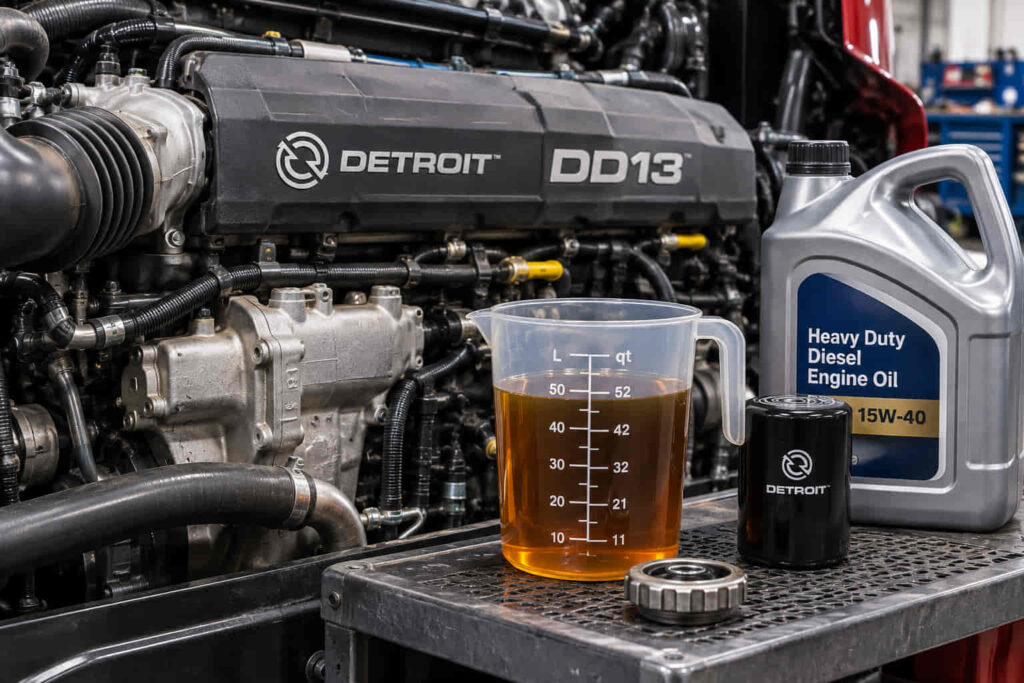
The DD13 oil capacity is approximately 40 US quarts (38 liters) when replacing the engine oil and oil filter on most modern Detroit DD13 truck engines. This specification applies to the Gen 5 DD13 and many earlier EPA07, EPA10, GHG14, and GHG17 configurations. However, certain older manuals and motorcoach applications list different refill quantities, making it important to identify the engine generation and vehicle application before servicing.
The Detroit DD13 is a 12.8-liter inline-six turbocharged diesel engine used primarily in Freightliner and Western Star commercial vehicles. Its lubrication system is designed to protect components exposed to heavy loads, high combustion pressures, and extended operating periods. Maintaining the correct oil level supports crankshaft bearings, pistons, camshafts, turbocharger bearings, and other internal components.
Detroit recommends heavy-duty diesel engine oil meeting its approved fluid specifications, including DFS 93K222 (API CK-4) or DFS 93K223 (API FA-4) for applicable engines. Oil change intervals depend on engine generation, vehicle duty cycle, fuel consumption, and operating hours rather than a single universal mileage recommendation.
Understanding the DD13 oil capacity, the difference between service-fill and dry-fill quantities, and the correct maintenance procedure helps prevent overfilling, oil starvation, and premature engine wear.
What Is the Detroit DD13 Oil Capacity?
The standard Detroit DD13 truck oil capacity is 40 US quarts (38 liters) for an engine oil and filter change. This is the service-fill specification published by Detroit for the Gen 5 DD13 and several earlier DD13 truck configurations.
The service-fill quantity represents the approximate amount of fresh oil needed after draining the existing lubricant and replacing the oil filter.
It does not represent the total amount of oil contained in a completely dry engine.
During a normal oil change, some lubricant remains inside the engine’s internal passages and other components. The amount retained depends on the lubrication system design and the draining procedure.
Detroit’s technical documentation for earlier DD13 truck engines identifies approximately 6 liters of oil remaining after a normal drain, including filter removal.
This explains why the published dry engine capacity can exceed the normal refill quantity.
For EPA07, EPA10, and GHG14 DD13 truck engines covered by the applicable operator’s manual, Detroit lists a total dry oil volume of 44 liters, equivalent to approximately 46.5 US quarts.
The same table identifies an oil and filter change quantity of 38 liters, or approximately 40.1 US quarts.
For the GHG17 DD13 truck and Gen 5 DD13, Detroit publishes a service-fill quantity of 38 liters, rounded to 40 US quarts.
The small difference between 40.0 and 40.1 quarts reflects the way the manufacturer presents rounded conversions.
In practical servicing, the final oil level should be confirmed with the dipstick.
The published 40-quart capacity is a starting reference, not permission to exceed the maximum oil level mark.
Does DD13 Oil Capacity Change by Engine Year?
Most Detroit DD13 truck engines use an approximately 40-quart oil and filter service capacity, but older manuals and different engine generations can specify slightly different quantities.
The DD13 has undergone several changes since its introduction, including updates associated with emissions standards, fuel efficiency, and engine technology.
These generations are often identified by emissions designations such as EPA07, EPA10, GHG14, GHG17, and Gen 5.
Detroit’s more recent documentation lists 38 liters, or approximately 40 quarts, for the conventional DD13 truck oil and filter service.
However, certain early Detroit operator’s manuals contain lower refill figures.
For example, an EPA07 DD13 operator’s manual published in 2009 specifies an average oil and filter change quantity of 36.6 liters, or approximately 38.7 US quarts.
A separate EPA10 manual describes different cold-engine and hot-engine draining quantities, with the hot-engine refill figure also listed near 38.7 quarts.
Later technical publications specify 38 liters for the applicable truck configurations.
This difference demonstrates why a single oil capacity figure cannot be applied blindly to every document or engine configuration.
For a 2014, 2016, or 2019 DD13 truck, the correct reference is the operator’s manual covering its specific engine generation.
For newer Gen 5 trucks, Detroit’s published specification remains 38 liters with an oil filter change.
The engine serial number and emissions configuration can help identify the correct documentation.
An engine installed as a replacement may also differ from the one originally supplied with the vehicle.
Owners should therefore verify the actual engine rather than relying only on the model year displayed on the truck’s registration.
What Is the Gen 5 Detroit DD13 Oil Capacity?
The Gen 5 Detroit DD13 requires 38 liters (40 US quarts) of engine oil for a standard oil and filter replacement. Its published oil pan operating range extends from approximately 30 liters at the low limit to 35 liters at the high limit.
The Gen 5 DD13 represents a newer version of Detroit’s 12.8-liter heavy-duty diesel engine.
Its engineering incorporates improvements intended to support efficiency, durability, and modern commercial vehicle operating requirements.
The lubrication system must maintain suitable oil delivery under demanding conditions, including sustained highway operation, frequent load changes, and heavy-duty vehicle use.
Detroit’s Gen 5 operator’s manual identifies the same 40-quart service-fill quantity commonly associated with earlier DD13 truck engines.
The manual also states that approximately 5 liters, or 5.2 US quarts, separate the low and high marks on the dipstick.
This provides an important distinction between the overall oil capacity and the amount represented by the dipstick’s operating range.
The engine does not need an additional five quarts simply because the dipstick contains a five-quart measurement range.
Instead, the dipstick indicates whether the existing oil level falls within the acceptable operating limits.
The maximum oil pan quantity should also not be confused with the total service refill.
Oil circulates through the filter, internal galleries, oil cooler, and other components in addition to residing in the sump.
The 40-quart refill specification reflects the entire lubrication system under normal service conditions.
For a Gen 5 DD13, owners should follow the current Detroit operator’s manual associated with the engine serial number and verify the level after the engine has operated and the lubricant has drained back into the pan.
How Much Oil Does a DD13 Motorcoach Engine Take?
DD13 motorcoach oil capacity can be higher than the standard truck specification, with Detroit publishing service-fill quantities ranging from approximately 42.3 to 48 US quarts for certain coach configurations.
The difference is associated with the vehicle application and lubrication system configuration.
Commercial motorcoaches may operate under different conditions and use different oil pan arrangements from highway trucks.
Detroit’s heavy-duty platform documentation identifies a 45-liter oil and filter change quantity for EPA10 DD13 coach applications.
This is equivalent to approximately 47.6 US quarts.
The same manual identifies a lower quantity of 40 liters, or approximately 42.3 quarts, for GHG14 DD13 coach applications.
For GHG17 DD13 coach engines, the published service-fill quantity returns to 45 liters, rounded to 48 quarts.
These specifications explain why a search for DD13 oil capacity may produce figures that appear inconsistent.
A value near 48 quarts may be correct for a particular coach configuration but excessive for a standard DD13 truck.
Similarly, a 42.3-quart figure should not automatically be applied to every DD13 engine simply because it appears in official Detroit documentation.
The relevant distinction is not only engine displacement but also the oil system configuration and application.
Motorcoach owners should identify the engine emissions generation and confirm the matching manual before purchasing oil.
For a conventional Freightliner or Western Star DD13 truck, the commonly published service quantity remains 40 quarts rather than the larger coach refill amount.
What Is the Difference Between DD13 Service Fill and Dry Fill?
DD13 service fill is the oil quantity required during a normal oil change, while dry fill refers to the total lubricant volume needed when the engine and lubrication system are essentially empty.
This distinction is particularly important after engine rebuilding or replacement.
In a standard oil change, the engine is drained through its oil pan and the oil filter is replaced.
However, lubricant remains in certain galleries, internal passages, and other parts of the engine.
Detroit’s earlier heavy-duty platform capacity table identifies 38 liters for a DD13 truck oil and filter change.
The same table identifies a total dry engine oil volume of 44 liters.
The approximately 6-liter difference reflects oil retained during the normal drain procedure.
A completely rebuilt engine may have different initial filling requirements because more of its internal passages and components have been emptied.
However, the exact quantity depends on how the engine was assembled and whether certain systems were already primed.
It would therefore be incorrect to assume that every rebuilt DD13 must receive exactly the published dry-fill amount without further checking.
The rebuild or installation instructions should determine the initial filling and priming procedure.
Oil pressure must be established correctly before the engine is placed under load.
For ordinary maintenance, the service-fill figure is the appropriate reference.
Adding the full dry-fill quantity during a normal oil change can result in overfilling because some used oil remains inside the engine.
The dipstick and approved oil-level checking procedure provide the final confirmation.
Why Is the DD13 Oil Pan Capacity Different From the Total Oil Capacity?
The DD13 oil pan capacity is lower than its total service-fill capacity because engine oil circulates throughout the lubrication system rather than remaining entirely inside the sump.
For the Gen 5 DD13 truck, Detroit lists a high oil pan limit of 35 liters, approximately 37 US quarts.
The low oil pan limit is 30 liters, or approximately 32 US quarts.
However, the complete oil and filter service quantity is 38 liters, or 40 US quarts.
This difference is normal.
The oil pan acts as the main reservoir for engine lubricant.
When the engine is running, the oil pump draws lubricant from the sump and distributes it through internal channels.
Oil flows to the crankshaft bearings, connecting rod bearings, camshaft components, piston cooling system, turbocharger bearings, and other parts requiring lubrication.
The filter removes contaminants from circulating oil, while the oil cooler helps control lubricant temperature.
Some oil remains distributed through these components while the engine operates.
When the engine stops, a portion drains back into the oil pan.
This is why oil-level measurements must be taken after allowing sufficient time for the lubricant to settle.
The published sump quantity should not be used as the normal refill amount after a complete oil and filter change.
Doing so could leave the engine below its intended total oil volume.
Likewise, the service-fill amount should not be poured into an engine that has not been properly drained.
Understanding the distinction helps prevent mistakes when comparing specifications from Detroit service manuals, oil pan descriptions, and third-party maintenance guides.
What Type of Oil Does a Detroit DD13 Engine Use?
Detroit recommends approved heavy-duty diesel engine oil meeting DFS 93K222 (API CK-4) or DFS 93K223 (API FA-4) for applicable DD13 engines. The exact viscosity must match the engine generation, ambient temperature, and manufacturer’s lubricant requirements.
Engine oil specification is just as important as quantity.
The DD13 operates under high combustion pressures and may run for extended periods while transporting heavy loads.
Its lubricant must protect the engine against bearing wear, piston deposits, oxidation, corrosion, and viscosity breakdown.
Detroit publishes its own fluid specifications to identify lubricants suitable for the engine.
DFS 93K222 is associated with API CK-4 heavy-duty diesel engine oil.
DFS 93K223 is associated with API FA-4 oil.
Both specifications appear in Detroit’s recommendations for applicable newer heavy-duty engines.
Detroit identifies DFS 93K223-approved FA-4 engine oil as the preferred option for optimal fuel economy in the appropriate applications.
However, API FA-4 is not universally interchangeable with every older diesel engine oil specification.
It is formulated for engines specifically approved for its use.
The engine’s emissions generation and manufacturer’s requirements must therefore be confirmed before selecting FA-4 oil.
Older EPA07 engines may have different recommendations.
Detroit’s published service information identifies DFS 93K222-approved CK-4 oil as recommended for these engines and permits certain older CJ-4 products under specified conditions and drain intervals.
An oil container displaying only a general diesel designation should not automatically be considered acceptable.
The lubricant should meet the applicable Detroit specification, not merely have a familiar viscosity grade.
Using approved oil helps maintain correct lubrication and supports the service intervals established by the manufacturer.
Is 10W-30 or 15W-40 Better for a DD13 Engine?
SAE 10W-30 is commonly associated with modern Detroit DD13 lubrication recommendations, while the suitability of 15W-40 depends on the engine’s approved oil specifications and operating conditions.
The viscosity grade describes how the oil flows under standardized low-temperature and operating-temperature conditions.
SAE 10W-30 has different viscosity characteristics from SAE 15W-40.
The 10W rating indicates a different low-temperature performance classification, while the 30 grade corresponds to a lower operating-temperature viscosity range than SAE 40.
Detroit’s fuel-economy-oriented FA-4 oil recommendations commonly involve SAE 10W-30 formulations.
These oils are designed to satisfy the performance requirements of engines approved for FA-4 lubricants.
However, choosing an oil solely because it is labeled 10W-30 is not sufficient.
A gasoline-engine 10W-30 product may not meet the heavy-duty diesel engine requirements.
The correct Detroit fluid specification must also be present.
Similarly, 15W-40 oil may be appropriate for certain older DD13 configurations and operating conditions when it meets the applicable manufacturer requirements.
It should not automatically replace a specified FA-4 10W-30 lubricant in a newer engine.
Oil viscosity influences pumpability, oil film formation, frictional losses, and cold-start lubrication.
Using a viscosity outside the recommended range may affect lubrication performance and engine efficiency.
The correct selection should therefore consider both Detroit’s fluid approval and the conditions in which the truck operates.
For maximum reliability, the engine-specific lubricant chart should take precedence over general advice that thicker oil always provides better protection.
What Is the Difference Between CK-4 and FA-4 Oil for the DD13?
API CK-4 and API FA-4 are heavy-duty diesel engine oil categories with different viscosity-related performance requirements, and the correct choice depends on Detroit’s approval for the specific DD13 application.
CK-4 oils are designed to provide protection against wear, deposits, oxidation, and other conditions encountered in modern heavy-duty diesel engines.
They are used in a broad range of diesel applications where the relevant manufacturer requirements are satisfied.
FA-4 oils are also designed for modern diesel engines but have a lower high-temperature, high-shear viscosity range than typical CK-4 lubricants.
This characteristic can help reduce frictional energy losses in engines designed for FA-4 use.
Detroit identifies DFS 93K223-approved FA-4 oil as suitable for certain DD13 applications and recommends it for optimal fuel economy.
However, this does not mean FA-4 should be used in every heavy-duty diesel engine.
Older engines and some other manufacturers’ powertrains may not approve FA-4.
For a fleet operating multiple engine brands, using one universal oil without checking compatibility can create problems.
A lubricant approved for a Gen 5 DD13 may not meet the requirements of an unrelated engine.
The approval designation on the oil container is therefore especially important.
Detroit’s DFS 93K222 and DFS 93K223 standards provide a clearer selection reference than general claims about diesel oil performance.
Oil selection should also take into account operating temperature and the appropriate viscosity.
An approved lubricant must be used consistently with the manufacturer’s specified drain interval.
Using a premium oil does not automatically authorize extending oil changes beyond Detroit’s published maintenance schedule.
Read more: 6.0 Powerstroke Firing Order
How Often Should You Change Oil in a Detroit DD13?
Detroit DD13 oil change intervals vary according to engine generation and duty cycle, with current Gen 5 maintenance schedules allowing up to 65,000 miles for qualifying efficient long-haul operation using approved oil and ultra-low-sulfur diesel fuel.
A universal oil change recommendation does not accurately represent every DD13 application.
Highway trucks can accumulate substantial mileage while operating at stable engine speeds and temperatures.
Short-haul and severe-service vehicles may experience more idling, frequent acceleration, lower average fuel economy, and greater lubricant contamination per mile.
Detroit accounts for these differences in its maintenance schedules.
The Gen 5 DD13 schedule identifies an oil change interval of 65,000 miles for qualifying efficient long-haul operation with fuel economy of at least 7.0 miles per gallon.
For long-haul applications averaging between 6.0 and 6.9 miles per gallon, the interval is 55,000 miles.
Short-haul applications averaging between 5.1 and 5.9 miles per gallon have a published interval of 40,000 miles or 1,000 operating hours, according to the relevant maintenance conditions.
Severe-service applications have an interval of 35,000 miles or 750 operating hours.
These are manufacturer-published intervals for the specified Gen 5 conditions and approved lubricants, not universal recommendations for every DD13 produced.
Earlier engines may use different schedules.
For example, Detroit’s documentation covering certain older engines operated with DFS 93K218-approved CJ-4 oil identifies shorter intervals, including 50,000 miles for qualifying long-haul use and lower limits for more demanding service.
The maintenance schedule should therefore match the engine generation, lubricant approval, fuel specification, and actual operating pattern.
The oil filter should be replaced at every scheduled engine oil change.
Does Idling and Heavy Towing Affect DD13 Oil Change Intervals?
Extended idling, low average fuel economy, frequent stop-and-go operation, and sustained heavy loads can shorten the appropriate DD13 oil change interval by increasing the demands placed on the lubricant.
Oil deterioration is influenced by more than distance traveled.
An engine can accumulate many operating hours without adding a large number of miles to the odometer.
This is common in construction-related transport, local distribution, and applications involving extended stationary operation.
During idling, fuel is still burned and combustion byproducts continue entering the engine’s lubrication environment.
The engine also continues circulating oil through its bearings, turbocharger-related passages, and other components.
Frequent short trips can increase the number of operating cycles and prevent some vehicles from maintaining stable temperatures for long periods.
Heavy loads produce additional heat and mechanical stress.
The lubricant must maintain appropriate performance while protecting components exposed to sustained combustion pressure.
These conditions influence how Detroit classifies vehicle duty cycles.
Gen 5 maintenance documentation distinguishes efficient long-haul, long-haul, short-haul, and severe-service operation partly through average fuel economy and annual mileage.
A truck that regularly operates under severe conditions should not use the maximum efficient long-haul oil change interval simply because the engine is capable of reaching that mileage.
Likewise, towing a heavy load does not automatically require an arbitrary 10,000-mile oil change if the manufacturer’s applicable duty-cycle schedule allows a different interval.
The correct maintenance plan should reflect actual operating conditions.
For commercial fleets, monitoring engine hours, fuel consumption, and maintenance history can help establish whether the current service schedule remains appropriate.
How Do You Change the Oil in a Detroit DD13 Engine?
A Detroit DD13 oil change involves draining the used lubricant, replacing the cartridge-style oil filter, installing the correct drain plug seal, refilling with approved oil, and confirming the final level and oil pressure.
Detroit’s service information recommends changing the engine oil when its temperature is approximately 60°C, or 140°F.
Oil at this temperature drains more readily than cold oil, helping the service procedure remove used lubricant from the sump.
The vehicle must be secured on a stable, level surface with the parking brake applied and appropriate safety precautions taken.
The engine should be shut down before servicing.
A suitable container with enough capacity for approximately 40 quarts of oil is essential.
Detroit’s service procedure specifies a drain container of approximately 50 US quarts or more for the relevant heavy-duty engines.
The oil filter housing should be cleaned before it is opened to prevent dirt and debris from entering the lubrication system.
The filter assembly uses a cartridge element installed inside a reusable housing.
On the applicable DD13 configuration, a suitable socket is used to remove the oil filter cap, after which the filter element can be replaced.
The sealing O-ring must be inspected and replaced as specified.
The oil filter housing should also be checked for contamination and damage to its internal standpipe and bypass valve.
After the used oil has been drained from the oil pan, the drain plug sealing component should be replaced according to the correct service instructions.
The drain plug must be tightened to the specification applicable to the installed oil pan material and design.
Fresh engine oil should then be added using the manufacturer’s recommended service-fill quantity.
For most modern DD13 trucks, this is approximately 38 liters, or 40 US quarts.
However, the full quantity should not be added without verifying the final level.
Once the filter and drain plug are secured, the engine can be started according to the approved procedure.
Oil pressure must be monitored immediately.
If the engine does not establish oil pressure within the period specified by Detroit, it should be shut down and the cause investigated.
The oil filter housing and drain plug should be inspected for leakage before the service is considered complete.
How Do You Check the Oil Level on a DD13 Engine?
The Detroit DD13 oil level should be checked with the truck parked on level ground, the engine stopped, and sufficient time allowed for oil to return to the sump.
The correct procedure is important because checking the dipstick immediately after shutting down a hot engine may produce an inaccurate reading.
When the engine operates, a portion of the lubricant circulates through the oil filter, internal oil passages, cylinder head, turbocharger, and other components.
After shutdown, much of this oil gradually drains back into the oil pan.
Detroit’s heavy-duty platform documentation provides specific settling requirements.
When the engine has reached an oil temperature of approximately 60°C, or 140°F, certain DD13 procedures allow an accurate measurement after approximately five minutes of shutdown on level ground.
When the engine has not reached that temperature, the manual specifies a longer settling period of approximately 60 minutes for an accurate reading.
Because checking instructions can differ between engine generations and procedures, the manual applicable to the exact DD13 should be followed.
The dipstick should be removed, wiped clean, fully reinserted, and removed again to obtain the final reading.
The oil level should remain within the marked operating range.
Detroit identifies a difference of approximately 5 liters, or 5.2 quarts, between the low and high dipstick marks on modern DD13 applications.
This means the difference between the marks is substantial, but it does not mean the engine should always be topped off to the absolute maximum.
Detroit specifically warns against adding oil when the reading is already within the acceptable crosshatched range.
If the oil level falls below the approved range, the correct lubricant should be added gradually.
Excessive oil should never be added simply to reach a predetermined number of quarts.
How Much Oil Should You Add When a DD13 Is Low?
The amount of oil needed to top off a DD13 depends on its actual dipstick reading, not on its total 40-quart service capacity.
A truck requiring a small oil-level correction should not receive the same quantity as an engine undergoing a complete oil change.
The dipstick provides the appropriate reference.
On the Gen 5 DD13, Detroit identifies approximately 5 liters, equivalent to 5.2 US quarts, between the lower and upper dipstick limits.
If the oil level is at the lower mark, the total difference to the upper mark is therefore about five liters.
However, the quantity needed at any intermediate reading will be smaller.
The engine should be parked on level ground and checked according to the applicable oil-temperature and settling procedure.
When topping off the engine, the same approved oil specification and appropriate viscosity should be used.
Adding oil in controlled amounts reduces the risk of overfilling.
The dipstick should be checked again after the lubricant has had sufficient time to settle.
An oil reading within the manufacturer’s acceptable range generally does not require additional oil.
Repeated top-offs may indicate an underlying problem.
Oil consumption can increase because of engine wear, turbocharger-related issues, crankcase ventilation problems, or external leakage.
If oil levels decline unusually quickly, the truck should be inspected rather than relying indefinitely on additional oil.
A sudden loss of oil accompanied by a low oil pressure warning requires immediate attention.
Maintaining the correct level helps protect the engine, but identifying the cause of abnormal oil loss is equally important.
What Happens If You Overfill a DD13 Engine With Oil?
Overfilling a Detroit DD13 engine can interfere with lubrication and crankcase ventilation, potentially causing oil aeration, increased oil consumption, and internal engine damage.
The DD13 is designed to operate with a specified quantity of oil inside its lubrication system.
The oil pan provides enough space for the crankshaft assembly and associated components to operate without excessive contact with the stored oil.
When the level becomes too high, rotating components may interact with the oil in unintended ways.
Under certain conditions, this can cause aeration or foaming.
Aerated oil may not maintain the same continuous lubricating film as properly circulated liquid oil.
This can interfere with reliable lubrication.
Excessive oil can also increase pressure or oil movement within the crankcase ventilation system.
Oil may enter areas where it does not belong, potentially contributing to intake contamination or abnormal oil consumption.
Turbocharged diesel engines require particular attention because the turbocharger depends on suitable oil supply and drainage.
Incorrect crankcase pressure or oil return conditions can contribute to turbocharger lubrication problems.
However, the effect depends on the degree of overfilling.
A small amount above the dipstick’s maximum mark does not necessarily cause immediate engine failure, but it should still be corrected.
Substantial overfilling is more serious and should be addressed before the truck returns to normal service.
Detroit explicitly warns that exceeding the approved oil level can damage the engine.
The proper refill procedure is therefore to use the published capacity as a reference and verify the final quantity through the dipstick rather than assuming that more oil provides better engine protection.
What Happens If a DD13 Engine Runs With Too Little Oil?
Insufficient engine oil can damage a Detroit DD13 by reducing lubrication to critical components, increasing friction, and potentially causing severe bearing or turbocharger failure.
The DD13 uses pressurized lubrication to protect numerous internal components.
The oil pump draws lubricant from the sump and circulates it through passages leading to the crankshaft bearings, connecting rod bearings, camshaft assemblies, piston cooling components, and turbocharger.
When the oil level becomes too low, the lubrication system may struggle to maintain adequate oil delivery under certain conditions.
Acceleration, braking, cornering, and operating on an incline can cause oil to move inside the sump.
If the oil pickup becomes exposed, the engine may experience an interruption in lubrication.
Even a brief interruption can be serious when the engine is operating under heavy load.
Connecting rod and main bearings depend on a continuous oil film to separate moving metal surfaces.
Loss of this film can cause rapid frictional damage and increased temperature.
The turbocharger also relies on a dependable supply of lubricant.
Oil starvation can damage its bearings and lead to expensive repairs.
A low oil pressure warning should therefore never be ignored.
If the engine indicates inadequate oil pressure, the truck should be stopped safely and the engine shut down.
Continuing to operate the engine while oil pressure is insufficient can turn a relatively manageable problem into a major mechanical failure.
It is also important to distinguish oil quantity from oil pressure.
A normal oil level does not guarantee that the oil pump, filter, or internal lubrication system is functioning correctly.
Likewise, an engine may lose oil without immediately displaying an oil pressure warning.
Regular dipstick checks and prompt investigation of abnormal pressure readings are both essential.
Why Is a DD13 Losing or Consuming Engine Oil?
A Detroit DD13 may lose engine oil because of external leaks, turbocharger-related problems, crankcase ventilation faults, internal wear, or abnormal operating conditions.
Oil loss should first be classified as external leakage or internal consumption.
An external leak allows lubricant to escape through a gasket, seal, connection, or other component.
Oil residue may appear around the oil pan, valve cover, oil filter housing, turbocharger oil connections, or other lubrication system interfaces.
Because heavy-duty engines contain substantial oil volumes, a slow leak may continue for some time before creating an obvious level warning.
However, even a small persistent leak can become significant over thousands of miles.
Internal oil consumption occurs when lubricant enters the combustion process or another engine airflow path.
Worn piston rings or cylinder walls can allow excessive oil to pass into the combustion chambers.
Crankcase ventilation problems may also influence oil movement.
Turbocharger bearing and sealing issues can permit abnormal oil transfer into the intake or exhaust system.
Blue or blue-gray exhaust smoke may indicate oil burning, although smoke appearance alone is not sufficient to establish the cause.
Oil consumption should be evaluated using measured quantities over a known operating distance or engine-hour period.
The vehicle’s operating conditions matter because high-load operation and extended idling can produce different consumption patterns.
Fuel dilution or coolant contamination may also affect oil level readings, sometimes making the crankcase level rise rather than fall.
If the level increases unexpectedly, contamination should be investigated.
The correct diagnosis may involve checking external leaks, crankcase pressure, turbocharger condition, oil consumption history, and used-oil analysis.
An engine that consistently requires additional oil should not be considered healthy solely because the total sump capacity is large.
Can Oil Analysis Help Determine DD13 Oil Change Intervals?
Used-oil analysis can help evaluate the condition of Detroit DD13 engine oil and identify contamination or abnormal wear, but Detroit does not recommend using it simply to extend service beyond approved drain intervals.
Oil analysis examines a sample of used lubricant to identify changes associated with engine operation.
Measurements may include viscosity, soot concentration, fuel dilution, water contamination, coolant-related indicators, and wear metals.
These results provide information that cannot be determined reliably by looking at the oil’s color.
Diesel engine oil often darkens during normal operation because it carries soot and other combustion byproducts.
Dark oil is therefore not automatically an indication that the lubricant has reached the end of its useful life.
However, excessive soot or abnormal viscosity can affect lubrication.
Fuel dilution can reduce oil viscosity and interfere with the lubricant’s intended performance.
Coolant contamination is particularly concerning because water and glycol can damage bearings and other internal components.
Wear metal trends may indicate abnormal contact between moving surfaces.
Detroit publishes guidance for interpreting oil analysis results within its lubrication technical literature.
The company also recommends used-oil analysis as a tool for evaluating engine and lubricant condition.
However, the manufacturer’s guidance states that oil analysis should not be used to maximize or extend oil drain intervals beyond the appropriate schedule.
Instead, analysis can identify situations where the oil must be replaced sooner.
For commercial fleets, consistent sampling can help establish trends across many operating hours.
A sudden increase in contamination or wear-related measurements may justify further inspection.
Oil analysis is most valuable when combined with correct maintenance intervals, engine operating data, and mechanical inspection.
It does not replace regular oil changes or the need to maintain the correct oil level.
Does the DD13 Need Synthetic Engine Oil?
A Detroit DD13 can use synthetic engine oil when the product meets the applicable Detroit fluid specification, but synthetic formulation alone does not authorize a longer oil change interval.
Synthetic lubricants are formulated to provide controlled viscosity performance and suitable protection under demanding operating conditions.
Depending on the formulation, they may offer advantages in low-temperature flow, oxidation resistance, and maintaining viscosity characteristics.
However, the term synthetic does not automatically mean an oil is approved for every DD13 engine.
The lubricant must still meet the appropriate Detroit Fluids Specification.
For suitable newer applications, DFS 93K222-approved CK-4 oil and DFS 93K223-approved FA-4 oil are identified in Detroit’s recommendations.
The selected viscosity must also meet the engine’s requirements.
An unapproved synthetic lubricant may be less suitable than a correctly approved conventional or synthetic-blend diesel oil.
Detroit also cautions that synthetic oil does not, by itself, permit extending the recommended service interval.
The correct drain schedule remains tied to the engine generation, fuel specification, duty cycle, and approved lubricant.
Supplemental oil additives should also be approached cautiously.
Detroit states that approved engine oils already contain balanced additive packages intended to meet the engine’s requirements.
Adding aftermarket oil treatments can alter that balance and may create undesirable effects.
For a DD13 operating under demanding commercial conditions, the priority should be using an approved lubricant and maintaining it according to the applicable schedule.
Choosing oil based solely on marketing claims about synthetic protection or extended drain performance can lead to incorrect maintenance decisions.
Is DD13 Oil Capacity the Same as DD15 and DD16?
No. The Detroit DD13 generally requires 40 US quarts during a standard truck oil and filter change, while the DD15 and DD16 typically require approximately 45 US quarts under the corresponding newer service specifications.
These engines belong to Detroit’s heavy-duty diesel platform but use different displacements and lubrication system configurations.
The DD13 has a displacement of approximately 12.8 liters.
The DD15 has a displacement of approximately 14.8 liters, while the DD16 is a larger 15.6-liter engine.
Different engine dimensions and oil system requirements influence the amount of lubricant needed.
For GHG17 engine configurations, Detroit identifies a service-fill quantity of 38 liters for the DD13 truck.
The DD15 and DD16 truck engines are listed at 43 liters, or approximately 45 US quarts.
For earlier EPA07, EPA10, and GHG14 documentation, the DD15 and DD16 oil and filter change quantity is identified as 43 liters, approximately 45.4 quarts.
The DD13 remains listed at 38 liters, or approximately 40.1 quarts, in the same table.
These differences explain why using a generic Detroit diesel oil capacity figure can lead to overfilling or underfilling.
A DD15 service-fill quantity should not be used when servicing a DD13.
Similarly, oil pan capacity and dry-fill specifications differ between the engine families.
The correct capacity must correspond to the actual engine installed in the truck.
Before servicing, the engine model should be verified through its identification label, engine serial number, or manufacturer documentation.
This is especially important when trucks have undergone engine replacement or other major modifications.
How Much Does a DD13 Oil Change Cost?
The cost of a DD13 oil change depends primarily on the price of approximately 40 quarts of approved diesel engine oil, the replacement oil filter, labor, and any additional maintenance performed during the service.
The DD13 requires substantially more lubricant than a passenger car or light-duty pickup.
A normal oil and filter change uses approximately 10 US gallons of oil.
As a result, lubricant cost represents a significant portion of the service expense.
The price varies depending on the oil brand, Detroit approval, viscosity, packaging, and purchasing volume.
Commercial fleets purchasing oil in bulk may pay a different price per gallon than independent operators buying individual containers.
The correct oil filter is another necessary expense.
Detroit’s cartridge-style filtration system requires an element compatible with the specific engine configuration.
The filter’s sealing components must also be installed correctly to prevent leakage or improper filtration.
Labor costs vary according to the service provider.
A truck serviced at a commercial repair facility may incur charges for technician time, shop supplies, and used-oil disposal.
Some operators perform their own maintenance when they have the appropriate equipment and experience.
However, safe handling of approximately 40 quarts of used oil requires suitable collection and storage equipment.
An oil change may also coincide with fuel filter replacement, chassis lubrication, inspection services, or other scheduled maintenance.
These additional services can increase the total invoice.
The most meaningful cost comparison is therefore based on the complete service performed rather than the price of engine oil alone.
Using an unapproved lubricant to reduce expenses can create greater financial risk than the amount saved during one oil change.
How Can You Confirm the Correct DD13 Oil Capacity?
The most reliable way to confirm DD13 oil capacity is to identify the engine’s emissions generation and application, then consult the matching Detroit operator’s manual or an authorized Detroit service location.
The engine serial number is particularly useful because Detroit produced different versions of the DD13 over time.
A 12.8-liter engine installed in an older truck may have documentation that differs from the Gen 5 version.
The vehicle application also matters.
Standard truck engines usually follow the approximately 40-quart service-fill specification.
However, certain coach applications require larger quantities.
A service manual should be checked for the exact engine and vehicle combination before purchasing replacement oil.
The capacity table must also be interpreted correctly.
Service fill refers to the amount added during a normal oil and filter change.
Dry fill refers to the lubricant quantity required when the lubrication system is essentially empty.
Oil pan capacity describes the operating quantity within the sump rather than the total amount circulating through the engine.
Confusing these specifications can cause an incorrect refill.
The oil filter should match the engine configuration, and the lubricant must meet the correct Detroit fluid approval.
After the oil has been changed, the engine should be operated according to the service procedure and checked for leakage.
The final level must be verified using the manufacturer’s dipstick procedure.
If the engine has a nonstandard oil pan, has undergone significant modification, or uses a specialized vehicle installation, the original specifications may not apply.
In those situations, confirmation from Detroit service documentation or an authorized service provider is especially important.
Final Verdict: How Much Oil Does a DD13 Take?
The Detroit DD13 oil capacity is approximately 40 US quarts (38 liters) for a normal oil and filter change on most modern truck applications. This includes the Gen 5 DD13 and many EPA07, EPA10, GHG14, and GHG17 truck configurations.
Certain older Detroit manuals identify refill quantities near 38.7 quarts, while DD13 motorcoach engines can require approximately 42.3 to 48 quarts depending on the emissions generation and oil system configuration.
These differences are why the correct engine documentation should always be checked.
For the Gen 5 DD13, Detroit specifies a 40-quart service refill, an oil pan high limit of approximately 37 quarts, and a difference of around 5.2 quarts between the low and high dipstick marks.
The oil pan volume should not be mistaken for the total oil and filter change quantity.
Approved lubricants for applicable engines include products meeting Detroit DFS 93K222 (API CK-4) or DFS 93K223 (API FA-4), with viscosity selected according to the engine’s requirements.
Oil change intervals also vary by operating conditions.
Current Gen 5 schedules specify intervals of up to 65,000 miles for qualifying efficient long-haul operation, with shorter intervals for long-haul, short-haul, and severe-service applications.
For a standard modern DD13 truck, 40 US quarts is the correct starting reference, but the final oil level must always be confirmed using the engine’s approved dipstick checking procedure.
Using the correct oil specification, replacing the filter at the required interval, avoiding overfilling, and monitoring oil consumption are essential for maintaining DD13 engine performance and long-term reliability.