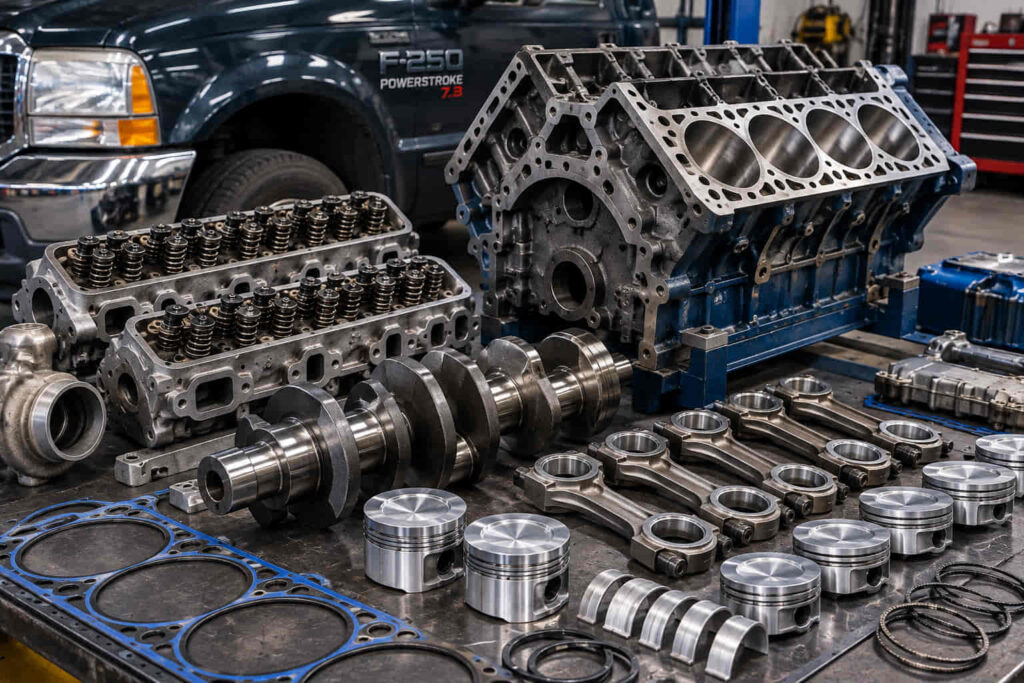
A 7.3 Powerstroke engine rebuild involves restoring the mechanical condition, compression, lubrication system, and reliability of Ford’s legendary 7.3-liter turbocharged diesel engine. Depending on the condition of the original engine, rebuilding may require replacing pistons, piston rings, bearings, gaskets, seals, and worn valvetrain components while machining the cylinder block, crankshaft, and cylinder heads to the correct specifications.
The 7.3L Power Stroke diesel, produced for Ford applications from 1994 through 2003, is widely recognized for its durable cast-iron construction, hydraulic electronic unit injection (HEUI) system, and ability to withstand demanding towing and commercial workloads. However, high mileage, inadequate lubrication, overheating, fuel contamination, and mechanical wear can eventually make an overhaul necessary.
A 7.3 Powerstroke rebuild can cost several thousand dollars for parts and machine work, while a professionally installed remanufactured engine may cost substantially more. Actual expenses depend on cylinder condition, crankshaft wear, cylinder head damage, injector health, and the quality of replacement components.
Understanding the rebuild process helps owners decide whether to repair their existing engine, install a remanufactured long block, or invest in a complete performance-oriented rebuild.
What Is a 7.3 Powerstroke Engine Rebuild?
A 7.3 Powerstroke engine rebuild is the process of disassembling, inspecting, machining, and reassembling the engine to restore worn internal components to acceptable operating specifications. The objective is to recover proper cylinder compression, oil pressure, combustion efficiency, and long-term mechanical reliability.
The 7.3L Power Stroke is a 444-cubic-inch turbocharged V8 diesel developed by International, now known as Navistar, and used extensively in Ford trucks and commercial vehicles.
Its engine block and cylinder heads are manufactured from cast iron, providing a durable foundation for rebuilding.
The engine features a bore of approximately 4.11 inches and a stroke of 4.18 inches. Its original compression ratio is approximately 17.5:1, although actual compression depends on piston configuration and engine condition.
Unlike conventional mechanically injected diesel engines, the 7.3 Powerstroke uses hydraulically actuated, electronically controlled unit injectors. High-pressure engine oil provides the hydraulic force required to operate the fuel injectors.
This system makes engine oil quality, oil pressure, and internal sealing especially important during a rebuild.
A complete rebuild normally involves inspecting the cylinder block, crankshaft, connecting rods, pistons, cylinder heads, camshaft, and lubrication components.
Worn parts are replaced, and reusable components are measured and machined where necessary.
The engine’s supporting systems, including fuel injectors, the high-pressure oil pump, turbocharger, and cooling system, should also be evaluated.
A rebuild is different from a simple repair because it addresses the overall mechanical condition of the engine rather than replacing only one failed component.
However, the exact definition varies between workshops. A basic overhaul may replace limited internal components, while a complete rebuild can involve extensive machine work and replacement of nearly every major wear component.
Is the 7.3 Powerstroke Engine Worth Rebuilding?
The 7.3 Powerstroke is often worth rebuilding when the engine block and crankshaft remain serviceable, the truck is otherwise in good condition, and the cost of restoration is lower than replacing the vehicle or installing another engine.
One of the main advantages of the 7.3 Powerstroke is its heavy-duty construction.
The cast-iron engine block, robust crankshaft, and relatively straightforward overhead-valve design provide a strong foundation for extended service.
Compared with some newer diesel engines, the 7.3 Powerstroke has fewer emissions-related components and does not use the complex aftertreatment systems found on many modern diesel trucks.
Its fuel injection system is electronically controlled but mechanically different from modern common-rail diesel systems.
These characteristics have contributed to the engine’s reputation for durability.
Nevertheless, rebuilding is not automatically the best option for every high-mileage truck.
The condition of the cylinder block is particularly important. Severe cracking, extensive cylinder damage, or other structural problems can make rebuilding uneconomical.
The surrounding vehicle also matters.
A truck with a healthy transmission, solid frame, functioning drivetrain, and limited corrosion may justify significant engine investment.
Conversely, a truck with extensive rust, transmission failure, electrical problems, and worn suspension components may require more money than its overall condition warrants.
The intended use should influence the decision.
Owners who depend on their trucks for towing, commercial operation, or long-distance transportation may benefit from restoring a known engine with properly documented machine work.
A well-executed rebuild can extend the useful life of an otherwise dependable truck, provided the engine’s supporting systems are also restored.
What Are the Signs That a 7.3 Powerstroke Needs a Rebuild?
Common signs that a 7.3 Powerstroke may need rebuilding include low cylinder compression, excessive blow-by, persistent low oil pressure, internal engine knocking, severe oil consumption, and metal contamination in the engine oil.
These symptoms can indicate substantial internal wear, but they do not automatically prove that a complete rebuild is necessary.
Excessive crankcase blow-by is one of the most frequently discussed symptoms.
Blow-by occurs when combustion gases escape past the piston rings and enter the crankcase.
A certain amount of blow-by is normal in internal combustion engines, but unusually high crankcase pressure may indicate worn piston rings, damaged cylinder walls, or other sealing problems.
Heavy oil consumption can provide another warning sign.
If engine oil repeatedly enters the combustion chambers through worn piston rings or damaged cylinders, the engine may produce blue-gray exhaust smoke.
However, oil consumption can also result from turbocharger problems, external leaks, or crankcase ventilation issues.
Low oil pressure is another concern.
Worn crankshaft bearings, an inadequate oil supply, or oil pump problems can affect lubrication pressure.
Because the 7.3 Powerstroke uses engine oil for both lubrication and injector actuation, oil-related problems deserve careful investigation.
Unusual mechanical noises may also indicate internal damage.
A deep knocking sound that changes with load can be associated with connecting rod bearings or other rotating components.
Persistent coolant contamination, unexplained overheating, or compression loss may suggest damage involving the cylinder heads, head gaskets, or engine block.
Nevertheless, a difficult-starting 7.3 Powerstroke may have an injector, glow plug, wiring, or high-pressure oil system problem rather than worn pistons or bearings.
A proper diagnosis is essential before committing to an expensive rebuild.
How Do You Diagnose a 7.3 Powerstroke Before Rebuilding?
A 7.3 Powerstroke should undergo compression testing, lubrication system evaluation, electronic diagnostics, and inspection for internal wear before a complete rebuild is authorized.
The diagnostic process should begin with the symptoms that originally caused concern.
A truck that starts poorly when hot may require a different investigation from an engine producing heavy blow-by or knocking noises.
Compression testing can help evaluate the condition of piston rings, cylinder walls, and valve sealing surfaces.
When one cylinder produces significantly lower compression than the others, the cause may involve a damaged piston, worn cylinder, leaking valve, or head gasket problem.
A cylinder leakage test can provide additional information by identifying where compressed air escapes.
Crankcase pressure evaluation helps determine whether excessive combustion gases are passing into the crankcase.
Oil pressure should also be measured using suitable equipment and compared with the factory specifications under the appropriate operating conditions.
The 7.3 Powerstroke’s HEUI system introduces another important diagnostic requirement.
The high-pressure oil system must generate sufficient hydraulic pressure to operate the injectors correctly.
Problems involving the injector pressure regulator, injector control pressure sensor, high-pressure oil pump, or injector sealing components can create symptoms resembling mechanical engine wear.
Electronic diagnostics can help evaluate injector operation, engine speed signals, and available high-pressure oil data.
An injector contribution test may identify individual cylinders that are not producing the expected power.
The cooling system should also be pressure-tested when internal coolant leakage is suspected.
Used engine oil and oil filters may be inspected for metallic particles, fuel dilution, or coolant contamination.
Combining these measurements helps determine whether the engine requires internal rebuilding or a less extensive repair.
How Much Does a 7.3 Powerstroke Engine Rebuild Cost?
The cost of a 7.3 Powerstroke engine rebuild depends on the amount of machine work, replacement parts, labor, and whether the project involves a short block, long block, or complete engine assembly.
A basic rebuild of a serviceable engine may involve replacement piston rings, bearings, gaskets, seals, and selected valvetrain components.
A more extensive overhaul may require new pistons, replacement connecting rods, crankshaft machining, cylinder head restoration, and additional lubrication system repairs.
Professional diesel engine machine work can become a substantial expense because precision inspection and machining require specialized equipment.
Cylinder boring and honing, crankshaft grinding, connecting rod resizing, and cylinder head pressure testing may all be necessary.
For comparison, a U.S. supplier, MTZ Engine Rebuilders, has advertised certain 7.3 Powerstroke remanufactured long blocks starting around $4,000, before applicable core deposits, shipping, installation, and additional components.
Other remanufactured engine suppliers advertise more comprehensive configurations at considerably higher prices. Some premium long-block packages exceed $9,000, depending on included components and specifications.
These figures represent supplier examples rather than a fixed national rebuild price.
The total cost of a professionally installed engine can be substantially higher once removal, installation, fluids, hoses, fuel-system work, and other labor are included.
A custom rebuild can also exceed the price of a remanufactured long block if extensive damage or high-performance components are involved.
The cheapest quote is not necessarily the best value.
Two rebuild estimates may differ because one includes professionally machined cylinder heads, tested injectors, and a restored oil system, while another includes only basic internal replacement parts.
Owners should compare the actual work performed, component specifications, testing procedures, and warranty coverage before choosing a rebuild service.
What Parts Are Needed for a 7.3 Powerstroke Engine Rebuild?
A complete 7.3 Powerstroke rebuild generally requires replacement piston rings, main bearings, connecting rod bearings, gaskets, seals, and any internal components that fail inspection. Pistons, connecting rods, camshaft components, and cylinder head parts may also require replacement depending on wear.
A rebuild kit provides many of the standard internal parts needed to restore the engine.
However, the contents of a kit vary between suppliers.
Some kits contain primarily gaskets, seals, and bearings. Others include pistons, rings, and more extensive internal components.
Piston selection depends on the final cylinder bore dimensions.
If the cylinders require machining to an oversize diameter, the replacement pistons and rings must match the finished bore.
Bearing sizes also depend on crankshaft and housing measurements.
A crankshaft that has been reground may require undersize bearings, while a crankshaft retaining its original journal dimensions may use standard-size bearings if all clearances meet specifications.
Cylinder head gaskets should match the engine configuration and required specifications.
Head fasteners must also be evaluated according to the service procedure. Certain fasteners may require replacement rather than reuse.
Valve seals, injector seals, and cooling system sealing components are important because aged seals can create fluid leaks even when the main engine components remain mechanically sound.
The oil pump and related lubrication components should be inspected carefully.
However, replacing every component without evaluating its condition is not always necessary.
A properly planned rebuild uses actual inspection measurements to determine which components can be reused and which require replacement.
The engine serial number, model year, and intended horsepower level should be confirmed before ordering a complete rebuild kit.
How Do You Remove and Disassemble a 7.3 Powerstroke Engine?
A 7.3 Powerstroke engine rebuild begins with removing the engine or gaining suitable access for the intended repair, then disassembling its external systems and internal components in a controlled sequence.
A complete out-of-frame rebuild generally requires removing the engine from the vehicle.
The 7.3L Power Stroke is a heavy cast-iron diesel engine, so appropriate lifting equipment, load-rated engine supports, and safe workshop procedures are essential.
Before removal, the batteries should be disconnected and engine fluids drained according to the service procedure.
The air intake system, intercooler connections where fitted, exhaust connections, cooling system hoses, electrical harnesses, fuel connections, and relevant accessories must be separated.
The turbocharger and related components may need to be removed to provide access.
During disassembly, wiring connectors, fasteners, brackets, and hoses should be identified so that they can be returned to their correct locations.
Photographs and component labeling can reduce assembly errors, particularly on engines that have undergone previous modifications.
Once the engine is secured on a suitable stand, external accessories can be removed.
The valve covers, rocker assemblies, pushrods, cylinder heads, oil system components, and timing components are then disassembled as required.
The crankshaft, pistons, connecting rods, and camshaft can be removed for inspection.
Components should be organized by their original positions whenever reuse is possible.
This is particularly important for bearing caps, connecting rods, and other parts that must maintain their original orientation.
The objective is not simply to remove the components but to preserve enough information to identify wear patterns and determine why the engine failed.
Disassembly findings should guide the subsequent inspection and machining process.
How Do You Inspect and Machine the 7.3 Powerstroke Engine Block?
The 7.3 Powerstroke engine block must be inspected for cracks, cylinder wear, bore distortion, deck damage, and main bearing housing alignment before rebuilding.
The cast-iron block forms the structural foundation of the engine.
Although it is durable, years of combustion pressure, thermal cycling, and mechanical loading can produce measurable wear.
After disassembly, the block should be thoroughly cleaned to remove oil sludge, carbon deposits, coolant residue, and debris.
Oil galleries and coolant passages require particular attention because contamination left inside the block can damage newly installed bearings and other components.
The block should then be inspected for cracking using an appropriate method for cast iron.
Cylinder bores must be measured at multiple heights and directions to identify taper, out-of-round conditions, and excessive wear.
A cylinder can appear smooth while still being too distorted to provide proper piston ring sealing.
If the cylinder dimensions remain within acceptable limits, controlled honing may be sufficient to restore the required surface finish.
However, cylinders with excessive wear or damage may need to be bored to an approved oversize and finished with a compatible honing process.
The final cylinder dimensions must match the replacement pistons and the specified piston-to-wall clearance.
Cylinder wall condition is especially important in a diesel engine because combustion pressures are relatively high.
The deck surfaces should also be checked for flatness and damage.
Excessive distortion can prevent proper cylinder head gasket sealing.
The main bearing housing bores should be measured to verify alignment and dimensional accuracy.
If correction is required, the machine shop must perform the appropriate operation while maintaining the engine’s specified geometry.
The block should not be reassembled until all machining work has been completed, the dimensions have been verified, and the oil passages are clean.
Should You Replace Pistons and Piston Rings During a 7.3 Powerstroke Rebuild?
Pistons and piston rings should be inspected during every major 7.3 Powerstroke rebuild and replaced when wear, damage, incorrect clearances, or cylinder machining makes reuse unsuitable.
The piston assembly performs several essential functions.
It transfers combustion pressure to the connecting rod, supports compression sealing through the piston rings, and helps transfer heat to the cylinder walls.
The piston rings provide the seal between the piston and cylinder wall while controlling the amount of lubricating oil remaining on the bore surface.
As the engine accumulates operating hours, the rings and cylinder walls gradually wear.
Excessive ring wear can reduce cylinder compression and allow combustion gases to escape into the crankcase.
This condition contributes to blow-by and can increase oil consumption.
Pistons should be inspected for cracks, ring land damage, abnormal skirt wear, and evidence of overheating.
The piston ring grooves must also be evaluated to determine whether the rings can maintain proper movement and sealing.
When cylinders are bored to an oversize diameter, appropriately sized pistons and rings are required.
Piston-to-cylinder clearance and ring end gap must be measured according to the selected component manufacturer’s specifications.
Improper ring end gap can cause significant problems.
If the gap is too small, thermal expansion may cause the ring ends to contact each other during operation, potentially damaging the piston or cylinder.
Excessive gap can reduce sealing efficiency.
The finished cylinder wall surface also influences how quickly new piston rings seat during break-in.
For an engine intended for higher horsepower or sustained heavy loads, upgraded pistons may be considered.
However, performance parts should be selected as part of a complete engine design rather than installed solely because they are marketed as stronger.
How Do You Rebuild the Crankshaft and Main Bearings?
Rebuilding the 7.3 Powerstroke crankshaft assembly involves checking journal wear, straightness, surface condition, and bearing clearances before installing new main and connecting rod bearings.
The crankshaft converts piston movement into rotational output.
Each combustion event transfers force through a connecting rod to the crankshaft journals.
Over time, inadequate lubrication, contamination, excessive loading, or normal wear can damage the crankshaft bearing surfaces.
The crankshaft should be cleaned and visually inspected for scoring, discoloration, cracks, and other signs of damage.
Precision measurements are necessary to determine whether the journals remain within the approved diameter and roundness limits.
A journal with excessive wear or damage may require grinding and polishing by a qualified machine shop.
If the crankshaft is machined to a smaller journal diameter, the corresponding bearing size must be selected to maintain the specified oil clearance.
Bearing clearance is particularly important because it affects the relationship between oil film thickness, engine load, and lubrication pressure.
Excessive clearance can contribute to oil pressure loss and bearing damage.
Insufficient clearance can restrict the formation of an appropriate oil film and create overheating or seizure risks.
The engine block’s main bearing housing bores must also be checked.
Correct crankshaft dimensions alone do not guarantee proper bearing alignment.
During assembly, the crankshaft should rotate smoothly with the bearings and caps installed to specification.
Crankshaft endplay must also be verified.
The correct bearing dimensions and tightening procedures should come from the applicable Ford or International service documentation and the selected bearing manufacturer’s instructions.
Reusing damaged bearings or installing new bearings on improperly machined journals can shorten the life of a freshly rebuilt engine.
Should You Upgrade the Connecting Rods in a 7.3 Powerstroke?
Connecting rod upgrades are most relevant when rebuilding a 7.3 Powerstroke for substantially increased horsepower, especially if the engine originally uses powdered-metal connecting rods.
The connecting rods transfer force from the pistons to the crankshaft.
Their strength and dimensional accuracy are essential for maintaining correct piston movement and reliable operation under high cylinder pressure.
The 7.3 Powerstroke used different connecting rod designs during its production history.
Earlier engines generally used forged steel connecting rods, while later production incorporated powdered-metal rods.
The transition occurred during the 2001 production period, meaning the model year alone does not reliably identify every engine’s original rod design.
The engine serial number or physical inspection can help establish which components are installed.
Both designs were developed for factory operating conditions, but their behavior under substantially increased mechanical loading can differ.
For a stock-power rebuild intended for normal towing and daily operation, the existing connecting rods may be reusable if they meet all dimensional and inspection requirements.
However, a performance rebuild involving larger fuel injectors, greater turbocharger boost, and significantly increased torque may justify upgraded rods.
Connecting rods should be inspected for bending, twisting, cracks, and wear at the bearing and piston pin interfaces.
The connecting rod big-end bore must remain within its specified dimensions.
Any required resizing or bushing replacement should be performed by a qualified machine shop.
Rod bolts and other fasteners also require attention because improper clamping can lead to bearing failure.
The decision to install performance rods should reflect the engine’s intended cylinder pressure and operating conditions rather than a universal horsepower claim.
How Do You Rebuild 7.3 Powerstroke Cylinder Heads?
Rebuilding 7.3 Powerstroke cylinder heads involves inspecting the cast-iron head castings, valves, valve guides, seats, springs, and injector sleeves to restore proper combustion sealing and valvetrain operation.
The 7.3 Powerstroke uses two cast-iron cylinder heads, each containing four cylinders.
Its overhead-valve arrangement uses two valves per cylinder, giving the engine a total of 16 valves.
The cylinder heads manage intake airflow, exhaust gas discharge, fuel injector positioning, and combustion chamber sealing.
During a rebuild, both heads should be cleaned and inspected for cracking, corrosion, and damage caused by overheating.
Pressure testing can help identify internal leaks that may not be visible during an external inspection.
The cylinder head sealing surfaces must also be checked for flatness.
A distorted head can prevent proper gasket sealing and contribute to coolant loss or combustion gas leakage.
Valve seats and valve faces should be inspected for wear, pitting, and poor sealing.
Damaged valves may require replacement, while usable components may be restored through appropriate machining.
Valve guides should be measured to confirm that valve stem clearance remains within specification.
Excessive clearance can affect valve movement and sealing performance.
Valve springs must also be inspected for correct pressure and physical condition.
Weak or damaged springs may contribute to improper valve operation, particularly at elevated engine speeds.
The injector bores and surrounding sealing areas deserve special attention because the 7.3 Powerstroke delivers fuel and high-pressure oil to the injectors through passages in the cylinder heads.
The brass injector sleeves, also called injector cups, must be inspected for cracking and sealing problems.
Proper cylinder head restoration is essential because a newly machined bottom end cannot deliver reliable performance if the valves or injector sealing surfaces are defective.
Should You Replace Injector Cups During a 7.3 Powerstroke Rebuild?
Injector cups should be inspected during a 7.3 Powerstroke rebuild and replaced when cracking, leakage, looseness, or damage is present. Some rebuilders choose to replace the complete set while the cylinder heads are already disassembled.
Each fuel injector fits into a brass sleeve installed within the cylinder head.
The sleeve helps separate the injector assembly from engine coolant while supporting heat transfer.
Over time, repeated thermal cycling and vibration can contribute to sleeve damage.
A cracked injector cup may allow diesel fuel to enter the cooling system.
This is a well-known problem associated with the 7.3 Powerstroke.
Fuel contamination may appear as an oily sheen or diesel odor in the coolant reservoir.
However, fluid contamination should be diagnosed rather than assuming the injector cups have failed.
A damaged cylinder head or another sealing problem can produce related symptoms.
Injector cup replacement requires specialized removal and installation tools.
The old sleeve must be removed without damaging the cylinder head bore.
The replacement cup must then be installed using the correct retaining compound and specified procedure.
Improper installation may result in coolant leakage, fuel contamination, or injector sealing problems.
Because access is easier when the cylinder heads and injectors are already being serviced, a rebuild provides an opportunity to address questionable injector sleeves.
Replacing damaged injector cups can help prevent a newly rebuilt engine from developing coolant contamination shortly after installation.
Do Fuel Injectors Need to Be Rebuilt With the Engine?
Fuel injectors do not automatically require replacement during every 7.3 Powerstroke rebuild, but they should be tested and serviced when their operating condition is uncertain.
The 7.3 Powerstroke uses hydraulically actuated electronic unit injectors, commonly referred to as HEUI injectors.
These injectors use high-pressure engine oil to actuate the internal mechanism responsible for injecting diesel fuel.
Unlike modern common-rail systems, the 7.3 Powerstroke does not rely on a shared high-pressure fuel rail to create its injection pressure.
Fuel is supplied to the injectors, while hydraulic oil pressure provides the force that drives the injection process.
Each injector depends on precise internal components and reliable sealing.
Worn injector components can cause rough idling, poor starting, reduced power, excessive smoke, and uneven combustion.
Injector O-rings are particularly important because they separate oil and fuel passages.
Damaged seals can allow fluid contamination or hydraulic pressure losses.
The injector copper sealing washer also contributes to proper sealing at the combustion chamber.
During an engine rebuild, injector components should be inspected for contamination, damaged seals, and evidence of abnormal operation.
Professional injector testing can help determine whether the injectors remain suitable for service.
Replacing injectors without testing may create unnecessary expenses, but reinstalling badly worn injectors can compromise the operation of an otherwise properly rebuilt engine.
A critical safety consideration is the possibility of fuel or oil accumulating inside the cylinders during injector removal.
Excess liquid must be evacuated using the approved service procedure before attempting to crank the engine.
Attempting to start an engine with liquid trapped in a cylinder can cause hydrolock and severe mechanical damage.
Should You Replace the High-Pressure Oil Pump During a 7.3 Powerstroke Rebuild?
The 7.3 Powerstroke high-pressure oil pump should be evaluated during a rebuild because it is essential to injector operation, but replacement should depend on testing and component condition.
The high-pressure oil pump, commonly called the HPOP, supplies pressurized engine oil to the HEUI injection system.
This oil pressure operates the hydraulic mechanisms inside the fuel injectors.
The engine control module manages injection operation partly through the injector pressure regulator and injector control pressure feedback.
When the system cannot maintain adequate pressure, the engine may experience difficult starting, rough running, loss of power, or failure to start.
However, these symptoms do not automatically indicate that the high-pressure oil pump has failed.
Leaking injector seals, control valve problems, damaged high-pressure oil lines, or inaccurate sensor signals can also affect operation.
During a rebuild, the pump should be inspected for leakage, abnormal wear, and evidence of contamination.
The associated oil passages, fittings, and seals require attention as well.
A pump with internal wear may fail to provide adequate oil volume or pressure under certain operating conditions.
Ford’s Motorcraft remanufacturing documentation identifies internal pump housing wear and control-surface deterioration among the conditions that can affect high-pressure oil pump performance.
Professional testing should determine whether the pump can be reused or requires replacement.
Installing a new pump without correcting leaks elsewhere in the high-pressure oil system may not resolve the problem.
For a stock-output rebuild, a properly functioning original-specification pump may be sufficient.
Higher-output injectors may require a different evaluation of the oil system’s capacity.
The correct pump configuration should match the engine generation, injection system, and intended performance level.
Read more: What Causes Backfire in an Engine
What Oil System Components Should Be Replaced During the Rebuild?
The 7.3 Powerstroke lubrication system should be inspected for worn pump components, restricted passages, damaged seals, and contamination before the rebuilt engine is returned to service.
Engine oil performs two particularly important functions in the 7.3 Powerstroke.
It lubricates the engine’s bearings, pistons, camshaft, and other moving surfaces while also providing hydraulic energy to operate the HEUI injectors.
Because these systems depend on a clean and reliable oil supply, oil contamination can have consequences beyond conventional bearing wear.
The low-pressure lubrication system must provide appropriate oil circulation throughout the engine.
The oil pump, pickup tube, pressure-related components, and internal galleries should be checked for damage and restriction.
The oil cooler also deserves attention.
It transfers heat between the engine oil and cooling system, helping control oil temperature during sustained operation.
Damaged oil cooler seals may cause external leakage or fluid contamination.
Depending on the condition of the cooler, cleaning, resealing, or replacement may be appropriate.
Oil passages must be thoroughly cleaned after machining because abrasive debris can damage bearings and injector components.
The high-pressure oil reservoir and associated passages should also be inspected.
Any significant oil contamination that caused the original failure must be addressed before reassembly.
Installing new bearings and pistons into an engine with dirty oil galleries can lead to rapid failure.
The finished lubrication system should be capable of establishing the required oil pressure before the engine is operated under load.
Should You Rebuild or Replace the 7.3 Powerstroke Turbocharger?
The 7.3 Powerstroke turbocharger should be inspected during an engine rebuild and repaired or replaced if excessive shaft wear, oil leakage, housing damage, or compressor problems are found.
The factory 7.3 Powerstroke uses a fixed-geometry turbocharger to increase the amount of air available for combustion.
Earlier applications commonly used Garrett TP38 turbochargers, while later engines used GTP38 configurations.
Turbocharger and intake arrangements differ by model year and vehicle application.
The turbocharger is driven by exhaust gas energy.
Exhaust gases spin a turbine connected to a compressor that pressurizes the intake air.
This process allows the engine to burn additional fuel efficiently and produce more torque than it could without boost.
However, the turbocharger operates at very high rotational speeds and depends on reliable lubrication.
Oil contamination, restricted oil supply, or excessive exhaust temperatures can damage its bearings and internal components.
During a rebuild, the turbocharger should be inspected for evidence of contact between rotating components and the housing.
Oil leakage, unusual mechanical noise, damaged compressor blades, and excessive bearing wear may indicate that service is needed.
The turbocharger oil supply and drain passages should also be inspected for restriction or damage.
If the turbocharger remains in good condition, replacing it may not be necessary.
However, installing a damaged turbocharger on a freshly rebuilt engine can create additional problems, including oil consumption, reduced boost pressure, and contamination of the intake system.
For performance builds, a larger turbocharger may be considered, but it must be matched to the engine’s fuel delivery and intended operating range.
How Important Is the Cooling System During a 7.3 Powerstroke Rebuild?
The cooling system is essential to a reliable 7.3 Powerstroke rebuild because improper coolant circulation, overheating, or internal leakage can damage cylinder heads, gaskets, and other engine components.
Diesel engines generate substantial heat during combustion, particularly when towing or operating under sustained heavy loads.
The cooling system transfers heat away from the cylinder walls, cylinder heads, and other engine areas.
During a rebuild, the radiator, water pump, thermostat, hoses, coolant passages, and related components should be evaluated.
The water pump must circulate sufficient coolant to maintain the intended operating temperature.
A damaged water pump or restricted coolant passage may cause overheating even when the rebuilt engine’s internal components are new.
The thermostat must also function correctly.
A thermostat stuck closed can restrict coolant circulation and cause overheating, while one stuck open may prevent the engine from reaching its intended temperature efficiently.
Coolant condition is especially important in older diesel engines.
The correct coolant chemistry and maintenance procedures help protect internal metal surfaces against corrosion and other forms of deterioration.
Cylinder wall cavitation is frequently discussed in connection with older Ford 7.3-liter diesel engines, particularly the earlier indirect-injection IDI family.
The 7.3 Powerstroke is a different engine design, so IDI-specific cavitation repair recommendations should not automatically be applied to the Powerstroke.
Nevertheless, the correct coolant formulation and any required supplemental coolant additives should be selected according to the specific Powerstroke model and coolant system requirements.
A complete rebuild should address the original cause of overheating if temperature-related damage contributed to the engine failure.
Failing to repair a faulty radiator, water pump, or cooling system restriction can quickly compromise a rebuilt engine.
How Do You Reassemble a 7.3 Powerstroke Engine Correctly?
Correct 7.3 Powerstroke engine reassembly requires clean components, verified mechanical clearances, proper lubrication, and precise adherence to the applicable service manual’s tightening procedures.
The engine should not be assembled until all machining work has been completed and inspection measurements have been confirmed.
Cleanliness is critical.
Metal particles, abrasive residue, and remaining machining debris can damage bearings and other components during initial startup.
The crankshaft is installed with appropriately sized bearings and assembly lubricant.
Bearing clearances and crankshaft endplay should be checked using suitable measuring equipment.
Connecting rods and pistons must be assembled according to the specified orientation.
Piston ring end gaps, ring positioning, and piston-to-cylinder clearances should meet the requirements of the selected components.
The camshaft, lifters, and timing components must be installed while maintaining the correct relationship between valve timing and crankshaft position.
Cylinder heads should be installed only after their sealing surfaces and internal components have passed inspection.
The proper head gasket specifications, fastener procedures, and tightening sequence must be followed.
The valvetrain should then be assembled with the required component alignment and clearances.
The 7.3 Powerstroke uses hydraulic roller lifters, so its normal factory valvetrain arrangement does not require the same routine valve lash adjustments associated with solid-lifter designs.
However, pushrod condition, rocker arm wear, lifter operation, and overall valvetrain geometry still require inspection.
Fuel injectors must be installed with the correct seals and approved procedures.
The lubrication system, turbocharger connections, cooling components, and external accessories can then be assembled.
All torque values and tightening sequences should be obtained from the service information applicable to the exact engine configuration.
Using generic torque specifications from another Powerstroke engine can cause sealing problems or mechanical damage.
Are Head Studs Necessary for a Rebuilt 7.3 Powerstroke?
Head studs are not automatically required for a stock-power 7.3 Powerstroke rebuild, but upgraded fasteners may be beneficial in engines designed for substantially increased cylinder pressure.
The cylinder head fasteners provide the clamping force that maintains the seal between the cylinder heads, gaskets, and engine block.
During operation, combustion pressure acts on the cylinder heads and attempts to separate them from the block.
The fasteners must maintain sufficient clamping force to preserve the sealing surfaces.
For a stock-output engine, properly selected factory-specification head fasteners are generally appropriate when installed according to the correct procedure.
Performance applications may impose greater demands.
Increasing turbocharger boost and fuel delivery can raise cylinder pressure, placing additional stress on the head gasket sealing system.
Some engine builders choose aftermarket head studs to improve clamping consistency and support higher-load operation.
However, head studs do not compensate for incorrect surface preparation, damaged cylinder heads, poor gasket selection, or inadequate tightening procedures.
Stud installation may also involve different torque or lubrication requirements compared with factory bolts.
These procedures should follow the specific fastener manufacturer’s instructions.
For a daily-driven towing truck remaining near its original power level, head studs may not provide enough practical benefit to justify the additional expense.
For an aggressive performance build, they may be a reasonable supporting modification.
The decision should be based on the intended engine configuration and the recommendations of the engine builder.
Can You Rebuild a 7.3 Powerstroke Engine Yourself?
A 7.3 Powerstroke engine can be rebuilt by an experienced DIY mechanic, but a complete rebuild requires precision measuring equipment, safe lifting equipment, diesel engine knowledge, and access to a qualified machine shop.
Mechanical disassembly and reassembly are only part of the work.
A successful rebuild also requires accurate evaluation of internal component wear.
Cylinder bore measurements, crankshaft journal inspection, bearing clearance verification, and cylinder head assessment must be performed correctly.
Without these measurements, a rebuilt engine may contain new parts while retaining the original mechanical problems.
Specialized tools are often necessary.
An engine hoist and suitable stand are required for safe handling.
Precision micrometers, bore gauges, and other measuring equipment are needed for internal inspection.
Injector service may require dedicated tools because the HEUI injectors and brass cups have specific installation requirements.
The 7.3 Powerstroke’s high-pressure oil injection system also introduces complexity that is less familiar to mechanics accustomed to conventional gasoline engines.
A workshop manual is essential because the correct tightening sequences, clearances, timing relationships, and installation procedures cannot be reliably determined from general engine rebuild advice.
Even experienced DIY builders typically outsource cylinder boring, honing, crankshaft grinding, and cylinder head machining.
The cost advantage of DIY rebuilding depends on how much work can be performed correctly without specialized shop labor.
Mistakes involving piston ring clearance, bearing installation, injector sealing, or mechanical timing can destroy expensive components.
For owners with limited diesel rebuilding experience, professional machine work combined with careful assembly may provide a better balance between cost and reliability.
Is It Better to Rebuild or Buy a Remanufactured 7.3 Powerstroke Engine?
Rebuilding the existing 7.3 Powerstroke may provide better control over component selection, while purchasing a remanufactured engine can simplify the replacement process and provide more predictable assembly quality when supplied by a reputable rebuilder.
A custom rebuild allows the owner to retain the original engine block if it remains serviceable.
This can be useful for trucks with matching original components or specialized engine configurations.
The builder can select replacement pistons, bearings, connecting rods, and other components based on the intended application.
However, the final cost and completion time may be uncertain until the engine has been disassembled and inspected.
Unexpected cracks, damaged crankshaft journals, or severe cylinder wear can increase expenses.
A remanufactured engine is assembled by a supplier using a defined restoration process.
Depending on the manufacturer, the engine may include a rebuilt short block, cylinder heads, valvetrain, and other components.
A short block generally contains the assembled lower engine components, while a long block normally adds the cylinder heads and associated valvetrain.
The exact contents are not standardized across all suppliers.
Some long blocks include additional accessories, while others require the buyer to reuse the original turbocharger, fuel injectors, high-pressure oil pump, and external components.
Ford and Motorcraft have offered remanufactured 7.3L Power Stroke engines in several build levels.
Ford describes inspection and testing procedures intended to verify the performance of remanufactured units.
When evaluating a replacement, the owner should review the supplier’s component list, compatibility requirements, warranty terms, core return policy, and installation conditions.
A remanufactured engine may provide better value when the original block or crankshaft has extensive damage.
A custom rebuild may be preferable when the original engine is structurally sound and the owner wants specific internal components or performance characteristics.
What Performance Upgrades Can Be Added During a 7.3 Powerstroke Rebuild?
A 7.3 Powerstroke rebuild provides an opportunity to strengthen internal components and prepare the engine for higher horsepower, but performance upgrades should match the intended workload and fuel system capacity.
For an engine intended primarily for daily driving and towing, reliability may be more valuable than maximum horsepower.
A stock-style rebuild with correctly machined cylinders, suitable pistons, dependable bearings, and properly functioning injectors can restore much of the engine’s original performance.
For higher-output applications, upgraded connecting rods may be considered.
This is particularly relevant for engines originally equipped with powdered-metal rods that will be subjected to substantially greater loads than their factory operating conditions.
Forged pistons or other performance piston designs may also be appropriate for demanding builds.
However, material selection alone does not determine reliability.
Compression ratio, piston-to-cylinder clearance, ring end gap, combustion temperature, and fuel calibration all influence durability.
Fuel injector upgrades can increase the amount of diesel delivered during combustion.
Larger injectors may support more horsepower, but they also require suitable high-pressure oil supply and engine management calibration.
The turbocharger must provide enough airflow to support the increased fuel quantity.
Insufficient airflow can contribute to excessive exhaust gas temperatures, smoke, and poor efficiency.
A suitable intercooler, exhaust system, and monitoring equipment may help manage operating conditions.
Head fasteners, valve springs, and lubrication components should also be evaluated as the performance target increases.
The transmission and drivetrain must be capable of handling the additional torque.
A balanced performance rebuild improves the complete engine combination rather than installing isolated upgrades that create new weaknesses.
How Do You Start a Newly Rebuilt 7.3 Powerstroke Engine?
The first startup of a rebuilt 7.3 Powerstroke requires the lubrication, high-pressure oil, fuel, and cooling systems to be prepared correctly before the engine is allowed to run.
Initial startup is a critical stage because newly installed bearings, piston rings, and other components depend on an adequate oil supply.
The engine should be filled with an appropriate diesel engine oil that meets the service requirements.
A typical 7.3 Powerstroke oil and filter change requires approximately 15 US quarts of engine oil.
However, an engine that has been completely disassembled may have additional empty oil passages, high-pressure oil components, or reservoirs that require priming according to the relevant service procedure.
The final oil level should always be verified rather than assuming that the routine refill quantity covers every condition.
The high-pressure oil system requires special attention because the HEUI injectors cannot function properly without adequate hydraulic oil pressure.
The fuel system must also be prepared so that the injectors receive fuel correctly.
Air remaining in the systems after major service can cause extended cranking or delayed starting.
Before cranking, all injector bores and combustion chambers must be confirmed free of excess fuel, oil, and coolant.
This precaution is especially important after injector removal because liquid can accumulate inside the cylinders.
A cylinder containing excessive liquid can hydrolock and damage internal engine components during cranking.
The cooling system should be filled and checked for leaks.
Electrical connectors, sensor connections, intake plumbing, and exhaust components should also be verified.
Once the engine starts, oil pressure and operating behavior should be monitored immediately.
Unusual mechanical noises, severe leaks, or abnormal temperature changes require prompt shutdown and investigation.
The objective of the first startup is to establish stable operation without exposing the new internal components to unnecessary stress.
How Do You Break In a Rebuilt 7.3 Powerstroke Engine?
A rebuilt 7.3 Powerstroke should be broken in according to the engine builder’s instructions to allow piston rings and cylinder walls to establish proper contact while protecting new bearings and other components.
Break-in procedures vary because rebuilds may use different piston rings, cylinder finishes, camshaft components, and bearing materials.
A professionally rebuilt engine may also have undergone initial testing before delivery.
For this reason, there is no universal break-in schedule that applies to every 7.3 Powerstroke rebuild.
One of the most important goals is proper piston ring seating.
The rings must establish effective contact with the cylinder walls to maintain compression and control oil consumption.
The cylinder honing finish plays a major role in this process.
The engine should not be operated with excessive load or RPM until its initial operating condition has been verified and the builder’s procedure permits it.
However, prolonged idling without appropriate operating conditions may also be undesirable for ring seating in some rebuilds.
Manufacturers and professional rebuilders may recommend controlled variation in engine load rather than extended operation at one constant speed.
Oil pressure, coolant temperature, and exhaust behavior should be monitored throughout the initial operating period.
The engine should be inspected for oil leaks, coolant leaks, and fuel system problems.
Oil and filter replacement during the initial service period should follow the engine builder’s recommendations.
An early inspection can also help identify abnormal contamination or mechanical wear before it develops into a major failure.
Heavy towing, aggressive acceleration, and performance tuning should be postponed until the engine has completed the specified break-in process and has demonstrated stable operation.
How Long Will a Rebuilt 7.3 Powerstroke Engine Last?
A properly rebuilt 7.3 Powerstroke can provide many additional years of service, but its lifespan depends on machining quality, component selection, operating conditions, and maintenance rather than a guaranteed mileage figure.
The original 7.3 Powerstroke is known for its durability, and many engines have accumulated substantial mileage in towing and commercial applications.
However, a rebuild does not automatically return every component in the vehicle to new condition.
The rebuilt engine may contain restored internal parts while continuing to use an older turbocharger, fuel system, cooling system, and electrical components.
These supporting systems can influence the engine’s long-term reliability.
For example, a defective injector can cause poor combustion and potentially damage internal components.
A failing cooling system can cause overheating even when the cylinder heads and pistons have recently been rebuilt.
Oil quality is particularly important because the HEUI injection system and internal engine components both depend on the engine’s lubrication supply.
Using the correct oil, replacing filters at the specified intervals, and monitoring operating temperatures can reduce the risk of premature wear.
Fuel quality and filtration also affect injector performance.
For trucks used in demanding towing applications, excessive exhaust gas temperature and sustained high engine load can increase mechanical stress.
Monitoring engine condition and addressing small problems early helps protect the rebuild investment.
A professionally machined engine with suitable components and proper calibration has a much better chance of achieving long service life than one assembled without accurate measurements.
No responsible rebuilder can guarantee a specific mileage solely from the engine’s design.
Reliability depends on the complete quality of the rebuild and the way the vehicle is operated afterward.
What Are the Most Common 7.3 Powerstroke Rebuild Mistakes?
The most common 7.3 Powerstroke rebuild mistakes include inadequate diagnosis, incorrect component measurements, poor cleaning, reused damaged parts, and failure to inspect the HEUI injection and cooling systems.
One major mistake is rebuilding an engine before confirming that internal mechanical wear is responsible for the symptoms.
A hard-starting engine may have a high-pressure oil problem, failing glow plugs, injector wiring faults, or an electronic control issue.
Replacing pistons and bearings will not correct these problems.
Another mistake is assuming that the cylinder block and crankshaft can be reused without precision measurement.
New piston rings cannot compensate for excessive cylinder taper or an unsuitable honing finish.
Likewise, new crankshaft bearings may fail rapidly if journal dimensions or alignment are incorrect.
Contamination is another serious concern.
Machining residue left inside oil passages can circulate through the engine during startup and damage newly installed components.
Injector sealing is especially important on the 7.3 Powerstroke because oil and fuel travel through passages in the cylinder heads.
Incorrect injector O-ring installation can cause fluid leakage and injection system problems.
Failing to remove oil or fuel from the cylinders after injector work can create a risk of hydrolock.
Improper fastener procedures can also cause problems.
Cylinder head bolts, connecting rod fasteners, main bearing caps, and other critical components require the correct tightening methods and specifications.
Using general torque values from unrelated engines is not appropriate.
Another mistake is overlooking the original cause of failure.
If overheating damaged the engine, the cooling problem must be repaired.
If contaminated oil damaged the bearings, the source of contamination must be eliminated.
A successful rebuild restores both the engine components and the supporting conditions required for reliable operation.
How Can You Maintain a Rebuilt 7.3 Powerstroke for Maximum Reliability?
Maintaining a rebuilt 7.3 Powerstroke requires correct diesel engine oil, reliable fuel filtration, appropriate coolant maintenance, and regular monitoring of engine operating conditions.
Engine oil maintenance is particularly important because the 7.3 Powerstroke uses its oil for lubrication and hydraulic fuel injector operation.
Contaminated or degraded oil can affect both systems.
The correct viscosity depends on ambient temperature and the applicable manufacturer requirements.
Many 7.3 Powerstroke applications specify heavy-duty diesel oil in viscosity grades such as 15W-40 under suitable temperature conditions, with other approved grades for colder environments.
Owners should use oil meeting the relevant engine specifications rather than choosing viscosity based only on availability.
The oil filter should be replaced at the required service interval.
Fuel filters also require regular attention because contamination can affect injector performance.
Water entering the fuel system should be addressed promptly to reduce corrosion and injector damage.
The cooling system should be maintained with the proper coolant formulation and concentration.
Coolant condition and any applicable additive requirements should follow the specific engine’s service documentation.
The turbocharger depends on a clean oil supply and appropriate operating temperatures.
After heavy towing or sustained high-load operation, following the manufacturer’s operating and shutdown guidance can help manage turbocharger temperatures.
Unusual exhaust smoke, increasing blow-by, oil consumption, or declining performance should be investigated early.
Electrical connections and injector wiring should also be kept in good condition.
A rebuilt engine can deliver dependable service only when its supporting systems continue operating correctly.
Consistent maintenance is generally more valuable than relying on aftermarket additives to compensate for missed service.
What Is the Difference Between a 7.3 Powerstroke Rebuild and an IDI Diesel Rebuild?
The 7.3 Powerstroke and the earlier Ford 7.3 IDI are different diesel engine designs, so their rebuild parts, fuel injection systems, service procedures, and internal specifications should not be treated as interchangeable.
Ford used a 7.3-liter indirect-injection diesel engine in trucks before the Powerstroke was introduced.
The IDI engine uses a mechanically controlled fuel injection system that delivers fuel into a precombustion chamber.
The later 7.3 Powerstroke uses direct injection with electronically controlled HEUI injectors.
Its engine oil system plays an important role in fuel injector actuation, creating different diagnostic and maintenance requirements.
The Powerstroke also uses a different engine architecture and supporting systems.
Although both engines have approximately 7.3 liters of displacement and were associated with International engine development, their pistons, cylinder heads, injectors, and many other components are different.
This distinction matters when purchasing rebuild kits.
A product advertised for a Ford 7.3 diesel engine may be intended for the older IDI rather than the Powerstroke.
The engine model, production year, and part numbers must be checked before ordering.
Owners should also avoid confusing the diesel Powerstroke with Ford’s modern 7.3-liter gasoline V8, commonly called the Godzilla engine.
The gasoline 7.3 is an entirely different powerplant with different components and rebuild requirements.
For a 1994–2003 Powerstroke rebuild, parts should be selected specifically for the correct 7.3L direct-injection diesel configuration.
What Should You Look for in a Professional 7.3 Powerstroke Engine Rebuilder?
A reliable 7.3 Powerstroke engine rebuilder should provide documented inspection procedures, accurate machining specifications, clear component descriptions, and meaningful warranty coverage.
The quality of the rebuild depends heavily on workmanship.
A shop specializing in diesel engines should understand the 7.3 Powerstroke’s cast-iron block, cylinder head design, HEUI injection system, and oil circulation requirements.
Before authorizing the work, owners should understand what is included in the quoted price.
Some shops rebuild only the short block, while others provide complete long-block or drop-in engine assemblies.
The difference can substantially affect the final installation expense.
A professional rebuilder should explain how the cylinder bores, crankshaft journals, connecting rods, and cylinder heads are inspected.
The shop should also identify whether original components are reused, machined, or replaced.
Machine shop records and component measurements help demonstrate that the engine has been assembled to the intended specifications.
Testing procedures are another important consideration.
Some remanufacturing companies perform oil system testing, compression-related checks, or dynamometer testing before delivery.
Ford states that its remanufactured 7.3 Powerstroke long-block and complete engine configurations undergo running and testing procedures.
Warranty details should be reviewed carefully.
Coverage may differ for parts, labor, commercial use, overheating, installation errors, and performance modifications.
Core deposit policies and return conditions also affect the total cost.
The most dependable rebuild is one supported by transparent specifications and verifiable quality control rather than claims that the engine is simply stronger or better than new.
Final Verdict: Is a 7.3 Powerstroke Engine Rebuild a Good Investment?
A 7.3 Powerstroke engine rebuild can be a worthwhile investment when the original engine has a serviceable block and crankshaft, the truck remains mechanically sound, and the rebuild is performed with accurate machining and quality components.
The engine’s cast-iron construction, durable V8 architecture, and established aftermarket support make it a practical candidate for restoration.
However, successful rebuilding requires more than replacing piston rings and bearings.
Cylinder bores must be measured and machined correctly, crankshaft and connecting rod clearances must meet specification, and cylinder heads must be inspected for sealing problems.
The HEUI injection system requires particular attention because the high-pressure oil pump, injectors, injector seals, and oil passages affect both starting performance and engine operation.
The turbocharger, oil cooler, and cooling system should also be evaluated to prevent existing problems from damaging the rebuilt engine.
For owners who want a reliable towing or daily-driving truck, a properly executed stock-style rebuild may offer the best balance between cost and durability.
Performance-oriented rebuilds can incorporate upgraded connecting rods, pistons, head fasteners, and fuel system components, but these modifications should be designed around realistic horsepower and operating requirements.
A remanufactured long block may be preferable when the original engine has extensive damage or when a professionally assembled replacement offers better value.
The most important factor in a successful 7.3 Powerstroke engine rebuild is restoring the complete engine system to reliable operating condition, not simply installing new internal parts.
Careful diagnosis, precise machine work, correct assembly procedures, and consistent maintenance provide the strongest foundation for extending the life of Ford’s 7.3-liter Power Stroke diesel.