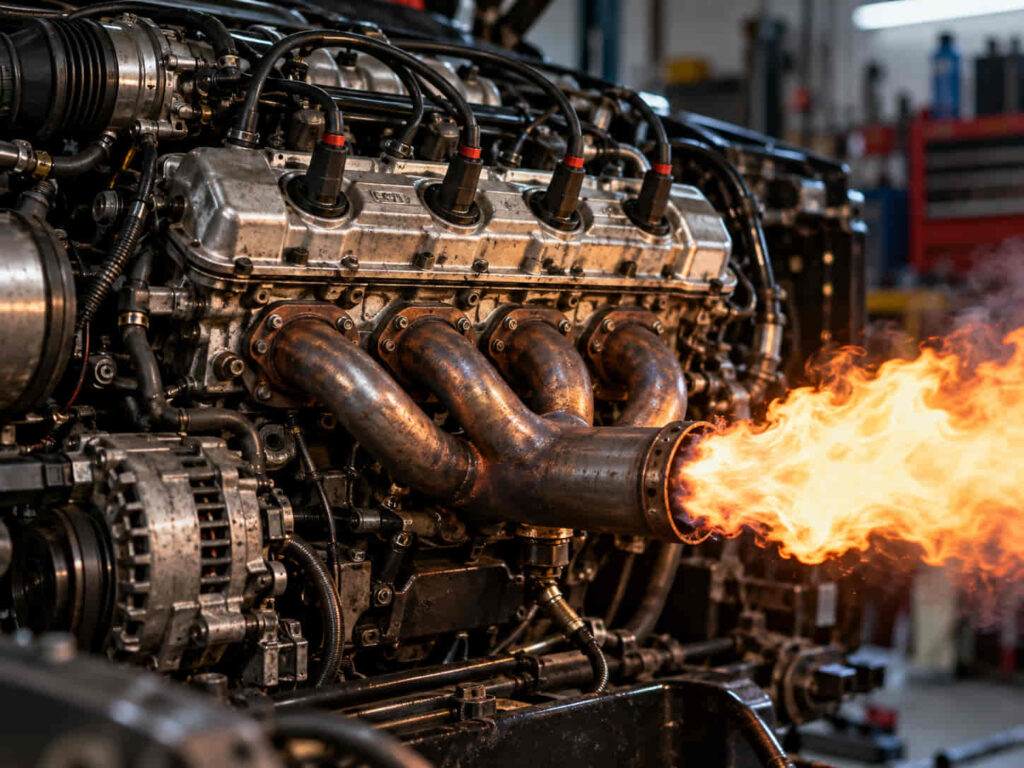
What causes backfire in an engine? Engine backfiring occurs when an air-fuel mixture ignites at the wrong time or burns outside the intended combustion process, producing a sudden popping, banging, or explosive sound. The most common causes include incorrect ignition timing, lean or rich air-fuel mixtures, faulty spark plugs, damaged ignition coils, vacuum leaks, fuel delivery problems, and improper valve timing.
An engine can backfire through the intake manifold or produce a similar combustion event in the exhaust system. Intake backfires generally involve combustion traveling backward into the intake passages, while exhaust backfires occur when unburned fuel ignites inside the exhaust system. Although both conditions create unusual noises, they often have different mechanical causes.
Occasional exhaust popping may occur during deceleration in certain performance vehicles, but repeated backfiring accompanied by rough idling, hesitation, reduced power, or a check engine light usually indicates a problem requiring attention. Understanding when and where the backfire occurs helps identify its cause and determine the appropriate repair.
What Is Engine Backfiring and How Does It Happen?
Engine backfiring is an abnormal combustion event that occurs when a combustible mixture ignites in the intake system or exhaust system rather than burning entirely within the combustion chamber at the intended time.
In a typical four-stroke gasoline engine, the piston moves through intake, compression, power, and exhaust strokes. During the intake stroke, the engine draws air into the cylinder and mixes it with fuel, either before the intake valve or through direct fuel injection.
The piston then compresses the mixture, and the spark plug ignites it at a carefully controlled point near the end of the compression stroke. Combustion pressure forces the piston downward, generating torque at the crankshaft.
After the power stroke, the exhaust valve opens and the piston pushes the burned gases into the exhaust manifold.
Under normal operating conditions, combustion occurs in a controlled manner within the cylinder. However, problems with fuel delivery, ignition timing, or valve operation can interrupt this process.
If combustion propagates toward the intake manifold while an intake valve is open, a pressure wave may travel backward through the intake system. This can create a sharp popping sound near the air filter, throttle body, or carburetor.
When unburned fuel enters the exhaust system and encounters enough oxygen and an ignition source, it may ignite inside the exhaust manifold, catalytic converter region, or exhaust piping.
The resulting pressure wave produces the loud bang commonly described as an exhaust backfire.
Technically, combustion within the exhaust system is often called afterfire, while backfire can refer more specifically to combustion traveling backward through the intake. However, in everyday automotive terminology, both events are commonly described as engine backfiring.
The distinction matters because intake and exhaust combustion problems often require different diagnostic procedures.
What Are the Most Common Causes of Engine Backfire?
The most common causes of engine backfire are incorrect ignition timing, improper air-fuel ratio, ignition system misfires, vacuum leaks, fuel system faults, and mechanical valve timing problems. These conditions interfere with the engine’s ability to ignite and burn fuel at the correct point in its operating cycle.
Ignition timing is particularly important because the spark plug must fire when the piston and valves are positioned appropriately for combustion.
If ignition occurs at an incorrect point, the flame may develop while an intake or exhaust valve is open, or combustion may continue later than intended.
Fuel mixture problems can produce similar symptoms.
An excessively lean mixture contains too little fuel relative to the available air. Under certain operating conditions, this can cause unstable or unusually slow combustion and contribute to an intake backfire.
An excessively rich mixture contains more fuel than the engine can burn efficiently. Unburned fuel may enter the exhaust system, where it can ignite and produce a loud pop.
Faulty spark plugs and ignition coils are another frequent cause.
If a cylinder fails to ignite its fuel charge, part of the unburned mixture may pass into the exhaust. When suitable ignition conditions exist, the accumulated fuel can produce an exhaust backfire.
Vacuum leaks, failing fuel pumps, restricted injectors, and inaccurate engine sensor signals can all disrupt the air-fuel ratio.
Mechanical problems involving valves, timing chains, or camshafts may also create backfiring by disrupting the relationship between piston movement and valve operation.
The exact cause often becomes clearer when the backfire is evaluated alongside its location, engine temperature, vehicle speed, and driving conditions.
What Is the Difference Between Intake Backfire and Exhaust Backfire?
Intake backfire occurs when combustion travels backward into the intake system, while exhaust backfire occurs when unburned fuel or combustible gases ignite inside the exhaust system.
An intake backfire usually creates a sharp popping sound near the engine compartment.
In carbureted vehicles, the sound may originate directly from the carburetor. In fuel-injected engines, it may be heard around the intake manifold, throttle body, or air filter housing.
The underlying problem often involves incorrect ignition synchronization, an excessively lean mixture, or a valve that is not sealing or operating correctly.
For example, if an intake valve remains open while combustion occurs, pressure and flame can travel toward the intake passage.
This reverse combustion event can damage intake components, vacuum connections, or the air filter assembly in severe cases.
Exhaust backfire produces a different sound because combustion occurs after the gases have left the engine’s cylinders.
When a cylinder misfires or receives excessive fuel, unburned hydrocarbons may enter the exhaust system.
If oxygen is available and the exhaust temperature is sufficiently high, these gases can ignite and create a loud bang.
An exhaust leak may contribute to this condition by allowing fresh oxygen into the exhaust stream.
The sound of an exhaust backfire often comes from underneath the vehicle or near the tailpipe rather than from the engine’s intake system.
Exhaust combustion can damage mufflers, exhaust piping, and catalytic converters when the pressure or temperature becomes excessive.
Identifying the location of the sound is therefore one of the most useful early steps in diagnosing an engine backfire.
Can Incorrect Ignition Timing Cause an Engine to Backfire?
Incorrect ignition timing can cause an engine to backfire because combustion may begin too early, too late, or in the wrong cylinder relative to piston and valve movement.
Ignition timing determines when the spark plug fires in relation to crankshaft position.
In a correctly operating gasoline engine, the spark generally occurs shortly before the piston reaches top dead center on the compression stroke. This provides time for combustion pressure to develop as the piston begins its power stroke.
When ignition timing is excessively retarded, the spark occurs later than intended.
Combustion may continue while the exhaust valve begins opening, increasing the amount of heat and combustible material entering the exhaust system.
Under suitable conditions, this can contribute to exhaust popping and afterfire.
Incorrectly advanced ignition timing can also cause abnormal combustion, excessive cylinder pressure, and engine knocking.
However, ignition timing that is too advanced does not automatically produce an intake backfire. Reverse combustion is more directly associated with ignition or flame propagation occurring while the intake path is open.
On older distributor-equipped engines, crossed spark plug wires or an incorrectly installed distributor can deliver ignition energy to the wrong cylinder.
This can create severe intake backfires, difficult starting, or complete failure to start.
Modern engines use electronic control modules to calculate ignition timing from crankshaft position, camshaft position, engine load, temperature, and other operating information.
Faulty sensors, damaged wiring, or mechanical timing problems can disrupt this synchronization.
The correct repair depends on the ignition system design.
Older engines may require distributor inspection and timing verification, while electronically controlled engines generally require diagnostic testing of sensors, ignition components, and engine timing data.
Ignition timing should always be evaluated against the manufacturer’s specifications rather than adjusted by guesswork.
How Does a Lean Air-Fuel Mixture Cause Backfiring?
A lean air-fuel mixture can cause engine backfiring by creating unstable combustion, increasing combustion temperatures under some conditions, and allowing combustion to continue or propagate abnormally.
A lean mixture contains less fuel relative to air than the engine requires for the current operating conditions.
Gasoline engines need an appropriate air-fuel ratio to maintain reliable combustion and produce the intended torque.
For conventional gasoline, the theoretical stoichiometric air-fuel ratio is approximately 14.7 parts air to one part fuel by mass, although the correct mixture changes with load, fuel composition, and engine control strategy.
A moderately lean mixture may operate efficiently under some conditions, but an excessively lean mixture can become difficult to ignite consistently.
When fuel concentration becomes too low, flame propagation may become slow or unstable.
In certain circumstances, combustion can continue into later parts of the engine cycle. Hot residual gases or burning material may then interact with the incoming charge and contribute to an intake backfire.
Lean operation is especially likely to cause hesitation or popping when the throttle is opened quickly and the fuel system fails to supply adequate enrichment.
A vacuum leak is one possible cause because it allows additional air into the intake manifold without the corresponding fuel adjustment.
Restricted fuel injectors, low fuel pressure, blocked fuel passages, and carburetor calibration problems can also create an excessively lean condition.
Fuel-injected vehicles may respond by adjusting fuel trims, but the correction range is limited.
A significant lean condition can eventually cause rough idling, hesitation, misfires, and diagnostic trouble codes.
Correcting the problem requires identifying whether the engine is receiving too much unmetered air, insufficient fuel, or inaccurate sensor information.
Simply increasing fuel delivery without diagnosing the underlying cause may conceal the problem rather than solve it.
Can a Rich Fuel Mixture Cause Exhaust Backfire?
An excessively rich air-fuel mixture can cause exhaust backfire because fuel that does not burn completely inside the cylinder may enter the hot exhaust system and ignite.
A rich mixture contains more fuel than is required for the available air.
Gasoline engines sometimes operate with additional fuel under specific load or temperature conditions, but excessive enrichment can reduce combustion efficiency.
When too much fuel enters a cylinder, some may remain unburned after the combustion event.
This fuel can pass into the exhaust manifold along with the combustion gases.
If oxygen is present and the conditions support ignition, the remaining fuel may burn inside the exhaust system.
The resulting pressure increase produces a popping or banging sound.
Possible causes of excessive fueling include leaking injectors, excessive fuel pressure, malfunctioning carburetor components, inaccurate engine temperature information, and incorrect electronic fuel calibration.
A restricted air filter may also contribute to rich operation in certain engine management or carburetor systems by reducing the air available for combustion.
In carbureted engines, an incorrectly adjusted choke or excessive fuel bowl level can supply too much gasoline.
Modern fuel-injected engines may experience overfueling when the control module receives misleading information from sensors or when a mechanical injector fault allows uncontrolled fuel delivery.
A rich-running engine may also exhibit black exhaust smoke, increased fuel consumption, a strong gasoline odor, or carbon deposits on the spark plugs.
However, exhaust backfire is not proof of a rich mixture.
Ignition misfires can allow fuel to enter the exhaust even when the commanded air-fuel ratio is otherwise correct.
Proper diagnosis should include fuel trim analysis, ignition system inspection, and verification of fuel delivery before replacing components.
Read more: Nissan Rogue Oil Capacity
Do Bad Spark Plugs and Ignition Coils Cause Engine Backfire?
Faulty spark plugs and ignition coils can cause engine backfire by producing weak, inconsistent, or missing ignition events that allow unburned fuel to enter the exhaust system.
Spark plugs are responsible for initiating combustion in gasoline engines.
Each plug must create a reliable spark across its electrode gap at the appropriate time.
As spark plugs age, their electrodes may wear, increasing the voltage required to produce a spark.
Carbon deposits, oil contamination, cracked insulation, and incorrect electrode gaps can also interfere with ignition.
When the spark becomes unreliable, the cylinder may misfire.
A misfire occurs when the intended combustion event fails or produces insufficient torque.
If fuel continues entering the affected cylinder, some of it may pass through the exhaust valve without burning.
The unburned mixture can then ignite downstream and create an exhaust backfire.
Ignition coils can produce similar problems.
A failing coil may work normally at idle but struggle under acceleration because higher cylinder pressure can increase the voltage required for ignition.
Damaged spark plug wires, deteriorated coil boots, and poor electrical connections may also allow ignition voltage to escape before reaching the plug.
On older vehicles, distributor caps and rotors can contribute to incorrect or unreliable ignition.
A vehicle with ignition-related backfiring may also experience rough acceleration, unstable idle, reduced power, or a flashing check engine light.
Replacing defective ignition components often resolves the problem when the cause is confirmed.
However, spark plugs should not be replaced repeatedly without identifying the reason for unusual deposits or premature failure.
A plug contaminated by engine oil or excessive fuel may fail again unless the underlying condition is corrected.
Can Vacuum Leaks Make an Engine Backfire?
A vacuum leak can cause engine backfiring by allowing unmetered air to enter the intake system, potentially creating a lean mixture that interferes with stable combustion.
During normal operation, the intake manifold of a naturally aspirated gasoline engine often operates below atmospheric pressure.
This pressure difference allows air to enter through properly controlled intake passages.
A vacuum leak develops when air enters through an unintended opening, such as a cracked hose, damaged intake manifold gasket, leaking connection, or faulty crankcase ventilation component.
In vehicles equipped with a mass airflow sensor, air entering downstream of the sensor may not be measured correctly.
As a result, the engine control module may initially calculate fuel delivery using an incomplete estimate of the air entering the engine.
This can produce a lean condition.
At idle, vacuum leaks can be particularly noticeable because a relatively small amount of additional air represents a significant proportion of the engine’s total airflow.
Symptoms may include rough idling, increased idle speed, hesitation, and occasional intake popping.
When the throttle opens, the effects of the leak may change because intake manifold pressure and total airflow change.
Engine control systems may compensate by increasing fuel delivery, but large leaks can exceed their correction capability.
A diagnostic smoke test is one of the most useful methods for locating intake leaks.
The test introduces controlled diagnostic smoke into the intake system while the engine is off, allowing leaks to be identified without exposing the running engine to flammable chemicals.
Repair normally involves replacing damaged hoses, seals, gaskets, or other affected components.
After the leak is corrected, fuel trim readings and engine operation should be checked again to confirm that the underlying problem has been resolved.
Can Fuel Injectors and a Bad Fuel Pump Cause Backfire?
Faulty fuel injectors and inadequate fuel pump performance can cause backfiring by disrupting the amount of fuel delivered to the engine, creating lean combustion, misfires, or excessive fueling.
Fuel injectors must deliver carefully controlled quantities of fuel at the correct time.
Modern gasoline engines depend on accurate injector operation to maintain consistent combustion across different speeds and loads.
When an injector becomes restricted by deposits or contamination, the affected cylinder may receive less fuel than required.
A severely restricted injector can cause a lean misfire or unstable combustion.
Conversely, an injector that leaks or remains partially open may deliver excessive fuel.
This can lead to incomplete combustion and allow unburned gasoline to reach the exhaust system.
Fuel pressure also influences injector performance.
A weak fuel pump, restricted fuel filter, malfunctioning pressure regulator, or electrical supply problem can reduce fuel delivery under demanding operating conditions.
An engine may idle normally but begin hesitating or backfiring during acceleration because fuel demand increases as the throttle opens.
In such cases, the fuel system cannot maintain the required pressure or volume.
Modern direct-injection engines may contain both low-pressure and high-pressure fuel delivery systems, making diagnosis more complicated.
Fuel pressure and injector operation should be evaluated using the specifications and procedures for the particular engine.
Fuel trim data, injector balance tests, and cylinder-specific misfire information can help distinguish fuel delivery problems from ignition faults.
High-pressure gasoline direct-injection systems can retain hazardous pressure even when the engine is switched off.
Fuel connections should never be opened without following the manufacturer’s depressurization and safety procedures.
The correct repair may involve replacing a defective injector, restoring fuel pressure, repairing electrical connections, or removing contamination from the fuel system.
Can a Bad MAF or Oxygen Sensor Cause Engine Backfire?
A malfunctioning mass airflow sensor, manifold absolute pressure sensor, or oxygen sensor can contribute to engine backfire by causing incorrect fuel calculations or preventing the engine control system from maintaining an appropriate air-fuel mixture.
Modern gasoline engines use several sensors to monitor airflow, engine operating conditions, and exhaust composition.
The mass airflow sensor, commonly called the MAF sensor, measures or estimates the amount of air entering the engine.
The engine control module uses this information to calculate the fuel quantity required for combustion.
If the MAF sensor reports incorrect airflow information, the calculated fuel delivery may become inaccurate.
A manifold absolute pressure sensor, or MAP sensor, measures pressure within the intake manifold.
Many engines use MAP information with engine speed and other data to estimate cylinder airflow.
A defective MAP sensor or an incorrect pressure reading can also interfere with fuel calculations and engine load estimation.
Oxygen sensors monitor oxygen content in the exhaust gases.
Their signals help the engine management system adjust fuel delivery during appropriate operating conditions.
A malfunctioning sensor can lead to fuel control problems, but inaccurate oxygen readings may also result from exhaust leaks or engine misfires rather than sensor failure.
For example, a misfiring cylinder can send excess oxygen into the exhaust, potentially causing a sensor to indicate a lean condition even though the cylinder is receiving fuel.
This is why sensor replacement should not be based solely on an unusual fuel trim value.
Technicians should evaluate sensor readings together with diagnostic trouble codes, engine load, operating temperature, fuel pressure, and physical inspection results.
Restoring accurate sensor information can resolve backfiring when incorrect fuel control is the underlying cause.
Can Incorrect Valve Timing or a Timing Chain Problem Cause Backfire?
Incorrect valve timing can cause engine backfire when intake and exhaust valves open or close at inappropriate points relative to piston movement and combustion.
The camshaft controls the operation of the engine’s intake and exhaust valves.
Its rotation must remain synchronized with the crankshaft so that the valves operate at the intended positions within the four-stroke cycle.
Most automotive engines use a timing chain, timing belt, or gear system to maintain this synchronization.
If a timing chain stretches excessively, a belt slips, or timing components are installed incorrectly, the camshaft timing may deviate from its intended position.
This can change how effectively the cylinders fill with air and expel exhaust gases.
In more severe cases, incorrect timing may allow combustion pressure or an active flame front to interact with an open intake valve.
The result may be an intake backfire accompanied by rough running, reduced power, and difficult starting.
Valve problems can produce similar symptoms.
A bent, burned, or sticking intake valve may fail to seal correctly during compression or combustion.
This can allow combustion pressure to escape toward the intake system.
Low cylinder compression may also result, contributing to misfires and unstable engine performance.
Engines equipped with variable valve timing can develop related problems when their camshaft phasers, oil control valves, or timing mechanisms malfunction.
Diagnostic trouble codes involving crankshaft and camshaft correlation, such as P0016 on applicable vehicles, may provide useful clues.
However, a timing-related trouble code does not automatically prove that the timing chain has failed.
The condition must be confirmed through appropriate mechanical inspection and diagnostic testing.
If mechanical timing is incorrect, replacing spark plugs or cleaning fuel injectors will not solve the underlying problem.
Severe timing faults should be diagnosed promptly because certain engine designs can suffer piston-to-valve contact when synchronization is lost.
Why Does an Engine Backfire When Accelerating?
An engine that backfires during acceleration commonly has a fuel delivery problem, ignition misfire, lean air-fuel mixture, or incorrect ignition timing that becomes more noticeable as engine load increases.
Acceleration increases the amount of air entering the engine.
To maintain efficient combustion, the fuel system must respond by delivering the appropriate additional fuel.
If the fuel pump cannot maintain pressure, the injectors are restricted, or the carburetor’s acceleration enrichment is inadequate, the mixture may become excessively lean.
This can cause hesitation, unstable combustion, or intake popping when the throttle is opened.
Carbureted engines are particularly sensitive to problems with accelerator pump operation.
The accelerator pump supplies extra fuel during rapid throttle opening to compensate for the temporary change in airflow and fuel delivery.
If the pump diaphragm, discharge passages, or adjustment is defective, the engine may stumble or backfire.
Ignition components can also fail under acceleration.
Higher cylinder pressures may increase the voltage required to fire the spark plugs.
A worn plug, damaged ignition coil, or deteriorated ignition wire may produce a spark at idle but fail under heavier load.
The resulting misfire can send unburned fuel into the exhaust system.
Other possible causes include incorrect fuel pressure, inaccurate load sensor readings, and mechanical timing problems.
The distinction between intake and exhaust noise remains important.
A sharp pop near the air filter often suggests intake combustion or a severe airflow-related disturbance, while a bang from the tailpipe points toward exhaust combustion.
Diagnosis should focus on the conditions under which the symptom appears rather than assuming that acceleration-related backfiring always indicates a fuel pump failure.
Why Does an Engine Backfire When Decelerating?
Backfiring or popping during deceleration often occurs when combustible gases ignite in the exhaust system, sometimes because of an exhaust leak, incomplete combustion, or a fuel control strategy that leaves fuel available during overrun.
When the driver releases the accelerator, the throttle closes or returns toward its idle position.
Engine load decreases, and the electronic control system may reduce or temporarily stop fuel injection.
Many modern vehicles use deceleration fuel cutoff under suitable operating conditions to reduce fuel consumption and emissions.
However, fuel cutoff behavior varies with engine temperature, operating speed, transmission state, and calibration.
In older carbureted engines, fuel may continue flowing during deceleration even when the throttle is nearly closed.
If unburned fuel reaches the hot exhaust system, it may ignite when sufficient oxygen is present.
Exhaust leaks can increase the likelihood of this behavior.
A small leak at an exhaust manifold gasket, flange, flex pipe, or other connection may allow fresh air into the exhaust stream.
When this oxygen mixes with unburned fuel, popping or crackling can occur.
Performance exhaust systems may make these sounds more noticeable because their mufflers and resonators provide less sound attenuation.
Some modern performance vehicles also use deliberate engine calibration strategies that create exhaust burbles during deceleration.
This means a controlled pop in a factory-calibrated performance vehicle is not necessarily evidence of a mechanical defect.
However, loud or newly developed backfiring in an otherwise standard vehicle should not automatically be considered normal.
A sudden change in exhaust behavior, especially when accompanied by rough running, a fuel smell, or a warning light, deserves inspection.
Why Does an Engine Backfire at Idle?
Engine backfiring at idle can result from vacuum leaks, ignition misfires, incorrect fuel mixture, valve problems, or unstable combustion at low engine speeds.
At idle, the engine produces enough power to continue running without substantial load.
The throttle opening is small, and the engine requires relatively little fuel.
Because airflow is limited, small disturbances can have a noticeable effect on combustion stability.
A vacuum leak, for example, may introduce enough additional air to create a lean condition that causes rough idle and occasional intake popping.
Faulty spark plugs or ignition coils can also become noticeable at idle.
A cylinder that fails to burn its fuel charge may allow unburned gasoline to pass into the exhaust system.
Under suitable conditions, this can produce an exhaust pop.
Fuel injector problems may create uneven combustion between cylinders.
If one injector supplies too little or too much fuel, the engine may shake or run unevenly.
Incorrect valve clearance, low compression, or a valve that does not seal properly can create similar symptoms.
Carbureted engines may also backfire at idle when the idle mixture, throttle position, or ignition timing is incorrectly adjusted.
Modern vehicles may store misfire or fuel trim fault codes when the engine control system detects an abnormal condition.
A stable idle generally requires correct fuel control, sufficient compression, reliable ignition, and suitable valve timing.
The appropriate repair depends on identifying which of these requirements is not being met.
Why Does an Engine Backfire When Starting or Shutting Off?
Engine backfire during startup often involves incorrect ignition timing, improper fuel delivery, or mechanical synchronization problems, while popping after shutdown is frequently associated with unburned fuel igniting in the hot exhaust system.
During startup, the engine operates at relatively low speed while the starting system rotates the crankshaft.
The engine control system must deliver fuel and ignition events in the correct sequence to establish normal combustion.
If spark plug wires are crossed on a distributor-equipped engine, ignition may occur in a cylinder that is not ready for combustion.
This can cause a loud pop through the intake system or exhaust.
An incorrectly installed distributor or serious mechanical timing error may produce similar symptoms.
Fuel-related problems can also interfere with startup.
A leaking injector may allow excessive fuel into a cylinder, while a restricted fuel supply may prevent adequate fuel delivery.
Both conditions can cause misfires and unstable combustion.
Backfiring after shutdown is especially common in certain small gasoline engines.
When an engine is stopped at high RPM, fuel may continue entering the engine briefly.
The remaining combustible mixture can pass into the exhaust system, where hot surfaces may ignite it.
Some small engines use an anti-afterfire solenoid to reduce this problem by limiting fuel flow when the engine is switched off.
A defective solenoid can allow excessive fuel to enter the exhaust during shutdown.
Shutdown procedures vary by engine design, so the manufacturer’s instructions should be followed rather than assuming that every engine should be stopped in the same manner.
A single afterfire event does not always indicate major internal damage, but repeated or unusually violent explosions should be investigated.
Why Does a Lawn Mower or Small Engine Backfire?
A lawn mower or other small gasoline engine may backfire because of an incorrect carburetor mixture, high operating temperature, ignition problems, or unburned fuel igniting in the muffler during shutdown.
Small engines used in lawn mowers, portable generators, pressure washers, and outdoor equipment often have simpler fuel and ignition systems than modern passenger cars.
Many use carburetors to mix gasoline with incoming air.
If the carburetor is improperly adjusted, the engine may receive an excessively lean or rich mixture.
A lean condition can contribute to unstable combustion and intake backfiring, while excess fuel may reach the muffler and ignite.
Engine temperature also influences the process.
High temperatures can increase the likelihood of abnormal combustion or ignition of residual fuel in the exhaust system.
A damaged spark plug, incorrect ignition timing, or valve clearance problem can contribute to repeated popping.
On certain small engines, the flywheel key helps maintain the correct mechanical relationship between crankshaft position and ignition timing.
A damaged or sheared flywheel key can shift the ignition timing and create starting or running problems.
Backfiring after shutdown can result from fuel continuing to enter the engine while the exhaust system remains hot.
Briggs & Stratton identifies carburetor adjustment, muffler characteristics, fuel properties, and anti-afterfire solenoid operation among the possible factors associated with backfiring and afterfire in its small engines.
The correct shutdown procedure depends on the exact engine model.
For some engines, allowing the engine speed to decrease before shutdown helps reduce afterfire. Other configurations with anti-afterfire solenoids may have different instructions.
Because procedures vary, the engine’s operating manual should be consulted before changing carburetor settings or shutdown practices.
Can a Diesel Engine Backfire?
A diesel engine can experience abnormal combustion or exhaust afterfire, but conventional diesel engines do not backfire for exactly the same reasons as spark-ignition gasoline engines.
Diesel engines normally ignite fuel through compression-generated heat rather than using spark plugs.
As the piston compresses air, cylinder temperature rises sufficiently for injected diesel fuel to ignite.
Because fuel is introduced differently from a conventional gasoline intake system, a typical diesel engine does not usually contain the same combustible air-fuel mixture within its intake manifold.
Consequently, classic intake backfire is less common in ordinary diesel operation.
However, diesel engines can experience abnormal combustion events caused by incorrect injection timing, faulty injectors, fuel delivery problems, or mechanical engine damage.
Unburned fuel may also enter the exhaust system when combustion is incomplete.
Under particular operating conditions, combustible material can ignite downstream.
Some diesel engines can produce unusual exhaust noises during aftertreatment operation, including regeneration events, but these should not automatically be classified as normal backfiring.
A diesel engine showing repeated loud exhaust explosions, severe misfiring, or unusual smoke requires diagnosis of the fuel injection, engine timing, and exhaust systems.
Diesel engines also operate with very high fuel injection pressures.
Their fuel system should be tested only with suitable equipment and the procedures specified by the manufacturer.
The underlying combustion process must be considered when interpreting a backfire-like sound in a diesel vehicle.
Can a Bad Catalytic Converter Cause Engine Backfire?
A damaged or restricted catalytic converter can contribute to engine performance problems, but it is often a consequence of repeated misfires or exhaust backfires rather than the original cause.
The catalytic converter reduces harmful exhaust emissions through chemical reactions involving exhaust gases.
It operates at elevated temperatures and depends on appropriate engine combustion and fuel control.
When an engine repeatedly misfires, unburned fuel may enter the exhaust system.
If the fuel ignites or reacts within the catalytic converter, the temperature can increase significantly.
Excessive heat may damage the catalytic substrate, reducing its ability to control emissions.
In severe cases, portions of the converter can melt or become restricted.
A restricted exhaust system may increase backpressure and interfere with engine breathing.
This can cause poor acceleration, reduced engine power, and abnormal operating temperatures.
However, exhaust restriction alone does not automatically cause a backfire.
The engine must still experience conditions that permit abnormal combustion in the intake or exhaust system.
If a catalytic converter has been damaged by repeated misfires, replacing it without correcting the ignition or fuel problem may result in another failure.
Technicians may evaluate exhaust restriction through appropriate pressure testing, temperature measurements, and other diagnostic procedures.
Catalytic converter efficiency trouble codes, such as P0420 or P0430 on applicable vehicles, may indicate an aftertreatment problem but do not independently establish the original cause.
The fuel and ignition systems should be checked before assuming that a catalytic converter is responsible for the backfiring.
How Do You Diagnose an Engine That Keeps Backfiring?
Diagnosing repeated engine backfire requires determining whether the combustion event occurs in the intake or exhaust system, identifying when the symptom appears, and checking the systems responsible for fuel delivery, ignition, and valve timing.
The location of the sound provides an important starting point.
A pop near the air filter or throttle body may indicate an intake backfire, while a loud bang beneath the vehicle or near the tailpipe suggests exhaust afterfire.
The next consideration is the operating condition.
Backfiring during acceleration may involve fuel pressure problems, inadequate enrichment, or ignition components that fail under load.
Popping during deceleration may be associated with exhaust leaks, residual fuel, or the engine’s fuel control strategy.
Backfiring during startup can indicate incorrect spark plug wire routing, ignition timing problems, or mechanical synchronization faults.
Before replacing components, the engine should be checked for obvious problems such as disconnected vacuum hoses, damaged ignition wiring, visible exhaust leaks, and incorrect recent service work.
A diagnostic scanner can provide additional information on electronically controlled engines.
Misfire codes such as P0300 and cylinder-specific codes in the P0301–P0308 range may help identify combustion problems.
Lean mixture codes such as P0171 or P0174 on applicable vehicles may point toward unmetered air or fuel delivery problems.
However, diagnostic trouble codes identify monitored abnormalities rather than guaranteeing that a particular component has failed.
Fuel trim values can help determine whether the engine control system is adding or subtracting fuel.
Ignition components may require inspection or electrical testing.
Fuel pressure measurements can reveal whether the engine receives adequate fuel under operating conditions.
A smoke test can help locate intake vacuum leaks, while compression or cylinder leakage testing can identify mechanical sealing problems.
When valve timing is suspected, crankshaft and camshaft synchronization should be verified using manufacturer-approved procedures.
Diagnosis should progress from observable symptoms and noninvasive checks toward more specialized mechanical tests.
This approach reduces unnecessary part replacement and increases the likelihood of correcting the actual problem.
How Do You Fix an Engine That Backfires?
Fixing an engine backfire requires correcting the ignition, fuel mixture, air leakage, or mechanical timing problem responsible for the abnormal combustion. The proper repair depends on the identified cause rather than the sound alone.
When incorrect ignition timing is responsible, the ignition system must be returned to the manufacturer’s specified configuration.
On older distributor-equipped vehicles, this may involve confirming spark plug wire routing, distributor indexing, and base ignition timing.
For modern electronically controlled engines, the relevant sensors, ignition control system, and mechanical timing relationship must be checked.
If worn spark plugs or defective ignition coils are causing misfires, replacing the affected components may restore reliable combustion.
However, the reason for premature plug fouling or coil failure should also be investigated.
When an excessively lean mixture causes intake popping, the repair may involve fixing vacuum leaks, restoring fuel pressure, cleaning or replacing a restricted injector, or correcting carburetor enrichment.
An excessively rich mixture may require repairing leaking injectors, correcting excessive fuel pressure, or addressing faulty sensor data that affects fuel calculations.
Exhaust leaks should also be repaired when they allow oxygen to enter areas containing unburned fuel.
Damaged exhaust gaskets, corroded pipes, or leaking joints may require replacement.
If incorrect valve timing is responsible, the timing components must be inspected and repaired.
A worn timing chain, damaged tensioner, or incorrectly installed timing belt may require mechanical correction.
Burned, bent, or sticking valves can involve more substantial engine repairs.
Fuel additives and general engine cleaners are not guaranteed solutions to backfiring.
They cannot correct crossed ignition wires, damaged valves, or serious timing faults.
The engine should be tested again after the underlying repair to confirm that combustion is stable and the backfiring has stopped.
How Much Does It Cost to Fix Engine Backfiring?
The cost of fixing engine backfiring depends on the underlying failure, vehicle design, required diagnostic work, and labor involved. Minor ignition repairs are generally less complicated than timing system repairs or internal engine work.
A backfire caused by a damaged vacuum hose may be relatively inexpensive to correct.
Replacing spark plugs can also be straightforward on vehicles with accessible ignition components.
However, certain engine designs require additional labor to reach individual spark plugs or ignition coils.
Fuel system repairs vary considerably.
A restricted fuel filter or minor fuel supply problem may require limited maintenance, while replacing a high-pressure fuel pump or multiple injectors can involve more expensive components and specialized labor.
Exhaust leak repairs also depend on location.
Replacing an accessible exhaust gasket may be simpler than repairing a cracked exhaust manifold or a complex exhaust assembly.
Incorrect mechanical timing may require major engine disassembly.
If a timing belt or chain has slipped and damaged internal components, the repair may involve cylinder head work or other extensive mechanical procedures.
A damaged catalytic converter can further increase expenses, especially when the original misfire has also harmed the exhaust aftertreatment system.
Accurate diagnosis is therefore one of the most effective ways to control repair costs.
Replacing parts based solely on a popping noise can lead to unnecessary spending without eliminating the problem.
The complete repair estimate should reflect the confirmed defect rather than a generic backfire symptom.
Is It Safe to Drive a Car That Is Backfiring?
Driving a car that repeatedly backfires is not recommended until the underlying cause is identified, particularly when the problem is accompanied by misfires, loss of power, fuel odors, or a flashing check engine light.
An occasional mild exhaust pop in a vehicle designed to produce that sound is different from repeated uncontrolled combustion in the intake or exhaust system.
If a standard vehicle suddenly begins backfiring, it may indicate incorrect fuel delivery, ignition failure, or a developing mechanical problem.
Continuing to drive with repeated misfires can allow unburned fuel into the exhaust system.
This may increase exhaust temperatures and damage the catalytic converter.
Severe intake backfires can also damage intake components and create a potential fire hazard when fuel or combustible vapors are present.
A flashing check engine light often indicates a misfire severe enough to threaten the catalytic converter.
Under these conditions, heavy acceleration and continued driving should be avoided, and prompt inspection is necessary.
If backfiring is accompanied by severe power loss, overheating, a strong gasoline smell, visible flames, or unusual mechanical noises, the vehicle should be stopped safely and the engine shut off.
An active fuel leak or fire hazard requires immediate attention rather than attempting to restart the engine.
The vehicle may need to be transported to a repair facility instead of driven.
Even when the engine continues running, repeated backfiring should be treated as a symptom of abnormal combustion rather than something that will necessarily disappear on its own.
Can Engine Backfire Damage Spark Plugs, Valves, or the Exhaust?
Severe or repeated engine backfires can damage intake components, exhaust parts, catalytic converters, and other engine systems, although the exact damage depends on the location and intensity of the combustion event.
An intake backfire creates a pressure wave in an area not intended to contain substantial combustion pressure.
This can damage certain intake ducting, air filter housings, vacuum connections, and carburetor components.
Older carburetor designs may be particularly vulnerable to damage from sudden intake combustion, although some designs include protective features.
Exhaust backfires expose the exhaust system to pressure pulses and potentially excessive temperatures.
Mufflers, exhaust joints, and catalytic converters may be affected by repeated severe events.
The catalytic converter is particularly vulnerable when unburned gasoline enters the exhaust and burns within the catalyst.
Abnormal combustion may also be associated with valve damage, but the relationship requires careful interpretation.
A burned or improperly sealing valve can cause backfiring, meaning the valve defect may be the original problem rather than the consequence.
Similarly, damaged spark plugs can cause misfires that lead to afterfire, although repeated overheating and abnormal combustion can further deteriorate ignition components.
Severe engine timing problems can involve additional mechanical risks, including piston-to-valve contact in certain engine designs.
The most effective way to avoid damage is to identify and correct the problem before repeated backfiring places additional stress on the engine and exhaust system.
Is Engine Backfire the Same as Misfire or Engine Knocking?
Engine backfire, engine misfire, and engine knocking are different combustion problems, although they can sometimes occur together.
A backfire involves abnormal combustion in the intake or exhaust system.
A misfire occurs when a cylinder fails to produce its expected combustion power contribution.
A knocking or detonation event involves abnormal pressure-wave behavior inside the combustion chamber during combustion.
These distinctions are important because each condition suggests different possible causes.
For example, a damaged ignition coil may cause a cylinder to misfire.
The unburned fuel from that cylinder may subsequently ignite in the exhaust, producing an afterfire.
In this case, the misfire contributes directly to the exhaust backfire.
Engine knock is different.
Knock occurs when part of the unburned air-fuel mixture inside the cylinder autoignites because of elevated pressure and temperature during the normal combustion process.
It commonly produces a metallic pinging or rattling sound rather than a loud exhaust bang.
Excessively advanced ignition timing, inadequate fuel octane, high combustion temperatures, and excessive engine load can contribute to knocking.
Pre-ignition is another distinct problem in which a hot spot ignites the mixture before the intended spark event.
Severe knock and pre-ignition can damage pistons, spark plugs, and other internal components.
Although incorrect ignition timing may be associated with more than one of these conditions, they should not be treated as interchangeable symptoms.
Accurate diagnosis requires identifying the actual combustion abnormality rather than describing every unusual engine noise as a backfire.
Can Performance Exhaust Systems Cause Backfiring?
Performance exhaust systems can make combustion-related popping more noticeable, but installing a louder exhaust does not necessarily create the underlying conditions required for a true backfire.
A conventional exhaust system uses piping, catalytic converters, resonators, and mufflers to manage exhaust flow, emissions, and sound.
Performance systems may use different muffler designs or reduced sound attenuation.
As a result, small combustion-related pressure fluctuations that were previously difficult to hear may become more noticeable.
Certain performance vehicles also use engine control strategies that intentionally create exhaust burbles during deceleration.
These calibrations may modify fuel delivery and ignition behavior under specific operating conditions.
However, intentionally producing exhaust combustion can increase thermal demands on exhaust components.
Aggressive aftermarket calibrations that create repeated loud explosions may increase the risk of catalytic converter or exhaust system damage.
Exhaust leaks can also become relevant after a modification.
Poorly sealed joints or incorrectly installed exhaust components may allow outside air into the exhaust system.
If unburned fuel is present, the additional oxygen can contribute to exhaust popping.
A properly installed performance exhaust should not automatically cause severe misfiring, intake backfiring, or major drivability problems.
When these symptoms appear immediately after an exhaust modification, the installation, sensor locations, and engine calibration should be inspected.
Sound alone is not a reliable indicator of engine power or mechanical health.
How Can You Prevent Engine Backfiring?
Preventing engine backfiring involves maintaining accurate ignition timing, a suitable air-fuel mixture, reliable fuel delivery, and correct valve operation. Regular maintenance can reduce the risk of several common causes.
Spark plugs should be inspected and replaced according to the manufacturer’s maintenance schedule.
Using the correct plug specification and electrode gap helps maintain reliable ignition.
Ignition coils, wires, and electrical connections should be repaired when wear or deterioration affects performance.
Fuel system maintenance also plays an important role.
Clean fuel filters, functioning injectors, and correct fuel pressure help ensure the engine receives the appropriate fuel quantity under different operating conditions.
Vacuum hoses and intake seals should be inspected for cracks or deterioration.
Unmetered air entering the engine can interfere with fuel control and create lean combustion conditions.
On carbureted engines, correct carburetor adjustment and choke operation are especially important.
The ignition system and mechanical timing components should remain properly synchronized.
Timing belts and chains should be serviced or inspected according to the manufacturer’s instructions.
Engine sensors also influence combustion quality.
When a warning light appears or fuel trim data indicates a significant problem, diagnosing the cause early can prevent repeated misfires.
Exhaust system maintenance is another preventive measure.
Repairing leaks can reduce unwanted oxygen entry into the exhaust and help prevent popping associated with residual fuel.
Performance modifications should be installed and calibrated by qualified technicians who understand the requirements of the specific engine.
Finally, unusual noises should not be ignored.
A small problem involving an ignition connection, vacuum hose, or fuel delivery component can become more expensive if repeated abnormal combustion damages other parts.
Will Engine Backfire Go Away on Its Own?
Engine backfire may disappear if it was caused by a temporary operating condition, but repeated backfiring usually requires diagnosis because mechanical and electrical faults rarely correct themselves permanently.
A brief exhaust pop during a cold start or deceleration event does not always indicate a serious problem.
Some engines produce occasional afterfire because of their normal operating characteristics or specific shutdown conditions.
However, recurring backfiring while accelerating, idling, or starting suggests that the combustion process is not operating correctly.
A failing ignition coil may function intermittently, causing symptoms that appear and disappear as the component heats up.
A small vacuum leak may also create different symptoms depending on engine temperature and manifold pressure.
Likewise, fuel pressure problems may only become noticeable under heavy load.
The temporary disappearance of a backfire does not prove that the underlying problem has been resolved.
If the condition returns, becomes more frequent, or occurs alongside rough running and warning lights, further inspection is necessary.
Waiting for a damaged ignition component or mechanical timing fault to correct itself may increase the risk of additional engine damage.
The most reliable solution is to identify the operating condition associated with the backfire and determine whether a specific component or system is malfunctioning.
Final Verdict: What Causes Backfire in an Engine?
The primary causes of engine backfire are incorrect ignition timing, lean or rich air-fuel mixtures, faulty spark plugs, ignition coil failures, vacuum leaks, fuel delivery problems, and incorrect valve timing. These conditions disrupt normal combustion and can allow a combustible mixture to ignite in the intake or exhaust system.
Intake backfires are commonly associated with lean combustion, incorrect ignition synchronization, and mechanical valve problems. They often produce a sharp popping sound near the air filter, carburetor, or intake manifold.
Exhaust backfires generally occur when unburned fuel encounters sufficient oxygen and heat within the exhaust system. Ignition misfires, excessive fueling, exhaust leaks, and certain deceleration conditions can contribute to this process.
A backfire that occurs during acceleration may indicate inadequate fuel delivery or an ignition fault under load. Popping during deceleration may involve exhaust leaks or residual fuel combustion, while backfiring during startup can point toward ignition timing or mechanical synchronization problems.
The correct repair depends on the source of the abnormal combustion. Spark plug replacement, fuel pressure correction, vacuum leak repair, or timing system maintenance may resolve the problem when the related fault is confirmed.
The most important step in fixing an engine backfire is determining whether the noise originates from the intake or exhaust system and identifying the condition that allows combustion to occur at the wrong time or location.
Diagnosing the underlying cause early helps restore smooth engine operation, prevent unnecessary repairs, protect the catalytic converter, and reduce the risk of long-term engine damage.