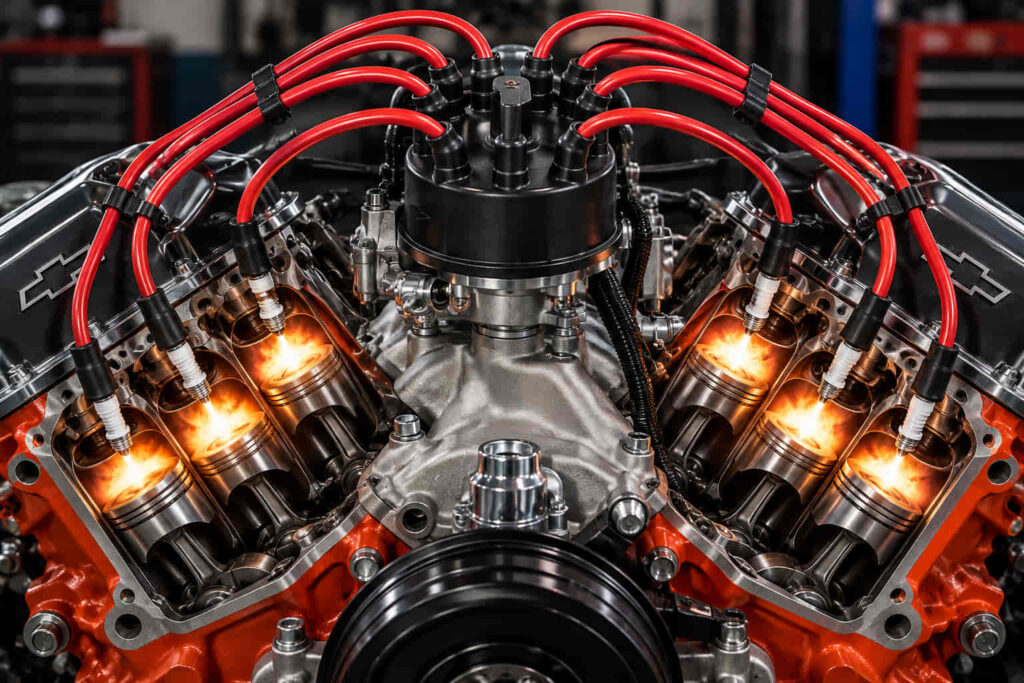
The Chevy V8 firing order depends on the engine generation and design. Traditional Chevrolet small-block and big-block V8 engines use the firing sequence 1-8-4-3-6-5-7-2, while modern LS and Gen V LT engines generally use 1-8-7-2-6-5-4-3. Understanding the correct firing order is essential for proper ignition timing, smooth engine operation, and accurate spark plug wire installation.
Chevrolet has produced several generations of V8 engines, including the classic 305, 327, 350, and 400 small-block engines, the 396, 427, and 454 big-block engines, and modern LS1, LS2, LS3, LS6, and LT-series powerplants. Although these engines share a V8 configuration, their firing sequences are not always interchangeable.
Using an incorrect firing order can cause engine misfires, rough idling, backfiring, reduced power, and difficult starting. Whether replacing spark plug wires, installing a distributor, rebuilding a small-block Chevy, or troubleshooting a modern LS engine, identifying the correct firing sequence and cylinder numbering is the first step toward reliable engine operation.
What Is the Chevy V8 Firing Order?
The standard Chevy V8 firing order is 1-8-4-3-6-5-7-2 for traditional small-block and big-block engines, while most modern Chevrolet LS and Gen V LT V8 engines use 1-8-7-2-6-5-4-3. The difference reflects changes in engine architecture, camshaft design, and combustion-event sequencing.
An engine’s firing order describes the sequence in which its cylinders produce combustion power strokes. In a four-stroke gasoline engine, each cylinder completes intake, compression, combustion and expansion, and exhaust processes during two crankshaft revolutions.
Because a four-stroke V8 has eight cylinders, it produces eight combustion power strokes during a complete 720-degree engine cycle. In a conventional evenly firing Chevy V8, successive power strokes begin at intervals of 90 degrees of crankshaft rotation.
The firing order determines which cylinder begins its power stroke at each of these intervals.
For traditional Chevrolet V8 engines, cylinder number 1 fires first, followed by cylinders 8, 4, 3, 6, 5, 7, and 2. The sequence then repeats continuously while the engine operates.
Modern LS engines use a revised arrangement in which cylinder number 1 is followed by cylinders 8, 7, 2, 6, 5, 4, and 3.
Although both sequences provide evenly spaced combustion events, they distribute those events differently across the engine’s cylinders and crankshaft.
The firing sequence is established primarily by the relationship between crankshaft position, camshaft valve timing, and ignition control. It cannot be changed simply by rearranging spark plug wires.
For this reason, the correct firing order must match the engine’s internal configuration rather than only its displacement or vehicle model.
How Are the Cylinders Numbered on a Chevy V8?
Chevrolet V8 engines generally number their cylinders 1-3-5-7 on the driver’s side and 2-4-6-8 on the passenger’s side, moving from the front of the engine toward the rear. This arrangement applies to traditional Chevrolet small-block engines, conventional big-block engines, and modern LS and LT V8 families.
Cylinder number 1 is located at the front of the left engine bank, which corresponds to the driver’s side in a typical left-hand-drive, longitudinally mounted Chevrolet vehicle.
Behind cylinder 1 are cylinders 3, 5, and 7, arranged in that order toward the transmission.
The opposite bank begins with cylinder number 2 at the front, followed by cylinders 4, 6, and 8 toward the rear of the engine.
The front of the engine refers to the timing cover and crankshaft pulley end, rather than necessarily the front of the vehicle. This distinction matters when working on custom engine installations or vehicles with different engine orientations.
Cylinder numbering and firing order describe two separate characteristics.
Cylinder numbering identifies the physical position of each combustion chamber, while firing order identifies the sequence in which combustion occurs.
For example, cylinders 1 and 3 are located next to each other on the same bank, but they do not fire consecutively in the traditional Chevrolet sequence.
Likewise, cylinders 1 and 8 are located on opposite banks and at opposite ends of the engine, yet cylinder 8 fires immediately after cylinder 1 in both common Chevrolet V8 firing orders.
Understanding these physical positions helps prevent spark plug wires from being connected to the wrong cylinders.
It also allows technicians to identify the correct cylinder when a diagnostic trouble code reports a misfire, such as P0301 for cylinder 1 or P0307 for cylinder 7.
When working on an unfamiliar engine or engine swap, the cylinder numbering system should always be confirmed using the relevant service documentation.
What Is the Firing Order for a Chevy 350 Small Block?
The standard Chevy 350 small-block firing order is 1-8-4-3-6-5-7-2, with the distributor rotor rotating clockwise when viewed from above. This configuration is used by factory-standard traditional Chevrolet 350 cubic-inch V8 engines.
The Chevrolet 350 is one of the most widely recognized members of the original small-block engine family.
Introduced for the 1967 model year, the 350 became a common engine in Chevrolet passenger cars, pickup trucks, performance vehicles, and numerous other applications.
Its displacement is approximately 5.7 liters, and its conventional design uses a single camshaft located inside the engine block to operate the intake and exhaust valves through lifters, pushrods, and rocker arms.
The camshaft arrangement determines the timing of valve events for each cylinder.
In the standard 350 engine, the valve timing and ignition system are designed around the traditional 1-8-4-3-6-5-7-2 sequence.
For engines equipped with a conventional distributor, the spark plug wires must be connected to the distributor cap in the same sequence as the rotor turns clockwise.
Cylinder number 1 serves as the starting reference. Once the correct number 1 cap terminal is identified, the remaining connections follow the firing sequence around the distributor.
This arrangement applies to many carbureted Chevy 350 engines and later fuel-injected versions that retain the traditional small-block architecture.
The Vortec 5700 L31 engine also uses the traditional firing order, despite its updated cylinder heads and fuel injection system.
However, not every engine described as a Chevrolet 5.7-liter V8 is the same.
The LS1 is also a 5.7-liter Chevrolet V8, but it belongs to the newer Gen III small-block family and uses a different firing order.
Therefore, engine generation must be verified before applying a firing-order diagram based only on the 5.7-liter displacement.
Do Chevy 305, 327, and 400 Engines Have the Same Firing Order?
Most factory-standard Chevrolet 305, 327, and 400 small-block V8 engines share the same 1-8-4-3-6-5-7-2 firing order as the Chevy 350. Their differences in displacement, bore, stroke, and performance characteristics do not normally change the firing sequence.
The Chevrolet small-block architecture has been used in numerous displacement configurations since the introduction of the original 265 cubic-inch V8 in 1955.
Popular versions include the 283, 302, 305, 307, 327, 350, and 400 cubic-inch engines.
Despite their differences in displacement and application, these traditional small-block engines generally follow the same cylinder numbering and combustion sequence.
This consistency simplifies service procedures across many older Chevrolet vehicles.
A mechanic familiar with the distributor wiring of a traditional 350 small-block can apply the same firing-order principles to a standard 305 or 327 engine.
However, distributor components, ignition timing specifications, spark plug requirements, and engine calibration may differ.
The same firing order does not mean that all ignition parts are interchangeable.
Another important consideration is the use of aftermarket performance camshafts.
Some modified Chevrolet small-block engines use a camshaft designed with an alternative firing sequence, including a 4/7 firing-order swap.
In these engines, the factory firing order may no longer apply.
Consequently, owners of rebuilt racing engines or heavily modified street engines should confirm the camshaft specifications before routing spark plug wires.
For an unmodified factory 305, 327, or 400 engine, the traditional Chevrolet firing sequence remains the appropriate reference.
What Is the Chevy 454 Big Block Firing Order?
The standard Chevy 454 big-block firing order is 1-8-4-3-6-5-7-2, the same sequence used by traditional Chevrolet small-block engines. The distributor also rotates clockwise when viewed from above in conventional distributor-equipped applications.
The Chevrolet 454 belongs to the big-block engine family, which uses a physically larger engine architecture than the traditional small-block design.
Its 454 cubic-inch displacement is approximately 7.4 liters.
Although the 454 has different cylinder dimensions, cylinder heads, and internal components from the 350 small-block, the two engines share the same conventional firing sequence.
Other traditional Chevrolet big-block engines, including the 396, 402, and 427, also commonly use 1-8-4-3-6-5-7-2.
Cylinder numbering follows the same basic Chevrolet pattern, with odd-numbered cylinders on the driver’s side and even-numbered cylinders on the passenger’s side.
For a traditional 454 equipped with a conventional distributor, spark plug wires are arranged clockwise around the cap according to the engine’s specified firing order.
The distributor itself is located at the rear of the engine, although exact component layout and access vary by application.
Correct spark plug wire routing is especially important because big-block Chevrolet engines often operate under substantial load in performance vehicles, trucks, and marine applications.
A crossed ignition wire may cause misfiring, uneven torque delivery, or backfiring.
However, the traditional big-block sequence should not be applied automatically to every later GM big-block engine.
The Vortec 8100 8.1-liter V8, for example, uses the newer 1-8-7-2-6-5-4-3 firing order.
This distinction makes engine identification essential when servicing Chevrolet V8 engines from different generations.
What Is the Firing Order for an LS1, LS2, LS3, or LS7 Engine?
The standard LS engine firing order is 1-8-7-2-6-5-4-3, which applies to factory-configured LS1, LS2, LS3, LS6, and LS7 V8 engines. This sequence differs from the traditional Chevrolet small-block order while retaining the same general cylinder numbering arrangement.
General Motors introduced the LS1 in the 1997 Chevrolet Corvette as part of the Gen III small-block V8 family.
The LS architecture introduced significant changes compared with earlier small-block engines, including a redesigned cylinder block, improved cylinder head structure, and an electronically controlled ignition system.
One important change was the firing order.
Instead of using the traditional 1-8-4-3-6-5-7-2 sequence, the LS engine family adopted 1-8-7-2-6-5-4-3.
This revised sequence changes the distribution of combustion events between the cylinders and affects crankshaft loading and engine vibration characteristics.
The LS1 and related engines also use a distributorless ignition system.
Rather than sending high-voltage current through a single distributor cap and rotor, these engines use individual ignition coils controlled electronically by the engine control module.
Each coil delivers ignition energy to its corresponding cylinder through a short spark plug wire or suitable connection.
The engine control module uses crankshaft and camshaft position information to determine when each cylinder requires ignition.
Despite these changes, the cylinder numbering pattern remains consistent with Chevrolet’s conventional V8 arrangement.
Cylinder number 1 is at the front of the driver’s-side bank, while cylinder number 8 is at the rear of the passenger-side bank.
The same basic firing-order principles apply to other factory LS-based engines, although their fuel injection, ignition components, and engine management systems may differ.
For an LS engine with a stock camshaft and correctly configured ignition control system, the 1-8-7-2-6-5-4-3 sequence is the correct reference.
Read more: LS1 Performance Upgrades
What Is the Difference Between the Chevy Small Block and LS Firing Order?
The traditional Chevy small-block uses 1-8-4-3-6-5-7-2, while the LS engine uses 1-8-7-2-6-5-4-3. Both sequences produce eight evenly spaced combustion power strokes over 720 degrees of crankshaft rotation, but the order of combustion events differs.
The original Chevrolet small-block design was developed around mechanical valve timing and distributor-based ignition systems.
Its firing sequence was retained across numerous production engines because it provided an effective balance of mechanical operation, torque delivery, and manufacturing consistency.
When General Motors developed the LS family, engineers adopted a different camshaft firing arrangement.
The revised sequence changes the order in which cylinders generate combustion pressure.
These changes influence how combustion forces act on the crankshaft and how exhaust pulses travel through the cylinder banks.
Firing order can affect torsional vibration, bearing loading, exhaust pulse distribution, and other engine characteristics.
However, it does not independently determine maximum horsepower.
Engine output also depends on airflow, compression ratio, camshaft specifications, combustion efficiency, fuel delivery, ignition timing, and operating speed.
The change from the traditional firing order to the LS arrangement was therefore part of a broader engine engineering development rather than a simple horsepower modification.
The two firing orders are not interchangeable during routine ignition service.
Connecting the spark plug wires of a traditional Chevrolet 350 according to the LS sequence will not make it operate like an LS engine.
Likewise, applying the classic small-block sequence to an LS ignition system can cause incorrect cylinder ignition and severe running problems.
The engine’s camshaft and ignition system must be configured for the intended firing order.
What Is the Firing Order for Chevy LT1 and LT4 Engines?
The Chevy LT1 firing order depends on the engine generation: the 1990s Gen II LT1 uses 1-8-4-3-6-5-7-2, while the modern Gen V LT1 uses 1-8-7-2-6-5-4-3. The same distinction applies to the LT4 name across different engine generations.
Chevrolet used the LT1 designation for more than one small-block V8 engine design.
The second-generation LT1, introduced in the 1992 Corvette and later used in other General Motors vehicles, retained the traditional Chevrolet firing order.
It also used an OptiSpark ignition distributor mounted at the front of the engine.
Although the OptiSpark system differs from a conventional rear-mounted distributor, its ignition sequence remains 1-8-4-3-6-5-7-2.
The naturally aspirated Gen II LT4 introduced in the 1996 Corvette also follows the traditional sequence.
The modern LT1, introduced with the seventh-generation Chevrolet Corvette for the 2014 model year, belongs to the Gen V small-block engine family.
This engine uses a modern distributorless ignition system and the firing order 1-8-7-2-6-5-4-3.
The supercharged Gen V LT4 also uses this modern sequence.
Consequently, the engine name alone is not sufficient to establish the correct firing order.
A 1996 Corvette LT1 and a 2014 Corvette LT1 share an engine designation but represent different engine generations with different ignition and combustion-event configurations.
Vehicle model year, engine code, and factory service specifications should be used to confirm which version is installed.
This distinction is particularly important when purchasing ignition components or troubleshooting a Corvette with an LT-series engine.
What Is the Firing Order for Chevy 5.3, 6.0, and 6.2 V8 Engines?
Factory Chevrolet LS-based 5.3-liter, 6.0-liter, and 6.2-liter V8 engines generally use the firing order 1-8-7-2-6-5-4-3. This pattern is also used by many Gen V Chevrolet V8 engines found in modern trucks and performance vehicles.
The 5.3-liter engine became a popular member of GM’s LS-based truck V8 family.
Common examples include the LM7, L59, LH6, LY5, and LC9, along with other related variants.
Despite differences in cylinder heads, block materials, fuel systems, and production years, these engines share the LS-style firing sequence.
The 6.0-liter LS-based engines also generally use the same order.
Examples include the LQ4, LQ9, LY6, and L96, which were used in various trucks, SUVs, and commercial applications.
The 6.2-liter LS3 and related Gen IV engines also follow the 1-8-7-2-6-5-4-3 arrangement.
Later Gen V V8 engines, including the L86 and L87 6.2-liter truck engines, retain this firing sequence despite introducing technologies such as direct fuel injection and advanced cylinder management.
The same firing order does not imply that these engines use identical ignition components or service procedures.
A 5.3-liter engine with coil-near-plug ignition requires a different diagnostic approach from a traditional distributor-equipped 350.
Additionally, cylinder deactivation technologies such as Active Fuel Management and Dynamic Fuel Management can temporarily disable combustion in selected cylinders during certain operating conditions.
This does not change the engine’s fundamental eight-cylinder firing order.
When full-cylinder operation resumes, combustion follows the sequence determined by the engine’s design and control system.
For accurate diagnosis, the exact engine code and model year should always be verified.
Does the Chevy Vortec 8.1L Have the Same Firing Order as a 454?
The Chevrolet Vortec 8100 8.1-liter V8 uses 1-8-7-2-6-5-4-3, while the traditional Chevy 454 uses 1-8-4-3-6-5-7-2. Although both belong to the broader Chevrolet big-block lineage, they do not share the same factory firing sequence.
The Vortec 8100, also known by the L18 engine code, was developed for heavy-duty truck and commercial applications.
It uses a displacement of approximately 496 cubic inches and features electronic fuel injection with individual ignition coils.
The Vortec 8100’s firing sequence follows the same general pattern used in LS engines rather than the older big-block order.
This is an important exception to the assumption that all Chevrolet big-block engines fire in the same sequence.
A mechanic familiar with a traditional 454 may expect the 1-8-4-3-6-5-7-2 pattern, but applying it to an 8.1-liter L18 engine would be incorrect.
The Vortec 8100 also uses different engine management and ignition hardware from older distributor-equipped big-block engines.
Its ignition system is controlled electronically according to crankshaft and camshaft position information.
The correct firing order should therefore be confirmed through the L18 engine specifications rather than through a general Chevrolet big-block wiring diagram.
Which Direction Does a Chevy V8 Distributor Rotate?
The distributor rotor on a traditional Chevrolet small-block or big-block V8 rotates clockwise when viewed from above. This direction determines how spark plug wires are arranged around the distributor cap.
A conventional ignition distributor receives high-voltage electrical energy from the ignition coil and directs it to individual spark plug terminals as the rotor turns.
The distributor shaft is mechanically driven by the engine, maintaining a specific relationship with crankshaft and camshaft rotation.
For a standard Chevy 350 using the 1-8-4-3-6-5-7-2 firing order, each successive spark plug connection follows this sequence clockwise around the distributor cap.
The same basic clockwise routing applies to traditional distributor-equipped 305, 327, 400, 396, 427, and 454 engines using the standard firing order.
However, the physical position of the number 1 terminal on the distributor cap can vary.
Different distributors, cap designs, and installation orientations may position the number 1 wire terminal in different locations.
Therefore, the number 1 terminal should not be identified solely by its position in a generic diagram.
It must correspond to the rotor position when cylinder number 1 is at the appropriate ignition reference position near top dead center on the compression stroke.
Modern LS and Gen V LT engines do not use a traditional distributor.
Their ignition systems are electronically controlled, making distributor rotation irrelevant to spark plug wire routing.
For these engines, the ignition coil connections and ECU control strategy must match the factory wiring configuration.
How Do You Connect Spark Plug Wires Using the Chevy V8 Firing Order?
To connect spark plug wires on a traditional Chevy V8, identify the number 1 distributor cap terminal and follow the correct firing order clockwise around the cap. The procedure must match the engine’s firing sequence and distributor configuration.
For a conventional Chevy 350, the correct sequence is 1-8-4-3-6-5-7-2.
Before moving any wires, verify that the engine is switched off and cannot start unexpectedly.
If the original wiring is still installed correctly, identifying and labeling each existing connection can reduce the risk of routing errors.
The cylinder numbering pattern must also be confirmed.
On a conventional longitudinal Chevrolet V8, cylinders 1, 3, 5, and 7 are on the driver’s side, while cylinders 2, 4, 6, and 8 are on the passenger’s side.
The number 1 distributor terminal should be identified using the manufacturer’s reference or by verifying the distributor rotor position with cylinder 1 at top dead center on the compression stroke.
Once that starting point is established, the remaining cap terminals follow the firing order in the clockwise direction.
Each terminal connects to the spark plug in the corresponding cylinder.
The spark plug wires should be routed through suitable separators or retainers and kept away from exhaust manifolds, sharp edges, and moving components.
Wire length and routing also matter.
Excessively stretched wires may become disconnected, while wires resting against hot exhaust components can suffer insulation damage.
Long parallel runs between certain ignition wires can also contribute to unwanted inductive coupling or crossfire, particularly in older high-voltage distributor systems.
On traditional Chevrolet V8 engines, cylinders 5 and 7 are consecutive in the firing order and are located next to each other on the same cylinder bank.
Maintaining appropriate wire separation in this area can help reduce crossfire risk.
After installation, all wire connections should be checked for proper seating before starting the engine.
If the engine misfires, backfires, or fails to start, the wiring should be verified again before ignition timing is adjusted.
How Do You Find Cylinder Number 1 and Top Dead Center on a Chevy V8?
Cylinder number 1 is the front cylinder on the driver’s-side bank of a conventional Chevrolet V8, and its top dead center position can be used to establish the correct ignition reference for distributor installation.
Top dead center, commonly abbreviated TDC, occurs when the piston reaches its highest position inside the cylinder.
However, a four-stroke engine reaches top dead center twice during each complete operating cycle.
One TDC position occurs at the end of the compression stroke, while the other occurs between the exhaust and intake strokes.
This difference is essential when installing or timing a distributor.
The ignition reference for cylinder number 1 is associated with the compression stroke, not the exhaust stroke.
During compression, the piston moves upward while the intake and exhaust valves remain closed.
A technician can identify the compression stroke by following the manufacturer’s approved procedure and confirming the pressure or valve events associated with cylinder 1.
The crankshaft can then be rotated carefully to the appropriate timing reference.
On many traditional Chevrolet engines, the crankshaft balancer and timing cover provide timing marks that indicate piston position relative to top dead center.
However, the actual ignition timing specification may require the spark event to occur a certain number of degrees before TDC.
The correct timing value depends on the engine and ignition system.
Once the compression reference has been established, the distributor can be positioned so that the rotor aligns with the intended number 1 terminal.
If the distributor is installed 180 degrees out of phase, the engine may fail to start or experience severe backfiring because the ignition events occur during the wrong part of the cylinder cycle.
Mechanical timing should therefore be confirmed before making further adjustments.
Engine service manuals provide the most reliable reference for distributor installation, initial timing settings, and any procedures involving electronic timing controls.
How Does the Chevy V8 Firing Order Work Without a Distributor?
Modern Chevy LS and Gen V LT engines use electronically controlled ignition systems that follow the firing order 1-8-7-2-6-5-4-3 without a mechanical distributor.
In a traditional distributor system, a single high-voltage distribution mechanism directs ignition energy to the cylinders.
Modern Chevrolet V8 engines instead use individual ignition coils or coil-near-plug arrangements.
Each coil receives a control signal from the engine control module, which determines the appropriate spark timing for its cylinder.
The engine control module uses crankshaft position information to establish engine rotation and piston position.
Camshaft position information helps identify the engine’s operating phase within the four-stroke cycle.
Together, these signals allow the control system to coordinate ignition and fuel injection events.
The mechanical firing order remains established by the engine’s camshaft and crankshaft configuration.
Electronic control determines when the spark occurs relative to each cylinder’s operating cycle.
For example, when cylinder number 1 reaches its ignition event, the engine control module activates the corresponding ignition coil.
The next combustion event occurs in cylinder 8, followed by cylinders 7, 2, 6, 5, 4, and 3.
Because each cylinder has an electronically controlled ignition circuit, there is no distributor cap that can be rewired clockwise.
Instead, proper operation depends on correct ignition coil connections, wiring harness configuration, sensor signals, and engine control calibration.
This distinction becomes particularly important during LS engine swaps.
When an LS engine is installed in an older Chevrolet vehicle, the engine does not adopt the older vehicle’s original firing order.
The LS engine retains its own mechanical combustion sequence and must use an appropriate ignition management system.
Why Did Chevrolet Change the V8 Firing Order?
Chevrolet adopted a different firing order for its LS engine family to improve the distribution of combustion events and support engine refinement, including crankshaft vibration and loading characteristics.
A V8 engine converts combustion pressure into rotational force through its pistons, connecting rods, and crankshaft.
Each combustion event applies torque to the crankshaft.
Although the power strokes are evenly spaced, the order in which individual cylinders fire influences the distribution of these forces along the crankshaft.
Crankshaft torsional vibration occurs when different portions of the crankshaft experience alternating rotational loads.
These vibrations can affect engine refinement and contribute to mechanical stress.
Firing order can also influence how successive combustion pulses are distributed through the exhaust manifolds.
The interaction between exhaust pressure waves and engine operating conditions can affect scavenging behavior and exhaust sound.
When General Motors developed the LS architecture, engineers had the opportunity to optimize these characteristics as part of the broader engine redesign.
The revised firing order changes which cylinders produce consecutive power strokes without changing the total number of combustion events.
Both the traditional and LS firing orders continue to produce one combustion event every 90 degrees of crankshaft rotation.
Therefore, the newer order does not automatically create more power simply by changing the sequence.
Instead, firing order is one of several engineering variables that influence mechanical loading, vibration behavior, and the interaction between engine components.
Actual engine performance depends on the complete design, including cylinder heads, valve timing, intake and exhaust systems, combustion characteristics, and engine calibration.
Can You Change the Chevy V8 Firing Order for Better Performance?
A Chevy V8 firing order can be changed through a specially designed camshaft and correctly configured ignition system, but rearranging spark plug wires alone will not create a functional firing-order conversion.
The camshaft determines the timing of the intake and exhaust valve events in each cylinder.
For combustion to occur correctly, the cylinder must receive its air-fuel charge, compress it, and ignite the mixture at the appropriate point in the operating cycle.
Changing the firing sequence therefore requires the valve events and ignition events to remain synchronized.
Some aftermarket racing camshafts are manufactured with alternative firing orders.
One example is the 4/7 swap used in certain traditional Chevrolet small-block performance engines.
The standard Chevrolet sequence is 1-8-4-3-6-5-7-2.
A conventional 4/7 swap changes the sequence to 1-8-7-3-6-5-4-2.
This should not be confused with the standard LS firing order of 1-8-7-2-6-5-4-3, which changes the relative positions of additional cylinders.
Alternative firing-order camshafts may be developed to influence crankshaft loading, vibration, or exhaust characteristics in specialized applications.
However, any performance advantage depends on the complete engine configuration.
The camshaft must be designed for the intended sequence, and the ignition control or distributor wiring must match the resulting combustion events.
Attempting to reproduce an alternative firing order by changing plug wire positions on an otherwise standard engine can cause misfiring and severe running problems.
For most street-driven Chevrolet V8 engines, retaining the factory firing order is the appropriate choice.
Alternative firing sequences are generally relevant to specialized engine development and racing applications where the complete combination is engineered around the change.
What Happens If the Chevy V8 Firing Order Is Wrong?
An incorrect Chevy V8 firing order can cause engine misfires, rough idling, backfiring, loss of power, difficult starting, and potentially catalytic converter damage. The severity depends on which ignition connections are incorrect and whether the engine can continue running.
When the spark plug fires in the wrong cylinder, the ignition event may occur when the piston and valves are not positioned for normal combustion.
If the mixture ignites at an unsuitable point, combustion may fail to produce useful torque.
In some cases, the engine may not start at all.
If only two spark plug wires are crossed, the engine may still run on its remaining properly firing cylinders, but operation can become unstable.
Rough idle is a common symptom because the combustion events no longer produce consistent torque.
Acceleration may feel weak or uneven, especially when additional engine load increases the demand for reliable ignition.
Backfiring may occur when unburned fuel reaches the intake or exhaust system and ignites under unfavorable conditions.
Exhaust popping and unusual engine vibration can also accompany incorrect ignition routing.
On fuel-injected vehicles, the engine control module may detect combustion irregularities and store misfire-related diagnostic trouble codes.
A flashing malfunction indicator light can indicate a misfire severe enough to threaten the catalytic converter.
Unburned fuel entering a hot catalytic converter may cause overheating and damage to the converter substrate.
These symptoms are not unique to an incorrect firing order.
Faulty ignition coils, worn spark plugs, fuel injector problems, vacuum leaks, and mechanical engine faults can produce similar behavior.
However, if the symptoms begin immediately after replacing spark plug wires, installing a distributor, or performing ignition-related service, incorrect connections should be investigated before more expensive components are replaced.
How Can You Diagnose a Chevy V8 Firing Order Problem?
Diagnosing a Chevy V8 firing order problem begins with verifying the engine type, cylinder numbering, ignition connections, and mechanical timing. The exact diagnostic procedure depends on whether the engine uses a traditional distributor or electronic coil-controlled ignition.
For a classic Chevrolet small-block or big-block engine, the distributor cap and spark plug wires are the primary areas to inspect after ignition service.
Each wire should be traced from its distributor cap terminal to the correct cylinder.
The sequence around the cap must match 1-8-4-3-6-5-7-2 in the clockwise direction for a standard distributor-equipped engine.
The number 1 terminal should also correspond to the correct rotor position at the engine’s specified ignition reference point.
If the wiring is correct but the engine still backfires or refuses to start, incorrect distributor installation or mechanical timing may be responsible.
A distributor installed out of phase can produce ignition symptoms that resemble crossed spark plug wires.
For modern LS and LT engines, the diagnostic process focuses on individual ignition coils, wiring connections, engine position sensors, and control system information.
An OBD-II diagnostic scanner can identify stored misfire codes and reveal which cylinders are affected.
For example, P0300 indicates a random or multiple-cylinder misfire, while P0301 refers to cylinder 1 and P0308 refers to cylinder 8.
A cylinder-specific code does not automatically confirm an ignition coil failure.
The affected cylinder may also have a faulty spark plug, injector problem, compression loss, or another condition that prevents proper combustion.
Where appropriate, technicians may use ignition waveform testing, component inspections, compression measurements, or other manufacturer-approved procedures.
High-voltage ignition components should not be touched while the engine is running.
The objective is to establish whether the problem involves incorrect ignition sequencing, an individual cylinder malfunction, or another mechanical or electronic fault.
Can an Incorrect Firing Order Damage a Chevy V8 Engine?
An incorrect firing order can damage engine components if misfiring or abnormal combustion continues, although a brief wiring mistake does not necessarily cause permanent engine damage.
The most immediate problem is the loss of correct combustion timing.
When the wrong spark plug fires, the affected cylinder may fail to produce its intended power stroke.
Unburned fuel can then enter the exhaust system.
If sufficient fuel reaches a hot catalytic converter, it can burn within the converter and cause excessive temperatures.
This may damage the catalyst and surrounding exhaust components.
Repeated combustion irregularities can also create substantial vibration and uneven torque delivery.
In severe cases, abnormal combustion events may place unusual stresses on engine components.
The exact risk depends on the ignition error, engine operating conditions, and whether the engine continues running.
A simple pair of crossed wires may primarily cause misfiring, while incorrect mechanical valve timing can create much more serious problems in engines where piston-to-valve clearance is limited.
These faults should not be treated as identical.
Changing the firing order incorrectly through spark plug wiring does not physically change camshaft timing.
However, incorrectly installing timing components during an engine rebuild can disrupt the relationship between piston movement and valve operation.
When serious ignition or mechanical timing symptoms appear, the engine should be shut down and inspected.
Repeated attempts to start or accelerate an engine with severe backfiring can increase the risk of additional damage.
Correcting the ignition connections and confirming mechanical timing before continued operation is the most reliable approach.
How Do You Verify the Firing Order After a Chevy V8 Engine Rebuild?
After rebuilding a Chevy V8, the firing order should be verified against the installed camshaft, engine specifications, and ignition system before the first startup.
Engine rebuilding can introduce several opportunities for ignition and timing errors.
During disassembly, the distributor, spark plug wires, camshaft, timing chain, and related components may be removed or replaced.
If the replacement camshaft uses the original factory firing sequence, the standard engine-specific order remains applicable.
However, some performance camshafts use modified firing arrangements.
This makes it necessary to review the camshaft manufacturer’s specifications rather than relying exclusively on the engine block casting or displacement.
Mechanical camshaft timing should also be confirmed during assembly.
The timing chain and sprockets establish the relationship between crankshaft rotation and camshaft movement.
Incorrect installation can cause valve timing errors even when the spark plug wires follow the correct firing sequence.
Once the valvetrain has been assembled correctly, the engine can be positioned at the appropriate cylinder 1 reference point for ignition setup.
On distributor-equipped engines, the distributor must be installed and indexed according to the intended timing procedure.
Spark plug wire routing should then be checked against the firing order.
On LS-based engines, individual ignition coils, crankshaft and camshaft sensors, wiring harness connections, and ECU compatibility must be verified.
An aftermarket engine management system may require the firing order and ignition configuration to be entered or confirmed during setup.
This is especially important when a custom camshaft or nonstandard ignition arrangement is used.
Before attempting the first startup, lubrication system preparation and other required engine assembly checks should also be completed according to the engine manufacturer’s instructions.
A careful verification process helps prevent unnecessary starting difficulties and protects recently installed components.
Is the Chevy V8 Firing Order the Same for Every Model Year?
The Chevy V8 firing order is not the same for every model year because Chevrolet has used multiple engine generations with different combustion sequences. Engine architecture and identification code are generally more reliable indicators than vehicle age alone.
A traditional Chevrolet 350 from the 1970s commonly uses 1-8-4-3-6-5-7-2.
A 1990s Chevrolet truck equipped with a Vortec 5700 L31 engine also uses the traditional sequence.
However, a Chevrolet Corvette equipped with the LS1 engine uses 1-8-7-2-6-5-4-3.
Modern Silverado models with LS-based or Gen V V8 engines generally follow the newer firing order.
This creates a potential source of confusion because Chevrolet continued offering traditional and modern engine architectures across overlapping periods.
A model year that falls near an engine generation change does not automatically identify the firing sequence.
Engine swaps create another complication.
An older Chevrolet pickup may contain a newer LS engine, while a custom project may use a traditional small-block installed in a more recent chassis.
The vehicle identification number can help establish the original engine configuration, but it cannot confirm a replacement engine that was installed later.
Engine casting numbers, engine codes, visible ignition system characteristics, and service documentation provide additional identification methods.
The distinction between engine generations is particularly important for 5.7-liter V8 engines.
Both the traditional Chevy 350 and the LS1 are approximately 5.7 liters, but they use different firing orders.
The same issue applies to LT1 engines from different generations.
Therefore, the correct firing order should be established from the actual engine installed in the vehicle rather than from the vehicle name or displacement alone.
Why Is the Correct Chevy V8 Firing Order Important for Engine Performance?
The correct Chevy V8 firing order ensures that combustion occurs in the intended sequence, allowing the engine to deliver smooth torque, stable idle, proper acceleration, and reliable operation.
Every cylinder in a four-stroke V8 must complete its operating cycle in coordination with the crankshaft and camshaft.
The firing order establishes when each cylinder contributes power to the rotating assembly.
With the correct sequence, combustion events are distributed at the intended intervals and the engine can produce consistent rotational output.
When ignition timing and fuel delivery are also correct, the engine can operate efficiently throughout its designed speed and load range.
Incorrect ignition sequencing disrupts this process.
Some cylinders may fail to ignite their mixtures at the correct time, reducing the number of useful power strokes.
The resulting torque fluctuations can cause vibration, unstable idling, and poor acceleration.
Fuel economy may also deteriorate because fuel is consumed without producing the intended amount of useful work.
In electronically controlled engines, repeated misfires may cause the engine control module to adjust operating strategies or activate warning indicators.
Correct firing order is also important for interpreting diagnostic information.
Knowing which cylinder fires next helps technicians understand ignition system behavior, crankshaft position relationships, and cylinder-specific faults.
For performance engine builders, firing order is one of several parameters that influence engine refinement and exhaust pulse behavior.
However, maintaining the proper factory sequence is generally more important than attempting to change it for an unproven performance benefit.
A correctly timed and properly maintained V8 provides a more dependable foundation for horsepower improvements than an engine with unresolved ignition sequencing problems.
Final Verdict: What Is the Correct Chevy V8 Firing Order?
The correct Chevy V8 firing order is 1-8-4-3-6-5-7-2 for traditional Chevrolet small-block and big-block engines, while LS and modern Gen V LT engines generally use 1-8-7-2-6-5-4-3.
Classic Chevrolet 305, 327, 350, and 400 engines share the traditional firing order, as do conventional 396, 427, and 454 big-block engines.
Modern LS1, LS2, LS3, LS6, and LS7 engines follow the revised LS sequence, along with most related 5.3-liter, 6.0-liter, and 6.2-liter V8 engines.
The 1990s Gen II LT1 retains the classic order, while the newer Gen V LT1 uses the modern sequence. The Vortec 8100 8.1-liter big-block is another important exception because it uses the LS-style firing order.
Despite these differences, Chevrolet V8 cylinder numbering generally remains consistent, with cylinders 1-3-5-7 on the driver’s side and 2-4-6-8 on the passenger’s side.
For traditional distributor-equipped engines, the rotor turns clockwise when viewed from above, and the spark plug wires must follow the correct firing sequence around the distributor cap.
Modern distributorless engines use electronically controlled ignition coils, but their mechanical firing order remains fixed by engine design.
The most reliable way to determine the Chevy V8 firing order is to identify the exact engine generation, verify its cylinder numbering, and follow the manufacturer’s ignition specifications. Doing so helps prevent misfires, protects engine components, and ensures smooth and efficient V8 performance.