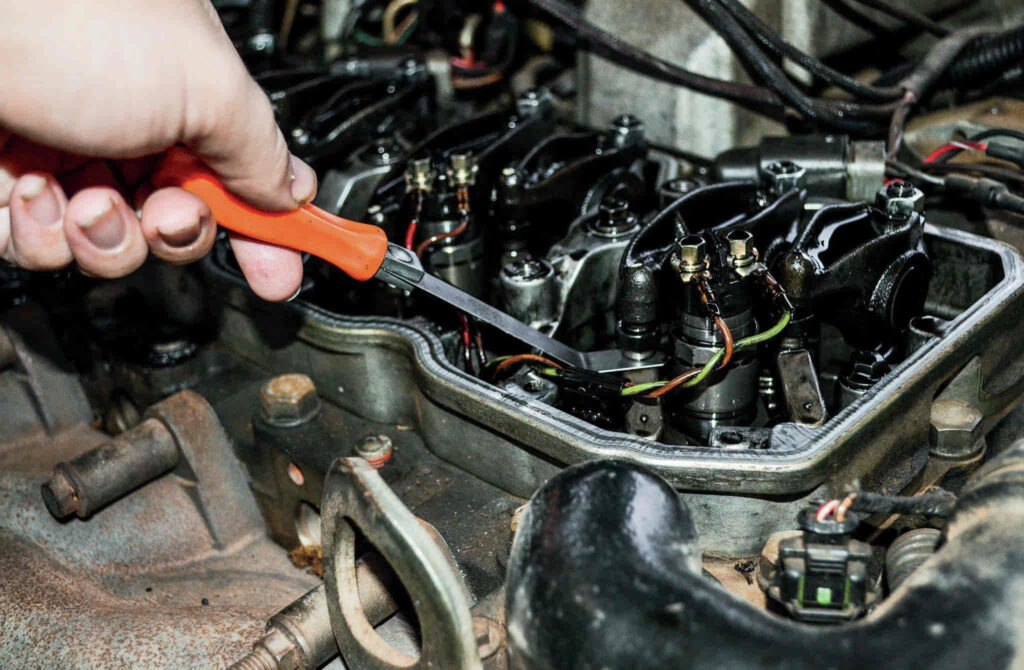
The valve adjustment interval for a 6.7 Cummins diesel engine depends on the specific engine configuration, model year, and applicable maintenance schedule. Valve adjustment, also known as valve lash adjustment, maintains the specified clearance between the valvetrain components so the intake and exhaust valves operate as designed. Following the correct maintenance schedule helps preserve engine performance, support reliable operation, and identify valvetrain problems before they develop into more expensive repairs.
Unlike routine oil changes, valve lash inspection and adjustment require access to the engine’s valvetrain and accurate clearance measurements. The required service interval should therefore be verified using the appropriate Cummins maintenance documentation or vehicle service manual rather than applying one mileage recommendation to every 6.7L Cummins engine.
Understanding when to inspect valve clearance, which operating conditions warrant attention, and how to recognize potential valvetrain problems helps owners make informed maintenance decisions. This guide explains the factors that determine the 6.7 Cummins valve adjustment interval, the difference between inspecting and adjusting valve lash, and how to verify the correct maintenance requirements for your engine. It also explains why symptoms alone cannot confirm incorrect valve clearance and when professional diesel engine diagnosis is appropriate.
How Often Should You Adjust the Valves on a 6.7 Cummins?
The valve adjustment interval for a 6.7 Cummins depends on the engine’s model year, application, and manufacturer-recommended maintenance schedule. There is no single mileage interval that should automatically be applied to every 6.7L Cummins engine without checking the relevant service documentation. Owners should verify whether their specific engine requires periodic valve lash inspection, valve adjustment, or both, because measuring valve clearance and correcting it are two different maintenance operations.
Valve lash refers to the clearance between components in the valvetrain when the valves are in the correct position for measurement. This clearance allows the intake and exhaust valves to operate according to the engine’s mechanical specifications as temperatures and operating conditions change. If the clearance falls outside the permitted range, valve movement may no longer match the intended specifications. For this reason, the correct maintenance schedule and measurement procedure matter more than relying on a general recommendation found online.
For certain 6.7L Cummins Turbo Diesel applications, Cummins provides a specific valve adjustment interval. For example, the manufacturer’s published specifications for the 2018 6.7L Cummins Turbo Diesel list valve lash adjustment at 150,000 miles (240,000 km). However, this interval should not be treated as universal across every engine configuration.
Model year and engine design are especially important when determining whether valve adjustment is required at all. Cummins states that its 2019 6.7L Turbo Diesel chassis cab configuration uses hydraulic lash adjusters that eliminate the need for scheduled valve train adjustment. This difference demonstrates why owners must identify their exact engine application before scheduling the service.
The most reliable way to establish the correct interval is to consult the applicable Cummins Operation and Maintenance Manual or vehicle owner’s manual. Cummins also provides a service literature lookup for finding technical documentation. Checking the engine configuration and applicable service information helps prevent unnecessary work and ensures that required maintenance is not overlooked.
What Factors Affect the 6.7 Cummins Valve Adjustment Schedule?
The 6.7 Cummins valve adjustment schedule is determined primarily by the engine’s design, model year, vehicle application, and applicable manufacturer maintenance requirements. These factors matter because different versions of the 6.7L Cummins Turbo Diesel may use different valvetrain designs and service procedures. A maintenance interval specified for one Ram truck or commercial vehicle should not automatically be applied to another application without confirming that the engine configuration and service requirements match.
Engine design is particularly important because it determines whether valve lash requires periodic adjustment. Engines with mechanically adjustable valve lash require clearance measurements and adjustments according to the relevant service specifications. By contrast, an engine equipped with hydraulic lash adjusters may not require the same scheduled adjustment procedure. Identifying the valvetrain configuration is therefore an essential first step before deciding whether an adjustment is due.
Vehicle usage and maintenance history also help determine when an inspection deserves attention. A truck used for frequent towing, heavy loads, or commercial operation may experience different operating demands from a vehicle used mainly for daily commuting. However, severe operating conditions do not automatically establish a shorter valve adjustment interval. Owners should follow the manufacturer’s maintenance guidance and use additional inspections when the applicable service documentation or a qualified technician identifies a specific need.
Mileage alone does not provide a complete picture of valvetrain maintenance. A vehicle with incomplete service records may require a maintenance-history review to establish whether the recommended inspection or adjustment has already been performed. Comparing the current odometer reading with documented maintenance, identifying the exact engine application, and consulting the appropriate service manual provide a more reliable basis for scheduling work than relying on a generic online interval.
Does Heavy-Duty Use Change the Valve Adjustment Interval?
Heavy-duty use can affect the maintenance demands placed on a 6.7 Cummins, but the correct response depends on the manufacturer’s recommendations for the particular engine. Frequent towing, sustained high loads, and commercial duty cycles can increase overall engine operating demands. Nevertheless, these conditions should not be used to invent a valve adjustment interval or assume that every engine needs more frequent adjustments.
For example, a Ram truck regularly towing a heavy trailer should have its maintenance schedule reviewed according to its exact model year, engine configuration, and operating requirements. If the maintenance documentation specifies a valve adjustment interval, that requirement should guide scheduling. If the engine uses a valvetrain design that does not require scheduled valve adjustment, heavy-duty use alone does not establish that the procedure is necessary. When unusual valvetrain noise or other mechanical symptoms develop, a technician can determine whether valve clearance inspection is appropriate or whether another component requires diagnosis.
Read more: Cars With Wankel Rotary Engine
What Are the Signs That a 6.7 Cummins Needs a Valve Lash Inspection?
A 6.7 Cummins may need a valve lash inspection when the engine develops unusual valvetrain noise, experiences unexplained performance changes, or shows symptoms that suggest a mechanical problem. These signs do not automatically mean the valve clearance is incorrect, because other engine components can produce similar symptoms. An inspection helps establish whether the valve lash falls within the manufacturer’s specified range or whether another fault requires attention.
Unusual ticking or tapping from the upper portion of the engine is one symptom that may justify further investigation. The valvetrain contains rocker arms, valves, and related components that move in a coordinated sequence during engine operation. Abnormal clearance or wear can change the sound produced by these components. However, normal diesel combustion noise and other mechanical issues can also cause ticking sounds, so noise alone cannot confirm that a valve adjustment is necessary.
Changes in engine performance may also warrant a diagnostic inspection. Incorrect valve clearance can interfere with the intended opening and closing behavior of the intake or exhaust valves, potentially affecting cylinder operation. However, reduced power, rough running, or unusual exhaust behavior can also result from fuel system problems, air intake restrictions, turbocharger faults, or other mechanical issues. A technician should evaluate the symptoms alongside the vehicle’s diagnostic information and maintenance history before identifying valve lash as the cause.
Can Incorrect Valve Lash Cause Engine Noise or Performance Problems?
Incorrect valve lash can affect valvetrain operation because the specified clearance allows the mechanical components to move as intended. When the clearance is outside the permitted range, the resulting effect depends on whether the clearance is too large or too small and on the engine’s specific design. Excessive clearance can contribute to abnormal mechanical noise, while insufficient clearance can prevent a valve from seating correctly under certain operating conditions. Both conditions require accurate measurement and comparison with the appropriate service specifications.
The consequences depend on the extent of the deviation and the engine configuration. A noise that develops gradually may justify checking the maintenance history and arranging an inspection, while a sudden or severe change in engine operation warrants prompt professional diagnosis. Continuing to operate an engine with a suspected mechanical fault without determining its cause can increase the risk of additional damage.
A proper valve lash inspection requires the correct measurement procedure, the appropriate measuring tools, and the specifications for the exact 6.7L Cummins application. The technician must position the engine correctly for each measurement and compare the recorded clearances with the manufacturer’s limits. If the measurements are within specification, an adjustment may not be necessary. If they fall outside the permitted range, the applicable service procedure determines the required correction.
What Happens If You Delay a Required Valve Adjustment?
Delaying a required valve adjustment on a 6.7 Cummins can allow incorrect valve lash to remain undetected, potentially affecting valve operation and engine performance. Valve lash is the clearance between valvetrain components when the valves are in the specified position. When this clearance falls outside the manufacturer’s limits, the valves may not operate as designed. The actual consequences depend on the engine’s configuration, the amount of deviation, and how long the condition persists.
Excessive valve lash can increase mechanical noise and change how motion transfers through the valvetrain. Insufficient lash can be more concerning because thermal expansion may reduce the clearance further as the engine warms up. Depending on the engine design and severity, a valve may not close as intended, potentially affecting compression, combustion, and component durability. These outcomes are not inevitable whenever service is overdue; they depend on the measured clearance and the specific engine design.
A change in engine sound, reduced performance, or rough running does not prove that valve lash is incorrect. Fuel-system problems, air-intake restrictions, turbocharger issues, and other mechanical faults can produce similar symptoms. Adjusting the valves without confirming the cause may therefore waste time and leave the actual problem unresolved.
The appropriate response is to follow the maintenance schedule and service procedure specified for the exact 6.7 Cummins model and application. If the manufacturer calls for a valve-lash inspection or adjustment at a defined service interval, delaying that service means postponing a required check of the valvetrain. If symptoms appear before the scheduled interval, have the engine diagnosed rather than assuming an adjustment is necessary. Confirming the measured clearance against the correct specifications is the reliable way to determine whether adjustment is required.
How Do You Know Whether Your 6.7 Cummins Valves Need Adjustment or Inspection?
The way to determine whether a 6.7 Cummins needs valve adjustment is to compare its maintenance requirements and measured valve lash with the specifications for the exact engine configuration. An inspection checks the condition or clearance of the valvetrain, while an adjustment changes the clearance when the measurement falls outside the permitted range. These are different service operations, so an inspection does not automatically mean that adjustment is necessary.
The first step is to identify the engine’s model year and application, then consult the appropriate Cummins or vehicle manufacturer service documentation. The recommended procedure and maintenance interval can differ between engine configurations. A schedule for one 6.7-liter Cummins application should not automatically be applied to another, even if both engines share the same displacement and general engine family. Confirming the correct documentation helps prevent unnecessary work and incorrect adjustments.
When a valve-lash inspection is required, a technician follows the specified engine-positioning procedure and measures the clearance using the appropriate tools, such as a feeler gauge where the procedure calls for one. The resulting measurements must be compared with the manufacturer’s specifications for that engine. If the measured clearance is within the permitted range, adjustment may not be required. If it falls outside the specified limits, the technician can determine the appropriate corrective action using the approved service procedure.
Symptoms such as unusual valvetrain noise, rough running, or unexplained performance changes may justify diagnostic inspection, but they cannot confirm incorrect valve lash on their own. Other engine systems can produce similar symptoms. Likewise, reaching a mileage milestone does not necessarily mean every 6.7 Cummins requires the same adjustment procedure. The reliable decision comes from combining the correct maintenance schedule, the engine’s service history, diagnostic findings, and measured clearance where applicable.
Should You Adjust 6.7 Cummins Valves Yourself or Hire a Diesel Mechanic?
Whether you should adjust the valves on a 6.7 Cummins yourself depends on your mechanical experience, access to the correct service information, and ability to follow the specified procedure accurately. Valve adjustment is a precision maintenance task, not simply a matter of tightening or loosening engine components. The correct method, measurement limits, engine positioning, and adjustment requirements depend on the specific engine configuration.
An experienced DIY mechanic may be able to complete the work if the manufacturer provides an applicable procedure and the mechanic has the necessary tools, workspace, and technical knowledge. This includes understanding how to position the engine correctly, measure valve lash when required, and compare each measurement against the appropriate specifications. Using the wrong procedure or applying specifications from a different model year can lead to an incorrect adjustment and additional engine problems.
Hiring a qualified diesel mechanic is a practical choice when the engine configuration is uncertain, the required tools are unavailable, or the technician lacks experience with diesel valvetrain service. A professional can identify the correct service documentation, inspect the valvetrain, measure clearances where applicable, and determine whether adjustment is actually necessary. This approach is particularly useful when unusual engine noise or performance changes need diagnosis because those symptoms may originate from systems other than the valves.
Before deciding, confirm whether the specific 6.7 Cummins requires a scheduled valve-lash inspection or adjustment. Some configurations may use different valvetrain designs and maintenance requirements. The best choice is the one that ensures the correct procedure is followed and the results are verified against the manufacturer’s specifications, rather than choosing DIY work or professional service based on mileage alone.
What Should You Check Before Scheduling a 6.7 Cummins Valve Adjustment?
Before scheduling a valve adjustment on a 6.7 Cummins, confirm the engine’s model year, application, and valvetrain configuration. These details determine which maintenance schedule and service procedure apply. A 6.7-liter Cummins used in a Ram pickup may have different service requirements from an engine installed in a commercial vehicle or chassis cab. Checking the exact configuration first helps prevent unnecessary adjustments and ensures that the correct specifications are used.
The next consideration is the engine’s mileage and maintenance history. Review previous service records to determine whether valve-lash inspections or adjustments have already been completed and whether any measurements were recorded. If the maintenance history is incomplete, consult the applicable manufacturer documentation or ask a qualified diesel technician to determine the appropriate next step. Do not assume that every 6.7 Cummins requires adjustment at the same mileage.
You should also identify any symptoms that may justify additional diagnosis. Unusual valvetrain noise, rough running, or unexplained performance changes can be reasons to investigate the engine, but they do not confirm that valve lash is incorrect. A technician may need to examine other engine systems before recommending adjustment. If the manufacturer specifies a scheduled inspection, follow that requirement even if the engine appears to run normally.
Finally, clarify the scope of the service before authorizing the work. Ask whether the appointment includes valve-lash measurement, adjustment if necessary, and any related checks required by the applicable procedure. Request an explanation of the findings and confirmation that the correct engine-specific specifications were used. These steps help you understand whether the service is necessary, what work will be performed, and how the recommendation relates to the manufacturer’s maintenance requirements.