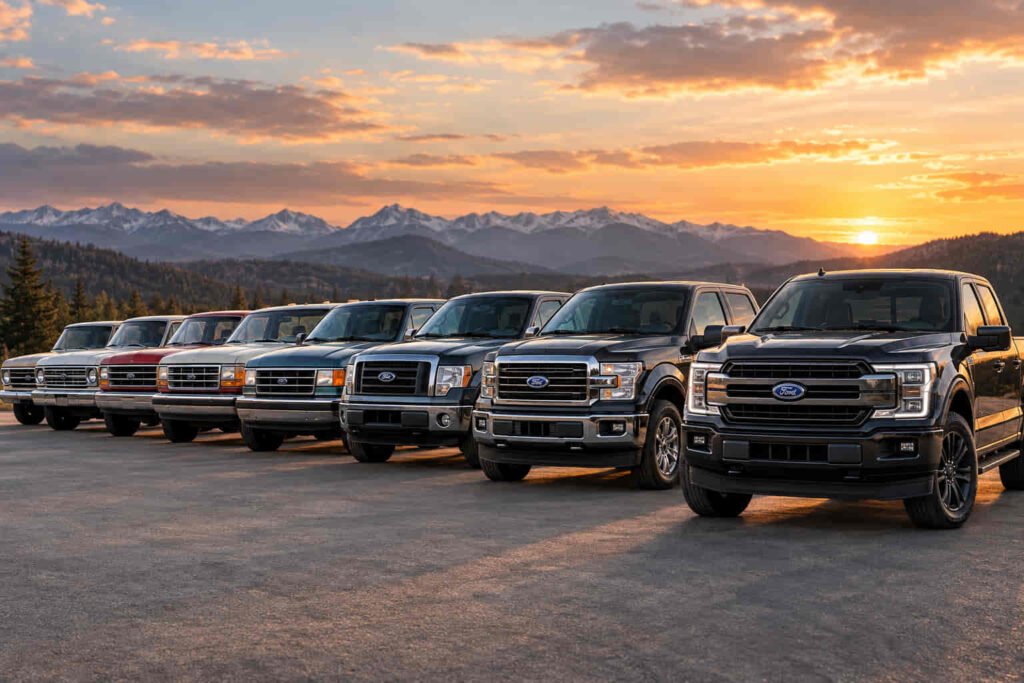
The Ford F-150 has evolved through multiple generations of Ford’s full-size pickup truck platform, becoming one of the most recognizable truck nameplates in the automotive market. Understanding Ford F150 generations is useful when researching model-year differences, engines, body styles, suspension systems, towing equipment, bed dimensions, interior technology, and replacement parts.
There is an important distinction when discussing F150 generations. The Ford F-Series began with the 1948 model year, while the F-150 name itself was introduced for the 1975 model year. Ford currently describes the F-Series as being in its 14th generation, while generation numbering can differ depending on whether the discussion refers to the entire F-Series history or specifically to the F-150 nameplate.
What Are Ford F150 Generations?
A vehicle generation generally represents a major redesign or engineering change to the underlying truck platform. A new F-150 generation can introduce changes to the body structure, frame, suspension, engines, transmissions, electrical architecture, interior, bed configuration, and available technology.
For parts and maintenance research, the generation is particularly important because components that fit one generation may not fit another. Headlights, tail lights, grilles, bumpers, suspension components, bed accessories, wiring, engines, and interior parts can change significantly when Ford introduces a new platform.
The F-Series itself dates back to 1948. Ford introduced the first postwar F-Series as a newly designed truck line, with the original range including the F-1 through F-8. The F-1 represented the half-ton segment that eventually evolved into the F-100 and ultimately the F-150.
When Did the Ford F150 Start?
The Ford F-150 was introduced for the 1975 model year. Ford positioned it between the F-100 and F-250 as a heavier-duty half-ton pickup, giving customers additional payload capability while maintaining the basic characteristics of the conventional F-Series pickup.
This means that references to the “first-generation F-150” can be confusing. The F-150 nameplate did not exist during the first five generations of the broader F-Series. Those earlier trucks are part of F-Series history, but they were not sold as F-150s.
For modern F-150 research, the 1975 model year is therefore the most useful starting point when discussing F-150-specific generations.
Ford F150 Generations by Model Year
The F-150 has gone through several major redesigns since its introduction. The commonly used F-150-specific generation structure begins with the 1975–1979 trucks and continues through the current 2021-present generation.
The exact naming convention can differ between historical sources because Ford’s generation numbering traditionally applies to the entire F-Series rather than only the F-150. A generation-focused F-150 reference should therefore include both the model-year range and the major engineering characteristics rather than relying only on a generation number.
1975–1979 Ford F150 Generation
The first F-150 appeared during the sixth-generation F-Series period. Ford introduced the F-150 in 1975 as a heavier-duty half-ton alternative positioned above the F-100.
These trucks are commonly associated with the “Dentside” design because of the distinctive body-side indentation running along the truck. The F-150 was available with different cab, bed, engine, and drivetrain configurations, making exact parts compatibility dependent on the individual truck.
For restoration and parts research, the 1975–1979 period should be treated separately from later F-150 generations because the frame, body, suspension, wiring, and engine configurations belong to a substantially different truck architecture.
1980–1986 Ford F150 Generation
Ford redesigned the F-Series for the 1980 model year, introducing a new generation with a more aerodynamic body and a revised chassis. This generation is commonly known as the “Bullnose” F-Series because of its front-end styling.
The redesign changed the relationship between the body, frame, suspension, and powertrain. Ford also continued to develop four-wheel-drive configurations and different cab and bed combinations throughout the generation.
For owners working with a 1980–1986 F-150, the model year remains important because Ford made running changes to engines, transmissions, trim levels, and equipment during the generation.
1987–1991 Ford F150 Generation
The 1987 F-Series introduced another significant redesign and is commonly referred to as the “OBS” generation, or Old Body Style. The truck adopted smoother exterior styling while retaining the traditional body-on-frame pickup architecture.
This generation is particularly important in F-150 history because it continued Ford’s transition toward more modern fuel-injection, electronic-control, interior, and safety technologies.
Parts catalogs frequently distinguish 1987–1991 F-150 applications from both earlier and later trucks. Exterior panels, lighting, suspension components, wiring, and drivetrain parts should therefore be matched by model year and configuration rather than by the F-150 name alone.
1992–1996 Ford F150 Generation
The 1992 F-Series introduced another major styling and platform update. The truck retained the basic full-size pickup architecture while receiving a more aerodynamic exterior and updated interior.
The 1990s F-150 continued Ford’s development of fuel-injected gasoline engines, electronic systems, automatic transmissions, and four-wheel-drive technology. During this period, configuration became increasingly important for parts and service information.
A 1992–1996 F-150 can therefore have different specifications depending on engine, cab, bed, drivetrain, and equipment. The model year should be used together with these attributes when determining compatibility.
1997–2003 Ford F150 Generation
The 1997 F-150 represented a major departure from the previous generation. Ford introduced a substantially redesigned body and interior with a more rounded exterior appearance and a stronger focus on passenger comfort.
This generation also became closely associated with Ford’s Modular engine family, including Triton V8 applications. The F-150 moved further away from the utilitarian styling and packaging of earlier generations and toward the modern full-size pickup format.
Cab configurations also expanded, and the SuperCab and later SuperCrew-related development helped establish the F-150 as both a work truck and a daily-use vehicle.
2004–2008 Ford F150 Generation
Ford introduced another major F-150 redesign for the 2004 model year. The new truck featured a more substantial frame and a boxier exterior design compared with the previous generation.
The 2004–2008 F-150 continued the use of Triton engines while receiving updated suspension, chassis, interior, electrical, and safety systems. The generation also became associated with the transition toward increasingly sophisticated electronic vehicle systems.
Because of these changes, components from the 1997–2003 F-150 should not automatically be considered interchangeable with 2004–2008 trucks.
2009–2014 Ford F150 Generation
The 2009 F-150 introduced a new generation with a more rugged exterior, revised frame, updated suspension, and a substantially modernized interior. Ford expanded the range of available engines and configurations during this period.
This generation is also important in the development of Ford’s modern truck technology. Features such as integrated trailer technology, updated infotainment, advanced interior controls, and improved towing capability became increasingly prominent.
Engine selection became particularly important as Ford expanded its use of EcoBoost technology. The 3.5L EcoBoost became one of the defining powertrains of the modern F-150 era.
2015–2020 Ford F150 Generation
The 2015 F-150 represented one of the most significant engineering changes in the history of the nameplate. Ford transitioned the body to a high-strength, military-grade aluminum-alloy construction while retaining a high-strength steel frame.
This generation changed more than the exterior appearance. Body construction, weight, suspension components, bed design, electrical systems, and available technology all evolved substantially.
The aluminum body became one of the defining characteristics of the 2015–2020 F-150 generation. This distinction is important when selecting replacement body panels, bumpers, beds, tailgates, lighting components, and other exterior parts.
Ford also continued expanding EcoBoost engine applications during this generation while retaining naturally aspirated V8 options.
2021–Present Ford F150 Generation
The 2021 model year introduced the current F-150 generation. Ford describes the 2021 truck as an all-new F-150 with extensive changes to the exterior, interior, technology, productivity features, and powertrain lineup.
One of the major developments was the introduction of the 3.5L PowerBoost full-hybrid powertrain, combining an internal-combustion engine with an electric motor and additional electrical capability. Ford also introduced features such as Pro Power Onboard, an available integrated power system designed to provide electrical power for tools and equipment.
The 2021-present generation also introduced updated interior technology, available 12-inch displays, SYNC 4 connectivity, revised exterior styling, and new productivity features.
The current generation should be treated as a separate fitment category from the 2015–2020 F-150 because the body, interior, electrical architecture, and many components changed with the redesign.
Read more: Ford F150 Bed Cover Installation
How Many Ford F150 Generations Are There?
The answer depends on how the generations are counted.
Ford states that the F-Series began in 1948 and describes the current F-Series as its 14th generation.
However, the F-150 name was introduced in 1975. When only the F-150 nameplate is considered, generation references typically begin with the 1975–1979 truck and continue through the current generation.
This distinction explains why two sources can give different generation numbers without necessarily disagreeing about the actual vehicles. One source may be counting the entire F-Series history, while another is counting only the F-150 nameplate.
For SEO, parts research, and fitment purposes, model-year ranges are generally more useful than generation numbers alone.
Ford F150 Generation vs Model Year
A generation covers multiple model years, while a model year identifies a specific production year within that generation.
For example, the 2015–2020 F-150 belongs to the same broad generation, but Ford can introduce changes to engines, trims, technology, safety systems, suspension components, and equipment during that period.
This is why “13th generation F-150” may be useful as a starting point but is not enough information for ordering a replacement component. The exact model year, engine, cab, bed length, drivetrain, and factory options may still be required.
Ford F150 Generation vs Engine
Engine selection is another important attribute within each F-150 generation. Ford has offered multiple engines during individual generations, and engine families can change without the entire truck platform being redesigned.
The 1997–2003 generation, for example, is associated with Triton V8 applications, while later generations introduced increasingly prominent EcoBoost engines. The 2021 generation added the PowerBoost hybrid to the F-150 powertrain family.
Consequently, an F-150 generation should never be treated as an engine specification. The correct engine must be identified separately when researching oil requirements, spark plugs, towing capacity, cooling components, exhaust systems, or drivetrain parts.
Why Ford F150 Generations Matter for Parts Compatibility
Generation information is particularly valuable when researching aftermarket and replacement parts. A component designed for a 2009–2014 F-150 may use different mounting points, electrical connections, dimensions, or materials from a similar component designed for a 2015–2020 truck.
The same principle applies to accessories. Bed covers, floor liners, running boards, grille guards, headlights, tail lights, suspension components, exhaust systems, and towing equipment can all have generation-specific fitment.
The safest compatibility chain is therefore model year → generation → engine → cab → bed → drivetrain → trim → factory equipment. The more specific the component, the more important this complete vehicle profile becomes.
Ford F150 Generations and Major Technology Changes
The history of the F-150 can also be understood through its major technology transitions. Earlier generations focused heavily on mechanical simplicity, payload, durability, and basic truck utility. Later generations progressively added electronic fuel injection, computer-controlled powertrains, advanced transmissions, electronic four-wheel drive, infotainment, driver-assistance systems, and connected vehicle technology.
The 2015 generation marked a particularly important material change with the aluminum-alloy body, while the 2021 generation introduced the PowerBoost hybrid and a broader range of connected productivity technology.
These technological changes are why an F-150 from one generation can require completely different diagnostic procedures and replacement components from an apparently similar truck from another generation.
How to Identify Your Ford F150 Generation
The easiest way to identify an F-150 generation is to start with the model year. Once the year is known, the generation can be determined from the applicable production range.
The VIN can then provide additional vehicle-specific information. The engine, cab configuration, drivetrain, bed length, trim, and factory equipment should be identified before ordering parts or following a repair procedure.
Visual identification can help distinguish major generations, but it should not replace model-year and VIN-based verification. Mid-cycle updates can make two trucks from the same generation look different, while similar-looking trucks from different generations can share certain styling characteristics.
Ford F150 Generations FAQ
How many generations of Ford F150 are there?
The answer depends on the counting method. Ford counts the broader F-Series from its 1948 introduction and identifies the current lineup as the 14th generation. The F-150 name itself began in 1975, so F-150-specific generation counts are different.
What year did the F-150 start?
The Ford F-150 was introduced for the 1975 model year. Ford positioned it as a heavier-duty half-ton pickup between the F-100 and F-250.
What is the newest Ford F150 generation?
The current F-150 generation began with the 2021 model year. Ford introduced the redesigned truck with updated technology, interior, exterior design, and new powertrain options including the 3.5L PowerBoost hybrid.
What is the 13th generation Ford F150?
The 13th-generation F-150 generally refers to the 2015–2020 model years. Its defining engineering characteristic is the aluminum-alloy body construction over a high-strength steel frame.
What is the 14th generation Ford F150?
The 14th-generation F-150 generally refers to the 2021-present generation. It introduced a redesigned truck with updated technology, productivity features, and the available PowerBoost hybrid powertrain.
Are F150 parts interchangeable between generations?
Not necessarily. Major redesigns can change mounting points, dimensions, electrical connections, suspension components, body structures, and drivetrain configurations. Parts should be verified against the exact model year and configuration.
Is the F-150 generation the same as the F-Series generation?
No. Ford’s generation numbering traditionally refers to the broader F-Series history. Because the F-150 name did not appear until 1975, the F-150-specific generation count starts later than the overall F-Series count.
Why is the model year more important than the generation?
A generation can span several model years during which Ford may introduce changes to engines, trims, electronics, suspension, or factory equipment. For parts and repair information, the exact model year provides a more precise starting point than generation alone.