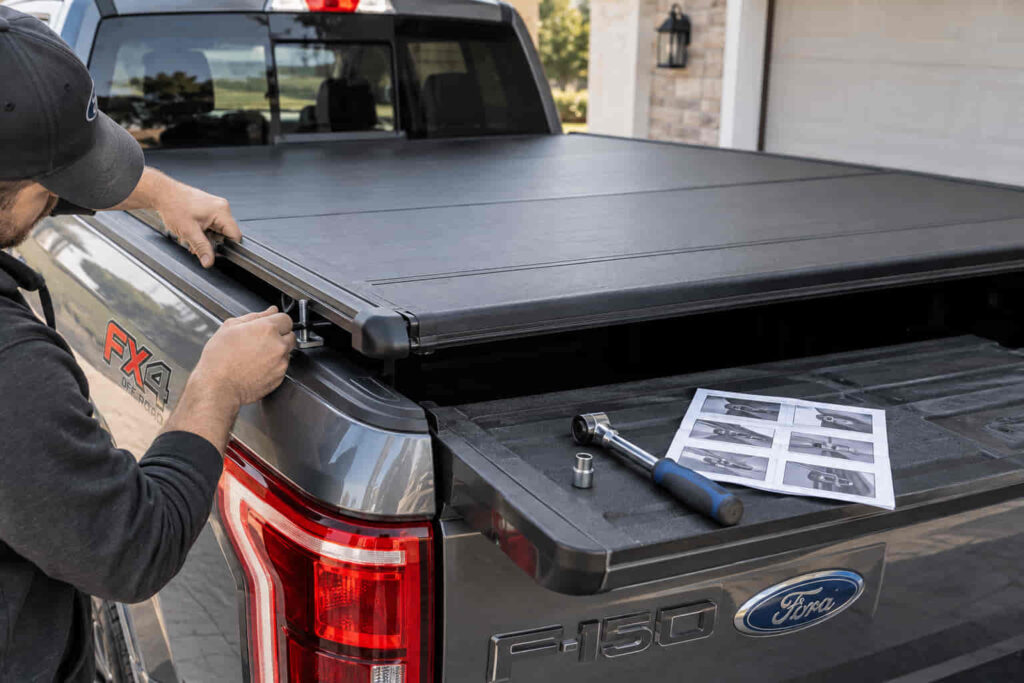
A Ford F150 tonneau cover installation requires more than simply placing a cover over the truck bed. The cover must match the F-150 bed dimensions and configuration, attach correctly to the bed or mounting rails, remain properly aligned, and allow the tailgate and other bed accessories to operate as intended.
Different tonneau covers use different mounting systems. Folding, rolling, retractable, hinged, and other designs can use different rails, clamps, brackets, seals, and adjustment procedures. Because Ford F-150 bed dimensions and configurations vary by model year and bed length, the correct installation procedure should always be matched to the specific truck and tonneau cover.
A properly installed tonneau cover should sit evenly on the bed, operate smoothly, maintain appropriate clearance around the tailgate, and provide the weather protection expected from the product.
What Is a Ford F150 Tonneau Cover?
A tonneau cover is a protective cover designed to enclose the pickup bed. On a Ford F-150, it can help protect cargo from weather, reduce exposure to debris, and provide a more finished appearance while the truck is being driven.
Tonneau covers are available in several designs, including soft roll-up covers, hard folding covers, retractable covers, hinged covers, and other integrated systems. Each design creates a different relationship between the cover, bed rails, tailgate, and cargo space.
The installation method therefore depends on the construction of the cover as much as the truck itself.
Ford F150 Tonneau Cover Compatibility
Compatibility should be confirmed before installation. The most important factors include model year, bed length, bed configuration, and the specific tonneau cover application.
An F-150 can be equipped with different bed lengths, and accessories mounted inside or around the bed can affect available installation space. Factory bedliners, bed caps, utility rails, tie-down systems, and other accessories can also influence how a cover mounts.
A tonneau cover designed for one F-150 bed configuration should not automatically be assumed to fit another simply because the trucks share the same model name.
The product’s vehicle application information should therefore be checked before beginning installation.
Ford F150 Bed Length and Tonneau Cover Fit
Bed length is one of the most important dimensions when selecting a tonneau cover. A cover designed for a shorter or longer F-150 bed will not align correctly with the intended mounting points.
Correct measurement is especially important when purchasing a tonneau cover without using a vehicle-specific fitment system. The usable bed dimensions, rail configuration, and tailgate relationship can all affect compatibility.
The cover should be positioned according to the manufacturer’s installation instructions rather than adjusted to compensate for an incorrect bed-size selection.
Ford F150 Tonneau Cover Installation Preparation
Before installing the cover, the truck bed should be inspected and cleaned. Dirt, debris, excessive buildup, or damaged bed surfaces can interfere with mounting hardware and seals.
The tonneau cover and its mounting components should also be inspected before installation. Rails, clamps, brackets, fasteners, seals, and support components should correspond to the intended vehicle application.
The truck should be parked on a stable, level surface whenever possible. A level starting position makes alignment easier and reduces the chance of installing the cover unevenly.
Installation should also account for any existing accessories that occupy the bed rail area or interfere with the cover’s mounting system.
Ford F150 Tonneau Cover Install Guide
The general installation process begins by positioning the tonneau cover and identifying the correct relationship between the cover, bed rails, and tailgate. Depending on the design, the mounting rails or brackets may need to be installed before the cover itself is secured.
The rails should be positioned evenly on both sides of the bed. Their alignment determines how the cover opens, closes, and seals, so small positioning errors can become noticeable when the cover is operated.
Once the mounting components are positioned, the clamps or fasteners can be installed according to the product-specific instructions. Hardware should initially remain adjustable until the alignment of the complete system has been confirmed.
The cover should then be placed into its operating position and checked from the front, rear, and both sides. The goal is to achieve consistent spacing, even contact with the seals, and smooth operation.
After alignment is confirmed, the mounting hardware can be tightened using the manufacturer’s specified procedure. The cover should then be opened and closed several times to confirm that tightening the hardware has not shifted the rails or changed the fit.
How to Align a Ford F150 Tonneau Cover
Correct alignment is essential because the cover interacts with multiple reference points at the same time. The front edge should sit correctly relative to the bed, the side rails should remain parallel, and the rear portion should align with the tailgate area.
If one side of the cover sits higher than the other, the mounting rails or brackets may not be positioned evenly. If the cover appears too far forward or backward, the mounting system may need to be repositioned before final tightening.
Alignment should be checked with the cover both open and closed. A system that appears correct while open may reveal interference or sealing problems when fully closed.
Ford F150 Tonneau Cover and Tailgate Clearance
Tailgate clearance is an important part of tonneau cover installation. The cover should allow the tailgate to operate without unnecessary interference while maintaining the intended relationship between the rear edge of the cover and the bed.
Some tonneau covers are designed to work with the tailgate closed before the cover is secured, while others have specific installation or adjustment requirements. The exact sequence depends on the cover design.
After installation, the tailgate should be opened and closed to verify that the cover, seal, brackets, and tailgate do not interfere with one another.
Read more: Ford F150 Tail Light Wiring Diagram
Ford F150 Tonneau Cover Seals and Weather Protection
Weather sealing depends on correct alignment between the cover, seals, bed rails, and tailgate area. A poorly positioned cover can create gaps even when the cover itself is undamaged.
Seals should sit evenly against their intended surfaces without excessive compression or obvious gaps. The seal should also remain in the correct position when the cover is opened and closed.
Water resistance should not be assumed simply because the cover physically fits the truck. The mounting position and sealing system are both important to the final result.
Ford F150 Tonneau Cover Clamp Installation
Many tonneau covers use clamps to secure mounting rails to the truck bed. The clamps must be positioned according to the cover manufacturer’s instructions because their location affects the stability and alignment of the system.
The clamp should engage the intended mounting surface securely without damaging the truck bed or interfering with other components. Hardware should be tightened evenly rather than using excessive force on one side before the other side has been aligned.
A clamp that appears tight is not necessarily correctly positioned. Its contact surface, orientation, and relationship to the mounting rail all matter.
Ford F150 Tonneau Cover Installation With a Bedliner
A factory or aftermarket bedliner can affect tonneau cover installation when it changes the surface available for clamps or mounting rails. Spray-in and drop-in bedliners can have different effects depending on their thickness and design.
A drop-in liner can sometimes interfere with the position of mounting hardware, while a spray-in liner may create a different mounting surface. The tonneau cover manufacturer’s instructions should determine whether any liner-related adjustment is required.
The bedliner should not be modified simply to make a cover fit unless the product documentation specifically calls for that procedure.
Ford F150 Tonneau Cover Installation With Bed Rails
Some F-150 configurations include factory bed rail systems or other bed-mounted accessories. These components can affect the space available for tonneau cover rails and clamps.
Compatibility should therefore be checked before installation. Some tonneau covers are designed to work with existing rail systems, while others require a specific mounting arrangement.
The cover should never be forced into a mounting position that conflicts with an existing rail or accessory.
Ford F150 Folding Tonneau Cover Installation
Folding tonneau covers generally use a series of panels or sections that move together when the cover is opened. Their installation requires correct positioning of the mounting rails and support hardware so the panels remain aligned.
After installation, each folding section should move without binding. The panels should meet evenly when closed, and the rear section should maintain the intended relationship with the tailgate.
If the panels become difficult to fold after the clamps are tightened, the mounting system may have shifted or the rails may not be parallel.
Ford F150 Roll-Up Tonneau Cover Installation
Roll-up covers require additional attention to the relationship between the side rails and the roll-up mechanism. The rails must remain parallel so the cover can move smoothly from the closed position to the rolled position.
The cover should not require excessive force to roll or unroll. If the fabric or cover material becomes uneven during operation, the mounting position should be checked before further adjustment.
The rear closure system should also engage correctly when the cover is fully extended.
Ford F150 Retractable Tonneau Cover Installation
Retractable tonneau covers can require more involved mounting because the system typically includes a housing, side rails, and a retracting mechanism.
The housing must be positioned correctly within the bed, while the rails need to remain aligned with the retractable cover. Available bed space can also be affected by bed accessories or the specific design of the retractable system.
Because these systems contain moving components, smooth operation should be verified before the installation is considered complete.
What Happens If a Ford F150 Tonneau Cover Is Installed Incorrectly?
An incorrectly installed tonneau cover can produce several problems, including uneven gaps, water intrusion, difficult opening, binding, loose mounting hardware, excessive vibration, and tailgate interference.
The symptoms can also appear only after driving because vibration and movement can expose an alignment or clamping problem that was not obvious while the truck was stationary.
If a cover begins shifting after installation, the mounting hardware and rail alignment should be inspected rather than simply tightening every fastener further.
Ford F150 Tonneau Cover Troubleshooting After Installation
A cover that is difficult to close may have an alignment or clearance problem. A cover that appears loose may have improperly positioned clamps or mounting hardware. Water entering the bed can indicate a sealing problem, incorrect positioning, or limitations of the cover’s weather-resistant design.
If the cover is uneven from one side to the other, the side rails should be checked for parallel alignment. If the tailgate is difficult to operate, the rear edge of the cover and its mounting position should be inspected.
Troubleshooting should always begin with the installation instructions for the specific tonneau cover because different designs use different adjustment mechanisms.
Does a Ford F150 Tonneau Cover Require Drilling?
Many tonneau covers are designed to mount without drilling, using clamps, brackets, rails, or existing mounting locations. However, not every tonneau cover uses the same installation method.
Whether drilling is required depends on the specific product and F-150 configuration. A no-drill design should not be modified with unnecessary drilling simply because the installation appears difficult.
The product-specific instructions should establish whether drilling, cutting, or permanent modification is actually part of the intended installation.
How to Maintain a Ford F150 Tonneau Cover After Installation
Regular inspection helps preserve proper fit and operation. Mounting hardware should be checked according to the product manufacturer’s maintenance recommendations, while seals and rails should be kept clean.
The cover should also be inspected for damage, loose components, distorted seals, and changes in alignment. If the cover begins operating differently from when it was first installed, the mounting system should be inspected before the problem becomes more serious.
Maintenance requirements vary between soft, hard, folding, rolling, and retractable designs, so the manufacturer’s care instructions remain the primary reference.
Ford F150 Tonneau Cover Installation and Cargo Access
A correctly installed tonneau cover should balance cargo protection with the access requirements of the truck bed. Folding and rolling designs may allow partial bed access, while retractable or hinged systems can provide different opening configurations.
The available cargo space can also change depending on whether the cover requires a front housing, support rails, or other components inside the bed.
Installation should therefore be evaluated not only by whether the cover closes, but also by whether it provides the intended access and clearance for normal F-150 use.
FAQ About Ford F150 Tonneau Cover Installation
How do I install a tonneau cover on a Ford F150?
The general process involves preparing the bed, positioning the mounting hardware or rails, aligning the cover, installing clamps or brackets, checking tailgate clearance, and tightening the hardware according to the manufacturer’s instructions. The exact procedure varies by tonneau cover design and F-150 configuration.
Do all Ford F150 tonneau covers install the same way?
No. Folding, rolling, retractable, hinged, and other tonneau covers can use different mounting systems and adjustment procedures.
Does a tonneau cover need to match the F150 bed size?
Yes. Bed length and configuration are critical fitment factors. A cover designed for a different bed configuration may not align correctly.
Can I install a tonneau cover over a Ford F150 bedliner?
In many applications, yes, but compatibility depends on the bedliner and tonneau cover mounting system. The manufacturer’s fitment and installation instructions should be checked before installation.
Why is my F150 tonneau cover not closing evenly?
Uneven closing can result from rails that are not parallel, improperly positioned clamps, incorrect cover alignment, or interference from the bed or tailgate. The mounting system should be checked before applying additional tightening force.
Can a Ford F150 tonneau cover be installed without drilling?
Many tonneau covers use no-drill clamp or bracket systems, but this is product-specific. The exact installation requirements should be confirmed for the selected cover and F-150 configuration.
How do I stop water from getting under my F150 tonneau cover?
Water intrusion can result from incorrect alignment, gaps around the seals, installation issues, or the normal limitations of a particular cover design. Check the cover’s mounting position and seals according to the manufacturer’s instructions before modifying the system.