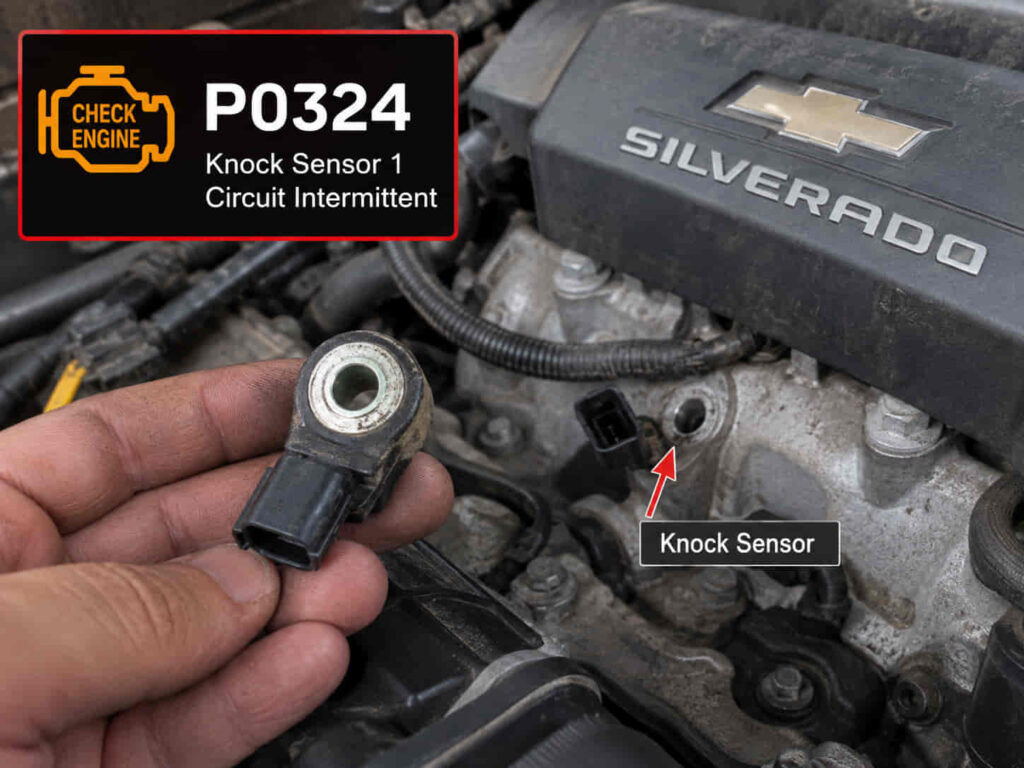
The P0324 code on a Chevy Silverado means the engine control module has detected a problem with the knock control system. This system uses knock sensor signals to identify abnormal combustion and allows the engine computer to adjust ignition timing when necessary. When the expected knock control operation or signal falls outside the parameters monitored by the control module, the Check Engine Light may illuminate and the P0324 diagnostic trouble code can be stored.
P0324 does not automatically mean the knock sensor itself has failed. A faulty knock sensor is one possible cause, but damaged wiring, poor electrical connections, circuit faults, and less common control module problems can also produce a knock control system error. Replacing the sensor without diagnosing the circuit can therefore leave the original problem unresolved.
A Chevy Silverado with P0324 may show few noticeable symptoms, or it may develop reduced performance, hesitation, abnormal engine noise, or other drivability problems depending on the underlying fault. Correct diagnosis requires checking the stored codes and related diagnostic information before inspecting the knock sensor circuit and repairing the confirmed cause. This guide explains what P0324 means on a Chevy Silverado, its symptoms and causes, how serious it is, and how to diagnose and fix the fault correctly.
What Does the P0324 Code Mean on a Chevy Silverado?
The P0324 code on a Chevy Silverado means the powertrain control system has detected an error in the engine’s knock control system. The knock control system is responsible for detecting combustion knock and providing the information the engine computer needs to manage ignition timing. When the control module identifies operation outside the expected parameters of this system, it can store P0324 and illuminate the Check Engine Light.
The knock control system relies on one or more knock sensors to detect vibrations associated with abnormal combustion. These sensors convert engine vibrations into electrical signals that the ECM or PCM can evaluate. When combustion knock is detected, the control module can alter ignition timing to reduce detonation and protect the engine. P0324 indicates a problem with this monitoring and control process rather than proving that the engine is physically knocking at that moment.
A P0324 code also does not confirm that the knock sensor needs replacement. The sensor is only one component in the diagnostic path because its signal must travel through wiring and electrical connections before reaching the control module. A damaged wire, poor connector contact, abnormal circuit condition, or control-related fault can interfere with this process and produce the same general knock control system error. For this reason, diagnosis should identify where the signal or control process is failing before any component is replaced.
The exact diagnostic approach can also depend on the Silverado’s model year, engine, and other codes stored at the same time. Chevrolet Silverado trucks have been produced with different engine configurations and control systems, so a test specification for one engine should not automatically be applied to every Silverado. The correct approach is to identify the vehicle and engine first, examine P0324 alongside any accompanying DTCs, and then follow the applicable diagnostic procedure.
What Symptoms Can a Chevy Silverado Have With a P0324 Code?
A Chevy Silverado with a P0324 code can have a Check Engine Light, reduced engine performance, hesitation, poor acceleration, abnormal combustion noise, or no obvious drivability symptoms. The exact symptoms depend on what caused the knock control system error and how the engine computer responds to the affected signal. This explains why two Silverado trucks with the same P0324 code do not necessarily behave in the same way.
The Check Engine Light is the most direct observable indication because P0324 is stored when the control module detects a fault within the monitored knock control system. A Silverado can therefore appear to drive normally while the Check Engine Light remains illuminated. The absence of noticeable performance problems does not prove that the code is insignificant; it only means the fault has not produced an obvious drivability symptom under the conditions experienced by the driver.
Reduced performance, hesitation, or weaker acceleration can occur when the engine management system cannot use knock-related information as expected. Knock detection is connected to ignition timing control, and ignition timing directly influences how efficiently cylinder pressure is converted into engine torque. A problem within this control process can therefore affect the way the engine responds under acceleration or load, although the exact behavior depends on the engine and the nature of the fault.
Abnormal knocking or pinging requires greater attention because P0324 concerns the system used to monitor combustion knock. Audible knock should not automatically be attributed to a failed knock sensor; actual abnormal combustion and an electrical knock-control fault are different conditions and need to be distinguished during diagnosis. A Silverado that develops pronounced knocking, severe loss of power, misfiring, a flashing Check Engine Light, or additional warning symptoms requires more immediate investigation than a truck with a stored P0324 code and otherwise normal operation.
Fuel economy may also change when an engine is not operating under its intended ignition-control strategy, but fuel consumption alone is not sufficient evidence to diagnose P0324. Tire pressure, driving conditions, vehicle load, other engine faults, and driving behavior also affect fuel use. The stored diagnostic information and electrical or mechanical testing should therefore determine the cause rather than symptoms alone.
Read more: Honda CRV Master Window Switch Program
What Causes the P0324 Code on a Chevy Silverado?
The P0324 code on a Chevy Silverado can be caused by a faulty knock sensor, damaged wiring, poor electrical connections, a problem within the knock sensor circuit, or a less common ECM or PCM-related fault. These causes affect different parts of the same signal path between the engine, knock sensor, electrical circuit, and control module. For that reason, P0324 identifies a knock control system problem but does not identify the failed component by itself.
A faulty knock sensor is one possible cause because the sensor provides the electrical signal the control module uses to monitor engine vibration associated with combustion knock. A sensor that cannot produce or transmit an expected signal can interfere with the knock control strategy and contribute to P0324. However, replacing the knock sensor solely because P0324 is stored can result in an unnecessary repair. The sensor should be considered together with its circuit, wiring, connectors, related trouble codes, and applicable test results.
Damaged wiring and poor electrical connections can create a similar fault without any internal failure of the knock sensor. The sensor signal must travel through an electrical circuit before the ECM or PCM can interpret it. An open circuit, short circuit, damaged harness, loose terminal, corrosion, or poor connector contact can disrupt that signal path. Visual inspection is therefore an important diagnostic step because repairing a damaged wire or connection can resolve the underlying problem without replacing a functional sensor.
Actual combustion problems must also be separated from electrical knock control faults. Engine knock, sometimes described as detonation or pinging, occurs when combustion does not progress as intended inside the cylinder. The knock control system is designed to detect relevant vibration and allow the engine computer to respond through ignition control. P0324 concerns an error within that control system, so the presence of the code alone does not prove that abnormal combustion is occurring. Conversely, audible knocking should not be dismissed simply because an electrical fault is also present.
An ECM or PCM-related problem is another possible diagnostic direction, but the control module should not be treated as the first component to replace. The module receives and processes knock-related information, which means a fault affecting that process can theoretically contribute to P0324. Diagnosis should first eliminate more direct problems in the sensor, connector, wiring, power or ground paths where applicable, and associated circuits before concluding that the control module itself requires repair or replacement.
The Silverado’s model year and engine configuration also matter when identifying the actual cause. Different Silverado powertrains can use different component locations, wiring arrangements, diagnostic specifications, and service procedures. A diagnostic value or replacement procedure taken from one Silverado engine should therefore not be assumed to apply to another. Vehicle-specific service information becomes particularly important when electrical testing is required.
How Serious Is the P0324 Code on a Chevy Silverado?
P0324 on a Chevy Silverado should be diagnosed promptly because the fault affects the system responsible for monitoring and responding to engine knock, but the code does not automatically mean the truck must be stopped immediately. Severity depends on the underlying cause, the truck’s drivability, additional trouble codes, warning-light behavior, and whether abnormal engine noise is present.
A Silverado that stores P0324 while continuing to start, idle, accelerate, and operate normally presents a different situation from a truck experiencing severe hesitation, loss of power, misfiring, or audible knocking. The code still requires diagnosis because normal drivability does not prove that the knock control system is functioning correctly. It means only that the driver has not observed a severe operating symptom at that time.
Driving for an extended period without diagnosing P0324 is not a good repair strategy. The knock control system contributes to the engine computer’s ability to manage ignition timing in response to combustion conditions. Leaving a confirmed fault unresolved can prevent the system from operating as intended, while simply clearing the code removes the stored warning without repairing the condition that caused it.
A Silverado with P0324 can generally be moved for diagnosis when it operates normally and no severe warning signs are present, but continued driving should be reconsidered when significant symptoms develop. Pronounced metallic knocking or pinging, severe power loss, repeated misfiring, overheating, a flashing Check Engine Light, or additional serious engine codes indicate that the vehicle needs immediate inspection. These symptoms can represent problems beyond the P0324 circuit fault itself and should not be ignored.
The practical severity of P0324 is therefore determined by diagnosis rather than by the code number alone. Reading all stored and pending DTCs, examining available freeze-frame or scan data, listening for abnormal engine noise, and checking current engine operation provides more useful information than assuming every Silverado with P0324 has the same level of risk.
How Do You Diagnose the P0324 Code on a Chevy Silverado?
To diagnose P0324 on a Chevy Silverado, scan the vehicle for all stored and pending trouble codes, review the available diagnostic data, inspect the knock sensor wiring and connectors, test the applicable circuit, and verify the suspected fault before replacing the knock sensor or control module. This sequence is important because P0324 identifies a knock control system error rather than a specific failed component. Replacing parts before testing the system can leave a wiring, connection, or circuit problem unresolved.
Start by connecting an OBD-II scan tool and recording P0324 together with every additional stored or pending DTC. Do not erase the codes before recording the available information because related codes can change the diagnostic direction. Freeze-frame data, when available, can also show operating conditions such as engine speed, load, coolant temperature, and other parameters at or near the time the control module detected the fault. This information helps establish the context in which P0324 was stored rather than treating the code as an isolated event.
The next step is to determine whether P0324 is the only relevant code. Additional knock sensor, ignition, misfire, voltage, or engine-management codes can provide evidence that the problem extends beyond a single sensor. For example, a combination of codes affecting electrically related components can justify investigating shared wiring, connections, power, ground, or control conditions before replacing an individual component. Diagnostic trouble codes should therefore be interpreted as evidence within the complete fault pattern, not as automatic instructions to replace the component named in a code description.
Inspect the knock sensor circuit and its accessible wiring after reviewing the scan results. Look for damaged insulation, broken or pinched wires, loose connections, contaminated or corroded terminals, and evidence that a harness has contacted a hot, sharp, or moving component. A wiring defect matters because the knock sensor’s electrical signal must reach the ECM or PCM within the parameters expected by the control system. A functional sensor cannot provide useful information to the module when the signal path between the two is compromised.
Electrical testing should follow the service information for the Silverado’s specific model year and engine. Depending on the applicable diagnostic procedure, testing can involve checking circuit continuity, shorts, connector integrity, or signal behavior with appropriate diagnostic equipment. The important distinction is that a measured value must be compared with the correct specification for that vehicle and engine. A resistance, voltage, or signal specification from a different Silverado powertrain should not be used as a universal pass-or-fail value.
The knock sensor should be considered defective only after the diagnostic evidence supports that conclusion. If wiring and connections pass the applicable checks but the sensor does not produce the expected response under the specified test conditions, sensor replacement becomes a justified repair. If testing identifies an open circuit, short, damaged terminal, or poor connection instead, repairing that electrical fault addresses the diagnosed cause without replacing a sensor that may still be functional.
Mechanical engine condition also deserves attention when the truck produces audible knocking or other abnormal combustion symptoms. P0324 describes a knock control system error, while actual detonation or mechanical noise is a separate condition that can influence the diagnostic picture. A technician should therefore distinguish an electrical control fault from genuine abnormal combustion rather than assuming that every knocking sound is caused by the sensor or that every P0324 code confirms physical engine knock.
ECM or PCM diagnosis should come later in the process. A control module participates in knock monitoring, but condemning it before verifying the sensor circuit introduces both diagnostic uncertainty and potentially unnecessary expense. Module-related diagnosis should be supported by vehicle-specific testing and by evidence that the relevant external components and circuits operate correctly. Software or calibration considerations should likewise be checked against applicable service information rather than assumed from the presence of P0324 alone.
After the confirmed fault is repaired, clear the diagnostic trouble codes and operate the Silverado under appropriate conditions before scanning the system again. A successful repair is confirmed when the original fault condition is no longer detected, P0324 does not return under the applicable monitoring conditions, and any related drivability symptoms have been resolved. Simply turning off the Check Engine Light or clearing the stored code does not confirm a repair because the underlying fault can cause P0324 to return after the monitor runs again.
This diagnostic sequence prevents the most important mistake when dealing with P0324: replacing the knock sensor based on the code alone. The correct repair follows the evidence from the scan data, wiring inspection, electrical testing, component testing, and post-repair verification. That approach isolates the actual failure within the Chevy Silverado’s knock control system instead of treating P0324 as a direct knock sensor replacement command.
How Do You Fix the P0324 Code on a Chevy Silverado?
To fix the P0324 code on a Chevy Silverado, repair the specific fault found during diagnosis rather than automatically replacing the knock sensor. The correct repair may involve fixing damaged wiring or connectors, replacing a confirmed faulty knock sensor, correcting another problem affecting the knock control circuit, or addressing a control module-related fault when vehicle-specific testing supports that diagnosis. After the repair, the codes should be cleared and the system retested to confirm that P0324 does not return.
Repair damaged wiring first when inspection or electrical testing identifies an open circuit, short, damaged conductor, poor terminal connection, or compromised connector. The knock sensor depends on an intact electrical path to communicate information to the engine control system. Replacing the sensor will not correct P0324 when the original sensor is functional but its signal cannot travel through the circuit correctly. Wiring repairs should restore the affected circuit and connector integrity rather than merely clear the code and wait to see whether it returns.
Replace the knock sensor when diagnostic testing confirms that the sensor itself cannot operate within the specifications for the Silverado’s engine and model year. The replacement procedure depends on the specific engine because sensor quantity, location, accessibility, and surrounding components can differ between Silverado powertrains. This distinction affects both repair procedure and labor time, which is why a generic knock sensor replacement process should not be applied to every Chevrolet Silverado.
Component selection also matters when a knock sensor replacement is justified. The replacement sensor must match the application and provide the signal characteristics expected by the engine management system. Installation should follow the applicable service procedure, including connector handling and any installation specifications required for that engine. Because a knock sensor responds to engine vibration, correct installation is part of restoring the system rather than a separate cosmetic detail.
A connector fault requires correction at the connection itself. Loose terminals, damaged pins, contamination, corrosion, or a connector that cannot maintain proper electrical contact can interrupt the knock sensor signal even when the sensor and the remaining wiring are functional. Cleaning, terminal repair, connector replacement, or harness repair should be selected according to the condition actually found during inspection. The objective is to restore a stable electrical path between the sensor circuit and the control system.
Actual combustion or mechanical problems should be repaired separately when diagnosis shows that abnormal engine operation exists alongside P0324. Audible pinging or knocking is not proof that the knock sensor has failed, just as P0324 is not proof that the engine is physically detonating. When both conditions appear together, diagnosis needs to determine whether the sound results from combustion, another mechanical source, or a separate engine fault while also resolving the knock control system error.
ECM or PCM repair, programming, or replacement should only be considered after the relevant external components and circuits have been verified according to the applicable diagnostic procedure. The control module sits at the end of the diagnostic path because sensor and circuit faults can produce symptoms that appear to involve the module. Replacing a module before eliminating those faults can create a costly repair without correcting the original cause of P0324.
Clearing P0324 is the final step after the fault has been repaired, not the repair itself. Use the scan tool to clear the stored DTC, operate the Silverado under conditions that allow the relevant monitor to run, and scan the vehicle again. The repair is supported when P0324 remains absent after appropriate monitoring, related trouble codes do not return, and the original drivability symptoms are no longer present.
The most efficient P0324 repair therefore follows the same direction as the diagnosis: identify the failure, repair that failure, and verify the result. A Chevy Silverado should receive a new knock sensor because testing identifies a faulty knock sensor, not simply because the scanner displays P0324. This distinction reduces unnecessary parts replacement and keeps the repair focused on the actual fault within the knock control system.
How Much Does It Cost to Fix P0324 on a Chevy Silverado?
The cost to fix P0324 on a Chevy Silverado depends on whether the actual problem is the knock sensor, wiring or connector damage, another circuit fault, or a less common ECM or PCM-related issue. There is no single repair price that applies to every Silverado because P0324 identifies a knock control system error rather than one component that must always be replaced. The final cost combines diagnosis, replacement parts when required, and the labor needed to access and repair the failed part of the system.
Diagnostic labor is the first cost to consider when the cause has not already been confirmed. A proper diagnosis involves more than reading P0324 with an OBD-II scanner. The technician may need to review additional DTCs and scan data, inspect the harness and connectors, perform circuit tests, and determine whether the knock sensor produces the expected response. Paying for accurate diagnosis can prevent a more expensive parts-replacement approach in which a functional sensor is replaced while the actual wiring or connection fault remains.
A wiring or connector problem can change the repair cost substantially because the amount of labor depends on the location and extent of the damage. Repairing an accessible damaged wire or terminal is different from tracing an intermittent electrical fault through a larger section of the engine harness. Connector condition also matters. A repair involving an individual terminal may require less work than replacing a damaged connector or repairing multiple affected conductors.
Knock sensor replacement cost depends heavily on the Silverado’s engine and the amount of disassembly required to reach the sensor. Chevrolet has used multiple engine configurations across Silverado model years, so component location and accessibility are not identical across every truck. Labor can therefore represent a significant part of the total repair even when the replacement sensor itself is not the most expensive component. The exact vehicle identification, engine, and service procedure should be established before estimating replacement labor.
The price can increase further when diagnosis identifies a control module-related problem, but an ECM or PCM should not be included automatically in a P0324 repair estimate. Module replacement can involve the component itself as well as programming or setup requirements for the vehicle. Because this repair can be considerably more involved than correcting a wiring fault, it should be supported by vehicle-specific diagnostic results showing that the external sensor circuit and relevant connections are functioning correctly.
The most useful P0324 repair estimate is therefore one based on the diagnosed cause rather than the trouble code alone. Two Chevy Silverado trucks displaying P0324 can require completely different repairs: one may need an electrical connection corrected, while another may require knock sensor replacement and additional labor to access the component. Identifying the fault first provides a more accurate estimate and prevents the cost of replacing parts that testing has not shown to be defective.
What Is the Difference Between P0324 and Other Chevy Silverado Knock Sensor Codes?
P0324 identifies an error in the Chevy Silverado’s knock control system, while other knock-related DTCs can identify different circuit conditions or a more specific area of the knock sensor system. This distinction matters because codes that belong to the same general system do not necessarily have the same cause or require the same repair. P0324 should therefore be diagnosed according to its definition and the complete combination of codes stored in the vehicle rather than treated as interchangeable with every knock sensor DTC.
When P0324 appears with another knock-related code, the additional DTC can provide more context for diagnosis. The combination may help narrow attention toward a particular sensor circuit, electrical condition, or another part of the system covered by the applicable service procedure. This is why all stored and pending codes should be recorded before they are cleared. Removing the codes before examining their relationship eliminates information that can help identify where the fault occurred.
The same principle applies when P0324 appears with codes outside the knock sensor category. Ignition, misfire, electrical, or other engine-management faults can change the diagnostic context because P0324 does not exist independently from the rest of the engine control system. A technician should determine whether the codes represent separate problems or whether they provide evidence of a related underlying condition before replacing components.
The exact interpretation of related codes should remain vehicle-specific. Silverado model years and engine configurations do not all use identical knock sensor arrangements or diagnostic procedures. For this reason, the correct DTC definitions and diagnostic information for the specific truck should be used instead of assuming that every knock-related code applies identically across the entire Silverado range.
How Can You Prevent the P0324 Code From Returning?
The most effective way to prevent P0324 from returning is to repair the confirmed cause completely and verify the knock control system after the repair. Clearing the code, disconnecting the battery, or replacing a component without confirming the underlying fault does not prevent recurrence. P0324 can return when the ECM or PCM runs the relevant monitor again and detects the same unresolved condition.
Electrical repairs should restore both the affected circuit and the physical condition that allowed the fault to develop. For example, repairing a damaged conductor without addressing a harness that continues to rub against another component can allow the wiring to fail again. The repaired harness should be routed and secured correctly, while affected terminals and connectors should maintain reliable electrical contact. This approach addresses the failure mechanism instead of only its immediate symptom.
A replaced knock sensor should also be installed according to the procedure and specifications for the Silverado’s particular engine. Correct component selection, electrical connection, installation, and any applicable mounting requirements matter because the sensor is part of a system that interprets engine vibration. Using vehicle-specific service information prevents a generic repair procedure from being applied to a powertrain for which it was not intended.
Post-repair verification is the final protection against an immediate recurrence. Clear the DTC after completing the repair, operate the vehicle under appropriate monitoring conditions, and scan it again for stored or pending codes. P0324 remaining absent after the relevant monitor has run provides stronger evidence of a successful repair than simply seeing the Check Engine Light turn off.
P0324 does not require a special maintenance routine once its actual cause has been corrected. The important preventive principle is to avoid leaving known wiring damage, connector problems, abnormal engine operation, or related trouble codes unresolved. Diagnose the complete fault, repair the confirmed cause, and verify the result; these three steps provide the strongest basis for keeping P0324 from returning on a Chevy Silverado.