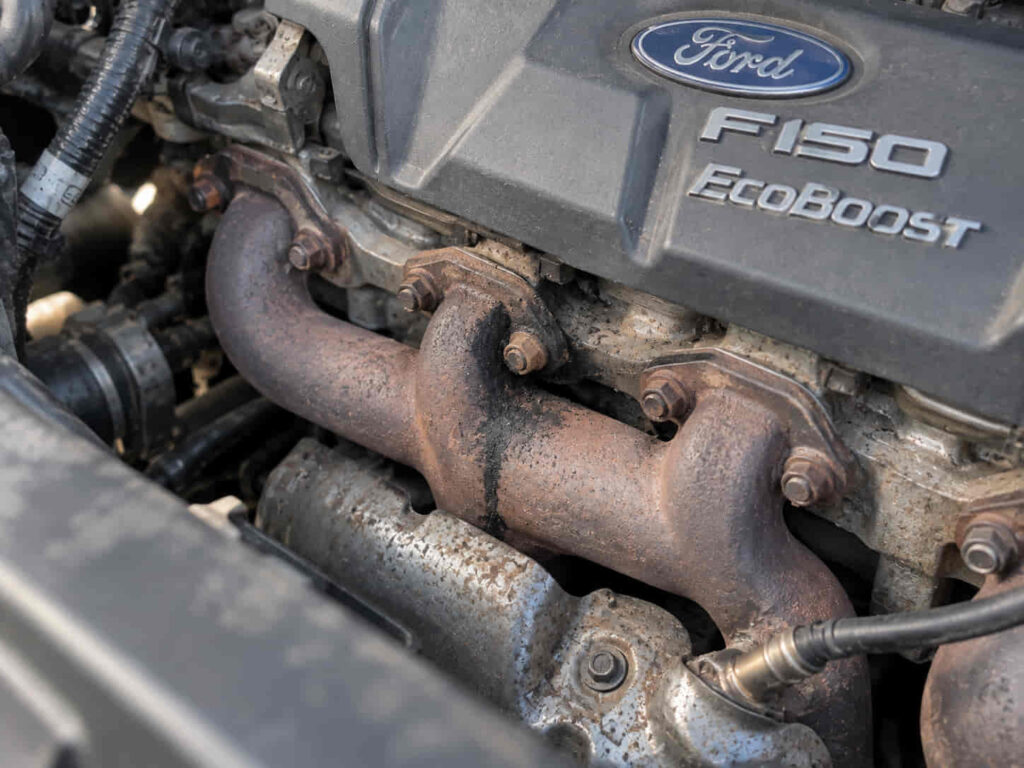
A Ford F-150 EcoBoost exhaust manifold leak occurs when exhaust gases escape through a failed sealing point around the exhaust manifold instead of remaining contained within the intended exhaust path. The leak may develop around the manifold sealing surface, gasket, or mounting hardware, including damaged or broken exhaust manifold studs. Because the EcoBoost engine uses exhaust flow as part of the turbocharging system, identifying the location and severity of the leak is important before replacing parts or assuming that another engine component is responsible.
A ticking or tapping noise is one of the most recognizable signs of an exhaust manifold leak, particularly when the engine is cold. The sound may change as the engine warms because the manifold and surrounding metal components expand with increasing temperature. Exhaust odor and dark soot around a leaking joint can provide additional evidence, while more significant leaks may require further diagnosis when they occur alongside performance or drivability symptoms.
Diagnosing the problem correctly requires more than identifying an unusual engine noise. This guide explains the symptoms and causes of a Ford F-150 EcoBoost exhaust manifold leak, how the leak is diagnosed, what happens when it is left unrepaired, how the manifold and related hardware are repaired, and which factors determine the final repair cost.
What Are the Symptoms of a Ford F-150 EcoBoost Exhaust Manifold Leak?
The most recognizable symptom of a Ford F-150 EcoBoost exhaust manifold leak is a ticking or tapping noise from the exhaust manifold area, especially during a cold start. Exhaust odor and visible soot around a leaking connection can provide additional evidence. The exact symptoms depend on the size and location of the leak, so engine noise alone is not sufficient to confirm that the exhaust manifold has failed.
Cold-start ticking can occur because the exhaust manifold and adjoining metal components change dimensions as their temperature rises. A small opening at the sealing surface can therefore allow exhaust pulses to escape more noticeably immediately after startup. As the components heat and expand, the opening may become smaller and the ticking may become quieter. A noise that is strongest after a cold start and changes as the engine reaches operating temperature is consequently an important diagnostic clue, but it still needs to be traced to the manifold area before a repair decision is made.
Escaping exhaust gases can also leave black or dark-gray soot around the point where the manifold should remain sealed. This residue is useful because it provides physical evidence of the path taken by exhaust gases. An exhaust smell near the engine compartment can indicate the same problem when gases escape before reaching the downstream exhaust system. Exhaust odor should not be treated as proof of a manifold leak by itself because other damaged exhaust connections can produce a similar symptom.
More severe drivability symptoms require broader diagnosis. Poor acceleration, abnormal boost behavior, or a check engine light should not automatically be attributed to the exhaust manifold simply because a ticking noise is also present. The EcoBoost system contains multiple components that can affect engine performance. The location of the leak and its relationship to exhaust flow must therefore be established before linking a performance problem directly to the manifold.
How Can You Diagnose an Exhaust Manifold Leak on a Ford F-150 EcoBoost?
Diagnosing a Ford F-150 EcoBoost exhaust manifold leak requires confirming where exhaust gas is escaping and inspecting the manifold, sealing area, and mounting hardware for evidence of failure. The diagnosis should establish both the leak location and its underlying cause because replacing a gasket alone will not correct a warped manifold or restore clamping force from a broken stud.
Start by identifying where the ticking or exhaust noise is strongest while the engine is cold. A suspected manifold leak is more convincing when the noise originates from the manifold area and follows the cold-start pattern described above. As the engine warms, a change in noise intensity provides another diagnostic clue. Inspection around the manifold can then look for soot trails or discoloration that indicate exhaust gases have passed through a joint that should remain sealed.
The mounting hardware also needs inspection because the manifold depends on sufficient clamping force to maintain its seal against the cylinder head. A damaged, loose, or broken exhaust manifold stud can reduce that force at one section of the manifold. Exhaust pressure can then escape through the resulting opening. When a broken stud accompanies soot around the same area, the two observations provide stronger evidence of the failure mechanism than ticking noise alone.
The manifold itself and its sealing surface must also be considered. Repeated heating and cooling expose exhaust components to thermal expansion and contraction. If the manifold no longer maintains the required sealing relationship with the cylinder head, replacing only the gasket may leave the underlying problem unresolved. Diagnosis should therefore distinguish among a sealing failure, damaged mounting hardware, and manifold distortion before determining which components need replacement.
Finally, other sources of ticking must be excluded before the exhaust manifold is condemned. An engine contains several mechanical and fuel-system components capable of producing repetitive noises, while leaks elsewhere in the exhaust path can create sounds that resemble a manifold leak. A reliable diagnosis connects multiple observations—noise location, cold-versus-warm behavior, soot or exhaust evidence, hardware condition, and the manifold sealing area—rather than relying on a single symptom.
Read more: Honda CRV Recalls
What Causes an Exhaust Manifold Leak on a Ford F-150 EcoBoost?
A Ford F-150 EcoBoost exhaust manifold leak develops when the manifold can no longer maintain a complete seal against the cylinder head, with damaged mounting hardware, manifold distortion, and sealing-surface failure being the main mechanisms to investigate. These failures are closely connected because the exhaust manifold repeatedly experiences high temperatures followed by cooling, while the studs and other mounting hardware must maintain enough clamping force to keep the joint sealed throughout those temperature changes.
A broken exhaust manifold stud can create a leak by reducing clamping force at one section of the manifold. The studs hold the manifold against the cylinder head so that exhaust gases leaving the exhaust ports remain contained within the intended exhaust path. When a stud breaks, the affected section can lose part of that clamping force. A small gap can then develop between the mating surfaces, allowing high-pressure exhaust pulses to escape. This mechanism explains why a leak associated with damaged hardware may produce both a repetitive ticking noise and soot near the affected area.
Manifold distortion can produce a similar sealing failure even when the visible problem is not initially a broken stud. The exhaust manifold heats substantially while the engine operates and cools again after shutdown. This repeated thermal cycling causes expansion and contraction of the metal. If the manifold sealing surface no longer remains sufficiently aligned with the cylinder-head surface, uniform sealing becomes more difficult. The mounting hardware may then experience uneven loading, and the sealing problem can progressively worsen instead of remaining confined to a minor gap.
The gasket or sealing interface can also be involved, but identifying a failed gasket does not establish the root cause by itself. A sealing material cannot compensate indefinitely for inadequate clamping force or a manifold surface that no longer mates correctly with the cylinder head. For this reason, replacing only the gasket without inspecting the manifold and mounting hardware can leave the original failure mechanism in place. The repair decision should be based on the condition of the entire sealing assembly rather than treating the gasket as an isolated component.
Thermal cycling connects these failure mechanisms. The manifold, cylinder head, studs, and sealing interface operate as a system exposed to repeated temperature changes. A loss of clamping force at one location changes how the manifold is held against the cylinder head, while distortion can increase stress on the mounting points. The resulting relationship can progress from a minor sealing irregularity to a detectable exhaust leak. This is why diagnosis should determine whether the visible leak is the primary failure or the consequence of damaged hardware or manifold distortion.
Are Ford F-150 EcoBoost Exhaust Manifold Leaks Common?
Exhaust manifold leaks are a recognized repair issue on Ford F-150 EcoBoost engines, but the likelihood and failure pattern should be evaluated by engine configuration and model year rather than assuming that every EcoBoost F-150 has the same risk. The EcoBoost name covers different engines and multiple generations of the F-150, so a symptom found on one configuration should not automatically be generalized to every 2.7L or 3.5L EcoBoost truck.
Both the 2.7L and 3.5L EcoBoost belong to the same broader turbocharged engine family concept, but their exhaust components, packaging, hardware, and revisions are not identical across every application. Model year also matters because Ford can change component designs and service procedures during a vehicle’s production life. An accurate diagnosis should therefore begin with the truck’s model year, engine displacement, and specific component configuration before determining which repair procedure or replacement part applies.
The same distinction matters when owners compare symptoms reported by other F-150 drivers. A cold-start tick associated with an exhaust leak on one EcoBoost configuration can provide a useful diagnostic lead, but it does not prove that another truck with a similar noise has the same failure. Evidence from the individual vehicle—such as the location of the sound, soot around a sealing point, damaged hardware, or a confirmed leak—carries more diagnostic value than the fact that similar repairs have occurred on other F-150s.
For the same reason, claims that a particular model year or EcoBoost engine is inherently more likely to develop an exhaust manifold leak require model-specific reliability, service, or repair data. Without that evidence, the technically useful conclusion is narrower: Ford F-150 EcoBoost exhaust manifold leaks can occur, and diagnosis should identify the affected engine configuration and physical failure mechanism before determining the appropriate repair.
Can You Drive a Ford F-150 EcoBoost With an Exhaust Manifold Leak?
A Ford F-150 EcoBoost can still operate with a small exhaust manifold leak, but continuing to drive without diagnosing the leak can allow the sealing problem to worsen and expose nearby components to escaping hot exhaust gases. The urgency of the repair depends on the leak location, its severity, the condition of the manifold and mounting hardware, and whether the truck has developed additional symptoms such as strong exhaust odor, increasing noise, or abnormal engine performance.
A minor leak may initially appear as a ticking noise that is most noticeable immediately after a cold start. This does not mean the leak should be ignored simply because the truck remains drivable. Exhaust gases repeatedly pass through the opening whenever the engine runs, while the manifold continues to expand and contract during normal heat cycles. If the original problem involves reduced clamping force from damaged hardware or a distorted sealing surface, continued operation does not restore that mechanical seal.
A progressing leak can become louder as the opening increases or the sealing condition deteriorates. Escaping exhaust gases can also leave increasingly visible soot around the affected area. These changes are useful indicators because they show that the problem is no longer limited to an unexplained engine noise. A leak that was initially most apparent during a cold start may become easier to hear after the engine warms if the sealing gap becomes sufficiently large.
The location of escaping exhaust gases is another reason to diagnose the problem instead of judging severity from sound alone. Exhaust gas leaving the manifold is extremely hot, and an unintended leak changes where that heat is released inside the engine compartment. Components, wiring, hoses, shields, and connections near the leak should therefore be inspected when there is evidence that hot gases have been escaping in their direction.
Exhaust odor also changes the repair priority. A persistent exhaust smell around the truck or engine compartment indicates that gases are leaving the intended exhaust path and requires investigation of the leak source. If exhaust odor is entering the passenger compartment, the vehicle should not simply be treated as having a harmless cold-start tick. The source and path of the exhaust gases need to be identified before normal operation continues.
The practical decision is therefore based on severity rather than a universal mileage or time limit. A Ford F-150 that remains drivable can still have an exhaust manifold leak requiring repair. Increasing ticking, visible soot, damaged manifold hardware, strong exhaust odor, or new performance symptoms are reasons to move from monitoring the symptom to diagnosing and correcting the failure.
Can an Exhaust Manifold Leak Affect the EcoBoost Turbocharger?
An exhaust manifold leak can affect EcoBoost turbocharger operation when the leak allows exhaust energy to escape before that energy reaches the turbine, but the actual effect depends on the position and size of the leak. This relationship is particularly relevant on a turbocharged EcoBoost engine because exhaust flow is not used only to remove combustion gases; it also supplies the energy that drives the turbocharger turbine.
After combustion, exhaust gases leave the cylinders through the exhaust ports and enter the exhaust manifold before continuing through the turbocharging and exhaust path. The pressure and thermal energy contained in that exhaust flow contribute to turbine operation. A leak located upstream of the turbine creates an unintended path through which part of that exhaust flow can escape. The larger and more strategically located the leak is, the more important its potential effect on the energy available to the turbocharger becomes.
This mechanism does not mean that every Ford F-150 EcoBoost exhaust manifold leak causes an obvious loss of boost. A small sealing leak may produce a clearly audible tick while creating little or no noticeable change in acceleration. A larger leak can have a greater effect because more exhaust gas escapes through the opening instead of following the intended path. Leak severity therefore needs to be established before poor turbocharger performance is attributed to the manifold.
Poor acceleration or abnormal boost behavior should also be diagnosed independently rather than used as proof of an exhaust manifold leak. The EcoBoost system contains multiple intake, exhaust, boost-control, ignition, fuel, sensor, and turbocharger components that can influence engine performance. When a truck has both a confirmed manifold leak and a performance complaint, the relationship between the two should be tested instead of assumed.
The most useful diagnostic sequence is to confirm the exhaust leak first, establish its position relative to the turbocharger, and then determine whether the performance symptom remains after the exhaust sealing problem is corrected. This separates a direct mechanical finding—the exhaust leak—from a secondary symptom that may have more than one cause. It also prevents unnecessary turbocharger replacement when damaged manifold hardware or an inadequate manifold seal is the actual problem.
How Do You Fix a Ford F-150 EcoBoost Exhaust Manifold Leak?
Fixing a Ford F-150 EcoBoost exhaust manifold leak requires correcting the component or sealing condition that allows exhaust gas to escape, which may involve replacing the manifold, restoring the sealing interface, replacing damaged mounting hardware, or addressing a broken exhaust manifold stud. The correct repair depends on the failure identified during diagnosis. Replacing a gasket alone is not a complete repair when damaged hardware or manifold distortion prevents the assembly from sealing correctly.
The repair begins by gaining sufficient access to the affected exhaust manifold and removing the components necessary to inspect the manifold-to-cylinder-head connection. Access is an important part of the job on an EcoBoost engine because the exhaust side is closely associated with turbocharger hardware and other components in a confined engine compartment. The exact removal procedure varies by engine configuration and model year, so the repair procedure and replacement parts should match the specific F-150 rather than being generalized across every EcoBoost application.
Once the manifold is accessible, its mounting hardware becomes a primary inspection point. A broken stud requires more than installing a new gasket because the missing clamping force that contributed to the leak must be restored. The remaining portion of the stud may also need to be extracted before replacement hardware can be installed. Stud extraction can substantially increase repair difficulty when the broken section is difficult to access or cannot be removed cleanly.
The exhaust manifold and its mating surface must then be evaluated for the condition that caused the sealing failure. Installing a new gasket against a manifold that cannot maintain the required sealing relationship can allow the leak to remain or return. When manifold distortion is responsible for the failed seal, the repair must address that distortion rather than treating the gasket as the root cause. This distinction is important because the gasket, manifold, studs, and cylinder-head sealing surface function together as one mechanical joint.
Replacement decisions should therefore follow the physical evidence found during disassembly. A manifold that remains suitable for service does not automatically require replacement merely because a leak exists, while a damaged or unsuitable sealing surface should not be reused simply to reduce the parts cost. Likewise, damaged studs and related hardware should be addressed as part of the repair when they prevent the manifold from maintaining the required clamping force.
After reassembly, the repair needs to be verified under the conditions that previously exposed the problem. If the original symptom was a pronounced cold-start tick, checking the engine after it has cooled provides more diagnostic value than evaluating it only when fully warm. The repaired area should no longer show evidence of escaping exhaust gases, and any soot, exhaust odor, or abnormal noise associated with the original leak should be reassessed. This final verification confirms whether the repair corrected the leak rather than merely replacing a suspected component.
How Much Does It Cost to Fix a Ford F-150 EcoBoost Exhaust Manifold Leak?
The cost to repair a Ford F-150 EcoBoost exhaust manifold leak depends primarily on the parts that require replacement, the labor needed to access the manifold, and whether broken studs or other damaged hardware add extraction work to the repair. A gasket or hardware repair and a job requiring manifold replacement plus broken-stud extraction are mechanically different repairs, so they should not be represented by one universal price.
Parts cost is determined by what the inspection shows. A repair can involve sealing components and mounting hardware, while another vehicle may require an exhaust manifold in addition to those items. The specific EcoBoost engine and model year also matter because component designs and part applications can differ. An accurate estimate should therefore be based on the vehicle identification and the components actually being replaced rather than on a generic F-150 exhaust-manifold price.
Labor can represent a substantial portion of the total repair because reaching and removing the exhaust manifold requires access to a tightly packaged area of the EcoBoost engine. Labor requirements increase when surrounding components must be removed or repositioned to reach the manifold. Differences in engine configuration and the condition of existing hardware can consequently produce different labor times even when two trucks initially present with a similar ticking noise.
Broken exhaust manifold studs can increase the repair cost further because extraction adds a separate operation to the job. A stud that comes out without complication requires less work than one that has broken in a position that makes removal difficult. Additional labor may be necessary to remove the remaining stud while preserving the mounting point needed for the replacement hardware. The condition discovered after disassembly therefore has a direct effect on the final labor charge.
For this reason, a reliable repair estimate separates diagnosis, required parts, normal manifold labor, and any additional work caused by damaged hardware. A price quoted before the leak location and hardware condition are confirmed should be treated as an initial estimate rather than the guaranteed final cost. The most useful comparison between repair quotes is not simply which shop provides the lowest total number, but whether each estimate addresses the same manifold condition, replacement parts, mounting hardware, and broken-stud work.
Can You Fix a Ford F-150 EcoBoost Exhaust Manifold Leak Yourself?
A Ford F-150 EcoBoost exhaust manifold leak can be repaired as a DIY job when the person performing the repair has the tools, access, and mechanical experience required to remove exhaust-side components and deal with damaged mounting hardware. The difficulty increases significantly when the repair involves a broken exhaust manifold stud, restricted access, or a manifold that must be removed to determine whether its sealing surface remains suitable for reuse.
The main challenge is not simply replacing the exhaust manifold gasket. The repair requires access to the manifold, removal of associated hardware, inspection of the sealing surfaces, correction of the actual failure, and reassembly without creating another sealing problem. EcoBoost packaging also matters because the exhaust manifold operates as part of the exhaust path associated with the turbocharging system. Components around this area can make access more complicated than the apparent size of the failed gasket or stud suggests.
Broken studs are one of the conditions that can turn a straightforward component replacement into a more difficult repair. When a stud breaks, the remaining section may need to be extracted before the manifold can be secured correctly again. The objective is not merely to remove the broken piece; the mounting location must remain capable of accepting the replacement hardware and supplying the clamping force required to seal the manifold. An unsuccessful extraction can therefore create additional repair work rather than solving the original exhaust leak.
DIY repair is more appropriate when the failure has been accurately diagnosed, the necessary components can be accessed without improvisation, and the person performing the work is prepared to deal with hardware that may not come apart normally. Professional repair becomes the more practical route when broken-stud extraction, uncertain manifold condition, difficult access, or the possibility of damaging the mounting point exceeds the owner’s tools or experience.
The decision should ultimately be based on the repair procedure rather than the apparent simplicity of the symptom. A ticking noise may originate from a small opening, but restoring the seal can require substantially more work if the underlying cause is damaged mounting hardware or manifold distortion. Diagnosing the failure before beginning disassembly provides a better basis for deciding whether the repair belongs in a home garage or a professional repair shop.
How Can You Prevent Another Ford F-150 EcoBoost Exhaust Manifold Leak?
Preventing another Ford F-150 EcoBoost exhaust manifold leak starts with correcting the complete failure mechanism during the original repair and verifying that the manifold, sealing interface, and mounting hardware can maintain the required seal. Replacing only the component where the leak becomes visible does not address the problem when another part of the assembly caused the loss of sealing force.
The condition of the mounting hardware is particularly important because the manifold depends on consistent clamping force against the cylinder head. If damaged hardware contributed to the original leak, restoring that mounting condition is part of preventing recurrence. The manifold sealing surface also needs to be suitable for reuse. Installing new sealing material while retaining an underlying mechanical problem can reproduce the same leak after additional heating and cooling cycles.
Repair verification should reproduce the conditions under which the original symptoms were easiest to detect. A truck that previously produced a pronounced ticking noise immediately after startup should be evaluated again after the engine has cooled. The absence of the previous cold-start noise, combined with no new soot or exhaust evidence around the repaired joint, provides stronger confirmation than checking only a fully warmed engine immediately after the repair.
The repaired area should also be reconsidered if the original symptoms return. A renewed cold-start tick, exhaust odor, or soot around the manifold should trigger another inspection rather than being dismissed as a normal characteristic of the EcoBoost engine. Returning symptoms indicate that the sealing relationship or another nearby exhaust connection needs to be evaluated again.
A durable repair therefore depends on treating the exhaust manifold as an assembly rather than an isolated replacement part. The manifold, mounting hardware, sealing interface, cylinder-head mating surface, and associated exhaust connections all contribute to whether exhaust gases remain contained. Correcting the root mechanical failure and verifying the result after repair provides a stronger defense against recurrence than repeatedly replacing the component assumed to be responsible for the leak.