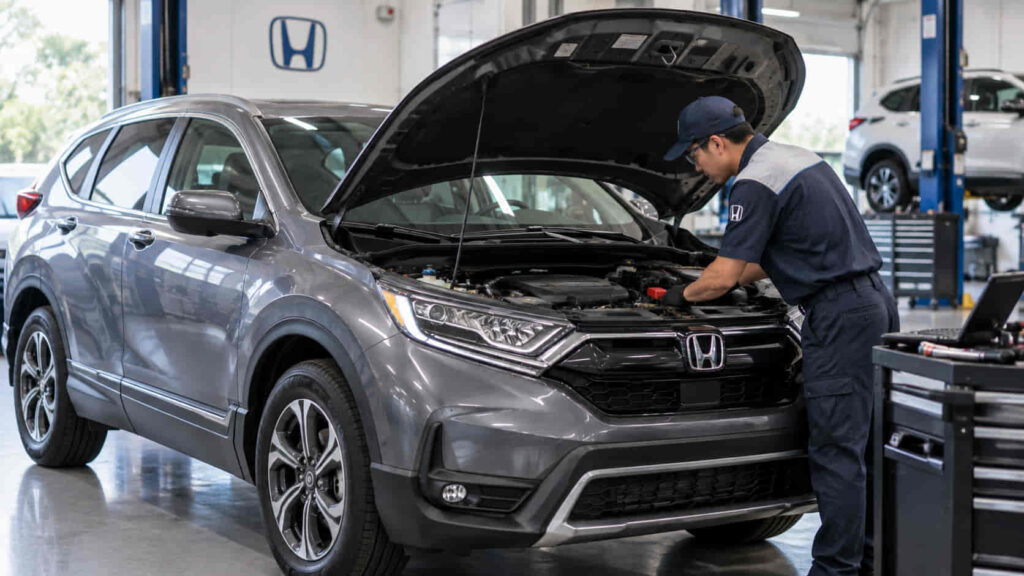
Honda CR-V recalls cover safety defects and compliance problems identified across different model years, but a recall listed for a particular CR-V year does not automatically mean every vehicle from that year is affected. Recall applicability can depend on the production range, vehicle configuration, affected component, and individual Vehicle Identification Number (VIN). The most reliable way to determine whether a specific Honda CR-V currently needs recall repair is therefore to check its VIN rather than relying only on a model-year recall list.
Honda CR-V recall campaigns have addressed different vehicle systems over the model’s history. For example, 2002–2011 CR-V models appear within the Takata air bag recall population, while other campaigns have involved newer CR-V model years and different components or compliance issues. Each campaign defines its own affected population, safety problem, potential consequence, and remedy. A vehicle appearing within a broadly affected model-year range still needs VIN verification to establish its individual recall status.
NHTSA’s recall lookup shows unrepaired recalls associated with a specific VIN, while a year, make, and model search provides broader recall information. This guide explains which Honda CR-V model years have been involved in recalls, the major recall problems owners should understand, how to check a CR-V by VIN, what an open recall means, how recall repairs work, whether recalls expire, and what to check before buying a used Honda CR-V.
What Are Honda CR-V Recalls?
Honda CR-V recalls are formal safety or compliance campaigns that identify a defect or noncompliance affecting a defined population of Honda CR-V vehicles and provide a specified remedy for affected vehicles. A recall is therefore different from a general reliability problem reported by owners. The campaign identifies which vehicles are included, describes the problem and its potential consequence, and establishes the action required to correct it.
A Honda CR-V recall can involve a mechanical component, electrical component, safety restraint system, or another vehicle system when the identified condition creates a safety issue or fails to meet an applicable safety requirement. The existence of a problem on one CR-V does not automatically make that problem a recall. A formal recall has a defined campaign and affected vehicle population rather than being based solely on symptoms, complaints, or repair frequency.
Recall information is connected to several identifiers. NHTSA assigns a recall campaign number, while the manufacturer may also use its own recall number or campaign designation. The recall documentation identifies the affected make, model, model years or production population, describes the defect or noncompliance, explains the safety consequence, and states the remedy that will be provided to affected owners.
The affected population is especially important for Honda CR-V owners. A campaign may cover only certain vehicles within a model year because production dates, components, suppliers, manufacturing processes, or vehicle configurations can differ. As a result, seeing a specific Honda CR-V model year in recall information establishes that the year may be involved in the campaign; it does not establish that every CR-V produced during that model year requires the repair.
This creates a clear distinction between recall history and individual recall status. Recall history explains which campaigns have involved Honda CR-V vehicles, while individual recall status determines whether a specific VIN is included and whether the required remedy remains incomplete. This is why a model-year recall list is useful for research but a VIN lookup is more useful for deciding whether a particular vehicle needs recall service.
Which Honda CR-V Model Years Have Been Recalled?
Honda CR-V recalls have affected multiple model years across different generations, so there is no single CR-V model-year range that represents every recall. Each safety campaign defines its own affected population, and some model years have been involved in more than one campaign addressing different components. The correct question is therefore not simply whether a CR-V year has ever been recalled, but which campaign applies to that year and whether the individual VIN is included.
Older Honda CR-V models provide a clear example. NHTSA identifies 2002–2011 Honda CR-V model years within the broader Takata air bag recall population. The Takata recalls involved defective air bag inflators that could rupture during deployment and propel metal fragments toward vehicle occupants. This history makes air bag recall status particularly relevant when researching an older CR-V, but the applicable campaign and completion status still need to be checked for the individual vehicle.
Newer CR-V generations have been involved in different campaigns. NHTSA Campaign 24V-744, announced in 2024, includes certain 2023–2025 Honda CR-V and CR-V Hybrid vehicles in a steering gearbox recall. According to the campaign documentation, improperly produced steering gearbox components can create excessive internal friction, increasing steering effort and the risk of a crash. The remedy addresses the affected steering gearbox components rather than treating every steering complaint on these model years as part of the recall.
Recall coverage can also overlap across vehicle generations when a component or safety issue affects vehicles produced over a broader period. This means a useful Honda CR-V recall history cannot be reduced to a statement such as “these are the bad years” or “all vehicles from these years were recalled.” One model year can contain vehicles included in a campaign and other vehicles that are not included because the recall population is defined more precisely than the model-year label alone.
Honda CR-V Hybrid variants also need to be considered according to the individual campaign. A recall can identify conventional CR-V and CR-V Hybrid vehicles together, as Campaign 24V-744 does for certain 2023–2025 vehicles, while another campaign may define a different model or production population. Model name, powertrain, model year, production information, and VIN can therefore all contribute to determining applicability.
The most accurate interpretation follows the relationship model year → relevant recall campaign → affected vehicle population → individual VIN → repair status. A Honda CR-V model year can help identify recalls worth investigating, but the VIN determines whether a specific vehicle has an applicable unrepaired recall. This distinction becomes increasingly important as a CR-V accumulates recall history across different components and campaigns.
Read more: Honda CRV Wheel Alignment
What Are the Most Important Honda CR-V Recall Problems?
Important Honda CR-V recall problems have involved safety systems and mechanical components including air bags, fuel pumps, and steering gearboxes, but the affected model years and VIN populations differ between campaigns. A recall should therefore be understood through the specific component, defect mechanism, safety consequence, and remedy rather than treating every reported CR-V problem as a recall.
Air bag inflators represent one of the most significant recall issues associated with older Honda CR-V models. Honda CR-V model years from 2002 through 2011 are included within the broader Takata air bag recall population identified by NHTSA. The safety concern involves defective inflators that can rupture during air bag deployment and send metal fragments toward vehicle occupants. This issue is different from a normal air bag warning light or an unrelated Supplemental Restraint System fault because recall eligibility is tied to the affected inflator and vehicle population.
Some older vehicles require additional attention because recall severity is not identical across the entire Takata population. NHTSA has issued a Do Not Drive warning for certain 2002 Honda CR-V vehicles equipped with unrepaired Takata Alpha inflators because these inflators have an especially high risk of rupture. This illustrates why checking only the model year is insufficient: two CR-Vs from the same year can have different recall status depending on their VIN and whether the required repair has already been completed.
Fuel pump recalls affect another group of Honda CR-V vehicles. NHTSA Campaign 23V-858 covers certain Honda and Acura vehicles and includes 2018–2020 Honda CR-V models and the 2020 CR-V Hybrid. The campaign addresses fuel pump motors with defective impellers. Honda’s service information explains that the impeller can deform or swell and cause the fuel pump to stop working. If the pump becomes inoperative, the engine may fail to start or the vehicle can lose motive power or stall while driving, increasing crash risk.
The fuel pump example also demonstrates why symptoms should not be used as a substitute for VIN verification. Difficulty starting, hesitation, engine stalling, or a warning light can occur for reasons unrelated to a recall. Conversely, an affected vehicle can belong to the recall population even before the owner notices a symptom. The campaign and VIN status establish recall eligibility; symptoms alone do not.
Newer Honda CR-V models have also been affected by steering-related recalls. Honda’s service documentation for NHTSA Campaign 24V-744 identifies certain 2023–2025 CR-V and CR-V Hybrid vehicles, as well as the 2025 CR-V e:FCEV, for a steering gearbox problem. The defect involves improperly produced steering gearbox components that can increase friction between the worm wheel and worm gear. Increased friction can make steering more difficult and increase the risk of a crash.
The remedy for the steering gearbox campaign shows how a recall targets the defect mechanism rather than merely treating the symptom. Honda’s service bulletin specifies replacement of affected gearbox components and the addition of grease to the EPS gearbox. An owner experiencing unusual steering effort should still verify VIN eligibility because not every steering problem on a 2023–2025 CR-V is automatically caused by this recall.
Fuel-system recalls also extend beyond the earlier fuel pump motor campaign. Honda issued a separate safety recall covering certain 2023–2025 CR-V Hybrid vehicles with improperly manufactured high-pressure fuel pumps. The affected pump can fracture and allow fuel to leak. This is a different defect, component condition, and affected population from the fuel pump motor problem associated with earlier CR-V model years, even though both campaigns involve the fuel system.
These campaigns demonstrate why a useful Honda CR-V recall history should not simply count the number of recalls associated with each year. Air bag inflator rupture, fuel pump failure, fuel leakage, and increased steering effort are different safety mechanisms requiring different remedies and affecting different vehicle populations. A model year identifies where to begin the investigation, while the campaign information explains the defect and the VIN establishes whether the individual CR-V is included.
The correct diagnostic relationship is therefore model year → recall campaign → affected component → defect mechanism → safety consequence → VIN eligibility → recall remedy. Following this sequence prevents a common mistake: assuming that every CR-V with a similar symptom qualifies for a recall repair or that every vehicle from an affected model year contains the recalled component.
How Do You Check a Honda CR-V for Recalls by VIN?
You can check a Honda CR-V for recalls by entering its 17-character Vehicle Identification Number into NHTSA’s recall lookup tool. A VIN search is more specific than searching by model year because it identifies whether the individual vehicle has an unrepaired safety recall recorded in the lookup system.
The VIN identifies a particular vehicle rather than an entire Honda CR-V model year. On a CR-V, the VIN can be found through vehicle identification locations and documents, including the lower driver-side area of the windshield and the vehicle registration. NHTSA also notes that the VIN may appear on the insurance card. Using the complete 17-character number prevents a general model-year search from being mistaken for an individual recall-status check.
The distinction between VIN search and year, make, and model search is important. Searching for a Honda CR-V by model year provides general information about recalls, investigations, complaints, and manufacturer communications associated with that vehicle category. Searching by VIN instead answers the more specific question of whether that individual CR-V currently needs repair as part of a recall.
If NHTSA identifies an unrepaired recall, the result establishes that the vehicle has an open recall recorded in the system. If the search returns “0 unrepaired recalls associated with this VIN,” the lookup has not identified an outstanding recall within the information the tool currently displays. This result should not be interpreted as proof that the CR-V has never been recalled because completed recalls are not displayed as open recalls.
The lookup also has limitations that matter when researching Honda CR-V recall history. NHTSA states that its VIN search does not display safety recalls that have already been repaired. It may also temporarily omit recently announced recalls when all affected VINs have not yet been identified, and the tool generally does not display safety recalls more than 15 years old unless the manufacturer provides additional coverage. These limitations explain why historical recall research and current VIN status can produce different information.
A recently announced Honda CR-V recall deserves particular attention. A VIN that does not initially appear in a newly announced campaign may need to be checked again because affected VINs can be added as the manufacturer identifies the complete recall population. NHTSA specifically advises consumers to check regularly when a recently announced recall has not yet been fully populated in the lookup system.
VIN verification therefore follows the relationship Honda CR-V VIN → NHTSA recall lookup → unrepaired recall result → campaign information → required remedy. Model-year information identifies recalls worth researching, but VIN lookup provides the more relevant answer when an owner needs to know whether a specific Honda CR-V currently has an outstanding safety recall.
What Does an Open Recall Mean on a Honda CR-V?
An open recall on a Honda CR-V means the vehicle is included in a safety recall and the required recall remedy has not been recorded as completed. The recall remains relevant to that vehicle until the applicable remedy is performed, so an open recall represents an action item rather than simply part of the CR-V’s historical recall record.
This distinction separates an open recall from a completed recall. A Honda CR-V can have been included in a recall campaign earlier in its life and subsequently receive the required repair. NHTSA’s VIN lookup does not display a safety recall that has already been repaired, which means a vehicle with zero unrepaired recalls can still have completed recall campaigns in its history.
An open recall should also be separated from a symptom or owner complaint. A CR-V does not need to display the recall-related symptom before its VIN can qualify for a campaign. Recall eligibility is established by the defined affected population and VIN, while the recall documentation explains the defect, potential safety consequence, and remedy. Waiting for the described failure to occur is therefore not necessary before responding to a confirmed open safety recall.
The opposite situation is also possible. A Honda CR-V may develop a symptom similar to one described in a recall even though its VIN is not included in that campaign. A steering complaint, fuel-system problem, or air bag warning does not independently establish recall eligibility. The vehicle still requires appropriate diagnosis when the VIN does not show an applicable open recall.
Open recall status can also change over the ownership period. A vehicle with no unrepaired recall today can become subject to a future safety campaign if a new defect is identified and its VIN is included. NHTSA consequently provides recall alerts and recommends continued recall monitoring rather than treating one VIN check as permanent confirmation that a vehicle will never be recalled.
The practical sequence is open recall identified → review campaign instructions → contact the appropriate dealer → complete the specified remedy → continue monitoring for future recalls. NHTSA advises owners to address unrepaired recalls promptly, and recall repairs are provided free through the vehicle manufacturer’s dealership when the vehicle is covered by the safety recall.
What Should You Do If Your Honda CR-V Has a Recall?
If your Honda CR-V has an open safety recall, review the campaign instructions and contact an authorized Honda dealer to arrange the specified recall remedy. NHTSA recommends that owners address open recalls promptly rather than wait for the recalled component to develop symptoms. The recall exists because a safety-related defect or noncompliance has already been identified for the affected vehicle population.
The first step is to confirm that the recall applies to the individual CR-V. A VIN lookup identifies open recalls associated with the vehicle, while the campaign information explains the affected component, safety risk, and remedy. This prevents a general Honda CR-V recall announcement from being confused with confirmation that every vehicle from the listed model year requires the same repair.
After confirming the recall, the owner should follow the instructions associated with that campaign. In most cases, this means contacting an authorized Honda dealer and scheduling the recall service. The dealer performs the remedy defined by the campaign, which can involve replacing a component, inspecting it and replacing it when necessary, updating software, or completing another specified repair. The exact remedy depends on the defect rather than on a universal Honda recall procedure.
Owners should not assume that every recall requires them to stop driving immediately. Most recall notices direct owners to arrange repair, but campaigns with an urgent warning require different action. NHTSA specifically advises owners to follow manufacturer instructions such as “Do Not Drive” or “Park Outside” warnings when those instructions apply to the vehicle.
Certain 2002 Honda CR-V vehicles with unrepaired Takata Alpha air bag inflators provide an important example. NHTSA includes the 2002 CR-V among vehicles covered by a critical Do Not Drive warning because the affected Alpha inflators have a substantially elevated rupture risk. An owner whose VIN confirms this unrepaired recall should follow the urgent campaign instructions rather than drive the CR-V normally until the recall is completed.
Parts availability can also affect the timing of a recall remedy. A vehicle can have an open recall even when replacement parts are not immediately available for every affected owner. Honda’s documentation for the large fuel-pump recall, for example, previously described prioritizing vehicles showing recall-related symptoms while replacement-part supply was limited. This does not remove the vehicle from the recall; it affects how and when the remedy is scheduled.
A confirmed Honda CR-V recall should therefore follow the sequence VIN confirmation → campaign instructions → Honda dealer contact → specified remedy → completed recall. If the campaign contains an urgent operating restriction, that instruction takes priority over the normal process of continuing to drive until the appointment.
Are Honda CR-V Recall Repairs Free?
Honda CR-V safety recall repairs are provided free of charge when the vehicle is covered by the recall and receives the remedy specified by the campaign. NHTSA states that vehicle recall repairs are free at the vehicle manufacturer’s dealership and directs owners with open recalls to contact the dealership to schedule the repair.
The free remedy applies to the recall repair rather than every problem discovered on the Honda CR-V during the service visit. If the recall requires replacement of a particular component, inspection of an affected part, or a specified modification, that campaign remedy is performed without charging the owner for the recall work. An unrelated maintenance item or mechanical fault does not automatically become free merely because the vehicle is at the dealership for a recall.
This distinction is particularly important when a CR-V has symptoms similar to those described by a recall. For example, a vehicle can develop a fuel-system or steering problem without its VIN belonging to the corresponding recall population. Similar symptoms do not independently establish eligibility for a free recall repair. VIN applicability and the campaign terms determine whether the manufacturer-provided recall remedy applies.
Honda recall notices illustrate how the remedy is tied to the campaign. For the fuel-pump recall, Honda’s owner communication states that the dealer replaces the affected fuel pump module free of charge. Other Honda campaign documents similarly instruct affected owners to schedule the specified inspection or repair with an authorized dealer at no charge.
Previous out-of-pocket repairs can require a separate determination. Honda recall correspondence for some campaigns states that owners who previously paid for the specific recall repair may be eligible for reimbursement and directs them to contact American Honda for eligibility requirements and instructions. This should not be interpreted as automatic reimbursement for every previous repair involving the same general vehicle system.
The relevant cost relationship is therefore confirmed recall eligibility → specified campaign remedy → free recall repair at the manufacturer’s dealership. Additional diagnosis or repairs outside the recall scope remain separate from the campaign unless the recall documentation or manufacturer determines otherwise.
Do Honda CR-V Recalls Expire?
A Honda CR-V safety recall does not expire simply because the vehicle becomes older. NHTSA states that once a vehicle has been recalled, the recall does not expire. This means an affected CR-V does not stop being associated with a safety campaign merely because several years have passed since the recall was announced.
Recall age and online recall visibility are different issues. NHTSA’s VIN lookup generally does not display safety recalls that are more than 15 years old, except when a manufacturer offers additional coverage. As a result, an older Honda CR-V can have historical recall information that does not appear in the same way as a recent open recall in the current VIN lookup tool.
This distinction is particularly relevant to older CR-V models involved in long-running safety campaigns. The Takata air bag recalls include Honda CR-V model years dating back to 2002. Owners researching these vehicles should not interpret the age of the CR-V as evidence that an applicable safety issue is no longer relevant. Recall history, VIN status, and repair completion need to be considered together.
A zero-result VIN search also needs to be interpreted according to what the lookup tool displays. NHTSA states that its VIN search does not show safety recalls that have already been repaired. Therefore, “0 unrepaired recalls” can mean that no currently displayed open recall is associated with the VIN; it does not mean the vehicle has never participated in a recall campaign.
New recalls create another timing issue. NHTSA explains that a recently announced campaign may not immediately contain every affected VIN because manufacturers can still be identifying the complete vehicle population. A Honda CR-V owner who checks immediately after a recall announcement may therefore need to repeat the VIN search as the campaign information is updated.
Recall status should consequently be understood through campaign existence → VIN applicability → remedy status → lookup visibility. The recall itself does not simply expire with vehicle age, while the information visible through an online lookup can depend on recall age, repair completion, and whether a newly announced campaign has finished identifying affected VINs.
Is a Honda CR-V Recall the Same as a Technical Service Bulletin?
A Honda CR-V safety recall is not the same as a Technical Service Bulletin or other manufacturer communication. A recall identifies a safety-related defect or regulatory noncompliance in a defined vehicle population and establishes a formal remedy, while manufacturer communications provide technical information to dealers about vehicle conditions, diagnosis, service procedures, warranty matters, or other repair-related topics.
The distinction matters because a service bulletin does not automatically mean the affected Honda CR-V has a safety recall. A manufacturer can issue technical instructions for a condition that technicians may encounter without creating a recall campaign for every vehicle described in the communication. The bulletin can help diagnose or repair a condition while remaining separate from the formal safety-recall process.
NHTSA reflects this distinction in its vehicle information system by separating recalls from manufacturer communications. Recall records identify formal campaigns and include information such as the NHTSA campaign number, affected vehicle population, safety consequence, and remedy. Manufacturer communications are maintained as a separate information category rather than being presented as equivalent recall campaigns.
Cost coverage should not be inferred from the existence of a service bulletin either. A confirmed safety recall includes the specified recall remedy at no charge to the affected owner. A Technical Service Bulletin by itself does not establish the same recall entitlement. Whether work described in a bulletin is covered can depend on warranty status, a separate warranty extension, another manufacturer program, or the individual repair circumstances.
The distinction also prevents incorrect diagnosis from search results. Finding a Honda service bulletin that describes steering noise, an electrical condition, or another CR-V symptom does not establish that the vehicle has an open recall. The owner still needs to check the VIN for formal recall status and use the appropriate diagnostic or warranty process for conditions outside a recall campaign.
The semantic relationship is therefore recall = formal safety campaign and remedy, while TSB or manufacturer communication = technical service information. Keeping these entities separate allows Honda CR-V owners to determine whether they are dealing with a safety recall, a service procedure, a warranty-related condition, or an unrelated repair instead of treating every manufacturer document as a recall notice.
Should You Check for Recalls Before Buying a Used Honda CR-V?
You should check a used Honda CR-V for open recalls before buying it because model-year recall history does not confirm whether the specific vehicle has completed every applicable recall repair. Two CR-Vs from the same model year can have different recall status because campaign eligibility and repair completion are connected to the individual VIN.
The first distinction is between a model-year recall search and a VIN recall check. A model-year search can identify safety campaigns associated with that generation of Honda CR-V, which helps a buyer understand the vehicle’s recall history. The VIN lookup answers the more practical question of whether the individual CR-V currently has an unrepaired recall recorded in NHTSA’s system.
This distinction becomes especially important with older CR-V models. A vehicle may have been included in a recall years earlier and already received the required remedy. NHTSA’s VIN lookup does not display a completed recall as an unrepaired recall, so a buyer should not assume that the absence of an open recall means the model has never been subject to a campaign. Recall history and current recall status describe different information.
The opposite condition also matters. A used Honda CR-V can look mechanically normal during a purchase inspection while still having an open safety recall. Recall eligibility does not require the vehicle to display a symptom before the repair is performed. Checking the VIN therefore adds information that a road test or visual inspection cannot provide by itself.
An open recall does not automatically establish the overall mechanical condition of a used CR-V either. Recall verification addresses identified safety campaigns, while a pre-purchase mechanical inspection evaluates the broader condition of systems such as the engine, transmission, brakes, steering, suspension, tires, and electrical equipment. A VIN with no open recalls should not be interpreted as evidence that the entire vehicle is mechanically problem-free.
If the VIN shows an unrepaired recall, the buyer can identify the campaign, understand the affected component and safety consequence, and determine what remedy needs to be completed. NHTSA states that open vehicle safety recalls are repaired free of charge through the vehicle manufacturer’s dealership. This allows recall status to be resolved separately from negotiations over unrelated maintenance or mechanical repairs.
A used Honda CR-V recall check should therefore follow model-year research → VIN verification → open recall identification → recall remedy → broader vehicle inspection. This sequence establishes both the recall status of the individual vehicle and the limits of what recall information can tell a prospective buyer.
How Can You Stay Updated on New Honda CR-V Recalls?
Honda CR-V owners can stay updated on new recalls by checking their VIN periodically and using recall notifications instead of relying on a single search performed when the vehicle is purchased. Recall status can change because new safety campaigns may be announced after a CR-V has already been in service for years.
NHTSA recommends checking for open vehicle safety recalls at least twice a year. A periodic VIN check matters because a Honda CR-V that has no open recall today can become part of a future campaign if a safety defect is subsequently identified and the vehicle falls within the affected population. A previous zero-result search therefore describes recall status at that point in time rather than permanently clearing the vehicle of future recalls.
The NHTSA SaferCar app provides another monitoring method. Owners can add their vehicle and VIN, and the app checks recall information and provides an alert when a safety recall is identified for the stored vehicle. This changes recall monitoring from a process that depends entirely on remembering to perform manual searches into an ongoing notification system.
Manufacturer notifications remain relevant as well. Recall campaigns include owner-notification procedures, so keeping vehicle registration and ownership information current helps recall notices reach the appropriate owner. This is particularly important after purchasing a used Honda CR-V because ownership has changed since the vehicle was originally sold.
Owners should still verify recall information directly when they encounter news about a newly announced Honda CR-V campaign. A recall announcement can initially identify model years or a vehicle population before every affected VIN appears in the lookup system. Rechecking the VIN helps establish whether the individual CR-V becomes part of the finalized affected population.
When a new open recall appears, the next step is not simply to record it in the vehicle history. The owner should review the campaign instructions and arrange the specified remedy with the manufacturer’s dealership. Any urgent operating instruction associated with the campaign, including a Do Not Drive or Park Outside warning when applicable, should be followed according to the recall notice.
Effective Honda CR-V recall monitoring therefore follows a continuing cycle of VIN check → recall notification → campaign verification → required repair → future monitoring. Recall history explains what has happened to the model, while repeated VIN verification helps owners respond when a new safety campaign becomes relevant to their individual CR-V.