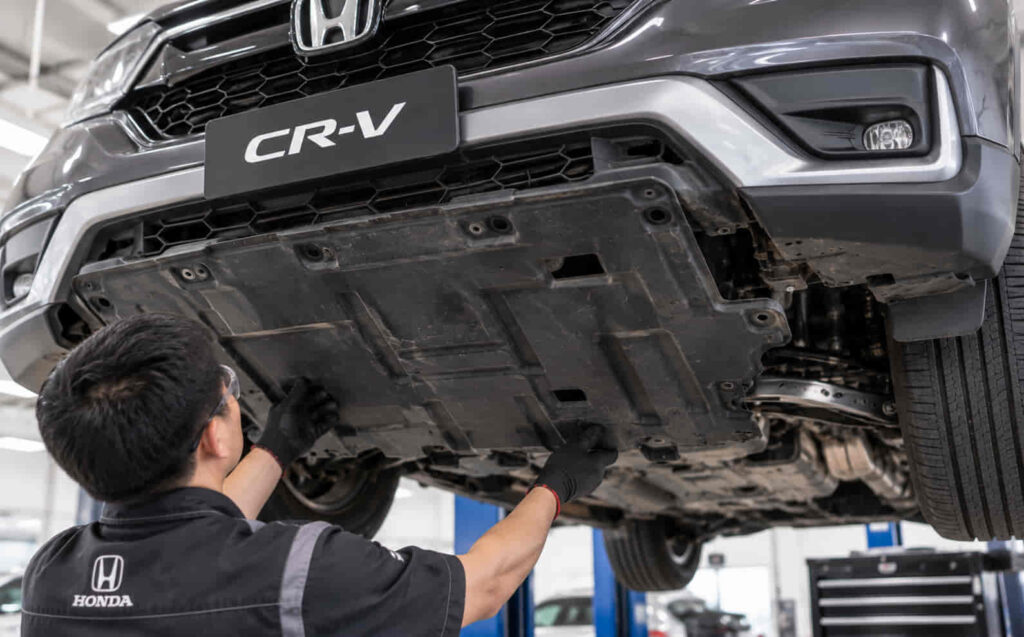
The Honda CR-V engine splash shield is an underbody panel located beneath the front powertrain area that helps limit the amount of water, dirt, and road debris reaching components above it. It also forms part of the vehicle’s lower underbody covering, so a damaged, loose, or missing shield can affect more than the appearance of the underside of the vehicle.
Splash shield problems often become noticeable when the panel starts hanging down, scraping the road, vibrating at speed, or separating from its mounting points. The shield itself is not always the failed part. Missing clips, damaged fasteners, torn mounting holes, or impact damage can allow an otherwise intact panel to come loose. This distinction matters because some problems require only mounting-hardware repair, while a cracked or structurally damaged shield may need complete replacement.
Finding the correct replacement also requires more than searching for a generic Honda CR-V splash shield. Underbody panel design, mounting locations, and part configuration can vary by model year, generation, and powertrain, and adjacent underbody covers may be listed as separate parts.
This guide explains what the Honda CR-V engine splash shield does, where it is located, how to identify damage, when repair or replacement is appropriate, whether you can drive without it, how to verify fitment, and what affects replacement cost.
What Is the Engine Splash Shield on a Honda CR-V?
The Honda CR-V engine splash shield is a lower underbody panel that covers part of the area beneath the engine and helps separate the powertrain compartment from water, dirt, and road debris coming from below the vehicle. Depending on the model year and parts terminology, the same general component may also be described as an engine under cover, lower engine cover, or underbody shield. These terms are useful when searching for replacement parts, but they should not be treated as universal part names because Honda CR-V underbody assemblies can contain multiple separate panels.
The splash shield forms a physical barrier between the road surface and selected components in the lower engine area. As the CR-V moves, its underside is continuously exposed to water spray, mud, gravel, dust, and other material thrown upward by the tires or surrounding traffic. The panel reduces direct exposure to this material rather than sealing the engine compartment completely. Openings and gaps remain necessary for the vehicle’s mechanical layout, airflow, service access, and surrounding underbody components.
An engine splash shield should also be distinguished from a heavy-duty skid plate. A splash shield is primarily an underbody covering and contamination barrier, while a skid plate is designed to provide greater resistance against direct contact with rocks, obstacles, or rough terrain. The presence of a Honda CR-V splash shield therefore does not mean the oil pan, transmission area, or other lower components are protected from every type of impact.
The shield itself can be made as a shaped panel with multiple mounting points around its perimeter. Clips, screws, bolts, retainers, or a combination of fasteners hold the panel against the surrounding structure. These attachment points are important because a splash shield does not need to break across its main surface to become unusable. A torn mounting hole or missing fastener can allow one edge to drop into the airflow beneath the vehicle, causing vibration, scraping, or further panel damage.
The Honda CR-V engine splash shield is therefore best understood as part of a larger underbody covering system rather than as a universal protective plate beneath the entire engine. Identifying the exact panel matters when diagnosing damage or ordering a replacement because neighboring covers can look similar while using different shapes and mounting locations.
Where Is the Honda CR-V Engine Splash Shield Located?
The Honda CR-V engine splash shield is located underneath the front portion of the vehicle, below the engine and surrounding powertrain area. It occupies part of the space between the lower front body area and the components farther toward the center of the vehicle, creating a covering between the road and selected mechanical components above it.
From underneath the CR-V, the shield appears as one of the panels forming the front underbody surface. Its exact shape and boundaries depend on the vehicle configuration. The front edge can interface with lower body or bumper-area structures, while other edges attach near surrounding underbody mounting points and adjacent covers. This arrangement allows several panels to work together instead of requiring one large shield to cover the entire underside of the vehicle.
This location explains why the engine splash shield is vulnerable to physical damage. A low obstacle, road debris, steep driveway transition, curb contact, or material on the roadway can strike the panel before reaching components positioned higher in the engine compartment. The mounting hardware is also exposed to repeated road conditions, which makes the attachment system an important part of any inspection when the shield begins to sag or scrape.
The location also matters during routine vehicle service. Access to components from underneath the engine may require an under cover to be loosened or removed. If a fastener is missing, damaged, or not secured correctly afterward, an edge of the panel can separate from its mounting position. Airflow beneath the moving vehicle can then place additional force on the loose section and make a relatively small attachment problem progressively worse.
Not every visible panel underneath a Honda CR-V is the engine splash shield. Depending on model year and configuration, the underbody can include adjacent covers and separate sections with different functions and part numbers. A replacement should therefore be identified by its exact position and mounting pattern rather than by appearance alone.
The practical way to identify a Honda CR-V engine splash shield is to locate the damaged underbody panel first, establish its position relative to the engine and neighboring covers, and then match that location to the correct part for the specific vehicle. This prevents a common fitment problem in which a replacement is advertised broadly as a “CR-V splash shield” but corresponds to a different underbody section.
Read more: Honda CRV AC Compressor Recall
What Does the Honda CR-V Engine Splash Shield Do?
The Honda CR-V engine splash shield helps reduce direct exposure of the lower engine area to water, dirt, mud, and road debris while forming part of the vehicle’s underbody covering. It is not a sealed enclosure or heavy-duty impact plate. Its function is to create a controlled barrier between the road surface and selected components positioned above the panel.
Water and contamination control are two of its primary functions. When a CR-V travels on wet or dirty roads, the underside of the vehicle is exposed to material thrown upward by the tires and surrounding traffic. The splash shield intercepts part of this material before it reaches the areas positioned directly above the panel. This reduces direct exposure rather than making the engine compartment waterproof, because the underbody still contains openings, gaps, and other paths through which air and moisture can move.
The shield also limits direct contact with smaller road debris. Gravel, loose material, and other objects can strike the underside of a moving vehicle, and the panel provides a physical layer between some of this material and the components behind it. This protection has limits. A large object or strong impact can crack, deform, detach, or penetrate the shield, which is why an engine splash shield should not be described as providing the same level of impact protection as a structural skid plate.
Another function is maintaining the intended underbody surface around the front powertrain area. The shield fills spaces that would otherwise leave a more irregular underside exposed to moving air. Its shape and installed position therefore contribute to the way air passes beneath the vehicle. A loose panel changes that surface and can catch airflow, which explains why a small attachment problem may become more noticeable at higher vehicle speeds.
The shield can also reduce the amount of contamination accumulating directly on selected areas above it. This does not eliminate the need for inspection or maintenance, but it explains why permanently removing a damaged shield is different from repairing or replacing it. The component was installed as part of the vehicle’s underbody system and continues to serve a protective function even though the CR-V may still operate when the panel is missing.
The Honda CR-V engine splash shield therefore performs three connected roles: it reduces direct splash and contamination, provides a barrier against smaller road debris, and maintains part of the designed underbody covering. These functions also explain why damage should be evaluated according to whether the panel can remain securely mounted and continue covering its intended area.
How Can You Tell If a Honda CR-V Engine Splash Shield Is Damaged?
A damaged Honda CR-V engine splash shield commonly becomes noticeable through a hanging or loose panel, scraping beneath the vehicle, visible cracks, missing sections, damaged mounting holes, or fasteners that no longer hold the shield securely. These conditions can often be identified visually, but a noise from underneath the CR-V should not be attributed to the splash shield until the source is confirmed.
A shield hanging below its normal position is one of the clearest signs of an attachment problem. One edge may remain secured while another drops because a clip, screw, bolt, retainer, or mounting point has failed. Once the panel moves out of position, airflow beneath the vehicle can pull on the loose section and increase movement. The result can be vibration at speed or intermittent contact with the road surface.
Scraping or dragging noise is another common indicator when the shield has dropped far enough to contact the pavement. The sound can change with vehicle speed, road surface, or suspension movement because the panel does not remain at a fixed distance from the ground. Continuing to drag the shield can enlarge damaged mounting holes or wear through the panel material, turning a fastener problem into a replacement problem.
Visible cracking provides a different type of evidence. A small surface mark or scrape does not automatically make the shield unusable, but a crack that extends through a mounting point or allows part of the panel to move independently affects its ability to stay secured. Missing material creates a similar problem because the remaining section may no longer align correctly with its mounting locations or adjacent underbody panels.
Mounting points deserve separate inspection because the main surface of the shield can appear intact while its attachment system has failed. A fastener can disappear without breaking the entire panel, while a mounting hole can become enlarged or torn after repeated movement. In the first situation, replacing the correct hardware may restore the panel to its intended position. In the second, installing a new clip alone may not provide a secure repair because the shield itself can no longer retain the fastener properly.
Damage can also become apparent shortly after underbody service. If an engine under cover was removed for access and later begins to sag, the condition of the attachment hardware and mounting points should be checked. This does not prove that previous service caused the problem, but the timing provides a useful inspection context because these panels rely on multiple attachment points to remain correctly positioned.
A scraping noise by itself is not enough to diagnose a damaged engine splash shield. Other loose underbody components can produce similar sounds, and contact with foreign material beneath the vehicle can create comparable symptoms. Visual confirmation is therefore important before ordering a replacement part.
The key distinction is whether the Honda CR-V splash shield has cosmetic damage, an attachment failure, or structural panel damage. Cosmetic marks may require no action, missing or damaged fasteners may allow repair, and cracks or torn mounting areas that prevent secure installation can make replacement the more appropriate solution.
Why Is the Honda CR-V Splash Shield Hanging or Dragging?
A Honda CR-V splash shield usually hangs or drags when one or more attachment points can no longer hold the panel in its intended position. The underlying problem may be a missing fastener, damaged clip or retainer, torn mounting hole, cracked shield, damaged mounting point, or physical impact that has displaced part of the underbody panel.
Fastener failure can create a noticeable problem even when most of the splash shield remains intact. The panel relies on multiple attachment points to distribute its weight and keep its edges aligned with the surrounding underbody structure. If one or more fasteners are lost, an unsupported section can begin to sag. Air moving beneath the CR-V can then place additional force on the loose edge, causing the panel to move farther away from its normal position.
This process explains why a relatively small attachment problem can develop into more extensive damage. A loose edge may initially vibrate without touching the road, but continued movement can enlarge the mounting hole around the remaining fastener. If the panel drops farther, it can begin scraping the pavement. Repeated road contact can wear away material or extend an existing crack until the shield can no longer be securely attached using its original mounting points.
Physical impact can produce the same final symptom through a different mechanism. Road debris, a curb, a raised obstacle, or another object contacting the underside of the CR-V can crack or displace the panel. An impact near a mounting point can break the shield around the fastener while leaving the hardware attached to the vehicle. In this situation, replacing the missing hardware alone would not restore the mounting point because the damaged material is part of the shield itself.
A hanging splash shield can also appear after the panel has been removed or loosened for vehicle service. Engine under covers may need to be moved to access components from below. If attachment hardware is damaged, missing, incorrectly positioned, or unable to secure the panel afterward, one section can remain lower than intended. The correct response is to inspect the attachment system rather than assuming that the entire panel failed.
The location of the loose section provides useful diagnostic information. If the shield is intact and only one attachment area has separated, the problem may be concentrated around a fastener or mounting point. If several areas are detached, the panel is visibly cracked, or material is missing around multiple attachment locations, the shield itself becomes a stronger candidate for replacement.
Driving conditions can accelerate the failure once the shield is already loose. Airflow beneath the vehicle continuously loads an unsupported panel, while road contact adds abrasion and impact. A shield that only makes noise at highway speed may therefore still have an attachment problem even if it does not scrape during low-speed inspection.
A hanging or dragging Honda CR-V splash shield should therefore be diagnosed by checking the panel, its mounting holes, the fasteners, and the surrounding attachment points together. The visible hanging panel is the symptom; determining which part of the attachment system failed establishes whether the correct repair requires hardware, panel repair, or complete shield replacement.
Can a Damaged Honda CR-V Splash Shield Be Repaired?
A damaged Honda CR-V splash shield can sometimes be repaired without replacing the entire panel when the shield remains structurally intact and the problem is limited to replaceable mounting hardware. If the panel is severely cracked, missing material, or unable to hold its fasteners securely, replacement becomes more appropriate because the shield can no longer remain reliably attached in its intended position.
A missing clip or damaged fastener represents the simplest repair scenario. When the corresponding mounting hole in the shield remains intact and the vehicle-side attachment point is undamaged, installing the correct replacement hardware can restore the panel to its normal position. The repair addresses the failed connection rather than replacing a usable underbody panel.
The decision changes when the shield material around the mounting point has torn. A new fastener cannot provide its intended clamping function if the hole has become too large or the surrounding material has separated. Even if the panel can temporarily be pushed back into position, continued vibration and airflow can pull it loose again because the attachment area no longer has its original strength and geometry.
Cracks away from the mounting points require evaluation based on their size, position, and effect on panel stability. Minor cosmetic scraping does not automatically require replacement because an underbody shield is expected to experience some exposure to road conditions. A crack that allows a section to flex independently, extends toward an attachment point, or prevents the panel from maintaining its shape is more significant because it affects how securely the shield can remain installed.
The surrounding vehicle-side mounting points must also be inspected before a new shield is ordered. Replacing the panel will not solve the problem if the structure or attachment location that supports it is damaged. This is particularly relevant after a substantial underbody impact, where the visible splash shield may be only one of the affected components.
Temporary methods that merely hold a loose panel away from the road should not be confused with restoring the original mounting system. The objective of a proper repair is to return the shield to a secure position with adequate clearance and reliable attachment. If the existing panel cannot achieve that condition, replacement provides a more direct solution than repeatedly securing a structurally damaged section.
Repair versus replacement should therefore be determined by the condition of the complete attachment system. An intact shield with failed removable hardware can often be retained, while a panel with torn mounting areas, extensive cracking, missing material, or an inability to stay securely positioned is a stronger replacement candidate.
The practical rule is to replace only what has actually failed: replace clips or fasteners when the panel and mounting points remain sound, but replace the Honda CR-V engine splash shield when damage to the panel prevents secure and stable installation.
When Should You Replace the Honda CR-V Engine Splash Shield?
You should replace a Honda CR-V engine splash shield when the panel can no longer remain securely mounted, maintain its intended position, or provide adequate coverage because of physical damage. Replacement is generally determined by structural condition and mounting integrity rather than cosmetic appearance alone.
A shield with scratches or superficial abrasion does not automatically require replacement. The panel is installed underneath the vehicle and is naturally exposed to water, dirt, gravel, and occasional contact with road debris. Surface marks are therefore less important than whether the shield remains securely attached and retains the shape required to cover its intended underbody area.
Cracks become more significant when they affect panel stability. A crack extending through a mounting hole can prevent a fastener from distributing clamping force across the panel. Once the material around that attachment point separates, installing another clip or screw may not restore a reliable connection. Continued airflow and vibration can then enlarge the damaged area and allow the shield to drop again.
Missing material is another strong reason to consider replacement. If part of the shield has broken away, the remaining panel may no longer cover the intended area or connect correctly with neighboring underbody sections. The severity depends on where the material is missing, but loss around mounting points is particularly important because it directly affects the panel’s ability to stay installed.
Panel deformation can also justify replacement even when there is no large visible crack. An impact can change the shape of the shield enough that its mounting holes no longer align correctly or part of the panel sits lower than intended. Forcing a distorted shield into position does not necessarily restore proper fitment and may place unnecessary stress on its attachment points.
Replacement should also be considered when repeated fastener repairs fail to keep the panel secure. If new hardware repeatedly becomes loose because the shield’s mounting holes are enlarged or damaged, the underlying problem is no longer simply the fastener. Replacing hardware without correcting the damaged panel can reproduce the same hanging or dragging condition.
The surrounding mounting structure must still be inspected before replacing the shield. A new panel depends on usable attachment points on the vehicle. If an underbody impact damaged both the shield and its supporting locations, installing a new cover without addressing the surrounding damage may leave the replacement misaligned or inadequately secured.
The replacement threshold is reached when damage prevents the Honda CR-V splash shield from performing as a securely mounted underbody panel. Cosmetic wear can remain serviceable, removable hardware can be replaced separately, but torn mounting areas, substantial cracks, missing sections, severe deformation, or repeated attachment failure indicate that a new shield may be required.
Can You Drive a Honda CR-V Without the Engine Splash Shield?
A Honda CR-V can generally continue operating if the engine splash shield is completely missing, but driving without it leaves the area that the panel normally covers more exposed to water, dirt, mud, and road debris. The absence of the shield does not automatically prevent the engine from running, but it removes part of the vehicle’s intended underbody covering and should not be treated as an ideal permanent condition.
A missing shield and a hanging shield create different situations. When the panel is completely absent, the primary issue is loss of underbody coverage. When the panel remains attached on only part of its mounting system, it can hang into the airflow or contact the road. The second condition requires more immediate attention because continued movement can cause the panel to tear farther, scrape against the pavement, or separate from additional attachment points.
Driving conditions influence how much the missing shield matters. Wet, muddy, gravel-covered, or debris-filled roads expose the underside of the vehicle to more contamination and material than clean, dry pavement. Because the splash shield normally creates a barrier beneath part of the powertrain area, removing it increases direct exposure in the section that was designed to be covered.
The shield should not be credited with protection it was not designed to provide. Installing a replacement does not make the CR-V resistant to major underbody impacts, and driving without the panel does not mean that an engine failure will immediately occur. The relevant change is that a designed layer of underbody coverage is no longer present.
A missing shield can also affect the shape of the underbody surface around the area it normally occupies. The installed panel fills a defined space beneath the front portion of the vehicle, while removing it leaves components and structural shapes above the panel more directly exposed to airflow. This is another reason to view the shield as a functional vehicle component rather than disposable packaging beneath the engine.
If the shield has been damaged but remains partially attached, the priority is to prevent it from continuing to drag or move unpredictably. Inspection can establish whether the existing panel can be secured with correct hardware or whether its mounting areas have deteriorated enough to require replacement. Simply continuing to drive while the panel repeatedly contacts the road can convert repairable attachment damage into more extensive panel damage.
A completely missing shield should also lead to an inspection of the surrounding area. If the panel disappeared after an impact, the same event may have affected adjacent underbody components or mounting points. Replacing the shield without checking those areas can overlook the actual reason it detached.
Driving without the Honda CR-V engine splash shield is therefore different from driving with a loose shield: a missing panel primarily reduces underbody coverage, while a hanging or dragging panel creates an additional physical attachment problem that should be corrected promptly. In either case, restoring a correctly fitted and securely mounted shield returns the underbody area to its intended configuration.
How Do You Replace a Honda CR-V Engine Splash Shield?
Replacing a Honda CR-V engine splash shield involves removing the damaged underbody panel, inspecting its mounting locations, positioning the correct replacement shield, and securing it with the appropriate fasteners. The replacement must match the specific vehicle and panel position because a shield that looks similar can still have different dimensions, mounting holes, or attachment points.
The process begins with safe access to the underside of the vehicle and confirmation that the correct panel has been identified. A Honda CR-V can have multiple covers beneath the front and engine area, so the damaged component should be matched by location rather than assuming every lower panel is the same engine splash shield. This identification becomes especially important when ordering parts online, where terms such as engine under cover, lower engine cover, and splash shield may be used inconsistently.
Before removing the existing shield, its attachment pattern should be examined. The panel may use several types of retainers, including clips, screws, bolts, or other fasteners positioned around different edges. Observing where each attachment belongs helps distinguish a missing fastener from a mounting location that was never intended to contain one. It also provides a reference for installing the replacement panel in the correct orientation.
Once the damaged shield is removed, the exposed mounting points should be inspected before the new panel is installed. A replacement shield cannot correct a damaged vehicle-side attachment location. If an impact has bent, broken, or displaced a supporting area, that condition can prevent the new panel from aligning properly even when the replacement part itself is correct.
Adjacent underbody covers should also be checked at this stage. The engine splash shield may interface with neighboring panels, and an impact strong enough to damage one section can loosen another. Correct installation depends on these pieces meeting in their intended positions rather than overlapping incorrectly or leaving an edge unsupported.
The replacement shield is then positioned so its mounting holes align naturally with the corresponding attachment locations. Correct fitment should not require excessive bending or forcing the panel into place. Significant misalignment can indicate an incorrect part, a damaged mounting structure, or another underbody panel positioned incorrectly.
Fasteners should secure the shield without leaving loose edges that can catch airflow. After installation, the panel should remain stable and maintain adequate clearance from the road and surrounding mechanical components. The objective is not simply to attach the new shield somewhere beneath the engine but to restore its intended position within the underbody assembly.
Safe vehicle access is an important part of the procedure. Reaching attachment points underneath the CR-V may require the vehicle to be raised, and proper lifting and support procedures are necessary before working underneath it. An owner who does not have suitable equipment or a safe working environment can have the panel installed by a repair facility rather than taking unnecessary risks to reduce labor cost.
A successful Honda CR-V engine splash shield replacement therefore depends on three factors working together: the correct replacement panel, undamaged mounting locations, and properly installed attachment hardware. If any one of these is incorrect, a new shield can still sag, vibrate, scrape, or fail to align with the surrounding underbody panels.
Do You Need New Clips and Fasteners When Replacing the Splash Shield?
You do not automatically need to replace every clip and fastener when installing a Honda CR-V engine splash shield, but any missing, broken, deformed, or unreliable hardware should be replaced with the correct type. The condition and fit of the attachment hardware are as important as the replacement panel because the shield depends on these fasteners to remain securely positioned.
Reusable hardware should be evaluated rather than assumed to be serviceable. A fastener may still be present but no longer provide adequate retention because its locking features are worn or damaged. Reusing hardware in that condition can allow a newly installed splash shield to loosen even though the panel itself fits correctly.
Missing fasteners create a different problem. Each designed attachment point contributes to holding the panel against the surrounding structure. Leaving a required mounting location unsecured can allow an edge to move under airflow and vibration. That movement places additional stress on the remaining attachment points and can eventually enlarge or damage the mounting holes in the new shield.
Using the correct fastener type also matters. Clips, screws, bolts, and retainers are not universally interchangeable simply because they physically fit through a hole. Their dimensions and retention methods must correspond to the mounting location. An incorrect fastener can fit loosely, fail to engage properly, or apply force to the panel in a way that does not reproduce the intended attachment.
The condition of the mounting hole should be checked at the same time as the hardware. If a fastener repeatedly falls out, the fastener may not be the only problem. The panel opening or vehicle-side attachment point can be damaged, enlarged, or unable to retain the hardware correctly. Installing another identical clip without addressing that condition can produce another failure.
A replacement shield purchased without hardware should therefore not be installed under the assumption that every old fastener can be transferred. The existing hardware should first be matched to the new panel and inspected individually. Conversely, purchasing a complete set of new clips does not solve a fitment problem if the replacement shield has the wrong mounting pattern for the vehicle.
This relationship becomes particularly important when comparing OEM and aftermarket panels. A replacement may reproduce the overall shape of the original shield while using attachment openings that must still align accurately with the CR-V’s existing mounting locations. Correct hardware cannot compensate for substantial differences in panel geometry or hole placement.
The correct approach is to treat the Honda CR-V splash shield and its fasteners as one attachment system: retain serviceable hardware when appropriate, replace damaged or missing retainers, and confirm that every required mounting point securely holds the panel after installation. This reduces the chance that a newly replaced shield will develop the same hanging or dragging problem as the original.
How Do You Find the Correct Honda CR-V Engine Splash Shield?
To find the correct Honda CR-V engine splash shield, match the replacement to the vehicle’s model year, powertrain configuration, exact underbody position, and applicable part information rather than buying a panel based only on the Honda CR-V name. The term “engine splash shield” describes a component category, not one universal panel that fits every CR-V.
Model year is the first fitment filter because the Honda CR-V has changed across generations and redesigns. Changes to the front body structure, engine compartment layout, bumper area, underbody covering, and mounting locations can affect the dimensions and attachment pattern of the shield. A panel designed for one generation should therefore not be assumed to fit another simply because both vehicles are Honda CR-Vs.
Powertrain configuration can provide another fitment distinction. The shape of an underbody cover must correspond to the components and structures positioned around it, so differences in engine or drivetrain configuration can affect the required panel. This is why a replacement listing that specifies only “Honda CR-V” without sufficient vehicle details should be verified before purchase.
The exact location of the damaged panel is equally important. A CR-V can use more than one underbody cover, and online listings may describe adjacent pieces with similar terms such as engine splash shield, engine under cover, lower cover, or underbody shield. Before ordering a replacement, the damaged panel should be identified by where it sits underneath the vehicle and how it interfaces with neighboring covers.
Mounting-hole geometry provides a practical way to verify that identification. The replacement panel should correspond to the original shield’s overall shape, edges, openings, and attachment locations. A part that appears visually similar can still be incorrect if several mounting holes do not align with the vehicle-side attachment points. Fasteners should secure a correctly matched panel; they should not be used to force an incorrectly shaped panel into position.
Existing part information can provide a stronger reference than a generic product title. If an identifiable part number or catalog reference is available from the original component or a vehicle-specific parts catalog, it can be compared with the replacement listing. The important step is to verify the application of that reference to the specific CR-V rather than assuming that a similar-looking number or superseded component has the same fitment.
VIN-based verification can add another level of accuracy when fitment remains uncertain. A Honda parts department or vehicle-specific parts catalog can use the vehicle information to identify applicable components. This is particularly useful when a model year includes more than one configuration or when multiple underbody panels appear similar in online listings.
The replacement should also be compared with the original panel before installation whenever possible. Differences in overall dimensions, molded contours, access openings, edge profiles, or mounting locations can reveal a fitment problem before the new shield is secured underneath the vehicle. Discovering the mismatch at this stage prevents unnecessary modification of a part that was not designed for the application.
Correct Honda CR-V engine splash shield fitment is therefore established by matching the vehicle and the exact panel, not by matching the keyword on a product listing. Model year narrows the application, powertrain and vehicle configuration refine it, panel location identifies the component, and part or VIN verification provides additional confirmation when the application is uncertain.
Are Honda CR-V Engine Splash Shields Interchangeable Between Model Years?
Honda CR-V engine splash shields are not automatically interchangeable between model years, even when the vehicles look similar or belong to nearby production years. Interchangeability depends on whether the relevant CR-V configurations use compatible panel dimensions, contours, openings, and mounting points.
Model-year overlap is possible when Honda retains the same underbody design across multiple years. A replacement manufacturer or parts catalog may therefore identify one splash shield as fitting a range of CR-V model years. That compatibility should be treated as part-specific fitment information rather than evidence that all underbody panels from those years are interchangeable.
Generation boundaries require particular attention because a redesign can change the structures surrounding the engine splash shield. Different bumper geometry, powertrain packaging, underbody layout, or attachment locations can require a different panel even though the component performs the same basic function. The shared name “engine splash shield” describes what the component does, not the geometry required for every generation.
Differences can also exist within a model-year range. A listing covering several CR-V years may include qualifications for engine, drivetrain, trim, production configuration, or panel position. These qualifications matter because a small change in mounting-hole location or molded clearance can prevent the shield from installing correctly.
Visual similarity is therefore weak evidence of interchangeability. Two panels can have nearly identical outlines when photographed separately but differ at their attachment points. A few centimeters of difference in an opening or mounting tab can prevent correct alignment underneath the vehicle. Modifying the panel or forcing fasteners into misaligned holes can create stress points and leave sections inadequately supported.
Seller fitment information is useful when it identifies the vehicle application clearly, but it should be checked against additional part information when the listing is ambiguous. This is especially important for marketplace listings that use broad phrases such as “fits Honda CR-V” while showing multiple model years. The more general the listing, the more important vehicle-specific verification becomes.
An OEM reference or verified cross-reference can help establish whether a replacement applies to several model years. Aftermarket manufacturers may also produce one replacement for multiple compatible applications. In either case, the relevant question is not whether the years are close together but whether the part has been specified for those particular vehicle configurations.
Fasteners should not be used as evidence that an incorrect shield is compatible. Even if the same style of clip or bolt is used on two model years, the panel geometry and attachment locations can still differ. Hardware compatibility and panel compatibility are separate fitment considerations.
The reliable rule is to assume that Honda CR-V engine splash shields require vehicle-specific fitment verification rather than assuming interchangeability from model year alone. A panel can legitimately fit multiple years when the part application confirms it, but year proximity, appearance, and the shared CR-V model name are not sufficient evidence by themselves.
Should You Buy an OEM or Aftermarket Honda CR-V Engine Splash Shield?
Both OEM and aftermarket Honda CR-V engine splash shields can be valid replacement options, but the better choice depends on verified fitment, panel construction, mounting-point accuracy, availability, and price. The brand category alone does not determine whether a shield will install correctly on a specific CR-V.
An OEM splash shield is designed for the vehicle application identified by Honda’s parts system. Its primary advantage is part identification and correspondence with the original vehicle configuration when the correct OEM reference is selected. This can reduce uncertainty about panel shape, openings, and mounting locations, particularly when the CR-V uses several adjacent underbody pieces that are easy to confuse.
OEM does not mean that every Honda CR-V uses the same shield. Genuine Honda parts still need to be matched to the specific vehicle. Current parts catalogs illustrate this distinction clearly: newer CR-V configurations can list an under cover, front shield, center shield, and related hardware as separate components rather than treating the entire lower area as one universal splash shield. The correct OEM option is therefore the component specified for the exact underbody position and vehicle configuration.
Aftermarket splash shields are produced as replacements for specific original applications and can provide a lower-cost alternative when fitment is correctly verified. The important question is whether the manufacturer identifies the panel for the correct CR-V model years and configuration. A well-matched aftermarket shield should place its edges, openings, and mounting holes where the vehicle requires them without extensive modification.
Construction can vary between replacement panels. Differences in material thickness, rigidity, molded shape, or manufacturing method can affect how a shield feels and how accurately it follows the original underbody geometry. These differences do not automatically make an aftermarket part unsuitable, but they make application-specific fitment information more important than a generic product description.
Mounting-point alignment deserves particular attention when evaluating an aftermarket shield. A panel can reproduce the approximate exterior dimensions of the original while still creating installation problems if its holes or tabs are positioned incorrectly. A lower purchase price provides little value if the installer must force the shield into place or leave attachment points unsecured.
Availability can also influence the decision. An OEM panel may be preferable when exact original part matching is the priority, while an aftermarket replacement can be practical when the applicable OEM component is expensive or difficult to obtain. The comparison should still be made between parts designed for the same vehicle application rather than between unrelated panels carrying similar names.
The condition of the vehicle also matters. For a CR-V with intact mounting points that needs only a damaged panel replaced, either a correctly matched OEM or aftermarket shield can potentially restore the underbody covering. If surrounding mounting locations are damaged, changing from OEM to aftermarket or vice versa will not correct the underlying attachment problem.
The correct choice is therefore not automatically OEM or aftermarket; it is the splash shield that matches the specific Honda CR-V, aligns correctly with every required mounting point, provides suitable construction for the application, and offers an acceptable balance between fitment confidence and price.
How Much Does a Honda CR-V Engine Splash Shield Replacement Cost?
The cost to replace a Honda CR-V engine splash shield depends on the exact panel required, whether the replacement is OEM or aftermarket, the condition of the mounting hardware, and the amount of labor needed for installation. There is no single replacement price that accurately represents every CR-V model year because Honda has used different underbody panels and configurations across generations.
The replacement panel is the first cost component. Current aftermarket listings demonstrate how model year changes the price and part itself. For example, a front engine splash shield listed for the 2017–2022 CR-V can cost around the lower end of the replacement-parts range, while panels for other generations carry different prices. Newer CR-Vs can also use multiple separately identified underbody pieces, meaning the required part must be identified before its price can be meaningfully compared.
OEM pricing follows the same vehicle-specific principle. Genuine parts catalogs for recent CR-V models identify separate under covers and shields, with individual components carrying different prices. This means an owner asking for the cost of an “engine splash shield” first needs to determine which panel is actually damaged. Replacing one front shield is financially different from replacing a larger under cover or several connected pieces after an underbody impact.
Mounting hardware adds another cost when clips, pins, screws, bolts, or retainers cannot be reused. Individual fasteners are inexpensive compared with a complete underbody panel, but multiple missing or damaged attachment points can increase the parts total. Hardware should be included in the repair estimate when inspection shows that the existing pieces cannot securely retain the replacement shield.
Labor is the next variable. Splash shield replacement is generally less mechanically complex than repairs involving internal engine or transmission components because the work is concentrated on the underbody panel and its attachment system. Labor still depends on vehicle access, the number and condition of fasteners, and whether damaged mounting points or neighboring panels require additional work.
A straightforward replacement with intact mounting locations requires less work than a repair following substantial underbody impact. Rusted or damaged hardware, torn attachment points, misaligned adjacent covers, or vehicle-side mounting damage can increase the time required even when the replacement shield itself is inexpensive. This is why part price alone should not be treated as the total repair cost.
DIY installation can eliminate professional labor charges, but the economic advantage depends on having a safe method of accessing the underside of the vehicle and correctly identifying the part and hardware. Buying an incorrect shield because it was cheaper can eliminate those savings once return shipping, replacement hardware, or a second part purchase is required.
Cost should therefore be calculated from the actual repair scope rather than from a generic splash-shield estimate. A CR-V that only needs several retainers has a different repair from one requiring a complete panel, while a vehicle with impact damage affecting several underbody pieces represents a different repair again.
The total Honda CR-V engine splash shield replacement cost is best understood as the price of the correct vehicle-specific panel plus required fasteners and installation labor, with additional cost only when adjacent panels or mounting points are also damaged. Confirming the exact failed component before purchasing parts is the most reliable way to avoid paying for an unnecessary or incompatible replacement.
What Should You Check Before Buying a Honda CR-V Engine Splash Shield?
Before buying a Honda CR-V engine splash shield, confirm the exact damaged panel, vehicle model year and configuration, mounting-point condition, required hardware, and replacement-part fitment. A product described simply as a “Honda CR-V engine splash shield” should not be purchased until those details correspond to the vehicle because the CR-V can use different underbody panels across generations and configurations.
The first step is identifying which panel actually needs replacement. The front underside of a Honda CR-V can contain multiple covers, and terms such as engine splash shield, engine under cover, lower engine cover, and underbody shield are not always used consistently across parts catalogs and online listings. The physical location of the damaged panel should therefore be established before searching for a replacement. Comparing its position, shape, edges, openings, and relationship with adjacent covers provides a more reliable starting point than relying on the product name alone.
Vehicle information should then be matched to the replacement application. Model year is essential because underbody design can change between CR-V generations, while powertrain and other vehicle configurations can further affect panel fitment. A listing that covers several model years is useful only when the specific CR-V falls within the stated application and any additional fitment qualifications are satisfied.
The mounting system should be inspected before the replacement panel is ordered. A missing shield fastener does not necessarily mean the shield itself needs replacement, while a new shield cannot solve a damaged vehicle-side mounting point. Inspecting the attachment locations establishes whether the repair requires a panel, hardware, repair to a supporting location, or a combination of these components.
Existing clips, screws, bolts, and retainers should also be included in the purchase decision. If the original shield came loose because hardware was lost or damaged, transferring the same incomplete attachment set to a new panel can reproduce the original problem. Conversely, buying a complete fastener kit is unnecessary if the existing hardware remains serviceable and corresponds to the replacement panel. The objective is to restore every required attachment point with the correct hardware.
Part identification provides another layer of fitment confirmation. An OEM part reference, verified aftermarket cross-reference, vehicle-specific catalog, or VIN-based parts lookup can help establish whether a shield corresponds to the exact CR-V. This is more reliable than choosing a part because its product image resembles the damaged panel. Photographs can confirm general shape, but they may not reveal small differences in mounting-hole placement or molded clearance.
The replacement panel’s attachment pattern should be compared with the original whenever possible. Mounting holes, tabs, access openings, edges, and contours should correspond to the locations on the vehicle. A correctly matched shield should align with its mounting points without substantial cutting, drilling, bending, or forcing. Significant modification requirements are a warning that the part or application should be verified again before installation.
Price should be evaluated only after fitment has been established. A less expensive panel does not reduce repair cost if it cannot be installed correctly, while a higher-priced OEM component is unnecessary if a properly specified aftermarket replacement meets the required fitment and construction for the vehicle. The meaningful comparison is between compatible parts for the same application rather than between the cheapest and most expensive products carrying the Honda CR-V name.
The condition of adjacent underbody components should also influence the purchase. An impact that broke the engine splash shield can damage neighboring covers or attachment locations. If more than one panel is affected, identifying the complete repair scope before ordering parts prevents repeated purchases and makes it easier to determine which hardware belongs to each section.
The most reliable buying sequence is to identify the damaged Honda CR-V underbody panel first, verify the vehicle and its configuration, inspect the mounting system, determine which hardware is required, and then confirm the replacement part against vehicle-specific fitment information. This approach prevents the central purchasing mistake associated with the Honda CR-V engine splash shield: buying a panel that matches the search term but not the actual vehicle.