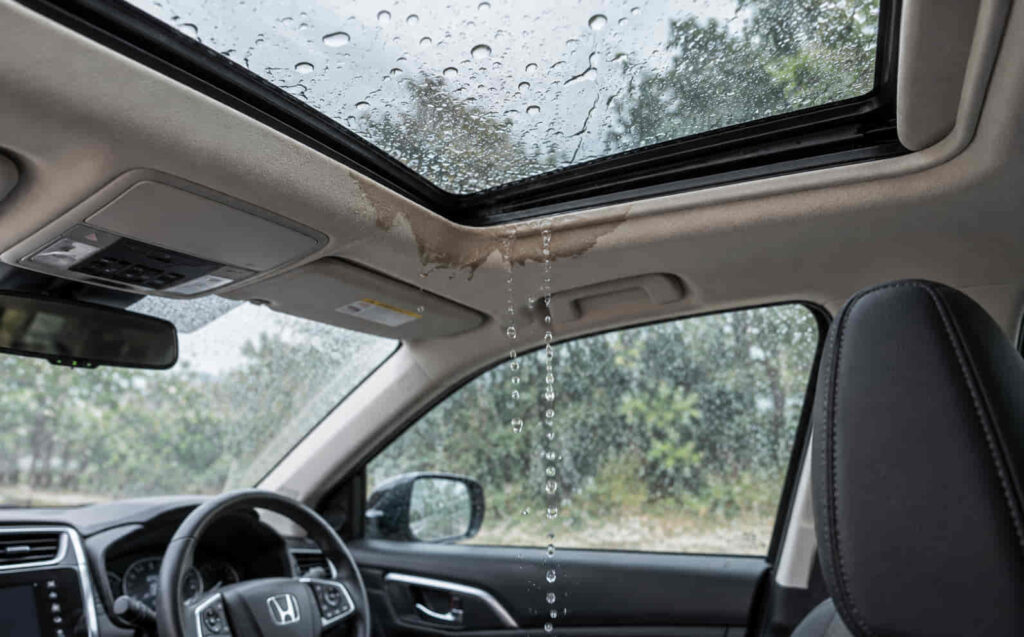
A Honda CR-V sunroof leak occurs when water entering the sunroof area is not managed or drained correctly and reaches the vehicle’s interior. The first signs often appear as a wet headliner, moisture around a pillar, damp carpet, water stains, or dripping inside the cabin after rain or a car wash. However, water near the sunroof does not automatically mean the sunroof seal needs to be replaced.
The Honda CR-V sunroof system must manage water around the roof opening and direct it away from the cabin through its drainage path. If a drain becomes blocked, a drain tube is damaged or disconnected, or another part of the sunroof system fails to control water correctly, water can overflow or travel behind interior trim. This is why the location where water becomes visible may not be the same location where the leak begins.
Correct diagnosis therefore depends on tracing the water path before replacing parts. This guide explains the common causes of a Honda CR-V sunroof leak, how clogged drains can create water intrusion, how to distinguish a drainage problem from a seal problem, and how the confirmed leak source should be repaired. It also covers the consequences of leaving the leak unresolved and the steps that help reduce the risk of recurring water intrusion.
What Does a Honda CR-V Sunroof Leak Mean?
A Honda CR-V sunroof leak means water from the sunroof area is reaching the vehicle’s interior instead of being controlled and directed away through the intended drainage path. The visible result can be water around the headliner, pillars, roof trim, or floor, but the location where moisture appears does not necessarily identify the point where the water first entered.
The sunroof opening manages water through more than the contact between the glass and the surrounding weatherstrip. Water that reaches the perimeter of the sunroof must remain controlled around the opening and move through the intended drainage path rather than entering the cabin. A problem develops when that water path is interrupted or when another part of the sunroof assembly allows water to move into an unintended area.
This distinction explains why replacing the sunroof seal is not automatically the correct response to a leak. If water is reaching the interior because a drainage path is blocked or a drain tube is no longer carrying water correctly, changing the weatherstrip does not address the failure responsible for the water intrusion. Conversely, a drainage repair does not correct a problem that has been confirmed at another sealing, alignment, or structural point.
Water can also travel before becoming visible. Moisture entering near the roof can move along the headliner, behind pillar trim, or through concealed body areas before reaching a location where the driver notices it. A wet spot several inches away from the sunroof opening can therefore still be related to the sunroof drainage system, while water visible near the sunroof can potentially originate from another nearby water-entry point.
A Honda CR-V sunroof leak should therefore be diagnosed by tracing the water path from its entry point through the drainage or sealing system to the location where it appears inside the vehicle. Establishing that path provides the basis for determining whether the actual failure involves a clogged drain, a drain tube, the sunroof seal or alignment, or another nearby source of water intrusion.
Read more: Honda CRV AC Condenser Leak
What Are the Signs of a Honda CR-V Sunroof Leak?
The main signs of a Honda CR-V sunroof leak are moisture or water appearing in the headliner, around the pillars, or in the carpet after the vehicle is exposed to rain or water. These symptoms indicate water intrusion in the roof or upper-body area, but they do not independently prove that the sunroof glass or weatherstrip is the exact source.
A wet headliner is one of the clearest indicators when moisture develops close to the sunroof opening. Water may create a visible stain, dampen the fabric, or eventually drip from an edge of the headliner. The important diagnostic detail is that water can travel behind the material before becoming visible. A wet area beside the sunroof can therefore originate from a drainage or sealing problem located farther away from the visible stain.
Moisture around the A-pillar or another pillar can indicate that water is traveling away from the roof area behind interior trim. This pattern is particularly relevant when the moisture repeatedly appears after rainfall or washing. The pillar should be treated as part of the observed water path rather than automatically as the original entry point because concealed drainage components and body surfaces can carry water from the roof toward lower sections of the cabin.
Damp carpet or water accumulating on the floor can represent a later stage of the same water path. Water entering higher in the vehicle can move downward behind trim before reaching the carpet, which makes the final wet area appear far from the original leak. Persistent moisture can also produce staining or a musty odor when interior materials remain damp instead of drying completely.
The timing of the symptom provides additional diagnostic context. Water that consistently appears after rain, a car wash, or another direct exposure to the roof supports an exterior water-entry problem. However, the symptom identifies where water has become visible, while diagnosis must establish where the water entered and why it was able to reach that location.
What Causes a Honda CR-V Sunroof to Leak?
A Honda CR-V sunroof can leak when its drainage path becomes blocked or compromised, when a drain tube cannot carry water correctly, or when a sealing, alignment, or nearby roof-area problem allows water to reach the interior. These causes require different repairs, so identifying the failure mechanism is more useful than assuming every sunroof leak comes from a damaged weatherstrip.
A drainage restriction can cause water to accumulate around the sunroof channel instead of leaving the roof area through its intended path. When water enters faster than the restricted drainage path can remove it, the level can rise until water reaches an unintended route into the headliner or surrounding trim. In this situation, the drainage failure creates the cabin leak even if the visible sunroof weatherstrip is not the failed component.
A drain tube can produce a different failure when it is disconnected, damaged, or otherwise unable to carry collected water to the intended outlet. Water may enter the drainage channel correctly but leave the drainage system before reaching the exterior of the vehicle. This failure can explain why moisture appears behind pillar trim or lower in the cabin even though the sunroof opening itself does not appear obviously damaged.
A sealing or alignment problem must be evaluated separately. Deteriorated components, incorrect glass positioning, or another problem around the sunroof opening can alter how water is controlled around the assembly. The relevant evidence is not simply that the weatherstrip becomes wet during rain; the diagnosis must connect the condition of the sealing or alignment area to the abnormal water path entering the cabin.
Water around the sunroof can also originate from an adjacent roof or body area rather than the sunroof system itself. This possibility becomes important when the drains function correctly and testing does not reproduce leakage from the sunroof assembly. The actual cause of a Honda CR-V sunroof leak is therefore the failure point that creates the abnormal water path, not merely the interior location where the water is eventually discovered.
How Can Clogged Sunroof Drains Cause a Honda CR-V to Leak?
Clogged sunroof drains can cause a Honda CR-V to leak when water reaches the sunroof drainage channel faster than the restricted drains can carry it away, allowing water to accumulate and enter the cabin through an unintended path. The problem is therefore not simply that water reaches the sunroof area. The leak develops because the drainage system can no longer manage that water correctly.
The sunroof drainage path is designed to move collected water away from the roof opening and discharge it outside the vehicle. When debris or another obstruction restricts this path, the amount of water leaving the channel decreases. Continued rainfall or washing can then add water faster than the restricted drain can remove it. Once the drainage channel can no longer contain the accumulating water, moisture can move toward the headliner, pillars, or other interior areas.
The location where water appears depends on the path it follows after leaving the intended drainage system. Water overflowing near the roof can spread along concealed surfaces before becoming visible at the edge of the headliner. If it moves downward behind trim, the driver may first notice moisture around a pillar or even damp carpet. This explains why a clogged sunroof drain can produce symptoms away from the sunroof opening itself.
A drainage problem can also exist without a complete blockage. A partially restricted path may still remove water during light exposure but fail when the volume of water increases. This can produce an intermittent leak that appears during heavier rain while remaining absent under less demanding conditions. The relationship between water volume, drainage capacity, and the location of the resulting moisture helps explain why the same vehicle may not leak every time it gets wet.
A clogged drain should not be assumed solely because water is present in the cabin. A disconnected or damaged drain tube, a sealing or alignment problem, or another roof-area leak can create similar symptoms. A drain blockage becomes the relevant diagnosis when testing shows that water is not moving through the intended drainage path correctly and that this failure corresponds with the observed water intrusion.
How Do You Find the Source of a Honda CR-V Sunroof Leak?
The source of a Honda CR-V sunroof leak is found by tracing where water first enters, how it moves through the sunroof or roof area, and where the intended drainage or sealing path stops working correctly. Diagnosis should follow the water path rather than beginning with the assumption that the wettest visible interior area is the source.
Inspection can begin around the sunroof opening, drainage channel, accessible drain areas, weatherstrip, and surrounding roof components. Visible debris, displaced components, deterioration, or signs that water has repeatedly traveled through a particular area can help narrow the search. Interior moisture patterns also provide useful evidence because stains or wet trim can indicate the direction in which water has traveled after entering the vehicle.
Controlled water testing can help reproduce the leak and connect the interior symptom to a specific exterior area. The purpose is to observe how water behaves under conditions that allow its path to be traced. If water enters the drainage channel but does not leave through the intended route, the drainage system becomes a stronger suspect. If drainage works correctly while water enters through another point, diagnosis needs to shift toward that location rather than continuing to treat the drains as the cause.
The sequence in which moisture appears can provide additional evidence. Water first becoming visible near the headliner and then progressing down a pillar indicates a different path from moisture that begins at a lower body area. Tracing this progression backward helps separate the point where water is discovered from the point where the leak originates.
Diagnosis is complete when the observed water intrusion can be consistently connected to a specific failure point. The objective is not merely to reproduce a wet headliner or damp carpet; it is to determine which drain, tube, sealing area, alignment condition, or adjacent water-entry point allows water to reach the cabin. That distinction determines which repair can actually stop the Honda CR-V sunroof leak from returning.
How Can You Tell a Sunroof Drain Leak From a Sunroof Seal Problem?
You can distinguish a Honda CR-V sunroof drain problem from a seal problem by determining whether water is entering the drainage system normally but failing to exit, or whether a sealing or alignment condition is creating an abnormal water path around the sunroof opening. Both problems can produce a wet headliner or moisture around the pillars, so the interior symptom alone cannot identify which component has failed.
A drainage problem occurs when water reaches the area intended to collect it but cannot continue through the drainage path correctly. A blocked drain can restrict water flow until the channel accumulates more water than it can manage. A disconnected or damaged drain tube creates a different version of the same problem: water enters the drainage system but leaves the intended path before reaching the exterior. In either case, diagnosis should reveal abnormal water movement within the drainage route.
A seal or alignment problem follows a different mechanism. The relevant question is whether the condition around the sunroof glass and opening allows water to follow a path that the system cannot manage as intended. Visible deterioration, displacement, or an alignment condition can support this diagnosis when controlled testing connects that specific area with the water entering the cabin. Simply seeing water on the weatherstrip after rain is not enough to establish that the seal has failed.
The behavior of the drainage system provides the strongest distinction. If water reaches the drainage channel and fails to move through the expected route, the drain or drain tube requires further attention. If the drainage path functions normally but testing consistently traces the intrusion to a sealing, alignment, or adjacent roof area, the diagnosis should follow that evidence instead.
The difference between a drain leak and a seal problem is therefore determined by the failed water-management path, not by where the headliner or carpet becomes wet. This distinction prevents unnecessary seal replacement when the actual problem is drainage and prevents repeated drain cleaning when water is entering through another confirmed point.
How Do You Fix a Honda CR-V Sunroof Leak?
A Honda CR-V sunroof leak is fixed by restoring the specific drainage, tube, sealing, alignment, or roof-area component that diagnosis identifies as the source of water intrusion. There is no single repair that correctly addresses every sunroof leak because different failure points can create similar interior symptoms.
When a restricted drainage path is confirmed, the repair needs to restore normal water flow through that path. The objective is for water entering the drainage channel to travel through the intended route and discharge outside the vehicle instead of accumulating around the sunroof opening. The drainage path should remain intact after the restriction is addressed; using excessive force on a drain without understanding its routing can create a different problem rather than correcting the original one.
If a drain tube is disconnected or damaged, clearing the drain opening alone does not repair the leak. Water may enter the tube correctly but escape behind the headliner or pillar trim before reaching the exterior. Repair must restore the continuity of that drainage path so collected water remains contained from the sunroof channel to its intended outlet.
A confirmed sealing or alignment problem requires a different repair. The affected component must be corrected so water is managed around the sunroof opening as intended. Replacement becomes relevant when deterioration or damage has been identified in a component that cannot perform its function correctly. Adjustment may be relevant when the diagnosed problem involves positioning rather than deterioration, but the repair should follow the confirmed failure instead of assuming every leak requires a new seal.
The interior also needs attention after the exterior water path has been corrected. Headliner, carpet, insulation, and trim that remain damp can retain moisture even after the leak stops, making it appear that the repair has failed or allowing odor and staining to persist. Drying affected materials therefore addresses the consequence of the leak while repairing the water-entry point addresses its cause.
A successful Honda CR-V sunroof leak repair has two results: water follows the intended exterior drainage path, and the previously affected interior area remains dry when the leak condition is tested again. If water returns, diagnosis should continue because the original failure may remain unresolved or more than one water-entry point may be present.
Should You Replace the Honda CR-V Sunroof Seal if It Leaks?
You should replace a Honda CR-V sunroof seal only when diagnosis confirms that deterioration, damage, or another sealing-related condition is contributing to the water intrusion. Water inside the cabin does not by itself prove that the seal has failed because blocked drains, damaged or disconnected drain tubes, alignment problems, and other roof-area leak sources can produce similar symptoms.
Replacing the seal without identifying the water path can leave the original leak unchanged. For example, if water is collecting normally around the sunroof but cannot leave because a drain is restricted, a new seal does not restore drainage capacity. Water can continue accumulating until it reaches an unintended path into the headliner or surrounding interior areas. In this case, the drain restriction rather than the seal is the failure that must be corrected.
The same principle applies to a disconnected or damaged drain tube. Water can pass from the sunroof area into the drainage system correctly but escape behind interior trim before reaching its intended outlet. Because the failure occurs downstream from the sunroof opening, replacing the weatherstrip does not reconnect or repair the drainage path.
Seal replacement becomes relevant when inspection and water testing connect the leak to the sealing area itself and the affected component is damaged or deteriorated. An alignment-related problem should also be distinguished from physical seal deterioration because correcting component position and replacing a component address different failure mechanisms. The repair should correspond to what testing actually identifies.
The decision to replace a Honda CR-V sunroof seal should therefore follow diagnosis, not precede it. Confirming whether the problem involves drainage, a drain tube, sealing, alignment, or another nearby water-entry point reduces unnecessary parts replacement and increases the likelihood that the repair will stop the leak from returning.
What Happens If You Do Not Fix a Honda CR-V Sunroof Leak?
If a Honda CR-V sunroof leak is not fixed, repeated water intrusion can keep the headliner, trim, carpet, insulation, or other interior materials damp and allow the affected area to expand. The consequences depend on where the water travels and how much enters the cabin, but an unresolved leak provides the same pathway for moisture each time the vehicle is exposed to conditions that reproduce it.
Staining is one visible consequence when water repeatedly reaches the headliner or other absorbent interior materials. Even after the surface appears dry, previous water movement can leave discoloration that reveals the route moisture followed. A stain that becomes larger or reappears after subsequent rain indicates that the water-entry problem has not been fully corrected.
Persistent moisture can also create an odor problem. Carpet, insulation, and concealed materials can retain water longer than exposed surfaces, especially when moisture travels behind trim. This explains why the cabin can develop a musty smell even when no standing water is visible. Drying the interior can address the retained moisture, but the odor can return if the exterior leak remains open.
Water may also travel beyond the first visible wet area. A leak beginning around the roof can move behind the headliner and down a pillar before reaching lower interior sections. Components located along the water path can therefore be exposed to moisture even when the driver initially notices only a small stain. The exact consequences depend on the route the water takes, so electrical damage should not be assumed solely because a sunroof leak exists.
Leaving the problem unresolved can also make diagnosis more complicated because repeated water intrusion increases the number of damp areas inside the vehicle. Repairing the confirmed leak source stops new water intrusion, while drying and cleaning the affected interior addresses the moisture and contamination already present. Both parts are relevant when a Honda CR-V sunroof leak has persisted long enough to soak interior materials.
How Can You Prevent a Honda CR-V Sunroof From Leaking Again?
You can reduce the risk of another Honda CR-V sunroof leak by keeping the drainage path functional, correcting damaged or displaced components when they are identified, and investigating new signs of water intrusion before moisture spreads through the interior. Prevention focuses on maintaining the system that controls water around the sunroof rather than trying to stop all water from reaching the sunroof opening.
The drainage system should remain capable of moving collected water away from the roof area. Debris around the sunroof channel or drain openings can interfere with that process when it accumulates enough to restrict water flow. Keeping accessible drainage areas free from contamination reduces the chance that water will accumulate faster than the system can remove it. Any drain maintenance should preserve the drain tubes and their connections rather than using excessive force that could damage or disconnect concealed components.
Changes in water flow can also provide an early indication of a developing drainage problem. If water begins accumulating around the sunroof channel, drains more slowly than expected, or appears inside the vehicle after rain, the drainage path should be investigated before repeated exposure allows more moisture to enter. Early diagnosis can limit the amount of water reaching the headliner, pillars, carpet, and other absorbent interior materials.
The condition of the sunroof assembly also matters. Visible deterioration, displaced components, abnormal glass positioning, or damage around the roof opening should be evaluated when they affect how water is managed. The same principle applies after roof or sunroof repairs: if water intrusion begins after work in that area, the relationship between the repair and the new water path provides useful diagnostic context.
Interior moisture should not be ignored after the exterior leak has been corrected. Damp carpet, insulation, trim, or headliner can retain water and produce staining or odor even when no new water is entering. Drying the affected materials helps separate residual moisture from a recurring leak and makes subsequent water intrusion easier to identify.
Preventing a recurring Honda CR-V sunroof leak ultimately depends on maintaining a functional water-management path and repairing the specific failure when one develops. Drain maintenance can reduce blockage-related problems, but it cannot prevent every seal, tube, alignment, or adjacent roof-area failure. When water reappears inside the vehicle, tracing the new water path provides a more reliable response than automatically cleaning the drains or replacing the sunroof seal.