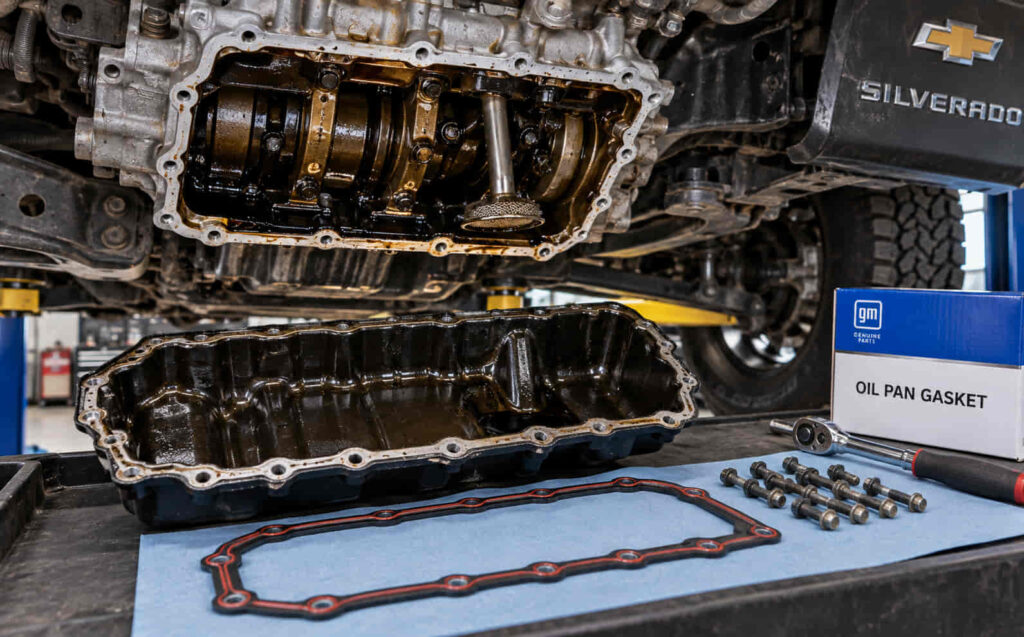
The Chevy Silverado oil pan gasket seals the connection between the oil pan and the lower portion of the engine, preventing engine oil from leaking through the mating surfaces. A leak can develop when the sealing material deteriorates, the sealing surface is damaged, or a previous repair does not create the correct seal. However, oil found on the outside of the pan does not automatically confirm a failed oil pan gasket because engine oil can leak from a higher location and travel downward before collecting around the pan.
Correct diagnosis is important before replacing the gasket because oil pan access and sealing methods can differ by Silverado model year, engine, and drivetrain configuration. The oil pan may also be positioned around components that affect removal, making the difficulty of the repair dependent on more than the gasket itself. A minor oil seep and an active leak that causes the engine oil level to drop also represent different levels of repair urgency.
This guide explains the Chevy Silverado oil pan gasket location, common leak symptoms, failure causes, diagnostic process, replacement procedure, repair difficulty, and replacement cost. It also explains when an oil pan gasket leak can affect oil level or oil pressure, whether the truck can continue to be driven, and how to select the correct gasket or sealing method for the specific Silverado engine.
What Is the Oil Pan Gasket on a Chevy Silverado?
The Chevy Silverado oil pan gasket is the sealing interface between the engine oil pan and the lower section of the engine, where it prevents engine oil from escaping through the joint between the two mating surfaces. The exact sealing design depends on the Silverado engine and application, so the sealing interface should be identified before assuming that every truck uses the same conventional preformed gasket.
The oil pan forms the lower enclosure of the engine lubrication system and provides a reservoir for engine oil when it returns from lubricated engine components. Because the pan attaches to the bottom of the engine, its perimeter requires a continuous oil-tight seal. The oil pan gasket or specified sealing material creates this barrier between the mating surfaces while the engine operates through repeated heating, cooling, vibration, and oil exposure.
A successful seal depends on more than the gasket material itself. The mating surfaces of the oil pan and engine must provide a suitable sealing interface, and the applicable gasket or sealant must be installed according to the engine’s design. Contamination, damaged sealing surfaces, incorrect sealing material, or improper installation can prevent the joint from remaining oil-tight even when a new gasket has been installed.
The oil pan gasket does not regulate oil pressure or circulate oil through the engine. Its primary function is containment. Engine oil is circulated by the lubrication system, while the gasket prevents that oil from escaping where the oil pan joins the engine. This distinction matters when diagnosing low oil pressure because a leaking oil pan gasket affects oil pressure indirectly only when sufficient oil loss or another lubrication problem changes operating conditions.
A visible oil leak around the lower engine also does not prove that the gasket itself has failed. Engine oil follows surfaces and gravity, so oil originating above the pan can travel downward and collect along the oil pan perimeter. The gasket should therefore be treated as the confirmed source only after the leak origin has been identified at the sealing interface.
Where Is the Oil Pan Gasket Located on a Chevy Silverado?
The Chevy Silverado oil pan gasket is located along the perimeter where the oil pan attaches to the bottom of the engine. It forms a continuous sealing interface between the oil pan and the engine rather than functioning as an externally mounted component that can be inspected completely from one viewing angle.
The oil pan can generally be identified from underneath the engine as the lower enclosure associated with the engine oil reservoir. The gasket or sealing material sits at the oil pan mounting flange, directly between the pan and the corresponding engine sealing surface. This position places the sealing perimeter low on the engine, which is why oil leaking from other engine components can eventually reach the same area.
Access to the oil pan is not identical across every Chevy Silverado. Model year, engine, drivetrain, and surrounding component layout can change the amount of working space available around the pan. Components positioned beneath or near the engine can also affect how easily the complete oil pan perimeter can be inspected or removed. A location description should therefore identify the sealing interface without assuming that every Silverado provides the same physical access.
The position of the gasket also affects leak diagnosis. Oil found at the lowest edge of the pan may have originated at the gasket, but it may also have traveled from a higher leak source. Gravity moves oil downward after it leaves its original sealing point, while airflow around a moving vehicle can spread the residue across adjacent surfaces. The wettest or lowest point is consequently not always the actual origin of the leak.
Correct identification requires inspecting the perimeter where the pan meets the engine and determining whether fresh oil begins at that joint. Cleaning accumulated oil can make this distinction easier because an active leak can then be traced from its earliest visible point rather than through old residue covering multiple engine surfaces.
The location should also be confirmed before ordering replacement parts. Because the Silverado has been produced with different engine configurations, identifying the vehicle by model name alone does not establish the required gasket or sealing method. Model year, engine, oil pan design, and applicable sealing specification should determine the replacement component.
Read more: Chevy Silverado PCV Valve
What Are the Symptoms of a Chevy Silverado Oil Pan Gasket Leak?
The main symptoms of a Chevy Silverado oil pan gasket leak are fresh oil around the oil pan sealing perimeter, oil spots beneath the truck, a gradually declining engine oil level, and oil residue spreading across the lower engine. The severity of these symptoms depends on the rate of leakage. A light seep around the sealing surface can behave differently from an active leak that releases enough oil to produce visible drops or measurable oil loss.
Fresh oil appearing directly along the joint between the oil pan and engine provides stronger evidence of a gasket or sealing problem than oil found only at the bottom of the pan. An active sealing-interface leak typically begins where the pan meets the engine and then moves downward across the outside of the pan. Accumulated dirt can mix with the oil and create a dark, wet coating around the affected area, especially when the leak has existed for an extended period.
Oil spots beneath a parked Silverado can indicate an active engine oil leak when the oil reaches the lowest surface and drips onto the ground. The location of a spot under the truck does not identify the failed gasket by itself because oil can travel across engine surfaces before falling. A spot positioned beneath the oil pan therefore establishes evidence of oil loss but not necessarily the exact point where the leak began.
A declining engine oil level becomes more important when leakage continues between oil-level checks. The oil pan gasket’s function is to contain engine oil, so an active leak can gradually reduce the amount of oil available in the lubrication system. The rate matters: a minor seep may leave residue without producing a quickly measurable change, while a larger active leak can require oil to be added between normal service intervals.
Oil residue across the lower engine can also be a symptom, but its distribution must be interpreted carefully. Gravity moves leaking oil downward, and airflow around the vehicle while driving can carry it rearward or across adjacent components. A wide oil-covered area does not necessarily mean that multiple gaskets have failed. It can originate from one leak that has spread beyond its source.
A burning-oil odor can occur when leaking engine oil reaches a sufficiently hot surface, but this symptom is not specific to the oil pan gasket. Oil from another engine leak can produce the same odor. The smell should therefore prompt inspection for the location of the leak rather than being used as confirmation that the oil pan sealing interface has failed.
A warning related to low oil level or oil pressure represents a more serious condition than visible seepage alone and requires the lubrication condition to be checked rather than assuming the gasket is the only problem. An oil pan gasket leak can contribute to oil loss, but the warning itself does not establish where the oil was lost or whether another lubrication-system fault exists.
The strongest evidence of a Silverado oil pan gasket leak is fresh oil originating at the oil pan-to-engine sealing interface after old contamination has been removed. This separates a verified gasket-area leak from oil that simply happens to be visible on the pan.
What Causes a Chevy Silverado Oil Pan Gasket to Leak?
A Chevy Silverado oil pan gasket can leak when the sealing material deteriorates, the mating surfaces no longer form an effective seal, the oil pan is physically damaged, or a previous installation creates an incomplete sealing interface. The actual cause should be identified during removal and inspection because installing another gasket without correcting a damaged surface or installation problem can allow the leak to return.
The sealing interface operates in an environment exposed to engine oil, vibration, and repeated temperature changes. The engine heats during operation and cools after shutdown, creating repeated thermal cycles across the pan and surrounding components. Over time, the sealing system can lose its ability to maintain an oil-tight barrier when its material or sealing condition deteriorates.
Surface condition is equally important because a gasket or sealant must contact the mating surfaces correctly to create a continuous seal. Old gasket material, oil contamination, debris, scratches, deformation, or other surface defects can interrupt that contact. A new sealing component installed over an unsuitable mating surface can consequently leak even though the replacement gasket itself is not defective.
Physical damage to the oil pan can also compromise the sealing relationship. An impact can damage or deform the pan, and deformation near the mounting flange can prevent the mating surfaces from maintaining the intended contact. In this situation, replacing only the gasket may not correct the cause because the component against which the gasket seals has changed shape or condition.
Previous repair work is another possible source of leakage. Incorrect sealing material, inadequate surface preparation, improper placement of the specified sealant, or an installation that does not follow the applicable engine procedure can leave an incomplete seal. Applying additional sealant without identifying the correct sealing method is not necessarily a solution because different Silverado engines and oil-pan designs can require different sealing specifications.
Fastener installation can affect sealing when the oil pan design depends on controlled and even clamping of the mating surfaces. The applicable tightening procedure should be followed during installation rather than using excessive force in an attempt to stop leakage. More clamping force does not automatically create a better seal and can create additional problems when it differs from the specified procedure.
A recurring leak after gasket replacement should therefore trigger inspection of the sealing surfaces, oil pan condition, sealing method, and installation procedure rather than another automatic gasket replacement. The objective is to identify why the sealing interface failed and correct that mechanism, not merely replace the component where oil became visible.
How Do You Know if the Silverado Oil Pan Gasket Is Actually Leaking?
A Chevy Silverado oil pan gasket leak is confirmed when fresh engine oil can be traced to the sealing interface between the oil pan and engine rather than to a higher or nearby leak source. Oil covering the bottom or side of the pan is not sufficient evidence because gravity and airflow can move leaking oil away from its original source.
Diagnosis is easier when accumulated oil and dirt no longer obscure the sealing area. Old residue can cover the oil pan, surrounding engine surfaces, fasteners, and nearby components until several areas appear wet at the same time. Inspecting a contaminated engine without establishing where fresh oil begins can lead to replacing the oil pan gasket even though the leak originates elsewhere.
After the affected area is clean, the oil pan perimeter should be inspected for fresh oil developing directly at the joint between the pan and engine. The starting point matters more than the final location of the oil. Fresh oil that emerges from the sealing interface and then travels down the outside of the pan provides stronger evidence of a gasket or sealing failure than oil that arrives at the joint from above.
The direction of oil travel provides additional diagnostic information. Gravity generally carries oil toward lower engine surfaces after it escapes, while airflow under a moving truck can spread the oil rearward and across adjacent components. An oil pan can therefore become heavily coated even when the actual leak is positioned higher on the engine. Following the wet path upward toward its earliest point helps separate the source from the surfaces contaminated afterward.
Leak rate should also be evaluated. A light seep that creates a damp sealing edge without measurable oil loss is different from an active leak that produces drops beneath the truck or causes the dipstick level to decline. Establishing the rate helps determine repair urgency, but it does not change the requirement to identify the source before replacing parts.
When the source remains difficult to identify because oil has spread across a large area, further leak-tracing methods may be necessary. The objective remains the same regardless of the diagnostic method: establish the first point at which fresh engine oil appears. A repair decision should be based on that origin rather than on whichever lower component has accumulated the most oil.
Diagnosis should also consider the condition of the oil pan itself. Oil appearing near the pan does not necessarily pass through the gasket interface. Damage to the pan, a problem around another sealing point, or another nearby source can create leakage in the same general area. The pan and its sealing perimeter should therefore be evaluated as related but separate potential leak locations.
The oil pan gasket should be replaced only after the evidence supports the sealing interface as the source. Tracing fresh oil to the oil pan-to-engine joint provides substantially stronger diagnostic evidence than finding oil residue on the oil pan.
What Other Oil Leaks Can Look Like an Oil Pan Gasket Leak?
Oil leaking from another part of a Chevy Silverado engine can travel downward and make the oil pan gasket appear to be leaking even when the pan sealing interface remains intact. Any oil source located above or near the pan should therefore be considered when fresh oil cannot be traced directly to the oil pan perimeter.
Leaks from higher engine sealing areas can follow the exterior of the engine until they reach the oil pan flange. Once the oil reaches this joint, surface tension and accumulated dirt can cause it to spread along the perimeter. The resulting wet line can resemble a gasket leak even though the oil entered the area from above. Inspecting upward from the pan is therefore an important part of identifying the actual source.
Oil near the rear of the pan requires the same caution. The lower engine and transmission area contains multiple surfaces across which oil can travel, and a leak originating elsewhere can collect around the rear portion of the oil pan. The visible location should not be converted directly into a component diagnosis without tracing the oil to its starting point.
The oil drain plug area can also create leakage that spreads across the bottom of the pan. Oil released near the drain opening can move along the pan surface while the vehicle is parked or driven, creating contamination beyond the original leak point. A wet oil pan bottom therefore needs to be inspected separately from leakage specifically originating along the pan-to-engine sealing perimeter.
Oil associated with the oil filter or nearby lubrication-system connections can produce similar confusion when the engine configuration places those components in a path that allows leaking oil to reach lower surfaces. The diagnostic principle remains consistent: identify where fresh oil first appears before deciding which gasket, seal, fitting, or component has failed.
Multiple leak sources are also possible, particularly when an engine already has widespread oil contamination. Finding one confirmed leak does not prove that every wet area originates from that location. After repairing a verified source, cleaning and reinspecting the engine can reveal whether another active leak remains.
This distinction prevents unnecessary oil pan removal. The presence of oil on a Chevy Silverado oil pan identifies an area that needs inspection; fresh oil beginning at the oil pan sealing interface identifies the gasket or sealing system as the more likely source. Separating those two observations is the key step in diagnosing an oil pan gasket leak accurately.
How Do You Replace a Chevy Silverado Oil Pan Gasket?
To replace a Chevy Silverado oil pan gasket, the oil pan must be accessed and removed, the old sealing material must be eliminated from the mating surfaces, and the pan must be reinstalled using the sealing method specified for the particular engine. The exact procedure depends on the model year, engine, drivetrain configuration, and components surrounding the oil pan, so one removal procedure should not be applied to every Silverado.
Replacement should begin only after the oil pan sealing interface has been confirmed as the source of the leak. Engine oil must be drained before the pan is removed, and sufficient working access must be created around the pan. Depending on the Silverado configuration, surrounding components can limit direct removal and increase the amount of disassembly required before the oil pan can be separated from the engine.
Once access is available, the oil pan fasteners can be removed according to the applicable service procedure and the pan separated carefully from the engine. The mating surfaces should not be damaged during separation because scratches, gouges, or deformation can compromise the new seal. If the pan does not release easily, forcing a tool into the sealing surface can create a new leak path even when the original gasket was the only failed component.
Surface preparation is one of the most important parts of oil pan gasket replacement. Old gasket material, cured sealant, engine oil, and debris must be removed from the areas that form the new seal. The objective is to create clean mating surfaces without damaging them. Installing a new gasket or sealant over contaminated surfaces can prevent consistent contact and allow engine oil to escape after the repair.
The oil pan should also be inspected while it is removed. A damaged or distorted sealing flange can prevent the new sealing system from maintaining uniform contact with the engine. Replacing the gasket alone does not correct a pan that can no longer provide the required mating surface. The cause of the original leak should therefore be considered before reassembly rather than assuming that every sealing failure originates solely from aged gasket material.
The replacement sealing method must match the specific Silverado engine and oil pan design. Some applications can use a formed gasket, while other sealing arrangements can depend on specified sealant or application-specific procedures. Additional RTV should not be applied simply because more material appears likely to create a stronger seal. The correct material, placement, and installation method determine whether the joint seals properly.
The oil pan must then be positioned without disturbing the new sealing interface and secured according to the applicable installation procedure. Fastener tightening is part of the sealing process because the pan needs controlled contact with the engine mating surface. Excessive tightening should not be used as a method for stopping leaks. More clamping force does not automatically produce a more reliable seal and can interfere with the intended installation.
After reassembly, the engine should be refilled with the correct amount and specification of engine oil for the particular application. The repaired sealing perimeter should then be inspected while checking for fresh leakage. The repair is confirmed when the original leak no longer develops from the oil pan-to-engine interface, not simply when a new gasket has been installed.
How Difficult Is Chevy Silverado Oil Pan Gasket Replacement?
Chevy Silverado oil pan gasket replacement can range from a relatively direct sealing repair to a labor-intensive job because the main difficulty is gaining enough access to remove the oil pan. The gasket itself is not necessarily the complex part of the repair. Engine layout, drivetrain configuration, surrounding components, and available clearance can determine most of the labor involved.
This distinction explains why oil pan gasket replacement can require considerably more work than the price or appearance of the gasket suggests. The oil pan occupies the lower portion of the engine, where chassis and drivetrain components can limit removal clearance. If the pan cannot move far enough to separate from the engine and clear surrounding structures, additional components may need to be moved or removed according to the applicable service procedure.
A truck’s drivetrain configuration can also affect repair access. Components associated with the front drivetrain can occupy space beneath or around the engine on applicable Silverado configurations. For this reason, a replacement procedure demonstrated on one Silverado should not automatically be treated as the correct procedure for another truck with a different engine or drivetrain layout.
Surface preparation adds another level of repair difficulty even after the pan has been removed. The new seal depends on clean, undamaged mating surfaces and the correct application of the specified sealing system. Rushing this stage can turn a successful disassembly into a repeat leak. A technically simple gasket replacement can therefore fail because of poor surface preparation rather than because the replacement part itself is defective.
DIY suitability should be evaluated from the complete repair procedure rather than from the gasket alone. A vehicle owner who can identify the leak and replace an accessible oil pan may still encounter a substantially different task when surrounding components restrict removal. The required equipment, safe vehicle support, working clearance, and applicable engine procedure all influence whether the repair is practical outside a professional workshop.
The most accurate way to estimate difficulty is to identify the model year, engine, drivetrain configuration, and required oil pan removal procedure before beginning the repair. This avoids describing every Chevy Silverado oil pan gasket replacement as either simple or difficult when the actual labor requirement depends on the specific truck.
How Much Does Chevy Silverado Oil Pan Gasket Replacement Cost?
Chevy Silverado oil pan gasket replacement cost depends primarily on labor, oil pan access, engine configuration, and the sealing system required for the specific truck. The gasket or sealing material is only one part of the total repair expense. Engine oil, related sealing materials, replacement hardware when required, and the labor needed to remove and reinstall the oil pan can have a greater effect on the final cost.
Labor varies because the oil pan cannot be removed with the same amount of disassembly on every Silverado. A configuration with relatively direct pan access requires a different amount of work from one in which drivetrain or chassis components restrict removal. This is why two Silverado oil pan gasket repairs can have different labor charges even when the basic objective—resealing the joint between the oil pan and engine—is identical.
The condition of the oil pan and mating surfaces can also change the repair cost. If inspection shows that the pan is damaged or its sealing flange cannot create the required mating surface, installing another gasket alone may not correct the leak. The repair then involves correcting or replacing the affected component rather than paying only for a new sealing material.
A professional estimate should therefore identify the actual leak source and the required oil pan removal procedure before the total cost is evaluated. An estimate based only on the price of an oil pan gasket does not represent the complete repair because it excludes the work required to reach, remove, prepare, reseal, and reinstall the pan.
DIY replacement changes the labor expense but does not eliminate the complexity of the job. The vehicle still requires safe support, sufficient access, the correct sealing procedure, fresh engine oil, and any application-specific materials required during reassembly. A low-cost gasket does not make the complete repair inexpensive when substantial disassembly or additional equipment is necessary.
For the most useful cost estimate, the repair should be matched to the Silverado model year, engine, drivetrain configuration, confirmed leak source, and required sealing method. These variables provide a stronger basis for estimating repair cost than a single price range applied to every Chevrolet Silverado.
Can You Drive a Chevy Silverado With an Oil Pan Gasket Leak?
A Chevy Silverado with a minor oil pan gasket seep may remain operable when the engine maintains the correct oil level, but an active leak that causes significant oil loss should not be treated as a condition for continued normal driving. The important factor is not simply whether the gasket leaks; it is how quickly engine oil is being lost and whether adequate lubrication can be maintained.
A minor seep can leave an oily film around the sealing perimeter without immediately removing a substantial quantity of oil from the pan. This still requires inspection because the leak can progress and because visible oil around the pan may originate elsewhere. Monitoring the oil level provides information about oil loss, while tracing the leak establishes whether the oil pan gasket is actually responsible.
An active leak creates a different risk. As oil escapes, the quantity available to the lubrication system decreases. The engine depends on an adequate oil supply to lubricate moving components and carry out other oil-dependent functions. Continuing to operate the truck while the oil level falls can therefore turn an external sealing problem into a lubrication problem with much greater consequences.
Visible leakage should be treated more urgently when the truck leaves fresh oil on the ground, requires repeated oil additions, develops a rapidly declining oil level, or displays an oil-pressure warning. These conditions indicate that the issue has moved beyond cosmetic residue around the pan. An oil-pressure warning in particular requires attention to the engine’s lubrication condition rather than assuming that continued driving is safe because the engine still runs.
Adding oil can restore the level temporarily, but it does not repair the failed sealing interface. The replacement oil can continue to escape through the same leak, and the loss rate can change. Maintaining the oil level is therefore a monitoring or short-term protective measure, not a substitute for diagnosing and repairing an active leak.
Driving decisions should ultimately be based on leak severity, current oil level, evidence of active oil loss, and any lubrication warnings. A damp gasket perimeter and a leak that is rapidly reducing the engine oil supply are not equivalent conditions and should not be assigned the same level of urgency.
Can an Oil Pan Gasket Leak Cause Low Oil Pressure?
An oil pan gasket leak can contribute to low oil pressure indirectly when it causes enough engine oil loss to reduce the available oil supply, but the gasket itself does not regulate oil pressure. This distinction is important because replacing a leaking gasket should not automatically be expected to correct every low-oil-pressure condition.
The oil pan gasket performs a containment function. It seals the joint around the oil pan so engine oil remains inside the lubrication system. Oil pressure, by contrast, depends on the operation and condition of the lubrication system rather than on the gasket acting as a pressure-control component. The relationship between the two begins when an external leak removes oil from the engine.
The causal sequence is therefore oil pan gasket leak → engine oil loss → sufficiently low oil level → increased risk of lubrication and oil-pressure problems. A minor seep that does not materially reduce the oil level should not be described as directly producing low oil pressure. The severity and duration of the oil loss determine whether the gasket leak becomes relevant to the available oil supply.
Low oil pressure can also have causes unrelated to the oil pan gasket. For this reason, an oil-pressure warning should not be diagnosed solely from the presence of oil around the pan. The oil level should be checked, the external leak should be identified, and the lubrication problem should be investigated according to the symptoms present.
This distinction also prevents an incorrect repair assumption. A Silverado can have a confirmed oil pan gasket leak and a separate oil-pressure problem at the same time. Repairing the external leak restores the sealing interface, but additional diagnosis remains necessary when an oil-pressure warning or abnormal lubrication condition continues after the engine has the correct oil level.
The oil pan gasket and oil pressure are therefore related through oil containment and oil loss, not through direct pressure regulation. That semantic distinction explains why a severe leak can become mechanically important while a small amount of gasket seepage does not automatically mean that the engine has low oil pressure.
Should You Use a Gasket or RTV on a Chevy Silverado Oil Pan?
Whether a Chevy Silverado oil pan requires a formed gasket, RTV sealant, or an application-specific combination depends on the engine and oil pan sealing design. There is no single sealing method that should be applied to every Silverado generation and engine. The correct repair is the method specified for the particular application rather than automatically adding RTV to a replacement gasket.
A formed gasket creates a physical sealing layer between mating surfaces designed to use that component. RTV works differently because the material is applied in an uncured state and forms a seal after installation and curing. These methods are not automatically interchangeable. A sealing surface designed around one method can require a specific material, application pattern, or installation procedure to create the intended oil-tight joint.
Using more sealant does not necessarily improve the repair. Excess material can prevent the sealing interface from being assembled as intended, while insufficient or incorrectly positioned material can leave gaps where oil escapes. The objective is to create a continuous seal using the specified amount and placement rather than applying the largest possible bead.
RTV also should not be added to every formed gasket as additional protection against leaks. When a gasket is designed to be installed according to a particular procedure, adding unrequired sealant changes the sealing interface. Sealant may be specified at particular joints or transitions on an applicable engine, but that requirement should come from the engine-specific procedure rather than from a universal rule for Silverado oil pans.
Surface preparation remains essential regardless of the sealing method. A correct gasket installed over oil, debris, damaged material, or an unsuitable mating surface can still leak. RTV also depends on properly prepared surfaces and the applicable curing and assembly procedure. Choosing the correct sealing product cannot compensate for poor preparation of the oil pan and engine mating surfaces.
The sealing method should therefore be identified before the oil pan is reinstalled. Engine-specific service information and the requirements of the replacement sealing system should determine whether the Silverado uses a gasket, RTV, or another specified arrangement. This prevents a repair method that works on one Silverado engine from being incorrectly transferred to another.
How Do You Choose the Correct Oil Pan Gasket for a Chevy Silverado?
The correct Chevy Silverado oil pan gasket should be selected by matching the truck’s model year, engine, oil pan design, and specified sealing method to the replacement part. Searching by “Chevy Silverado” alone is not sufficient because the Silverado name covers multiple generations, engines, drivetrains, and oil pan configurations.
The engine is a critical fitment attribute because the gasket must correspond to the mating geometry of the applicable oil pan and engine. Two trucks carrying the Silverado name do not necessarily share the same sealing interface. Identifying the engine before ordering the part reduces the risk of selecting a gasket that appears appropriate by vehicle name but does not match the actual application.
Model year provides another layer of identification because engine and component configurations can change across Silverado generations and production periods. The year should therefore be combined with engine information rather than used as the only fitment criterion. Drivetrain and oil pan configuration can also become relevant when different applications use different pan designs.
The existing sealing system can provide useful context during repair, but old material should not be treated as the sole authority for choosing the replacement method. A previous repair may have used an incorrect gasket or unnecessary sealant. The replacement decision should instead be checked against application-specific part information or the applicable service procedure.
OEM and aftermarket options should be evaluated primarily by correct fitment and sealing specification rather than by brand category alone. An aftermarket gasket that accurately matches the required application and material specification serves a different purpose from a part that is merely advertised broadly for Silverado trucks. Likewise, an OEM-labelled component still needs to correspond to the specific engine and oil pan application being repaired.
The same principle applies when a replacement kit includes additional seals, hardware, or sealant. The presence of an item in a kit does not establish that every included material should be applied everywhere on the oil pan. Each component should have a defined role within the specified installation method.
Part selection should ultimately follow the sequence model year → engine → oil pan configuration → sealing design → verified fitment. This process connects the replacement component to the actual sealing interface and reduces the risk of repeating the repair because the wrong gasket or sealing method was installed.
How Does an Oil Pan Gasket Leak Affect Engine Oil Level?
A Chevy Silverado oil pan gasket leak can lower the engine oil level when oil escapes through the sealing interface faster than it is replaced during normal maintenance. The effect depends primarily on the leak rate and the length of time the leak continues. A light seep can leave visible residue around the oil pan without producing a rapid change on the dipstick, while an active leak can remove enough oil to make the level decline between checks.
The connection between the gasket and oil level is direct because the oil pan contains part of the engine’s oil supply when the oil returns to the bottom of the engine. Once the sealing interface allows oil to escape, that oil is no longer available to the lubrication system. The total loss accumulates over time, so a leak that appears small during a brief inspection can become more significant when it continues through repeated driving cycles.
Oil spots beneath the truck can provide evidence that oil is leaving the engine, but the amount visible on the ground should not be used as the only measure of total oil loss. Oil can remain on the pan, engine surfaces, shields, or nearby components instead of immediately dripping onto the parking surface. Checking the engine oil level provides a more useful indication of whether an external leak is reducing the available oil supply.
The rate of oil-level decline can also help establish repair urgency. A stable oil level accompanied by minor residue represents a different condition from a truck that requires repeated oil additions. Rapid or continuing oil loss increases the importance of locating and repairing the leak because insufficient oil can affect lubrication long before the external appearance of the gasket becomes the primary concern.
Adding engine oil restores the quantity that has been lost, but it does not restore the failed seal. If the oil pan gasket remains the confirmed leak source, newly added oil remains exposed to the same escape path. Oil-level monitoring therefore protects against unnoticed loss while diagnosis or repair is being arranged; it does not eliminate the need to correct an active sealing failure.
The practical relationship is oil pan gasket leak → external oil loss → declining oil level when the loss becomes sufficient → increased lubrication risk if the level is allowed to fall too far. This explains why the condition of the engine oil supply is more important than judging severity from the appearance of the gasket alone.
How Can You Prevent Oil Pan Gasket Leaks on a Chevy Silverado?
The most effective way to reduce the risk of a recurring Chevy Silverado oil pan gasket leak is to use the correct sealing method, prepare the mating surfaces properly, inspect the oil pan for damage, and follow the applicable installation procedure during repair. Preventive maintenance cannot guarantee that a sealing system will never deteriorate, but correct installation removes several avoidable causes of repeat leakage.
Surface preparation is particularly important because the new sealing system depends on consistent contact between the oil pan and engine mating surfaces. Residual gasket material, cured sealant, oil contamination, debris, or damage can interrupt that contact. Cleaning the surfaces correctly before installation addresses the sealing condition itself rather than attempting to compensate for contamination with additional gasket material or RTV.
The oil pan should also be inspected instead of automatically reused after removal. A damaged or distorted sealing flange can prevent a new gasket or sealant from maintaining the intended interface. Installing a new sealing component against a defective pan can reproduce the same leak even though the replacement material is new.
Using the specified gasket or sealant reduces another preventable source of failure. The Silverado platform includes different engine and oil pan configurations, so a sealing method appropriate for one application should not be assumed to fit another. Matching the repair to the model year, engine, oil pan design, and service specification provides a more reliable basis than applying a universal gasket or RTV procedure.
Correct assembly matters after the sealing surfaces have been prepared. The oil pan must be positioned without disrupting the sealing material, and the applicable fastener procedure should create the intended clamping relationship between the mating surfaces. Excessive tightening should not be used as a preventive strategy because additional force does not automatically improve the seal.
Regular inspection can limit the consequences of a leak that develops later. Fresh oil around the pan perimeter, new spots beneath the truck, or a declining oil level provides an opportunity to identify the source before substantial oil loss occurs. Early diagnosis also makes it easier to distinguish a localized leak from widespread contamination that has accumulated across the lower engine.
Preventing repeat leakage therefore depends on maintaining the entire oil pan sealing interface, not simply installing a new gasket. Correct fitment, suitable mating surfaces, the specified sealing method, proper assembly, and early leak detection work together to keep engine oil contained and reduce the likelihood that the same repair will need to be repeated.