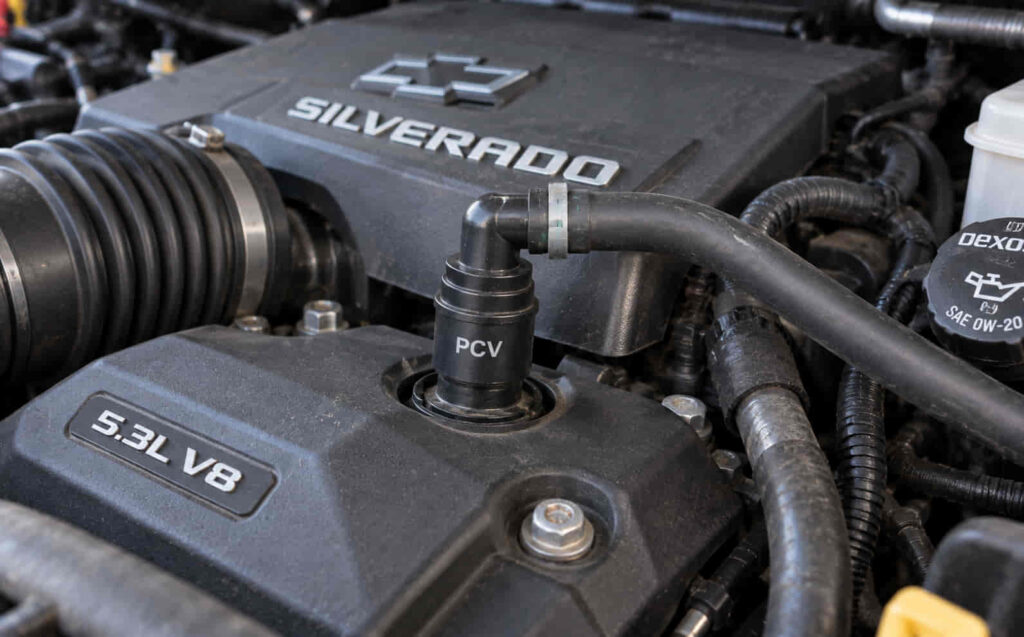
The Chevy Silverado PCV valve is part of the positive crankcase ventilation system that controls crankcase pressure and routes blow-by gases back into the engine’s intake system for combustion. Its exact design and location depend on the Silverado model year and engine. Some engines use a separately serviceable PCV component, while others incorporate crankcase ventilation components into the valve cover or a related assembly. Identifying the engine and PCV configuration is therefore necessary before testing, buying parts, or starting a replacement.
A faulty or restricted PCV system can affect how a Silverado engine manages crankcase gases and vacuum. Depending on the type of failure, drivers may notice rough idle, abnormal oil consumption, oil leaks, whistling or hissing noises, or a Check Engine Light. These symptoms do not automatically confirm a bad PCV valve because vacuum leaks, ignition faults, gasket failures, and other engine problems can produce similar effects.
This guide explains where the Chevy Silverado PCV valve or related PCV components are located, how the system works, which symptoms indicate a possible problem, how to test the system, and how replacement differs between engine configurations. It also covers replacement cost, maintenance considerations, crankcase pressure, and PCV-related oil consumption so the fault can be diagnosed before parts are replaced.
What Is the PCV Valve on a Chevy Silverado?
The PCV valve on a Chevy Silverado is a component of the Positive Crankcase Ventilation system that regulates the movement of blow-by gases from the crankcase into the engine intake. Blow-by occurs when a small amount of combustion gas passes the piston rings and enters the crankcase while the engine is running. These gases contain combustion byproducts and can increase crankcase pressure if they are not continuously ventilated.
The PCV system uses intake vacuum to draw these gases and oil vapors out of the crankcase. They travel through the crankcase ventilation circuit and enter the intake stream, where the engine can burn them during combustion. Fresh filtered air enters the ventilation system from the opposite side to maintain airflow through the crankcase. The PCV system therefore forms a controlled ventilation circuit rather than simply releasing crankcase gases outside the engine.
The PCV valve or calibrated PCV passage controls this airflow because unrestricted intake vacuum would draw too much air and vapor from the crankcase. The amount of vacuum available changes with engine operating conditions, including idle, acceleration, and higher engine loads. A correctly functioning PCV system maintains the intended ventilation flow while limiting unwanted effects on the engine’s air-fuel management.
This distinction is important on a Chevrolet Silverado because the term “PCV valve” does not always refer to a removable valve that looks and functions identically across every engine. Silverado model years have been offered with different engines and crankcase ventilation designs. Depending on the application, the ventilation system can use a serviceable valve, calibrated passages, hoses, fittings, or components associated with the valve cover. The specific engine configuration should therefore determine how the PCV system is identified, diagnosed, and serviced.
PCV operation is also directly connected to crankcase pressure. A restriction in the ventilation path can prevent blow-by gases from leaving the crankcase at the intended rate, while an abnormal opening or leak can affect engine vacuum and airflow. This explains why PCV problems can appear as more than a simple ventilation fault. Rough idle, abnormal oil movement, oil leakage, vacuum-related symptoms, and changes in crankcase pressure can all justify inspecting the PCV system, although none of these symptoms alone proves that the PCV component has failed.
Where Is the PCV Valve Located on a Chevy Silverado?
The Chevy Silverado PCV valve or crankcase ventilation connection is generally associated with the engine’s valve cover and intake ventilation circuit, but its exact location and design depend on the model year and engine. A Silverado should therefore be identified by year and engine before a specific PCV location or replacement procedure is followed. Looking for one universal removable valve on every Silverado can lead to identifying the wrong component.
On an engine that uses a conventional serviceable PCV valve, the component is connected to the crankcase ventilation path and a hose routes crankcase vapors toward the intake. Other Silverado engine configurations use a different arrangement in which part of the PCV function is incorporated into the valve-cover ventilation system or uses a calibrated passage rather than the traditional standalone valve that owners may expect to pull from a rubber grommet.
The practical way to identify the system is to trace the crankcase ventilation path instead of relying only on the appearance of a replacement PCV valve. Start with the valve-cover area and identify the ventilation connections running between the engine and the intake system. Following these connections shows where crankcase vapors leave the engine and where they enter the intake airflow. This also makes it easier to inspect the associated hoses, fittings, passages, and connections for deterioration or restriction.
Engine identification matters because “Chevy Silverado” describes a vehicle line rather than one engine configuration. Two Silverado trucks from different model years or with different engines can require different PCV components and service procedures. A replacement part should therefore be matched using the vehicle’s model year, engine specification, and applicable part information rather than the Silverado name alone.
The same rule applies when diagnosing the system. Finding oil around a ventilation connection or discovering a damaged hose does not automatically mean that a standalone PCV valve needs replacement. The fault can exist in a hose, fitting, ventilation passage, valve-cover-related component, or another part of the crankcase ventilation circuit. Identifying the complete PCV configuration first prevents replacing a component that is not responsible for the original symptom.
Read more: Ford F150 Raptor Colors
What Are the Symptoms of a Bad PCV Valve on a Chevy Silverado?
The main symptoms of a bad Chevy Silverado PCV valve or PCV system include rough idle, increased oil consumption, oil leaks, abnormal crankcase pressure, whistling or hissing noises, and a Check Engine Light. The exact symptoms depend on whether the PCV system is restricted, leaking, or allowing an incorrect amount of airflow. These signs should be used to identify a possible crankcase ventilation problem rather than treated as automatic confirmation that the PCV valve itself has failed.
A rough or unstable idle can develop when a PCV fault changes the amount of air entering the intake system. The engine management system expects airflow to remain within a controlled range. A leaking PCV hose, damaged connection, or PCV component that allows excessive airflow can behave like a vacuum leak and disturb the air-fuel mixture. The effect is often more noticeable at idle because intake manifold vacuum is high and relatively small airflow changes can have a greater influence on engine operation.
Abnormal oil consumption is another reason to inspect the Silverado PCV system. The crankcase contains both blow-by gases and suspended oil vapor. A ventilation fault can change how these vapors move through the system and, under certain failure conditions, increase the amount of oil entering the intake tract. PCV-related oil consumption should not be diagnosed from oil loss alone because piston rings, valve seals, external leaks, and other engine conditions can also reduce the oil level.
Oil leakage can occur when the PCV system becomes restricted and crankcase gases cannot leave at the intended rate. Blow-by continues entering the crankcase while the engine operates, so inadequate ventilation can increase crankcase pressure. That pressure can contribute to oil being pushed through vulnerable sealing areas. Finding an oil leak therefore justifies checking crankcase ventilation, particularly when the leak appears alongside other PCV-related symptoms, but the gasket or seal itself can also be the source of the problem.
Whistling and hissing noises can indicate abnormal airflow through the PCV circuit. Air moving through a damaged hose, loose fitting, restricted passage, or failed PCV-related component can create an audible noise that changes with engine speed or vacuum. Locating the sound around the valve cover and intake connections can help narrow the diagnostic area, although other intake vacuum leaks can produce similar noises.
A Check Engine Light can accompany a PCV problem when abnormal airflow affects a condition monitored by the engine control system. The warning light itself does not identify the PCV valve as the failed component. Diagnostic trouble codes and engine data need to be interpreted together with a physical inspection because intake leaks and other engine-management faults can produce overlapping symptoms.
The most useful diagnosis comes from combining symptoms rather than relying on one sign. For example, rough idle accompanied by a hissing noise near a PCV connection provides a stronger reason to inspect the ventilation circuit than rough idle alone. Likewise, abnormal oil consumption combined with evidence of oil in the PCV or intake path provides more diagnostic context than oil consumption without any other PCV-related evidence.
What Causes a Chevy Silverado PCV Valve to Fail?
A Chevy Silverado PCV system can develop problems when oil deposits restrict ventilation passages, hoses or fittings deteriorate, connections leak, or a PCV-related valve or internal component no longer regulates airflow correctly. The specific failure point depends on the engine’s PCV design, which is why the entire ventilation circuit should be inspected instead of assuming that every fault requires replacing a standalone valve.
Oil vapor continuously passes through the crankcase ventilation system during normal engine operation. As the engine accumulates operating time, oil residue and combustion contaminants can collect inside ventilation passages and related components. A sufficient buildup can reduce the effective passage size and restrict the rate at which crankcase gases leave the engine. The result is a ventilation problem even when the external hoses appear intact.
PCV hoses and fittings can create a different type of failure. Heat, oil exposure, vibration, and age can deteriorate rubber and plastic components around the engine. A cracked hose or poorly sealed fitting can introduce unintended airflow into the system instead of simply blocking it. This distinction matters because a restricted PCV circuit and a leaking PCV circuit can produce different crankcase-pressure and engine-vacuum behavior even though both are described generally as a “bad PCV valve.”
Mechanical or integrated PCV components can also deteriorate. When the airflow-regulating component no longer operates as designed, the system may pass too much or too little crankcase vapor for the current engine condition. The resulting symptoms depend on the failure mode and the specific Silverado engine configuration. This is one reason that replacing a generic PCV valve based only on vehicle name is less reliable than identifying the actual ventilation design first.
Engine condition can also influence how quickly contamination develops in the PCV circuit. The system must continuously handle gases and oil vapor originating in the crankcase, so excessive contamination or abnormal blow-by can place additional demand on crankcase ventilation. In this situation, a contaminated PCV component may be part of a broader engine condition rather than the only cause of the problem.
A failed PCV diagnosis should therefore identify the mechanism of failure: restriction, unintended air leakage, damaged plumbing, or malfunction of the airflow-control component. Determining which condition exists provides a stronger basis for repair than replacing the PCV component solely because the truck has rough idle, an oil leak, or increased oil consumption.
How Do You Test a Chevy Silverado PCV Valve?
To test a Chevy Silverado PCV valve, inspect the complete crankcase ventilation circuit for damaged hoses, loose connections, blocked passages, abnormal airflow, and signs of incorrect crankcase pressure before deciding that the PCV component needs replacement. The correct test depends on the Silverado model year, engine, and PCV design because a conventional removable PCV valve cannot be tested in exactly the same way as a system that uses integrated or calibrated ventilation components.
Begin with the PCV hoses, fittings, valve-cover connections, and the ventilation path leading toward the intake. Cracks, collapsed sections, disconnected fittings, hardened hoses, and visible contamination can reveal a ventilation problem without removing the PCV component. Oil residue by itself does not confirm a failure because oil vapor normally travels through the crankcase ventilation circuit. Heavy deposits, an obvious restriction, a damaged connection, or an unusual concentration of oil requires further inspection.
The next diagnostic step is determining whether airflow through the PCV system behaves normally while the engine is running. The system relies on a controlled pressure difference between the crankcase and intake side. A major leak can allow unintended air into the intake circuit, while a restriction can prevent crankcase gases from being evacuated at the intended rate. These two failure modes should not be treated as the same problem because one primarily introduces unwanted airflow while the other limits ventilation.
Crankcase pressure provides additional diagnostic information. Blow-by gases continuously enter the crankcase while the engine runs, and the PCV system must remove those gases at a controlled rate. Abnormal positive pressure can indicate inadequate ventilation, but it does not identify the PCV valve as the only possible cause. A blocked hose, restricted passage, PCV-related component failure, or an engine condition producing excessive blow-by can affect the same pressure relationship. Measuring or evaluating crankcase pressure is therefore most useful when combined with inspection of the complete system.
A removable PCV valve should also be evaluated according to its specific design rather than judged only by whether it makes a sound when shaken. A simple movement or rattle check can indicate that an internal component is not completely immobilized, but it does not prove that airflow is correctly regulated under engine vacuum. The diagnostic objective is to determine whether the PCV system controls ventilation correctly, not merely whether a moving component inside the valve can be heard.
Symptoms should then be compared with other possible faults. Rough idle can result from a PCV-related vacuum leak, but it can also originate elsewhere in the intake, ignition, fuel, or engine-management systems. Oil consumption can involve the PCV system, but oil can also be lost externally or consumed because of internal engine conditions. A Check Engine Light provides additional evidence only after the stored diagnostic trouble codes and related engine data are considered in context.
The strongest indication of a PCV fault is a consistent relationship between the symptom and a verified defect in the ventilation system. For example, finding a damaged PCV hose while investigating a vacuum-related idle problem provides a direct fault to address. Finding restricted ventilation together with abnormal crankcase pressure also provides stronger evidence than replacing a PCV component simply because the engine is leaking oil.
Testing should end with confirmation after the identified fault is repaired. The engine should be checked again for the original symptom, abnormal noises, leaks, and ventilation behavior. If the original condition remains, further diagnosis is necessary rather than assuming that another PCV component should automatically be replaced.
How Do You Replace a PCV Valve on a Chevy Silverado?
To replace a Chevy Silverado PCV valve, first identify the model year, engine, and PCV configuration, then remove and replace the serviceable PCV component or the assembly that contains the failed ventilation component. The procedure varies between Silverado engines because the PCV function is not packaged as the same removable valve across every model year and engine configuration. Confirming the actual system design before buying parts prevents an incorrect replacement procedure.
Start with the engine cold and locate the crankcase ventilation connections identified during diagnosis. Trace the ventilation path from the valve-cover area toward the intake and confirm which component has failed. A conventional serviceable PCV valve can generally be disconnected from its hose and mounting point before the replacement is installed. A system that incorporates PCV functions into another component requires a different procedure and should not be treated as though a universal pull-out valve is present.
Inspect the surrounding PCV hose, fittings, seals, and ventilation passages while the component is accessible. Replacing the valve without addressing a cracked hose or restricted passage can leave the original ventilation problem unresolved. A hose that has hardened, collapsed, split, or become heavily restricted should be addressed according to the applicable engine configuration. Connections should also be checked for damage that could allow unintended air into the intake side of the system.
Install a replacement component that matches the Silverado’s specific engine application. PCV airflow is controlled as part of the engine’s ventilation and intake system, so physical fit alone is not sufficient evidence that a replacement part is correct. The component should match the required application and connect securely to the existing ventilation circuit without modifying the hose routing or creating an additional restriction.
After installation, reconnect every hose and component removed for access and verify that each ventilation connection is seated correctly. Start the engine and inspect the repaired area for vacuum noises, oil leakage, loose fittings, and abnormal idle behavior. The original symptom should then be reevaluated. A repair is not confirmed simply because a new PCV component has been installed; the symptom or diagnostic condition that justified the repair should also be corrected.
The time required for replacement depends primarily on component accessibility and PCV design. Replacing an easily accessible standalone valve is fundamentally different from servicing a ventilation component incorporated into a larger assembly or located behind components that must first be removed. For this reason, a single replacement time should not be applied to every Chevy Silverado.
DIY replacement is most appropriate when the failed component has been positively identified, the PCV configuration is known, and access does not require procedures beyond the owner’s mechanical ability. Professional diagnosis is more appropriate when abnormal crankcase pressure remains unexplained, the PCV component is integrated into a larger assembly, or symptoms such as oil consumption and rough idle remain after obvious ventilation faults have been eliminated.
How Much Does Chevy Silverado PCV Valve Replacement Cost?
Chevy Silverado PCV valve replacement cost depends on the engine, model year, PCV component design, replacement part, and labor required to access it. A Silverado with a separately replaceable PCV valve can have a substantially different repair cost from an engine in which the relevant crankcase ventilation component is incorporated into a larger assembly. A single price cannot accurately represent every Silverado configuration.
The first part of the cost is the replacement component itself. A standalone PCV valve is a smaller service item, while an integrated PCV-related repair can require replacing a more substantial component. The correct comparison should therefore be based on the actual part required for the specific engine rather than comparing products that are all marketed broadly as Silverado PCV replacements.
Labor forms the second part of professional replacement cost. An accessible component requires less disassembly, while a PCV-related component positioned within or attached to a larger assembly can increase service time. Labor rates also differ between repair facilities and locations. An estimate should consequently identify both the required component and expected labor before it is used to make a repair decision.
Related damage can create a third cost category. A deteriorated PCV hose, damaged fitting, leaking seal, or contaminated ventilation passage can require attention at the same time as the primary PCV repair. Replacing these components when a verified defect exists is different from replacing unrelated parts as a precaution. Diagnosis should determine which additional components are necessary.
DIY replacement eliminates professional labor charges but does not eliminate the need for correct diagnosis and fitment. Purchasing an inexpensive PCV valve is not a saving if the Silverado uses a different ventilation design or if the actual problem is a damaged hose, restricted passage, vacuum leak, or another engine fault. The relevant cost is the cost of correcting the verified failure, not simply the retail price of a component labeled as a PCV valve.
A useful repair estimate should therefore begin with the Silverado’s model year and engine, identify whether the PCV component is separately serviceable or integrated, and then calculate the applicable part and labor requirements. This approach produces a more meaningful estimate than assigning one universal PCV valve replacement price to the entire Chevrolet Silverado range.
How Often Should You Replace the PCV Valve on a Chevy Silverado?
A Chevy Silverado PCV valve should be replaced according to the service requirements of the specific engine or when diagnosis confirms that the PCV component is restricted, damaged, leaking, or no longer controlling crankcase ventilation correctly. There is no single replacement interval that should be applied to every Silverado because the truck has used different engines and PCV system designs across its model years.
The distinction between scheduled replacement and condition-based replacement is important. A traditional serviceable PCV valve can be treated differently from a crankcase ventilation system that incorporates calibrated passages or PCV-related components into another engine assembly. Applying a universal mileage interval ignores these differences and can result in replacing a component that is not scheduled for routine service on that particular engine.
Inspection becomes more important as the vehicle accumulates operating time. PCV hoses and connections are exposed to engine heat, oil vapor, vibration, and repeated temperature changes. Deposits can also accumulate inside ventilation passages. These conditions make the complete ventilation circuit relevant during maintenance, not just the component commonly called the PCV valve.
A PCV inspection is particularly appropriate when a Silverado develops rough idle, abnormal oil consumption, unexplained oil leakage, vacuum-related noises, or evidence of abnormal crankcase pressure. These conditions do not prove PCV failure, but they provide a reason to inspect the system rather than waiting for an assumed replacement mileage.
The correct maintenance decision should therefore follow the Silverado’s engine-specific service information and the physical condition of its crankcase ventilation system. Replace a PCV component when its applicable service requirement calls for replacement or when testing identifies a verified fault. This approach is more accurate than treating the PCV valve as a universal part with one service interval for every Silverado.
What Happens If You Keep Driving With a Bad Silverado PCV Valve?
Driving with a bad Silverado PCV valve can allow an existing crankcase ventilation problem to continue affecting crankcase pressure, intake airflow, oil control, and engine operation. The consequences depend on whether the PCV fault is restricting ventilation or allowing abnormal airflow, so a failed system does not produce the same progression in every truck.
A restricted PCV circuit can reduce the rate at which blow-by gases leave the crankcase. Combustion gases continue passing into the crankcase while the engine operates, so inadequate ventilation can allow pressure to rise beyond the intended operating condition. That pressure can contribute to oil being forced toward vulnerable seals and gasket areas. Continuing to drive without correcting the restriction leaves the pressure mechanism in place even if the resulting oil leak initially appears minor.
A leaking or incorrectly regulated PCV circuit creates a different problem. Unintended airflow can affect intake vacuum and the amount of air entering the engine. This can contribute to unstable idle or other air-fuel control symptoms. Continuing to operate the engine does not correct the underlying airflow fault and can make diagnosis more difficult if additional symptoms develop.
Oil movement through the ventilation circuit can also become relevant when PCV operation is abnormal. If a PCV-related fault contributes to excessive oil entering the intake path, continued operation can increase oil consumption. However, oil consumption should not automatically be attributed to the PCV system because internal engine wear, sealing problems, and external leaks can produce the same observable result.
The severity of a PCV problem should therefore be determined by the verified failure and its effects rather than by the name of the component alone. A damaged hose causing a vacuum leak, a restricted ventilation passage producing abnormal crankcase pressure, and an integrated PCV component failure are separate mechanical conditions even though all belong to the same ventilation system.
Continuing to drive is particularly difficult to justify when the PCV fault is accompanied by substantial oil loss, persistent driveability problems, or evidence of abnormal crankcase pressure. The appropriate repair is to identify the failed part of the ventilation circuit and correct that defect before secondary effects are allowed to continue.
Can You Clean a Chevy Silverado PCV Valve Instead of Replacing It?
Cleaning can remove deposits from a serviceable PCV passage or component, but it cannot repair a cracked hose, damaged fitting, worn valve, failed internal component, or defective integrated PCV assembly. Whether cleaning is appropriate therefore depends on what has failed and how the Silverado’s PCV system is constructed.
A ventilation restriction caused by removable contamination is fundamentally different from mechanical deterioration. Oil residue and deposits can accumulate in passages that carry crankcase vapors. Removing accessible deposits can restore an otherwise functional passage when contamination is the verified cause of the restriction. Cleaning should not be interpreted as proof that every PCV component can be restored to its original operating condition.
Mechanical damage requires a different response. A split hose continues leaking after nearby deposits are removed, and a damaged fitting cannot regulate airflow simply because it has been cleaned. The same principle applies when the airflow-control component itself has deteriorated. Cleaning the exterior or removing visible residue does not restore a component that can no longer perform its intended mechanical function.
Integrated PCV designs require additional caution because the serviceable unit may be larger than the part an owner informally identifies as the “PCV valve.” Attempting to clean a component without first understanding the ventilation design can leave an internal failure unresolved. The applicable engine configuration should determine whether a passage can be serviced, a smaller component can be replaced, or a related assembly requires repair.
The decision between cleaning and replacement should therefore follow the failure mechanism. Clean a PCV passage when service information permits it and removable contamination is the problem; replace the affected component when physical or functional failure has been confirmed. This distinction prevents cleaning from becoming a temporary substitute for repairing a damaged crankcase ventilation system.
How Do You Choose the Correct PCV Valve for a Chevy Silverado?
Choose the correct Chevy Silverado PCV valve by matching the replacement component to the truck’s model year, engine, and specific crankcase ventilation configuration rather than buying a part based on the Silverado name alone. Chevrolet has used different engines and PCV designs across the Silverado range, so a component listed broadly for a Silverado does not automatically fit every engine or perform the same function.
Engine identification should come before part selection because the PCV system is part of the engine rather than a universal chassis component. Two Silverado trucks can share the same model designation while using different engines and crankcase ventilation arrangements. The required part may therefore be a conventional PCV valve on one application and a different ventilation component or related assembly on another. Confirming the engine prevents the replacement process from starting with an incorrect assumption about the system design.
Model year also matters because engine and component configurations change across vehicle generations and production periods. A PCV component that fits an earlier Silverado engine should not be assumed to fit a later truck simply because both vehicles carry the Silverado badge. The replacement part should correspond to the applicable year and engine information in the parts catalog or service information.
Part numbers provide a stronger fitment reference than appearance alone. Two PCV components can look similar while using different connections, internal airflow characteristics, or applications. The purpose of the PCV system is to regulate crankcase ventilation under changing engine conditions, so selecting a component solely because it physically connects to the hose does not establish correct compatibility. The replacement should match the specified application and PCV configuration.
The same principle applies when choosing between OEM and aftermarket components. An OEM PCV component is intended to match the original application, while an aftermarket part can also be suitable when its manufacturer specifies compatibility with the exact Silverado year and engine. The useful comparison is therefore not simply OEM versus aftermarket. Fitment, PCV design, material quality, manufacturer specification, warranty, and the actual component being replaced provide more meaningful selection criteria.
Price should be considered after compatibility has been established. A lower-cost valve offers no practical saving when it is intended for a different PCV configuration, and purchasing an expensive assembly is unnecessary when the engine uses a separately serviceable component. Correctly identifying the failed part first narrows the purchase decision to components capable of performing the required function.
The existing PCV hoses and fittings should also be considered during part selection. A replacement valve does not correct a cracked hose, damaged connector, or restricted ventilation passage. If diagnosis identifies deterioration in one of these related components, the repair should include the verified defective part rather than assuming a new valve alone will restore the entire ventilation circuit.
The most reliable selection sequence is therefore vehicle model year, engine identification, PCV system design, applicable part number, and confirmed fitment. Following that sequence connects the replacement part to the actual engine configuration and reduces the risk of buying a PCV component that fits the general vehicle description but not the specific Chevy Silverado being repaired.
How Is the Silverado PCV System Related to Crankcase Pressure?
The Chevy Silverado PCV system helps control crankcase pressure by continuously removing blow-by gases from the crankcase and routing them into the intake system. Combustion pressure creates blow-by when a portion of combustion gases passes the piston rings and enters the crankcase. Because this process occurs while the engine is running, the crankcase needs a controlled ventilation path to prevent these gases from accumulating.
A properly functioning PCV system uses the pressure difference between the crankcase and intake side to move gases through the ventilation circuit. The airflow must remain controlled because the system is connected to engine vacuum. Removing too little crankcase vapor can contribute to pressure buildup, while incorrect airflow through a leaking or failed PCV circuit can affect intake operation. The PCV system therefore manages both ventilation and the pressure relationship between the crankcase and intake.
Restricted ventilation can cause crankcase pressure to increase when blow-by enters the crankcase faster than the PCV circuit can evacuate it. A blocked passage, collapsed hose, restricted fitting, or malfunctioning PCV-related component can reduce ventilation capacity. The resulting pressure can place additional stress on sealing areas and contribute to oil appearing around gaskets or other vulnerable locations.
Abnormal crankcase pressure does not prove that the PCV valve itself has failed. The complete ventilation path must be considered because a restriction can exist elsewhere in the circuit. Engine condition also matters. Excessive blow-by can increase the volume of gases entering the crankcase and produce a pressure problem even when part of the ventilation system remains functional. Diagnosis should therefore distinguish insufficient PCV flow from an engine condition that is generating an abnormal amount of crankcase gas.
This relationship explains why crankcase pressure is useful during PCV diagnosis. Rather than treating an oil leak or pressure symptom as an isolated failure, checking the ventilation circuit establishes whether the engine can evacuate crankcase gases correctly. The objective is to identify the cause of abnormal pressure before replacing a PCV component.
How Is a Bad PCV System Related to Silverado Oil Consumption?
A faulty Chevy Silverado PCV system can contribute to oil consumption when abnormal crankcase ventilation allows excessive oil vapor or liquid oil to enter the intake path, but PCV failure is not the only cause of oil loss. The connection exists because the PCV system handles gases and oil vapor from inside the crankcase while the engine is operating.
Oil is naturally present as a mist within the crankcase environment. The ventilation system is designed to manage crankcase vapors without allowing an uncontrolled amount of oil to enter the intake. When PCV airflow becomes abnormal or a related component fails, the amount and movement of oil through the ventilation circuit can change. Oil that reaches the intake can then enter the combustion process instead of remaining in the lubrication system.
This mechanism makes the PCV system relevant when a Silverado begins consuming more oil than expected, especially when evidence of oil is also found in the crankcase ventilation or intake path. However, decreasing engine-oil level alone is insufficient to diagnose a PCV fault. External leakage and internal engine conditions can produce the same basic observation, which means the location and mechanism of the oil loss must be established.
Crankcase pressure can connect PCV problems with external oil loss as well. Restricted ventilation can increase pressure inside the crankcase, and that pressure can contribute to oil escaping through vulnerable sealing areas. In this case, the engine loses oil externally rather than drawing excessive oil through the intake. Both mechanisms involve crankcase ventilation, but they require different diagnostic evidence.
A useful oil-consumption diagnosis therefore determines where the oil is going. Evidence in the PCV or intake circuit supports investigation of the ventilation system, while visible external leakage directs attention toward the leak and its possible relationship with crankcase pressure. When neither mechanism explains the loss, the diagnosis should expand beyond the PCV system instead of repeatedly replacing ventilation components.
How Can You Prevent PCV System Problems on a Chevy Silverado?
Prevent Chevy Silverado PCV system problems by maintaining the engine correctly, inspecting the crankcase ventilation circuit when symptoms appear, and repairing damaged or restricted components before they affect ventilation performance. Preventive maintenance should cover the entire PCV path because the system depends on hoses, fittings, passages, and airflow-control components working together.
Engine oil maintenance is relevant because oil vapor and combustion contaminants continuously pass through the crankcase environment. Using the correct engine oil and following the applicable service requirements helps maintain the lubrication system and limits avoidable contamination. Oil maintenance does not make the PCV system immune to deposits or component deterioration, but neglected engine conditions can increase the amount of contamination the ventilation circuit must handle.
PCV hoses and connections should be inspected when the engine shows vacuum-related symptoms, abnormal oil consumption, unexplained oil leakage, or ventilation noises. Heat and repeated engine operation can deteriorate flexible hoses and plastic connections over time. Finding a cracked hose or damaged fitting early allows the specific defect to be repaired before it develops into a larger airflow problem.
Unexplained oil leaks should not automatically be treated as isolated gasket failures. Checking crankcase ventilation is appropriate when other evidence suggests abnormal pressure because replacing a leaking seal without addressing an underlying ventilation restriction can leave the pressure condition unchanged. The objective is to correct both the visible failure and its verified cause when a causal relationship exists.
Replacement parts should also match the Silverado’s exact engine and PCV configuration. Correct fitment preserves the intended ventilation path and avoids introducing a component with the wrong application. Model year, engine identification, PCV design, and applicable part information should therefore be confirmed before replacement.
Effective prevention ultimately depends on responding to evidence rather than replacing PCV parts at arbitrary intervals. Rough idle, unusual vacuum noises, oil entering the ventilation path, abnormal crankcase pressure, and deteriorated PCV plumbing provide specific reasons to inspect the system. Maintaining the complete ventilation circuit and correcting verified faults is more effective than treating the PCV valve as an isolated maintenance part.