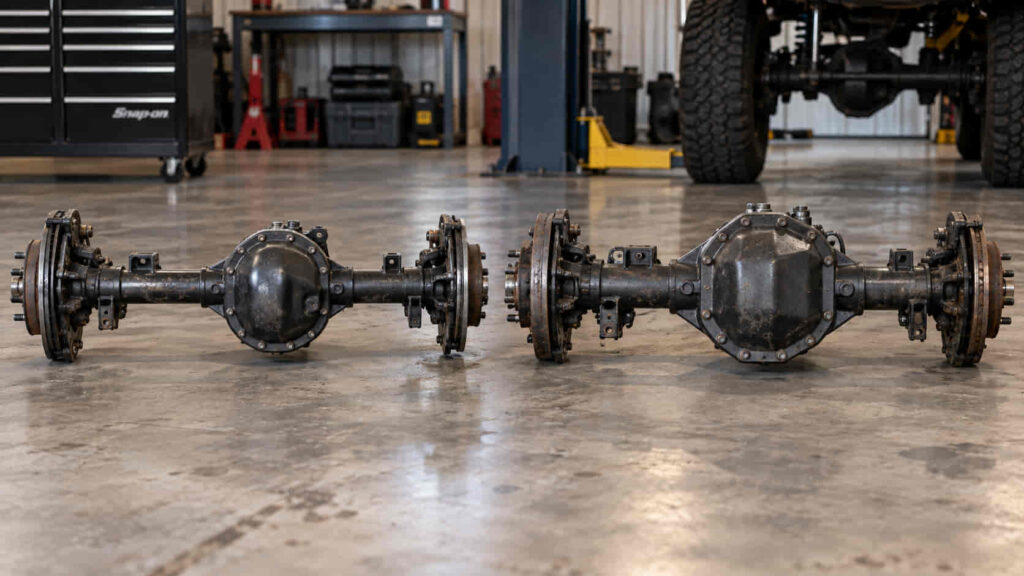
The main difference between the Dana 44 and Dana 35 is their strength and load-handling capability. The Dana 44 is generally a heavier-duty axle family with larger drivetrain components, while the Dana 35 was designed primarily for lighter-duty applications. This difference becomes especially important when a vehicle uses larger tires, increased engine torque, a differential locker, or regularly operates on high-traction off-road terrain.
Dana 35 and Dana 44 axles have both appeared in Jeep applications, which is why comparing them is common among Jeep owners considering repairs, modifications, or an axle swap. However, the Dana designation alone does not define every specification. Ring gear size, axle shaft configuration, spline count, housing design, gear ratio, and other components can vary by axle version, model year, and vehicle application. Identifying the exact axle is therefore necessary before ordering replacement or upgrade parts.
This Dana 44 vs Dana 35 comparison explains their construction, strength, identification features, vehicle applications, off-road capability, and upgrade considerations. It also examines when a Dana 35 remains suitable and when moving to a Dana 44 provides a meaningful increase in axle capability.
What Is the Difference Between a Dana 44 and Dana 35?
The Dana 44 is a heavier-duty axle family than the Dana 35, with differences centered on ring gear size, axle shafts, housing construction, load capacity, and intended application. The Dana 35 was developed for lighter-duty vehicle applications, while Dana 44 variants are commonly used where the drivetrain must handle greater loads. These construction differences explain why a Dana 44 is generally preferred when a vehicle has larger tires, increased torque, or more demanding off-road requirements.
Ring gear size is one of the clearest mechanical differences. A Dana 35 uses a ring gear of approximately 7.5 inches in diameter, while a conventional Dana 44 is associated with a ring gear of approximately 8.5 inches. The larger ring gear provides a greater physical area for transferring torque through the differential. Ring gear diameter alone does not determine the capacity of an axle, however, because axle shafts, bearings, housing construction, spline configuration, and the specific Dana 44 or Dana 35 variant also affect the complete assembly.
Axle shaft construction creates another important difference. Dana 35 applications commonly use smaller axle shafts than comparable Dana 44 applications, while spline counts vary according to axle version and production application. A larger shaft can generally resist greater torsional loads because more material is available to withstand twisting forces. This distinction becomes more relevant when larger tires or increased traction multiply the stress transferred from the drivetrain through the differential to the axle shafts.
Housing and axle tube construction also influence how each axle responds to vehicle loads. Dana 44 assemblies are generally built around heavier-duty components than Dana 35 assemblies, although exact housing and tube specifications vary between applications. A stronger complete axle assembly is valuable because drivetrain forces do not act on the ring gear or shafts independently. Torque passes through the differential and shafts while the housing, tubes, bearings, and related components support loads created by the vehicle, tires, and terrain.
The exact specifications must therefore be compared by axle variant rather than by the Dana 35 or Dana 44 name alone. Dana produced these axle families for different vehicles, production periods, and configurations. A Jeep owner identifying an axle for replacement parts or an upgrade should verify the axle identification information and vehicle application before relying on a single ring gear, spline, shaft, or housing specification.
Is a Dana 44 Stronger Than a Dana 35?
A Dana 44 is generally stronger than a Dana 35 because the Dana 44 family was designed around heavier-duty drivetrain applications and typically uses larger or more robust load-bearing components. The practical strength difference becomes most relevant when drivetrain load increases through larger tires, additional engine torque, greater traction, or demanding off-road use. A stock vehicle used primarily on pavement places very different loads on an axle than a modified vehicle climbing rocks with oversized tires and a locker.
Axle strength is determined by the complete load path rather than one component. Engine torque travels through the transmission and transfer case to the driveshaft, pinion gear, ring gear, differential, axle shafts, and wheels. A component becomes a potential failure point when the torque or shock load passing through it exceeds what it can reliably withstand. The Dana 44’s heavier-duty construction provides more capacity within this load path, while the lighter Dana 35 reaches its practical limits sooner as vehicle demands increase.
Tire diameter has a direct mechanical effect on this comparison. Increasing tire diameter increases leverage at the axle because the contact patch moves farther from the rotational center of the shaft. Added tire mass can also increase rotational load. A Dana 35 that performs adequately with a factory-style vehicle configuration can therefore experience substantially different stress after larger tires and other drivetrain modifications are installed. The axle designation has not changed, but the operating conditions imposed on it have.
Traction also determines how much stress reaches the axle. Wheelspin can temporarily release drivetrain load because a tire is rotating rather than maintaining full traction. When the tire suddenly regains grip, the drivetrain can experience a shock load. A differential locker can further change load distribution by allowing both axle shafts to receive driving force instead of relying on the behavior of an open differential. These conditions explain why axle durability cannot be predicted from tire diameter alone.
The Dana 35 should not be classified as universally weak. Its suitability depends on the vehicle configuration and intended use. A Dana 35 in an appropriate factory or light-duty application can perform its intended function without requiring replacement simply because a Dana 44 is stronger. The comparison changes when modifications increase torque, traction, tire leverage, or repeated shock loading beyond the operating conditions for which the existing axle is suited.
A Dana 35 can also be strengthened with aftermarket components, including upgraded axle shafts and differential components designed for particular applications. These modifications address specific limitations, but they do not automatically convert every part of the axle assembly into the equivalent of a Dana 44. The housing, tubes, bearings, gears, shafts, differential, and mounting configuration remain parts of the overall strength equation. For a heavily modified vehicle, comparing the total cost and capability of strengthening a Dana 35 against installing a suitable Dana 44 is therefore more useful than comparing one upgraded component in isolation.
Read more: Toyota Sienna Air Conditioning Not Cold
How Can You Tell a Dana 44 From a Dana 35?
The most reliable way to tell a Dana 44 from a Dana 35 is to combine the axle identification number with physical characteristics such as the differential cover and housing shape. Visual inspection can quickly narrow down the axle family, but identification data is more dependable when replacement gears, bearings, axle shafts, lockers, or other application-specific parts need to be ordered.
The differential cover provides one of the easiest visual clues when the axle is still installed. Dana 35 and Dana 44 housings use noticeably different cover profiles. A Dana 35 cover has a more rounded, oval appearance, whereas a traditional Dana 44 cover has a more angular and irregular shape. Looking at the overall housing and cover geometry is more useful than relying only on cover bolt count because similar bolt counts do not mean that two axle assemblies are the same.
Identification tags, stamped numbers, and bill-of-material information provide a more precise method. Dana/Spicer axle assemblies can carry identifying information on a tag or axle housing that connects the assembly to its original specifications. This information can help determine the axle model and application and, where records are available, narrow down details such as gearing and component configuration. Cleaning dirt, rust, or coating from the relevant area may be necessary before stamped identification marks become visible.
Vehicle information can also help identify an axle, but the vehicle model alone should not be treated as definitive proof. Axle availability can differ by model year, trim, drivetrain configuration, and factory option. More importantly, older Jeeps and modified off-road vehicles may no longer retain their original axles. An axle swap performed by a previous owner can make a factory application chart inaccurate for the vehicle currently being inspected.
Physical inspection becomes especially important before purchasing internal components. Two axles belonging to the same Dana family can have application-specific differences in shafts, splines, brakes, gear sets, bearings, or other components. Identifying an axle as simply a “Dana 44” is therefore the first step rather than the complete parts identification process. The specific axle variant should be verified when component compatibility matters.
Which Vehicles Use Dana 35 and Dana 44 Axles?
Dana 35 and Dana 44 axles have been used across multiple vehicle applications, with the Dana 35 associated primarily with lighter-duty configurations and the Dana 44 appearing in a broader range of applications requiring greater axle capacity. Jeep vehicles are particularly relevant to this comparison because both axle families have appeared across Jeep platforms and are frequently encountered during repairs, restorations, and off-road modifications.
The Dana 35 is strongly associated with rear-axle applications in several Jeep platforms. Variants have appeared in vehicles such as the Jeep Wrangler and Jeep Cherokee, among other applications. Its lighter-duty construction made it suitable for factory configurations where vehicle weight, tire size, engine output, and intended operating loads remained within the axle’s design requirements. This factory use also explains why Dana 35 axles remain common in older Jeep projects today.
The Dana 44 has been used in Jeep applications where a heavier-duty axle was required or offered as part of a particular drivetrain configuration. Depending on the model, production year, trim, and option package, Dana 44 variants can be found in front or rear axle positions. Dana 44 is also an axle family rather than one universally identical assembly, so a Dana 44 from one vehicle should not automatically be assumed to fit another vehicle or use identical internal components.
The same Jeep model family can consequently be encountered with different axle configurations. A Wrangler, for example, cannot be identified as having a Dana 35 or Dana 44 solely from the word “Wrangler.” Generation, model year, trim, factory equipment, and axle position must also be considered. This distinction becomes increasingly important with used off-road vehicles because previous owners frequently replace factory drivetrain components as part of modification projects.
Factory application information should therefore be used as an identification aid rather than the final identification method. Confirming the actual axle installed under the vehicle prevents an incorrect assumption based on what the vehicle originally left the factory with. This is particularly important when selecting gear sets, axle shafts, differential lockers, bearings, seals, brake components, or a replacement axle assembly.
Vehicle application also explains why comparing Dana 35 vs Dana 44 solely by their names can be misleading. The practical question is not simply which axle family is stronger, but whether the specific axle assembly matches the vehicle’s weight, tire size, drivetrain output, traction level, and intended use. A factory Dana 35 can remain appropriate for one Jeep configuration, while another vehicle subjected to greater drivetrain loads can benefit from the additional capability available from a suitable Dana 44.
Is a Dana 44 Better Than a Dana 35 for Off-Roading?
A Dana 44 is generally better suited than a Dana 35 to demanding off-road use because its heavier-duty construction provides greater capacity for the loads created by larger tires, increased traction, and drivetrain torque. The advantage becomes more significant as a vehicle moves away from its factory configuration. A lightly modified Jeep driven on moderate trails does not impose the same axle loads as a vehicle using substantially larger tires, locking differentials, and high-traction rock-crawling techniques.
Larger tires increase axle stress because tire radius changes the leverage acting against the drivetrain. When tire diameter increases, the axle must transmit torque through a longer effective lever between the axle centerline and the tire’s contact patch. Larger tires also tend to add rotating mass. The combined effect places additional demand on axle shafts, differential components, gears, bearings, and other parts of the assembly. This is one reason tire modifications can expose the limits of a Dana 35 that operated reliably with its original tire configuration.
Traction creates a second source of stress. An open differential allows differences in wheel speed and can direct torque differently from a locking differential. A locker connects the driving behavior of the two sides more directly, improving the vehicle’s ability to maintain propulsion when one wheel has limited traction. That additional traction also means the drivetrain can transmit greater loads instead of releasing them through wheelspin. The axle shafts and differential must absorb those loads when the tires maintain grip.
Shock loading can be more damaging than a smooth application of torque. A tire spinning on mud, loose soil, or rock can suddenly regain traction, causing a rapid change in rotational resistance. The resulting force travels back through the axle shaft and differential rather than building progressively. Aggressive throttle input under these conditions further increases drivetrain stress. A heavier-duty axle does not eliminate shock loading, but the Dana 44 generally provides a greater mechanical margin than the Dana 35 for demanding configurations.
This does not mean every off-road Jeep requires a Dana 44. Vehicle weight, engine output, transmission gearing, transfer-case reduction, tire dimensions, differential type, terrain, and driving technique all affect axle load. A Dana 35 can remain functional in a relatively mild vehicle used within appropriate limits. Replacing it solely because the vehicle occasionally leaves pavement does not account for the actual operating conditions.
The Dana 44 becomes more relevant as modifications and use increase the load placed on the axle. Larger tires, greater available torque, increased traction, and repeated high-load trail use collectively move the drivetrain farther from the conditions of a light-duty factory setup. For this reason, the Dana 44’s off-road advantage should be understood as additional drivetrain capacity rather than a universal requirement for every modified vehicle.
Is It Worth Upgrading From a Dana 35 to a Dana 44?
Upgrading from a Dana 35 to a Dana 44 is worth considering when the vehicle’s tire size, traction, drivetrain output, or intended use places greater loads on the axle than the existing Dana 35 is intended to handle reliably. A Dana 44 swap is not automatically necessary for a stock or lightly modified vehicle. The value of the upgrade depends on whether the additional axle capability solves a real limitation in the current drivetrain.
Keeping a Dana 35 makes the most sense when the vehicle remains close to its intended configuration and the existing axle performs reliably. A street-driven Jeep with moderate trail use creates a different cost-benefit equation from a dedicated off-road build. Replacing a functioning axle with a Dana 44 adds the cost of the axle assembly and can introduce additional work involving gearing, brakes, driveshaft compatibility, mounting hardware, and other vehicle-specific components. Those costs provide limited practical benefit when the existing axle already meets the vehicle’s operating requirements.
A Dana 44 becomes more compelling when a build progressively increases drivetrain stress. Larger tires increase leverage, a locker increases usable traction, engine modifications can increase available torque, and demanding terrain can create repeated shock loads. When several of these conditions occur together, strengthening or replacing the axle becomes part of maintaining drivetrain reliability rather than an isolated modification.
Upgrading individual Dana 35 components provides an alternative in some builds. Stronger aftermarket axle shafts and compatible differential components can address specific weak points without requiring a complete axle replacement. This approach is most useful when the existing housing, gearing, brakes, mounting arrangement, and other components remain appropriate for the vehicle. Strengthening one component, however, does not increase the capacity of every component in the axle assembly. Load can move to another limiting component once the original weak point has been reinforced.
A Dana 35-to-Dana 44 swap must also be evaluated as a complete drivetrain change rather than a simple housing replacement. The replacement axle needs the correct width and mounting configuration for the vehicle, while driveshaft connections, brakes, wheel bolt pattern, gear ratio, ABS-related equipment, and suspension mounting points may require verification depending on the application. Four-wheel-drive vehicles introduce an additional gearing requirement because front and rear axle ratios must be compatible for four-wheel-drive operation.
Gear ratio deserves particular attention when selecting a replacement axle. Installing a Dana 44 with an unsuitable ratio can require regearing even when the physical axle fits the vehicle. Tire-size changes can also alter the effective gearing of the drivetrain, making an axle swap an opportunity to select gearing appropriate for the modified configuration. The axle model and gear ratio should therefore be considered together rather than as unrelated upgrade decisions.
The practical decision is based on the complete vehicle configuration. Keep the Dana 35 when it reliably supports the vehicle’s present load and intended use; consider a suitable Dana 44 when modifications or operating conditions require greater axle capability. This approach ties the upgrade to measurable drivetrain requirements instead of treating the Dana 44 as a mandatory replacement simply because it is the heavier-duty axle family.
Can Dana 35 and Dana 44 Parts Be Interchanged?
Dana 35 and Dana 44 parts are generally not directly interchangeable because the two axle families use different dimensions, load capacities, and internal component designs. Although both belong to Dana axle families and perform the same basic drivetrain function, sharing a manufacturer does not make their gears, axle shafts, carriers, bearings, or other internal components compatible.
The ring-and-pinion assemblies illustrate this difference. A Dana 35 and a conventional Dana 44 use different ring gear dimensions, so their gear sets are designed around their respective differential housings and cannot simply be transferred from one axle family to the other. Differential carriers and related internal components must likewise match the axle family, gear configuration, and specific application.
Axle shafts present another compatibility issue. Shaft length, diameter, spline count, bearing arrangement, and retention method can vary between Dana 35 and Dana 44 assemblies and can also vary within the same axle family. A shaft identified only as a Dana 44 component is therefore not automatically compatible with every Dana 44. Vehicle application and the exact axle variant remain necessary when selecting replacement shafts.
The same principle applies to differential lockers. A locker must correspond to the axle family and the specifications of the differential in which it will operate. Gear ratio ranges, spline configuration, carrier design, and application-specific differences can affect compatibility. Selecting a locker because it is marketed for a Dana axle without verifying these specifications can result in an incompatible combination.
External components also require application-specific verification. Brakes, hubs, seals, bearings, yokes, differential covers, mounting hardware, and related parts can differ between axle versions. Some aftermarket products may support multiple applications, but this compatibility comes from the design of the individual product rather than from general interchangeability between Dana 35 and Dana 44 axles.
The correct method is therefore to identify the exact axle before ordering components. The Dana family designation establishes the basic axle type, while identification numbers, vehicle application, model year, axle position, gear ratio, spline configuration, and other specifications determine which replacement or upgrade parts fit the assembly.
Do Dana 35 and Dana 44 Use the Same Gear Ratios?
Dana 35 and Dana 44 axles can be available with some of the same numerical gear ratios, but their ring-and-pinion gear sets are not interchangeable. Gear ratio describes the relationship between ring gear and pinion gear rotation; it does not describe the physical dimensions of the gear set. Two different axle families can therefore use the same numerical ratio while requiring completely different components.
A 4.10:1 axle ratio, for example, means the driveshaft and pinion rotate approximately 4.10 times for one rotation of the ring gear and wheels. If both a Dana 35 and Dana 44 are configured with that numerical ratio, they provide the same basic driveshaft-to-axle rotational relationship. Their ring gears, pinions, carriers, housings, and associated dimensions remain specific to their respective axle designs.
Gear ratio becomes especially important on a four-wheel-drive vehicle because the front and rear axles must operate with compatible ratios when four-wheel drive is engaged. Installing a replacement rear Dana 44 with a ratio that does not match the front axle can create drivetrain binding because the front and rear wheels are being driven at incompatible rotational relationships. An axle swap must therefore account for gearing as well as physical fitment.
Tire diameter also affects gear selection. Larger tires travel farther with each wheel revolution, effectively reducing the mechanical advantage provided by the existing axle gearing. The vehicle may consequently accelerate differently, place different loads on the drivetrain, and operate at a lower engine speed for a given road speed. Regearing can compensate for this change by restoring a more appropriate relationship between engine speed, drivetrain torque, and tire diameter.
A Dana 35-to-Dana 44 swap is therefore not complete simply because the replacement axle mounts under the vehicle. The numerical gear ratio must be verified, particularly on a four-wheel-drive Jeep, and the selected ratio should also make sense for the tire size and intended use. This makes axle gearing part of the Dana 35 vs Dana 44 comparison rather than a separate issue considered only after installation.
How Do You Choose Between a Dana 35 and Dana 44?
Choose between a Dana 35 and Dana 44 according to the vehicle’s existing configuration, tire size, drivetrain load, terrain, and future modification plan. The Dana 44 provides greater capability for demanding applications, but the Dana 35 can remain appropriate when the vehicle operates within the requirements of a lighter-duty axle. The correct choice depends on the load the axle must handle rather than axle reputation alone.
Vehicle configuration establishes the starting point. A largely stock Jeep used for road driving and moderate recreational trails may not create enough axle stress to justify replacing a functional Dana 35. In this situation, maintaining the existing axle can avoid the cost and compatibility work associated with a complete swap while preserving a drivetrain configuration that already meets the vehicle’s needs.
Tire size and traction become increasingly important as the vehicle is modified. Larger tires increase leverage against the axle, while locking differentials allow more drivetrain force to reach tires that maintain traction. Combining these changes with demanding terrain increases the loads transmitted through the gears, differential, axle shafts, and housing. A Dana 44 becomes more relevant when these modifications are central to the vehicle’s intended use.
Drivetrain output must also be considered. An engine or drivetrain configuration capable of delivering greater torque can increase the force the axle has to transmit. The effect becomes more significant when high torque is combined with low gearing and strong tire traction. An axle suitable for a stock drivetrain does not automatically retain the same reliability margin after substantial modifications increase the loads reaching it.
Terrain and driving technique determine how those mechanical capabilities are used. Street driving generally produces smoother and more predictable axle loads than situations involving rocks, steep obstacles, sudden traction changes, or repeated wheelspin. A vehicle built for demanding trails consequently benefits more from additional axle capacity than one that spends nearly all of its operating time on pavement.
Future modifications should be considered before money is committed to the existing axle. Strengthening a Dana 35 can be reasonable when only a specific limitation needs to be addressed and the rest of the assembly remains appropriate. If the long-term build will include larger tires, greater traction, substantial drivetrain changes, and demanding off-road use, investing repeatedly in a lighter-duty axle can be less practical than planning the drivetrain around a suitable Dana 44 from the beginning.
The Dana 35 and Dana 44 therefore serve different levels of drivetrain demand rather than representing a universally bad and universally good axle. A Dana 35 fits lighter-duty configurations that remain within its operating requirements, while a Dana 44 provides a stronger foundation when tire size, torque, traction, terrain, or future modifications increase axle load. Identifying those requirements before choosing an axle produces a more useful decision than selecting one solely from its model designation.