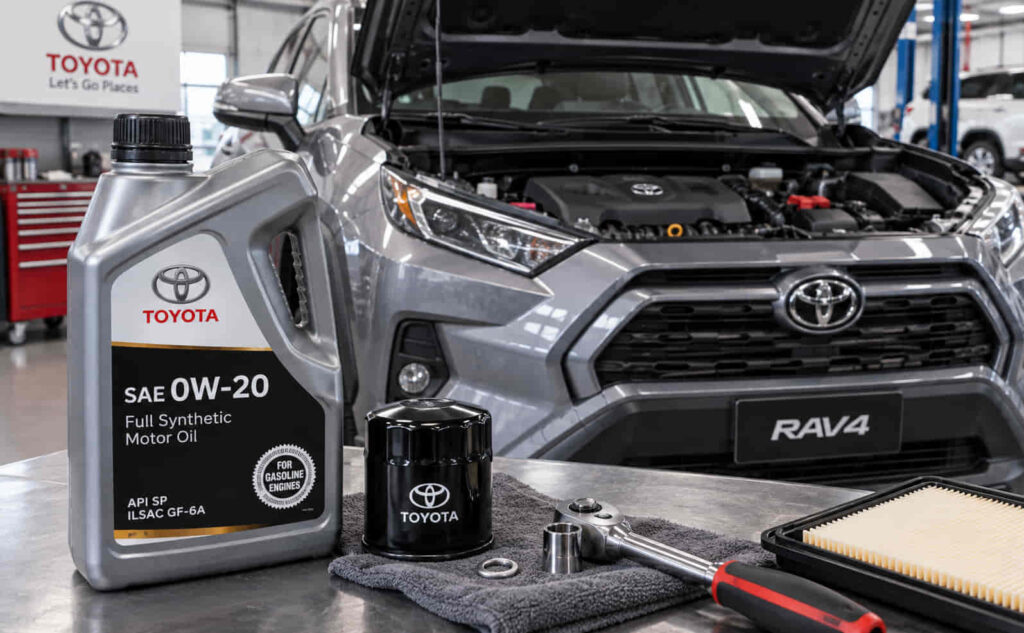
Choosing the correct Toyota RAV4 oil type depends primarily on the vehicle’s model year, engine configuration, and Toyota’s specified SAE viscosity. Different RAV4 generations can require different engine oils, so a viscosity such as 0W-16, 0W-20, or 5W-30 should not be treated as suitable for every Toyota RAV4. The correct choice is the oil grade and specification listed for the specific engine installed in the vehicle.
Toyota RAV4 owners should check four details before adding or replacing engine oil: the model year, engine type, recommended viscosity, and required oil specification. These factors determine how effectively the oil flows during a cold start, maintains lubrication at operating temperature, and protects internal engine components. They also affect the amount of oil required during an oil change.
This guide explains the recommended Toyota RAV4 oil type by model year, the difference between common viscosity grades, whether a RAV4 requires synthetic oil, how much oil each engine needs, and how oil requirements differ between gasoline, Hybrid, and RAV4 Prime models. It also covers oil change intervals, high-mileage RAV4s, climate considerations, and what can happen when the wrong oil viscosity is used.
What Type of Oil Does a Toyota RAV4 Take?
A Toyota RAV4 takes the engine oil viscosity specified for its model year and engine, rather than one universal oil type for every RAV4. For most U.S.-market models, the main viscosity grades are SAE 5W-30 on older RAV4s, SAE 0W-20 on many fourth-generation models, SAE 0W-16 on fifth-generation models, and SAE 0W-8 on the redesigned 2026 RAV4. The correct viscosity matters because Toyota designs each engine’s lubrication system around a defined oil-flow range during cold starts and at normal operating temperature. Using the model year and engine configuration is therefore more reliable than selecting oil based only on the RAV4 name.
For 2019 through 2025 RAV4 models, SAE 0W-16 is the primary viscosity for the 2.5-liter Dynamic Force engine family used in gasoline, Hybrid, and plug-in-hybrid versions. Toyota’s 2019 maintenance documentation states that vehicles certified for 0W-16 should use that viscosity and allows 0W-20 when 0W-16 is unavailable, with a return to 0W-16 at the next required oil change. The same 0W-16 requirement appears in Toyota documentation for later fifth-generation RAV4 models.
The 2013–2018 RAV4 uses a different specification. SAE 0W-20 is the recommended viscosity for the 2.5-liter engine used in this generation. Toyota’s 2013 owner’s manual identifies 0W-20 as the preferred viscosity and permits SAE 5W-20 when 0W-20 is unavailable, provided the engine is returned to 0W-20 at the following oil change. Toyota’s 2018 maintenance guide continues to identify 0W-20 as the certified oil for that model year.
Older RAV4 engines require more careful identification because the same generation could contain engines with different viscosity requirements. A 2006 RAV4 equipped with the 2.4-liter 2AZ-FE four-cylinder, for example, permits SAE 5W-20 or 0W-20, with Toyota identifying 0W-20 as the preferred choice for fuel economy and cold starting. The 3.5-liter 2GR-FE V6 from the same model year instead specifies SAE 5W-30. This difference shows why choosing oil by vehicle year alone is not sufficient when a RAV4 was offered with multiple engines.
Oil viscosity is also different from the oil’s performance specification. The numbers 0W-16, 0W-20, and 5W-30 describe SAE viscosity characteristics, while specifications such as API, ILSAC GF-5, ILSAC GF-6B, or JASO GLV-1 describe performance requirements that the oil must meet. The safest approach is to match both the viscosity and specification listed in the owner’s manual for the exact RAV4. A bottle carrying the correct viscosity but the wrong required performance standard should not automatically be treated as the correct engine oil.
What Oil Does a Toyota RAV4 Use by Model Year?
The Toyota RAV4 oil type changed several times between the first generation and the current model, so the model year is the fastest way to narrow down the correct viscosity. The largest changes occurred as Toyota introduced new engine families designed around lower-viscosity lubricants. Older RAV4 engines commonly used 5W-30, fourth-generation vehicles moved primarily to 0W-20, fifth-generation models adopted 0W-16, and the redesigned 2026 model uses an even lower-viscosity 0W-8 specification in U.S.-market owner-manual data.
For 2019–2025 Toyota RAV4 models, 0W-16 is the central oil specification to know. The fifth-generation RAV4 introduced Toyota’s 2.5-liter Dynamic Force engine family, including the A25A-FKS gasoline engine and A25A-FXS used with electrified powertrains. Toyota’s 2019 gasoline and Hybrid maintenance guides both identify Genuine Toyota 0W-16 motor oil for these vehicles. If 0W-16 is unavailable, Toyota permits 0W-20 as a temporary substitute and requires a return to 0W-16 at the next oil change. The same viscosity continued through the 2025 model year, including gasoline, Hybrid, and plug-in-hybrid configurations.
For 2013–2018 Toyota RAV4 models, SAE 0W-20 is the primary recommended viscosity. The 2013 owner’s manual specifies ILSAC GF-5 multigrade engine oil with SAE 0W-20 viscosity for the 2.5-liter engine. Toyota explains that the “0W” portion represents the oil’s cold-start characteristics, while the “20” describes viscosity characteristics at higher operating temperatures. SAE 5W-20 can be used when 0W-20 is unavailable, but Toyota directs the owner to return to 0W-20 at the next oil change.
For 2006–2012 Toyota RAV4 models, the correct oil depends more heavily on the engine. The 2012 RAV4 with the 2.5-liter 2AR-FE four-cylinder accepts SAE 5W-20 or 0W-20, with 0W-20 identified as the preferred choice. Earlier third-generation models could also be equipped with the 3.5-liter 2GR-FE V6, which Toyota specified for SAE 5W-30 in the 2006 owner’s manual. A driver with a RAV4 from this generation should therefore identify the engine before purchasing oil rather than assuming every 2006–2012 vehicle uses 0W-20.
For 2001–2005 Toyota RAV4 models, SAE 5W-30 is the main manufacturer-recommended viscosity. The 2001 owner’s manual specifies 5W-30 as the preferred engine oil and lists API SJ Energy-Conserving or ILSAC multigrade oil. Toyota’s 2005 manual likewise specifies SAE 5W-30 and permits 10W-30 when 5W-30 is unavailable, with a return to 5W-30 at the next oil change. These specifications reflect the lubrication requirements of the older RAV4 engine design and should not be replaced automatically with the thinner oil used by later generations.
For 1996–2000 Toyota RAV4 models, 5W-30 is also the key viscosity for U.S.-market vehicles. Toyota’s 1999 owner’s manual identifies SAE 5W-30 as the best choice for fuel economy and cold-weather starting and specifies an API or ILSAC multigrade engine oil appropriate to that model year. These older specifications also demonstrate why a modern RAV4 oil recommendation cannot be applied retrospectively to first-generation engines.
The 2026 Toyota RAV4 introduces another oil-specification change, with current U.S. owner-manual data indicating SAE 0W-8 and JASO GLV-1 for the redesigned model. SAE 0W-16 serves as the conditional substitute when 0W-8 is unavailable and should be replaced by the specified 0W-8 afterward. Because 2026 begins a new RAV4 generation, owners should avoid assuming that the 0W-16 recommendation used on 2019–2025 vehicles remains the default for the new model.
Does a Toyota RAV4 Use 0W-16 or 0W-20 Oil?
A Toyota RAV4 can use either 0W-16 or 0W-20 depending on the model year and engine, but the two viscosity grades should not be treated as interchangeable by default. For U.S.-market vehicles, the 2019 RAV4 was certified for Genuine Toyota 0W-16 motor oil, while the 2018 RAV4 was certified for Genuine Toyota 0W-20 motor oil. This model-year transition reflects a change in engine design rather than a simple preference for thinner oil. Toyota specifies the viscosity that matches the engine’s lubrication system, oil passages, operating clearances, cold-start requirements, and fuel-economy targets.
The difference between 0W-16 and 0W-20 is mainly their viscosity at operating temperature. Both grades carry a “0W” winter rating, which indicates that they are formulated to maintain suitable flow during cold starts. The second number distinguishes their higher-temperature viscosity characteristics: 0W-16 is thinner than 0W-20 under the standardized conditions used to classify SAE engine oils. That difference is small enough that the oils may appear similar to a driver, but it is significant enough for Toyota to specify one grade over another for a particular engine. The correct viscosity therefore comes from the vehicle specification, not from the assumption that a thicker oil always protects better or that a thinner oil always improves efficiency.
For the 2019 RAV4, Toyota provides a specific fallback rule rather than unrestricted interchangeability. The maintenance guide states that vehicles certified for 0W-16 should use 0W-16 and permits 0W-20 when 0W-16 is unavailable. Toyota then requires the vehicle to return to 0W-16 at the next scheduled oil change. This distinction matters because using 0W-20 temporarily is a manufacturer-defined exception, not evidence that owners can permanently choose either viscosity according to personal preference.
The same logic applies in the opposite direction to earlier RAV4 models. Toyota’s 2018 maintenance guide identifies 0W-20 as the certified oil for that model year and allows 5W-20 mineral oil when the specified 0W-20 is unavailable. The substitute must then be replaced with 0W-20 at the required interval. A 2018 RAV4 owner therefore should not switch to 0W-16 merely because newer RAV4 engines use it. The engine’s model-year specification remains the controlling factor.
Using the oil cap alone can provide a fast reference, but the owner’s manual remains the stronger source when there is uncertainty about engine configuration, temporary substitute viscosities, or oil performance standards. This is particularly important when buying a used RAV4, because replacement engine parts, regional specifications, or assumptions based on a neighboring model year can create confusion. A 2018 and a 2019 RAV4 may look closely related from a maintenance perspective, yet Toyota specifies different primary oil viscosities for them.
Does a Toyota RAV4 Require Full Synthetic Oil?
A Toyota RAV4 does not have one universal “full synthetic oil” requirement that applies to every model year; the controlling requirements are the oil grade, viscosity, certification, and maintenance instructions specified for the particular vehicle. Toyota’s RAV4 maintenance documentation identifies the required viscosity, such as 0W-20 or 0W-16, rather than establishing “full synthetic” as a blanket requirement for every RAV4 generation. Owners should therefore match the manufacturer specification first instead of choosing an oil solely because the container says conventional, synthetic blend, or full synthetic.
This distinction is important because oil formulation and oil viscosity describe different attributes. “Full synthetic” describes how the lubricant is formulated, while 0W-16 or 0W-20 describes its SAE viscosity grade. The API, ILSAC, or other certification specified for the engine describes another attribute: whether the oil satisfies a defined set of performance requirements. A bottle can therefore be synthetic and still be unsuitable if its viscosity or required certification does not match the RAV4. Conversely, the manufacturer documentation for some Toyota applications explicitly recognizes a temporary mineral-oil substitute, which shows why the word “synthetic” alone cannot determine compatibility.
Toyota’s 2019 RAV4 maintenance guide provides a clear example. The vehicle is certified for Genuine Toyota 0W-16 motor oil, but Toyota states that 0W-20 mineral oil can be used when 0W-16 is unavailable. That substitute changes the maintenance condition: the oil must be replaced on the shorter schedule stated by Toyota and the vehicle must return to the specified 0W-16 oil. The important point is not that mineral oil is preferable; it is that Toyota defines oil suitability through a combination of viscosity, availability, and service interval rather than through the label “full synthetic” alone.
The 2018 RAV4 follows the same type of manufacturer logic with a different viscosity. Toyota certifies that model for 0W-20 but allows 5W-20 mineral oil when 0W-20 is unavailable, again requiring a return to the specified oil under the prescribed maintenance schedule. This confirms that oil recommendations must remain model-specific even when comparing two RAV4s separated by only one model year.
For owners buying oil from a third-party brand, the safest method is to compare the bottle against the RAV4 owner’s manual rather than looking for a Toyota logo or the words “full synthetic” alone. The oil should carry the correct SAE viscosity and the required performance certification for the exact model year and engine. Toyota itself advises owners to consult the owner’s manual or dealer when they are unsure which oil type is recommended for their specific vehicle.
Full synthetic oil is still a practical choice for many later-model RAV4s because modern low-viscosity oils are commonly offered in synthetic formulations and are designed to maintain stable lubrication across a broad operating-temperature range. However, the SEO-relevant and mechanically accurate answer remains more specific: use the viscosity and oil specification Toyota requires for the exact RAV4, and treat “full synthetic” as a formulation characteristic rather than a replacement for the manufacturer specification.
Read more: Toyota Tundra Service Schedule
How Much Oil Does a Toyota RAV4 Need?
A Toyota RAV4 generally needs about 4.5 to 4.8 quarts of engine oil for many four-cylinder applications, but the exact capacity depends on the model year, engine, and whether the oil filter is replaced. Toyota treats the published oil capacity as a drain-and-refill reference rather than an instruction to pour the entire amount into the engine without checking the level. The final oil level should be confirmed with the dipstick after the engine has been filled and the oil has had enough time to drain back into the oil pan.
The 2018 Toyota RAV4 with the 2.5-liter four-cylinder engine has a reference capacity of 4.6 quarts (4.4 liters) with the oil filter replaced and 4.2 quarts (4.0 liters) without filter replacement. The same model uses SAE 0W-20 engine oil. This combination provides a useful reference for fourth-generation RAV4 owners, although the exact model year should still be checked before an oil change.
Engine configuration becomes particularly important on third-generation RAV4 models because Toyota offered both four-cylinder and V6 engines. The 2012 RAV4 with the 2.5-liter 2AR-FE four-cylinder holds approximately 4.6 quarts (4.4 liters) with a new filter, while the 3.5-liter 2GR-FE V6 holds approximately 6.4 quarts (6.1 liters) with a new filter. Without filter replacement, the reference capacities are approximately 4.2 quarts for the four-cylinder and 6.0 quarts for the V6. Two RAV4s from the same generation can therefore require substantially different quantities of oil because engine displacement and lubrication-system design determine capacity.
Fifth-generation RAV4 capacity also requires model-year verification. Toyota-related service data commonly lists approximately 4.8 quarts for earlier 2019–2023 2.5-liter applications, while later manuals show revised values for certain configurations. The 2025 RAV4 Hybrid owner’s manual, for example, specifies 4.5 quarts (4.3 liters) with the filter and 4.2 quarts (4.0 liters) without the filter. Toyota specifically describes these numbers as reference quantities and instructs the owner to confirm the final level on the dipstick.
The correct refill procedure is therefore more important than memorizing a single Toyota RAV4 oil-capacity number. Oil remaining inside the engine after draining, the amount retained by the filter, and differences between engines can change the amount required to reach the correct level. Adding slightly less than the reference capacity first and then checking the dipstick reduces the risk of overfilling. An overfilled engine is not better protected simply because it contains more oil; excess oil can interfere with normal crankcase operation and should be corrected.
Oil capacity should also be distinguished from oil viscosity. A RAV4 that requires 0W-16 does not necessarily hold the same quantity as every other RAV4 that uses 0W-16. Capacity describes how much lubricant the engine requires, while viscosity describes how that lubricant flows at low and operating temperatures. Both values must match the exact model-year and engine specification.
Does a Toyota RAV4 Hybrid Use the Same Oil as a Gas RAV4?
A Toyota RAV4 Hybrid often uses the same SAE oil viscosity as the gasoline RAV4 from the same generation, but owners should verify the specification for the exact model year rather than assuming all gasoline and Hybrid versions are identical. The hybrid powertrain does not eliminate the need for engine oil because the RAV4 Hybrid still contains an internal-combustion gasoline engine. That engine requires lubrication for components such as the crankshaft, bearings, pistons, camshafts, and valvetrain whenever it operates.
For the fourth-generation RAV4, both gasoline and Hybrid versions use SAE 0W-20 in their applicable U.S.-market specifications. The 2018 RAV4 gasoline model specifies ILSAC GF-5 multigrade SAE 0W-20 and has a 4.6-quart capacity with filter replacement. The 2018 RAV4 Hybrid owner’s manual specifies the same SAE 0W-20 viscosity, ILSAC GF-5 oil grade, and 4.6-quart reference capacity with the filter. The similarity means the electrified drivetrain does not automatically require a different oil simply because the vehicle carries the Hybrid badge.
The same pattern continues with the fifth-generation RAV4, although the specified viscosity changed. Toyota’s maintenance documentation for the 2019 RAV4 Hybrid identifies Genuine Toyota 0W-16 motor oil as the certified oil. Toyota permits 0W-20 when 0W-16 is unavailable, but the substitute must be replaced with 0W-16 according to Toyota’s stated maintenance conditions. Fifth-generation gasoline RAV4 models from this period were also designed around 0W-16 specifications, so the principal distinction between gasoline and Hybrid models is not simply a different oil viscosity.
The reason is mechanical. A RAV4 Hybrid uses an electric motor and traction battery to share propulsion duties with the gasoline engine, but the internal-combustion engine still relies on a conventional pressurized lubrication system. Engine oil must circulate through that engine whenever it starts, including situations where the vehicle transitions repeatedly between electric propulsion and gasoline-engine operation. Oil selection therefore remains tied to the engine’s design and Toyota’s lubrication specification rather than to whether the overall vehicle is classified as gasoline or hybrid.
Owners should nevertheless avoid transferring specifications between RAV4 variants without checking the manual. Toyota has changed viscosity grades and reference capacities across generations and model years. The 2018 Hybrid, for example, specifies 0W-20 and 4.6 quarts with a filter, while the 2019 Hybrid moved to 0W-16, and the 2025 Hybrid manual lists a 4.5-quart reference capacity with a filter. These changes show that model year and engine specification remain the primary identifiers for choosing Toyota RAV4 Hybrid oil, even when a gasoline RAV4 from the same generation uses a similar lubricant.
What Oil Does a Toyota RAV4 Prime Use?
The 2021–2024 Toyota RAV4 Prime uses SAE 0W-16 engine oil for its 2.5-liter gasoline engine. Toyota specifies 0W-16 because its viscosity characteristics match the lubrication requirements of the A25A-FXS engine used in the plug-in-hybrid powertrain. The fact that the RAV4 Prime can operate on electricity does not remove its engine-oil requirement. Whenever the gasoline engine operates, oil still lubricates its crankshaft, bearings, pistons, camshafts, timing components, and other internal surfaces.
The 2021 RAV4 Prime owner’s manual specifies API SN/RC multigrade engine oil with a recommended viscosity of SAE 0W-16. Toyota permits SAE 0W-20 when 0W-16 is unavailable, but 0W-20 is a temporary substitute rather than an equal long-term alternative. Toyota instructs owners to replace it with 0W-16 at the next oil change. The same 0W-16 recommendation appears in the 2023 RAV4 Prime documentation, confirming that Toyota maintained this viscosity specification through the fifth-generation Prime powertrain.
The RAV4 Prime also requires approximately 4.8 quarts (4.5 liters) when the oil filter is replaced and 4.4 quarts (4.2 liters) without filter replacement for the 2021 and 2023 applications documented by Toyota. These capacities are reference quantities rather than automatic fill targets. Toyota instructs owners to warm the vehicle, shut down the hybrid system, allow more than five minutes for oil to return to the pan, and then verify the final level with the dipstick. This procedure prevents the reference capacity from being mistaken for a fixed quantity that must always be poured into the engine.
Toyota changed the RAV4 Prime name for the 2025 model year. The vehicle became the RAV4 Plug-in Hybrid, while retaining the fifth-generation plug-in-hybrid powertrain concept and its 2.5-liter four-cylinder gasoline engine. This naming change is important when searching for an owner’s manual or maintenance information because a 2025 owner will find Toyota documentation under “RAV4 Plug-in Hybrid” rather than “RAV4 Prime.” The 2026 RAV4 begins a redesigned sixth generation with a new plug-in-hybrid system, so oil specifications from the 2021–2024 Prime should not automatically be applied to the redesigned vehicle.
The practical rule is therefore specific: use SAE 0W-16 in a 2021–2024 U.S.-market RAV4 Prime unless the exact owner’s manual states otherwise, use 0W-20 only under Toyota’s permitted substitution conditions, and verify the oil specification again when servicing a 2025 or newer RAV4 Plug-in Hybrid. Matching the model year remains more reliable than choosing oil solely from the Prime, Hybrid, or PHEV badge.
How Often Should You Change the Oil in a Toyota RAV4?
Many modern Toyota RAV4 models require an engine oil and filter change every 10,000 miles or 12 months under normal operating conditions when the specified oil is used, while qualifying special operating conditions can shorten the interval to 5,000 miles or 6 months. The exact interval remains model-year dependent, so the maintenance guide for the individual RAV4 takes priority over a universal mileage rule.
Toyota’s 2023 RAV4 Prime maintenance guide provides a clear example. A vehicle certified for Toyota 0W-16 motor oil has a normal oil-change interval of 10,000 miles or 12 months when 0W-16 is used. Toyota shortens that interval when 0W-20 mineral oil is used as a temporary substitute because 0W-16 is unavailable. In that situation, the substitute oil must be replaced at 5,000 miles or 6 months and the engine returned to the specified 0W-16.
Driving conditions can also shorten the interval even when the correct oil is installed. Toyota’s maintenance schedules identify special operating conditions that place greater demands on the engine and lubricant. These include operation on dirt or dusty roads, towing or carrying heavy loads, extensive idling or prolonged low-speed operation, and repeated trips of less than five miles in temperatures below 32°F (0°C). For a 2025 RAV4 Hybrid operated primarily under these conditions, Toyota’s maintenance chart calls for engine oil and filter replacement at the applicable 5,000-mile checkpoints rather than waiting for the standard 10,000-mile oil service.
The same normal-versus-special-use distinction appears in earlier RAV4 maintenance documentation. Toyota’s 2018 guide specifies 10,000 miles or 12 months for vehicles certified for 0W-20 when 0W-20 is used, but reduces oil and filter replacement to 5,000 miles or 6 months for vehicles primarily driven under the listed special operating conditions. If 5W-20 mineral oil is temporarily substituted because 0W-20 is unavailable, Toyota also requires the shorter 5,000-mile or six-month interval before returning to 0W-20.
Older RAV4s should not automatically follow the 10,000-mile rule. Toyota maintenance requirements changed across generations as engine designs and oil specifications evolved. For example, Toyota’s scheduled maintenance documentation for a 2005 RAV4 calls for engine oil and oil-filter replacement at 5,000 miles or 6 months. Applying a later 10,000-mile schedule to an older RAV4 simply because modern Toyota models use longer intervals can therefore extend service beyond the schedule intended for that engine.
Mileage is only one part of the interval because Toyota also places a time limit on oil service. A RAV4 driven only 4,000 miles in one year can still reach its 12-month oil-change requirement even though it has not reached 10,000 miles. This matters particularly for RAV4 Hybrid and RAV4 Prime owners whose gasoline engines may operate less frequently because part of the vehicle’s propulsion comes from electric motors. Lower gasoline-engine use does not automatically cancel the calendar-based maintenance requirement.
Synthetic oil also does not justify extending a RAV4 oil-change interval beyond Toyota’s schedule. The interval is established for the vehicle, specified lubricant, and operating conditions as a combined system. An oil manufacturer may advertise a longer service life for a particular product, but that claim does not replace Toyota’s model-specific maintenance schedule. For a RAV4 owner, the correct interval is the mileage or time limit stated in the applicable Toyota maintenance guide, whichever threshold is reached first.
Can You Use 5W-30 Instead of 0W-20 in a Toyota RAV4?
You should not use 5W-30 instead of 0W-20 in a Toyota RAV4 unless the owner’s manual for that specific model year and engine explicitly permits it. Toyota specifies oil viscosity according to the lubrication requirements of each engine, and a viscosity that is correct for an older RAV4 can be incorrect for a newer one. For example, Toyota’s 2018 RAV4 maintenance documentation identifies 0W-20 as the certified oil and allows 5W-20 as the temporary substitute when 0W-20 is unavailable. It does not establish 5W-30 as the normal replacement for 0W-20 in that application.
The difference between 5W-30 and 0W-20 affects oil behavior both during startup and after the engine reaches operating temperature. The number before the “W” represents the oil’s low-temperature viscosity characteristics, while the second number represents its viscosity grade at operating temperature. A 5W-30 oil is therefore thicker at operating temperature than a 0W-20 oil. Higher viscosity is not automatically better because engine designers balance lubrication-film strength with oil-pump requirements, internal clearances, friction, fuel economy, and operating temperature. Mobil specifically advises following the viscosity listed in the owner’s manual rather than assuming that a thicker oil provides greater protection.
Toyota RAV4 specifications also demonstrate why viscosity substitution must be model-specific. A 2018 RAV4 certified for 0W-20 can temporarily use 5W-20 when the recommended oil is unavailable, while a 2019 RAV4 certified for 0W-16 can temporarily use 0W-20. Toyota requires both vehicles to return to their specified viscosity at the appropriate subsequent oil service. These manufacturer-defined substitutions are narrower than simply moving to any thicker oil that fits the filler opening.
Older Toyota RAV4 engines are different. Certain earlier RAV4 applications were designed for 5W-30, which means that viscosity can be correct when Toyota originally specified it for the engine. This does not make 5W-30 a universal high-mileage upgrade for later engines designed around 0W-20 or 0W-16. The relationship is engine specification first, viscosity second. A 5W-30 oil should therefore be selected because the applicable Toyota documentation calls for it, not simply because the RAV4 is older, has accumulated more mileage, or operates in hot weather.
Climate also does not automatically justify moving from 0W-20 to 5W-30. Multigrade engine oils are engineered to operate across a wide temperature range, and Toyota already accounts for normal operating conditions when specifying the oil grade. Some manufacturers permit different viscosities for defined ambient-temperature or severe-load conditions, but that flexibility must appear in the relevant manual. The presence of hot summers alone is not sufficient evidence that a later-model RAV4 should use a thicker grade.
If a small amount of 5W-30 has already been added to an engine specified for 0W-20, the appropriate response depends on how much was added, the exact RAV4 specification, and the operating situation. An emergency top-off is different from intentionally filling the entire crankcase with an unapproved viscosity. The safest corrective action is to check the applicable Toyota manual and restore the manufacturer-specified oil rather than continuing to use an alternative viscosity indefinitely.
What Happens If You Put the Wrong Oil in a Toyota RAV4?
Using the wrong oil in a Toyota RAV4 can alter oil flow, increase internal friction, reduce fuel efficiency, and increase engine wear when the viscosity or performance specification does not match Toyota’s requirements. The severity depends on how different the incorrect oil is from the specified grade, how much was added, engine temperature, operating load, and how long the vehicle is driven with it. One accidental top-off with a closely related grade is not mechanically equivalent to running an entire oil-change interval with a substantially incorrect viscosity.
Oil that is too thick can circulate less efficiently during cold startup and require more energy for the oil pump to move through the lubrication system. Cold startup is a particularly important period because engine components need rapid oil circulation before normal operating pressure and temperature are established. Lubrication guidance from Mobil notes that excessive viscosity in cold conditions can reduce startup lubrication, while higher-viscosity oils also create greater resistance to pumping. For a RAV4 designed around low-viscosity oils such as 0W-16 or 0W-20, replacing the specified lubricant with a substantially thicker grade can therefore change the conditions Toyota intended for the lubrication system.
Oil that is too thin creates a different problem because viscosity helps maintain a lubricating film between moving engine surfaces. A lubricant below the engine’s required viscosity can reduce that film strength under temperature and load conditions for which the engine was designed. General lubricant guidance associates incorrect viscosity with increased friction, wear, heat generation, and potential engine problems. The relevant issue is not whether thin or thick oil is inherently superior; it is whether the viscosity matches the engine design.
The wrong viscosity can also affect fuel economy. Lower-viscosity oils reduce resistance in areas such as the oil pump, bearings, piston rings, and valvetrain, which is one reason manufacturers have adopted grades such as 0W-20 and 0W-16 in modern engines. Replacing a specified low-viscosity oil with a heavier grade increases viscous drag and can reduce the efficiency gains for which the engine and lubricant were calibrated. Mobil identifies lower pumping losses and lower internal friction as mechanisms through which recommended low-viscosity oils support fuel economy.
Using the correct viscosity but the wrong oil specification can also be a mistake. Engine-oil compatibility is determined by more than the SAE numbers printed on the container. Modern oils are also classified by performance standards that address characteristics such as wear protection, deposit control, oxidation resistance, fuel economy, and other engine-specific requirements. For example, current ILSAC standards distinguish between performance categories applicable to common viscosity grades and those designed specifically for 0W-16 oils. Matching only “0W-16” or “0W-20” without checking the required performance specification can therefore leave part of the Toyota requirement unresolved.
The appropriate response after using the wrong oil depends on the magnitude of the mismatch. If the engine was filled with a viscosity that Toyota does not approve for that RAV4, replacing it with the specified oil is more defensible than attempting to compensate through driving style or waiting until the next normal service interval. If the alternative is specifically permitted by Toyota, such as 0W-20 temporarily replacing 0W-16 in a 2019 RAV4, follow Toyota’s stated replacement interval and return to the specified viscosity. Toyota’s maintenance documentation explicitly limits that substitution, which demonstrates that an approved temporary alternative should not be interpreted as a permanent change in oil specification.
For this reason, the correct Toyota RAV4 oil is the viscosity and performance grade specified for the exact model year and engine, not simply the thickest, newest, or most expensive oil available. Matching Toyota’s specification preserves the lubrication characteristics around which the engine was designed and avoids introducing an unnecessary variable into engine wear, oil pressure, fuel economy, and long-term maintenance.
Can You Mix Different Oil Viscosities in a Toyota RAV4?
Different engine oil viscosities can physically mix inside a Toyota RAV4 engine, but mixing them should not replace the viscosity Toyota specifies for the vehicle. A small emergency top-off with a compatible motor oil is different from deliberately filling the crankcase with two viscosity grades during a routine oil change. The normal maintenance choice should remain the SAE viscosity and performance specification listed for the exact model year and engine.
Toyota’s own substitution rules show how this distinction works. A RAV4 designed for 0W-16 may be permitted to use 0W-20 when 0W-16 is unavailable, but Toyota treats the alternative as temporary and requires the engine to return to the specified viscosity at the following oil service. Likewise, some 0W-20 RAV4 applications permit 5W-20 under defined conditions. These instructions establish specific substitutes rather than giving unrestricted permission to combine 0W-16, 0W-20, 5W-20, and 5W-30 according to availability.
Mixing two viscosity grades also makes the resulting oil less predictable than using one approved grade. Adding 0W-20 to an engine containing 0W-16 does not create an officially recognized intermediate SAE grade with a guaranteed performance profile. The final mixture depends on the quantity of each oil, their viscosity characteristics, additive packages, base-oil formulations, and operating temperature. Even when both products are individually suitable motor oils, the mixture has not necessarily been tested as the exact lubricant specified by Toyota for that RAV4.
The amount added therefore matters. Adding a small quantity of an approved or closely related oil to restore a dangerously low oil level can be preferable to operating the engine with insufficient lubrication, especially when the manufacturer-approved grade is temporarily unavailable. Filling most or all of the crankcase with an unapproved viscosity is a different situation because the engine then operates primarily on oil outside its normal specification. Once the correct oil becomes available, restoring the manufacturer-specified grade removes that uncertainty.
Owners should also distinguish mixing viscosities from mixing brands. Two oils from different manufacturers can share the same SAE viscosity and required API, ILSAC, or other performance specification. Brand difference alone does not necessarily make the oils unsuitable for the same engine. The more important compatibility factors are the viscosity and performance standard Toyota requires. A premium oil from a different brand is still the wrong choice if it fails to meet those requirements, while a correctly certified oil does not become unsuitable simply because it does not carry Toyota branding.
Repeatedly mixing grades is also a poor way to address oil consumption. If a RAV4 regularly requires topping off between scheduled services, the useful question is why the oil level is falling. External leaks, internal oil consumption, maintenance history, engine wear, and the amount consumed over a measured mileage interval provide more useful diagnostic information than progressively adding thicker oil. Increasing viscosity without identifying the cause can change a symptom without correcting the underlying condition.
For routine maintenance, use one oil viscosity that meets Toyota’s specification for the exact RAV4 whenever possible. Treat a different viscosity as an exception only when the applicable Toyota documentation permits it or when an emergency top-off is necessary to prevent the engine from running low on oil.
Does Cold or Hot Weather Change the Toyota RAV4 Oil Type?
Normal seasonal changes in temperature usually do not require a Toyota RAV4 owner to change away from the oil viscosity specified in the owner’s manual. Modern multigrade oils such as 0W-16, 0W-20, and 5W-30 are designed to provide defined viscosity characteristics across both cold-start and normal operating conditions. Toyota selects a viscosity for the engine with those conditions in mind, so a hot summer or cold winter does not automatically justify choosing a thicker or thinner grade.
The first number in a multigrade oil describes its low-temperature performance classification. A 0W-16 and a 0W-20 both carry a 0W winter designation, while a 5W-30 carries a 5W designation. Lower winter ratings are formulated to satisfy more demanding low-temperature viscosity limits, which supports oil circulation during cold starting. This is important because the engine needs oil to reach bearings, camshafts, timing components, and other lubricated surfaces quickly after startup, before the engine reaches normal operating temperature.
The number after the “W” describes a different part of the viscosity classification at higher temperatures. A 30-grade oil maintains a higher viscosity under the standardized high-temperature measurement conditions than a 20-grade oil, while a 20-grade is thicker under those conditions than a 16-grade. This does not mean a RAV4 owner should automatically move from 0W-20 to 5W-30 when summer temperatures rise. The engine’s normal operating temperature is substantially higher than typical ambient summer temperatures, and the cooling and lubrication systems are designed around the viscosity specified by Toyota.
Cold weather likewise does not justify substituting any lower-viscosity oil without checking the vehicle specification. An older RAV4 designed for 5W-30 should not automatically receive 0W-16 simply because the vehicle is driven in winter. The two grades differ in more than their cold-temperature designation, and the later low-viscosity oil was developed for engines with different lubrication-system requirements. The correct question remains which viscosity Toyota approved for that engine under the expected temperature range.
Some owner’s manuals provide viscosity charts or identify alternative grades for particular temperature conditions. Those manufacturer-defined alternatives take priority over generic rules about using thicker oil in hot climates or thinner oil in cold climates. If Toyota specifies one viscosity across the expected operating-temperature range, climate alone is not a reason to ignore that recommendation. If the manual provides an alternative, the stated temperature range and restrictions define when it is appropriate.
Extreme service conditions can still influence oil maintenance even when they do not change the viscosity grade. Repeated short trips in freezing temperatures can prevent the engine from spending enough time at normal operating temperature, while towing, heavy loads, extensive idling, dusty-road operation, and sustained demanding use can increase thermal or contamination stress on the lubricant. Toyota may address these conditions through a shorter oil-change interval rather than through a different SAE grade.
The practical rule is therefore simple: use the Toyota-specified oil viscosity throughout normal seasonal temperature changes unless the owner’s manual explicitly provides a different viscosity for the operating conditions. Climate can affect how hard the oil works and how frequently it needs service, but it should not be used as a standalone reason to override the engine’s specified lubricant.
Should a High-Mileage Toyota RAV4 Use Different Oil?
A high-mileage Toyota RAV4 does not automatically need a thicker oil simply because the odometer has passed 100,000 or 150,000 miles. The starting point remains the SAE viscosity and performance specification Toyota lists for that model year and engine. Mileage can change the mechanical condition of an engine, but mileage by itself does not prove that its designed lubrication requirement has changed. Moving from 0W-20 to 5W-30, for example, should not be treated as a routine high-mileage upgrade when Toyota still specifies 0W-20 for the engine.
This distinction matters because “high-mileage oil” and “higher-viscosity oil” are not the same product characteristic. High-mileage motor oils are formulations marketed for engines with substantial accumulated use and may contain additive packages intended to address issues associated with aging seals, deposits, or oil consumption. A high-mileage oil can still be produced in the original viscosity required by Toyota. A RAV4 specified for 0W-20 can therefore use an appropriate high-mileage 0W-20 product that satisfies the required performance standard without automatically changing to 5W-30.
Oil consumption is a more useful maintenance signal than odometer mileage alone. Toyota has long noted that engine-oil consumption varies with oil viscosity, oil quality, driving conditions, frequent acceleration and deceleration, and engine condition. An older RAV4 that begins consuming oil should have its oil level monitored more frequently so the engine does not operate below the safe range. Toyota documentation for earlier RAV4 models specifically emphasizes regular oil-level checks because insufficient oil can result in serious engine problems.
A measurable increase in oil consumption should also be separated from the decision about viscosity. Oil can leave an engine through external leaks or be consumed internally through the combustion process. Worn piston rings, valve-related sealing problems, gasket deterioration, and other mechanical conditions can affect consumption. Installing thicker oil without identifying the reason for the loss may reduce a symptom in certain engines, but it does not establish that the underlying mechanical condition has been corrected.
Driving condition is another factor that can be confused with mileage. An older RAV4 used for long highway journeys can experience a different lubrication environment from a lower-mileage vehicle subjected to repeated short trips, extended idling, towing, dusty roads, or severe temperatures. Toyota addresses several demanding operating conditions through maintenance requirements, including shorter service intervals in applicable situations. The maintenance schedule should therefore be adjusted according to Toyota’s operating-condition guidance rather than according to odometer mileage alone.
Toyota’s viscosity recommendations can already account for demanding operation without requiring owners to invent a new oil grade. The 2021 RAV4 manual, for example, specifies SAE 0W-16 but notes that an oil with a higher viscosity may be better suited when the vehicle is operated at high speeds or under extreme load conditions. That statement is an operating-condition qualification, not a general instruction for every high-mileage RAV4 to switch to thicker oil. The exact model-year manual should still determine which alternative, if any, is acceptable.
For a high-mileage RAV4 that runs normally, maintains oil pressure, does not consume excessive oil, and has no significant leaks, continuing to use Toyota’s specified viscosity is the most defensible default. An owner who wants a high-mileage formulation can choose one in the correct viscosity and required API or ILSAC category. A change to a different viscosity is better based on Toyota documentation or a diagnosed engine condition than on an arbitrary mileage threshold.
How Do You Check the Oil Level in a Toyota RAV4?
Check a Toyota RAV4’s engine oil with the vehicle on level ground, the engine turned off, and enough time allowed for the oil to drain back into the oil pan before reading the dipstick. The exact waiting period can vary by model-year instructions, but later Toyota manuals commonly direct the owner to warm the engine, shut it off, wait more than five minutes, and then check the dipstick. This procedure produces a more reliable reading than checking immediately after the engine has been running.
Start by parking the RAV4 on a level surface. After the required waiting period, remove the engine-oil dipstick and wipe the oil from it with a clean cloth. Insert the dipstick completely back into its tube so it reaches its normal measuring position. Remove it again and inspect where the oil film sits relative to the low and full marks. Toyota has used this basic procedure across multiple RAV4 generations because an incomplete dipstick insertion or a vehicle parked on an incline can produce a misleading reading.
Oil should be added only when the reading indicates that the level is below the acceptable range. Add the correct engine oil in small quantities rather than pouring a large amount into the engine at once, then allow it to settle and check the dipstick again. Toyota specifically warns against overfilling because excessive oil can damage the engine. The goal is therefore to reach the specified dipstick range, not to exceed the full mark in an attempt to provide additional lubrication.
The dipstick reading is also more authoritative than assuming that the published oil capacity must always be poured into the engine. Toyota describes oil capacity as a reference quantity for an oil change. The actual refill can vary slightly depending on how completely the old oil drained, whether the filter was replaced, and how much oil remained in internal passages. Toyota’s 2021 RAV4 documentation consequently directs owners to use the dipstick to establish the final level after filling.
Regular oil-level checks become especially valuable as a RAV4 ages. A vehicle can consume oil between scheduled changes without immediately displaying an obvious external leak. Toyota’s earlier RAV4 documentation explains that oil consumption varies with viscosity, oil quality and driving conditions and emphasizes maintaining the engine at the correct oil level. Monitoring the dipstick over a known mileage interval can reveal whether consumption is stable or increasing.
The check should also be performed after an oil change. Even when the technician or owner begins with Toyota’s published capacity, the final dipstick reading confirms that the engine contains neither too little nor too much lubricant. The correct oil level and the correct oil type are separate requirements: proper viscosity cannot protect the engine if the oil level is too low, while the correct quantity does not compensate for an incorrect viscosity or specification.
How Do You Know Which Oil Is Correct for Your Toyota RAV4?
The correct Toyota RAV4 oil is determined by the exact model year, engine configuration, SAE viscosity, and performance specification listed in Toyota’s owner documentation. The RAV4 name alone is not enough because Toyota has used several engine families and oil viscosities since the model was introduced. First-generation RAV4s commonly specify 5W-30, many fourth-generation models specify 0W-20, fifth-generation U.S.-market models commonly specify 0W-16, and newer applications can introduce another specification. The owner should therefore identify the vehicle before selecting the oil.
The owner’s manual is the primary reference because it links the engine directly to Toyota’s required viscosity and oil grade. Toyota maintains model-specific manuals for current RAV4 vehicles and separates documentation where differences exist between gasoline, Hybrid, and other configurations. The 2025 Toyota Owners portal, for example, provides a dedicated RAV4 owner’s manual, while the RAV4 Hybrid has its own documentation. This separation reinforces why specifications should be checked against the exact vehicle rather than copied from another RAV4 with a similar model year.
The oil filler cap can provide a convenient viscosity reference on many vehicles, but it should not replace the manual when additional information is needed. A cap may identify a viscosity such as 0W-16 without explaining approved substitute oil, performance certification, oil capacity, severe-service requirements, or the required maintenance interval. The manual supplies those constraints and should resolve uncertainty when the cap and information from a parts catalog, previous owner, or online discussion appear inconsistent.
The engine configuration must also be verified on RAV4 generations offered with multiple engines. A third-generation vehicle could be fitted with a four-cylinder or V6 engine, and those engines did not necessarily use the same viscosity or capacity. Likewise, gasoline, Hybrid, and plug-in-hybrid variants should be identified by their actual model and year rather than assumed to share every specification. This prevents a correct recommendation for one RAV4 configuration from becoming an incorrect recommendation for another.
After identifying the required viscosity, the oil container should be checked for the appropriate performance certification. SAE 0W-16 or 0W-20 identifies viscosity characteristics; it does not by itself confirm every performance requirement. Toyota manuals also identify oil grades or certification systems such as API, ILSAC, or JASO where applicable. Matching both parts of the requirement provides stronger confirmation than selecting a bottle solely because the large viscosity numbers on the front label appear correct.
Temporary substitute oils must also be interpreted literally. When Toyota states that 0W-20 can be used because the specified 0W-16 is unavailable, that statement defines an exception and normally includes an instruction to return to 0W-16 at the next oil change. A permitted emergency or temporary substitute therefore does not become a second permanent recommended viscosity. Toyota’s 2021 RAV4 documentation illustrates this distinction by identifying 0W-16 as the recommended viscosity and 0W-20 as the alternative when 0W-16 cannot be obtained.
For practical maintenance, match the RAV4’s model year and engine to Toyota’s manual, confirm the SAE viscosity, confirm the required oil certification, and then verify the final oil level with the dipstick after filling. This method addresses the complete oil-selection process rather than relying on a generic statement such as “all RAV4s use synthetic 0W-20.” Toyota RAV4 oil requirements have changed substantially across generations, making vehicle-specific verification the most reliable way to select the correct engine oil.