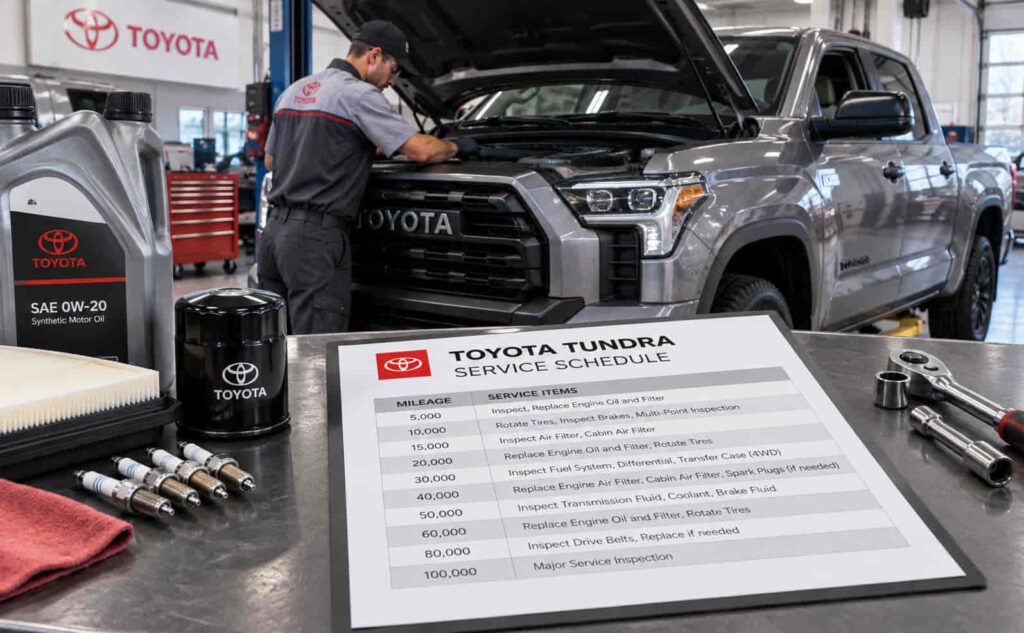
The Toyota Tundra service schedule organizes preventive maintenance around mileage, time, vehicle configuration, and operating conditions. A Tundra should be serviced according to the maintenance requirements for its specific model year rather than one universal mileage checklist applied to every truck. Engine, drivetrain, and usage differences can affect when individual components need to be inspected, serviced, or replaced.
Routine maintenance begins with recurring services and inspections, then expands as mileage accumulates. Common service points include 5,000, 10,000, 15,000, 30,000, 60,000, and 100,000 miles, but reaching one of these milestones does not mean every fluid, filter, or drivetrain component automatically requires replacement. Toyota may specify an inspection at one interval and replacement at another, while certain maintenance requirements can change when the truck is used for towing, heavy loads, or other special operating conditions.
This guide explains the Toyota Tundra service schedule by mileage, including what owners should consider at the major service intervals and how oil changes, fluids, towing, and operating conditions affect maintenance planning. Because requirements differ across Tundra generations and configurations, the schedule should be used as a maintenance framework alongside the documentation for the exact model year being serviced.
What Is the Toyota Tundra Service Schedule?
The Toyota Tundra service schedule is a mileage- and time-based maintenance framework that identifies when specific vehicle components should be inspected, serviced, or replaced. Its purpose is to organize preventive maintenance so owners can address routine wear and scheduled service before neglected components affect vehicle operation, reliability, or safety.
The schedule should not be interpreted as one identical maintenance checklist for every Tundra. Toyota has produced the truck with different engines, drivetrains, transmissions, and supporting systems across multiple generations. These differences affect which maintenance items apply to a particular vehicle and when they become relevant. A four-wheel-drive Tundra, for example, includes drivetrain components that do not create the same maintenance requirements on a two-wheel-drive configuration.
Mileage is only one dimension of the schedule. Time can also determine when maintenance becomes due because a truck may accumulate relatively few miles while fluids, rubber components, and other materials continue to age. This is why owners should consider both the applicable mileage and time requirements instead of postponing maintenance indefinitely because the odometer has not reached a particular milestone.
The action specified for each component is equally important. An instruction to inspect a component means its condition should be checked according to the applicable maintenance procedure; it does not automatically mean the component must be replaced. Replacement becomes necessary when the schedule specifically calls for it or when inspection identifies a condition that requires corrective service. Treating every inspection as mandatory replacement can result in unnecessary service, while treating a replacement requirement as an inspection can leave scheduled maintenance incomplete.
Operating conditions add another layer to the schedule. Towing, carrying heavy loads, repeated low-speed operation, or other conditions identified for a specific Tundra can create additional maintenance requirements. The correct service plan therefore comes from matching the truck’s model year and configuration with its mileage, time in service, and actual operating conditions.
The Toyota Tundra service schedule is best used as a vehicle-specific maintenance timeline rather than a generic list of parts to replace at fixed mileage points. That distinction becomes especially important when interpreting recurring service intervals such as 5,000 miles.
What Maintenance Does a Toyota Tundra Need Every 5,000 Miles?
The 5,000-mile interval is primarily a recurring maintenance checkpoint on applicable Toyota Tundra service schedules, with tire rotation and vehicle inspections forming an important part of the service cycle. The exact maintenance items must still be matched to the model year and operating conditions because a 5,000-mile visit does not mean every Tundra requires the same replacements.
Tire rotation is associated with recurring maintenance because tire position affects how tread wear develops across the vehicle. Front and rear tires experience different steering, braking, and load forces, so changing their positions according to the applicable rotation pattern helps distribute wear more evenly. The service visit also creates an opportunity to inspect tire condition and identify irregular wear that could indicate inflation, alignment, suspension, or other vehicle-condition issues.
A 5,000-mile checkpoint can also include inspections of safety- and chassis-related components specified for the vehicle. These inspections matter because maintenance is not limited to replacing fluids and filters. Brakes, fluid levels, steering or suspension components, and other applicable systems can be evaluated for condition before a developing problem becomes more noticeable during normal driving.
Engine oil requires more careful interpretation. A 5,000-mile service interval should not automatically be converted into a universal 5,000-mile oil-change interval for every Toyota Tundra. Oil and oil-filter requirements depend on the maintenance schedule applicable to the truck, including its model year and operating conditions. Some operating conditions can also change the applicable maintenance requirement, which is why owners should verify the oil interval instead of assuming every 5,000-mile service visit requires exactly the same work.
For example, a truck reaching 5,000 miles under routine driving and another Tundra accumulating similar mileage under qualifying towing or heavy-load conditions may not have identical maintenance needs. The odometer reading is the same, but operating context can change which additional service items apply. This relationship is especially important for trucks because their actual use can vary substantially between daily transportation and repeated load-intensive operation.
The practical purpose of the 5,000-mile service is therefore recurring preventive maintenance, not automatic replacement of every commonly serviced component. Owners should complete the inspections, rotations, and other actions specified for their exact Tundra while reserving oil, filter, fluid, and component replacements for the intervals and conditions under which they are actually required.
Read more: Toyota 4Runner ECT Power
What Maintenance Does a Toyota Tundra Need at 10,000 Miles?
At 10,000 miles, a Toyota Tundra reaches another recurring maintenance checkpoint where routine inspections and tire service continue, while engine oil and oil-filter service may become relevant according to the schedule for the specific model year and operating conditions. The correct 10,000-mile service should therefore build on the recurring maintenance cycle rather than be treated as an unrelated package of additional replacements.
Maintenance performed at earlier intervals does not eliminate the need for recurring checks. Tires continue accumulating wear, fluid levels can change, and components exposed to normal vehicle operation continue through their service life. Repeating applicable inspections allows changes to be identified over time instead of relying on a single inspection performed when the truck had substantially lower mileage.
Engine oil and the oil filter are especially important at this stage because owners frequently confuse the general service interval with the oil-change interval. The two should be treated separately. When the maintenance schedule for the specific Tundra calls for engine oil and filter replacement at 10,000 miles under the applicable operating conditions, that replacement becomes part of the scheduled service. If different requirements apply because of vehicle specification or operating conditions, those requirements take precedence over a generalized mileage rule.
The reason operating conditions matter is that equal mileage does not always represent equal use. A truck driven primarily under routine conditions and a truck repeatedly subjected to qualifying load-intensive or other special conditions can accumulate the same 10,000 miles while placing different demands on vehicle systems. Toyota’s applicable maintenance instructions determine whether those conditions require additional or more frequent service.
Owners should therefore avoid interpreting a 10,000-mile service as permission to postpone all maintenance until the odometer reaches that number. The service schedule works cumulatively: recurring maintenance continues at its applicable intervals while additional items enter the schedule when their mileage, time, or operating-condition requirements are reached.
The 10,000-mile checkpoint should be understood as part of an ongoing maintenance cycle, with oil and filter service performed when specified for the exact Tundra rather than because every Toyota truck follows one universal oil-change rule.
What Maintenance Does a Toyota Tundra Need at 15,000 Miles?
At 15,000 miles, Toyota Tundra maintenance can expand beyond the recurring tire and routine inspection cycle to include additional inspections specified for the truck’s model year, drivetrain, and operating conditions. The purpose of this interval is to continue preventive maintenance while evaluating components that have accumulated more operating time and mileage.
As mileage increases, inspection scope becomes more important because wear does not occur only in components that have fixed replacement intervals. Brake components, steering and suspension systems, fluid-related areas, and other applicable vehicle systems can develop measurable changes through normal operation. Scheduled inspections provide a structured point for checking their condition and determining whether corrective service is necessary.
Drivetrain configuration also affects what belongs in the maintenance scope. A two-wheel-drive Tundra and a four-wheel-drive Tundra do not contain an identical set of drivetrain components, so maintenance instructions involving four-wheel-drive hardware cannot be applied indiscriminately to both. The same principle applies when comparing Tundras from different generations or with different powertrain configurations.
Special operating conditions can further change what is required at this mileage. A Tundra used repeatedly for qualifying towing, heavy-load operation, or another condition identified in its maintenance documentation can require attention to items that are not scheduled identically under routine driving. The important relationship is not simply “15,000 miles equals additional replacement.” It is mileage plus operating condition plus vehicle configuration equals the applicable maintenance requirement.
This distinction prevents unnecessary replacement as well as missed maintenance. If the schedule calls for an inspection, the component should be inspected and evaluated rather than automatically replaced solely because the odometer reached 15,000 miles. If a required replacement or additional service applies to the truck’s operating conditions, treating it as an optional inspection would create the opposite error.
The 15,000-mile service is therefore an expanded preventive-maintenance checkpoint whose exact scope depends on the specific Toyota Tundra. Owners should continue recurring maintenance while adding the inspections or services that become applicable at this stage instead of purchasing a generic 15,000-mile service package without checking what the vehicle actually requires.
What Maintenance Does a Toyota Tundra Need at 30,000 Miles?
At 30,000 miles, Toyota Tundra maintenance generally becomes broader because the service schedule can combine recurring maintenance with additional filter, drivetrain, fluid, and mechanical inspections applicable to the specific truck. This makes 30,000 miles an important maintenance-planning point, but it does not mean every fluid and wear component should automatically be replaced when the odometer reaches this number.
The recurring maintenance cycle remains relevant. Tire service and applicable inspections continue because reaching a larger mileage milestone does not replace the maintenance requirements established at shorter intervals. The difference is that the 30,000-mile stage can introduce additional maintenance items that are not required at every routine visit, increasing the scope of the service rather than resetting the schedule.
Filters are one area that requires model-specific interpretation. Engine and cabin air filtration systems accumulate contamination as air passes through them, but the applicable inspection or replacement requirement depends on the maintenance schedule and operating environment. Driving regularly in dusty conditions can create a different filtration demand from operating primarily on cleaner paved roads. The correct action is therefore determined by the applicable schedule and filter condition rather than by assuming every Tundra needs every filter replaced at exactly 30,000 miles.
Drivetrain-related maintenance also becomes more relevant when interpreting this interval. A four-wheel-drive Tundra contains components associated with transferring power through its 4WD system that are not identical to those of a two-wheel-drive truck. Differential, transfer-case, driveshaft, and related maintenance requirements must therefore be matched to drivetrain configuration. Where the schedule specifies inspection, lubrication, or another service action, that instruction should be followed without converting it into a universal fluid-replacement requirement.
Fluid-related maintenance requires the same distinction. Engine coolant, transmission-related fluid, differential lubricant, and transfer-case lubricant serve different systems and should not be grouped under a single rule that all fluids must be changed at 30,000 miles. Each fluid has its own applicable inspection, service, or replacement requirements. Operating conditions can also alter those requirements, particularly when the truck regularly performs work that places additional demand on the drivetrain.
This is why a generic “30K service package” and the maintenance actually required by Toyota are not necessarily the same thing. A bundled service package can contain procedures beyond the applicable manufacturer schedule, while the vehicle itself may have configuration-specific requirements that a generic package does not communicate clearly.
The correct 30,000-mile service combines recurring maintenance with the additional inspections and service items specified for the Tundra’s model year, drivetrain, and operating conditions. Owners should verify each maintenance action individually instead of treating 30,000 miles as a universal replacement point for filters, fluids, and drivetrain components.
What Maintenance Does a Toyota Tundra Need at 60,000 Miles?
At 60,000 miles, a Toyota Tundra should continue its recurring maintenance while receiving the additional inspections, services, and replacements specified for its accumulated mileage, age, configuration, and operating conditions. The larger odometer reading makes this an important point for evaluating long-term component condition, but 60,000 miles is not a universal deadline for replacing every major fluid or drivetrain component.
By this stage, the truck has completed multiple shorter maintenance cycles. Tire rotations, oil-related service where applicable, and scheduled inspections should have occurred according to their respective intervals rather than being deferred until 60,000 miles. The 60,000-mile visit builds on that maintenance history. It should not function as a substitute for service that was missed at 5,000-, 10,000-, 15,000-, or 30,000-mile checkpoints.
Accumulated mileage makes condition-based inspections increasingly useful. Brake, steering, suspension, driveline, and fluid-related components have experienced substantially more operating cycles than they had during early ownership. Inspection allows wear, leakage, deterioration, or abnormal movement to be identified before deciding whether repair or replacement is required. A component that passes its scheduled inspection does not need to be classified as failed simply because the truck has reached 60,000 miles.
Fluids require particular care at this milestone because generic maintenance advice frequently treats 60,000 miles as an automatic replacement interval. Transmission fluid, differential lubricant, transfer-case lubricant, and coolant should be serviced according to the requirements that apply to the specific Tundra rather than one shared 60,000-mile rule. These systems perform different functions, and their maintenance requirements can vary with vehicle specification and use.
Operating conditions can change the maintenance picture further. A Tundra that regularly operates under qualifying towing, heavy-load, or other special conditions can have additional drivetrain or fluid-related requirements compared with a truck used under routine conditions. The reason is mechanical: increased load changes the operating demand placed on components that transfer power and manage heat. Whether that increased demand creates a specific maintenance action at 60,000 miles must still be determined from the applicable schedule.
Maintenance history also matters by this point. A truck that has received its required service consistently arrives at 60,000 miles with a different maintenance context from one with incomplete records. When prior service history is unknown, the odometer alone cannot establish that every earlier maintenance item was completed. Owners may need to verify component condition and available records before deciding which services are currently due.
The 60,000-mile service should therefore be treated as a cumulative maintenance milestone rather than a universal major-service package. The correct work consists of recurring maintenance plus any mileage-, time-, configuration-, and operating-condition-specific items that are actually due for that Toyota Tundra.
What Maintenance Does a Toyota Tundra Need at 100,000 Miles?
At 100,000 miles, a Toyota Tundra should receive all recurring maintenance that is currently due together with any higher-mileage inspections, services, or replacements specified for its model year, powertrain, drivetrain, age, and operating conditions. Reaching 100,000 miles is an important maintenance milestone, but it does not create a universal requirement to replace every major fluid or wear component.
Maintenance at this mileage is cumulative. A properly maintained Tundra should already have completed multiple cycles of tire service, engine oil and filter service at the applicable intervals, and scheduled inspections of brakes, steering, suspension, drivetrain components, and other systems. The 100,000-mile service continues that sequence rather than replacing the maintenance that should have occurred during earlier intervals.
Higher mileage increases the importance of component condition and maintenance history. Rubber components can deteriorate, mechanical components accumulate wear, and leaks or abnormal movement can develop as operating cycles increase. Scheduled inspection provides evidence for determining whether a component remains serviceable or requires corrective work. Mileage alone should not be used to declare every inspected component worn out.
Some model-specific maintenance items can also become relevant around higher mileage, but they must be verified against the exact Tundra. Coolant, spark plugs, filters, and drivetrain-related fluids should not all be assigned an automatic 100,000-mile replacement interval simply because they are common maintenance items. Different engines and vehicle generations can use different specifications and replacement schedules, while operating conditions can create additional requirements.
A truck’s previous maintenance records become particularly valuable at this stage. If the service history confirms that earlier scheduled work was completed, the owner can determine what is currently due without unnecessarily repeating recently performed maintenance. If the history is incomplete, the current odometer reading cannot prove whether earlier fluid services, inspections, or replacements actually occurred.
This distinction is especially important when purchasing a used high-mileage Tundra. A truck with 100,000 miles and documented scheduled maintenance presents a different maintenance context from another truck at the same mileage with no reliable service records. Both have identical odometer readings, but their immediate maintenance needs can differ because mileage is only one part of vehicle condition.
The correct 100,000-mile service is therefore a continuation of the Tundra’s vehicle-specific maintenance schedule, supported by its service history and current condition. Owners should identify what is actually due instead of treating 100,000 miles as a mandatory replacement point for every filter, fluid, spark plug, belt, or drivetrain component.
How Often Should You Change the Oil in a Toyota Tundra?
Toyota Tundra engine oil and the oil filter should be changed at the interval specified for the truck’s exact model year, engine, oil specification, and operating conditions rather than according to one universal interval for every Tundra. The oil-change schedule should therefore be separated from the broader service schedule instead of assuming that every maintenance visit automatically requires an oil change.
This distinction matters because a recurring service checkpoint and an engine oil replacement interval describe different maintenance actions. A Tundra can reach a scheduled visit where tire rotation and inspections are due without that automatically proving that engine oil replacement is due under the same operating conditions. Conversely, when the applicable maintenance schedule specifies an oil and filter change, completing only the inspection portion of the visit would leave scheduled maintenance unfinished.
Engine oil performs several functions while the engine operates. It lubricates moving surfaces, helps control friction, carries contaminants toward the filtration system, and operates under changing thermal loads. Oil condition is therefore connected to engine design, lubricant specification, operating time, and how the truck is used. These variables explain why oil-change guidance should be matched to the vehicle rather than generalized from another Tundra generation.
Operating conditions can also affect the applicable interval. A truck used under qualifying special conditions can be subject to different maintenance requirements from one driven under normal conditions. Towing or carrying substantial loads, for example, changes engine and powertrain demand. Whether a particular type of use requires a different oil-service interval should be determined from the maintenance instructions for that model rather than from a general assumption that all towing automatically requires the same shortened interval.
Time must also be considered alongside mileage when the applicable schedule specifies both. A Tundra driven relatively few miles each year should not assume that low odometer accumulation eliminates time-based maintenance. The correct trigger comes from the mileage and time criteria Toyota specifies for the vehicle and its operating conditions.
The oil itself must also meet the specification applicable to the engine. Oil viscosity and specification should not be selected solely because they were appropriate for a different Tundra engine or model year. Changes across generations make the exact vehicle documentation the appropriate reference for determining both the required lubricant and its service interval.
The correct Toyota Tundra oil-change interval is the interval specified for the exact truck under its actual operating conditions. Owners should not automatically equate every 5,000-mile service with an oil change or extend oil service based solely on a generalized interval that may apply to a different Tundra configuration.
When Should Toyota Tundra Fluids Be Changed?
Toyota Tundra fluids should be inspected or replaced according to the schedule for each individual fluid system, the truck’s model year and configuration, and its operating conditions. Engine coolant, transmission fluid, differential lubricant, and transfer-case lubricant perform different functions, so they should not be grouped under one universal fluid-change interval.
Engine coolant manages heat within the engine cooling system and has its own applicable service requirements. Transmission fluid operates within the transmission, while differential lubricant protects components that transfer torque through the axle assemblies. A four-wheel-drive Tundra can also have transfer-case lubrication requirements associated with distributing power through the 4WD system. Because these fluids operate in different systems, the maintenance requirement for one does not establish the replacement interval for another.
The distinction between inspection and replacement remains important when reading the service schedule. If Toyota specifies that a fluid or related component should be inspected at a particular interval, the required action is an inspection unless another condition or schedule requirement calls for replacement. An inspection can identify leakage, an incorrect fluid level, contamination, or another condition requiring corrective service, but the mileage checkpoint alone should not automatically be interpreted as a mandatory fluid change.
Transmission fluid illustrates why generalized replacement advice can be misleading. Transmission designs and maintenance requirements differ across Tundra generations, and operating conditions can affect the applicable service instructions. Assigning every Toyota Tundra the same transmission-fluid replacement mileage ignores differences in transmission hardware, vehicle configuration, and use.
Differential and transfer-case maintenance also depends heavily on drivetrain configuration and operating conditions. A two-wheel-drive truck does not have the same complete drivetrain arrangement as a four-wheel-drive Tundra. In addition, repeated towing or other qualifying load-intensive use can create maintenance requirements that differ from routine operation. The applicable schedule should determine whether the required action is inspection, fluid replacement, or another service.
Owners should therefore evaluate each fluid as a separate maintenance entity. The correct question is not simply whether a Tundra needs “all fluids changed” at 30,000, 60,000, or 100,000 miles. The correct question is which fluid system is being evaluated, what action the schedule specifies, and whether the truck’s mileage, time, configuration, and operating conditions make that action due.
Toyota Tundra fluid maintenance is system-specific rather than governed by one shared replacement interval. Following the requirement for each individual fluid prevents both premature replacement and the more serious mistake of overlooking a service that becomes necessary under the truck’s actual operating conditions.
Does Towing Change the Toyota Tundra Service Schedule?
Towing can change the Toyota Tundra service schedule when the truck’s towing use meets operating conditions for which Toyota specifies additional or more frequent maintenance. The correct maintenance change depends on the exact model and the conditions under which it is operated, so towing should not be converted into one shortened service interval that applies universally to every Tundra.
A trailer increases the load the powertrain must move. Acceleration, maintaining speed on grades, and repeated operation under load can increase demand on the engine, transmission, and drivetrain compared with unloaded cruising. These systems must transfer more energy while managing the heat and mechanical forces associated with the additional load. This mechanical relationship explains why towing can become relevant to maintenance planning.
The important step is determining which maintenance requirements Toyota associates with that operating condition. A towing-related schedule can call for additional attention to specific drivetrain or fluid-related items without changing every maintenance interval on the truck. For example, a requirement affecting a differential or transmission-related service should not automatically be extended to engine coolant, filters, or unrelated components unless their applicable schedules also specify a change.
Towing frequency and operating context also matter. A truck that performs qualifying towing repeatedly is not necessarily in the same maintenance context as a Tundra that pulls a trailer occasionally under different conditions. The vehicle’s maintenance documentation should be used to determine how Toyota defines the relevant operating condition and which additional service actions apply.
Towing capacity and maintenance intervals must also remain separate. Staying within the Tundra’s applicable towing limits does not mean additional maintenance can be ignored when the operating conditions call for it. Conversely, performing maintenance more frequently does not increase the truck’s rated towing capability. One concept defines vehicle maintenance requirements; the other defines how the vehicle can be loaded and operated.
This distinction becomes increasingly important as mileage accumulates. A Tundra used regularly for towing can reach 30,000, 60,000, or 100,000 miles with a different operating history from an otherwise similar truck used primarily for unloaded transportation. Identical odometer readings therefore do not guarantee identical maintenance requirements.
Towing should be treated as an operating-condition modifier to the Toyota Tundra service schedule, not as a separate universal maintenance schedule. Owners should identify the towing-related requirements specified for their exact truck and apply those requirements alongside the normal mileage- and time-based maintenance cycle.
Does the Toyota Tundra Service Schedule Change for Severe Driving Conditions?
The Toyota Tundra service schedule can change when the truck is operated under special conditions that trigger additional or more frequent maintenance requirements. These requirements should be applied to the specific maintenance items affected by the operating condition rather than interpreted as a rule that every component on the truck must be serviced more frequently.
The reason is that operating conditions change the mechanical and thermal demands placed on individual vehicle systems. Repeated load-intensive operation can increase the work performed by the engine, transmission, and drivetrain. Other operating environments can increase contamination, component exposure, or wear in different systems. The resulting maintenance requirement depends on which component is affected and what Toyota specifies for that condition.
The term “severe driving” should therefore be used carefully. Owners should not assume that one general definition found in maintenance advice for another vehicle automatically applies to their Tundra. The relevant question is whether the truck’s actual use matches a special operating condition identified in the maintenance information for its specific model year.
Towing provides one example because additional trailer load changes powertrain and drivetrain demand, but it is not the only operating context that can affect maintenance. Driving environment and usage pattern can also become relevant when they match conditions identified in the applicable schedule. Each condition should be connected to the maintenance item it actually affects instead of being used to justify shortening every service interval simultaneously.
This distinction also prevents unnecessary maintenance. If one special operating condition creates an additional drivetrain-fluid requirement, that does not automatically establish a shorter interval for an unrelated filter or cooling-system component. The schedule should be read as a set of relationships between operating conditions and specific maintenance actions, not as a blanket instruction to replace everything sooner.
Owners should reassess operating conditions as the truck’s use changes. A Tundra previously used for routine transportation can later begin regular towing or another demanding type of operation. Its maintenance planning should then account for any additional requirements that become applicable rather than relying exclusively on the service pattern established during its earlier use.
Special operating conditions modify the Toyota Tundra service schedule only where the applicable maintenance instructions specify a different requirement. The correct approach is to identify the truck’s actual use, determine which condition applies, and then perform the additional inspection, service, or replacement associated with that condition.
Does the Toyota Tundra Maintenance Schedule Change by Model Year?
Yes, Toyota Tundra maintenance requirements can change by model year because different generations and configurations use different engines, transmissions, drivetrains, components, fluids, and maintenance specifications. A service interval or replacement requirement from one Tundra should therefore not be treated as a universal specification for every model year.
Powertrain differences are one reason. Changes in engine and transmission design can affect lubricant specifications, filters, cooling-system components, spark plugs, and other scheduled maintenance items. Even when two Tundras share the same general maintenance category, the required product, inspection procedure, or replacement interval can differ.
Drivetrain configuration creates another distinction. Two-wheel-drive and four-wheel-drive trucks do not have an identical set of components requiring maintenance. A 4WD system introduces additional drivetrain context, including components associated with distributing power between the axles. Maintenance instructions involving those components apply according to the configuration of the vehicle rather than simply because it carries the Tundra name.
Changes between generations can also make generic mileage tables misleading. A statement that a particular fluid, filter, or component must be replaced at one mileage point can be accurate for one configuration while being unsupported for another. The more precise method is to use mileage as the starting point and then verify the maintenance action against the documentation for the exact model year.
This is particularly important for used Tundras. An owner moving from an older truck to a newer generation should not automatically continue the maintenance intervals learned from the previous vehicle. The same issue occurs when online maintenance advice combines multiple generations into a single schedule without identifying which powertrain or model years the recommendations cover.
Model year alone is not always the final qualifier. Engine, drivetrain, vehicle configuration, operating conditions, and previous maintenance can still affect what needs to be done. The correct maintenance plan therefore becomes progressively more specific: first identify the Toyota Tundra model year, then its relevant configuration, current mileage and time in service, operating conditions, and applicable maintenance history.
The Toyota Tundra maintenance schedule should ultimately be matched to the exact truck rather than selected solely by vehicle name or a generic mileage chart. Model-year-specific information determines whether a maintenance requirement actually applies and prevents service guidance from one generation from being incorrectly transferred to another.
Should You Follow the Toyota Maintenance Schedule or a Dealer Service Schedule?
The Toyota maintenance schedule for the specific Tundra should be the primary reference for determining manufacturer-specified maintenance, while a dealer service schedule can include additional services beyond that schedule. The two should not automatically be treated as identical because a dealer service package and a manufacturer maintenance requirement can serve different purposes.
Toyota’s applicable maintenance information establishes the scheduled inspections, services, and replacements associated with the vehicle’s mileage, time, configuration, and operating conditions. This provides the baseline for determining what the truck requires at a particular point in its service life. When an item is specified for inspection, the scheduled action is an inspection; when replacement is specified, replacement becomes the applicable maintenance action.
A dealer can recommend additional work based on vehicle condition, local operating environment, service history, or its own preventive-maintenance practices. An additional recommendation is not necessarily unnecessary, but it should be distinguished from maintenance specified by Toyota. The reason for the recommendation determines how the owner should evaluate it.
For example, an inspection can reveal a worn or leaking component that requires repair even when scheduled replacement is not due by mileage. In that situation, the additional work is supported by the vehicle’s actual condition. A different situation occurs when a service is included automatically in a mileage-based dealer package even though the applicable Toyota schedule does not require that replacement at the same interval.
This distinction is especially useful when evaluating fluid services. A package labeled as a 30,000- or 60,000-mile service can include multiple fluid replacements, but the package name alone does not establish that Toyota requires every included fluid to be replaced at that mileage. Each fluid should be checked against the applicable maintenance requirement and any condition-based reason for service.
Owners can therefore evaluate a dealer recommendation by identifying what is being proposed and why. The relevant question is whether the service is scheduled by Toyota, required because an inspection identified a condition, applicable because of the truck’s operating conditions, or an additional preventive recommendation from the service provider. These categories should not be presented as though they carry the same manufacturer requirement.
The Toyota schedule establishes the vehicle-specific maintenance baseline, while dealer recommendations should be evaluated according to the reason and evidence supporting the additional service. This approach allows owners to complete required maintenance without assuming that every item in a dealer package is automatically part of the Toyota Tundra service schedule.
How Do You Find the Correct Service Schedule for Your Toyota Tundra?
The correct Toyota Tundra service schedule is found by matching the truck’s exact model year and configuration with its mileage, time in service, operating conditions, and applicable Toyota maintenance information. A generic Tundra mileage chart can help organize maintenance planning, but vehicle-specific documentation should determine the actual service requirement.
Model year is the first important qualifier because maintenance specifications can change as engines, transmissions, drivetrain systems, fluids, and other components change. After identifying the model year, the owner should determine the relevant powertrain and drivetrain configuration. This prevents a maintenance instruction for one engine or a four-wheel-drive system from being incorrectly applied to a different configuration.
Mileage and time in service determine which scheduled maintenance points have been reached. These two measurements should be considered according to the applicable schedule rather than using mileage alone. A low-mileage truck can still reach a time-based maintenance requirement, while a heavily driven truck can reach multiple mileage-based intervals in a relatively short period.
Operating conditions determine whether additional requirements apply. A Tundra used under conditions identified by Toyota for additional maintenance should be evaluated against those instructions as well as the normal schedule. This is particularly important for trucks used for repeated towing, load-intensive operation, or other qualifying conditions because their maintenance requirements can differ from those of an otherwise similar Tundra under routine use.
Service history provides the final ownership context. Reaching a mileage milestone establishes what should be checked against the schedule, but it does not prove that all earlier maintenance was completed. Records of previous oil changes, inspections, fluid services, filter replacements, and other scheduled work help distinguish maintenance that is currently due from work that has already been performed.
The complete maintenance decision therefore follows a specific relationship: the vehicle identifies which schedule applies, mileage and time identify the relevant interval, operating conditions determine whether additional requirements apply, and service history shows what has already been completed. Current vehicle condition can then identify repairs or maintenance that are necessary independently of a scheduled mileage replacement.
The most accurate Toyota Tundra service plan is the one built for the exact truck rather than copied from a universal mileage chart. Matching model year, configuration, mileage, time, operating conditions, and maintenance history allows owners to determine what should be inspected, serviced, or replaced without confusing general maintenance guidance with vehicle-specific requirements.