Many cars from mainstream and luxury brands offer a head-up display (HUD), including models from Toyota, Lexus, BMW, Mercedes-Benz, Audi, Mazda, Hyundai, Kia, Genesis, Chevrolet, and Cadillac. A head-up display projects key driving information into the driver’s forward field of view, allowing information such as vehicle speed, navigation directions, speed limits, and driver-assistance alerts to be viewed without relying solely on the instrument cluster.
HUD availability, however, varies between vehicles. A manufacturer may offer a head-up display on one model but exclude it from another, while the same model may provide HUD as standard equipment on a higher trim and as optional equipment through a technology or premium package on a lower trim. Availability can also change between model years. For this reason, identifying a car as having a HUD does not mean that every version of that vehicle includes the feature.
This guide organizes cars with head-up displays by brand and explains where HUD is standard, optional, trim-dependent, or package-dependent. It also covers SUVs and electric cars with HUD, augmented reality head-up displays, and the steps buyers can use to verify HUD availability on a specific vehicle.
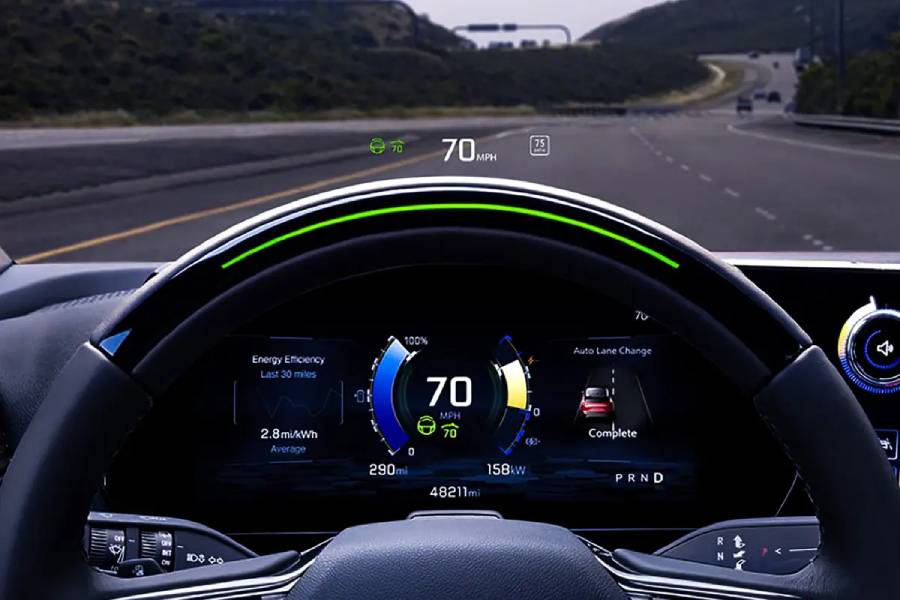
What cars have a head-up display?
Cars with a head-up display include selected models from Toyota, Lexus, BMW, Mercedes-Benz, Audi, Mazda, Hyundai, Kia, Genesis, Chevrolet, Cadillac, Volvo, Porsche, Lincoln, and several other manufacturers. HUD availability is not determined by the brand alone. It depends on the specific model, model year, trim level, and equipment package.
The table below provides a brand-level overview of vehicles commonly offered with a factory head-up display. Because manufacturers revise equipment between model years, a model appearing in this list should not be interpreted as having HUD on every trim.
| Brand | Examples of Models With HUD | Typical Availability |
|---|---|---|
| Toyota | Camry, Prius, Crown, Grand Highlander | Selected trims |
| Lexus | ES, LS, NX, RX, GX, LX | Selected trims or packages |
| BMW | 3 Series, 5 Series, 7 Series, X3, X5, X7 | Selected trims or packages |
| Mercedes-Benz | C-Class, E-Class, S-Class, GLC, GLE, GLS | Selected configurations |
| Audi | A6, A7, A8, Q7, Q8 | Selected trims or packages |
| Mazda | Mazda3, CX-30, CX-50, CX-70, CX-90 | Selected trims |
| Hyundai | Sonata, Santa Fe, Palisade, IONIQ models | Selected trims |
| Kia | K5, Telluride, EV6, EV9 | Selected trims |
| Genesis | G70, G80, G90, GV70, GV80 | Selected configurations |
| Chevrolet | Corvette, Silverado, Tahoe, Suburban | Selected trims |
| Cadillac | CT4, CT5, LYRIQ, Escalade | Selected trims |
| Volvo | Selected sedans, wagons, and SUVs | Selected configurations |
| Porsche | Selected sports cars and SUVs | Optional or configuration-dependent |
| Lincoln | Selected SUVs | Selected trims |
There are 4 main ways a manufacturer provides HUD: as standard equipment, as an option, as part of an equipment package, or exclusively on specific higher trims. For example, two vehicles with the same model name may have different equipment because one is a base trim and the other is a premium trim. A buyer therefore needs the model year and exact configuration to determine whether an individual vehicle actually has HUD.
The type of head-up display can also differ between cars. Conventional systems project information such as speed and navigation instructions onto the windshield, while more advanced systems can display driver-assistance information or augmented-reality navigation graphics. Manufacturer-specific names can create another distinction. Mazda, for example, has used the term Active Driving Display for its driver-facing display technology.
For buyers, the most useful way to read a list of cars with HUD is therefore brand → model → model year → trim/package → HUD availability. This hierarchy distinguishes vehicles that merely offer HUD somewhere in the model range from configurations that actually include the feature.
Which Toyota cars have a head-up display?
Toyota offers a head-up display on selected versions of models such as the Camry, Prius, Crown, Grand Highlander, and other higher-spec vehicles, depending on the model year and trim. HUD is not a universal Toyota feature, so its presence on one trim does not mean every version of the same model includes it.
Toyota generally positions HUD as a higher-level technology feature. This means availability is commonly connected to a specific trim or equipment configuration rather than the model name alone. For example, a higher trim may include a factory HUD while an entry-level version of the same vehicle relies on the instrument cluster and center display for driving information.
Toyota HUD systems typically place important information within the driver’s forward field of view, such as vehicle speed, navigation guidance, and selected driver-assistance information. The exact information displayed depends on the vehicle and system generation.
Buyers should therefore check the specification sheet for the exact Toyota model year and trim they are considering. This is particularly important when buying a used Toyota because trim structures and standard equipment can change between model years.
Which Lexus cars have a head-up display?
Lexus offers head-up displays on selected versions of models such as the ES, LS, NX, RX, GX, and LX. Depending on the model and configuration, HUD may be standard on a higher trim or available through an option or equipment package.
Head-up displays fit more broadly within the technology and driver-information equipment offered across the Lexus luxury lineup. However, the presence of HUD still varies by configuration. An RX or NX listing, for example, should not automatically be treated as confirmation that the individual vehicle has a head-up display.
The system can place driving information such as speed, navigation instructions, and driver-assistance notifications closer to the driver’s normal line of sight. The information available depends on the model, model year, and installed equipment.
For this reason, buyers comparing Lexus vehicles should verify both the trim and installed options. For used vehicles, checking the original equipment specification or physically confirming that the HUD is installed provides more reliable information than relying on the model name alone.
Which BMW cars have a head-up display?
BMW offers a head-up display on selected versions of vehicles including the 3 Series, 5 Series, 7 Series, X3, X5, and X7. Availability varies by model, market, model year, and equipment configuration, with the feature either included or offered as part of specific technology packages.
BMW’s implementation connects HUD with the wider digital cockpit and driver-information system. Depending on the vehicle, information projected into the driver’s field of view can include current speed, navigation instructions, speed-limit information, and selected driving or assistance notifications.
The important distinction is between a BMW model that supports HUD and an individual BMW that is equipped with HUD. Optional equipment makes these two categories different. Two vehicles from the same model series and model year can therefore have different HUD availability when their specifications or option packages differ.
Buyers should check the equipment list or build specification of the individual BMW before making a purchase decision based on HUD. This verification becomes especially important for used vehicles, where the model and trim name alone may not reveal every factory-installed option.
Which Mercedes-Benz cars have a head-up display?
Mercedes-Benz offers a head-up display on selected versions of models such as the C-Class, E-Class, S-Class, GLC, GLE, and GLS. Availability depends on the model year, trim, market, and equipment package, so HUD should be verified for the exact vehicle rather than assumed from the model name.
Mercedes-Benz integrates HUD with its wider digital cockpit and navigation systems. Depending on the configuration, the display can project information such as vehicle speed, speed limits, navigation instructions, and driver-assistance notifications into the driver’s forward field of view. Higher-spec systems can provide more extensive visual information than conventional HUD systems.
Selected Mercedes-Benz vehicles also offer augmented reality technology that expands how navigation information is presented. An augmented reality head-up display can position directional graphics within the driver’s view so that navigation instructions correspond more closely with the road ahead. This differs from a conventional HUD that primarily presents information in a fixed display area.
The distinction between available and installed equipment remains important. A Mercedes-Benz model may support HUD without including it on every vehicle. Buyers should check the exact trim, option package, and factory equipment list, particularly when comparing used vehicles from different model years.
Which Audi cars have a head-up display?
Audi offers a head-up display on selected versions of models such as the A6, A7, A8, Q7, and Q8, with availability varying by model year and configuration. Depending on the vehicle, HUD can be standard on a particular specification or included through optional equipment.
Audi’s HUD projects selected driving information into the driver’s forward viewing area. Depending on the installed system, this information can include vehicle speed, navigation guidance, traffic information, and driver-assistance notifications. The purpose is to provide important information without requiring the driver to rely entirely on displays positioned lower in the cockpit.
A head-up display should not be confused with Audi’s digital instrument display. The two systems can present overlapping information, but they use different locations. A digital instrument cluster is positioned behind the steering wheel, whereas a windshield HUD projects information into the driver’s forward field of view. A vehicle can therefore have a digital cockpit without having a head-up display.
Audi buyers should confirm the exact equipment specification before assuming HUD is included. This is particularly relevant when shopping for used cars because two examples of the same Audi model can have different technology packages and factory options.
Which Mazda cars have a head-up display?
Mazda offers head-up display technology on selected versions of vehicles such as the Mazda3, CX-30, CX-50, CX-70, and CX-90, depending on model year and trim. Mazda has used the name Active Driving Display for its driver-facing display technology, so buyers may encounter this term instead of a specification simply labeled “head-up display.”
Active Driving Display is designed to place selected driving information closer to the driver’s normal field of view. Depending on the Mazda model and system, displayed information can include vehicle speed, navigation guidance, traffic-sign information, and notifications from compatible driver-assistance functions.
Availability is closely connected to trim level. Higher Mazda trims generally receive more technology equipment than entry-level configurations, which means the presence of Active Driving Display should be checked against the exact trim rather than inferred from the model alone. Equipment can also change when Mazda updates a vehicle for a new model year.
Manufacturer terminology is particularly important when researching cars with HUD. A buyer searching only for the phrase “head-up display” could overlook a system marketed under a brand-specific name such as Active Driving Display. The function and implementation should therefore be checked alongside the terminology used in the vehicle’s official equipment specification.
Which Hyundai cars have a head-up display?
Hyundai offers a head-up display on selected versions of models such as the Sonata, Santa Fe, Palisade, and vehicles in the IONIQ lineup, depending on the model year and trim. The feature is generally associated with higher equipment levels rather than being standard across every version of a model.
Hyundai HUD systems place selected vehicle information within the driver’s forward field of view. Depending on the vehicle and installed equipment, the display can include vehicle speed, navigation directions, speed-limit information, and data from compatible driver-assistance systems. This allows the HUD to work alongside the digital instrument cluster and infotainment display rather than replacing either system.
Trim level is particularly important when identifying a Hyundai with HUD. A higher trim can include technology features that are unavailable on the entry-level version of the same vehicle. Equipment packages and market specifications can create further differences, while a new model year can introduce, remove, or reposition the feature within the trim structure.
Buyers should therefore verify the model year and exact trim before purchasing a Hyundai specifically for its head-up display. For a used Hyundai, the individual vehicle’s equipment list provides stronger confirmation than the model name alone.
Which Kia cars have a head-up display?
Kia offers a head-up display on selected versions of models such as the K5, Telluride, EV6, and EV9, with availability determined by model year, trim, and equipment configuration. HUD is not included across every version of these vehicles, making the exact specification an important part of the buying decision.
Depending on the model, Kia’s HUD can display information such as vehicle speed, navigation instructions, speed limits, and selected driver-assistance alerts. The information appears in the driver’s forward viewing area while the instrument cluster continues to provide the vehicle’s primary set of gauges and driving data.
There are important equipment differences within individual Kia model ranges. For example, a model can offer HUD only after the buyer moves to a higher trim or selects a configuration containing additional technology equipment. This means a statement that a Kia model “has HUD” describes feature availability within the model range, not necessarily every vehicle carrying that model name.
This distinction also matters when comparing new and used Kia vehicles. Buyers should match the model year with the trim and original equipment specification to establish whether a particular vehicle includes a factory head-up display.
Which Genesis cars have a head-up display?
Genesis offers a head-up display on selected configurations across models such as the G70, G80, G90, GV70, and GV80. As a luxury brand, Genesis makes HUD available across multiple sedans and SUVs, although the exact standard or optional status depends on the model, trim, model year, and market.
Genesis HUD systems can present information such as vehicle speed, navigation guidance, speed limits, and compatible driver-assistance information within the driver’s forward field of view. Integration with navigation and assistance technologies makes the display part of the broader driver-information environment rather than an isolated screen.
The equipment hierarchy remains relevant even within a luxury vehicle lineup. A feature available on a higher specification should not automatically be attributed to every lower configuration of the same model. Model-year changes can also alter which trims receive the system as standard equipment.
For buyers comparing the G70, G80, G90, GV70, or GV80 specifically because they want HUD, the final check should therefore be made against the exact vehicle specification. This approach separates model-level HUD availability from vehicle-level HUD installation, which is the key distinction when identifying cars that actually have the feature.
Which Chevrolet cars have a head-up display?
Chevrolet offers a head-up display on selected versions of models such as the Corvette, Silverado, Tahoe, and Suburban, depending on the model year, trim, and equipment package. The feature is concentrated in specific configurations rather than included across every Chevrolet vehicle or every trim of an eligible model.
Chevrolet demonstrates why the word “cars” in this search should not be limited to sedans. Factory HUD technology is also available in sports cars, pickup trucks, and full-size SUVs. The Corvette is a performance-oriented example, while the Silverado represents pickup trucks and the Tahoe and Suburban represent large SUVs. Including these vehicle types gives buyers a more complete view of HUD availability across the Chevrolet lineup.
The information presented by the HUD depends on the vehicle and installed system. Vehicle speed is a core function, while compatible configurations can add navigation information, driver-assistance status, and other driving data. The HUD works alongside the instrument cluster rather than replacing the vehicle’s primary displays.
Buyers should check the exact Chevrolet trim and equipment package because two vehicles carrying the same model name may have different technology equipment. This distinction becomes especially important with used vehicles, where optional factory equipment can differ substantially between otherwise similar examples.
Which Cadillac cars have a head-up display?
Cadillac offers a head-up display on selected versions of models such as the CT4, CT5, LYRIQ, and Escalade. Whether HUD is standard or configuration-dependent varies according to the vehicle, model year, trim, and installed equipment.
Cadillac uses HUD as part of a broader collection of driver-information and technology features. Depending on the model, the system can present vehicle speed, navigation information, and compatible driver-assistance data within the driver’s forward field of view. This arrangement allows information from several vehicle systems to be presented without relying exclusively on the instrument cluster.
The Escalade illustrates how HUD can appear alongside other advanced cockpit technologies without being the same feature. A large digital instrument display, infotainment screen, or driver-assistance system does not by itself establish that a vehicle has HUD. The defining characteristic is that HUD places information into the driver’s forward viewing area rather than only displaying it on a dashboard-mounted screen.
For the CT4, CT5, LYRIQ, Escalade, and other Cadillac vehicles that offer HUD, buyers should verify the equipment attached to the exact vehicle. The original window sticker, manufacturer specification, build information, or physical inspection can establish whether a used vehicle actually received the feature.
Which other car brands offer a head-up display?
Other manufacturers that offer head-up display technology on selected vehicles include brands such as Volvo, Porsche, Lincoln, and additional manufacturers across mainstream, premium, performance, and luxury segments. HUD is therefore no longer restricted to one vehicle category, although availability remains strongly dependent on model and configuration.
Volvo has offered HUD technology on selected vehicles in its sedan, wagon, and SUV ranges. As with other manufacturers, buyers should distinguish between a model that supports the feature and a specific configuration equipped with it. Higher equipment specifications are more likely to combine HUD with navigation and driver-assistance information.
Porsche also makes head-up display technology available on selected vehicles and configurations. Optional equipment plays a particularly important role when evaluating individual Porsche vehicles because two examples of the same model can have substantially different factory specifications. Checking the installed options is therefore necessary when HUD is a purchase requirement.
Lincoln provides another example of HUD extending beyond traditional luxury sedans into premium SUVs. Depending on the model and model year, the feature can be associated with specific trims or equipment configurations rather than the entire model range.
The same verification rule applies across all manufacturers: a model that offers a head-up display is not necessarily a vehicle that has a head-up display. Model year, trim level, option packages, market specification, and individual factory equipment determine the final configuration. Buyers comparing cars primarily for HUD should therefore use broad model lists for discovery and the exact vehicle specification for final confirmation.
Which SUVs have a head-up display?
SUVs with a head-up display include selected versions of models such as the Toyota Grand Highlander, Lexus NX, Lexus RX, BMW X3, BMW X5, BMW X7, Mercedes-Benz GLC, Mercedes-Benz GLE, Audi Q7, Audi Q8, Mazda CX-50, Mazda CX-70, Mazda CX-90, Hyundai Santa Fe, Hyundai Palisade, Kia Telluride, Genesis GV70, Genesis GV80, Chevrolet Tahoe, Chevrolet Suburban, and Cadillac Escalade. HUD availability depends on the model year, trim, package, and market rather than the SUV model name alone.
SUVs represent one of the broadest vehicle categories in which HUD is available. The feature appears across compact luxury SUVs, midsize family vehicles, and full-size SUVs. For example, the BMW X3 and Lexus NX occupy different positions from larger vehicles such as the BMW X7, Chevrolet Suburban, and Cadillac Escalade, yet selected configurations within each model range can offer a head-up display.
The main difference between these SUVs is not simply whether the manufacturer supports HUD, but which configuration includes it. One SUV may include the feature on a higher trim, while another may require a technology or premium equipment package. This distinction can affect the actual purchase price required to obtain HUD even when two models both advertise the feature.
Buyers comparing SUVs with HUD should therefore shortlist eligible models first and then compare the exact trims or packages that provide the system. This prevents a model-level feature list from being mistaken for the equipment specification of every vehicle in that model range.
Which electric cars have a head-up display?
Electric vehicles with a head-up display include selected versions of models such as the Kia EV6, Kia EV9, Cadillac LYRIQ, and other EVs whose manufacturers integrate HUD into specific configurations. As with gasoline-powered vehicles, the presence of a digital cockpit or large infotainment screen does not automatically mean an electric car has a head-up display.
HUD has a distinct role in an EV because it can move selected information from dashboard displays into the driver’s forward field of view. Depending on the system, this can include speed, navigation instructions, speed-limit information, and driver-assistance alerts. The driver can therefore receive selected information through the HUD while other vehicle and energy information remains on the instrument cluster or center screen.
A digital instrument cluster, center touchscreen, and head-up display are 3 different interfaces. The instrument cluster places information behind the steering wheel, the center touchscreen places controls and information toward the middle of the cabin, and HUD projects selected information into the driver’s forward viewing area. This distinction is particularly useful when comparing EV interiors that rely heavily on digital displays.
EV buyers should verify HUD against the exact model year and trim. Technology specifications can change as manufacturers update electric models, and a feature offered on a premium configuration may be absent from an entry-level version of the same EV.
Which cars have an augmented reality head-up display?
Selected newer vehicles offer augmented reality head-up displays that add context-sensitive graphics to the information projected into the driver’s field of view. AR HUD differs from a conventional head-up display because it can visually associate information such as navigation guidance with objects or locations farther ahead in the driver’s view.
A conventional HUD commonly presents information such as speed, speed limits, and navigation instructions within a relatively fixed viewing area. An augmented reality system adds another layer by positioning certain visual cues so they correspond more closely with the driving environment. Navigation arrows, for example, can provide more spatial context than a conventional turn-direction symbol.
AR HUD should not be treated as a synonym for every advanced head-up display. Manufacturers use different hardware, software, terminology, and implementations, and the capabilities available in one vehicle may differ from those in another. A large projection area or extensive information display alone does not establish that a system uses augmented reality.
For buyers specifically seeking AR HUD, the exact manufacturer description and vehicle specification should be checked rather than relying on the general term “head-up display.” This separates cars equipped with conventional windshield projection from vehicles that explicitly integrate augmented-reality functions into their HUD systems.
Is a head-up display standard or optional on most cars?
A head-up display can be standard equipment, an individual option, part of an equipment package, or restricted to specific higher trims. For this reason, a car model that offers HUD does not necessarily include the feature on every vehicle sold under that model name.
There are 4 main HUD availability structures. Standard equipment means the specified trim includes HUD without requiring another option. Optional equipment allows the feature to be added separately when configuring the vehicle. Package-dependent availability requires a technology, premium, or similarly named equipment package. Trim-dependent availability means buyers must select a particular trim level before HUD becomes standard or available.
Trim-dependent and package-dependent availability are particularly important when comparing vehicle prices. A lower-priced trim may initially appear to offer similar features to a higher trim, but obtaining HUD could require moving to a more expensive configuration or adding a package containing several other technologies. The relevant comparison is therefore not only whether a model offers HUD, but also how much vehicle and optional equipment is required to obtain it.
The same principle applies to used cars. Two vehicles with the same model name and model year can have different factory equipment when their trims or option packages differ. Buyers who consider HUD essential should verify the equipment of the individual vehicle instead of treating model-level availability as confirmation.
Does head-up display availability change by trim and model year?
Yes, head-up display availability can change by trim, model year, equipment package, and market. A manufacturer can make HUD standard on one trim, optional on another, remove it from a package, or change the trim structure when a vehicle is updated for a new model year.
Model-year changes matter because manufacturers regularly revise vehicle equipment. A feature that required an optional package in one model year may become standard on a later higher trim, while another model can receive an updated HUD system as part of a redesign or technology upgrade. The model name alone therefore provides insufficient information for confirming HUD availability.
Market specification creates another variable. Vehicles carrying the same model name can be configured differently between countries or regions because manufacturers use different trim structures and equipment packages. A HUD specification found for one market should not automatically be applied to a vehicle sold in another market.
There are 4 details buyers should match when checking HUD availability: model year, trim level, equipment package, and sales market. For a used vehicle, the individual factory specification provides an additional level of certainty because it identifies equipment installed on that particular car.
What information does a car head-up display show?
A car head-up display can show vehicle speed, navigation directions, speed-limit information, cruise-control status, and selected driver-assistance alerts. The exact number and type of information elements depend on the vehicle, HUD generation, and systems integrated with the display.
Vehicle speed is one of the most common HUD functions because it gives the driver access to a primary driving measurement within the forward viewing area. Some systems supplement speed with detected or mapped speed limits, allowing the driver to compare current vehicle speed with the applicable limit without relying entirely on the instrument cluster.
Navigation is another common HUD function. Compatible systems can display directional arrows, upcoming turns, road information, or other route guidance. More advanced implementations can provide richer navigation graphics, while augmented reality HUD systems can associate selected visual instructions more closely with the road environment ahead.
Driver-assistance information expands the HUD beyond speed and navigation. Depending on the vehicle, the display can present information related to cruise control, lane or safety systems, and other active driving functions. The HUD does not replace these systems; it provides another location for communicating selected information generated by them.
The amount of information shown is therefore not a reliable way to determine whether one HUD is universally better than another. Buyers should instead compare which information they use while driving, how clearly the system presents it, and whether the required HUD is included in the vehicle configuration they intend to purchase.
Read more: Honda Civic Stuck In Accessory Mode? Why It Happens And What You Can Do
Is a head-up display worth having in a car?
A head-up display is worth having for drivers who value seeing speed, navigation, and selected driver-assistance information within their forward field of view, provided the feature does not require an unjustifiably expensive trim or option package. Its practical value depends on the information displayed, the quality of the system, and the additional cost required to obtain it.
There are 3 main reasons a buyer may value HUD: information positioning, navigation visibility, and integration with other vehicle systems. Instead of relying exclusively on the instrument cluster for speed or the center display for navigation, the driver can receive selected information closer to the normal forward viewing area. Systems that integrate navigation, speed-limit information, cruise-control status, and driver-assistance alerts provide more functionality than systems limited primarily to vehicle speed.
The cost of obtaining HUD is equally important. A factory HUD may be attractive as an individual option but less compelling when it requires moving to a substantially more expensive trim or purchasing a large technology package. For example, a buyer interested primarily in HUD may find little value in paying for several unrelated premium features bundled into the same package. The correct comparison is therefore the additional cost required to obtain HUD versus the functions the driver will actually use.
HUD should also be evaluated in the context of the complete cockpit. A vehicle with a clear digital instrument cluster and well-positioned navigation display may reduce the buyer’s need for HUD, while a driver who frequently uses navigation or wants key information positioned farther forward may place greater value on it. Buyers should test the system from their normal seating position because display visibility and usefulness are partly affected by the vehicle’s specific implementation.
How can you check whether a specific car has a head-up display?
Check the exact model year, trim level, equipment package, and individual vehicle specification to confirm whether a specific car has a head-up display. Searching only by make and model is insufficient because HUD availability can differ between otherwise similar vehicles.
There are 5 practical checks. First, identify the model year because manufacturers can change feature availability annually. Second, identify the exact trim because HUD may be restricted to higher equipment levels. Third, review the manufacturer’s specification or equipment guide for that model year. Fourth, check technology, premium, or other optional packages that may contain HUD. Fifth, verify the equipment installed on the individual vehicle before purchasing it.
For a new car, the manufacturer’s current configurator, specification sheet, and window sticker can establish whether HUD is standard or requires an additional configuration. Pay attention to terminology because manufacturers do not always use identical names for similar technologies. Mazda, for example, has used the term Active Driving Display, so searching exclusively for equipment labeled “head-up display” can miss relevant information.
Used cars require an additional level of verification. A dealer advertisement may list equipment incorrectly or copy a generic feature list that applies to the model range rather than the individual vehicle. The original window sticker, VIN-related build information, factory equipment record, and physical inspection provide stronger evidence of what was installed on that specific car.
A physical check can provide final confirmation. A factory windshield HUD normally has a projection area or dashboard projector positioned in front of the driver, and activating the vehicle allows the projected information to be tested. This step also lets the buyer assess display position, brightness, information content, and visibility from their normal driving position.
The most reliable process is therefore model → model year → trim → package → individual vehicle. This sequence prevents a common mistake when shopping for cars with HUD: assuming that because a manufacturer offers the feature somewhere within a model range, every example of that model includes it.