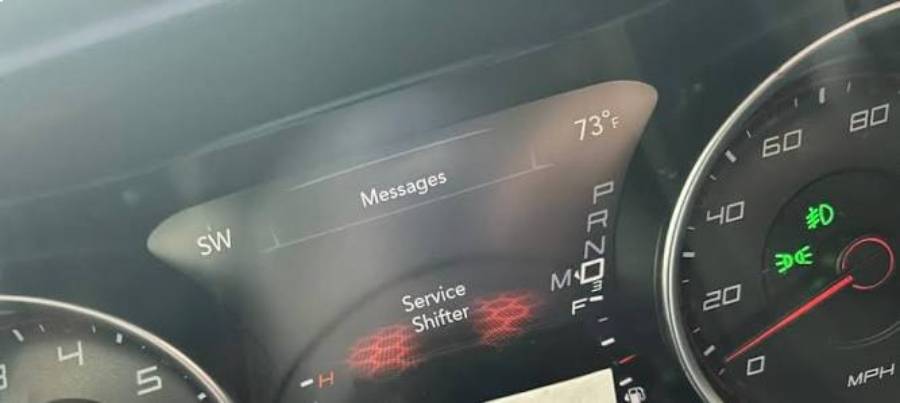
The Service Shifter warning on a Dodge Charger means the vehicle has detected a problem involving the electronic gear-shifting system or a component that supports its operation. The message does not automatically mean the transmission has failed. A fault can originate from the shifter assembly, wiring or electrical connections, battery voltage, an electrical circuit, or a control module, so the actual cause must be diagnosed before parts are replaced.
The severity of a Service Shifter warning depends on how the Charger behaves when the message appears. A car that displays the warning but continues to select every gear normally presents a different situation from one that will not shift out of Park, does not recognize the selected gear, or behaves unpredictably when changing gears. For this reason, clearing the warning without identifying its cause is not a complete repair.
This guide explains what the Dodge Charger Service Shifter message means, the symptoms and faults associated with it, and how the problem should be diagnosed. It also covers whether the vehicle is safe to drive, the available repair options, potential repair costs, and how model-year or recall information can affect the next step.
What Does the Service Shifter Message Mean on a Dodge Charger?
The Service Shifter message means the Dodge Charger has detected a fault associated with the electronic gear-shifting system. The warning indicates that the system responsible for recognizing or communicating gear selections requires diagnosis. It does not identify one failed component by itself, so seeing the message is not enough evidence to replace the shifter or transmission.
The Dodge Charger uses an electronic shifting system in which the driver’s gear selection must be recognized and communicated to the systems controlling transmission operation. A fault within this process can trigger the Service Shifter warning. The source can involve the shifter assembly itself or supporting electrical components, including wiring, connectors, circuits, voltage supply, or control electronics. Diagnosis is therefore necessary to determine where the communication or component fault originates.
The warning also does not automatically mean the transmission has suffered an internal mechanical failure. The shifter and transmission are related but perform different functions. The shifter provides the driver’s gear-selection input, while the transmission physically operates in the selected gear. An electrical or communication problem can therefore generate a shifter warning even when the transmission itself remains mechanically functional.
For this reason, the Service Shifter message should be treated as a diagnostic warning rather than a diagnosis. The next step is to evaluate how the vehicle shifts, identify any additional warning messages, scan for diagnostic trouble codes, and inspect the relevant electrical and shifter components before deciding which part requires repair.
What Symptoms Can Occur With a Dodge Charger Service Shifter Warning?
A Dodge Charger with a Service Shifter warning can display symptoms ranging from the dashboard message alone to problems selecting or recognizing a gear. The exact symptoms matter because they help determine whether the fault is limited to an intermittent electronic warning or is affecting the operation of the shifting system.
The most direct symptom is the Service Shifter message appearing on the instrument display. The warning can occur without an immediately noticeable change in vehicle operation. In this situation, the Charger may still start, select gears, and drive normally. Normal operation does not prove that the underlying fault has disappeared, particularly when the warning returns after the vehicle is restarted.
Gear-selection problems indicate a more significant shifting-system issue. The vehicle may have difficulty recognizing the driver’s selected gear, fail to shift as expected, or remain in a gear position when another position is requested. These symptoms require more attention than an isolated dashboard message because the fault is affecting the driver’s ability to control the vehicle’s operating state.
Shifter-related electrical symptoms can provide additional diagnostic clues. Abnormal shifter illumination, intermittent warnings, or a warning that appears alongside other electrical messages can justify checking the electrical supply, connectors, wiring, and stored diagnostic trouble codes. These observations should be used as evidence for diagnosis rather than as proof that a particular component has failed.
The most important distinction is whether the warning is accompanied by a loss of reliable gear selection. A Charger that continues to recognize every gear normally presents a different risk from a vehicle that cannot reliably enter Park, Reverse, Neutral, or Drive. The symptoms should therefore be documented before repairs begin because they help narrow the diagnostic path and determine whether the vehicle should continue to be driven.
What Causes the Service Shifter Warning on a Dodge Charger?
The Dodge Charger Service Shifter warning can result from faults in the shifter assembly, electrical wiring or connectors, the vehicle’s power supply, related circuits, or the electronic control system. These causes affect different parts of the shifting process, so the warning message alone cannot identify which component needs repair. The fault should be diagnosed before the shifter or another expensive component is replaced.
A faulty shifter assembly is one possible source of the warning. The electronic shifter must detect the driver’s gear-selection input and provide the information required by the vehicle’s control systems. An internal electrical or electronic fault can interfere with this process, causing the vehicle to detect an inconsistency and display the Service Shifter message. A defective assembly becomes a stronger diagnostic possibility when the warning occurs together with abnormal gear recognition or other shifter-specific symptoms.
Damaged wiring and poor electrical connections can produce similar symptoms without requiring replacement of the complete shifter assembly. The shifting system depends on electrical circuits to carry power and communication signals between components. A loose connector, damaged wire, poor terminal contact, or other circuit problem can interrupt those signals. An intermittent connection can also explain why a Service Shifter message appears during one drive but disappears after the Charger is restarted. Inspecting the relevant circuits helps distinguish a connection problem from a failed component.
Battery and charging-system condition should also be considered when electrical symptoms occur. Electronic modules require adequate and stable voltage to operate and communicate correctly. Low or unstable system voltage can therefore contribute to abnormal electronic behavior. Battery voltage should be tested rather than assuming that installing a new battery will fix the warning. A Charger that starts normally can still require electrical testing when multiple electronic warnings or other voltage-related symptoms appear.
A fuse or circuit fault can affect the power supplied to components involved in electronic shifting. Checking the appropriate fuse can be a useful diagnostic step, but a blown fuse is evidence of a circuit problem rather than a complete diagnosis. Replacing a fuse without determining why it failed can leave the underlying electrical fault unresolved. The correct fuse and circuit also depend on the Charger’s model year and configuration, so vehicle-specific service information should be used during testing.
Electronic control or communication faults are another possible cause. The shifter does not operate as an isolated mechanical lever; it functions as part of a network of electronic components that exchange information about gear selection and vehicle operation. A module-related problem, communication fault, or applicable software issue can disrupt that process and produce a Service Shifter warning even when the physical gear selector is not the original source of the problem.
These causes can produce overlapping symptoms, which is why replacing parts based only on the dashboard message is unreliable. The correct diagnostic sequence is to document the symptoms, check the vehicle’s electrical condition, retrieve diagnostic trouble codes, inspect the relevant wiring and connections, and test the component or circuit identified by that evidence. This approach separates a defective shifter assembly from electrical and control-system faults before repair costs increase unnecessarily.
Can You Drive a Dodge Charger With the Service Shifter Warning?
You should only continue driving a Dodge Charger with a Service Shifter warning when the vehicle still selects and holds the intended gear normally and no serious shifting symptoms are present. A warning accompanied by unreliable gear selection, inability to shift, or uncertainty about which gear is engaged requires a more cautious response because the fault is affecting a system used to control vehicle movement.
A Charger that displays the Service Shifter message while continuing to start, shift, and drive normally may have an intermittent or stored fault rather than an immediate loss of shifting capability. The absence of symptoms does not confirm that the system is functioning correctly. The warning indicates that a fault has been detected, so the vehicle should still be diagnosed rather than treating a restart or disappearing message as proof that the problem has resolved.
Stop normal driving when the Charger cannot reliably select the requested gear. Examples include being unable to shift out of Park, failing to engage Drive or Reverse as expected, displaying a gear position that does not correspond with the driver’s selection, or showing other significant shifting abnormalities. Continuing to operate the vehicle under these conditions can create a safety problem because the driver cannot depend on normal gear-selection behavior.
The safest action therefore depends on the symptoms rather than the warning message alone. A warning with otherwise normal shifting warrants prompt diagnosis, while a warning combined with unreliable gear engagement warrants stopping vehicle use and arranging professional diagnosis or towing when necessary. Do not assume the vehicle is safe solely because the engine still starts or the Service Shifter message temporarily disappears.
How Do You Diagnose the Service Shifter Warning on a Dodge Charger?
Diagnose a Dodge Charger Service Shifter warning by documenting the symptoms, checking the electrical supply, retrieving diagnostic trouble codes, inspecting the relevant wiring and connectors, and testing the component or circuit indicated by those findings. Diagnosis should identify the failed system before a shifter assembly, module, or other component is replaced.
Start by documenting exactly when the warning occurs and how the Charger behaves at that moment. Determine whether every gear can be selected normally, whether the warning is constant or intermittent, whether restarting the vehicle changes the message, and whether other electrical or transmission-related warnings appear at the same time. These observations provide diagnostic context because an intermittent warning with normal gear operation can point toward a different problem than a vehicle that consistently fails to recognize a gear selection.
Check battery and system voltage when the warning appears alongside electrical symptoms or when the vehicle has a known power-supply problem. The goal is to establish whether the electronic systems are receiving adequate voltage, not simply to replace the battery as a precaution. Battery terminals and relevant power connections should also be inspected for conditions that could interrupt electrical supply. If voltage and power delivery are normal, diagnosis can proceed to the shifter-related circuits and components.
Retrieve stored diagnostic trouble codes before clearing the warning. A capable diagnostic scanner can provide evidence about the system or circuit in which the vehicle detected a fault. A trouble code should be treated as a diagnostic starting point rather than proof that the component named or associated with the code requires replacement. For example, a circuit-related code can result from wiring or connector problems even when the component connected to that circuit remains functional.
Inspect the wiring and electrical connectors associated with the suspected circuit after the initial scan provides direction. Look for loose connections, damaged wiring, poor terminal contact, corrosion, or other visible conditions that could interfere with power or communication. Intermittent electrical faults deserve particular attention when the Service Shifter warning appears and disappears without a consistent mechanical symptom.
What Should You Check Before Replacing the Shifter?
Check the diagnostic trouble codes, battery and charging voltage, electrical connections, wiring, and relevant circuits before replacing the Dodge Charger shifter assembly. Replacing the shifter based solely on the Service Shifter message can result in an unnecessary repair because several electrical and control-system faults can produce a similar warning.
The shifter assembly becomes a stronger replacement candidate when diagnostic evidence points specifically to an internal shifter fault and external causes have been eliminated. This means verifying the power supply and related wiring rather than assuming that a shifter-related code automatically proves the assembly has failed. The diagnostic process should establish a cause-and-effect relationship between the component fault and the warning.
The same principle applies when a control module or software issue is suspected. Module replacement or software-related service should follow vehicle-specific diagnostic information rather than trial-and-error parts replacement. Some procedures also require equipment beyond a basic consumer OBD-II reader, making professional diagnosis appropriate when the available scan data cannot identify the affected circuit or communication fault.
The objective is to move from warning → diagnostic evidence → failed circuit or component → repair. This sequence reduces unnecessary parts replacement and provides a more reliable way to determine whether the Service Shifter warning originates from the shifter assembly itself or from the electrical and electronic systems supporting it.
How Do You Fix a Dodge Charger Service Shifter Warning?
Fix a Dodge Charger Service Shifter warning by repairing the specific shifter, wiring, electrical, power-supply, or control-system fault identified during diagnosis. There is no single repair that applies to every Service Shifter message because different faults can produce the same dashboard warning. The repair should therefore follow diagnostic evidence rather than begin with automatic replacement of the shifter assembly.
Repair wiring or connector problems when testing identifies an interruption between components. A loose connector may require proper reconnection, while damaged wiring or terminals require repair or replacement according to the affected circuit. Electrical faults can be intermittent, so a connection that appears normal during a visual inspection may still require circuit testing when the warning repeatedly disappears and returns. Correcting the electrical path allows the shifter and related control systems to exchange the signals required for normal gear selection.
Battery or power-supply problems require a different repair path. A weak battery, poor terminal connection, charging problem, or unstable electrical supply should be confirmed through testing before parts are replaced. Restoring proper voltage can resolve electronic behavior caused by insufficient power, but replacing the battery will not repair a defective shifter, damaged wiring, or module fault. Battery replacement should therefore be based on battery and charging-system test results.
Control-system or software-related faults require vehicle-specific diagnosis. When diagnostic results indicate a communication or module problem, the technician must determine whether the problem originates from the module, its power or communication circuit, or an applicable software condition. Programming and module procedures can require manufacturer-compatible diagnostic equipment, so these repairs are less suitable for trial-and-error DIY work.
When Does the Dodge Charger Shifter Assembly Need Replacement?
The Dodge Charger shifter assembly should be replaced when diagnostic testing confirms an internal shifter fault and external electrical causes have been ruled out. A Service Shifter message by itself is not sufficient evidence that the complete assembly has failed.
Before replacement, verify the power supply, connectors, wiring, relevant circuits, and diagnostic trouble codes. This distinction matters because a wiring fault can prevent a functional shifter from communicating correctly and create symptoms that resemble an internal shifter failure. Replacing the assembly under those conditions adds repair cost without correcting the original fault.
After a confirmed component is repaired or replaced, the vehicle should be tested again. The Service Shifter warning should no longer return, stored faults should be addressed appropriately, and the Charger should recognize each required gear position consistently. A successful repair corrects both the warning and its underlying cause rather than simply removing the message from the dashboard.
How Do You Reset the Service Shifter Message on a Dodge Charger?
The Service Shifter message should be cleared only after the underlying fault has been diagnosed and corrected. Clearing a stored fault or temporarily removing the dashboard warning does not repair the electrical, shifter, circuit, or control-system condition that originally triggered it.
A vehicle restart may cause an intermittent warning to disappear, but this should not be treated as a repair. Electronic faults can occur intermittently when a connection, circuit, voltage supply, or component fails only under certain conditions. If the Service Shifter message returns after restarting the Charger, the recurring warning provides additional evidence that the underlying fault remains present.
Diagnostic trouble codes should also be retrieved before they are cleared. Stored codes preserve information that can help identify the affected system and guide further testing. Erasing them at the beginning of diagnosis can remove useful evidence and make an intermittent fault harder to trace.
After the diagnosed fault has been repaired, codes can be cleared with appropriate diagnostic equipment when required, followed by an operational check. The Charger should correctly recognize the requested gear positions and the Service Shifter warning should remain absent. If the message returns, further diagnosis is required because either the original fault remains unresolved or another related fault is present.
Avoid treating battery disconnection, repeated restarts, or code clearing as permanent Service Shifter fixes. These actions may remove a warning temporarily under certain conditions, but they do not establish why the warning appeared. A successful reset is the result of correcting the fault first and confirming normal shifter operation afterward.
How Much Does It Cost to Fix a Dodge Charger Service Shifter Problem?
The cost to fix a Dodge Charger Service Shifter problem depends on whether the fault comes from a minor electrical issue, the shifter assembly, wiring, or an electronic control problem. There is no accurate single repair price for every Service Shifter warning because the dashboard message identifies a system fault rather than one specific failed part. Model year, labor rates, diagnostic time, and the component requiring repair also affect the final bill.
Diagnosis is the first potential expense. A repair shop may need to scan the vehicle for diagnostic trouble codes, test battery and charging voltage, inspect shifter-related circuits, and verify communication between electronic components. Paying for diagnosis before replacing parts can reduce the total repair cost when the actual cause is a connector, wiring, or power-supply problem rather than the complete shifter assembly.
Minor electrical repairs are generally different in scope from shifter replacement. A loose connection may require connector or terminal service, while damaged wiring can require circuit tracing and repair. The cost depends heavily on accessibility and diagnostic labor because locating an intermittent electrical fault can take longer than repairing the damaged connection once it has been found.
Replacing the shifter assembly involves the price of the replacement component plus labor and any vehicle-specific procedures required after installation. The assembly should not be replaced solely because the instrument panel displays Service Shifter. Confirming an internal shifter fault first prevents an expensive replacement from being used to troubleshoot a problem that actually originates elsewhere.
Module, communication, or software-related problems can produce another cost range because specialized diagnostic or programming equipment may be required. A software procedure is fundamentally different from replacing a failed electronic module, so these services should not be grouped under one fixed repair price.
For an accurate estimate, obtain the diagnostic result first and ask for the cost of repairing the identified fault. The useful question is not simply “How much does a Service Shifter repair cost?” but “Which component or circuit caused the Service Shifter warning, and what does that specific repair cost?” This distinction prevents a broad dashboard message from being converted into an inaccurate parts-and-labor estimate.
Which Dodge Charger Model Years Have Service Shifter Problems?
Service Shifter complaints must be evaluated by Dodge Charger model year rather than assumed to affect every Charger in the same way. The electronic systems, components, service information, and applicable manufacturer actions can differ between model years, which means a repair documented for one Charger should not automatically be applied to another.
Owner reports can help identify the symptoms drivers have experienced, but they do not establish that every vehicle from the same model year has a manufacturing defect. A collection of online reports also does not prove that Dodge issued a recall. The cause of two apparently identical Service Shifter warnings can differ, so model-year information should be combined with diagnostic results from the individual vehicle.
Technical Service Bulletins and recalls provide different types of evidence. A Technical Service Bulletin can provide technicians with manufacturer service information about a known condition or diagnostic procedure. A safety recall, by contrast, identifies a manufacturer or regulatory safety action affecting vehicles that meet specified criteria. The existence of a bulletin should therefore not be presented as evidence that the same vehicles are covered by a recall.
Vehicle configuration also matters when researching a Service Shifter problem. Two Dodge Chargers carrying the same model-year designation can have differences in equipment or production details that affect which parts or service procedures apply. Vehicle-specific service information is more reliable than selecting a repair solely because another owner reports the same dashboard message.
For this reason, owners should use the model year as the beginning of the research process rather than the final diagnosis. Confirm the vehicle information, retrieve the diagnostic trouble codes, compare the symptoms with applicable service information, and then determine whether a documented repair procedure applies. This approach keeps model-year reports useful without treating correlation as proof that every Dodge Charger with a Service Shifter warning has the same failure.
Is There a Recall for the Dodge Charger Service Shifter Problem?
A Service Shifter warning does not automatically mean a Dodge Charger is covered by a recall. Recall eligibility depends on the vehicle’s model year, configuration, production information, VIN, and the specific safety defect covered by the recall. Owners should therefore verify their individual vehicle rather than assuming that every Charger displaying the Service Shifter message qualifies for the same manufacturer repair.
A recall and a Technical Service Bulletin (TSB) are not the same. A recall addresses a safety-related defect or regulatory noncompliance affecting a defined group of vehicles and can require the manufacturer to provide a remedy. A TSB provides technicians with service or diagnostic information for a documented vehicle condition. Finding a bulletin that discusses a shifter-related problem does not establish that the affected vehicles are subject to a recall.
The Service Shifter message itself is also too broad to determine recall eligibility. The same dashboard warning can originate from different components or electrical conditions. A Charger with a wiring fault and another Charger with an internal shifter problem can display similar warnings even though the underlying repairs are different. Recall research should therefore be performed alongside diagnosis rather than used as a substitute for identifying the actual fault.
The most reliable approach is to check the vehicle’s VIN against current manufacturer or government recall information. If an applicable recall is found, compare the covered defect and remedy with the vehicle’s symptoms. If no applicable recall exists, the Service Shifter warning still requires diagnosis when it persists, returns, or affects gear selection.
How Can You Prevent Dodge Charger Shifter Problems?
You can reduce the risk of Dodge Charger shifter problems by maintaining a reliable electrical supply, addressing recurring electrical warnings, protecting wiring and connectors from damage, and diagnosing shifter faults when they first appear. Not every internal electronic failure is preventable, but early attention to supporting electrical systems can prevent a minor problem from remaining undiagnosed until it begins affecting gear selection.
Maintain the battery and charging system because electronic shifting depends on a stable electrical supply. Test a battery that shows signs of weakness rather than waiting for complete failure, and inspect battery connections when starting or electrical problems occur. This does not mean every weak battery will cause a Service Shifter warning; it means voltage condition is one relevant factor in a vehicle that relies on electronic modules and communication circuits.
Address intermittent warnings instead of assuming the problem has resolved when the message disappears. A loose electrical connection or intermittent circuit fault can function normally at one moment and fail under different conditions. Recording when the warning occurs, whether other warnings appear, and how the shifter behaves gives a technician more useful information if the problem becomes difficult to reproduce.
Protect shifter-related wiring and connectors during other repairs or interior work. Electrical connectors should be properly seated, and damaged wiring should be repaired using procedures appropriate for the affected circuit. Repeatedly clearing diagnostic codes without correcting their cause removes useful diagnostic information while leaving the underlying condition unchanged.
Most importantly, diagnose abnormal gear-selection behavior promptly. A dashboard message with normal shifting provides an opportunity to investigate the fault before relying on the vehicle becomes a safety concern. Difficulty selecting Park, Reverse, Neutral, or Drive changes the situation because reliable gear selection is fundamental to controlling the vehicle. Preventive care cannot eliminate every Service Shifter fault, but early diagnosis can stop an intermittent warning from becoming an unresolved and potentially more disruptive shifting problem.